How to show up in AI search answers, engine by engine
There is no single AI ranking. Each engine has its own crawler, index, citation style and location handling, so the work starts with a per-engine table and ends with re-checks.
By the Surfacedd teamUpdated 13 min readMarkdown
On this page
Short answer
To optimize for AI search, let each engine's search crawler read your key pages, publish pages that answer the exact questions buyers ask, earn mentions on the third-party pages engines cite, and re-check each engine separately. ChatGPT, Claude, Perplexity, Gemini, Grok, Meta AI and Google's two AI surfaces all retrieve differently.
Why is there no single "AI ranking"?
There is no single AI ranking because each AI search product decides on its own which pages to read and which brands to name. ChatGPT, Claude, Perplexity, Gemini, Grok, Meta AI, Google AI Mode and AI Overviews each use a different crawler or index, a different way of searching, and a different citation format. A page can be cited by one and ignored by the other seven.
Three facts follow from that, and they shape everything in this guide:
- Access is per crawler. OpenAI says sites that opt out of OAI-SearchBot "will not be shown in ChatGPT search answers" (OpenAI, Overview of OpenAI crawlers). Perplexity says PerplexityBot "is designed to surface and link websites in search results on Perplexity" (Perplexity crawlers). Blocking one bot removes you from one engine, not from "AI".
- Answers vary between identical runs. Ask the same question twice and you can get different brands in a different order. That is why one check proves very little, and why you should judge trends over several runs rather than a single screenshot.
- Nobody outside the engine sees its ranking. Google states that "No third-party tool has access to our internal ranking or AI systems" (Google Search Central, Optimizing your website for generative AI features). Every tool, ours included, measures the outputs: which brands an answer names, in what order, and which pages it cites.
So "ranking in AI search" really means raising the share of answers that name you, in each engine, for the questions your buyers ask. The rest of this guide is how to do that, then how to tell whether it worked.
What matters in each AI engine?
The table below is the reference for the rest of the guide. "How it searches" and "Citation style" describe what the engine's API returns when Surfacedd collects answers; "Crawler to allow" comes from each vendor's own crawler documentation, checked on 2026-11-19.
| Engine | Crawler to allow (search) | How it searches | Citation style | Location applied |
|---|---|---|---|---|
| ChatGPT | OAI-SearchBot; ChatGPT-User fetches pages users ask about | Web search tool; the queries it ran are exposed | Inline URL citations plus the full list of sources consulted | Approximate: country, region, city, time zone |
| Claude | Claude-SearchBot; Claude-User for user fetches | Web search tool, up to three searches per answer | Citations attached to the exact sentence they support | Approximate location |
| Perplexity | PerplexityBot; Perplexity-User for user fetches | Sonar with web search; queries returned | Numbered markers mapped to results; read-but-not-cited results kept | Country, region, city or coordinates |
| Gemini | Googlebot for the index; the Google-Extended token governs Gemini-app grounding | Grounding with Google Search | URL citations (redirect links resolved) | None in the API |
| Grok | No dedicated search crawler documented | Web search tool; X post search not used in our collection | Citation annotations plus a citation list | None in the API |
| Meta AI | meta-webindexer | Web search tool | Citations with page titles plus results read | Approximate |
| Google AI Mode | Googlebot (must be indexed and snippet-eligible) | Google's own fan-out; not exposed | References nested in the AI Mode block | Exact, down to coordinates |
| AI Overviews | Googlebot (must be indexed and snippet-eligible) | Google's own; not exposed | References inside the Overview, display order | Exact |
Two things stand out. First, Google's two AI surfaces and Gemini depend on Google's index, so ordinary Google SEO is the price of entry there: Google says a page "must be indexed and eligible to be shown in Google Search with a snippet" to appear in its AI features (Google Search Central). Second, the other engines each run their own retrieval, which is why a brand can be strong in AI Overviews and absent from Perplexity in the same week. For the engine-specific detail, read the guides for ChatGPT, Perplexity, AI Overviews, Google AI Mode, Gemini and Claude.
The cost of measuring each engine also differs. This is what one answer costs on the default model of each engine today, at list prices:
| Engine | What Surfacedd asks | Search fee | Location | Fan-out searches | Est. per answer |
|---|---|---|---|---|---|
| ChatGPT | ChatGPT with web search | $10.00 per 1,000 calls | Approximate: country, region, city and time zone are passed as the user's location | Exposed | $0.0109 |
| Claude | Claude with web search | $10.00 per 1,000 calls | Approximate | Exposed | $0.0112 |
| Gemini | Gemini grounded with Google Search | $14.00 per 1,000 searches (5,000 free a month) | Not applied | Exposed | $0.0163 |
| Perplexity | Perplexity Sonar with web search | $2.50 per 1,000 calls | Country, region and city, or coordinates, as you set them per market | Exposed | $0.0051 |
| Grok | Grok with web search | $5.00 per 1,000 calls | Not applied | Saved when xAI's response includes the search queries | $0.0201 |
| Meta AI (Preview) | Meta AI (Muse) with web search | $2.50 per 1,000 searches | Approximate: country, region, city and time zone | Not exposed | $0.0129 |
| Google AI Mode | Google AI Mode results page | $0.0012 per results page (standard queue) | Exact: any location DataForSEO supports, down to coordinates | Not exposed | $0.0012 |
| AI Overviews | AI Overview on the Google results page | $0.0012 per results page (standard queue) | Exact: any location DataForSEO supports | Not exposed | $0.0012 |
Per-answer estimates use each engine's default model, typical token counts and one search, at list prices on 2026-11-23 (UTC), price table 2026-11-13.1. Reading each answer adds about $0.0015.
Step 1: can each AI crawler reach your key pages?
Each AI engine can only cite a page its search crawler or fetcher was allowed to read, so access comes first. Check robots.txt, your CDN's bot protection and your rendering, in that order.
robots.txt. Separate search bots from training bots. Blocking GPTBot (training) does not remove you from ChatGPT search; blocking OAI-SearchBot does. OpenAI also notes it "can take ~24 hours from a site's robots.txt update" for its search systems to adjust (OpenAI). A policy that keeps you in AI answers while opting out of model training looks like this:
# Allow AI search and user-triggered fetchers
User-agent: OAI-SearchBot
User-agent: ChatGPT-User
User-agent: Claude-SearchBot
User-agent: Claude-User
User-agent: PerplexityBot
User-agent: Perplexity-User
Allow: /

# Opt out of model training (optional, your call)
User-agent: GPTBot
User-agent: ClaudeBot
User-agent: CCBot
Disallow: /
Before you copy the training block, read what each opt-out does and doesn't do. Google-Extended is the subtle one: Google says it "does not impact a site's inclusion in Google Search nor is it used as a ranking signal", but it does cover grounding in Gemini Apps (Google common crawlers). Blocking it keeps you out of Gemini-app answers that use your pages. The full walkthrough is in robots.txt for AI crawlers.
Bot protection. A firewall "bot fight" mode can return a challenge page to an AI crawler that robots.txt allows. The crawler sees the challenge, not your page. Test by fetching a key page with an AI crawler's user agent and comparing the response with a normal browser fetch.
Rendering. If your main text only appears after JavaScript runs, many AI crawlers see an empty shell. Surfacedd's site audit flags this as "Content needs JavaScript" and explains that crawlers such as GPTBot, ClaudeBot and PerplexityBot do not run JavaScript.
The fastest way to see all three at once is a per-crawler, per-page matrix. The free AI crawler checker reads your robots.txt and shows which bots can fetch which paths.
Step 2: what content gets cited in AI answers?
Pages that get cited answer one specific question in their first two sentences, carry facts with numbers and dates, and stay current. Engines retrieve passages to support a sentence, so the passage has to stand on its own.
What the evidence supports:
- Answer-first sections. Put the direct answer under a question-shaped heading, then the detail. This is the same pattern that won featured snippets, explained in answer engine optimization.
- Real freshness. Ahrefs analysed 17 million citations and found AI assistants cite content that is 25.7% "fresher" than organic Google results on average, with ChatGPT showing the strongest preference; AI Overviews were the exception, citing slightly older pages (Ahrefs, July 2025). Change the "updated" date only when the content really changed, and when it has, notify Bing and other participating engines with IndexNow.
- Pages for the sub-questions. AI engines often run several searches per prompt (a query fan-out). A buyer's "best CRM for a five-person team" may turn into searches about pricing, integrations and setup time. Pages that answer those sub-questions get pulled in.
- No special format. Google says "There's no requirement to break your content into tiny pieces" and that you don't need "new machine readable files, AI text files, markup, or Markdown" to appear in its AI features (Google Search Central). llms.txt and FAQ markup are optional extras, not levers.
What does not work: creating many near-duplicate pages aimed at AI answers. Google says doing so "primarily to manipulate rankings or generative AI responses" breaks its scaled content abuse policy (Google Search Central).
Step 3: why do off-site mentions matter so much?
Off-site mentions matter because most of the pages AI answers cite are not yours. When an engine answers "best X for Y", it usually leans on listicles, review sites, forums and comparison pages, and the brands those pages name are the brands the answer names.
The strongest public evidence is correlational. In an Ahrefs study of 75,000 brands, branded web mentions correlated with AI Overview brand visibility at 0.664 (Spearman), branded anchors at 0.527, branded search volume at 0.392 and backlinks at only 0.218 (Ahrefs, May 2025). Correlation is not cause, but it points the same way as what you see when you read the sources behind answers in your own category.
The practical version:
- Collect the pages AI engines cite for your prompts. Those are your targets.
- Sort them into pages that already name you, pages that name a competitor and not you, and pages that name nobody.
- Work the middle group first: a listicle that names three rivals and not you is the shortest path to being named.
- Take part where your buyers talk, under your own name. Reddit threads are a frequent source; read Reddit and AI answers before you post anything.
Google warns that "seeking inauthentic 'mentions' across the web isn't as helpful as it might seem" (Google Search Central). Earned mentions on pages people read are the goal, not volume. The full method is in brand mentions in AI search, and the sources question is covered in where AI answers get their sources.
Step 4: how do you measure, fix and re-check?
You measure AI search by asking the same fixed set of prompts on each engine on a schedule, recording which brands each answer names and which pages it cites, and comparing like with like. A change only counts when it holds across several runs.
A workable measurement set-up:
- Prompts. 20–50 questions your buyers ask, mostly without your brand name in them. Prompts that contain your name will name you and inflate the numbers.
- Engines. Start with the engines your buyers use. If you don't know, start with ChatGPT, Perplexity and Google AI Mode, then add.
- Samples. Ask each prompt more than once per run, or run weekly for a month before drawing conclusions.
- Metrics. AI visibility (share of answers naming you), share of voice against named competitors, and citation rate, each by engine.
The full method, including how to read ranges, is in how to measure AI visibility.
A 30/60/90-day plan for AI search
The plan below works for a single brand with one person spending a few hours a week. The cost line assumes 25 prompts asked once a week on the four default engines (ChatGPT, Claude, Perplexity and Google AI Mode), which comes to about $3.75 a month in API fees at today's list prices.
| Window | Do | Done when |
|---|---|---|
| Days 1–7 | Write 25 prompts across awareness, consideration and decision. Run a baseline on four engines. | You have a baseline per engine, with the answers saved. |
| Days 1–14 | Fix access: robots.txt for search bots, firewall challenges, JS-only content on key pages. | Every search crawler can fetch your home, pricing and product pages. |
| Days 15–30 | Fix facts: one consistent name, description, price and feature list on your site and main profiles. Answer the top three buyer questions on your own pages. | Each key question has an answer-first section on an owned page. |
| Days 31–60 | List cited third-party pages that name competitors and not you. Contact or contribute to the ten most-cited. Fix the cited pages that get your facts wrong. | Ten target pages worked, each with a dated note. |
| Days 61–90 | Re-run weekly. Compare like for like. Drop tactics that moved nothing after four runs. | You can say, per engine, what changed and what didn't. |
Decision points worth writing down in advance:
- If one engine is near zero and the others aren't, check that engine's crawler access first. It is almost always access, not content.
- If you are named but never cited, your own pages aren't answering the question; competitors' pages or listicles are.
- If visibility is flat after four weekly runs, the targets you picked aren't the pages the engine reads. Re-read the sources behind the answers you lost.
The 90-day version with weekly cadence and budgets is in GEO strategy. For a printable list of every check, use the GEO checklist.
How Surfacedd helps you optimize for AI search
Surfacedd runs your prompt set on every engine in the table above from your own computer, with your own API keys, and shows you per prompt and per engine whether you were named, at what position, and which pages were cited. It shows the cost of each run before it starts.
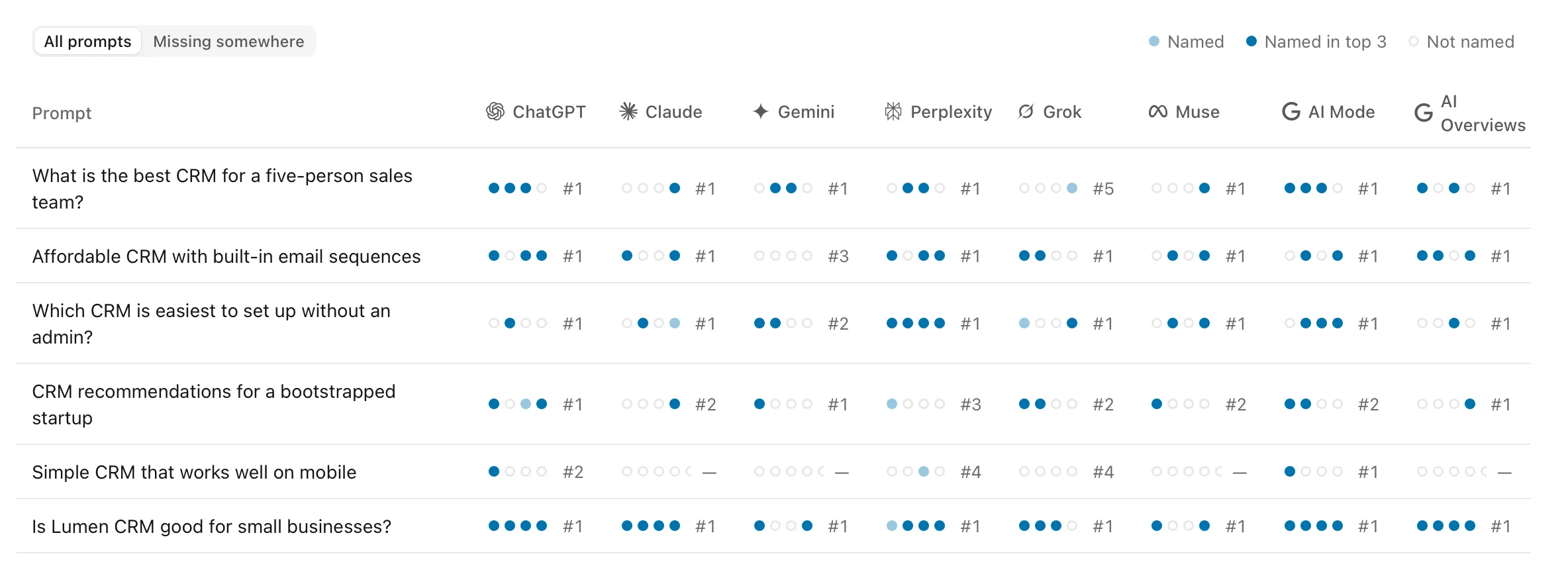
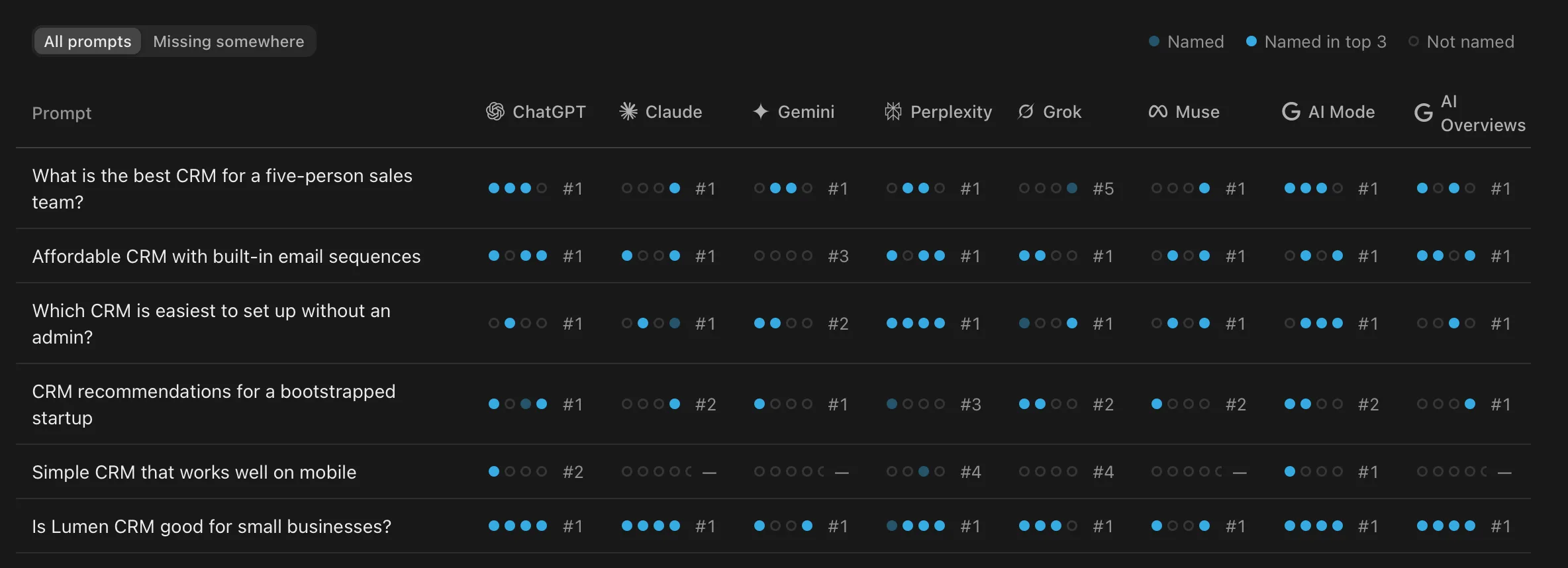
Three parts of the app map to the steps above:
- Access: the site audit's AI-crawler matrix shows which bots can reach which key pages, and flags JS-only content and snippet restrictions.
- Sources: for every answer, the pages cited and the pages read but not cited, plus a list of third-party pages that name a competitor and not you. See competitors and sources.
- Re-checks: scheduled runs compared like for like, with 95% ranges and "No clear change" when a difference isn't significant.
It does not write content, post on forums or contact site owners for you; it tells you where to act, with the answers behind each task. Pricing is a one-time licence (Launch price $29, $79 after 23:59 UTC on January 30, 2027.$79 once.) plus what your providers charge per answer: see pricing.
Sources
- OpenAI, Overview of OpenAI crawlers
- Perplexity, Perplexity crawlers
- Anthropic, Does Anthropic crawl data from the web, and how can site owners block the crawler?
- Google Search Central, Optimizing your website for generative AI features on Google Search
- Google Search Central, Google's common crawlers (Google-Extended)
- Ahrefs, Do AI assistants prefer to cite "fresh" content? (17 million citations), July 28, 2025
- Ahrefs, An analysis of AI Overview brand visibility factors (75K brands), May 26, 2025
Fair questions
Is optimizing for AI search different from SEO?
Partly. For Google AI Overviews, AI Mode and Gemini, you need the same things as Google SEO: indexed, snippet-eligible pages. The other engines use their own crawlers and indexes, so you also need their search bots allowed, answer-first pages, and mentions on the third-party pages they cite. Measurement is different too: you track the share of answers naming you, not a position. The full comparison is in our GEO vs AEO vs SEO guide.
Which AI engine should I optimize for first?
Start with the engine your buyers use most. If you don't know, check referral traffic from AI assistants in your analytics, then begin with ChatGPT, Perplexity and Google AI Mode, which cover different retrieval systems. Fix access for all of them at once, because robots.txt and firewall changes cost the same whether you do one bot or six. Add Claude, Gemini, Grok and Meta AI to measurement once the first three have a baseline.
Does blocking GPTBot stop ChatGPT from citing me?
No. GPTBot collects data for model training; OpenAI says disallowing it means your content "should not be used in training". ChatGPT search uses OAI-SearchBot, and pages users ask about are fetched by ChatGPT-User. You can block GPTBot and still be cited in ChatGPT search, as long as OAI-SearchBot is allowed. OpenAI says robots.txt changes take about 24 hours to reach its search systems.
How long does it take to show up in AI answers?
Access fixes can show within days for engines that fetch live, and OpenAI cites about 24 hours for robots.txt changes. Content and mention work usually takes weeks, because pages must be crawled, indexed and then chosen. Because answers vary run to run, judge progress over about four weekly runs rather than a single check. If nothing moves after that, re-read the sources behind the answers you lost.
Can I pay to be recommended by an AI assistant?
None of the vendors whose crawler documentation we cite describes a way to pay for a place in the answer itself; answers come from retrieval and the model. Advertising, where an engine offers it, is a separate, labelled placement and not the same as being named in the answer. The reliable path is the one in this guide: be readable, be the best answer on your own pages, and be named on the pages engines cite.
How many prompts do I need to track?
Twenty to fifty is a practical range for one brand. Fewer than ten gives ranges too wide to read, and Surfacedd shows "Not enough data" below ten prompts or twenty answers. Most prompts should be questions without your brand name, spread across awareness, consideration and decision. Twenty-five prompts on four engines weekly costs about $3.75 a month at list prices.
Free tools for this guide
How we research, write and correct pages: read our editorial policy.