Get AI to describe your brand correctly
Brand Audit asks six AI setups who you are and what people say about you, then traces each wrong or negative claim to the page the answer cited.
By the Surfacedd teamUpdated 9 min readMarkdown
On this page
Short answer
Surfacedd's Brand Audit asks two questions about your brand of six AI setups, three with live web search and three from training data only. It scores net sentiment, lists negative sources, flags possible misinformation against your own facts and gives each cited page a recommended action. One audit costs about eight cents on your own API keys.
When a buyer asks an AI assistant "What is Lumen CRM, and what do people say about it?", the answer they get is part of your reputation. You can't see it, and it changes with the model and the web pages the model happens to read. Brand Audit makes that answer visible, measures its tone, and shows you which page each claim came from, so you know what to fix and where.
What is an AI brand audit?
An AI brand audit is a structured check of what AI assistants say when someone asks about your brand by name. Surfacedd's version asks two fixed questions, one about information and one about reputation, and reads the answers the way an analyst would: tone, accuracy, which sources were cited and how each source was used.
It is different from a visibility report. A visibility report asks category questions ("best CRM for a 10-person agency") and counts how often you're named. A brand audit asks about you directly and judges what is said. Sentiment from the audit is reported in Brand Audit and Humans only. It never changes your visibility score.
The two questions are fixed so that one audit can be compared with the next:
| Group | Question asked (your name, site, category and market filled in) |
|---|---|
| Information | "What is {name} (website: {site})? Describe what it offers in {category}, who it is for and how it compares to alternatives in {place}." |
| Reputation | "What do people say about {name} in {category}? Summarize its reputation, strengths and weaknesses." |
Memory vs the live web: why the audit asks both
Models answer brand questions in two different ways. With web search on, they read pages now and cite them. Without it, they answer from what they learned in training, which can be a year or more out of date. A brand can look fine in one and wrong in the other, and the fix is different: a wrong page can be corrected this week, while a stale training memory changes only when models are retrained on newer pages.
So each audit asks the two questions of six setups:
| Slot | Engine | Mode |
|---|---|---|
| 1 | ChatGPT | Web search on |
| 2 | Perplexity | Web search on |
| 3 | Gemini, or Claude when Gemini is off | Web search on |
| 4 | ChatGPT | Training data only, no tools |
| 5 | Claude | Training data only, no tools |
| 6 | Gemini | Training data only, no tools |
Gemini's web search ships switched off. You turn it on only after accepting a notice about Google's terms for grounded results, which restrict analysing answers that use Google Search. When it's off, the third web slot uses Claude with web search, and the audit list says so. Gemini without grounding is not covered by that restriction, so the training-only Gemini slot can run either way. Each slot runs only if you've added that provider's key.
What the audit reports
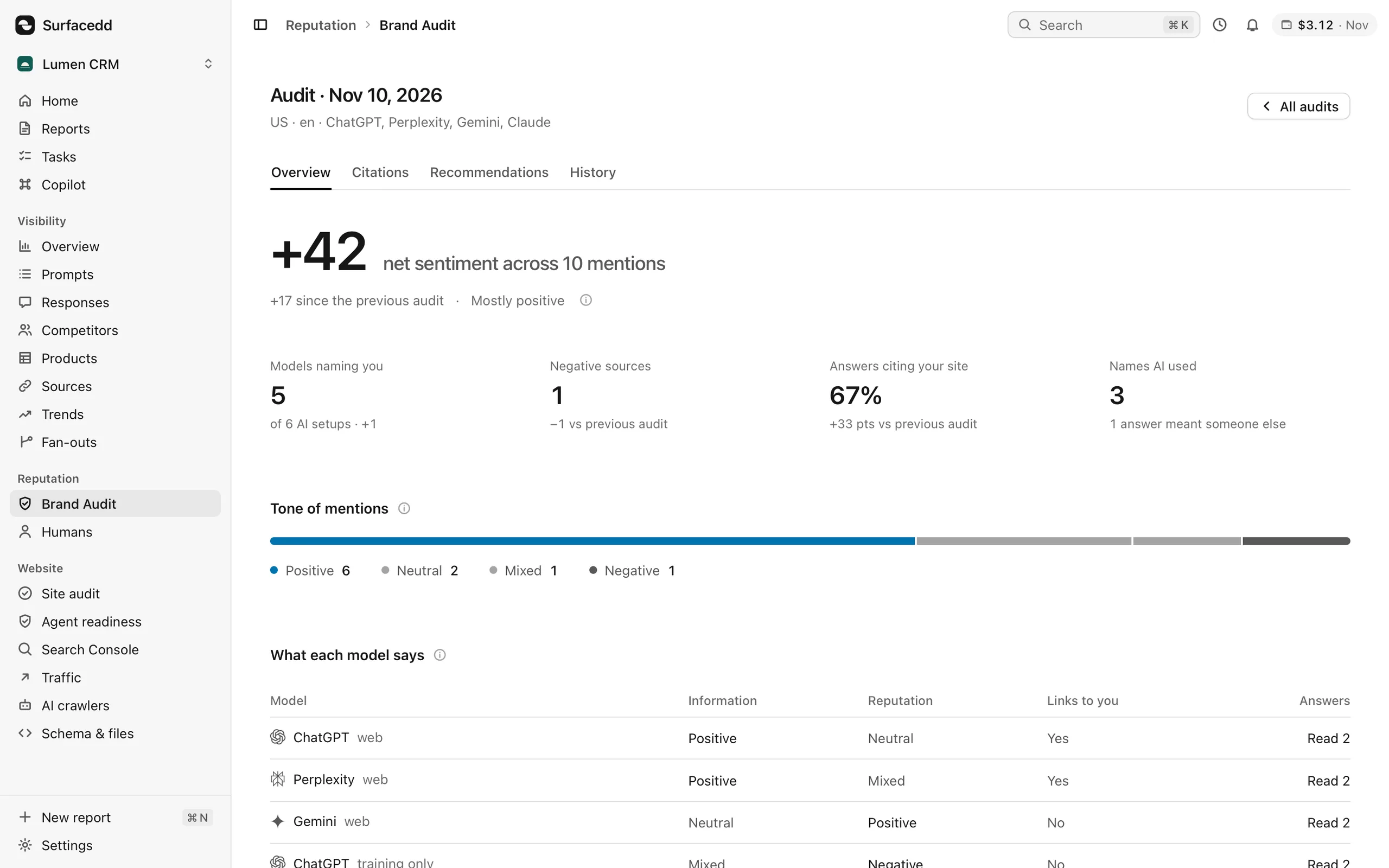
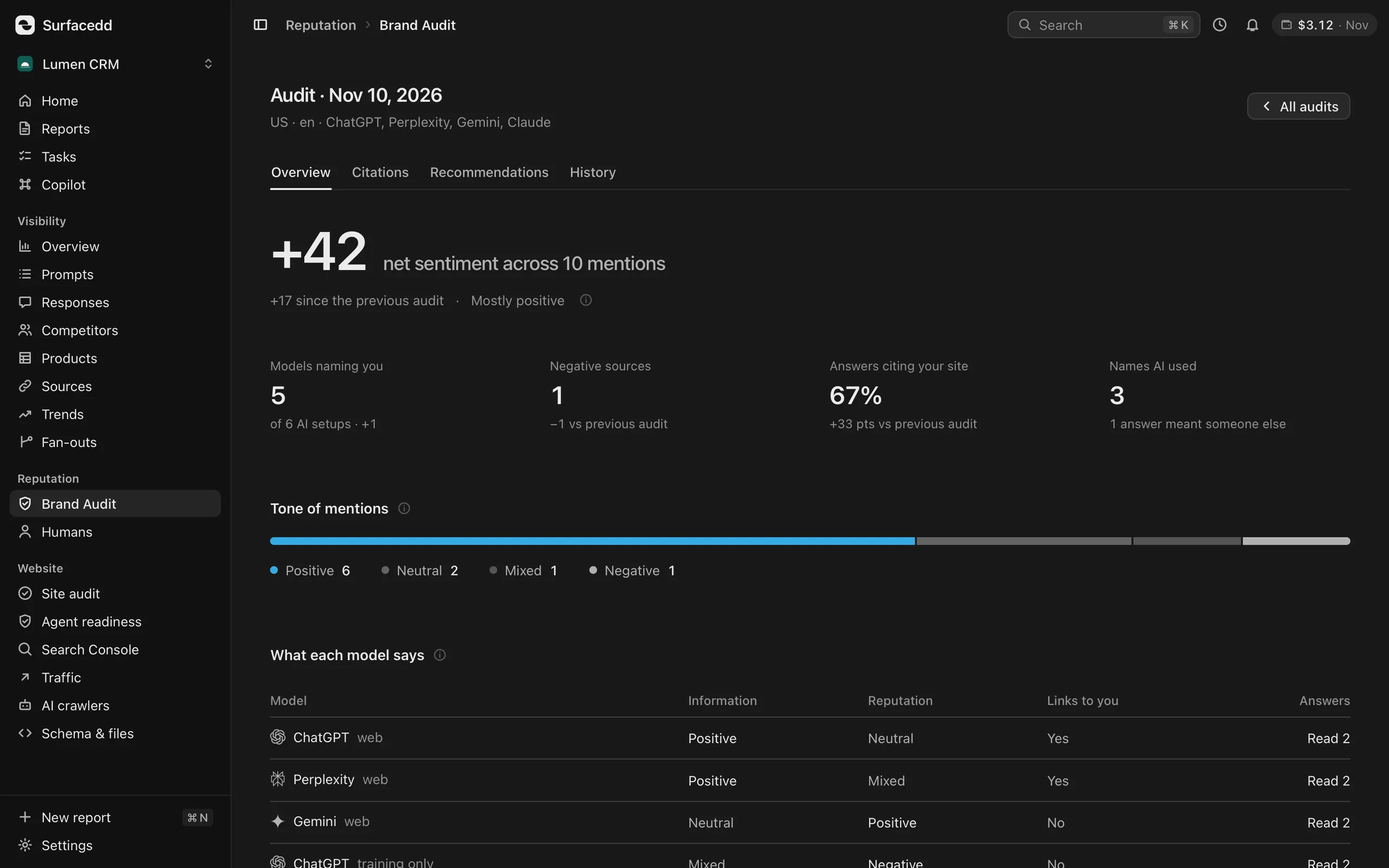
The Overview tab answers "how do AI assistants talk about us?" in five numbers and two tables.
- Net sentiment, from −100 to +100: positive minus negative mentions, divided by all mentions, with the change since the previous audit.
- Models naming you: how many of the six setups named you, and whether a model newly named you since last time.
- Negative sources: pages cited in answers that spoke negatively about you.
- Answers citing your site: the share of answers that cited a page on your own domain.
- Names AI used: the names the engines used for you, and how many answers meant a different company with the same name.
- Tone of mentions: counts of positive, neutral, mixed and negative mentions.
- What each model says: for each setup, the tone of its information answer and its reputation answer, whether it linked to you, and a link to read both answers in full.
- Tone by source type: net sentiment of the answers that cite each kind of source, such as review sites, news, Reddit or your own pages.
Citations: which pages shape the answer, and what to do about each
The Citations tab lists every page the audit's answers cited and tells you what to do with it. Two kinds of number sit on each row, and they come from different places so that no figure is invented:
- Alignment, 0–100, AI sentiment and possible misinformation are judgements. Your analysis model reads the answer sentences that used the page and compares them with your brand's own facts. Until a page is judged, these cells say "Unjudged". The app never guesses them.
- Citability, 0–100 and the recommended action are deterministic. Citability is
round(100 × (0.5 × share of models citing the page + 0.3 × position score + 0.2 × source-kind weight)), where the position score is 1 for the first source and 0 for the tenth or later. The formula is shown in the app.
The action follows fixed rules, in this order:
| If… | Recommended action |
|---|---|
| The page carries possible misinformation, or alignment is under 50 | Request an update |
| It's someone else's page and the answers using it didn't name you | Request a mention |
| It names you but doesn't link to you | Request a link |
| Citability is 50 or more | Monitor |
| Anything else | No action |
An opportunity matrix groups the pages into four boxes: Easy wins (your pages AI cites often: keep them accurate), Outreach targets (others' pages AI cites often, where a mention, link or fix would help), Your rarely cited pages, and Monitor. A Possible misinformation list shows each disputed claim, the page it came from and how many answers repeated it. Pages that couldn't be fetched are listed as failed sources, so a blocked page is never mistaken for a clean one. You can mark a page Relevant, Unrelated or Dismissed. Dismissed pages are never judged again.
Worked example (sample workspace, fictional brand)
The sample workspace audits a fictional company, Lumen CRM, in the US market in English. Its audit from 10 November 2026 reads like this:
- Net sentiment +42 across 10 mentions, +17 since the previous audit. Six mentions positive, two neutral, one mixed, one negative.
- 5 of 6 AI setups named the brand. 67% of answers cited its own site, up 33 points.
- 3 names were used for the brand, and 1 answer described a different company with a similar name.
- Two pieces of possible misinformation, each repeated in 2 answers. One answer said the free plan allows 5 users while the fact sheet says 3; it came from the brand's own pricing page. Another said support replies take a week, from a 2025 Reddit thread.
- The opportunity matrix: 2 easy wins, 4 outreach targets, 0 rarely cited own pages, 4 to monitor.
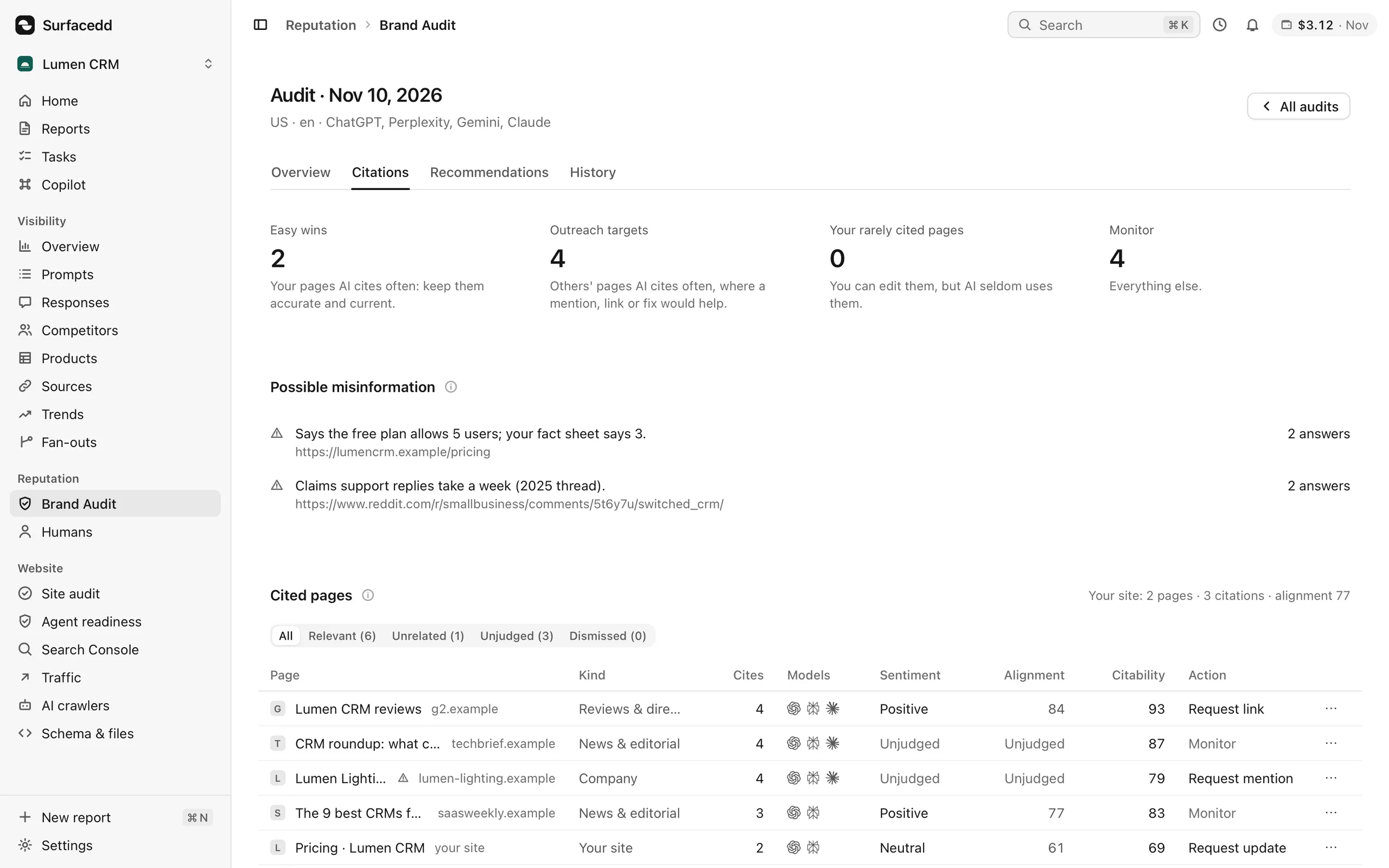
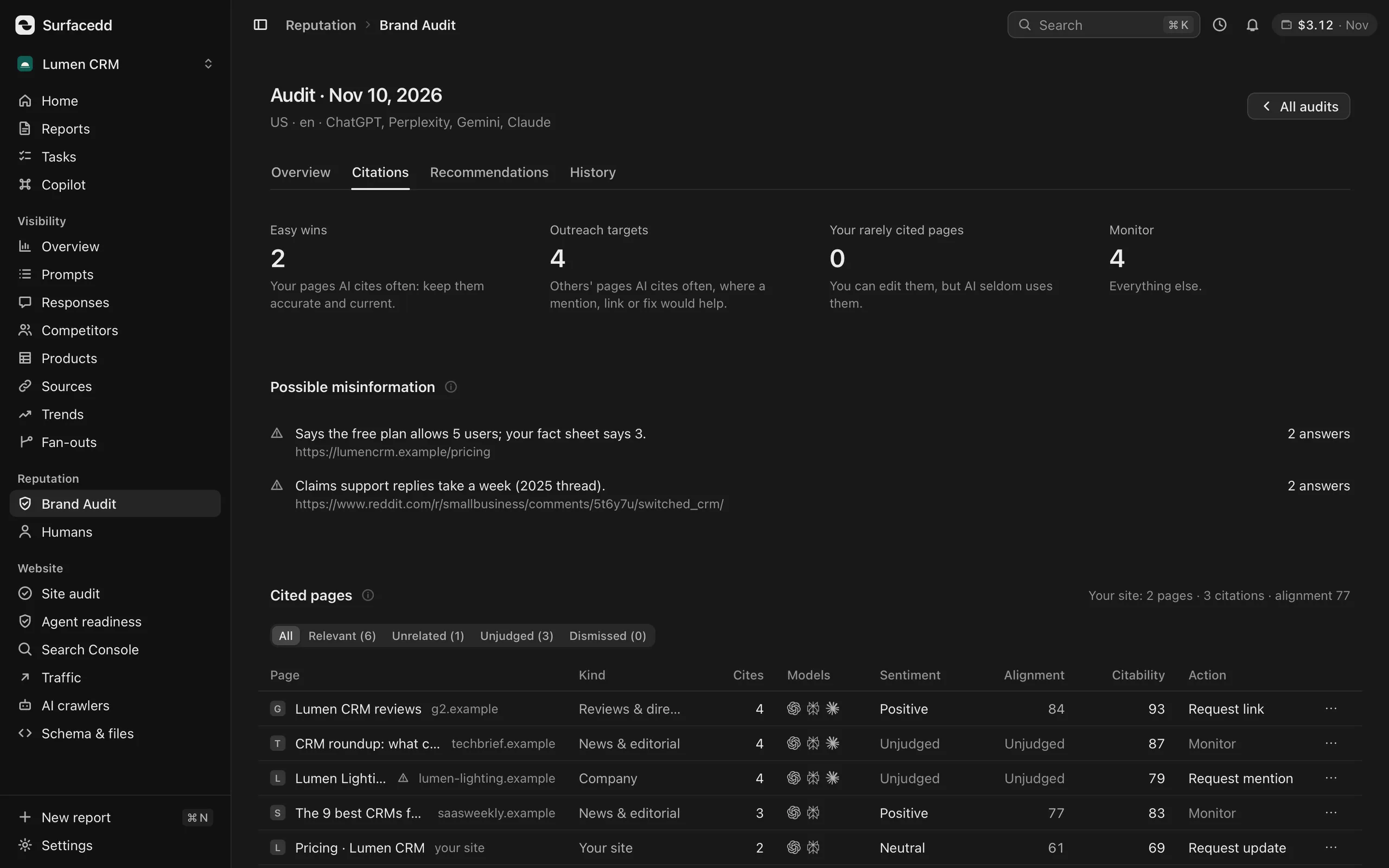
What to do first is visible in the table. The brand's own pricing page has alignment 61 and the action "Request update", because answers took a wrong user limit from it. That is the cheapest fix: edit your own page. A review site with citability 93 that names the brand but doesn't link it gets "Request link". A news roundup cited by three engines gets "Monitor". The Reddit thread can't be edited by the brand, so the realistic fix is a current, public answer to the same question on a page you control.
Cost
An audit is about twelve answers plus the reading step, on your own keys. At default models that comes to roughly $0.08 per audit, plus about $0.002 for each cited page your analysis model judges. The app shows its own estimate as a range before you confirm ("Run audit · $0.08"), and the actual cost afterwards, from what each provider reports. Nothing is billed by Surfacedd.
For comparison, a ChatGPT answer on the default model costs $0.0109 and a Perplexity answer $0.0051 on today's price table. See pricing for the licence and the full per-engine table.
Comparing audits over time
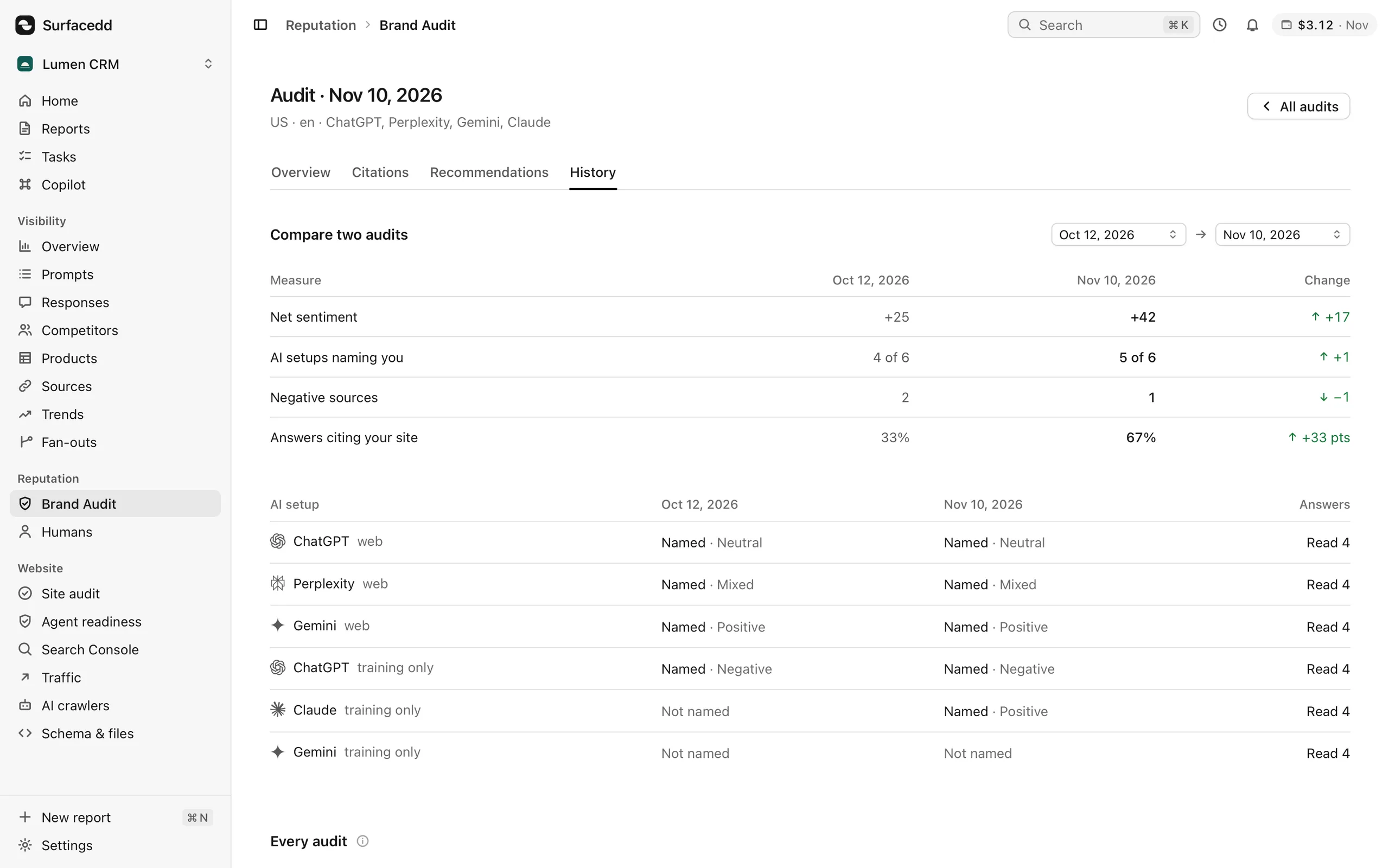
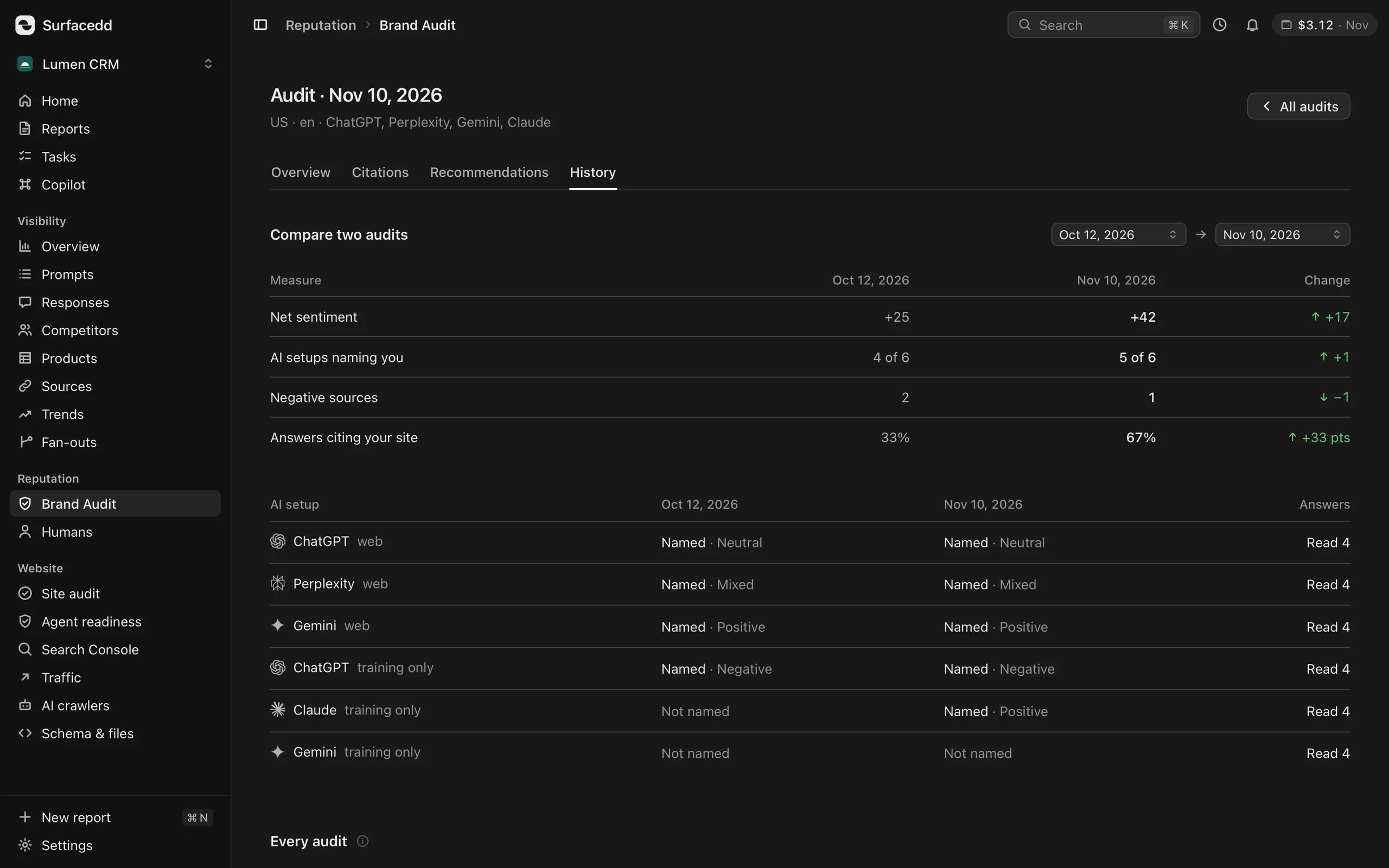
Each audit has four tabs: Overview, Citations, Recommendations and History. On Overview, each new audit for the same market is compared with the one before it: net sentiment, models naming you, negative sources and the share of answers citing your site all show their change ("+17 since the previous audit").
The History tab compares any two audits you pick, earlier and later, defaulting to the previous audit and this one. It lists the same four measures side by side with their change, then every AI setup with whether it named you and its tone in both audits, and a list of every audit with its sentiment. Run one after you fix a page, wait for engines to re-read it, and run another to see whether the claim moved. Answers vary between identical runs, so treat a single audit as a snapshot and look for the same change in two audits before you call it fixed.
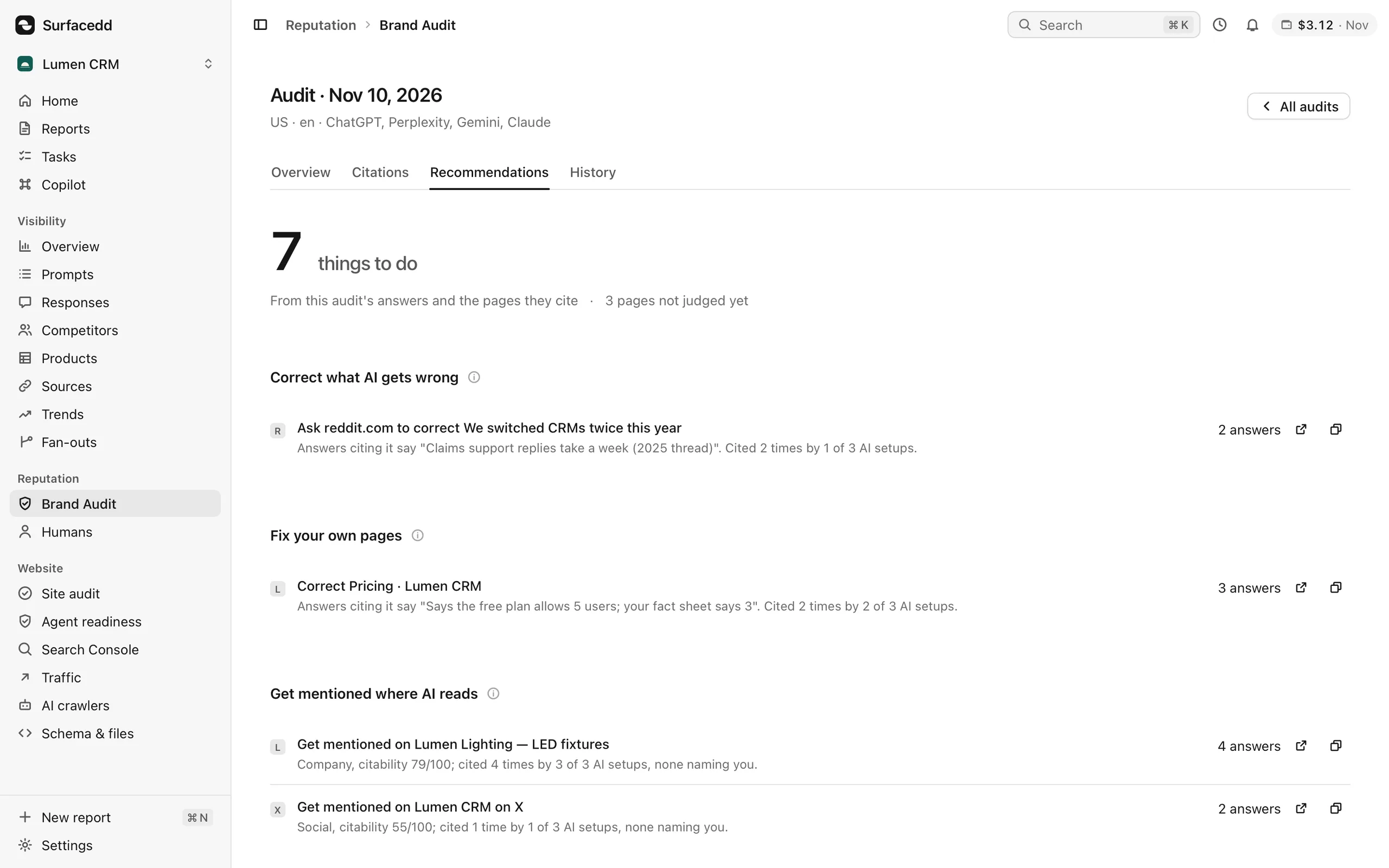
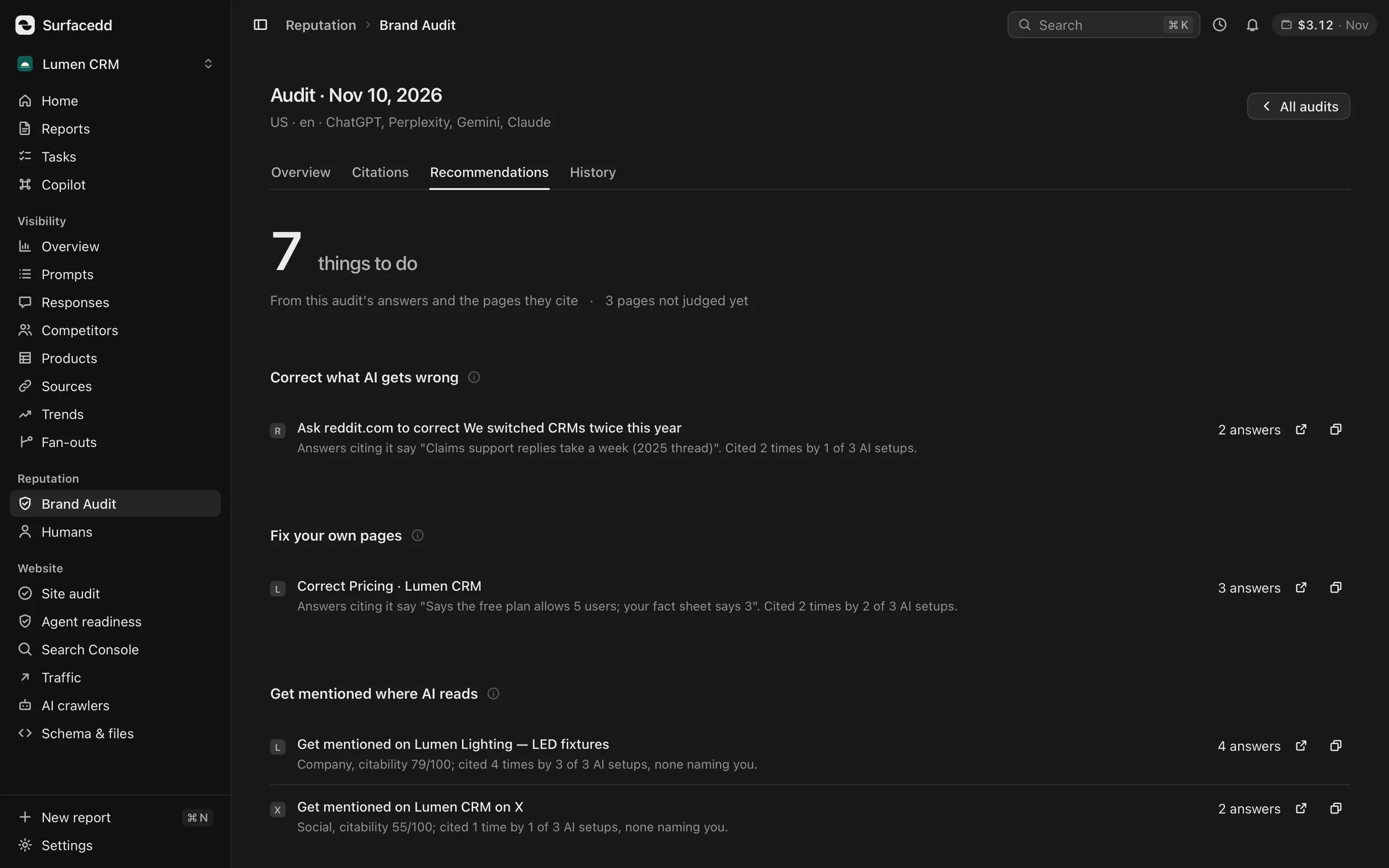
The Recommendations tab turns the audit into a to-do list, without another model call. It groups what to do by type: correct what AI gets wrong (with the page and the claim it repeats), fix your own pages, get mentioned on pages AI reads, ask for a link, answer negative sources, and win back setups that stopped naming you. Each item links its evidence and has a Copy brief button, so you can hand it to whoever owns the page.
Brand Audit, Humans and the rest of Surfacedd
Brand Audit is for companies and products. For a person, use Humans, which asks up to 22 question templates about you and checks each fact against a fact sheet you enter, with the same "find the source" approach. To see who AI recommends instead of you in category questions, and which pages convinced it, use Competitors and sources. For a step-by-step approach to correcting an AI answer, read how to fix what ChatGPT says about you.
What it doesn't do
Sources
Fair questions
Can Brand Audit make ChatGPT say better things about my brand?
No tool can make an AI assistant say something. Brand Audit shows what six AI setups say about you, how positive or negative it is, and which page each claim came from. You then fix what you control, such as your own pricing or about page, and ask other sites to correct or update theirs. A later audit shows whether the answers changed.
Why does the audit ask models without web search?
Because many people use assistants with search off, and those answers come from training data that may be a year or more old. If a training-only answer is wrong while web answers are right, your current pages are fine and you are waiting on retraining. If web answers are wrong, a page is feeding the error and you can act on it now.
What happens if I haven't turned on Gemini?
Gemini's web search stays off until you accept Google's terms notice. In that case the third web-search slot uses Claude with web search instead, and the audit list notes the substitution. The training-only Gemini slot doesn't use Google Search grounding, so it can still run if you've added a Gemini key. Without a Gemini key, that slot is skipped.
How is "possible misinformation" decided?
Your analysis model compares the answer sentences that used a page with your brand's own facts: name, website and the description you entered in brand settings. When they conflict, the page is listed with the claim and the number of answers repeating it. The more complete your brand description, the better this check works. Pages not yet judged show "Unjudged".
Is the sentiment score the same as my visibility score?
No. Net sentiment, from −100 to +100, is calculated only for Brand Audit and Humans. Visibility measures how often you're named in category questions. Keeping them separate stops a negative review from hiding the fact that you're recommended, or a friendly answer from hiding that you're rarely named.
How often should I run an audit?
Monthly is a sensible default, and again two to four weeks after you fix a page or get a third-party page updated. Engines need time to re-read pages, and answers vary from run to run, so look for the same change across two audits before deciding a fix worked. Each audit costs about eight cents on your keys.
How we research, write and correct pages: read our editorial policy.