See when Perplexity cites you, with the exact cost of every answer
Surfacedd asks Perplexity your buyers' questions through its Agent API and stores the numbered sources, the results it read but skipped, the searches it ran and the cost Perplexity reports for that answer.
By the Surfacedd teamUpdated 6 min readMarkdown
On this page
Short answer
A Perplexity rank tracker asks Perplexity your prompts through its API and records whether your brand is named and which pages are cited. Surfacedd uses Perplexity's Agent API, which replaced Sonar Chat Completions on 27 September 2026, and stores the exact cost Perplexity reports for each answer, plus location down to coordinates.
How Perplexity is collected
- How Surfacedd asks
- Perplexity Agent API (which replaced Sonar Chat Completions on 27 September 2026) with Perplexity's own Sonar model and the web_search tool.
- Key you need
- Perplexity API key
- Location
- Country, region and city, or coordinates, as you set them per market.
- Searches it ran (fan-outs)
- Exposed. Search queries are returned with the results.
- Citations
- Numbered inline markers mapped to search results; results that were read but not cited are kept as consulted sources.
- Search fee
- $2.50 per 1,000 search calls, plus tokens
- Default model
- Sonar. Mid and flagship models can be picked per report.
Worth knowing
- Requests are throttled to your account tier (one per second by default); you can raise it.
- Actual cost is taken from the cost Perplexity reports with each response.
Cost per answer
$0.0051
estimated, paid to Perplexity on your account
- 100 answers
- $0.51
- 25 prompts × 3 samples, weekly, for a month
- $1.65
- Reading each answer (GPT-6 Luna)
- +$0.0015
From price table 2026-11-13.1, using typical token counts and one search per answer. The app recalibrates from your own answers and shows its estimate before each run. How costs are estimated
What changed in Perplexity's API
Perplexity ended support for its Sonar Chat Completions API on 27 September 2026. Its migration guide says synchronous and streaming Sonar calls keep working for now, quietly reformulated as Agent API requests, while asynchronous Sonar calls are no longer supported. Trackers built on the old endpoint still return answers, but through a translation layer they don't control.
Surfacedd calls the Agent API directly, with Perplexity's own Sonar model and the web_search tool declared explicitly. That keeps the request shape stable and auditable: you know which model answered, which search tool ran and what it was told. The old fixed per-request fee table is gone too. Search is now billed per tool call, on top of tokens.
Citations and results not referenced
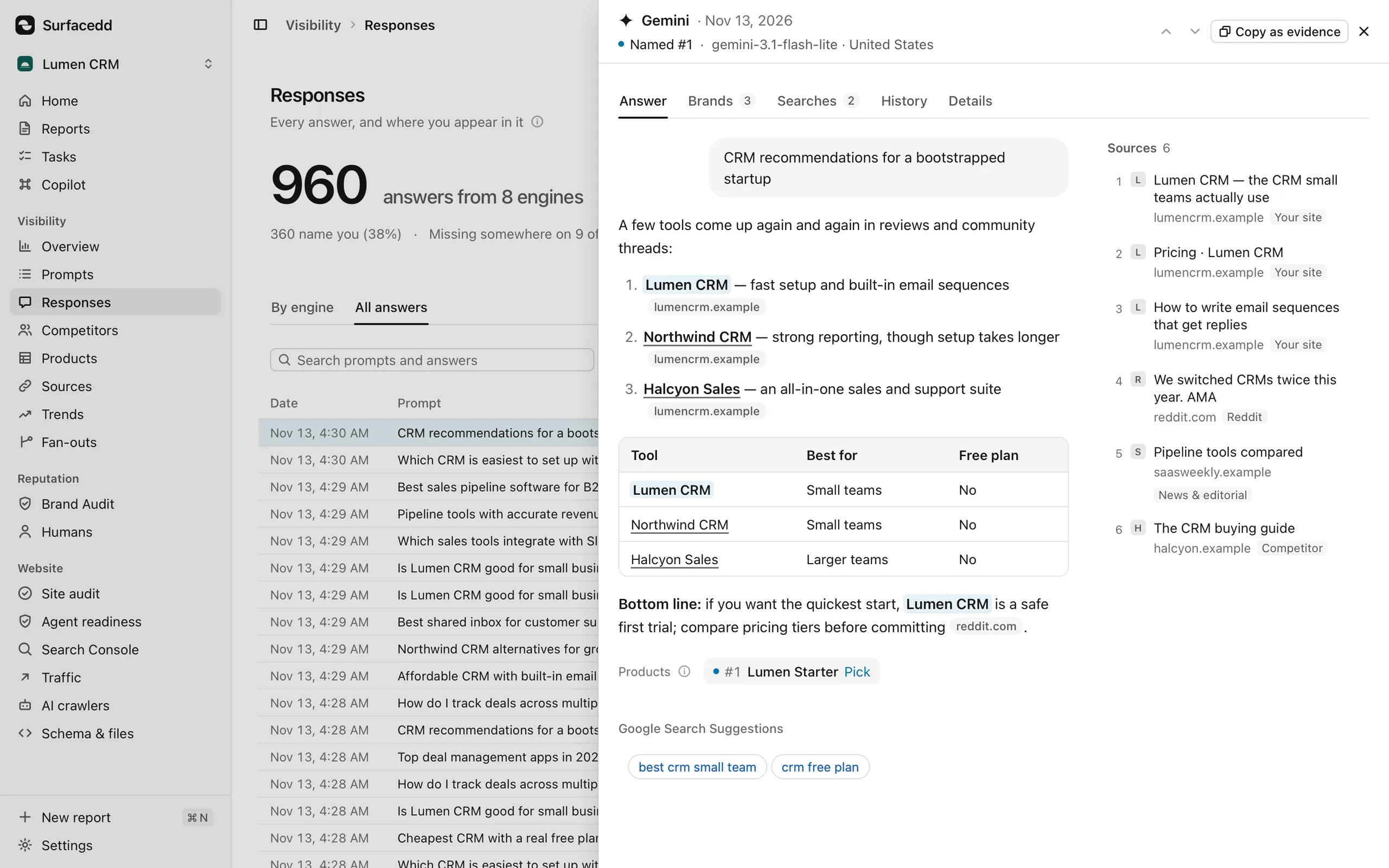
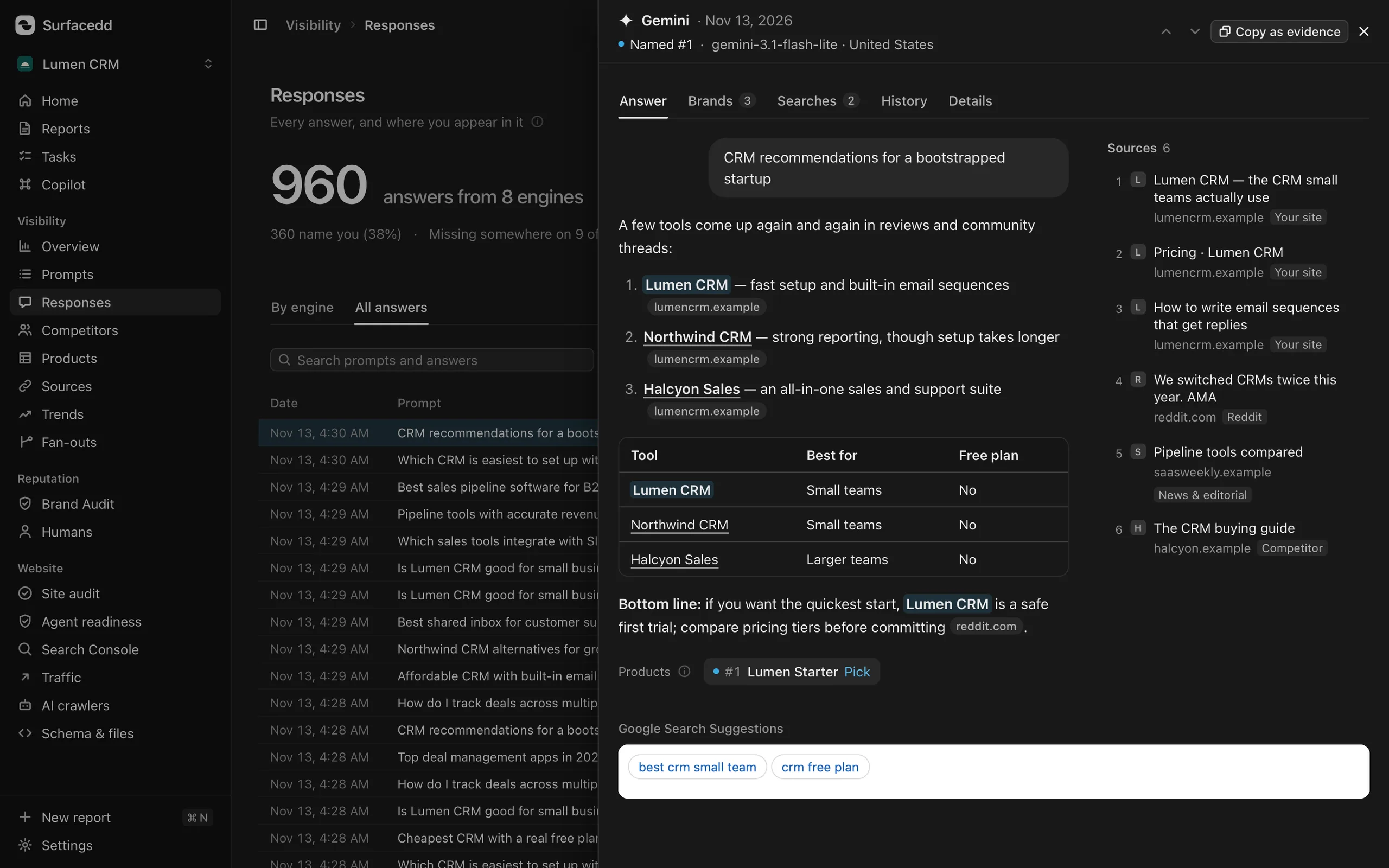
Perplexity's answer cites sources by number. The API returns a search_results item with every result it retrieved, each with an id, URL, title, snippet and dates, and the answer's [n] markers point at those ids. Two details matter for accurate tracking:
- Markers appear only when asked for. Perplexity's web search docs say whether the model adds markers depends on the prompt. Surfacedd's instructions ask for inline
[n]citations after each claim, so every cited sentence is traceable. - The result list is the source of truth. A citation is recorded only when a marker maps to a returned result id, in the order the markers first appear.
Every retrieved result that no marker points to is kept as read but not cited. Perplexity typically retrieves more pages than it cites, so this list is long and useful: it's the set of pages Perplexity found for your question and passed over. If your page is in it, the fix is on the page, not in getting discovered.
The searches Perplexity ran
The same search_results item lists the queries Perplexity issued. One question often becomes two or three searches, and Perplexity's docs note that the result budget is split across them. Surfacedd saves every query with the answer, and the Fan-outs screen shows which queries recur across your prompts. Those are the questions to answer on your pages.
Exact cost per answer
Perplexity is one of two engines that tell you what an answer cost. When a response completes, usage.cost.total_cost reports the calculated cost of that request, split into input, output, cache and tool costs. Surfacedd records that figure as the actual spend for the answer instead of computing it from a price table, and uses the computed figure only for the estimate shown before a run.
| Model | Tier | Input per 1M tokens | Output per 1M tokens | Per 1,000 searches | Est. per answer |
|---|---|---|---|---|---|
| Sonar (default) | cheap | $0.25 | $2.50 | $2.50 | $0.0051 |
| Fast preset (pinned 2026-11-11) | mid | $0.20 | $1.00 | $1.00 | $0.0025 |
| Low-effort research preset * | flagship | $2.00 | $10.00 | $2.50 | $0.0171 |
Estimates assume about 4,300 input and 600 output tokens and 1 search per answer, at Perplexity's list prices on 2026-11-23 (UTC), price table 2026-11-13.1. * Price not yet confirmed by the provider.
At the default, 25 prompts with 3 samples, asked weekly, cost about $2.14 a month, paid to Perplexity. The Fast preset is cheaper per search and runs a different underlying model on Perplexity's side, so its answers aren't directly comparable with Sonar's. Surfacedd stores the model per answer and never mixes the two on one trend line.
Location down to coordinates
Perplexity's web_search tool accepts a two-letter country code, a region, a city, and latitude and longitude, which must come with a country. That's the most precise location control of the chat-style engines. Set a market as "Shoreditch, London" or as coordinates for a single neighbourhood, and the searches run as if from there.
There's no language filter in the Agent API, so Surfacedd states the answer language in the instructions, and markets in other languages use translated prompts. Local businesses get the most out of this: "best physio near me" asked from three postcodes can return three different shortlists.
Quirks worth knowing
- One request per second by default. Perplexity limits new accounts to one request a second, rising with cumulative credit purchases. Surfacedd paces Perplexity to your tier automatically; you can raise the limit in Settings if your account allows it.
- Rate limits are retried, not billed twice. A rate-limited request is retried with backoff, honouring Perplexity's
Retry-Afterheader, and only the completed answer's reported cost is recorded. - Many sources per answer. Perplexity cites more sources than other engines, so citation share per page is naturally lower. Compare Perplexity with Perplexity, not with Claude.
- The API isn't the app. Perplexity's consumer app adds its own modes and, for signed-in users, history. The API answer is a repeatable sample, labelled with its model and collection method.
Getting a Perplexity key
Perplexity's API needs prepaid credit added in its console; there's no free API tier. The Perplexity API key guide covers creating the key, buying credit, the rate tiers and testing the key in Surfacedd with a single cheap search. For the content side, read how to get cited by Perplexity, which explains PerplexityBot and Perplexity-User.
What it doesn't do
See all eight surfaces on the engines overview, or buy Surfacedd once and add your key.
Sources
Fair questions
Is Sonar still available after the Chat Completions change?
Yes, as a model in the Agent API. Perplexity ended support for Sonar Chat Completions on 27 September 2026, but the Sonar model can still be called through the Agent API with the web search tool, which is what Surfacedd does. Old synchronous Chat Completions calls are being reformulated as Agent API requests; asynchronous ones no longer work.
Why is Perplexity cheaper to track than ChatGPT or Claude?
Its search fee per call is lower and its Sonar model has low token prices, so a typical answer costs a fraction of a cent. The cost table on this page shows today's figures from our price table. Surfacedd records the exact cost Perplexity reports with each response, so the spend you see afterwards is Perplexity's own number, not an estimate.
What does "read but not cited" mean for Perplexity?
Perplexity's API returns every result its searches retrieved, and the answer cites only some of them by number. Surfacedd keeps the rest as read but not cited. A page of yours in that list was found and considered, then passed over for another source. That's usually fixed on the page itself: a clearer answer to the sub-question, current facts and plain-text specifics.
Can I track Perplexity for a specific neighbourhood?
Yes. Perplexity's web search accepts latitude and longitude together with a country, as well as region and city. Surfacedd passes the market you set on the report, so the same prompt can be asked from several locations and compared. Results for national questions often look similar everywhere; local-service questions are where coordinates make a difference.
Do I need a paid Perplexity Pro subscription?
No. Perplexity Pro is the consumer subscription for the app. Tracking uses Perplexity's API, which draws on API credit bought in Perplexity's developer console and is billed per request. You need an API key with credit on it; whether you also pay for Pro makes no difference to what Surfacedd collects or what it costs.
How we research, write and correct pages: read our editorial policy.