The GEO checklist: 40 checks that raise your odds of being cited by AI
Every item has a yes-or-no pass test and the tool that answers it, so the checklist tells you what to fix rather than what to think about.
By the Surfacedd teamUpdated 13 min readMarkdown
On this page
Short answer
This GEO checklist has 40 checks in five groups: crawler access, facts and entities, pages, third-party mentions, and measurement. Each check has a pass test you can answer yes or no and a tool, mostly free, to answer it. Work access first: an AI engine cannot cite a page its crawler can't read.
How do you use this GEO checklist?
Go through the five groups in order and mark each check pass or fail. Fix every failing access check before anything else, then facts, then pages; mentions and measurement run in parallel from week one. A check only passes if its pass test is a clear yes today, not "probably".
Generative engine optimization has a lot of advice and not much of it is testable. This list keeps only checks with a concrete pass test, and drops the myths: there is no "AI schema", Google says you don't need special files or markup to appear in its AI features, and it says there's "no requirement to break your content into tiny pieces" (Google Search Central).
How to score it:
- Access (A1–A8): all eight should pass. One failing access check can zero out an engine.
- Facts, Pages, Mentions (F, P, M): aim for 6 of 8 in each group in the first 90 days.
- Measurement (X1–X8): set these up in week one. Without them you can't tell which other fixes worked.
Download the whole list as a spreadsheet: GEO checklist CSV (40 rows: id, group, check, pass test, tool, priority). The order of the work over a quarter is in GEO strategy.
Access: can AI crawlers read your pages?
Access checks whether each AI engine's crawler can fetch and read your key pages. They come first because an engine cannot cite what it can't read, and they're the fastest fixes on the list. Most can be answered with the free AI crawler checker and a terminal.
| # | Check | Pass test | Tool |
|---|---|---|---|
| A1 | AI search crawlers are allowed | robots.txt allows OAI-SearchBot, Claude-SearchBot, PerplexityBot, Googlebot and Bingbot on home, pricing and product pages | AI crawler checker |
| A2 | User-triggered fetchers are allowed | ChatGPT-User, Claude-User and Perplexity-User are not disallowed on pages users would ask about | AI crawler checker |
| A3 | Training opt-outs are deliberate | Each rule for GPTBot, ClaudeBot, CCBot, Google-Extended and Applebot-Extended is written down with a reason | robots.txt + your notes |
| A4 | robots.txt is reachable | /robots.txt returns 200 (or 404 if you have none) in under a second, never 5xx | curl -I or a site audit |
| A5 | No bot wall for AI agents | A key page fetched with an AI crawler's user agent returns the same 200 page as a browser, not a challenge, 403 or 429 | Agent readiness checker |
| A6 | Main content is in the raw HTML | The page's main text and links appear in curl output, without JavaScript | curl + grep, or a site audit |
| A7 | No snippet limits on pages you want quoted | No nosnippet, max-snippet:0 or a small max-snippet on key pages | Site audit or view-source |
| A8 | Crawlers really fetch your key pages | Server logs show verified search-bot hits on key pages returning 200 in the last 30 days | AI bot log analyzer |
Notes on the ones people get wrong:
- A1 vs A3. Search bots and training bots are separate. OpenAI says sites opted out of OAI-SearchBot "will not be shown in ChatGPT search answers", while disallowing GPTBot means your content "should not be used in training" (OpenAI). Blocking GPTBot alone doesn't remove you from ChatGPT search.
- A3 and Google-Extended. Google says Google-Extended doesn't affect inclusion or ranking in Google Search, but it does cover grounding in Gemini Apps (Google). Opting out keeps your pages out of those Gemini answers. Make that call on purpose.
- A2. Perplexity says Perplexity-User "generally ignores robots.txt rules" because a user triggered the fetch (Perplexity). A disallow there is a preference, not a block.
- A5. A firewall's bot protection can serve a challenge page to a crawler robots.txt allows. The free agent readiness checker compares an agent fetch with a browser fetch; the agent readiness score explains how bot walls weigh in the Reach category.
- A8. User agents can be spoofed. Count only hits whose IP matches the operator's published ranges; the guide to checking AI crawler IPs shows how, and the AI bot log analyzer does it in your browser.
A robots.txt that passes A1–A3 while opting out of training:
User-agent: OAI-SearchBot
User-agent: ChatGPT-User
User-agent: Claude-SearchBot
User-agent: Claude-User
User-agent: PerplexityBot
User-agent: Perplexity-User
Allow: /

# Deliberate training opt-out (A3): keep or delete
User-agent: GPTBot
User-agent: ClaudeBot
User-agent: CCBot
Disallow: /

Sitemap: https://example.com/sitemap.xml
The full reasoning per bot is in robots.txt for AI crawlers.
Facts and entities: does AI describe you correctly?
Facts checks whether your brand's name, description, prices and claims are identical everywhere AI engines read about you. Inconsistent facts are a common reason answers describe a product wrongly, and they're fixable on pages you control.
| # | Check | Pass test | Tool |
|---|---|---|---|
| F1 | One canonical name | Your brand is spelled and capitalised the same on your site, profiles, app listings and review sites | Manual check of the top 10 results for your name |
| F2 | One reusable description | A one-sentence description appears word for word on your home page, about page and main profiles | Manual |
| F3 | Prices and specs match | Price, plans, platforms and key limits are the same on your site, listings and review profiles | Manual, or a brand audit of AI answers |
| F4 | Organization markup is valid | Home page JSON-LD has Organization with name, url, logo and sameAs, and validates | Schema generator, Rich Results Test |
| F5 | Profiles link both ways | Every profile in sameAs links back to your site | Manual |
| F6 | An about page states the basics | Founding date, what you make, who runs it, where you are and how to contact you, in plain HTML | Manual |
| F7 | Knowledge bases agree | If a Wikidata or Wikipedia entry exists, its facts match yours; if not, you haven't created one without independent sources | Manual |
| F8 | AI answers about you are checked | You've asked the main engines "What is {brand}?" and "Is {brand} good for {use}?" and listed each wrong claim with the page it came from | Brand audit |
The Organization and Product JSON-LD behind F4 can be built with the free schema generator. Google is clear that structured data isn't required for its AI features, so F4 is about consistency, not a citation boost. F5 is the same idea as rel=me: a profile that links back confirms the identity. The wider method, including disambiguation from similarly named brands, is in entity SEO.
F8 is the check most teams skip. Ask the questions twice: once in a way that uses web search, and once in a way that relies on the model's memory. A wrong claim with a cited source is fixable at the source; a wrong claim with no source comes from training data and changes slowly. The difference between the two is covered under AI hallucination.
Pages: do your own pages answer the questions?
Pages checks whether your own site has a clear, current answer to each question buyers ask AI about your category. When an AI answer names you but cites someone else's page, this group is usually why.
| # | Check | Pass test | Tool |
|---|---|---|---|
| P1 | Top questions are answered first | Each of your top 10 buyer questions has a question-style heading on an owned page, answered in the first two sentences | Manual, against your prompt list |
| P2 | Prices are on the page | Pricing is visible text in the HTML, with currency and what's included | curl + grep for the price |
| P3 | Fair comparison pages exist | Each main rival has a dated comparison or alternatives page that says where the rival is better | Manual |
| P4 | Sub-questions are covered | Integrations, setup time, limits and security each have a page or section | Your prompt fan-outs |
| P5 | Dates are honest | The visible "updated" date, dateModified and sitemap lastmod change together, and only with real edits | View-source, sitemap |
| P6 | Headings and titles are clean | One H1 per page, no skipped heading levels, a unique title and meta description | Site audit |
| P7 | Structured data is valid where used | Product/Offer, Article and BreadcrumbList blocks parse and carry required properties | Site audit, Rich Results Test |
| P8 | No pages made only for AI | No thin, near-duplicate pages targeting phrasing variants | Site audit (thin and duplicate content) |
P1 is the pattern answer engines lift: a question, then a self-contained answer. Answer engine optimization shows it on a worked page. P4 matters because AI engines often run several searches for one prompt; that query fan-out is why a page about your Slack integration can decide a "best CRM" answer.
P5 matters because freshness is measurable: Ahrefs found AI assistants cite content 25.7% "fresher" than Google's organic results on average, with AI Overviews the exception (Ahrefs, July 2025). Bumping dates without changes is not a pass. When a page really changes, an IndexNow ping tells Bing and the other participating engines straight away instead of waiting for a recrawl.
P8 is a real risk, not a style point. Google says creating many pages "primarily to manipulate rankings or generative AI responses" breaks its scaled content abuse policy (Google Search Central).
Two common extras are left off on purpose. llms.txt is cheap to add, but Google says Search doesn't use it; treat it as informational. FAQ markup no longer earns a rich result; keep it only where the FAQ is real.
Mentions: are you named where AI engines read?
Mentions checks whether the third-party pages AI engines cite in your category name you, accurately. Most citations in AI answers point to sites you don't own, so this group is where most of the long-term movement comes from.
| # | Check | Pass test | Tool |
|---|---|---|---|
| M1 | You know which pages are cited | You have a list of the third-party URLs cited in answers to your prompts, with counts | Reading the answers, or source tracking |
| M2 | Rival-only listicles are worked | Each cited "best X" page that names a rival and not you has been contacted, with a dated note | Your target list |
| M3 | Directory and review profiles exist | You're listed, with correct facts, on the review and directory sites cited in your category | Manual |
| M4 | You take part in cited communities | Where forum threads are cited, you or your team take part under your own names, affiliation disclosed | Manual |
| M5 | Your people are findable | Founders or experts have a profile page on your site and consistent bios elsewhere | Person schema generator |
| M6 | Wrong third-party facts are reported | Each cited page with a wrong fact about you has a correction request on file | Your F8 list |
| M7 | You've published something worth citing | At least one dated page with original numbers or a method others can reference | Manual |
| M8 | No bought or fake mentions | Nothing paid for undisclosed, no sock-puppet posts | Your own policy |
The evidence for this group is correlational but consistent. In Ahrefs' study of 75,000 brands, branded web mentions correlated with AI Overview visibility at 0.664 (Spearman), against 0.218 for backlinks (Ahrefs, May 2025).
How to work M1–M2 without wasting effort is covered in brand mentions in AI search; M4 in Reddit and AI answers. For M5, the person schema generator builds ProfilePage and Person markup.
M8 is a pass test because it's a real temptation. Google warns that "seeking inauthentic 'mentions' across the web isn't as helpful as it might seem" (Google Search Central), and communities ban it.
Measurement: can you tell what worked?
Measurement checks whether you can see, per engine, how often AI answers name and cite you, and whether a change after a fix is real. Without this group, every other fix is a guess.
| # | Check | Pass test | Tool |
|---|---|---|---|
| X1 | A fixed prompt set exists | 20–50 buyer questions, at most 30% containing your brand, at least 3 per funnel stage | Spreadsheet or tracker |
| X2 | A fixed competitor list exists | 3–6 named rivals, unchanged for the quarter | Spreadsheet or tracker |
| X3 | There's a baseline with repeats | Every prompt asked at least 3 times on each chosen engine before changes | AI visibility tracker |
| X4 | Re-runs are scheduled | The same set runs weekly, compared only on prompts and engines present in both runs | AI visibility tracker |
| X5 | Results come with ranges | Visibility, share of voice and citation rate are reported per engine with a 95% range | AI visibility tracker |
| X6 | AI referral traffic is tracked | GA4 has a channel or segment for AI assistant referrals | GA4 AI traffic regex |
| X7 | Search Console is read for causes | Click changes are split into position, CTR and impressions monthly, and the generative AI report is checked | Search Console |
| X8 | Actions are logged with dates | Every fix and outreach has a date, so results can be read against it after four runs | Change log |
X1 and X5 carry the most weight. A prompt set full of your own brand name produces flattering numbers that say nothing about discovery. And because answers vary between identical runs, a single result without a range can't tell a real change from noise; the Wilson score interval is how a per-prompt range is computed from a few samples. The full method is in how to measure AI visibility.
For X6, the free GA4 AI traffic regex builds the channel rule. For X7, Google's Search Console now includes generative AI performance reports showing impressions in AI features by page, country and device, rolled out to all sites as of August 31, 2026 (Google Search Central Blog).
What X3–X5 cost in API fees: 25 prompts asked once a week on four engines comes to about $3.75 a month at today's list prices; the cost calculator works out other set-ups.
Download the checklist
The GEO checklist CSV has all 40 checks with their id, group, pass test, tool and a priority (P0 for access, P1 for facts, pages and measurement, P2 for mentions). Open it in any spreadsheet, add a "status" and "date" column, and re-score it each month. If you also sell or take bookings on your site, run the AI agent readiness checklist next: it covers what agents need to act on a page, not just read it.
How Surfacedd runs this checklist for you
Surfacedd answers about half of these checks from your own computer. The site audit crawls your site for free (up to 500 pages), checks AI crawler access per bot and per key page, and flags JavaScript-only content, snippet restrictions, invalid structured data and thin or duplicate pages. That covers A1–A4, A6–A7 and P6–P8.
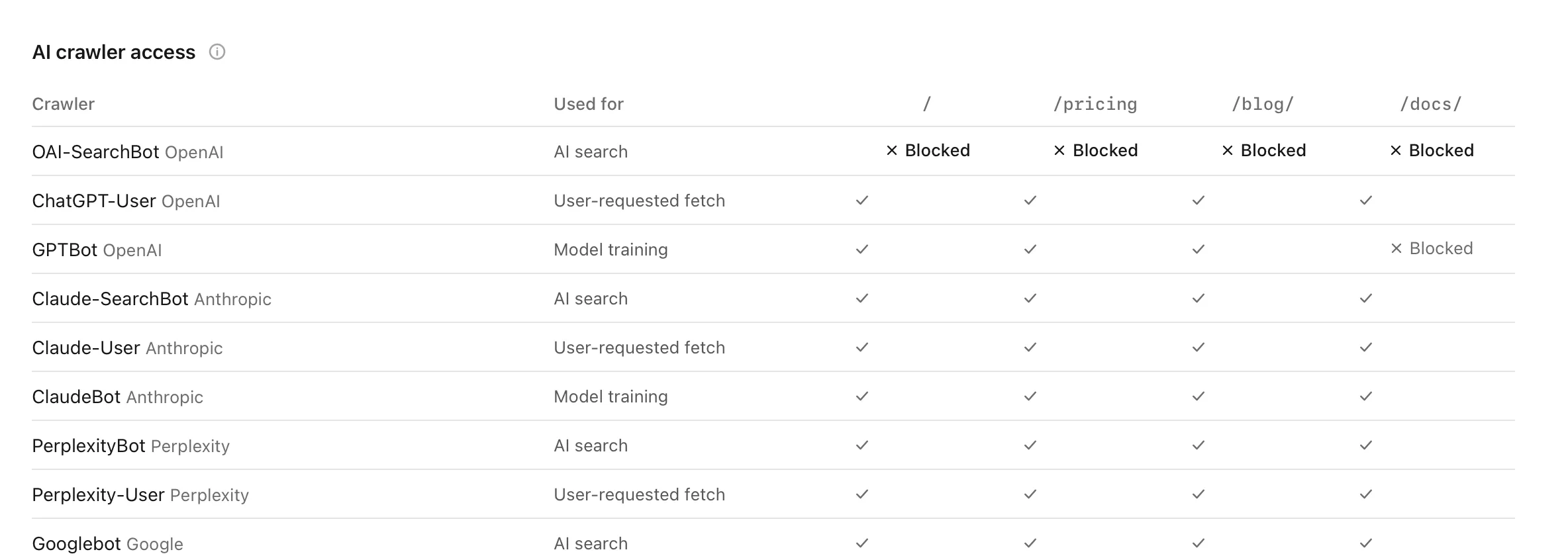
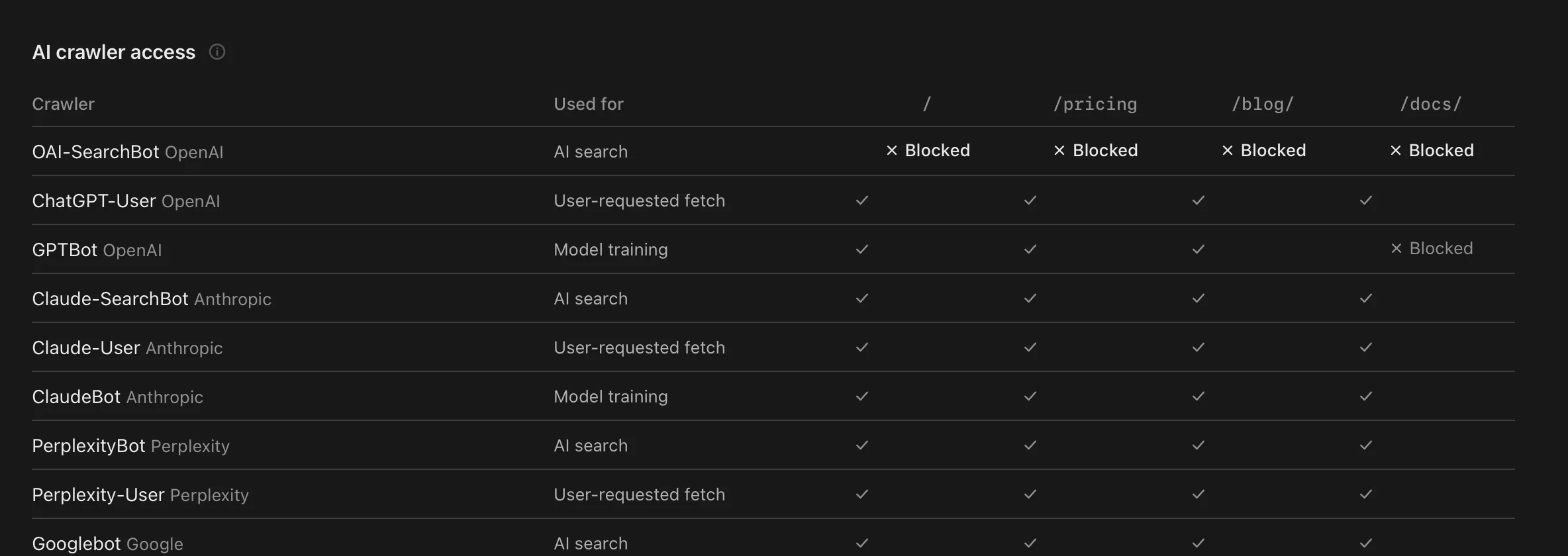
Crawler log analytics imports your server logs, keeps only daily aggregates, and marks each bot verified, unverifiable or spoofed (A8). Brand Audit lists wrong claims and the pages they came from (F3, F8). Source tracking shows which third-party pages are cited and which name a competitor and not you (M1–M2). Scheduled reports with ranges and like-for-like comparisons cover X3–X5, and the Search Console and GA4 import covers X6–X7.
It doesn't write pages, send outreach or post in communities; those checks stay with you. See the AI visibility audit for the full rule list, and pricing for the one-time licence (Launch price $29, $79 after 23:59 UTC on January 30, 2027.$79 once.).
Sources
- Google Search Central, Optimizing your website for generative AI features on Google Search
- Google Search Central, Google's common crawlers (Google-Extended)
- Google Search Central Blog, Search Generative AI performance reports in Search Console, June 3, 2026
- OpenAI, Overview of OpenAI crawlers
- Perplexity, Perplexity crawlers
- Anthropic, Does Anthropic crawl data from the web, and how can site owners block the crawler?
- Ahrefs, Do AI assistants prefer to cite "fresh" content?, July 28, 2025
- Ahrefs, An analysis of AI Overview brand visibility factors (75K brands), May 26, 2025
Fair questions
What is a GEO checklist?
A GEO checklist is a list of tests for whether AI engines can read your site, describe you correctly, find answers on your pages, see you mentioned elsewhere, and whether you can measure the result. This one has 40 checks in five groups, each with a yes-or-no pass test and a tool. It's the same idea as an SEO audit, extended to AI crawlers, third-party mentions and answer-level measurement.
Is a GEO checklist different from an AEO checklist?
Barely. Answer engine optimization grew out of featured snippets and voice answers, and focuses on answer-first pages; generative engine optimization adds the crawler access, mentions and measurement that AI search engines need. In practice the checks overlap almost entirely, which is why this list covers both. The differences are explained in our GEO vs AEO vs SEO guide.
Which checks should I do first?
The access group, A1 to A8. A single disallow rule or firewall challenge can keep an engine from reading any of your pages, so nothing else matters for that engine until it's fixed. These are also the quickest checks: most take minutes with a crawler checker and a terminal. Set up measurement (X1 to X5) in the same week so you have a baseline before you change anything else.
Does llms.txt belong on a GEO checklist?
Not as a pass or fail check. Google says its Search doesn't use llms.txt and that the file neither helps nor harms visibility there. It's cheap to publish and some developer tools read it, so add it if you like, but don't count it toward your score. We treat it as informational in both this list and the site audit.
How often should I re-run the checklist?
Monthly for the whole list, and weekly for measurement. Access can break without warning when someone changes a firewall rule or robots.txt, so re-check A1, A5 and A8 after any infrastructure change. Facts drift as pricing and plans change. Mentions move slowly; a monthly review of the cited pages is enough for most brands.
Can I pass every check and still not be cited?
Yes. The checklist removes the reasons an engine can't or won't use you; it can't force a choice. If you pass the access, facts and pages groups and still aren't named, the answer is usually in the mentions group: the pages engines read in your category name other brands. Read the sources behind the answers you lost and work those pages next.
Free tools for this guide
How we research, write and correct pages: read our editorial policy.