LLM SEO: get language models to know your brand and cite your pages
A language model knows about you in two ways: from what it learned in training and from pages it reads while answering. Each has its own task list, timescale and test.
By the Surfacedd teamUpdated 12 min readMarkdown
On this page
Short answer
LLM SEO, also called LLMO, is the work of improving how large language models describe and cite your brand. Models draw on two sources: training data, which changes only when a model is retrained, and live retrieval, which reads pages when a question is asked. Retrieval responds in days or weeks, training data in months or more.
What is LLM SEO?
LLM SEO is the practice of improving how large language models (LLMs) such as GPT, Claude, Gemini and Llama mention, describe and cite your brand. People also call it LLMO (large language model optimization). It overlaps almost completely with generative engine optimization; the difference is emphasis. GEO talks about AI search engines and their answer pages. LLM SEO talks about the model itself, and so it has to deal with something GEO often skips: a model can answer from memory, with no search at all.
That gives you two separate problems, and most advice blurs them together:
- Training data. What the model absorbed when it was trained. It is fixed until the next model version, and you can only influence it indirectly, by being written about widely before the next training cut.
- Live retrieval. Pages the model's search tool reads while it answers a question. This is ordinary retrieval-augmented generation: a search step finds pages, and the model writes from them. It responds to your changes within days or weeks.
The rest of this guide treats them as two task lists with two tests. If you're comparing LLM SEO with GEO and AEO in general, the GEO vs AEO vs SEO comparison has the side-by-side table.
How does a language model know about your brand?
A model has two kinds of memory. The 2020 paper that named retrieval-augmented generation, by Lewis and colleagues (NeurIPS 2020), describes models that "combine pre-trained parametric and non-parametric memory". Parametric memory is what's baked into the model's weights during training. Non-parametric memory is an external index the model can search at answer time.
Training data: what it learned
Training corpora are built mostly from the public web. The best-documented example is GPT-3: its paper, Language Models are Few-Shot Learners, lists a filtered Common Crawl at 60% of the training mix, then WebText2 at 22%, two book corpora at 8% each and English Wikipedia at 3% (Table 2.2). Newer model makers publish far less detail, but the operators of today's training crawlers say what they collect: OpenAI's GPTBot is "used to make our generative AI foundation models more useful and safe", and Anthropic's ClaudeBot collects web content "that could help train" its models.
Three properties of training data shape everything else:
- It has a cut-off. The model knows nothing published after its training data was frozen, so a rebrand, new pricing or a new product won't appear in memory-only answers until a later model.
- It rewards repetition across sources. A fact that appears on many independent pages is more likely to be learned than one that appears only on your site. This is our inference from how training works, not a documented ranking rule.
- It blends. The model doesn't store your page; it stores patterns. That is why memory-only answers can mix you up with a company that has a similar name, or repeat an old price.
Live retrieval: what it reads now
When an assistant searches, it sends one or more queries to a search index, reads some of the results and writes an answer that may cite them. That index is the assistant's own (OpenAI's OAI-SearchBot, Anthropic's Claude-SearchBot, PerplexityBot) or a search engine's (Google for Gemini and AI Overviews, Bing for Copilot). Answers built this way are called grounded, and grounding is the step where the model is tied to retrieved sources.
Retrieval works at the page level and changes as fast as the index does. If you fix a page, unblock a crawler or earn a new article that names you, retrieval-based answers can change within days.
How do you influence live retrieval?
This is where LLM SEO pays back fastest. The tasks, in the order we'd do them:
| # | Task | Why it works | Pass test |
|---|---|---|---|
| 1 | Allow AI search crawlers and user-triggered fetchers | Blocked pages can't be retrieved. OpenAI says sites opted out of OAI-SearchBot "will not be shown in ChatGPT search answers" | robots.txt allows OAI-SearchBot, ChatGPT-User, Claude-SearchBot, Claude-User, PerplexityBot, Googlebot, Bingbot; firewall doesn't challenge them |
| 2 | Serve your main text in the HTML | GPTBot, ClaudeBot and PerplexityBot don't render JavaScript (Vercel, December 2024) | curl of the page shows the main text and prices |
| 3 | Get indexed in Google and Bing | Gemini and AI Overviews use Google's index; Copilot uses Bing | URL Inspection shows indexed in both; Bing is notified of changes via IndexNow |
| 4 | Answer each buyer question in its own section | Retrieval pulls passages; a passage that answers alone gets used | Each H2 opens with a 1–2 sentence answer |
| 5 | Put facts in plain text, not images or PDFs | Text extraction is what the model reads | Price, plans, platforms and limits are crawlable text |
| 6 | Keep "updated" dates honest | Ahrefs found AI assistants cited pages 25.7% fresher than organic results on average | Visible date, dateModified and sitemap date change only on real edits |
| 7 | Earn mentions on the pages engines already cite for your questions | Answers often cite third-party pages, and a page that names you can carry you into the answer | You have a list of cited pages and whether each names you |
Step 7 deserves its own playbook. Our guide to brand mentions in AI search shows how to find the cited pages that name your competitors and not you, and the Reddit guide covers the forum threads engines quote.
Crawler access is the most common silent failure. Two bots matter here and are easy to confuse: blocking GPTBot keeps your content out of OpenAI's training, while blocking OAI-SearchBot removes you from ChatGPT search. The robots.txt guide for AI crawlers has a copyable configuration for each case.
How do you influence training data, realistically?
Slowly and indirectly. You can't submit pages to a training set, you can't see what was included, and you can't schedule the next model. What you can do is make it more likely that, whenever the next corpus is collected, accurate statements about you appear in many independent places.
| Task | What it does for training data | Timescale |
|---|---|---|
| Allow training crawlers, if your business can accept it | GPTBot, ClaudeBot, CCBot and others can only collect pages they're allowed to read | Effective from the next crawl; visible only after a new model ships |
| Keep one canonical description of your company and use it everywhere | Repeated, identical facts are easier to learn than conflicting ones | Months |
| Get covered by sources that end up in many corpora | Reference sites, established publications and widely linked articles | Months to years |
| Publish original data others will quote | Each citation of your study is one more independent mention | Months |
| Fix wrong facts at their source | Old directory listings and outdated reviews keep feeding wrong facts into future corpora | Months |
Allowing training crawlers is a business decision, not an SEO trick. Publishers whose content is the product often block them, and that's legitimate. A software company that wants assistants to know its name usually benefits from allowing them. Common Crawl documents how to block or verify CCBot, including a reverse-DNS check against crawl.commoncrawl.org, because some crawlers falsely identify themselves as CCBot.
Two honest limits apply. First, you won't see the effect for a long time: a model released next year may have been trained on a crawl from months before that. Second, you can't measure your influence on training data directly; you can only compare memory-only answers between model versions.
What doesn't work?
Most LLM SEO myths promise a shortcut into the model. The evidence doesn't support them.
| Myth | What the evidence says |
|---|---|
| "Stuff pages with keywords so the model picks them" | The original GEO paper found keyword stuffing offered "little to no improvement" and scored below the unoptimised baseline on its benchmark |
| "Rewrite pages in an LLM-friendly style and you'll be cited" | C-SEO Bench (NeurIPS 2025) found most conversational SEO methods "largely ineffective", often harmful; traditional ranking signals were "significantly more effective" |
| "Add an llms.txt and models will read it" | Google's AI features guide says you don't need "new machine readable files, AI text files, markup, or Markdown". See our llms.txt guide for where it does help |
| "Chunk content into tiny passages for LLMs" | Google: "There's no requirement to break your content into tiny pieces for AI to better understand it" |
| "Create AI-only pages" | Google says making content "primarily to manipulate rankings or generative AI responses" violates its spam policies |
| "Buy mentions on forums" | Google's guide says "seeking inauthentic 'mentions' across the web isn't as helpful as it might seem", and forums remove it |
| "Ask ChatGPT to remember your brand" | A user's chat doesn't change the model other people use |
The GEO paper is worth reading closely, because it's often quoted as proof that tricks work. Its best methods, citing sources, adding quotations and adding statistics, improved a visibility measure by up to 40% on its own benchmark. A later benchmark (C-SEO Bench) found that most such rewrites didn't hold up across engines, and that gains shrink as more sites use them. Adding real statistics and real sources makes a page better for readers anyway; treat any extra AI lift as a bonus, not a plan.
How do you measure both sides?
You can only see the two sources separately if you ask the same question two ways: once with web search on, and once with it off.
- Memory-only (training-only) answers show what the model learned. Ask an API model with no search tool: "What is {brand}?", "What does {brand} cost?", "Who are {brand}'s competitors?".
- Web-on answers show what retrieval adds. Ask the same questions with search enabled and record which pages were cited.
Then compare them field by field:
| What you see | What it means | What to work on |
|---|---|---|
| Memory wrong, web right | Old or blended training data; retrieval fixes it | Nothing urgent; it will improve with new models. Keep facts consistent |
| Memory right, web wrong | A retrieved page is feeding the wrong fact | Find the cited page and fix it or ask its owner to update it |
| Both wrong | The wrong fact is common across the web | Fix the sources; publish one clear, crawlable statement of the fact |
| Memory says nothing, web names you | You're too new or too small for training data | Retrieval work now; mentions for future models |
| Neither names you | Not retrievable and not known | Start with crawler access, indexing and the retrieval task list |
Run each question several times. Answers vary between identical runs, so one memory-only answer that gets your price wrong is a data point, not a diagnosis. Look for the same error in at least two of three samples before you act. If the wrong claim reads like an invention rather than something from a source, you're looking at an AI hallucination; if the answer cites a page that states it, the page is the problem.
A worked example: one wrong price, two sources
A fictional project-management tool cut its price from $12 to $9 per seat in March. Six months later, the founder asks three engines "How much does it cost?" three times each, with search off and on.
- Memory-only: 7 of 9 answers say "$12 per user per month". The old price appeared in reviews and comparison articles for two years before the change.
- Web-on: 6 of 9 answers say "$9", citing the pricing page. The other 3 say "$12" and all three cite the same 2025 comparison article.
The diagnosis splits cleanly. The memory-only error will fade only when new models train on newer pages, so there's nothing to do there today except keep the new price consistent everywhere. The web-on error has one cause: one comparison article. A polite update request to its author, with a link to the pricing page, is the highest-value task of the month. That's LLM SEO done honestly: find the source, fix what you control, ask for corrections on what you don't.
How Surfacedd separates memory from live answers
Surfacedd's Brand Audit asks two questions (information and reputation) six ways: three runs with web search on (ChatGPT, Perplexity, and Gemini or Claude) and three training-only runs with no tools (ChatGPT, Claude, Gemini). It reports what each model says from memory next to what it says from the web, and traces each negative claim to the page it was cited from.
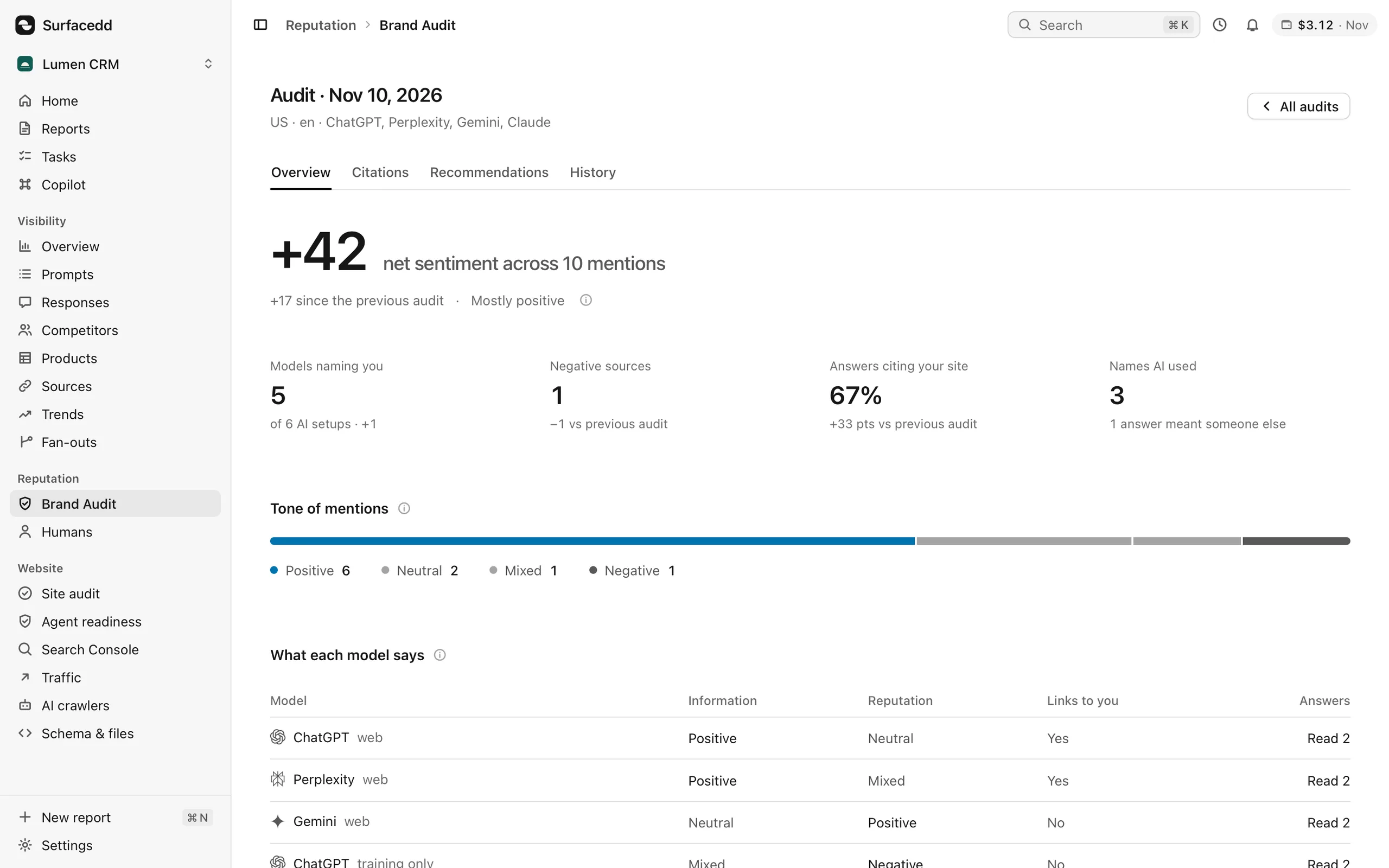
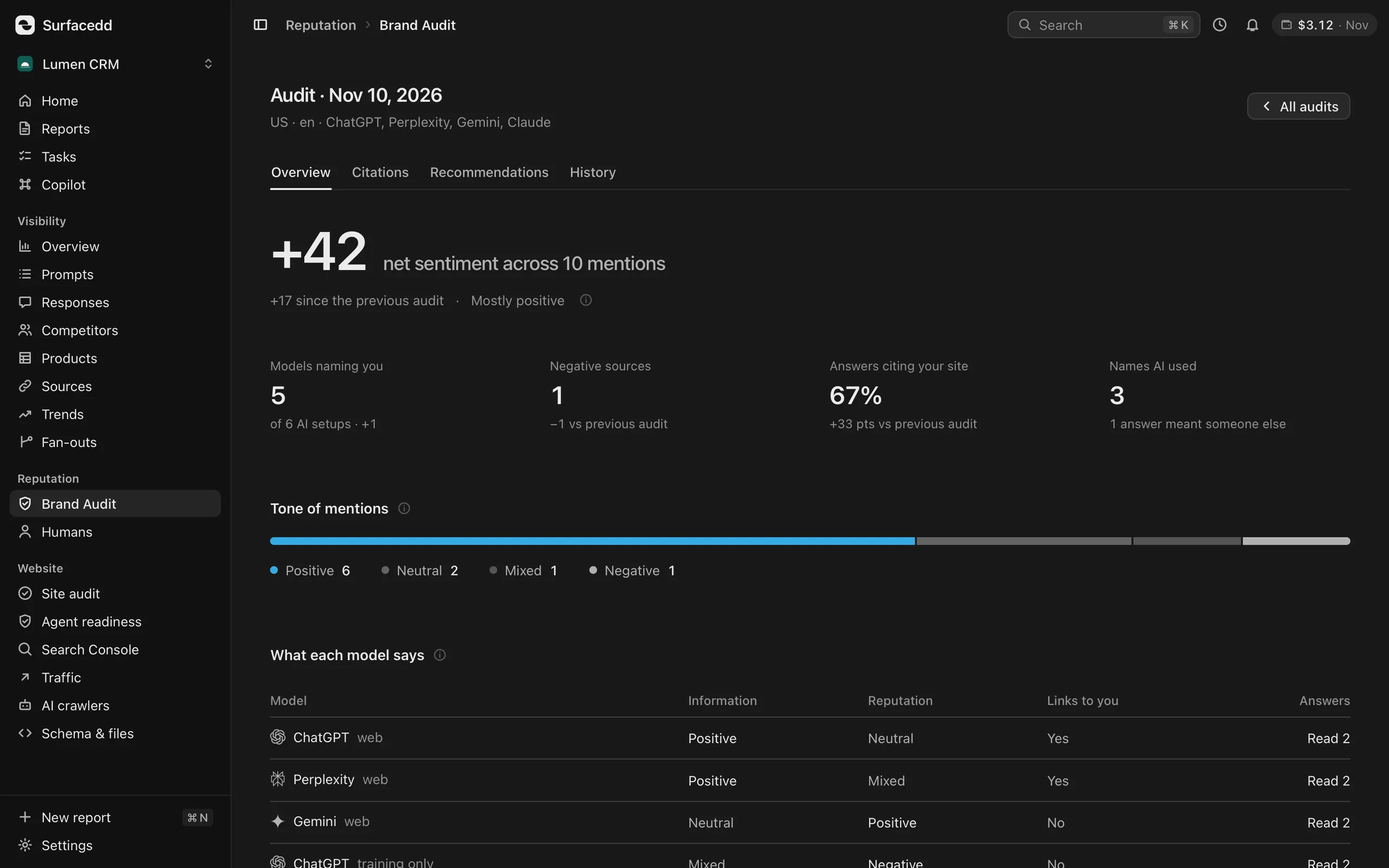
An audit costs about eight cents in API fees, paid to the providers with your own keys, plus about a fifth of a cent per cited page analysed. Two audits can be compared side by side to see what changed. See what Brand Audit checks, or the pricing page for the one-time licence.
Sources
- Lewis et al., Retrieval-Augmented Generation for Knowledge-Intensive NLP Tasks (NeurIPS 2020)
- Brown et al., Language Models are Few-Shot Learners (2020), Table 2.2
- Aggarwal et al., GEO: Generative Engine Optimization (KDD 2024)
- Puerto et al., C-SEO Bench: Does Conversational SEO Work? (NeurIPS 2025)
- OpenAI: Overview of OpenAI crawlers
- Anthropic: Does Anthropic crawl data from the web?
- Common Crawl: CCBot
- Google Search Central: Optimizing your website for generative AI features
- Vercel: The rise of the AI crawler (17 December 2024)
- Ahrefs: AI assistants prefer to cite fresher content (28 July 2025)
Fair questions
What is LLM SEO?
LLM SEO is the work of improving how large language models mention, describe and cite your brand. It has two parts: making your pages easy for an assistant's search tool to retrieve and quote, and making accurate facts about you common across the web so future training data picks them up. The first shows results in days or weeks; the second takes months and can only be measured indirectly.
Is LLM SEO different from GEO?
Mostly in emphasis. GEO focuses on AI search engines and their answer pages. LLM SEO focuses on the model, including answers it gives from memory with no search. The practical work overlaps: crawler access, crawlable facts, answer-first pages and off-site mentions. The extra step in LLM SEO is testing memory-only answers separately from web-on answers.
Can I get my website into ChatGPT's training data?
You can allow OpenAI's training crawler, GPTBot, in robots.txt, which makes your pages eligible for collection. You can't submit pages, see whether they were used, or know when a new model will include them. Being mentioned accurately on many independent sites is the indirect lever. For current answers, allowing OAI-SearchBot and ChatGPT-User matters more, because those serve ChatGPT search.
Does blocking GPTBot hurt my AI visibility?
Not in ChatGPT search. OpenAI documents GPTBot as its training crawler and OAI-SearchBot as the one that surfaces sites in ChatGPT search, and they're controlled separately in robots.txt. Blocking GPTBot means future OpenAI models won't learn from your pages, which may reduce how well memory-only answers know you. Many publishers accept that trade-off; many software companies don't.
How long does LLM SEO take to work?
Retrieval changes can show within days to a few weeks: unblocking a search crawler, getting a page indexed or earning a mention on a page engines already cite. Training-data changes show only when a new model version ships, which can be many months after the pages were crawled. Measure over about four weekly runs to tell a real change from normal run-to-run variation.
Why does ChatGPT give an outdated fact about my company?
Usually one of two reasons. With search off, the model answers from training data frozen before your change. With search on, it may be citing an old article that still states the outdated fact. Ask the same question with search on and off, several times each. If web-on answers cite a specific page, update or request a correction to that page.
Do I need special markup or an llms.txt file for LLMs?
No. Google says you don't need special AI files, markup or Markdown for its AI features, and that structured data isn't required for generative AI search. Structured data still helps search engines understand entities and earn rich results, and llms.txt can help coding agents read developer docs. Neither is a shortcut into what models say.
How we research, write and correct pages: read our editorial policy.