See whether your work moved Google rankings, and where AI is the easier win
Keyword research, weekly rank checks with the AI Overview flag, the live results page and competitor keyword gaps, next to your AI prompts so you can see which channel a topic is easier to win in.
By the Surfacedd teamUpdated 6 min readMarkdown
On this page
Short answer
Surfacedd's Google tools research keywords, track positions per keyword and device as the median of three reads, flag queries where Google's AI Overview answers and cites you, show the live results page, and list keywords a competitor wins that you don't. A weekly check of 50 keywords costs about $0.98 a month on your DataForSEO key.
Most rank trackers answer one question: where does the site sit for a keyword. Surfacedd answers three that matter more to a client report. Did last month's work move the rankings, or was that one odd results page? Does Google now answer the query with an AI Overview, and does it cite you? And is this topic easier to win on Google or in AI answers?
What you can decide with it
| Question | Where the answer comes from | Decision |
|---|---|---|
| Which pages are one push from page one? | Almost page one and Seen, not clicked in Keywords › Opportunities, from your own Search Console | What to rewrite this week |
| Which topics are worth a page? | Keyword research with volume, difficulty, CPC and intent | Which topics to write, and which are too hard for this site |
| Is AI the easier win? | Prompts and keywords: Google difficulty next to an open AI difficulty score | Where the client's budget pays back first |
| Did the work move rankings? | Rank tracking: weekly positions, movers and per-read history | What to report, and what to try next |
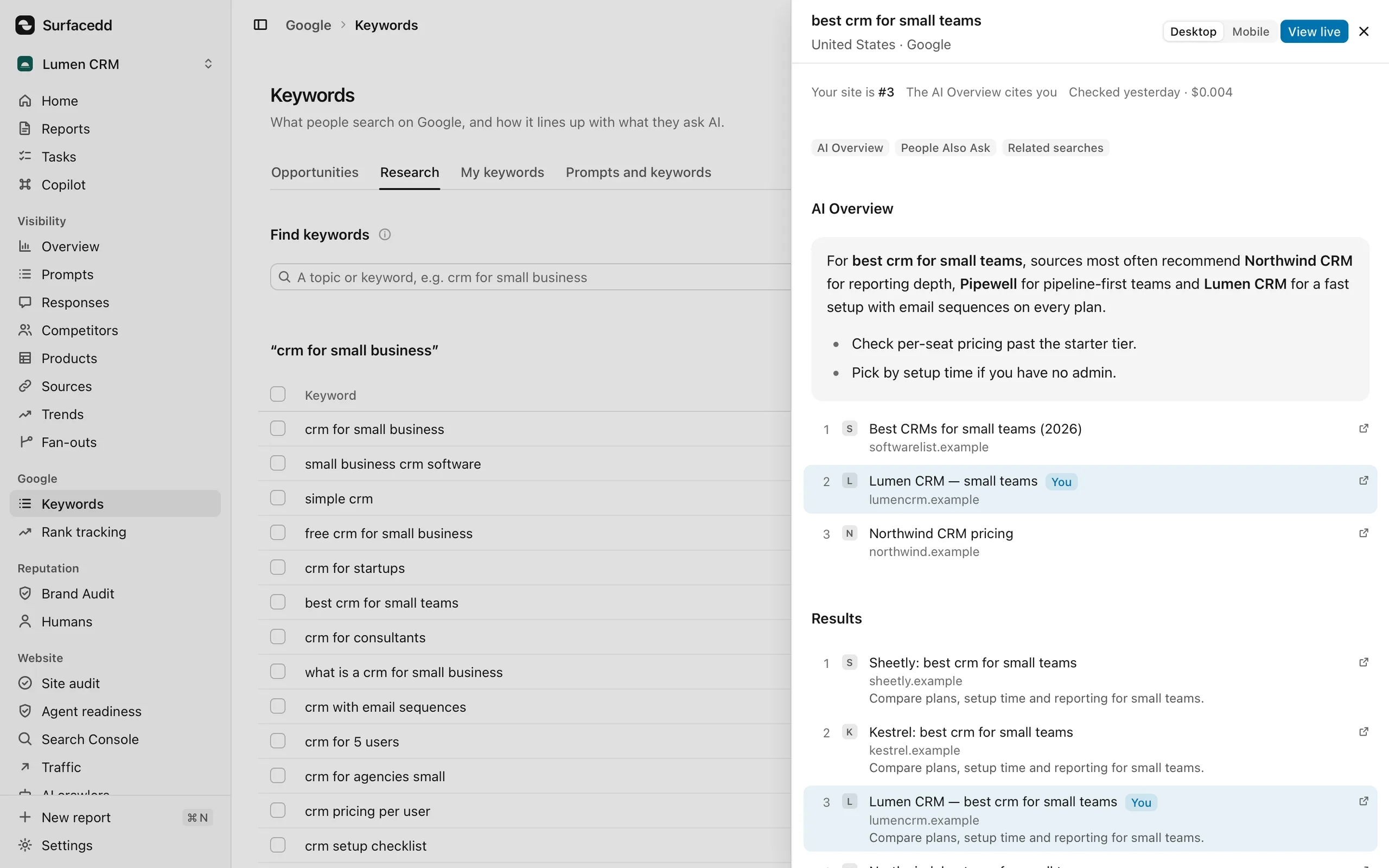
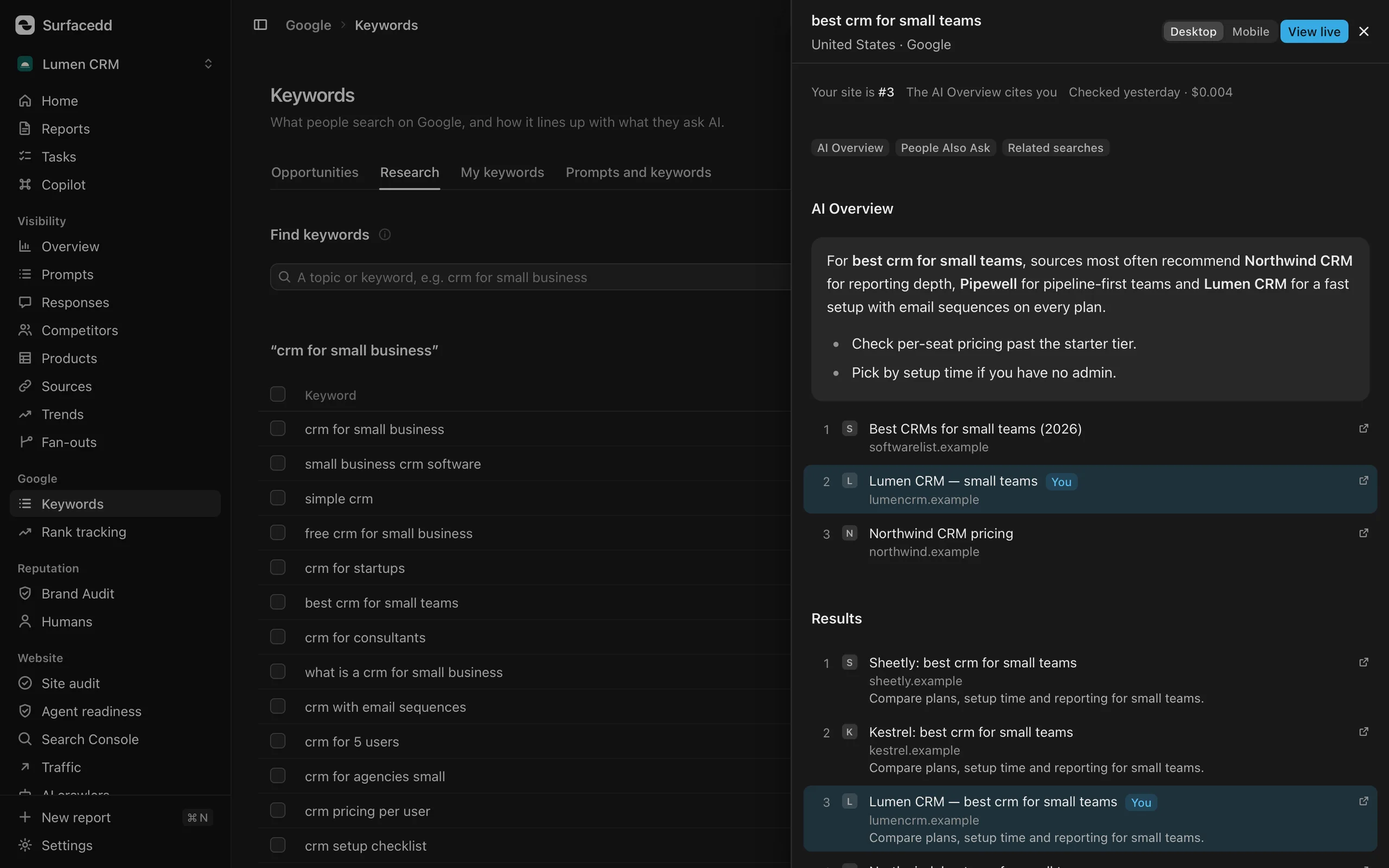
| What must a page answer? | View SERP: the AI Overview, its sources and People Also Ask | The outline of the page |
| What does a competitor win that we don't? | Competitors › Google tab and the keyword gap | The content plan |
How positions stay honest
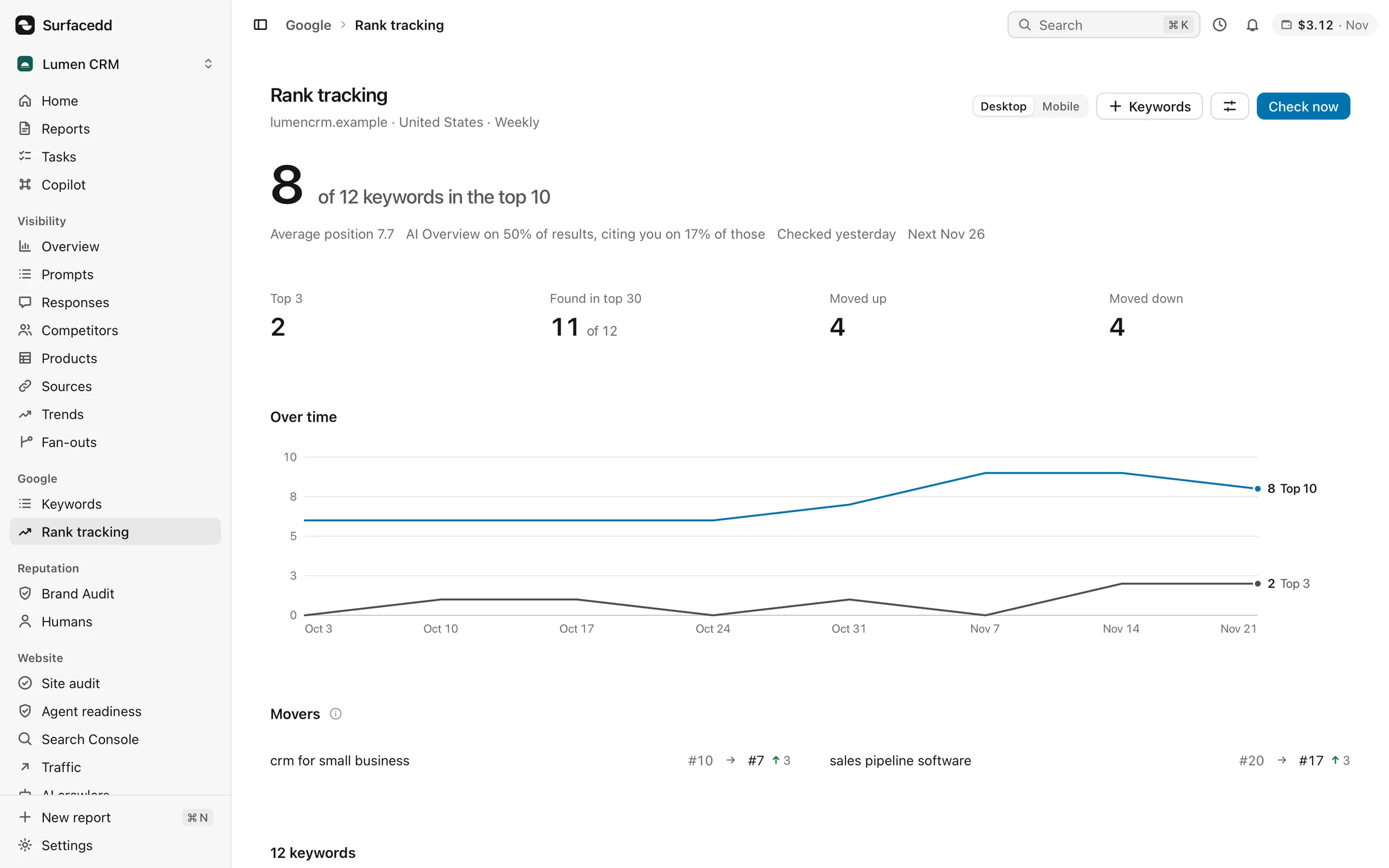
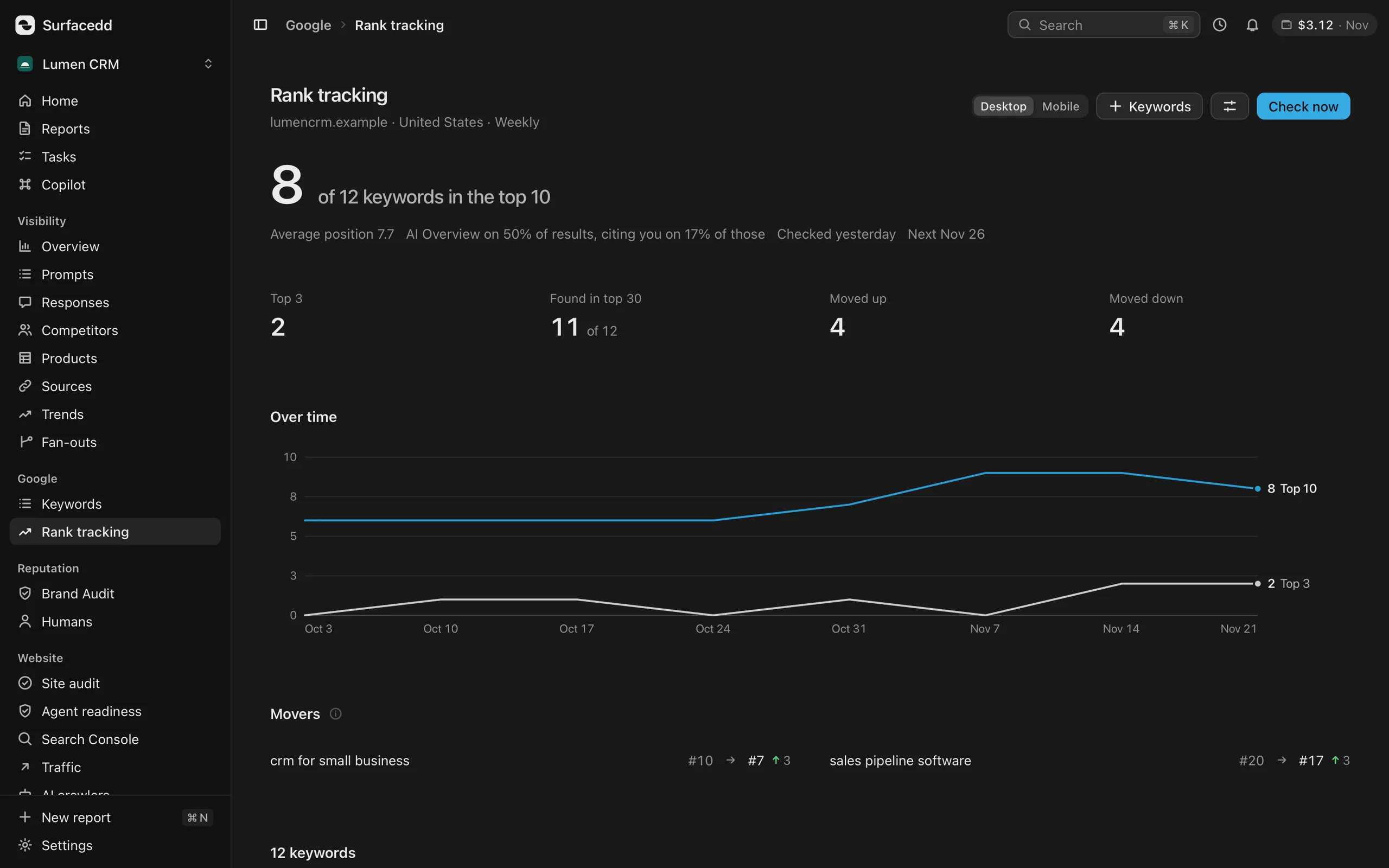
Google's results can differ from one request to the next. A tracker that reads once can show a client a drop that never happened. Surfacedd reads each keyword three times per check and keeps the median. When the reads disagree (the site is found in some and not others, or positions spread by more than two places), it takes three more and uses the median of six. The history drawer shows every read, so when a client asks why a number moved, you can show them.
Each check also records whether an AI Overview appeared above the results and whether it cited your site. A keyword can hold position 3 and still lose clicks when an Overview answers the question first. Seeing both on one row tells you whether to work on the page's ranking or on getting cited in the Overview. To follow Overviews across many prompts and markets, use AI Overviews tracking.
Find the topics where AI is the easier win
Prompts and keywords maps each saved keyword to the AI prompts it matches, then puts two scores side by side: Google's keyword difficulty, and an AI difficulty score worked out from your own answers. AI difficulty weighs how far the most-named brand is ahead of you on that prompt (half the score), how many competitors each answer names (30%) and how often answers fail to cite your site (20%). Every input is one click away in the app.
When AI difficulty is at least 15 points below Google's, the row says Easier in AI. That's a topic where a well-cited page might earn mentions in ChatGPT or Perplexity answers before it could reach Google's first page. When the reverse holds, the row says Easier on Google. Use it to split a budget, not as a forecast: both scores describe the competition today, not your odds.
Find the keywords a competitor wins
The Google tab on the Competitors screen fetches each rival's footprint: domain overview, top 50 keywords and top 10 pages, kept for 7 days. Find gap lists the keywords where a competitor ranks in Google's top 20 and you don't rank at all. For an agency onboarding a client, those 20 to 100 rows are the first content plan, and each one can be saved and tracked in a click.
What it costs
Every call runs on your own DataForSEO key at its list price, with the estimate shown first and the confirmed amount enforced as a cap.
| Action | Cost |
|---|---|
| Research one seed (150 keywords) | about $0.03, free again for 24 hours |
| Rank check, top 30, one keyword × device | $0.0045 (at most $0.009 when reads disagree) |
| 50 keywords, desktop, weekly | about $0.98 a month |
| View SERP | $0.004, free again for 24 hours |
| Competitor footprint | about $0.043 per site, kept 7 days |
| Keyword gap, 100 rows | about $0.024 |
| Search Console tiles, AI difficulty, history | free |
There's no plan limit on how many keywords you track or how often: you pay for the checks you run. The full list is on what Google, local and speed checks cost, and the app itself is a one-off purchase, see pricing.
In the app
Open Google › Keywords for research and the prompt mapping, and Google › Rank tracking for the tracker: a headline of keywords in the top 10 and top 3, a trend, movers, the table and a history drawer per keyword. View the results page opens from any keyword. The setup steps are in the rank tracking docs and the keywords docs.
The same data is available to assistants and scripts: surfacedd ranks and surfacedd keywords on the command line, and read-only MCP tools such as rank_summary and rank_history.
What it doesn't do
Sources
Fair questions
Why three reads per keyword instead of one?
Google's results page can differ between two requests made minutes apart. One read can show a drop that isn't real, and that drop ends up in a client report. Taking the median of three reads, and six when they disagree, keeps one odd page from moving the number. Each read stays visible in the history drawer.
How much does it cost to track 50 keywords?
At top 30 on desktop, weekly, about $0.98 a month on your own DataForSEO key, because each keyword costs $0.0045 per check and the app counts 4.35 checks a month. Disagreements between reads can raise a single keyword's check to $0.009. Tracking on mobile too doubles it. There's no subscription or keyword limit on top.
What is AI difficulty?
A 0–100 score per prompt, from your own AI answers. Half of it is how far the most-named brand is ahead of you, 30% is how many competitors the answers name, and 20% is how often the answers don't cite your site. The app shows the formula with that prompt's numbers, so you can check any score yourself. It needs a report run first.
Do I need Search Console?
Not for research, rank tracking, View SERP or competitor gaps; those use DataForSEO. You need Search Console for the free Opportunities tab (Almost page one, Seen, not clicked), which reads your own queries from the last 28 days. Connecting it is free and the data stays on your computer. See Search Console and GA4.
Can I see the AI Overview for a keyword?
Yes. View SERP opens the live Google page for that keyword, including the AI Overview with its sources, the organic results and People Also Ask. It costs $0.004 and is free to reopen for 24 hours. The tracker also flags, per check, whether an Overview appeared and whether it cited your site.
Does it work for clients in other countries?
Yes. Each tracker has a country and a device, and DataForSEO reads Google's results for that location. Research also takes a country. Use one tracker per market if a client sells in several, and check the cost estimate for each before it runs.
How we research, write and correct pages: read our editorial policy.