Write FAQs that AI answers quote, now that FAQ rich results are gone
The FAQ rich result is retired, but questions with direct answers are still the format assistants quote. Keep valid FAQPage markup where it mirrors a visible FAQ, and put the effort into the answers.
By the Surfacedd teamUpdated 8 min readMarkdown
On this page
Short answer
FAQ schema is FAQPage structured data that marks up questions and answers on a page. Google stopped showing FAQ rich results in Search from May 7, 2026, so the markup no longer earns a visual result. It's harmless and machine-readable, but answer engines quote the visible text, so well-written answers matter more than the markup.
What changed for FAQ rich results?
Google retired the FAQ rich result in two steps. In August 2023 it limited FAQ rich results to "well-known, authoritative government and health websites"; for everyone else, "this rich result will no longer be shown regularly". Then on May 8, 2026 Google's documentation changelog announced it was deprecating the feature, stating that it "will no longer appear in Google Search starting May 7, 2026". On June 15, 2026 Google removed the FAQ rich result documentation entirely, noting the feature "is no longer shown in Google Search results".
| Date | What Google changed | Source |
|---|---|---|
| 2023-08-08 | FAQ rich results shown only for well-known government and health sites | Search Central Blog |
| 2026-05-07 | FAQ rich results stop appearing in Google Search (announced in the changelog on 2026-05-08) | Search Central documentation updates |
| 2026-06-15 | FAQ rich result documentation removed | Search Central documentation updates |
It was part of a wider clean-up. Between 2025 and 2026 Google also removed documentation for course info, estimated salary, learning video, special announcement, vehicle listing and practice problem results. If a guide still promises an "FAQ dropdown in the results", it's out of date.
What didn't change: schema.org still defines FAQPage, Question and Answer, the markup is still valid JSON-LD, and Google's general guidance on structured data still applies. Only the Google Search display went away.
What does FAQ markup still do?
Three things, none of them dramatic.
- It describes the page accurately to any machine that reads JSON-LD. Google says it uses structured data "to understand the content of the page, as well as to gather information about the web and the world in general". Other search engines, browsers and agents can parse it too.
- It does no harm. When Google first restricted the result in 2023, it said "there's no need to proactively remove it" and "structured data that's not being used does not cause problems for Search".
- It keeps your Q&A content in a clean, parseable shape for tools that do read structured data, including site audits and validators.
What it doesn't do, on the current evidence, is get you cited by AI answers. Google's guide to its AI features says "structured data isn't required for generative AI search, and there's no special schema.org markup you need to add". Ahrefs tracked 1,885 pages that added JSON-LD, FAQ among the types, between August 2025 and March 2026, against matched controls. It found "no major uplift in citations on any platform": +2.4% on AI Mode and +2.2% on ChatGPT, both indistinguishable from zero, and −4.6% on AI Overviews. The same article reports a separate searchVIU test in which, during direct retrieval, "every system extracted only visible HTML content". JSON-LD was ignored at the moment the answer was being written.
So the markup is bookkeeping. The visible questions and answers are what an assistant reads and quotes.
When should you keep FAQ schema?
Keep it where it's cheap, accurate and mirrors a real, visible FAQ. Drop it where it was only ever there for the rich result. A quick decision table:
| Your situation | Keep FAQPage? | Why |
|---|---|---|
| A visible FAQ section, generated from the same source as the page text | Yes | No extra maintenance; the markup can't drift from the text |
| Hand-written JSON-LD that has drifted from the visible answers | Fix or remove | Mismatched markup describes a page that doesn't exist |
| FAQ markup on questions that aren't visible on the page | Remove | Google's policies say "don't mark up content that is not visible to readers of the page" |
| A forum or support page where users answer one question | Use QAPage instead | Google reserves QAPage for "a single question and its answers" from users |
| Every page given a FAQ only to get the dropdown | Remove the padding | The result is gone; thin, repeated FAQs add nothing for readers |
Don't confuse the two Q&A types. Google's QAPage documentation says not to use QAPage for "an FAQ page written by the site itself with no way for users to submit alternative answers" or for pages with multiple questions. A site-written FAQ is FAQPage. A thread where users answer one question is QAPage.
How do you write FAQs that answer engines quote?
Write each answer so it stands on its own when it's lifted out of the page. Answer engines retrieve passages, not pages, and Microsoft's advice on AI search answers makes the same point: "Direct questions with clear answers mirror the way people search", and "assistants can often lift these pairs word for word into AI-generated responses".
The rules we follow on this site's own FAQs:
- Use the question people actually ask, in their words. "How much does it cost per answer?" beats "Pricing considerations".
- Answer in the first sentence. Yes, no, a number or a name, then the reason.
- Name the subject. "Surfacedd stores data on your computer" survives being quoted; "It stores data locally" doesn't.
- Keep each answer between about 40 and 90 words. Long enough to be complete, short enough to quote.
- Include one checkable fact with a unit and, where it can change, a date.
- Don't repeat the page. An FAQ should cover the doubts the body doesn't, such as edge cases, objections and comparisons.
- Five to eight questions per page. Past that, readers stop and the answers start repeating each other.
A before-and-after rewrite
A typical FAQ answer written for the old rich result, and the same answer rewritten for quoting:
Before. Is our software secure? We take security very seriously and use industry-leading practices to keep your data safe at all times.
After. Where does Lumen CRM store customer data? Lumen CRM stores customer records in the EU (Frankfurt) on encrypted disks, and exports are available as CSV at any time from Settings › Data. Staff access requires two-factor sign-in and is logged. The current list of subprocessors is on the security page, updated 2026-11-01.
The "after" version names the product, answers the exact question, and includes facts an assistant can repeat and a reader can check. (Lumen CRM is a fictional brand.)
A FAQPage template
If your FAQ is visible on the page, this is all the markup it needs. Generate it from the same data as the visible FAQ, so the two can't drift apart:
<script type="application/ld+json">
{
  "@context": "https://schema.org",
  "@type": "FAQPage",
  "mainEntity": [
    {
      "@type": "Question",
      "name": "Where does Lumen CRM store customer data?",
      "acceptedAnswer": {
        "@type": "Answer",
        "text": "Lumen CRM stores customer records in the EU (Frankfurt) on encrypted disks. Exports are available as CSV at any time from Settings › Data."
      }
    }
  ]
}
</script>
Every Question needs a name and an acceptedAnswer; every Answer needs text. That's also what our validator checks. This site does it the same way: each guide's "Fair questions" section is rendered as a visible FAQ and emitted as FAQPage from the same Markdown, inside the page's single @graph.
To check a block before you ship it, paste it into the free schema generator and validator. For the bigger picture on which types matter for AI search, read structured data for AI search.
Check your FAQ markup with Surfacedd
Surfacedd's site audit crawls up to 500 pages on your computer and flags invalid-jsonld when a JSON-LD block doesn't parse or misses required schema.org properties, including FAQPage blocks whose questions lack an answer. It also flags key pages with no structured data at all, and snippet controls such as nosnippet that limit what Google can quote in AI Overviews and AI Mode. Each issue is tracked across audits as new, worse, still failing or resolved. The crawl is free and runs locally.
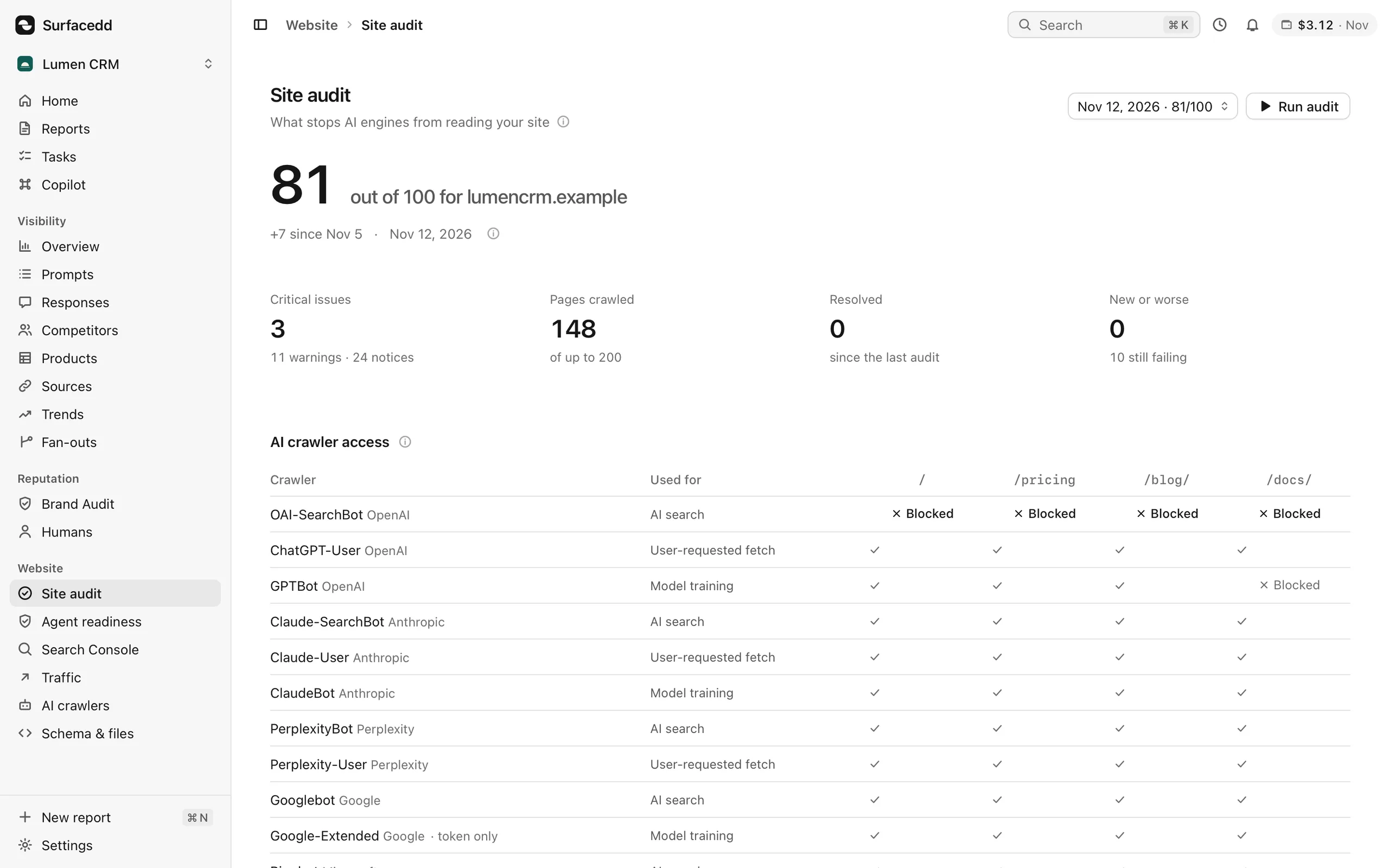
Markup tells you nothing about whether assistants quote you. For that, track the prompts your FAQs answer and see whether the answers name and cite you, which is what the AI visibility audit and the rest of Surfacedd are for. Pricing is a one-time licence plus the API fees you pay providers directly.
Sources
- Google Search Central Blog: Changes to HowTo and FAQ rich results, August 8, 2023
- Google Search Central: Latest documentation updates (May 8 and June 15, 2026 entries)
- Google Search Central: Introduction to structured data
- Google Search Central: General structured data guidelines
- Google Search Central: Optimizing your website for generative AI features
- Google Search Central: Q&A (QAPage) structured data
- Ahrefs: We tracked 1,885 pages adding schema. AI citations barely moved, May 11, 2026
- Microsoft Advertising: Optimizing your content for inclusion in AI search answers, October 8, 2025
Fair questions
Is FAQ schema still worth adding in 2026?
Only where you already have a visible FAQ and can generate the markup from the same source. Google stopped showing FAQ rich results from May 7, 2026, and a 2026 Ahrefs study found no meaningful citation lift from adding JSON-LD. The markup is harmless and accurate when generated, so keeping it costs little. Writing new FAQ markup only to win a result that no longer exists is wasted effort.
Should I remove FAQ schema from my site?
You don't need to. Google said in 2023 that structured data that isn't being used "does not cause problems for Search". Remove it only where it's wrong: questions that aren't visible on the page, answers that have drifted from the text, or FAQs added purely to fill space. Accurate markup that mirrors a real FAQ can stay.
Does FAQ schema help you get into AI Overviews?
There's no evidence it does. Google's AI features guide says no special schema.org markup is needed for its generative AI features. In Ahrefs' 2026 study of 1,885 pages that added JSON-LD, AI Overviews citations fell slightly against controls rather than rising. What gets quoted is the visible text, so write answers that stand on their own.
What's the difference between FAQPage and QAPage?
FAQPage is for a page where the site itself writes several questions and their answers. QAPage is for a page focused on one question where users can submit answers, such as a forum thread or a community support page. Google's documentation says not to use QAPage for site-written FAQs or for pages with several questions. Pick the type that matches what the page really is.
How long should an FAQ answer be?
Long enough to answer completely on its own, and short enough to quote: about 40 to 90 words is a good working range. Put the answer in the first sentence, name the product or subject instead of saying "it", and include one checkable fact with a unit or a date. Answers that need more than that usually belong in the body of the page.
Does Surfacedd generate FAQ answers for me?
No. Surfacedd doesn't write page copy. The site audit checks that your FAQPage and other JSON-LD blocks parse and carry the required properties, and the validator shows exactly which property is missing. Visibility tracking then shows whether answers to the questions your FAQs cover actually name and cite you.
How we research, write and correct pages: read our editorial policy.