Get named when someone asks AI for an expert
Humans asks the discovery questions clients and hosts ask, such as "Who should I follow to learn about {topic}?", records whether and where you're named, and shows the pages behind every list.
By the Surfacedd teamUpdated 7 min readMarkdown
On this page
Short answer
Consultants, authors and speakers win work when an assistant names them for a topic nobody tied to their name. Humans measures that: how often ChatGPT, Claude, Perplexity and Meta AI name you on expert, follow and podcast-guest questions, your position in each list with a 95% range, and which cited pages decided who got listed.
Why discovery is the number that pays
When a prospective client already has your name, they'll find you. The work you don't know you lost comes from questions without a name in them: "Who are the leading experts on pricing strategy?", "Who should I follow to learn about B2B onboarding?", "Good podcast guests on supply chain risk". An assistant answers with a short list, and the people on it get the call.
Humans calls this discovery and treats it as the key measure for a person: the share of discovery answers that name you, and your position when you're named. Recognition ("Who is {name}?") still matters, but it only checks what happens after someone has already found you.
Between roles rather than selling services? The pre-interview AI check is the shorter version for job seekers. And if you're an SEO consultant tracking client brands rather than yourself, see AI visibility for SEO consultants.
The expert prompt set
Discovery and expertise templates make up eight of the 22. Fill {topic} with the three to five topics you want to be known for, in the words a client would use, not your internal jargon.
| Group | Prompt | What it measures |
|---|---|---|
| Discovery | Who are the leading experts on {topic}? | Named or not, and position in the list |
| Discovery | Who should I follow to learn about {topic}? | Same, for people who publish and post |
| Discovery | Good podcast guests on {topic} | Whether hosts researching guests would find you |
| Discovery | Best {role} in {city} | Local discovery for consultants who sell in one city |
| Discovery | Top {industry} founders to watch | For consultants who also run a company |
| Expertise | Is {name} an expert on {topic}? | Topic association when your name is given |
| Expertise | What has {name} said about {topic}? | Whether your published views are found and quoted correctly |
| Expertise | Is {name} a credible source on {topic}? | Credibility, with the sources cited for it |
Each topic multiplies the discovery prompts, so three topics give you three versions of each topic question. Download the set with a column for what a good answer looks like: b2-expert-discovery-prompts.csv.
Measuring list position with ranges
List questions are noisy. Ask the same question twice and the list can change order or swap a name. So one answer that names you third is an anecdote; what you want is a rate across answers, with a range that says how sure it is.
A worked example: suppose you're named in 4 of 12 discovery answers (4 questions × 3 engines). That's 33%, but the 95% Wilson range is roughly 14% to 61%. Run three samples per question and get 12 of 36, still 33%, and the range narrows to roughly 20% to 50%. The Wilson score interval entry shows the formula.
Humans reports discovery rate and average list position with those ranges, and marks a change between runs as significant only when the ranges say it is. Anything else shows as "no clear change", which is the honest answer most weeks.
An example result
The sample workspace's profile is Maria Chen, a fictional founder who speaks on sales for small teams. Her overview shows the pattern most experts start with: well described when named, rarely named when not.
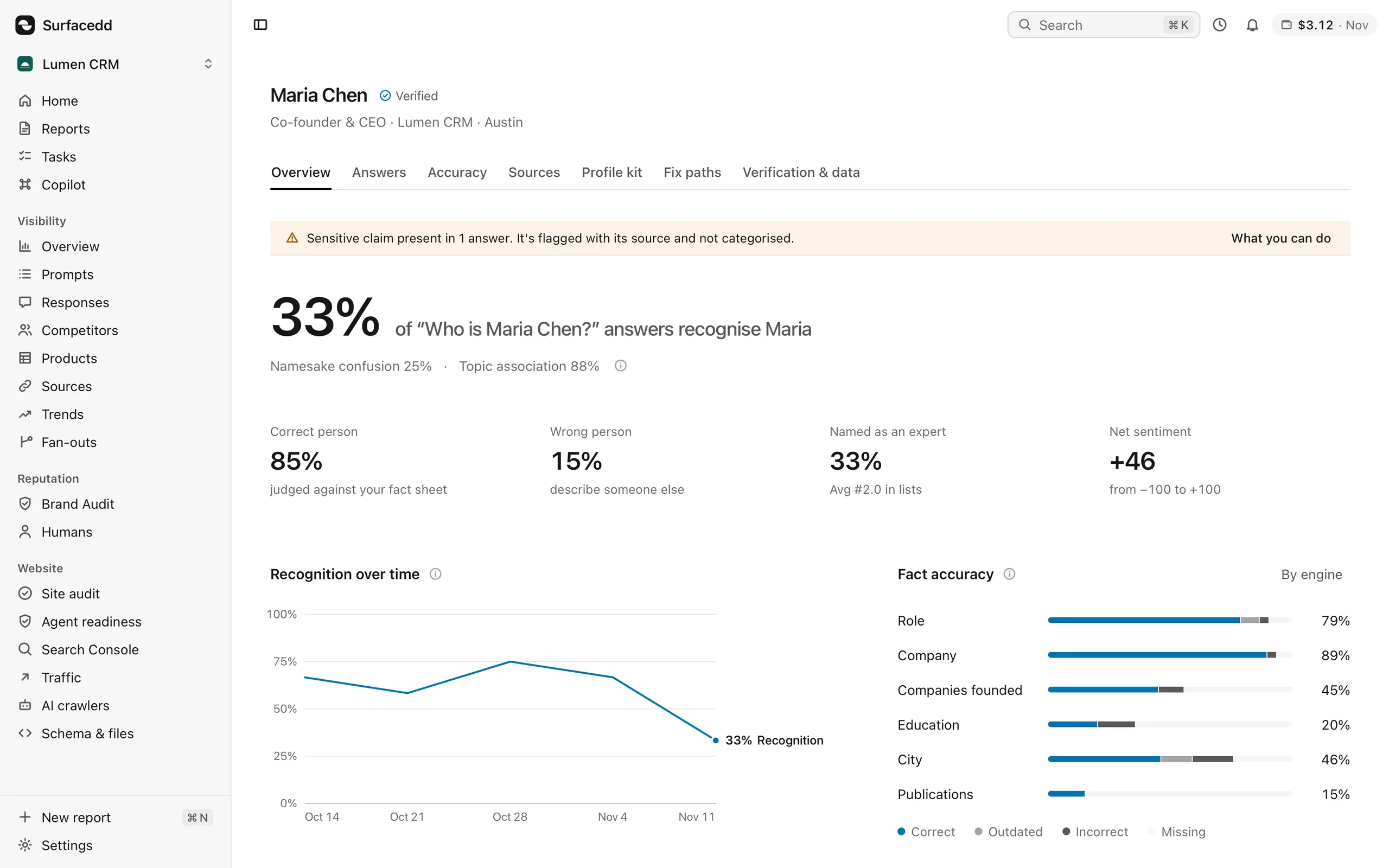
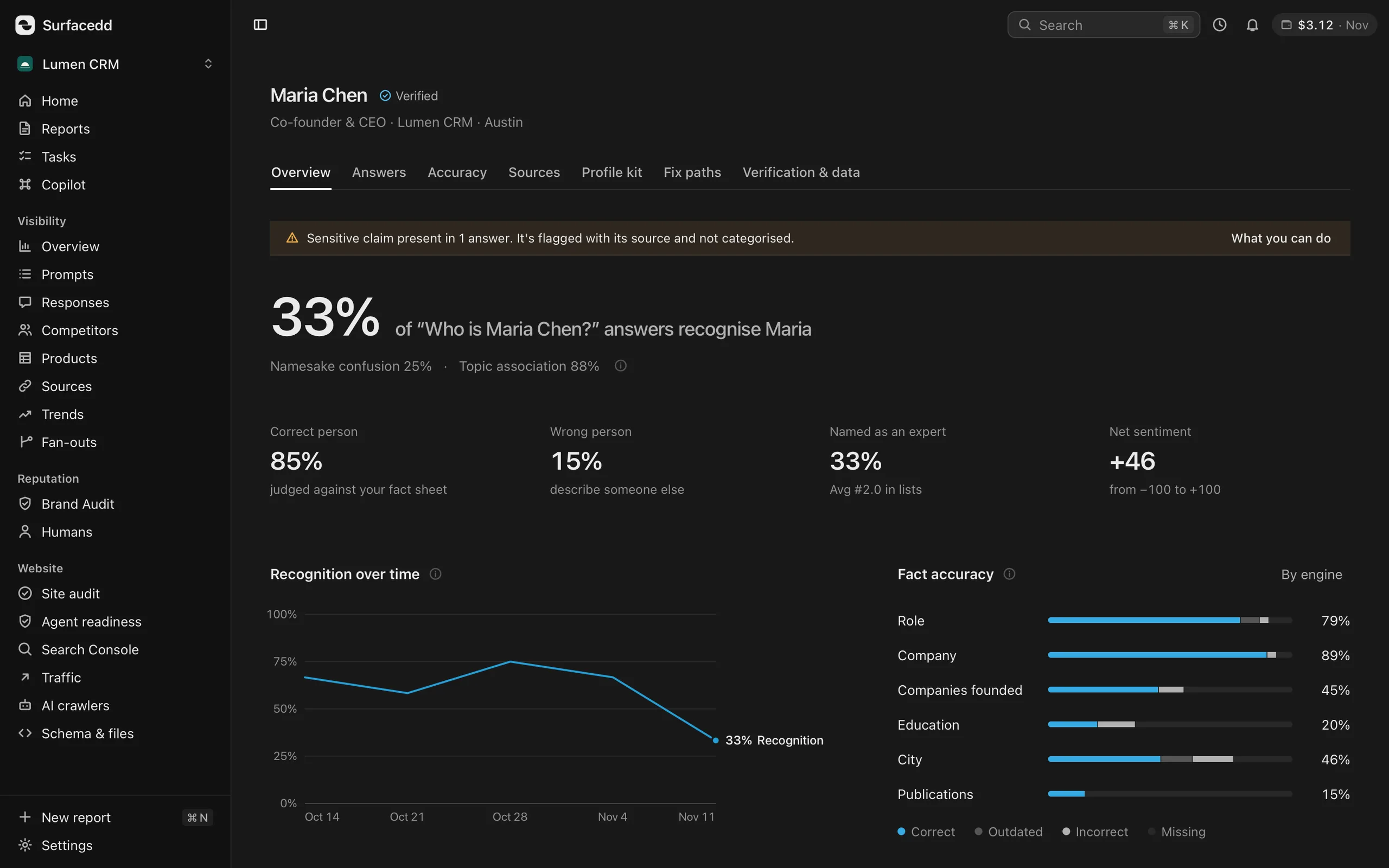
- Topic association is strong at 88%. When an answer is about Maria, it connects her to her topics.
- Discovery is 33%, average position 2.0. In a third of the expert answers she's named, and near the top when she is. In the other two thirds she isn't there at all.
- Recognition is a weak 33% on the bare name, partly because of a namesake. For discovery that matters less: lists name people by topic, not by bare name.
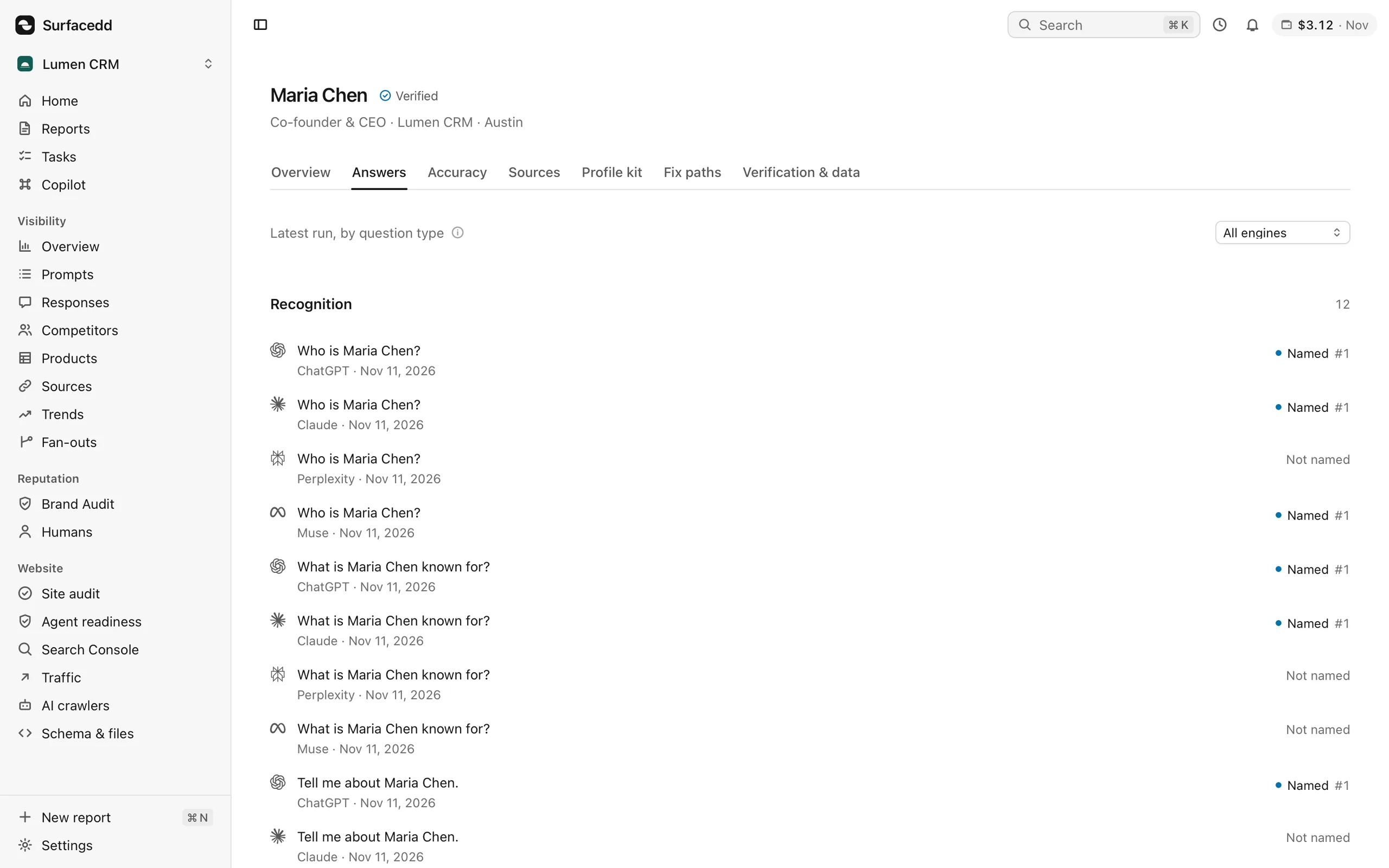
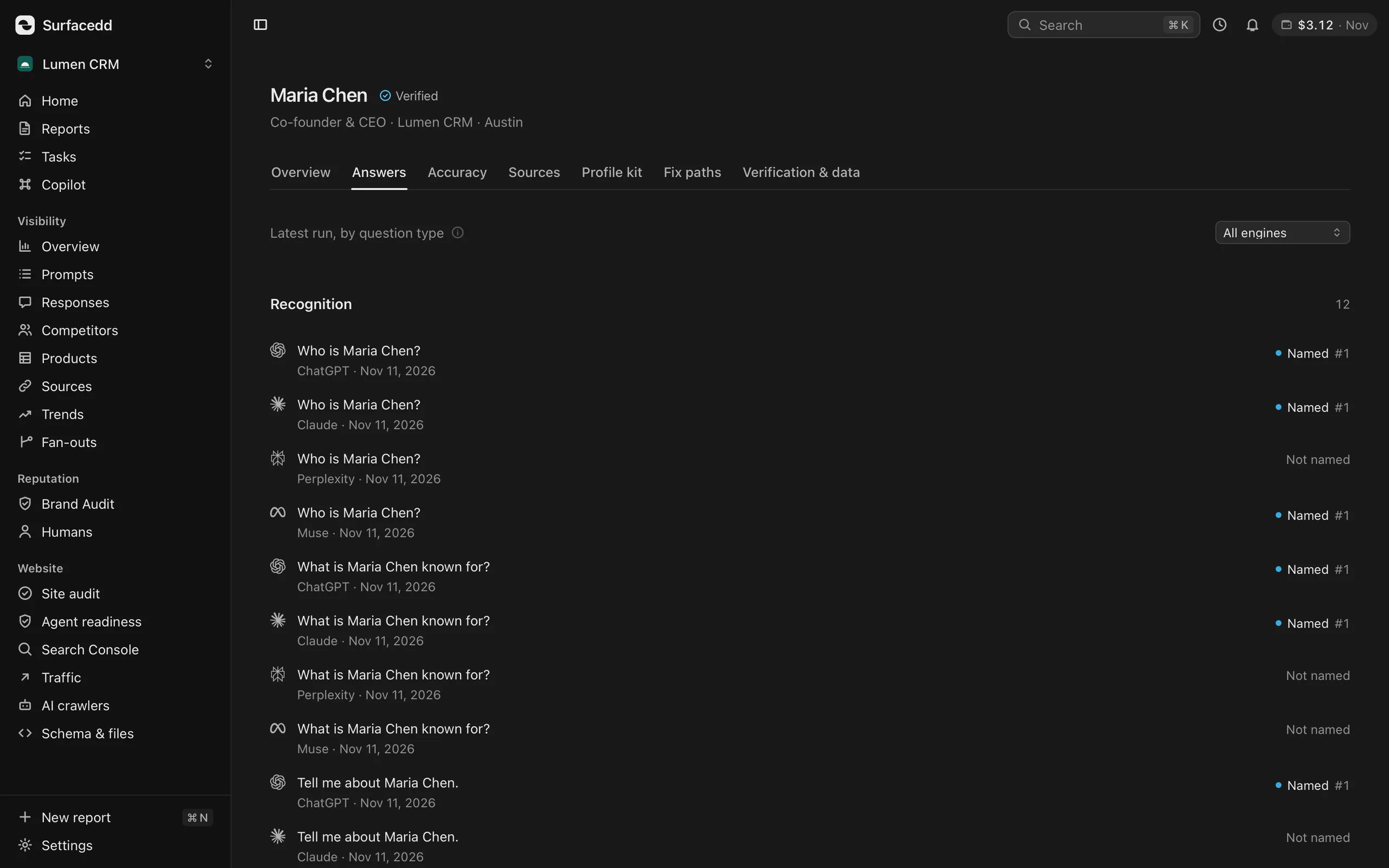
The gap between 88% and 33% is the useful part. It says the engines know what she's an expert in, but the pages they read to build expert lists don't include her.
Which sources decide expert lists?
Every answer stores the pages it cited. For discovery questions, those pages are the shortlist you need to be on. In practice they tend to fall into a few kinds:
| Source kind | Why engines cite it for expert lists | What you can do |
|---|---|---|
| "Top experts" listicles and roundups | They answer the question in the same shape | Pitch the author with something new to say, not a request to be added |
| Podcast and interview pages | Show notes name the guest and the topic together | Appear on shows in your field; ask hosts to use your full name and link your profile |
| Conference speaker pages | Name, topic and bio on one page | Keep the bio current and identical to your canonical sentence |
| Your own long-form writing | Signals you've said something on the topic | Publish under one name format with an author page |
| LinkedIn posts and articles | LinkedIn was the most cited domain for professional queries in Profound's study of 1.4 million citations, with posts and articles a growing share | Post original, specific work in your topic, not reshares |
Every answer you open lists the pages it cited, and Humans' Sources tab groups the pages behind each wrong fact. If the same roundup appears in answers that name three of your peers but not you, that roundup is your first outreach target.
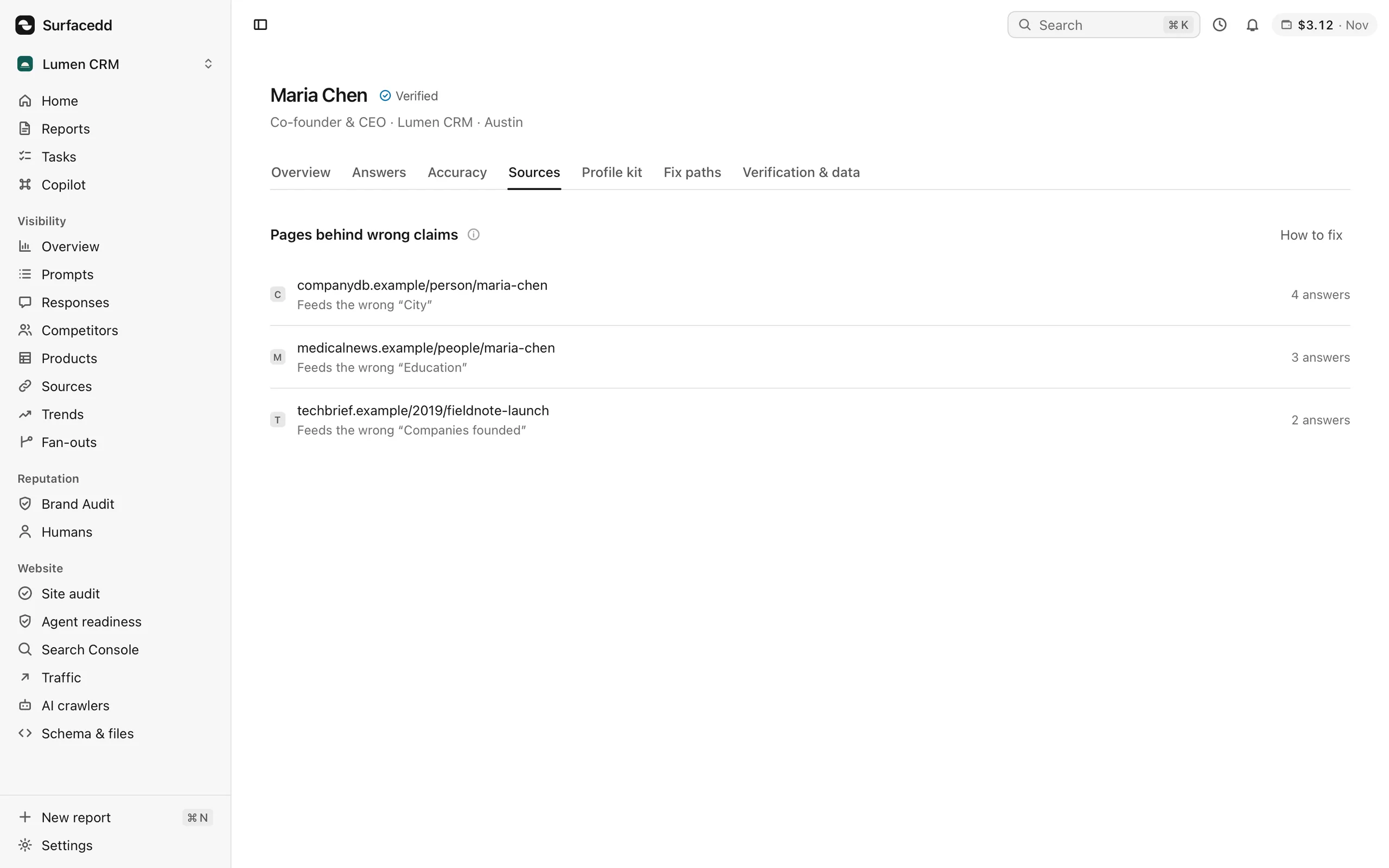
For brands, the same idea is a full feature: Competitors and sources lists cited pages that name a competitor and not you. The brand mentions guide covers how to earn mentions honestly, and the entity SEO guide explains how consistent names and links help engines connect you to a topic.
What to fix first
- Name your topics the way clients ask. If clients ask about "pricing for SaaS" and your site says "monetisation architecture", engines won't connect you.
- One canonical page that says it plainly. First sentence: name, what you do, the topics, the city if you sell locally. Add Person markup with
knowsAboutset to your topics; Humans' Profile kit generates it from your fact sheet. - Get onto the pages that build lists. Use the sources from your own discovery answers, not a generic list of "top sites".
- Re-run like for like. Same prompts, same engines, same samples, so a change in rate is a change in reality.
Verification and privacy
A profile is yours, verified by domain proof or by typing your name, or a client's with written authorization. Other experts named in the same lists are stored only as names in the answer text, for share-of-voice counts: Humans builds no profile of them and sends no alerts about them. Sensitive questions are blocked, answers stay on your computer, and one button deletes the profile and every answer. The acceptable use rules set out the self-only rule.
What it doesn't do
Sources
Fair questions
How do I get ChatGPT to list me as an expert?
No one can make it list you. What you can do is get onto the pages it cites when it builds expert lists for your topic, and make your own pages state your topics plainly. Humans shows which pages were cited in your discovery answers, and re-checks so you can see whether being on them changed your rate.
How many topics should I track?
Three to five. Fewer, and you miss how clients really phrase the question; more, and each topic gets too few answers to read a trend. Use the words a client would type, and keep them stable from run to run, because like-for-like comparisons only compare answers to the same wording.
Why does my position change every week?
Because list answers vary from one run to the next, even with the same question on the same model. That's why Humans reports a rate and average position with a 95% range, and marks a change only when it's larger than the noise. Adding samples per question narrows the range, at a proportional cost.
What does a discovery-focused run cost?
A full run of all 22 questions on ChatGPT, Claude, Perplexity and Meta AI costs $1.02 at today's list prices, paid to the providers on your own keys. Weekly, that's $4.43 a month. The app shows its estimate before each run.
Can I see which other experts get named instead of me?
You see their names in the answers and in share-of-voice counts, because they're part of the answer text. Humans doesn't create profiles for them, look them up, enrich their data or alert you about them. Comparing yourself with a named peer means reading the answers and the pages they cited, not monitoring that person.
Does this work for local consultants?
Yes. Fill in your city and role, and the "Best {role} in {city}" question measures local discovery. Answers to local questions depend on the location the engine applies, which varies by engine, so read them alongside the location label that Surfacedd adds to each answer.
How we research, write and correct pages: read our editorial policy.