See when ChatGPT recommends you, and which pages it read
Surfacedd asks ChatGPT's models your buyers' questions with web search on, then keeps the answer, the pages it cited, the pages it read but didn't cite, and the searches it ran.
By the Surfacedd teamUpdated 8 min readMarkdown
On this page
Short answer
A ChatGPT visibility tracker asks ChatGPT's models your prompts with web search switched on and records whether your brand is named, in what position and which pages are cited. Surfacedd does this through OpenAI's Responses API on your own key and also keeps the pages ChatGPT read but chose not to cite.
How ChatGPT is collected
- How Surfacedd asks
- OpenAI Responses API with the web_search tool. Stored responses are switched off (store: false).
- Key you need
- OpenAI API key
- Location
- Approximate: country, region, city and time zone are passed as the user's location.
- Searches it ran (fan-outs)
- Exposed. Every search query the model ran is saved with the answer.
- Citations
- Inline URL citations, ordered by where they appear in the text, plus the full list of sources consulted.
- Search fee
- $10.00 per 1,000 search calls, plus tokens
- Default model
- GPT-6 Luna. Mid and flagship models can be picked per report.
Worth knowing
- A 429 with insufficient_quota means the account needs billing; Surfacedd stops instead of retrying.
- Citations are shown inline and stay clickable, matching how ChatGPT displays them.
Cost per answer
$0.0109
estimated, paid to OpenAI on your account
- 100 answers
- $1.09
- 25 prompts × 3 samples, weekly, for a month
- $3.55
- Reading each answer (GPT-6 Luna)
- +$0.0015
From price table 2026-11-13.1, using typical token counts and one search per answer. The app recalibrates from your own answers and shows its estimate before each run. How costs are estimated
What does a ChatGPT visibility tracker measure?
It measures how often ChatGPT names your brand when people ask the questions that lead to a purchase, where you appear in the answer, and which web pages ChatGPT used to decide. One answer tells you little, because ChatGPT's answers change from run to run. The useful number is a rate over many answers: "named in 18 of 40 answers", with a range around it.
Surfacedd turns each answer into four facts you can act on:
| Fact | What it tells you | Where you see it |
|---|---|---|
| Named or not, and position | Whether ChatGPT recommended you and how early | Visibility, best rank, top-3 rate |
| Cited pages | The pages ChatGPT linked as its sources | Citation share, Sources |
| Read but not cited | Pages ChatGPT opened and then didn't credit | Answer drawer, "read but not cited" |
| Searches it ran | The queries ChatGPT sent to the web before answering | Fan-outs |
What ChatGPT users see vs what the API returns
ChatGPT in the app and ChatGPT through OpenAI's API are close relatives, not twins. In the app, a signed-in person gets answers shaped by their memory, custom instructions, chat history, the model OpenAI routes them to and the location ChatGPT infers from their IP address. Through the API, each question arrives fresh: no memory, no history, a model you pick and a location you pass.
That makes the API the right instrument for tracking, because every sample is asked the same way and two runs a month apart can be compared. It also means a tracker can't promise "this is exactly what your customer saw". Surfacedd labels every answer with the model OpenAI reports and the collection method, and the ChatGPT API vs ChatGPT app guide covers the differences and how to measure through them.
How ChatGPT searches before it answers
OpenAI's web search tool lets the model decide whether a question needs the web. When it does, the response contains web_search_call items. A search action carries the query the model ran, which OpenAI says it "will usually (but not always)" include. Reasoning models can also open a page or search inside one.
Surfacedd sends your prompt with the tool switched on and leaves the choice to the model, as ChatGPT does. Forcing a search on every prompt would measure something users never see. We ask for medium search context, the setting OpenAI describes as the balanced default, and switch stored responses off, so OpenAI doesn't keep a copy for later retrieval.
Cited vs read but not cited
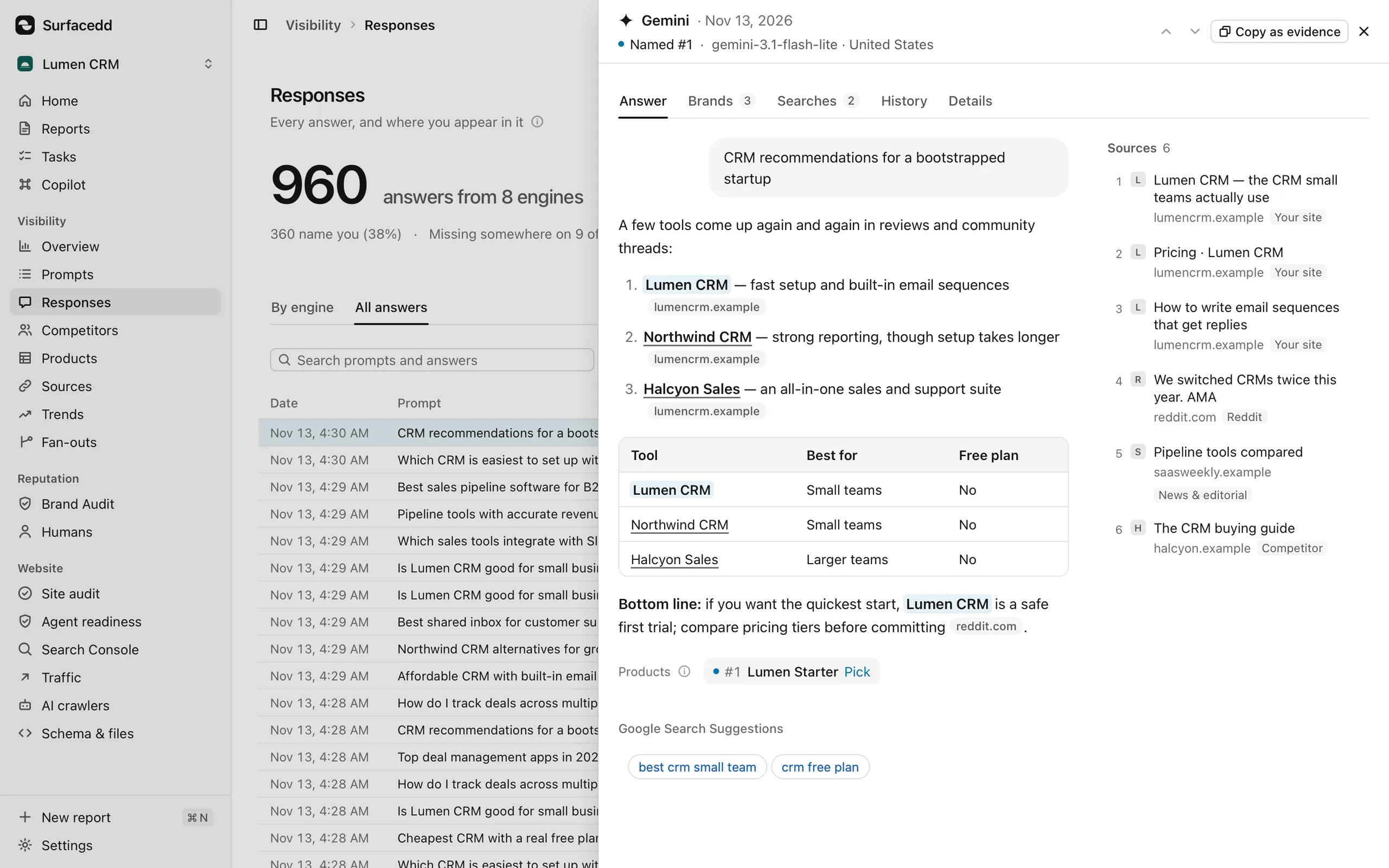
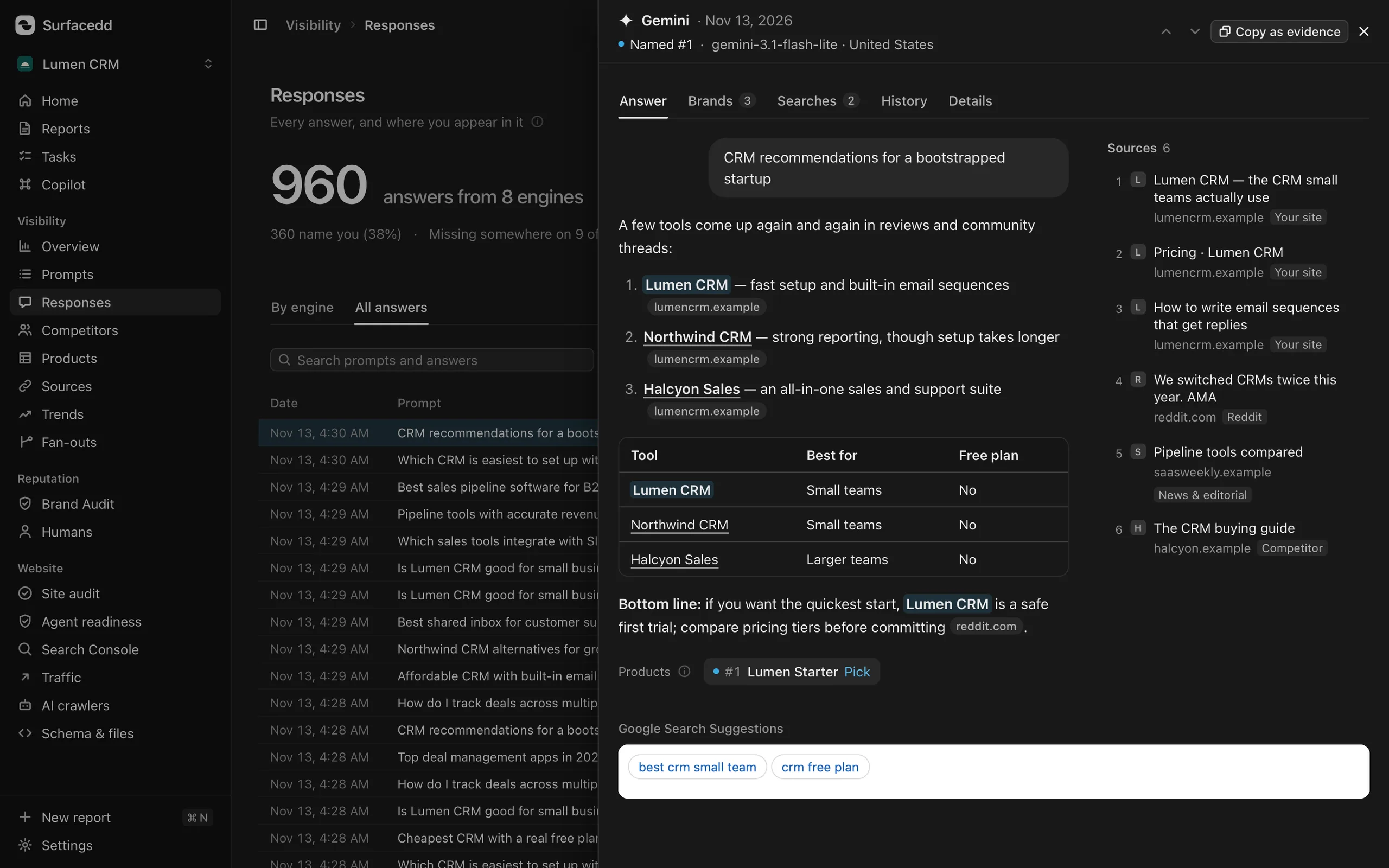
This is the most useful thing the API shows that the ChatGPT app hides. With include: ["web_search_call.action.sources"], OpenAI returns "the complete list of URLs the model consulted when forming its response", and notes that "the number of sources is often greater than the number of citations."
So for every answer Surfacedd stores two lists:
- Cited. The
url_citationannotations in the answer text, ordered by where they first appear. These are the links a ChatGPT user can click. - Read but not cited. Everything in the consulted list that never made it into a citation.
A page in the second list is close. ChatGPT found it, read it and still built the answer from someone else's page. That is usually a content problem (the page doesn't answer the question in a quotable passage) rather than a discovery problem, and it's a cheaper fix than earning a new mention elsewhere.
Fan-out queries: the searches behind the answer
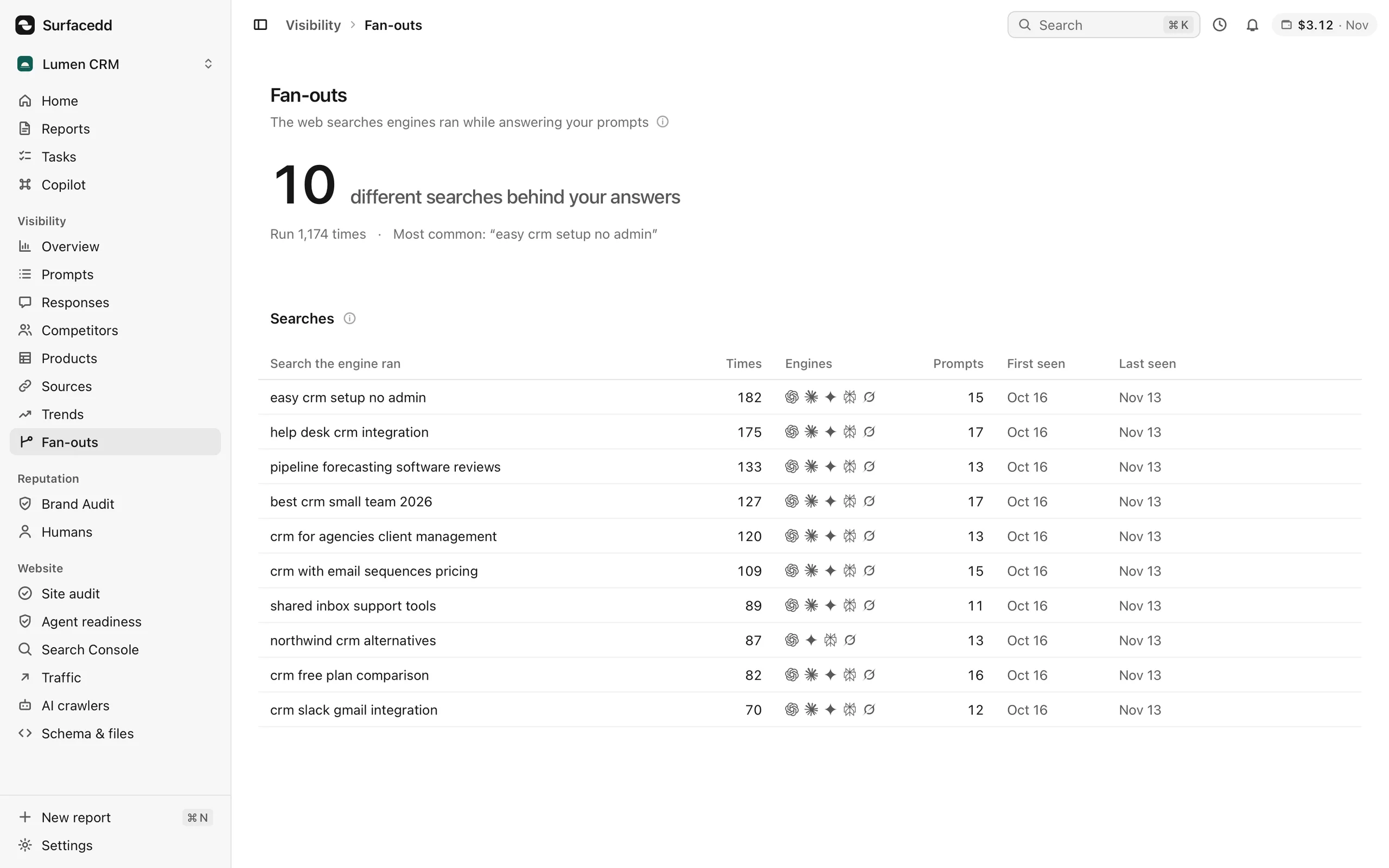
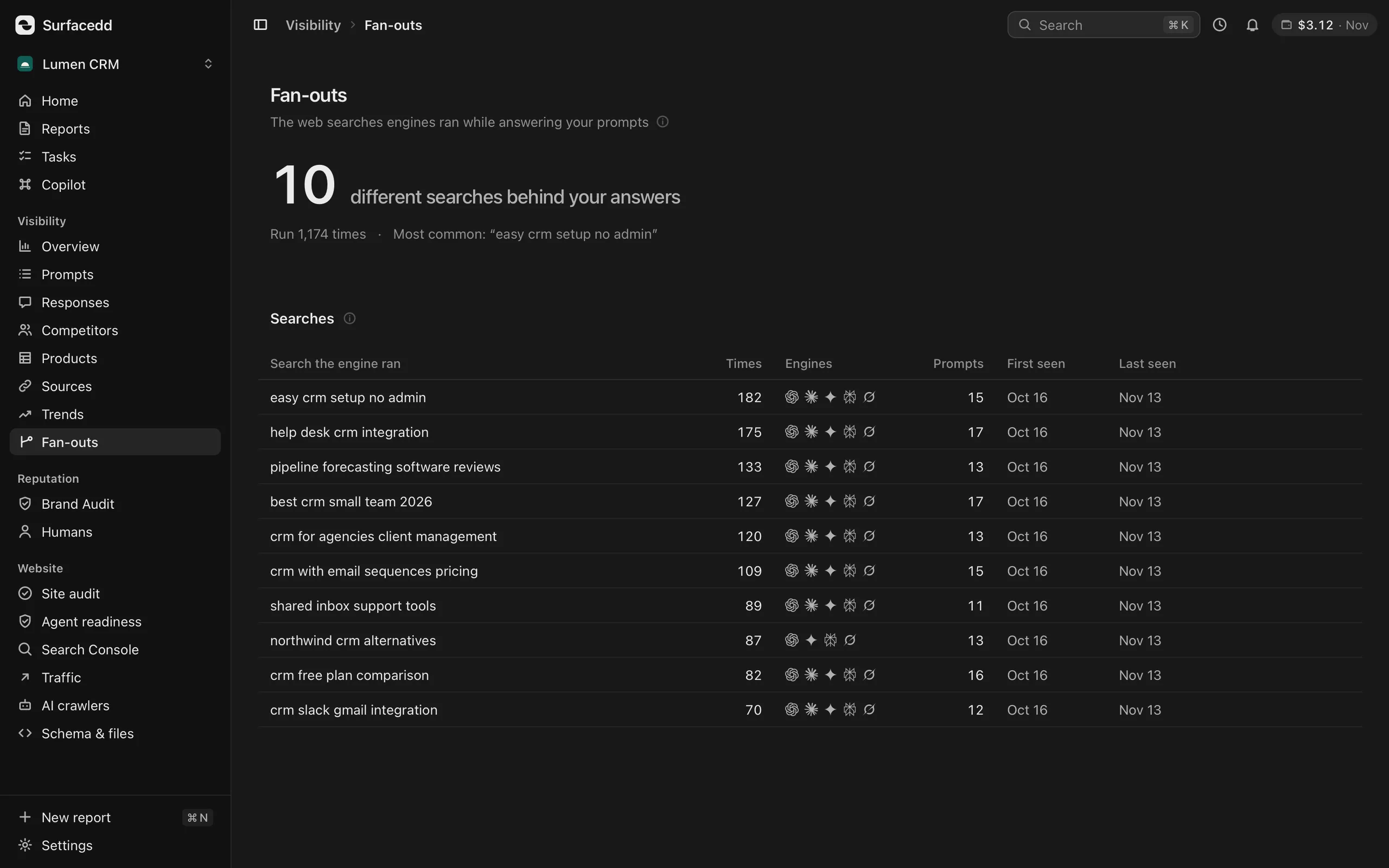
ChatGPT rarely searches for your prompt word for word. A question like "best CRM for a ten-person agency" may become several searches: one for CRM comparisons, one for agency workflows, one for pricing. Those sub-queries are query fan-out, and they explain why a page that ranks for the prompt itself can still lose.
Surfacedd saves every query from every search action with the answer. The Fan-outs screen counts how often each query appears, on which engines and for which prompts, and any of them can be turned into a tracked prompt with one click.
Model tiers and cost
Every model in the table runs the same web search tool; the price difference is in tokens. OpenAI charges per search call plus the search content the model reads, billed at that model's input rate, so the page text ChatGPT pulls in is most of the token bill. The table below is rendered from our price table, not typed, so it stays current when OpenAI changes prices.
| Model | Tier | Input per 1M tokens | Output per 1M tokens | Per 1,000 searches | Est. per answer |
|---|---|---|---|---|---|
| GPT-6 Luna (default) | cheap | $0.10 | $0.50 | $10.00 | $0.0109 |
| GPT-6.1 Terra | mid | $1.00 | $5.00 | $10.00 | $0.0193 |
| GPT-6.1 Sol | mid | $2.00 | $10.00 | $10.00 | $0.0286 |
| GPT-6 Astra | flagship | $10.00 | $50.00 | $10.00 | $0.1030 |
Estimates assume about 5,300 input and 800 output tokens and 1 search per answer, at OpenAI's list prices on 2026-11-23 (UTC), price table 2026-11-13.1.
Our default is GPT-6 Luna: the cheapest model in OpenAI's current family, which keeps the search behaviour and citation format of the larger ones. Pick a mid or flagship model per report when you want to see whether a stronger model changes who gets recommended. At the default, 25 prompts with 3 samples each, asked weekly, comes to about $4.05 a month, paid to OpenAI. Surfacedd shows its own estimate before every run and records the actual spend afterwards.
Location: approximate, by country and city
OpenAI accepts an approximate user location: a two-letter country code, a free-text city and region, and an IANA time zone. Surfacedd passes the market you set on the report, so "best accountant" asked for Manchester and for Austin are separate answers with separate sources. There is no language parameter, so the language comes from the prompt itself; markets in other languages use translated prompts.
The location is a hint, not a VPN. OpenAI doesn't say how strongly it weights it, and answers to national questions often look the same across cities. Treat city-level differences as worth checking, not as proof.
Known quirks
- Search is the model's choice. Some prompts get answered from training data with no search at all. Those answers have no citations, and that's a finding: ChatGPT thinks it already knows.
- Queries are usually, not always, present. OpenAI says so in its docs, so a missing fan-out list isn't an error.
- Billing errors look like rate limits. A 429 with
insufficient_quotameans the OpenAI account needs credit. Surfacedd stops and says "Add billing" instead of retrying a request that will keep failing. - Citations must stay clickable. OpenAI requires inline citations to be "prominent, clickable links" wherever results are shown. Surfacedd keeps them that way in the answer drawer and in exports.
Getting an OpenAI key
You need an OpenAI API key with billing set up; a ChatGPT Plus or Pro subscription doesn't include API credit. The OpenAI API key guide walks through creating the key, setting a spend limit at OpenAI and testing it in Surfacedd. The same key can also read answers for every other engine, so it's one of the two keys we suggest adding first.
What it doesn't do
If you only need to know what ChatGPT says once, ask it yourself. A tracker earns its keep when you need the rate over many prompts, the sources behind it and the trend after you act. To see where ChatGPT sits among the other surfaces, compare it on the engines overview, then read how to rank in ChatGPT for what to change. When you're ready, Surfacedd is a one-time purchase.
Sources
Fair questions
Is the API answer the same as what my customers see in ChatGPT?
Close, not identical. The API answer uses the same kind of model and search tool but has no memory, chat history or custom instructions, and the location is the one you pass rather than one inferred from an IP address. That's why Surfacedd samples each prompt several times and reports rates with ranges. Use the rate and the sources as the signal, not any single answer.
Which ChatGPT model should I track?
Start with the default, GPT-6 Luna, because it is cheap enough to sample every prompt several times a week and uses the same search tool as the larger models. Add a flagship-tier run on your most important prompts if you want to check whether a stronger model recommends different brands. Surfacedd stores the model OpenAI reports on every answer, so the two never mix on one trend line.
Why does ChatGPT cite pages that don't mention my brand?
Because citations support individual sentences, not the recommendation as a whole. ChatGPT may cite a pricing article for one claim and a review site for another, and name brands that appear in neither. That's why Surfacedd keeps the brand mention and the citations as separate metrics: you can be named without being cited, and cited without being named.
How much does tracking ChatGPT cost?
About $0.0109 per answer on the default model at today's list prices, paid to OpenAI on your key. Reading each answer to find the brands adds a fraction of a cent. Surfacedd itself is a one-time licence, so there's no per-prompt fee on top. The estimate appears before every run, and actual spend is recorded per answer.
Can I see the searches ChatGPT ran?
Usually. When ChatGPT searches, OpenAI's response normally includes the query text for each search, and Surfacedd saves every one with the answer. OpenAI says the query is present "usually (but not always)", so some answers show searches without query text. The Fan-outs screen aggregates the queries across prompts and engines.
Does blocking GPTBot hide me from ChatGPT answers?
No. GPTBot collects content for training. ChatGPT's search features rely on OAI-SearchBot, and OpenAI says sites that opt out of OAI-SearchBot won't appear in ChatGPT search answers. Check which of the two your robots.txt blocks before you decide; many sites block both by accident with one wildcard rule.
How we research, write and correct pages: read our editorial policy.