How to measure AI visibility and know which changes worked
A fixed prompt set, several samples per engine, the same facts extracted from every answer, and ranges that separate real changes from noise.
By the Surfacedd teamUpdated 12 min readMarkdown
On this page
Short answer
To measure AI visibility, ask a fixed set of buyer questions on each AI engine several times, count how often your brand is named and cited, and report each result as a rate with a 95% range. A brand named in 44 of 100 answers has a visibility of 44%, with a range of roughly 35–54%.
What are you actually measuring?
You are measuring the share of AI answers to relevant questions that name your brand. If you ask 100 buying questions and 44 answers mention you, your visibility is 44%. Position, share of voice and citations add detail to that core rate; the definition of AI visibility breaks it into its parts, and the AI visibility score entry gives the formula and tiers.
It is a sample statistic, not a ranking. Assistants write a fresh answer each time, so the honest way to report visibility is the way a pollster reports support for a candidate: a rate, the number of answers behind it, and a range.
Why do single checks mislead?
AI answers vary from run to run, so one check describes one draw, not your standing. SparkToro ran 12 brand-recommendation prompts 60 to 100 times each on ChatGPT, Claude and Google's AI surfaces and found less than a 1-in-100 chance of getting the same brand list twice, and under 0.1% for the same list in the same order (Search Engine Journal, January 2026). The same study found the share of runs naming a brand was far more consistent than its position.
Engines also disagree with each other. In Paradigm's recomputation of the public Search Arena dataset, ChatGPT search cited Wikipedia in 9.5% of citations and Reddit in none, while Perplexity cited Reddit 4.5% and YouTube 7.8% of the time. Two consequences follow:
- A screenshot of one good answer proves very little, and neither does one bad one.
- A result on one engine says little about another. Measure each engine you care about.
There is also a limit on what any tool can see. Google states that "no third-party tool has access to our internal ranking or AI systems" (Google Search Central). Every tracker, ours included, measures the answers engines return. None can see why they chose them.
Step 1: Build a prompt set that reflects demand
Write 20 to 100 questions a real buyer would ask an assistant, grouped by intent. Keep the set stable once you start, because changing prompts breaks comparisons over time.
Guidelines that keep the numbers meaningful:
- Mostly unbranded. "Best accounting software for a design studio" tells you about discovery. "Is Acme good?" tells you about reputation, and answers to it almost always name you. If more than about 30% of your prompts contain your brand name, your visibility will look higher than it is.
- Cover the funnel. Awareness ("how do I track invoices"), consideration ("best tools for…"), decision ("Acme vs Beta pricing").
- At least three prompts per group. Fewer than three in a group is too thin to compare one group with another.
- At least 10 unbranded prompts overall. Below that, the discovery rate rests on too few questions.
- Use real wording. Customer calls, support tickets and sales notes beat keyword tools, because AI questions are longer and more specific than search queries. Real prompt volumes don't exist publicly; see prompt volume for what the proxies can and can't tell you.
Step 2: Choose engines and how to reach them
Pick the engines your buyers use, and query each one the way it searches. For most engines that means the provider's API with web search turned on, so the answer is grounded in current pages and returns citations. For Google's AI Overviews and AI Mode, which have no public answer API, it means a SERP data provider that captures the AI block for a given location.
How Surfacedd reaches each surface, what each answer costs at the default model, and how much location control each one gives you:
| Engine | What Surfacedd asks | Search fee | Location | Fan-out searches | Est. per answer |
|---|---|---|---|---|---|
| ChatGPT | ChatGPT with web search | $10.00 per 1,000 calls | Approximate: country, region, city and time zone are passed as the user's location | Exposed | $0.0109 |
| Claude | Claude with web search | $10.00 per 1,000 calls | Approximate | Exposed | $0.0112 |
| Gemini | Gemini grounded with Google Search | $14.00 per 1,000 searches (5,000 free a month) | Not applied | Exposed | $0.0163 |
| Perplexity | Perplexity Sonar with web search | $2.50 per 1,000 calls | Country, region and city, or coordinates, as you set them per market | Exposed | $0.0051 |
| Grok | Grok with web search | $5.00 per 1,000 calls | Not applied | Saved when xAI's response includes the search queries | $0.0201 |
| Meta AI (Preview) | Meta AI (Muse) with web search | $2.50 per 1,000 searches | Approximate: country, region, city and time zone | Not exposed | $0.0129 |
| Google AI Mode | Google AI Mode results page | $0.0012 per results page (standard queue) | Exact: any location DataForSEO supports, down to coordinates | Not exposed | $0.0012 |
| AI Overviews | AI Overview on the Google results page | $0.0012 per results page (standard queue) | Exact: any location DataForSEO supports | Not exposed | $0.0012 |
Per-answer estimates use each engine's default model, typical token counts and one search, at list prices on 2026-11-23 (UTC), price table 2026-11-13.1. Reading each answer adds about $0.0015.
API answers can differ from the consumer apps, which may use other models, memory or personalization; the ChatGPT API vs app guide covers the differences. Note which collection method you used and don't mix methods on one trend line.
Gemini deserves a specific note. Google's terms for Grounding with Google Search prohibit you from analysing grounded results or implementing "monitoring of Grounded Results" (Gemini API Additional Terms, effective March 23, 2026). Read those terms before you measure Gemini through its API.
Step 3: Sample each prompt more than once
Run each prompt at least three times per engine per run, spaced apart, and count each answer once. With three or more samples you can say "named in 3 of 5 samples" for a single prompt, and the run-level rate rests on enough answers to compute a range.
Weekly runs suit most brands. Daily runs mostly measure noise unless you are watching a launch or an incident.
Step 4: Extract the same facts from every answer
For each answer, record the same fields so that rates are comparable:
- Named: does the answer mention your brand by name or alias, or link to your domain inside the answer text? A link that appears only in the engine's source list is an AI citation, not a mention.
- Position: the order in which your brand first appears among the distinct brands the answer names.
- Competitors named: which other brands appeared.
- Citations: the URLs the engine cited, in order.
- Searches run: the fan-out queries, where the engine exposes them (fan-outs).
- Refusals: an answer that declines to respond still counts in the denominator, as an answer that didn't name you.
Step 5: Compute the core metrics
Four numbers cover most decisions. Always show the count next to the rate.
| Metric | Definition | Example |
|---|---|---|
| Visibility | Answers naming you ÷ all answers | 44% (44 of 100 answers) |
| Share of voice | Answers naming you ÷ the sum, over you and each tracked competitor, of answers naming that brand | 21% |
| Average position | Mean position among brands named, over answers that name you | avg 2.4 |
| Citation share | Citations to your own domain ÷ all citations | 12% of 310 citations |
Two more are worth adding when you have the data: top-3 rate (answers where you are among the first three brands named) and citation rate (answers that cite at least one of your pages). The share of voice guide covers competitor metrics, and the metrics reference lists every definition Surfacedd uses.
Step 6: Add ranges and test changes properly
Report every rate with a 95% range, and only call a change real when the range of the difference excludes zero. Without this, normal run-to-run variation will look like wins and losses.
For a single prompt: the Wilson interval
For one prompt with several samples, a Wilson score interval gives a sensible range even for small counts. The table shows how wide those ranges are, which is the strongest argument for sampling more than once:
| Named in | Rate | 95% Wilson range |
|---|---|---|
| 1 of 3 samples | 33% | 6–79% |
| 3 of 5 samples | 60% | 23–88% |
| 5 of 5 samples | 100% | 57–100% |
| 8 of 20 answers | 40% | 22–61% |
| 20 of 50 answers | 40% | 28–54% |
| 40 of 100 answers | 40% | 31–50% |
| 120 of 300 answers | 40% | 35–46% |
Read it this way: a prompt that named you in 3 of 5 samples is consistent with anything from "rarely" to "almost always". Five out of five is strong, but even that range starts at 57%.
For a whole run: resample prompts
Answers to the same prompt are correlated: if an engine likes you for one question, it tends to like you every time it is asked. Treating 100 answers as 100 independent coin flips understates the uncertainty. Resample prompts instead of answers (a cluster bootstrap) and the range comes out wider and more honest than the 31–50% simple binomial range in the table.
As a rule of thumb, results built on fewer than 10 prompts or 20 answers are too thin to report, and trends deserve about four weekly runs before you trust them. The ranges and samples reference documents the exact method.
Step 7: Compare like for like
Only compare runs over the same prompts, engines, locations and models. When the setup changes, such as a new prompt, a model upgrade or a different location, mark the change on the chart instead of drawing a smooth line through it. Otherwise a model switch can look like your marketing worked.
A worked example: in week 3 you add five prompts about a new feature, and visibility rises from 38% to 45%. On the like-for-like set (the original prompts only) it went from 38% to 39%, inside the noise. The whole gain came from the new prompts, which you happen to do well on. Both numbers are true; only the like-for-like one says whether anything changed.
What does measurement cost?
On your own API keys, each answer costs a fraction of a dollar, and the price depends on the model, the number of web searches the engine runs, and the answer length. Current list prices per answer at each engine's default model, from Surfacedd's price table:
| Engine | Default model or source | Est. per answer | Per 100 answers |
|---|---|---|---|
| ChatGPT | GPT-6 Luna | $0.0109 | $1.09 |
| Claude | Claude Haiku 5.5 | $0.0112 | $1.12 |
| Gemini | Gemini 3.5 Flash-Lite | $0.0163 | $1.63 |
| Perplexity | Sonar | $0.0051 | $0.51 |
| Grok | Grok 4.3 | $0.0201 | $2.01 |
| Meta AI | Muse Spark 1.3 | $0.0129 | $1.29 |
| Google AI Mode | DataForSEO SERP (standard queue) | $0.0012 | $0.12 |
| AI Overviews | DataForSEO SERP (standard queue) | $0.0012 | $0.12 |
Estimates use typical token counts and one search per answer, at list prices on 2026-11-23 (UTC) from price table version 2026-11-13.1. Reading each answer (extraction on GPT-6 Luna) adds about $0.0015 per answer. The app recalibrates from your own last 50 answers and always shows its own estimate before a run.
Monthly cost is prompts × engines × samples × runs per month × cost per answer. Three common setups on the default four engines (ChatGPT, Claude, Perplexity, AI Mode):
| Setup | Monthly cost at list prices |
|---|---|
| 10 prompts, 1 sample, weekly | $1.52 |
| 25 prompts, 3 samples, weekly | $11.23 |
| 50 prompts, 3 samples, weekly | $22.49 |
The cost calculator runs this for your own numbers. Prices change; the providers' pricing pages are authoritative.
Common measurement mistakes
| Mistake | Why it misleads | Fix |
|---|---|---|
| Counting citations as mentions | A source-list link isn't the brand being named | Track mentions and citations as separate metrics |
| Too many branded prompts | Inflates visibility, hides discovery problems | Keep branded prompts under ~30% and report them separately |
| Changing the prompt set weekly | Trends become meaningless | Freeze the set; add prompts as a marked change |
| Mixing consumer-app screenshots and API answers | Different models, memory and personalization | Record the collection method; one method per trend line |
| One number without a range | A 5-point drop may be noise | Show count and 95% range; call changes only when clear |
| Ignoring answers with no AI block | Hides how often Google shows an Overview at all | Report the "shown" rate separately from visibility |
In Surfacedd
Surfacedd runs this method on your own computer with your own API keys. It sends your prompt set to ChatGPT, Claude, Gemini, Perplexity, Grok, Meta AI, Google AI Mode and AI Overviews, samples each prompt as many times as you choose, and extracts mentions, positions, competitors, citations and fan-out queries from each answer.
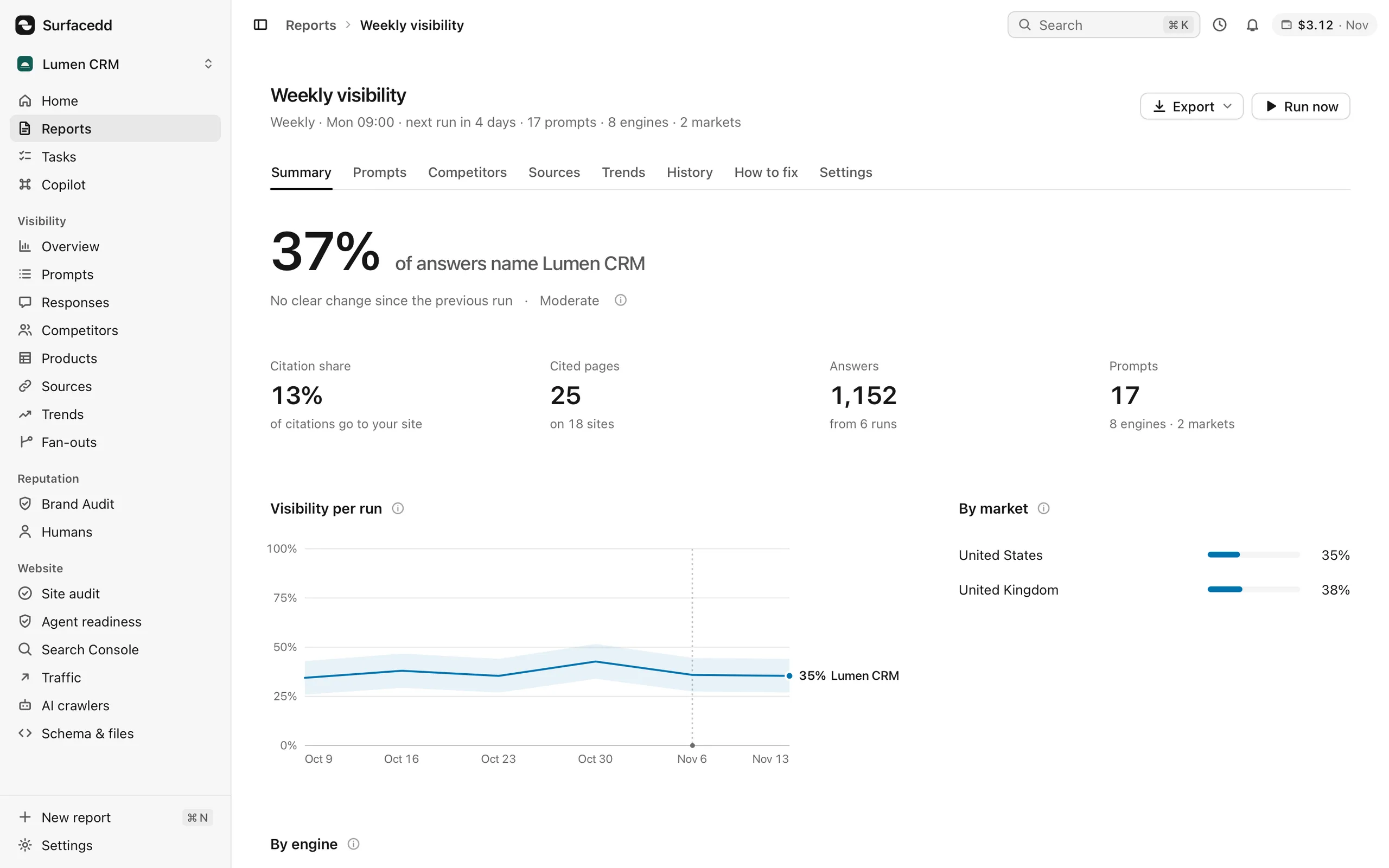
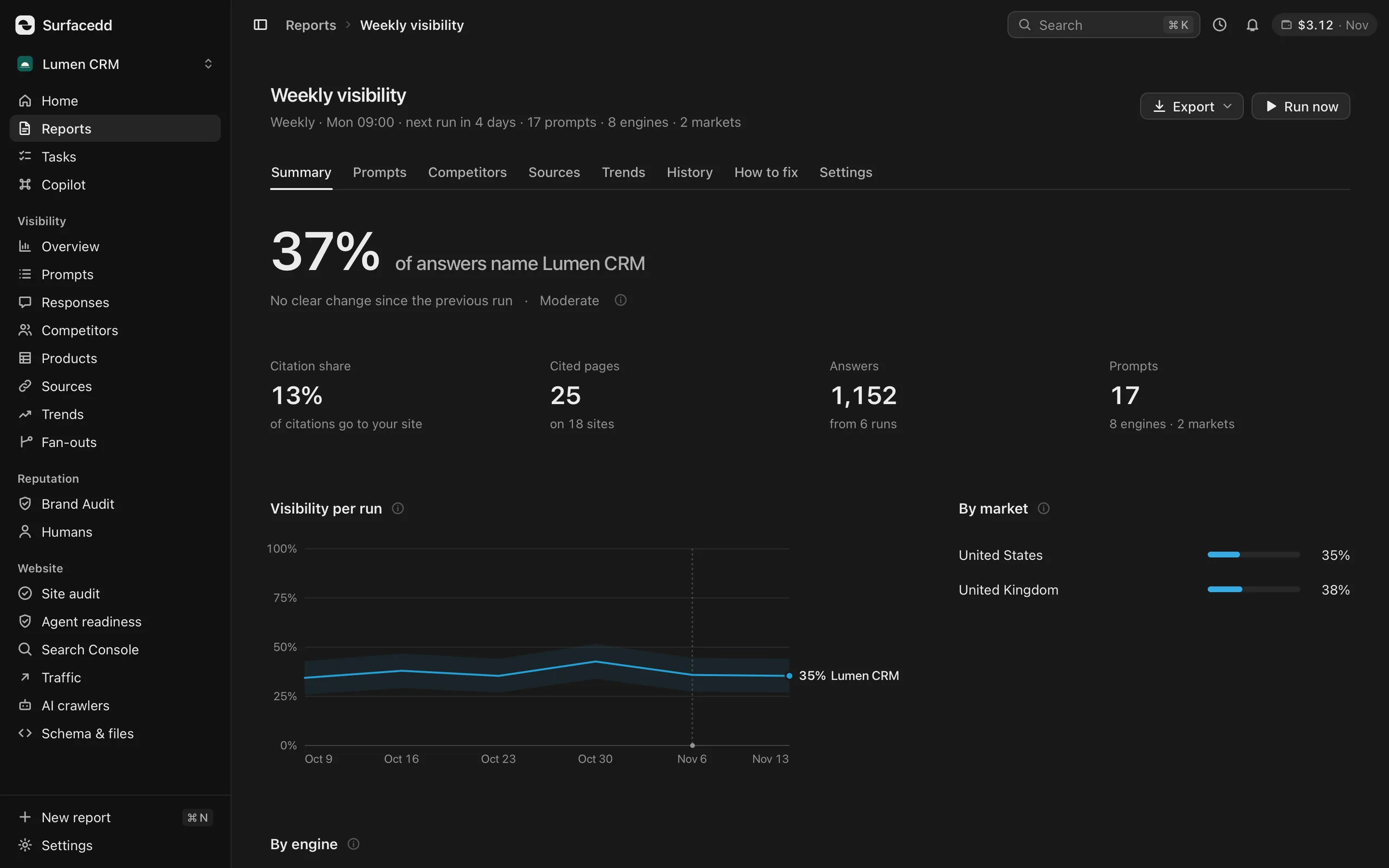
Visibility, share of voice, position and citation metrics carry 95% ranges (Wilson for single prompts, cluster bootstrap for aggregates), and a change gets an arrow only when it is statistically clear; otherwise the report says "no clear change", as in the screenshot. Charts mark runs whose prompts, engines, models or locations changed. Every number opens the answers it was counted from, and the app warns you when branded prompts exceed 30% of the set.
Before each run, the app estimates the cost on your keys and asks you to confirm above your chosen threshold; after the run, it shows the actual cost each provider reported. Gemini stays off until you read and accept a summary of Google's grounding terms. Scheduled AI visibility reports repeat the same set weekly so trends compare like for like. See pricing for the licence.
Sources
- Search Engine Journal: AI recommendations change with nearly every query (SparkToro, January 30, 2026)
- Paradigm: AI search citation study 2026
- Google Search Central: Optimizing your website for generative AI features on Google Search
- Gemini API Additional Terms of Service (Grounding with Google Search)
- Wikipedia: Binomial proportion confidence interval, Wilson score interval (E. B. Wilson, 1927)
Fair questions
How many prompts do I need?
Use at least 10 unbranded prompts and 20 answers per engine before you report anything; below that, ranges are too wide to act on. Most brands land between 20 and 50 prompts with three samples each. With 40 prompts, three samples and four engines you collect 480 answers a run, enough to see changes of several points over about four weekly runs.
Why sample the same prompt more than once?
Because a single answer is one draw from a distribution. A prompt that named you once in three samples has a 95% Wilson range of roughly 6–79%, so one check can't tell "rarely" from "usually". Three to five samples per prompt per run let you report a stable rate per prompt and give the run-level range enough answers to be useful.
Should I measure the ChatGPT app or the API?
Measure whichever you can repeat consistently, and label it. The API with web search is repeatable, priced per answer and returns citations; the consumer app may use a different model, memory and personalization, and can't be sampled at scale without breaking its terms. Keep one method per trend line, and spot-check the app by hand to see whether it broadly agrees.
What is a good AI visibility score?
It depends on the category and the prompt set, which is why a fixed set over time matters more than any benchmark. As a reading aid, Surfacedd labels 50% and above Strong, 25–49% Moderate and under 25% Emerging. A niche brand at 20% on hard unbranded prompts can be doing better than a market leader at 60% on easy ones.
How do I know a change is real?
Compare the same prompts, engines, locations and models in both periods, then compute a range for the difference. If that 95% range excludes zero, the change is real at that confidence; if it includes zero, report "no clear change". Give a fix about four weekly runs before you judge it, because engines re-crawl and re-rank on their own schedules.
Can I measure AI visibility without a tool?
Yes, for a small set. Ask 10–20 prompts three times each on each engine in fresh sessions, record named/position/citations in a spreadsheet, and compute rates with Wilson ranges. It takes a few hours per run, consumer apps vary by account and history, and keeping it weekly is the hard part. A tool earns its place when you want many prompts, engines and markets on a schedule.
Free tools for this guide
How we research, write and correct pages: read our editorial policy.