AI share of voice: see how often AI names you versus your competitors
The formula, the choices that quietly change it, and how to tell a real gain from run-to-run noise, with worked numbers.
By the Surfacedd teamUpdated 10 min readMarkdown
On this page
Short answer
AI share of voice is the number of AI answers that name your brand divided by the answers naming each brand you track, across the same prompts. If answers name you 45 times and three competitors 135 times, your share is 25%. It shows how you compare; visibility shows how often you appear at all.
What is AI share of voice?
AI share of voice (SOV) is your share of the brand mentions in AI answers, out of the mentions of every brand you track. If the answers to your prompts name you 20 times and your three competitors 80 times in total, your share of voice is 20%.
The idea comes from advertising, where share of voice meant your share of a category's ad spend or impressions. In AI search, the "voice" is the set of answers assistants such as ChatGPT, Perplexity and Google's AI Overviews give to questions in your category. It belongs next to AI visibility, not in place of it.
How is AI share of voice calculated?
The useful formula counts answers rather than raw mentions, so one answer that repeats a competitor's name five times still counts once:
share of voice (you) = answers naming you
                       ÷ sum over tracked brands (answers naming that brand)
The tracked brands are you plus the competitors you choose to include. That choice matters: adding a large indirect competitor to the set lowers everyone else's share without anything changing in the answers.
A worked example
Suppose you ask 50 prompts on one engine, three samples each, for 150 answers.
| Brand | Answers naming the brand | Share of voice |
|---|---|---|
| You | 45 | 45 ÷ 180 = 25% |
| Competitor A | 72 | 40% |
| Competitor B | 36 | 20% |
| Competitor C | 27 | 15% |
| Total | 180 | 100% |
Your visibility here is 45 ÷ 150 = 30%, because visibility divides by all answers, while share of voice divides by all brand mentions. Both are true at the same time, and they answer different questions.
Now add a fourth competitor, D, that appears in 60 of the same answers. Nothing in the answers changed, but your share falls to 45 ÷ 240 ≈ 19%. That is why the competitor set has to be fixed and labelled before you compare periods.
Share of voice vs visibility
Visibility asks "how often am I in the answer?" and share of voice asks "how do I compare with the others in the answers?". You need both, because each can move while the other stays still.
| Situation | Visibility | Share of voice | What it means |
|---|---|---|---|
| Answers start naming more brands overall | Same | Down | The category got more crowded, not worse for you specifically |
| A competitor drops out of answers | Same | Up | You gained relative position without gaining reach |
| You appear in more answers, so do competitors | Up | Same | The engine is listing more brands per answer |
| You appear in more answers, competitors don't | Up | Up | A real gain |
Report the two side by side, with counts, and don't let a rising share of voice hide a flat visibility rate.
Which prompts should count?
Share of voice is most useful on unbranded prompts, the questions buyers ask before they know who to pick. Prompts that contain your name almost always produce answers about you, which pushes your share up without telling you anything about discovery.
Two habits keep it honest:
- Filter by prompt type. Show share of voice for unbranded prompts by default, with branded and competitor-named prompts as separate views.
- Watch the mix. If more than about 30% of your active prompts mention your own brand, treat the overall share as inflated.
How should competitors be chosen?
Include the brands a buyer would actually compare you with, and label them by relationship. A practical scheme is direct competitors (same product, same buyer), indirect competitors (different product, same job), and others that appear in answers but aren't competitors, such as publishers, marketplaces or the AI platforms themselves.
Share of voice is normally calculated over direct and indirect competitors only. Counting a review site or a news publisher as a "competitor" distorts the number, because publishers are named as sources of advice, not as alternatives to buy.
Assistants also name brands you haven't listed. Review the brands that appear often in your answers each month and decide whether to add them, and mark the date you did. A competitor that wins answers you don't appear in, often called "won without you", is usually the most useful list in the whole report, because each of those answers is a concrete prompt to study.
How to read changes in share of voice
Treat a change in share of voice as real only when it is larger than the normal variation between runs. SparkToro found under a 1-in-100 chance that ChatGPT or Google's AI returned the same brand list twice for the same prompt (Search Engine Journal, January 2026), so a few points of movement between two runs is usually noise.
A method that holds up:
- Compare halves, not single runs. Split the runs in your date range into an older half and a newer half and compare the share between them. With an odd number of runs, leave the middle one out.
- Use like-for-like data. Only compare prompts, engines and locations present in both halves.
- Compute a range for the difference. Resample prompts (a cluster bootstrap) to get a 95% range for the change. If the range includes zero, report "no clear change".
- Break it down by engine. Engines draw on partly different sources, so an overall shift often comes from one engine.
Worked example: is a 4-point gain real?
Six weekly runs, 30 unbranded prompts, three samples, four engines. The older three runs give you a 22% share; the newer three give 26%. Resampling the 30 prompts 1,000 times gives a 95% range for the difference of −1 to +9 points (illustrative numbers). The range includes zero, so the honest reading is "no clear change, possibly rising". Two more runs later, the range is +1 to +8 points: now the gain is clear, and it is worth asking which prompts and engines produced it.
Position and co-occurrence
Share of voice counts presence. Two related metrics add order and context.
Average position is where your brand first appears among the distinct brands an answer names. Being named fourth in a list of eight is different from being named first. Report it next to a top-3 rate (the share of all answers where you appear in the first three) so a good average from a handful of answers doesn't mislead.
Co-occurrence shows which brands are named together. If Competitor A appears in 80% of the answers that name you, buyers are likely comparing you directly. The relationship is asymmetric: you might appear in only 20% of the answers that name Competitor A. That asymmetry tells you who is the reference brand in the category.
Share of voice by engine and location
Calculate share of voice per engine and per location as well as overall, because the totals hide the differences you can act on. Engines cite very different sources: in Paradigm's recomputation of the public Search Arena dataset, ChatGPT search drew 9.5% of its citations from Wikipedia and none from Reddit, while Perplexity cited Reddit 4.5% and YouTube 7.8% of the time. A competitor that dominates one engine may barely appear on another.
A useful layout is a table with brands as rows and engines as columns, each cell showing the share and the answer count behind it. Look for three patterns:
- One engine pulling the total down. Check which sources that engine cites for your prompts; the gap is usually a page or listing you're missing.
- A competitor strong everywhere. That usually reflects broad off-site presence: reviews, comparison articles, community discussion.
- Location differences. Engines that accept a location can name different local or regional brands. Compare locations only on engines that actually apply them (markets and location).
Small cells deserve caution. A share computed from 12 answers can swing many points between runs, so show the count and a range, and avoid ranking competitors on thin data.
Citations are a separate share
Being cited and being named are different events. An answer can link to your blog post in its sources without naming your product, or name you without linking anywhere. Track citation share (your domain's citations ÷ all citations) separately from share of voice, and don't let a citation stand in for a mention.
Citation data is also how you find the next action: if competitors are named alongside a comparison article you aren't in, that article is a concrete target.
How do you raise your share of voice?
You raise it by appearing in the answers your competitors win without you, and those answers are built from pages you can find. The order that works:
- List the prompts each competitor wins without you, by engine. Start with the competitor that wins the most.
- Open the sources cited in those answers. Sort them into your pages, competitor pages and third-party pages (reviews, listicles, forums, videos).
- Act on third-party pages first. If a "best tools" article cited in eight answers names three rivals and not you, getting accurately listed there can move several prompts at once. The brand mentions guide covers how to approach those pages without spam.
- Close the gaps on your own pages. If engines cite a competitor's comparison or pricing page for a sub-question you don't answer, publish a clear, factual answer to it.
- Re-check like for like over about four weekly runs, by engine.
The 90-day GEO strategy puts these steps on a calendar.
Common mistakes
| Mistake | Effect | Fix |
|---|---|---|
| Mixing branded and unbranded prompts in one headline | Share looks higher than discovery warrants | Report unbranded share by default |
| Counting mentions instead of answers | Rewards repetition in long answers | Count each brand once per answer |
| Changing the competitor set mid-period | Shares shift with no change in answers | Fix the set; mark additions on the chart |
| Reading one run as a trend | Noise looks like movement | Compare halves with a range |
| Mixing collection methods on one line | App screenshots and API answers aren't comparable | One method per trend line |
In Surfacedd
Surfacedd calculates share of voice from the answers stored on your computer. The default set is you plus direct and indirect competitors; publishers, AI platforms and other entities are classified separately and left out unless you include them. Prompt type (branded, competitor, organic) is detected automatically and available as a filter, and the app warns you when branded prompts make up more than 30% of the set.
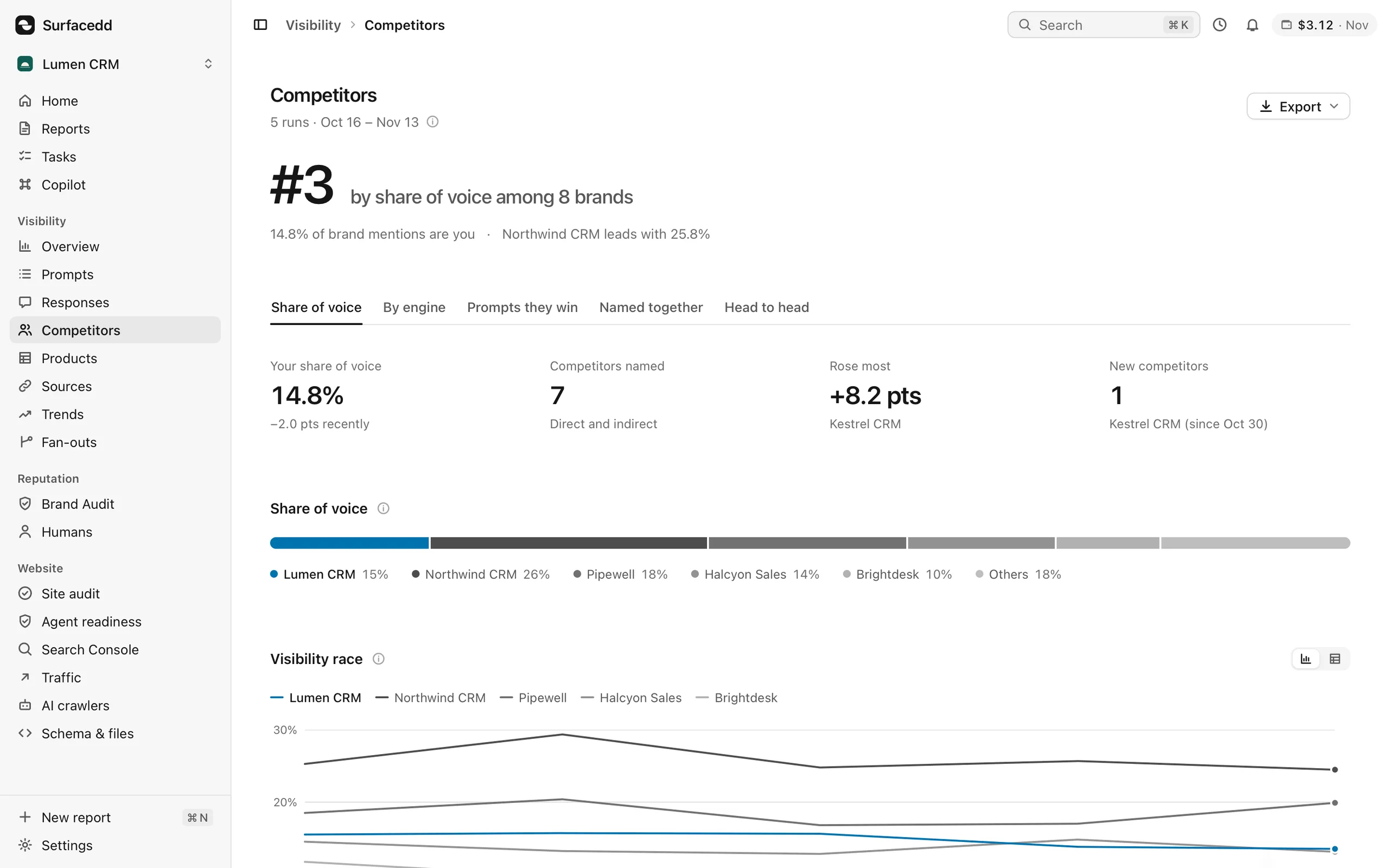
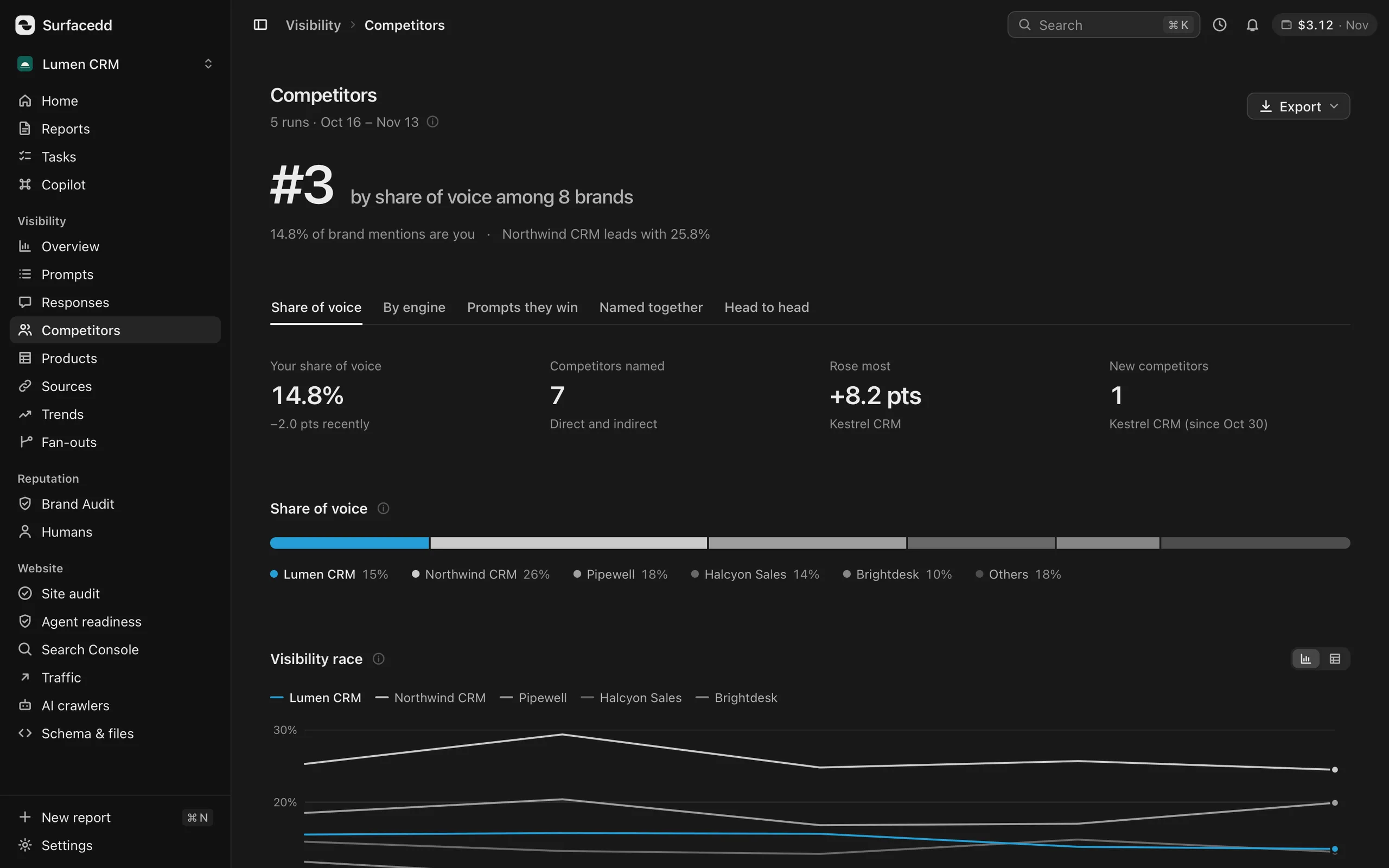
In the sample workspace above (fictional brands), the brand holds 14.8% of brand mentions, third of eight, while the leader holds 25.8%; the "Rose most" tile shows a newly detected competitor gaining 8.2 points. Change is computed from the newer half of runs against the older half, on like-for-like data, with a bootstrap range; changes that aren't statistically clear are labelled "no clear change". The competitors and sources view also lists the prompts each competitor wins without you, the named-together matrix, head-to-head results and the pages cited in each answer, and every number opens the answers it came from.
Runs use your own API keys on ChatGPT, Claude, Gemini, Perplexity, Grok, Meta AI, Google AI Mode and AI Overviews, with the estimated cost shown before each run. A weekly 25-prompt, three-sample run on the default engines costs about $11.23 a month at list prices; see pricing for the licence.
Sources
Fair questions
What is a good AI share of voice?
There is no universal benchmark, because the number depends on how many competitors you track and which prompts you ask. Compare yourself with the leader in your own set instead: the gap in points, and whether it is closing over several runs. In a set of five brands, an even split would be 20% each, so 25% already means you are named more often than average.
Is AI share of voice the same as visibility?
No. Visibility divides the answers naming you by all answers; share of voice divides them by all answers naming any tracked brand. You can be in 30% of answers and hold 25% of mentions at the same time. Visibility shows reach; share of voice shows standing against the competitors you chose. Report both with their counts.
Should publishers and review sites count as competitors?
Usually not. A review site or news publisher is named as a source of advice, not as an alternative to buy, and including it lowers every real competitor's share. Classify such entities separately and track them as sources instead. The exception is a marketplace that also sells a competing house brand; treat that brand as a competitor and the marketplace as a source.
Why did my share of voice drop when nothing changed?
Usually because something in the denominator changed: a new competitor was added to the set, engines began naming more brands per answer, or a competitor gained answers you were never in. Check the competitor set first, then visibility. If your visibility is flat while share fell, the category got more crowded rather than worse for you.
How many runs do I need before trusting a change?
About four weekly runs on the same prompts, engines and locations, compared as an older half against a newer half. Fewer runs leave the range for the difference wide enough to include zero for most real-world changes. If the range still includes zero after four runs, call it "no clear change" and keep watching.
Can I measure share of voice by hand?
For a small set, yes. Ask 10–20 unbranded prompts three times each on each engine, note every brand named per answer, count each brand once per answer, and divide. It is slow, consumer apps vary by account and history, and computing ranges by hand is tedious, so most teams switch to a tool once they track more than one engine weekly.
Free tools for this guide
How we research, write and correct pages: read our editorial policy.