How to get cited by Perplexity
Perplexity cites more sources per answer than any other engine, and shows them numbered next to each claim. Let its crawler in, answer sub-questions plainly, and measure how often you're cited instead of guessing.
By the Surfacedd teamUpdated 7 min readMarkdown
On this page
Short answer
To get cited by Perplexity, let PerplexityBot crawl your site, publish pages that answer specific sub-questions in plain text, and earn mentions on the sources it reads most, such as Reddit and review sites. Perplexity searches the web for nearly every question and numbers its sources, so citation rate is measurable per prompt.
How does Perplexity find and cite sources?
Perplexity is a search engine first. For almost every question it runs one or more web searches, reads the results and writes an answer with numbered citations attached to the sentences they support. Its own developer docs describe the same loop: the web_search tool can reformulate one question into several queries, and returns a list of results with an id, URL, title, snippet and dates that the answer cites by number.
That design has three consequences for anyone who wants to be cited:
- Search happens on nearly every answer. Unlike Claude, which answers stable questions from memory, Perplexity looks things up, so a page published last week can be cited this week.
- Answers cite many sources. Each claim can carry its own number, which means more slots per answer and more chances for a specialist page to be one of them.
- Some results are read but not cited. Perplexity's API returns every result it retrieved, and the answer cites only some of them. The gap between "retrieved" and "cited" is where most of your opportunity sits.
The sources it draws on come from Perplexity's own index, built by its crawler, plus pages it fetches live when a user asks.
PerplexityBot vs Perplexity-User
Perplexity runs two agents, and they do different jobs. Mixing them up is the most common reason a site is invisible in Perplexity.
| Agent | What it does | Obeys robots.txt? | Used for training? | Published IP ranges |
|---|---|---|---|---|
| PerplexityBot | Crawls the web to "surface and link websites in search results on Perplexity" | Yes. Perplexity recommends allowing it; changes can take up to 24 hours | No, per Perplexity | perplexity.ai/perplexitybot.json |
| Perplexity-User | Visits a page when a user's question needs it, and may link it in the answer | "Generally ignores robots.txt rules", because a person asked | No | perplexity.ai/perplexity-user.json |
Source: Perplexity crawlers documentation.
If you block PerplexityBot, your pages drop out of the index Perplexity searches first, and you rely on chance live fetches. Because PerplexityBot isn't used for model training, allowing it trades no training data for search visibility. The PerplexityBot glossary entry has the user-agent string and how to verify it in your logs.
A robots.txt block that keeps training crawlers out but lets Perplexity's search in:
# Let Perplexity's search crawler index the site
User-agent: PerplexityBot
Allow: /

# Example: opt out of a training crawler
User-agent: GPTBot
Disallow: /
Check your CDN or firewall too. Bot-protection modes often challenge AI crawlers even when robots.txt allows them. Test with Perplexity's published IP ranges, and see the robots.txt guide for AI crawlers for a full template.
What gets cited in Perplexity?
Pages that answer one specific question clearly, recently and in plain text. Across the public studies, three source types recur at the top for Perplexity: Reddit threads, YouTube videos and frequently updated comparison or review pages. Freshness counts more than in Google's AI Overviews; Perplexity and ChatGPT both tend to prefer recently updated pages.
Read that as a description of what Perplexity's searches return, not a ranking formula. Perplexity searches the way a person would, so the question to ask is: when Perplexity searches for each sub-question in my buyer's prompt, which page comes back, and is it one that mentions me?
A worked citation breakdown
Here is a hypothetical example to show how to read one answer. A buyer asks "best CRM for a 10-person agency". Perplexity runs three searches and cites seven results:
| # | Source | Type | Names your brand? | Why it was cited |
|---|---|---|---|---|
| 1 | A 2026 roundup on a marketing blog | Roundup | Yes, fourth | Overall shortlist |
| 2 | Reddit thread, r/agency | Forum | No | "What do you actually use?" opinions |
| 3 | Competitor A pricing page | Vendor | No | Per-seat price claim |
| 4 | YouTube review | Video | No | Pipeline-view demo |
| 5 | G2 category page | Review site | Yes | Ratings claim |
| 6 | Your integrations page | Vendor (yours) | Yes | "Connects to Slack and Xero" |
| 7 | Competitor B help article | Vendor | No | Client-portal claim |
Plus four results it retrieved and didn't cite, one of them your pricing page.
What this tells you: your pricing page was found but lost to a competitor's for the price claim, probably because yours hides the per-seat figure behind a toggle. The Reddit thread and the YouTube review never mention you, and they carry the opinion and demo claims. Those three are the work list: a plain pricing table, a useful reply in the thread if you have something to add, and a demo video. None of it requires "Perplexity SEO"; all of it is visible once you look at citations by number.
Steps that move the needle
Work through these in order. The early steps remove blockers; the later ones raise your odds once nothing is blocking you.
- Allow PerplexityBot in robots.txt and in your CDN or firewall. Confirm with a log check that it fetches pages and gets 200 responses.
- Serve the facts in HTML. Perplexity's crawler doesn't need your JavaScript to run to read the page. Prices, specifications, integrations and dates belong in the server-rendered text, not in tabs or images.
- Answer sub-questions under question headings. One question per heading, the answer in the first one or two sentences, detail after. Perplexity cites passages, and each passage needs to stand alone.
- Keep comparison and pricing pages current. Update the content when it changes and show the date. Don't bump the date without a change.
- Earn mentions where Perplexity reads. Useful participation in the Reddit communities your buyers use, demo and review videos on YouTube, and accurate listings on review sites. Paid or fake mentions break those platforms' rules and Google's, and are easy to spot.
- Re-check by prompt, not by page. After each change, re-run the prompts it was meant to affect and compare citation rates over several runs.
How do I measure Perplexity citations?
Ask Perplexity your buyers' questions repeatedly, through its API, and record which results it cited, which it retrieved but didn't cite, and whether your brand is named in the text. Single answers vary too much to judge; rates over several samples and weeks don't.
Perplexity's Agent API makes this unusually precise. Its web_search tool accepts a location down to latitude and longitude, returns the queries it ran and the full result list, and every response reports its own cost in usage.cost. Two caveats: inline [n] markers only appear when the request asks for them, and the results list, not the markers, is the source of truth for what was cited. A tracker should ask for markers explicitly and map them to result ids, as Perplexity's documentation recommends.
The API isn't the consumer app. Perplexity's app adds its own settings, follow-up context and, for signed-in users, history. The API gives you a repeatable measurement, which is what you need to see whether a change worked.
In Surfacedd
Surfacedd tracks Perplexity through the Agent API on your own key, with Perplexity's own Sonar model and the web_search tool. Each answer is stored with the cited results in the order Perplexity numbered them, a separate list of results it read but didn't cite, the searches it ran and the exact cost Perplexity reported. Location is set per market, down to coordinates. A default answer costs about $0.0051 at today's list prices, the cheapest of the API engines.
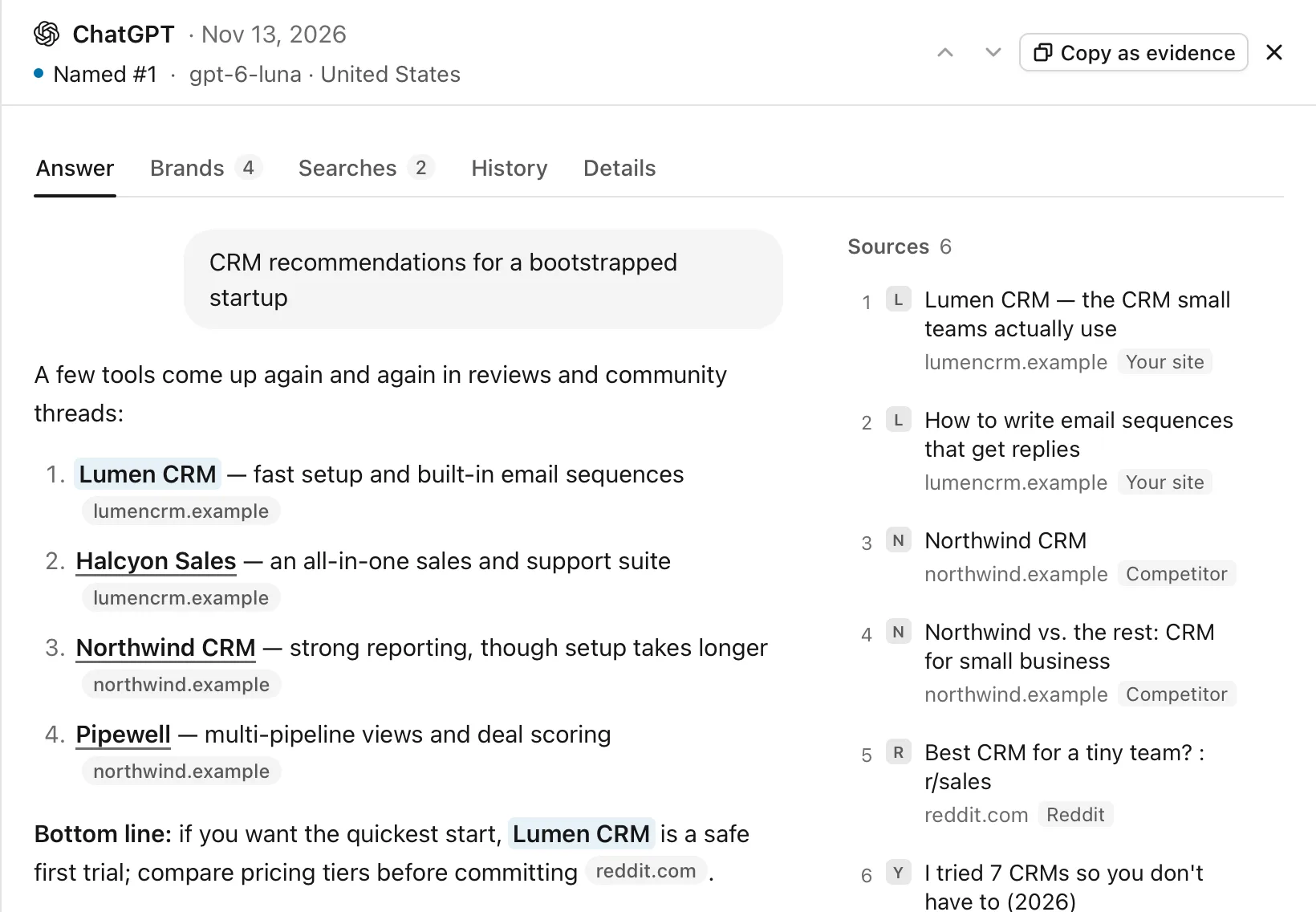
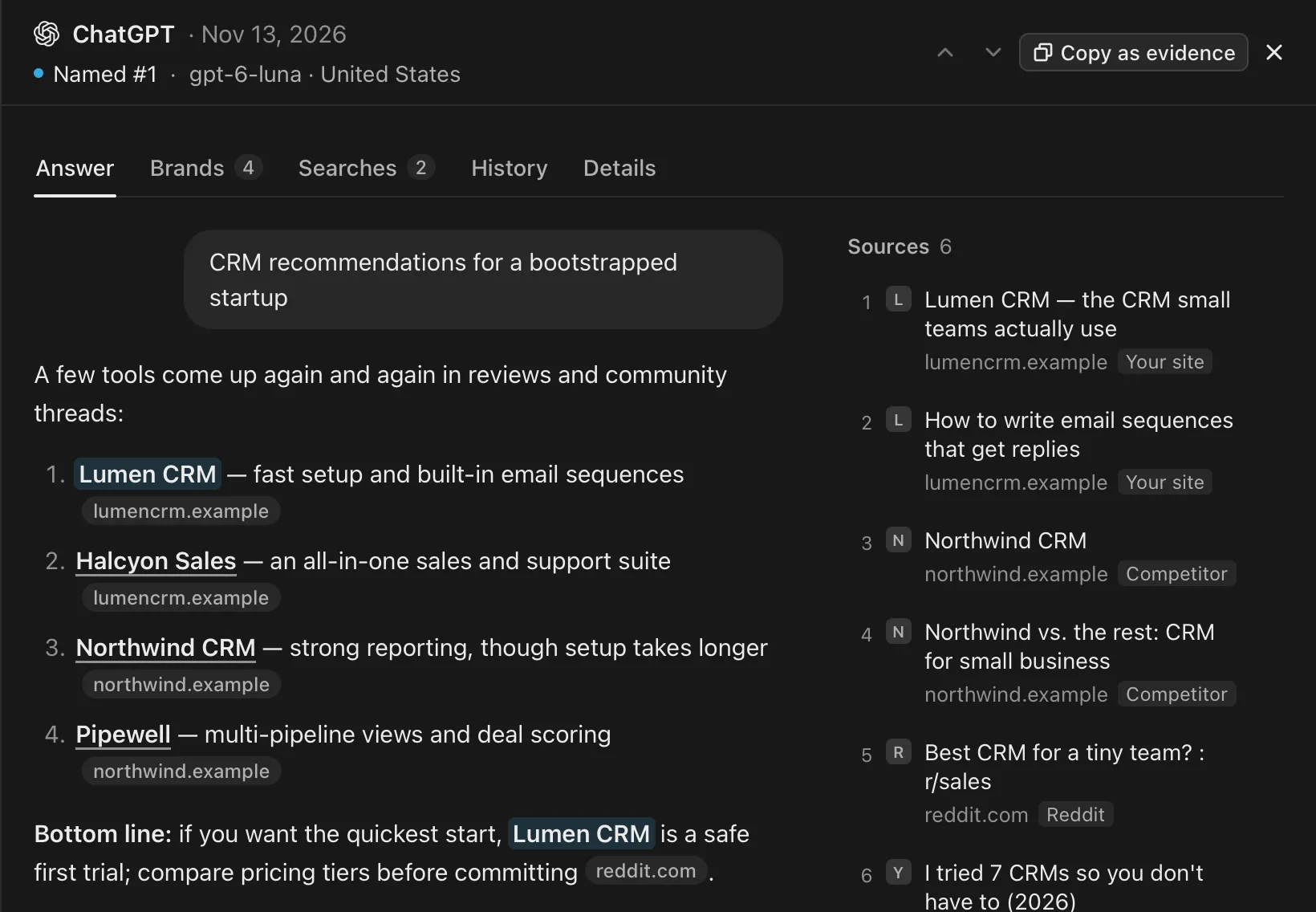
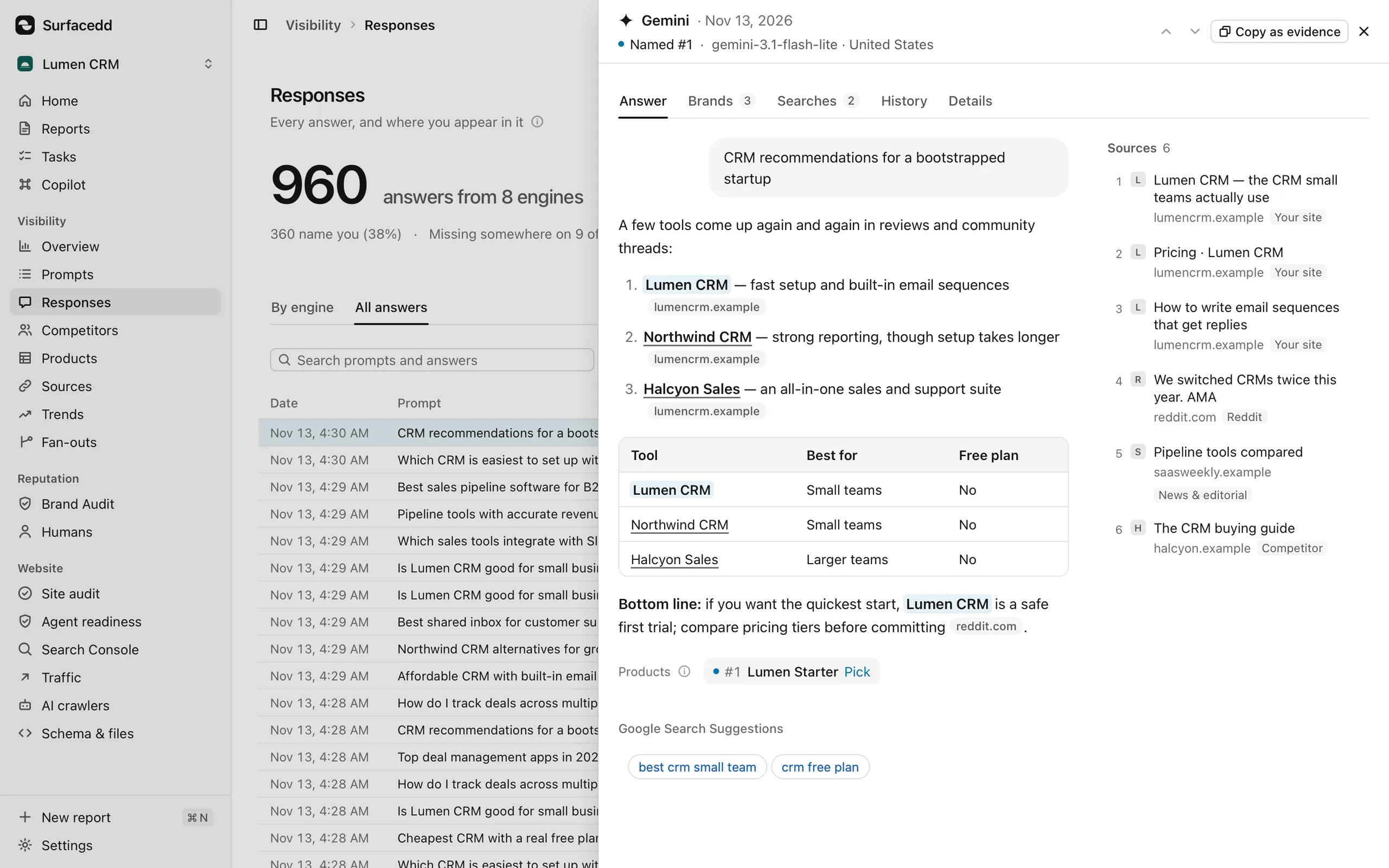
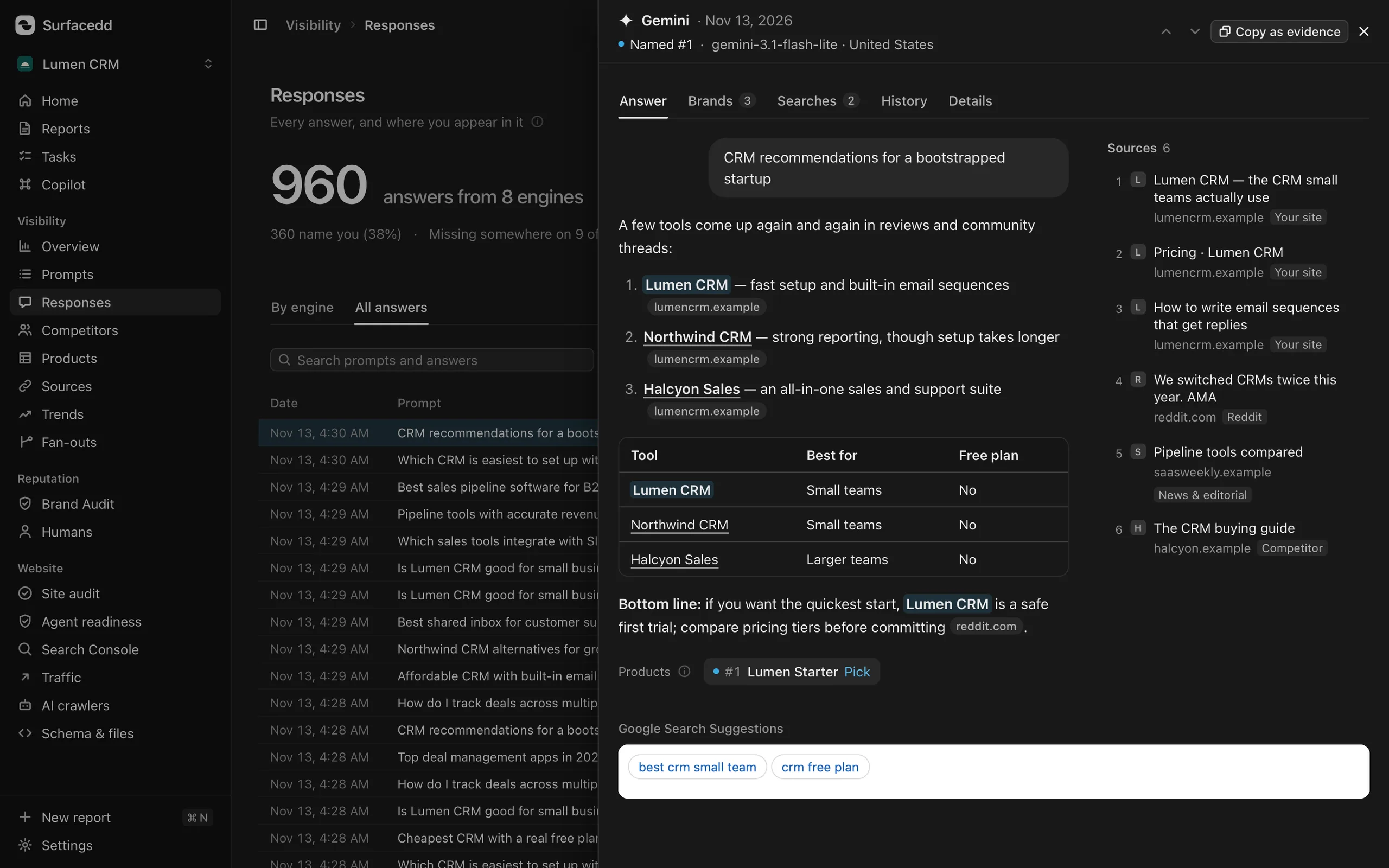
The answer drawer puts the two source lists side by side, so a page of yours that was retrieved but not cited is one click away from the competitor page that won the citation. Across a report, the Sources view ranks the domains Perplexity cites in your category and flags the ones that never mention you. Surfacedd is a one-time purchase; Perplexity bills your key directly.
Sources
Fair questions
Does Perplexity have ranking factors?
Not published ones. Perplexity doesn't document how it orders sources, and no outside tool can see inside it. What you can observe is which pages it retrieves and cites for your prompts. Those pages tend to answer one sub-question plainly, be recently updated and come from sources Perplexity searches heavily, such as Reddit, YouTube and review sites. Measure those patterns for your own prompts rather than trusting a generic list.
Should I block Perplexity-User?
Think before you do. Perplexity says Perplexity-User fetches a page when a user's question needs it and generally ignores robots.txt, because a person made the request. Blocking it at your firewall stops those live fetches, which can remove you from answers that would have linked to you. If your concern is training, note that Perplexity says neither of its agents collects content for training foundation models.
Does PerplexityBot use my content to train AI models?
Perplexity says no. Its documentation describes PerplexityBot as a crawler that surfaces and links websites in Perplexity's search results and states it isn't used to crawl content for AI foundation models. Allowing it is a search-visibility decision, not a training one. You can verify requests against Perplexity's published IP ranges before trusting the user-agent string.
Why does Perplexity cite a page and still not name my brand?
Citations support individual claims. Perplexity might cite your page for a fact about integrations and still recommend three competitors in the summary. That's why citation rate and visibility are separate metrics. A page that's cited but doesn't lead to a mention usually answers a side question; make sure your strongest pages also state plainly who the product is for and why.
How quickly do changes show up in Perplexity?
Often faster than in Google, because Perplexity searches on almost every question and can fetch pages live. Its crawler documentation says robots.txt changes can take up to 24 hours to take effect. Content changes appear when PerplexityBot recrawls the page. Judge results over several runs across a few weeks, because individual answers vary.
Is Perplexity worth optimising for if it's smaller than ChatGPT?
It depends on your audience, which you can measure. Perplexity is cheap to track, cites many sources per answer and exposes exactly what it read, so it's often the clearest early signal of whether your pages are being found at all. Fixes that win Perplexity citations, such as clear answers and current facts, usually help with the other engines too.
How we research, write and correct pages: read our editorial policy.