What is AI visibility, and what does a good number look like?
A precise definition built from five measurable parts: named, position, cited, recommended and sentiment. Each has a formula, an example and a reason it moves.
By the Surfacedd teamUpdated 9 min readMarkdown
On this page
Short answer
AI visibility is the share of AI-generated answers to a fixed set of buyer questions that name your brand. If 38 of 100 answers from ChatGPT, Perplexity and other assistants mention you, your visibility is 38%. Position, citations, recommendations and sentiment describe how you appear once you're named.
What is AI visibility?
AI visibility is how often AI assistants mention your brand when people ask the questions you want to be found for. It is measured as a rate: the number of answers that name you, divided by the number of answers collected, across a fixed set of prompts and engines. A brand named in 38 of 100 answers has 38% AI visibility.
Three parts of that definition do the work:
- AI assistants means the engines that write answers: ChatGPT, Claude, Gemini, Perplexity, Grok, Meta AI, and Google's AI Overviews and AI Mode. Each is measured separately, because each finds and ranks sources differently.
- The questions you want to be found for means a written-down prompt set, usually 10 to 50 buyer questions such as "best CRM for a five-person sales team". Visibility is always relative to a prompt set; change the prompts and the number changes. Pick prompts from real customer wording, because no AI company publishes prompt volume the way Google publishes keyword volume.
- A rate means visibility is a share of answers, not a position. AI answers vary between identical runs, so a single answer can't tell you where you stand.
People also say "AI search visibility" for the same thing. A single headline number that summarises it is often called an AI visibility score; that page covers the formula and colour bands in detail. The other metrics in this guide are defined, with worked maths, in the AI search glossary.
What are the five parts of AI visibility?
Being named is the headline. Four more parts describe how you're named. In Surfacedd's definitions, an answer names you only when your brand appears in the answer text; a link in the answer's source list alone doesn't count as a mention.
| Part | Question it answers | Formula | Example |
|---|---|---|---|
| 1. Named (visibility) | How often am I in the answer at all? | answers naming you ÷ all answers | 38 of 100 answers → 38% |
| 2. Position | When I'm named, how early? | order of first appearance among the brands named; average over answers naming you | named 2nd on average → "avg 2.0" |
| 3. Cited | Does the answer link to my pages? | answers citing at least one of your pages ÷ all answers | 21 of 100 answers cite your site → 21% citation rate |
| 4. Recommended | Am I presented as a pick? | answers recommending you ÷ all answers | 17 of 100 → 17% |
| 5. Sentiment | When I'm described, is it positive? | (positive − negative) ÷ mentions, from −100 to +100 | 6 positive, 1 negative of 10 mentions → +50 |
Each part can move without the others. You can be named often but late (high visibility, poor position), cited often but rarely recommended (your docs are used as a source while a rival gets the recommendation), or named often in mixed terms (high visibility, low sentiment). That is why a single score is useful for a dashboard and misleading for decisions.
Named: the core rate
Visibility weighs every answer the same. If you ask 10 prompts on 4 engines with 3 samples each, you have 120 answers; named in 42 of them, your visibility is 35%. Show the count next to the rate ("35% · 42 of 120 answers"), because 35% of 20 answers and 35% of 2,000 answers deserve very different confidence.
Position: early beats late
Position is the order in which your brand first appears among the distinct brands an answer names. Named first in a list of five is position 1. Average position only covers answers that name you, so always read it next to a companion rate: the share of all answers where you're in the top three. A brand named once, first, has a perfect average position and is still almost invisible.
Cited: naming is not citing
An AI citation is a link to a page in the answer's sources. Citation rate counts answers that cite at least one page on your domain or subdomains. A related number, citation share, counts your pages as a share of every page cited. Being cited without being named happens often: an answer may use your help docs to explain something and then recommend a competitor.
Recommended: a pick, not a mention
"Named" includes neutral and negative mentions ("some users find X expensive"). "Recommended" counts only answers that present you as a choice ("use X if you need Y"). It's the closest thing to the outcome you care about, and it's the hardest part to judge automatically, which is why it's a secondary number next to visibility rather than a replacement for it.
Sentiment: the tone of the mention
Net sentiment runs from −100 (every mention negative) to +100 (every mention positive). It's useful for reputation work, and it should never be blended into visibility: a brand mentioned often and badly isn't more visible in any useful sense. In Surfacedd, sentiment appears in Brand Audit and Humans and stays out of the visibility number.
Why does AI visibility change from run to run?
Because the answers do. Ask ChatGPT the same question twice and you'll often get a different list of brands, in a different order. Reasons include sampling in the model's text generation, different search results at different moments, and the model running different follow-up searches (a process called query fan-out) each time.
This has three consequences for how you read the number:
- One answer is an anecdote. A screenshot of ChatGPT naming you first proves the answer happened once.
- Rates need ranges. With 100 answers, a measured 38% is consistent with a true rate somewhere around 29% to 48%. A Wilson score interval or a bootstrap over prompts gives that range.
- Changes need tests. A drop from 38% to 33% between two weekly runs is within normal variation unless the range of the difference excludes zero. Surfacedd shows "No clear change" until it does, and advises judging trends over about four weekly runs.
| Answers collected | Measured visibility | Approximate 95% range (Wilson) |
|---|---|---|
| 20 | 40% (8 of 20) | 22% to 61% |
| 100 | 40% (40 of 100) | 31% to 50% |
| 500 | 40% (200 of 500) | 36% to 44% |
The ranges in this table are computed with the Wilson formula for a simple proportion. Real AI visibility data clusters by prompt, so a bootstrap over prompts usually gives a somewhat wider range. The lesson holds either way: small samples give wide ranges, and a weekly report of 20 answers can't detect a five-point change.
How is AI visibility different from SEO rankings?
SEO ranking is a position for a URL in a list of links for one query. AI visibility is a rate of brand mentions across many answers to many questions. The differences matter when you report them side by side:
| SEO ranking | AI visibility | |
|---|---|---|
| What's ranked | Your page (URL) | Your brand (name in text) |
| Unit | Position 1–100 | Share of answers, 0–100% |
| Stability | Fairly stable day to day | Varies between identical runs |
| Third-party pages | Compete with you for the position | Can put you into the answer without linking you |
| Official data | Search Console, Bing Webmaster Tools | Only partial: Google reports AI feature impressions; Bing reports Copilot citations |
| Measurement | One check per query is meaningful | Needs repeated samples and a range |
Rankings still feed AI visibility. Google's AI Overviews and AI Mode use pages from its index, and Google says there are no additional requirements to appear in them beyond normal Search eligibility. Our GEO vs AEO vs SEO comparison shows what carries over.
What does a good AI visibility number look like?
It depends on your category and prompt set, so compare against yourself and your competitors, not a universal benchmark. Surfacedd uses three tiers to label a visibility rate at a glance:
| Tier | Visibility | What it usually means |
|---|---|---|
| Strong | 50% or more | Named in most answers to your buyer questions; protect it and watch competitors |
| Moderate | 25% to 49% | Named often but not reliably; usually a few prompts or engines where you're missing |
| Emerging | under 25% | Named occasionally or not at all; start with crawler access, indexing and off-site mentions |
Two cautions apply. Branded prompts ("Is {brand} good?") almost always name you and inflate the rate, so keep most of the set unbranded. And visibility is relative to who's in the category: 30% in a market with 20 credible vendors can be a better position than 60% in a market with three. AI share of voice compares you with named competitors and complements the visibility rate.
A worked example from the sample workspace
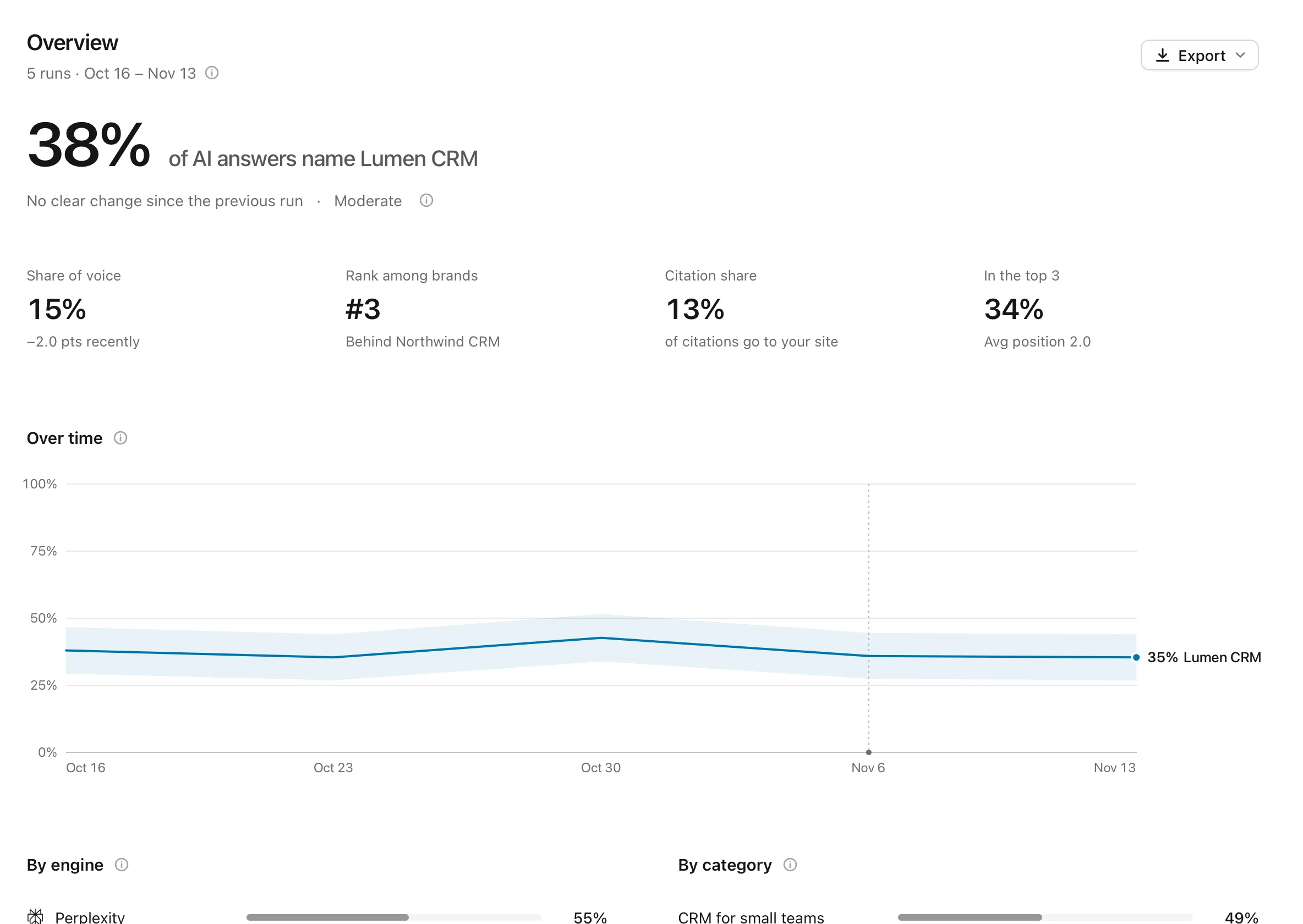
Here are five weekly runs for a fictional CRM, "Lumen CRM", from Surfacedd's sample workspace (fictional brand, invented data):
- Named: 38% of answers name Lumen CRM. Tier: Moderate. No clear change since the previous run.
- Position: average position 2.0 when named; in the top three in 34% of all answers.
- Cited: 13% of all citations go to Lumen's own site (citation share).
- Share of voice: 15%, and it ranks third among the brands named, behind a fictional competitor, Northwind CRM.
- By engine: Perplexity names Lumen in 55% of its answers, well above the average.
Read together: Lumen is known (named in over a third of answers) and named early when it appears, but rarely the source engines quote, and a competitor is named more. The next step isn't "improve visibility" in general; it's "find which pages engines cite in answers that name Northwind and not Lumen". The method for collecting numbers like these is in how to measure AI visibility.
How Surfacedd reports AI visibility
Surfacedd puts all five parts on one screen for each brand: the visibility rate with its tier, share of voice, rank among brands, citation share and top-three rate, plus a trend line with its range and a marker wherever the run setup changed. Every number links to the answers behind it.
It runs on your computer with your own AI provider keys, and shows the cost of each run before it starts. To see the full tracking workflow, read about the AI visibility tracker; for costs, see pricing.
Sources
- Google Search Central: AI features and your website
- Google Search Central Blog: generative AI performance reports in Search Console (3 June 2026)
- Bing Webmaster Blog: New AI visibility insights in Bing Webmaster Tools (16 June 2026)
- Wilson, E. B., Probable inference, the law of succession, and statistical inference (JASA, 1927)
Fair questions
What is AI visibility in simple terms?
AI visibility is how often AI assistants such as ChatGPT, Perplexity and Gemini mention your brand when asked the questions your buyers ask. It's measured as a percentage: answers that name you divided by all answers collected for a fixed set of prompts. If 30 of 100 answers name you, your AI visibility is 30% for that prompt set and those engines.
Is AI visibility the same as AI search visibility?
Yes, the terms are used interchangeably. Some people use "AI search visibility" for engines that search the web before answering, such as Perplexity and AI Overviews, and "AI visibility" to include answers from memory. In practice both mean the share of AI answers that mention your brand, measured per engine on a fixed prompt set.
What is a good AI visibility score?
It depends on your category and prompts, so compare with competitors measured the same way. As a rough guide, Surfacedd labels 50% or more as Strong, 25% to 49% as Moderate and under 25% as Emerging. Keep branded prompts to a minority of the set, because questions containing your name inflate the number without telling you anything about discovery.
Why did my AI visibility drop this week?
Possibly it didn't. AI answers vary between identical runs, so week-to-week movements of several points are often noise, especially with fewer than a few hundred answers. Check whether the change is outside the range for the difference, and whether anything in the setup changed, such as prompts, engines or models. Judge trends over about four weekly runs.
Does being cited count as being visible?
Not on its own. A citation is a link to your page in the answer's sources; a mention is your brand name in the answer text. An answer can cite your documentation and recommend a competitor. Count the two separately: visibility for mentions, citation rate and citation share for links. Both matter, and they often move differently.
Can I check my AI visibility for free?
You can ask assistants your buyer questions by hand and count mentions, which works for a rough first look. The limits are sample size and consistency: you'd need many repeated answers per engine to get a usable range. Tracking tools automate the repetition. Surfacedd uses your own API keys, so you pay providers per answer and see the cost before each run.
How is AI visibility different from share of voice?
Visibility divides answers naming you by all answers, so it shows reach. Share of voice divides answers naming you by the total answers naming each tracked brand, so it shows your position against competitors. If answers start listing more brands overall, your share of voice can fall while visibility stays flat. Report both side by side, with counts.
How we research, write and correct pages: read our editorial policy.