OAI-SearchBot: the bot that decides whether ChatGPT search can cite you
If ChatGPT never cites your pages, check this bot first. What it does, how a blanket robots.txt rule shuts it out, and how to confirm its visits are real.
By the Surfacedd teamUpdated 4 min readMarkdown
On this page
Short answer
OAI-SearchBot is OpenAI's crawler for ChatGPT search. It finds and indexes pages so ChatGPT can show them as cited sources in its answers. If robots.txt or a firewall blocks it, your pages stop appearing as citations, though they can still show as plain navigational links. OpenAI says robots.txt changes take about 24 hours to apply.
Definition
OAI-SearchBot is the OpenAI crawler that surfaces websites in ChatGPT's search features. Its user agent contains OAI-SearchBot (currently compatible; OAI-SearchBot/1.4; +https://openai.com/searchbot). It obeys robots.txt, and OpenAI publishes the IP ranges it uses (OpenAI, "Overview of OpenAI crawlers").
OpenAI is explicit about the consequence of blocking it: sites that opt out "will not be shown in ChatGPT search answers", though they "can still appear as navigational links". In other words, without OAI-SearchBot you lose the citation, the numbered source a reader can click, which is the part of a ChatGPT answer that sends traffic and builds trust.
| Fact | Value |
|---|---|
| Operator | OpenAI |
| Purpose | AI search and citations |
| Feeds AI search answers | Yes |
| User agent | Contains oai-searchbot (case-insensitive) |
| robots.txt token | OAI-SearchBot |
| Verification | Published IP ranges: https://openai.com/searchbot.json |
| Operator docs | https://platform.openai.com/docs/bots |
203.0.113.24 - - [18/Nov/2026:09:14:02 +0000] "GET /pricing HTTP/1.1" 200 18342 "-" "Mozilla/5.0 (compatible; OAI-SearchBot)"
Synthetic log line for illustration: the IP is from a documentation range (RFC 5737) and the user agent is shortened. Real user agents carry a version and a link to the operator's docs.
Source: Surfacedd's bot catalog (packages/data/ai-bots.json, version 2026-11-19.2).
How it differs from GPTBot
OAI-SearchBot and GPTBot come from the same company but have opposite jobs. GPTBot collects pages that may train future models; OAI-SearchBot builds the index ChatGPT search draws on when it answers right now. OpenAI treats the two settings as independent, so you can allow OAI-SearchBot while disallowing GPTBot, and many publishers do exactly that. The third OpenAI agent, ChatGPT-User, fetches a page only when a user's request needs it.
If you want to appear in ChatGPT answers, OAI-SearchBot is the one OpenAI crawler you can't afford to block. Our guide on how to rank in ChatGPT covers what happens after the crawl.
In practice: the blanket rule that blocks ChatGPT search
This file is typical of a staging site promoted to production, or of a site that once tried to "block all bots except Google":
User-agent: *
Disallow: /

User-agent: Googlebot
Allow: /
Walk through it the way a crawler does under RFC 9309. OAI-SearchBot looks for a group naming its own token. There isn't one, so it falls back to the * group, which disallows everything. Result: Google Search can index the site, ChatGPT search cannot, and nobody notices because Google traffic looks normal.
The fix is one more group:
User-agent: *
Disallow: /

User-agent: Googlebot
Allow: /

User-agent: OAI-SearchBot
Allow: /
Then the timeline. OpenAI says it takes "~24 hours from a site's robots.txt update" for its systems to adjust. So a sensible re-check plan is:
| When | What to check | Expected result |
|---|---|---|
| Day 0 | Deploy the new robots.txt; fetch /robots.txt yourself | The OAI-SearchBot group is live |
| Day 1–2 | Server logs | Verified OAI-SearchBot requests start reaching content pages, not only /robots.txt |
| Week 1–4 | ChatGPT answers for your prompts | Your pages can now appear as cited sources; judge the trend over several runs, not one |
The robots.txt fix only removes the block. Whether ChatGPT then cites you depends on whether your page answers the question better than the pages it already cites. Being crawlable makes it possible; it doesn't make it happen.
Robots.txt isn't the only gate. A CDN bot-protection mode or firewall rule can challenge OAI-SearchBot even when robots.txt allows it, and the bot never sees your page. If logs show OAI-SearchBot receiving 403 or 429 responses, look at your firewall before your content. The free AI crawler checker reads your robots.txt the way each bot would.
Allow or block?
| Your situation | OAI-SearchBot |
|---|---|
| You want to be cited in ChatGPT search | Allow |
| You block training but want citations | Allow it, block GPTBot |
| Paywalled content you don't want summarised | Allow the public pages that describe it; disallow the paywalled paths |
| Internal tools, staging, private paths | Disallow those paths only |
Blocking the whole site is rarely the right call for a business that wants to be found. If you do block it, expect ChatGPT to show your site, at most, as a link without being cited.
In your logs
On 2026-11-19, OpenAI's https://openai.com/searchbot.json listed 39 IPv4 prefixes. An OAI-SearchBot user agent from an address outside those ranges is not OpenAI. A quick standard-library check:
python3 -c 'import json,sys,ipaddress,urllib.request as u; ip=ipaddress.ip_address(sys.argv[2]); d=json.load(u.urlopen(sys.argv[1])); print(any(ip in ipaddress.ip_network(p.get("ipv4Prefix") or p["ipv6Prefix"]) for p in d["prefixes"]))' https://openai.com/searchbot.json 203.0.113.24
False for that documentation address, as expected. Three log patterns are worth acting on:
- Only
/robots.txtrequests, no page requests: something tells it not to proceed. Read the file as OAI-SearchBot would. - 4xx or 5xx on pages you want cited: the bot reached you and got an error. Fix those URLs first.
- Verified hits on old URLs that redirect: update internal links and sitemaps so the bot reaches the final URL directly.
See the AI crawler verification guide for batch verification.
In Surfacedd
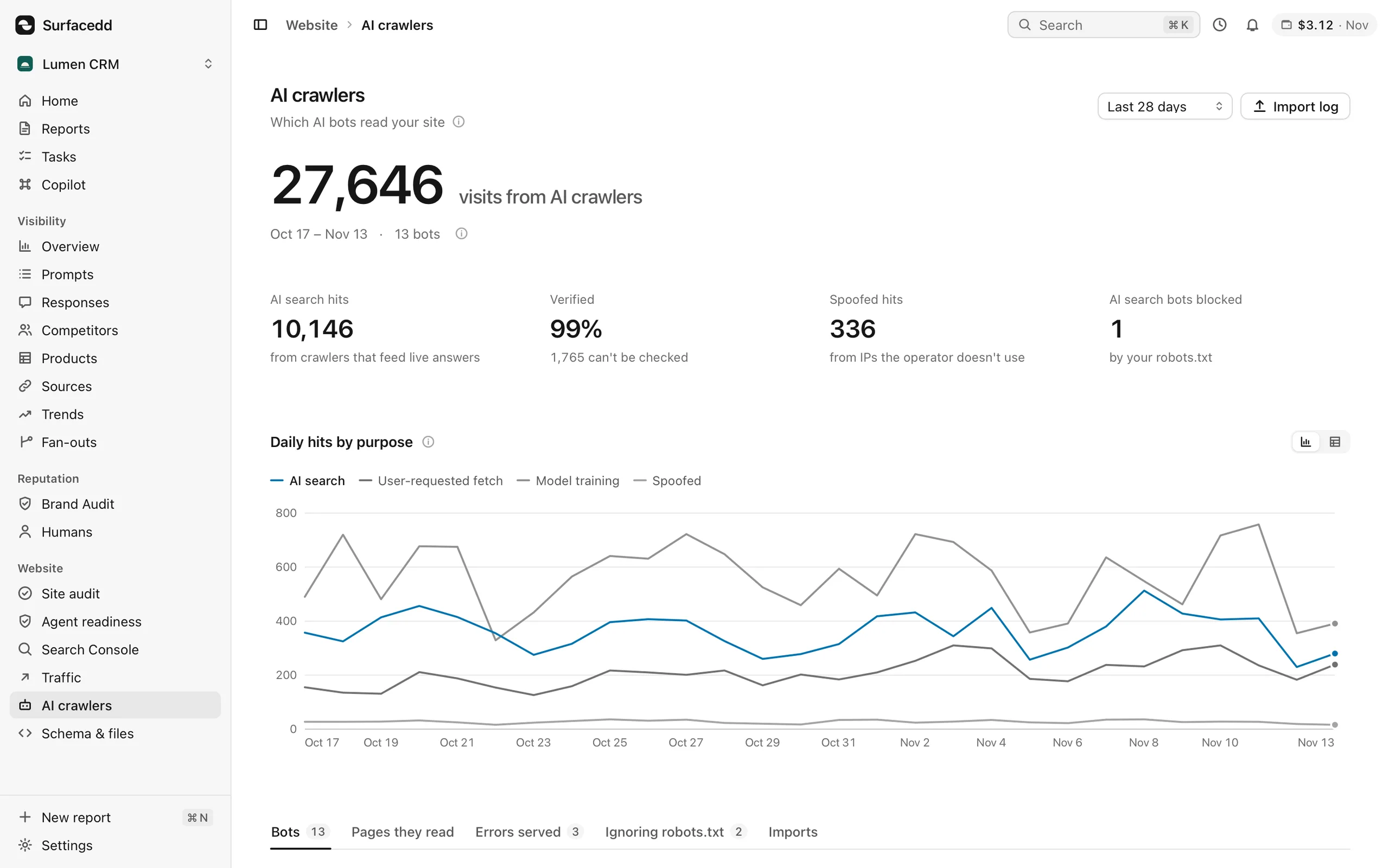
Surfacedd connects the crawl to the outcome. AI crawler analytics imports your logs locally and shows verified OAI-SearchBot hits, the pages it reads and the errors it gets. The site audit flags a robots.txt rule that blocks a search or citation bot as an issue on the pages it affects. And the ChatGPT tracking reports show whether those pages are then cited in answers to your prompts.
Related terms
- GPTBot: OpenAI's training crawler.
- ChatGPT-User: user-triggered fetches.
- PerplexityBot and ClaudeBot: the equivalent bots for other engines.
- AI citation: what OAI-SearchBot makes possible.
Sources
How we research, write and correct pages: read our editorial policy.