Know which AI crawlers decide whether you get cited
AI companies run separate bots for search, for live fetches and for training. This catalog shows each one's robots.txt token, whether you can verify it, and what you lose by blocking it.
By the Surfacedd teamUpdated 10 min readMarkdown
On this page
Short answer
AI crawlers are bots that AI companies send to read websites. They do three jobs: build a search index that assistants cite from, fetch a page live when a user asks, and collect training data. Only the first two decide whether ChatGPT, Claude or Perplexity can cite you, so block training bots if you like but keep the others in.
Three kinds of AI crawler
Every AI crawler does one of three jobs, and the job decides whether you should let it in. Operators now publish a separate user agent per job, so you can allow one and block another on the same site.
- Search index crawlers read your pages ahead of time so an assistant can find and cite them when someone asks a question. OpenAI's OAI-SearchBot, Anthropic's Claude-SearchBot and PerplexityBot are the AI-native ones. Googlebot, Bingbot and Applebot belong here too, because Google's AI Overviews and AI Mode, Microsoft Copilot and Siri answer from those indexes.
- User fetchers load one page, live, because a person in a chat asked about it or pasted its link. ChatGPT-User, Claude-User and Perplexity-User are the common ones. They do not crawl on their own schedule.
- Training crawlers collect pages that may go into future models. GPTBot, ClaudeBot, CCBot and Meta-ExternalAgent are the best known. Blocking them changes what future models learn from your site, not whether today's assistants can cite you.
Two entries in every list are not crawlers at all. Google-Extended and Applebot-Extended are robots.txt tokens with no user agent of their own: Googlebot and Applebot fetch the page, and the token only says how the content may be used afterwards.
The catalog: every AI crawler we track
The table below is generated from the bot catalog that Surfacedd's log analytics uses, so it changes when the catalog changes rather than when someone remembers to edit this page. It covers 32 entries, grouped by purpose. "Can be verified" says whether the operator publishes a way to prove a request is really theirs: an IP list, or reverse DNS.
| Crawler | Operator | Purpose | robots.txt token | Can be verified |
|---|---|---|---|---|
| OAI-SearchBot | OpenAI | AI search and citations | OAI-SearchBot | Yes, IP list |
| Claude-SearchBot | Anthropic | AI search and citations | Claude-SearchBot | Yes, IP list |
| PerplexityBot | Perplexity | AI search and citations | PerplexityBot | Yes, IP list |
| Googlebot | AI search and citations | Googlebot | Yes, reverse DNS | |
| Bingbot | Microsoft | AI search and citations | Bingbot | Yes, reverse DNS |
| Applebot | Apple | AI search and citations | Applebot | Yes, reverse DNS |
| Meta-WebIndexer | Meta | AI search and citations | Meta-WebIndexer | No |
| YouBot | You.com | AI search and citations | YouBot | No |
| Amzn-SearchBot | Amazon | AI search and citations | Amzn-SearchBot | Yes, IP list |
| MistralAI-Index | Mistral | AI search and citations | MistralAI-Index | Yes, IP list |
| ChatGPT-User | OpenAI | Fetches for a user's question | ChatGPT-User | Yes, IP list |
| Claude-User | Anthropic | Fetches for a user's question | Claude-User | Yes, IP list |
| Perplexity-User | Perplexity | Fetches for a user's question | Perplexity-User | Yes, IP list |
| Google user-triggered fetchers | Fetches for a user's question | None | Yes, reverse DNS | |
| Meta-ExternalFetcher | Meta | Fetches for a user's question | Meta-ExternalFetcher | No |
| cohere-ai | Cohere | Fetches for a user's question | cohere-ai | No |
| DuckAssistBot | DuckDuckGo | Fetches for a user's question | DuckAssistBot | Yes, IP list |
| MistralAI-User | Mistral AI | Fetches for a user's question | MistralAI-User | Yes, IP list |
| Claude-Agent | Anthropic | Fetches for a user's question | Claude-Agent | No |
| Amzn-User | Amazon | Fetches for a user's question | Amzn-User | Yes, IP list |
| GPTBot | OpenAI | Model training | GPTBot | Yes, IP list |
| ClaudeBot | Anthropic | Model training | ClaudeBot | Yes, IP list |
| Google-Extended | Model training | Google-Extended | No | |
| Applebot-Extended | Apple | Model training | Applebot-Extended | No |
| Meta-ExternalAgent | Meta | Model training | meta-externalagent | No |
| CCBot | Common Crawl | Model training | CCBot | Yes, reverse DNS |
| Amazonbot | Amazon | Model training | Amazonbot | Yes, reverse DNS |
| Bytespider | ByteDance | Model training | Bytespider | No |
| MistralAI-Training | Mistral | Model training | MistralAI-Training | No |
| OAI-AdsBot | OpenAI | Ads | OAI-AdsBot | Yes, IP list |
| meta-externalads | Meta | Ads | meta-externalads | No |
| GoogleOther | Other | GoogleOther | Yes, reverse DNS |
32 crawlers from Surfacedd's bot catalog, version 2026-11-19.2. The app updates this catalog without a new release.
A few rows need a note.
- Google user-triggered fetchers have no single robots.txt token. They cover tools such as Google's NotebookLM and Read Aloud fetching a page a person chose. Google publishes their IP ranges separately from Googlebot's.
- Claude-Agent is a browser that Anthropic hosts and drives for a user. It sends a normal browser user agent with
Claude-Agentin it, and Anthropic has not stated how it treats robots.txt. - OAI-AdsBot only visits landing pages submitted as ChatGPT ads. OpenAI says its data is not used to train foundation models. (OpenAI)
- Amzn-SearchBot and Amzn-User feed Alexa and Amazon's search answers. Amazon publishes their IPs as web pages rather than a machine-readable list, so our catalog marks them as not verifiable by IP.
Which ones decide whether you're cited
The crawlers that decide whether an assistant can cite you are the search index crawlers and the user fetchers. If OAI-SearchBot can't read a page, ChatGPT search can't quote it. OpenAI's documentation says sites that opt out of OAI-SearchBot "won't appear in ChatGPT search answers", though they can still show up as plain navigational links. (OpenAI)
Here is what each operator says about its own search-side bots:
| Assistant | Index crawler | Live fetcher | What the operator says about blocking |
|---|---|---|---|
| ChatGPT | OAI-SearchBot | ChatGPT-User | Blocking OAI-SearchBot removes you from ChatGPT search answers. ChatGPT-User acts on user requests, so "robots.txt rules may not apply". |
| Claude | Claude-SearchBot | Claude-User | Blocking Claude-SearchBot "prevents our system from indexing your content", and blocking Claude-User stops retrieval for user queries. |
| Perplexity | PerplexityBot | Perplexity-User | Perplexity recommends allowing PerplexityBot. Perplexity-User "generally ignores robots.txt rules". |
| Google AI Overviews and AI Mode | Googlebot | Google user-triggered fetchers | No separate opt-out. They answer from the normal Search index. |
| Gemini app | Googlebot fetches; Google-Extended governs use | — | Google-Extended covers Gemini training and grounding in Gemini Apps and Vertex AI, not Search. |
| Meta AI | Meta-WebIndexer | Meta-ExternalFetcher | Meta says allowing Meta-WebIndexer helps it cite and link to you. Meta-ExternalFetcher "may bypass robots.txt rules". |
Sources for every row are in the list at the end of this page. All were checked on 2026-11-19.
Two practical rules follow from the table. First, never let a blanket "block AI" setting catch a search crawler: you lose citations and gain no protection, because the training crawlers are separate bots. Second, don't count on robots.txt to stop user fetchers. Three of the five big operators say outright that a user-triggered fetch may ignore it. If you must keep a page away from them, you need authentication, not a robots.txt rule.
Which crawlers you can verify, and how
You can verify a crawler when its operator publishes either a list of the IP ranges it crawls from, or a reverse-DNS hostname pattern. In our catalog, OpenAI, Anthropic, Perplexity, Google, Microsoft, Apple, Common Crawl, DuckDuckGo and Mistral publish IP lists. Google, Microsoft, Apple, Common Crawl and Amazon also support reverse DNS. Meta, ByteDance, Cohere and You.com publish neither for the bots we track, so their traffic can only ever be "unverifiable".
Verification matters because a user agent is just a string anyone can send. Scrapers often claim to be GPTBot or Googlebot because many sites let those through. A request that names a verifiable crawler but comes from an IP outside its published ranges is almost certainly fake. The step-by-step method, with commands for each operator and a worked log example, is in our guide on how to spot fake Googlebot and verify AI crawlers.
What blocking each one costs you
Use this as a decision table. "Cost" means what you give up, based on the operator's own statements.
| If you block… | You lose | You keep |
|---|---|---|
| OAI-SearchBot | Citations in ChatGPT search answers | Training opt-out is unaffected, since that is GPTBot |
| Claude-SearchBot | Indexing for Claude's search results | Everything else in Claude |
| PerplexityBot | Being surfaced and linked in Perplexity | Perplexity says it doesn't train on PerplexityBot data |
| Googlebot | Google Search, AI Overviews and AI Mode together | Nothing in Google; never do this for AI reasons |
| Google-Extended | Use in Gemini training, and grounding in the Gemini app and Vertex AI | Google Search ranking and inclusion |
| Applebot | Siri, Spotlight and Safari suggestions | — |
| Applebot-Extended | Use in Apple foundation-model training | Siri and Spotlight indexing |
| GPTBot, ClaudeBot, CCBot, Meta-ExternalAgent | Your content in future training sets | Today's search citations |
| Bytespider | Use in ByteDance training | Everything else; it can't be verified anyway |
The middle path most brands choose: allow every search crawler and user fetcher, then decide on training crawlers as a separate business question. Publishers that license content often block training; software and service brands that want models to know them usually allow it. Our robots.txt guide for AI crawlers has copyable files for both choices.
Watching AI crawlers in your logs
robots.txt tells crawlers what they may do; your access logs show what they actually did. Four numbers from your logs answer most questions:
- Hits per crawler per day, split by purpose. If OAI-SearchBot never appears, ChatGPT can't be indexing you, whatever robots.txt says.
- Status codes served to each bot. Steady 403, 429 or 5xx responses to search crawlers mean something in front of your site is turning them away.
- Verified share. What fraction of "GPTBot" hits came from OpenAI's published ranges.
- Top paths per bot. Whether search crawlers reach your product and pricing pages, or only your blog, and whether any of them ever request the optional llms.txt file.
Logs count crawlers; the humans who click through from an assistant show up in analytics instead, as AI traffic in GA4.
Our method for log file analysis walks through getting logs out of nginx, Apache and Cloudflare and answering those questions in about 15 minutes. If you want a quick look first, the free AI bot log analyzer parses a log in your browser without uploading it. It identifies the bot but does not check IPs; IP verification runs in the desktop app.
Before reading logs, confirm the rules themselves. The AI crawler checker fetches your robots.txt and gives a verdict for each crawler, with the rule that decided it. For a wider check of whether AI agents can reach, understand and act on your site, try the agent readiness checker.
In Surfacedd
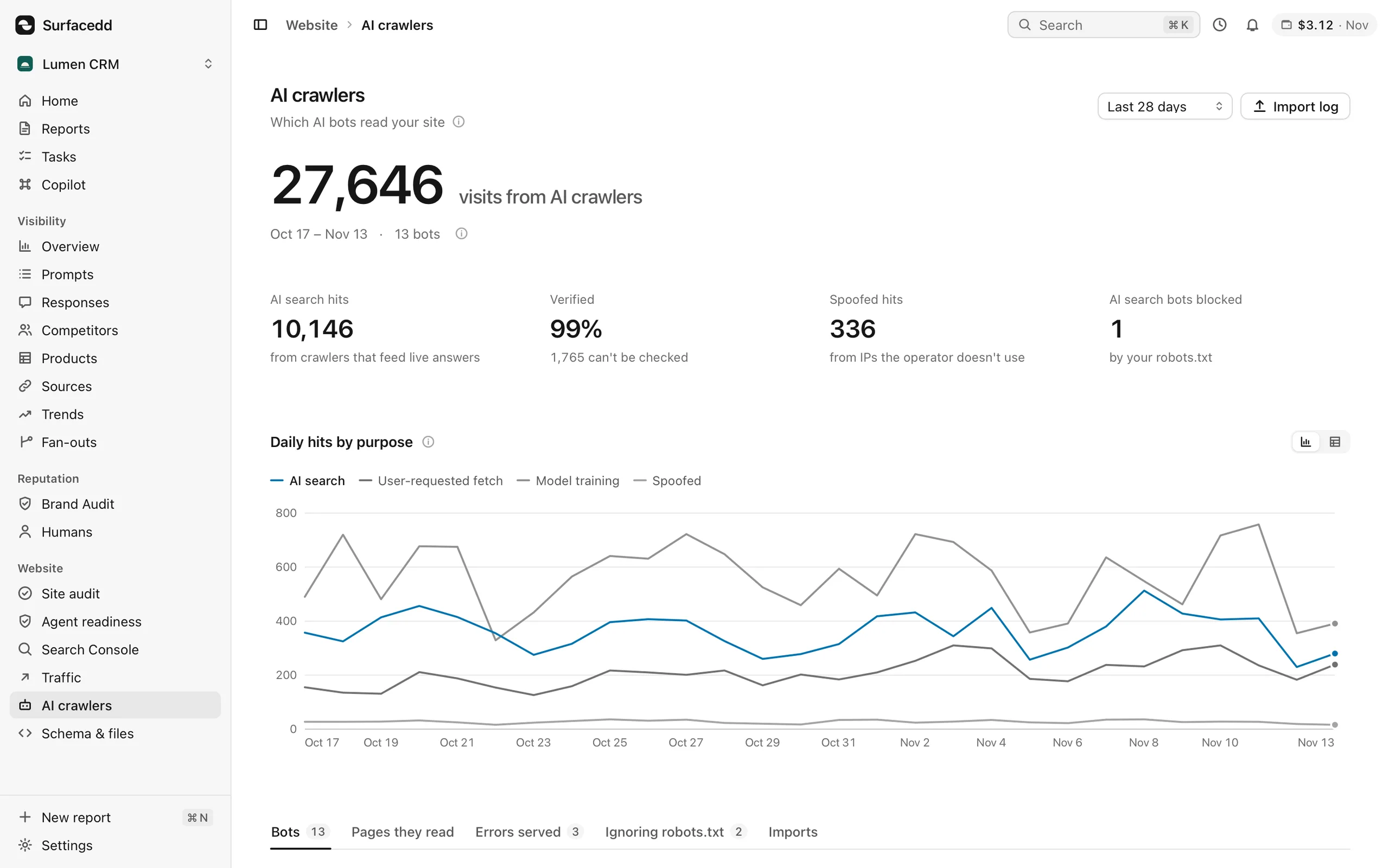
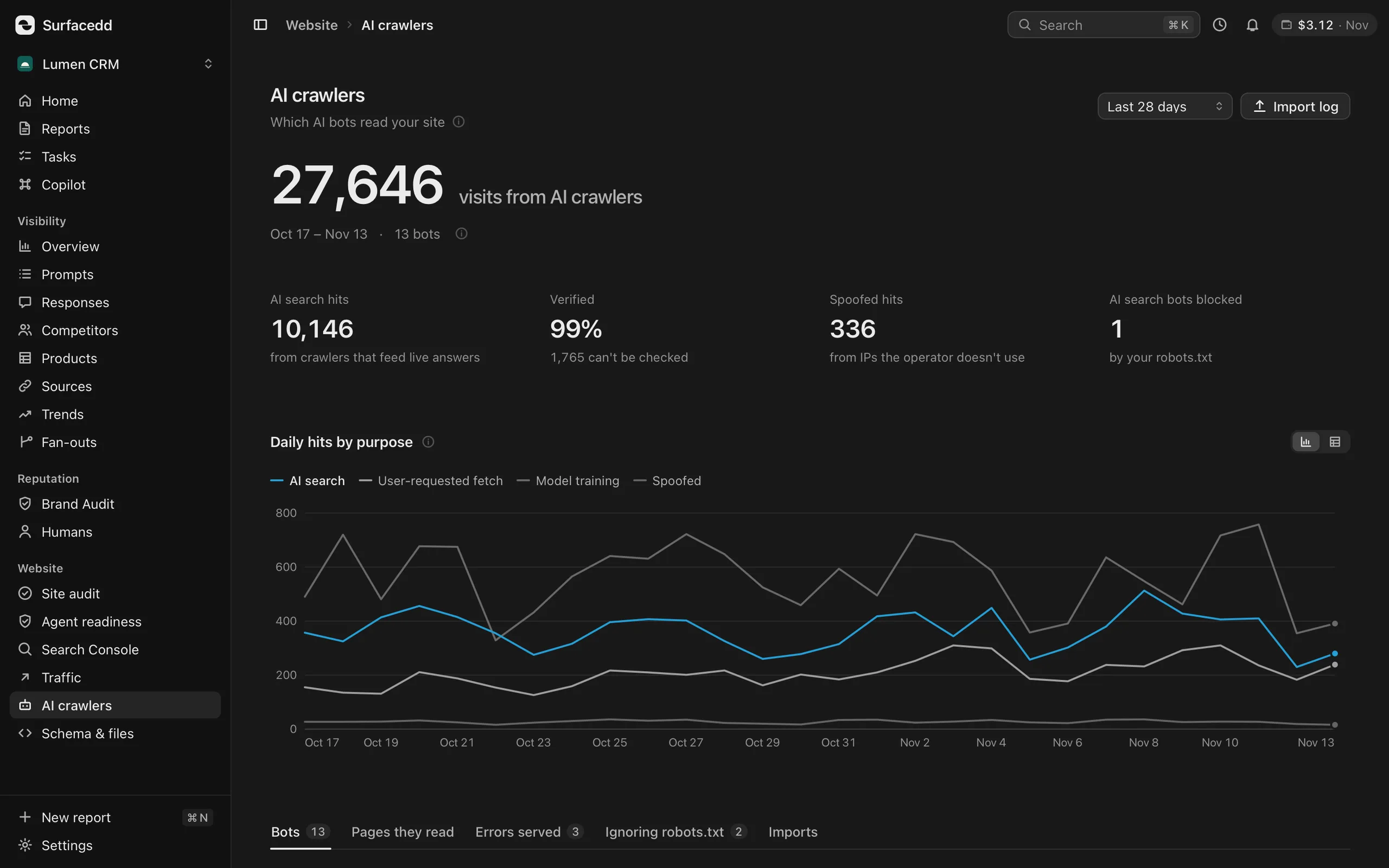
Surfacedd's AI crawlers screen imports your server or CDN log on your computer, matches every line against the catalog above, and checks each claimed crawler against its operator's published IP ranges. Each hit is labelled verified, spoofed, unverifiable or unchecked. You see daily hits by purpose, the pages each bot reads, errors served to bots, and bots still crawling paths your robots.txt blocks.
Only daily totals and the top 200 paths per bot per day are stored. IP addresses are never kept, and the log never leaves your machine. The AI crawler analytics feature explains the views in detail; the app is a one-time purchase, see pricing.
Sources
- OpenAI: Overview of OpenAI crawlers
- Anthropic: Does Anthropic crawl data from the web, and how can site owners block the crawler?
- Perplexity: Perplexity crawlers
- Google: Google's common crawlers (Google-Extended, GoogleOther)
- Google: AI features and your website
- Apple: About Applebot
- Meta: Meta web crawlers
Fair questions
What is the difference between GPTBot and OAI-SearchBot?
GPTBot collects pages that may be used to train OpenAI's future models. OAI-SearchBot indexes pages so ChatGPT search can show and cite them. They are controlled separately in robots.txt, so you can block GPTBot to opt out of training and still allow OAI-SearchBot. Blocking GPTBot does not remove you from ChatGPT's search answers.
What is ChatGPT's user agent?
ChatGPT uses three. OAI-SearchBot indexes pages for ChatGPT search, ChatGPT-User fetches a page live when someone asks ChatGPT to, and GPTBot crawls for training. Each full user-agent string contains its name plus a version and a link to openai.com. Match on the name, not the exact string, because OpenAI says the version numbers change.
Does blocking AI crawlers stop AI from talking about me?
No. Assistants also answer from what models learned earlier and from other sites that mention you. Blocking search crawlers mainly stops them citing your own pages, which usually leaves third-party pages to describe you instead. Blocking training crawlers only affects future models. Neither removes facts already learned or published elsewhere.
Do AI crawlers run JavaScript?
Most AI search crawlers and user fetchers read the HTML your server sends, and their operators don't document full JavaScript rendering. Googlebot is the exception: it renders pages. If your prices, product names or answers only appear after scripts run, many assistants will not see them. Serve key facts in the initial HTML.
How often do AI crawlers pick up robots.txt changes?
OpenAI says its search systems can take about 24 hours to reflect a robots.txt change, and Perplexity says up to 24 hours. The robots.txt standard (RFC 9309) also tells crawlers not to rely on a cached copy for more than 24 hours. Plan for a day before you judge whether a change worked.
Should I block Bytespider?
Bytespider is ByteDance's crawler, and its operator publishes no IP list, so you cannot verify which hits really come from ByteDance. It has no search role in the assistants we track. Blocking it is a training decision with no citation cost, but a scraper using its name may ignore robots.txt anyway.
How many AI crawlers are there?
Surfacedd's catalog currently tracks 32 entries, including two robots.txt tokens that never visit. New ones appear every few months, usually as a vendor splits one bot into search, fetch and training versions. That's why the catalog updates without an app release, and why this page's table is generated rather than typed.
Free tools for this guide
How we research, write and correct pages: read our editorial policy.