See when Google's AI Overviews show up, and whether they cite you
Surfacedd fetches the real Google results page through DataForSEO at the exact city and language you choose, records whether an AI Overview appeared, and reads every page it cited.
By the Surfacedd teamUpdated 7 min readMarkdown
On this page
Short answer
An AI Overviews tracker checks the Google results page for your queries and records two things: whether an AI Overview appeared at all, and which pages it cited. Surfacedd captures both through DataForSEO at the exact location and language you set, and reports the shown rate separately from your citation rate.
How AI Overviews is collected
- How Surfacedd asks
- A Google results page fetched through DataForSEO with the asynchronous AI Overview loaded.
- Key you need
- DataForSEO API login
- Location
- Exact: any location DataForSEO supports.
- Searches it ran (fan-outs)
- Not exposed.
- Citations
- References inside the AI Overview block, in display order.
- Search fee
- $0.0012 per results page, all-in (standard queue)
- Default model
- Not a model: the Google results page, via DataForSEO
Worth knowing
- When Google shows no AI Overview, that is recorded as a result: it counts as an answer that does not name you, and the share of queries that showed an Overview is reported separately.
Cost per answer
$0.0012
estimated, paid to DataForSEO on your account
- 100 answers
- $0.12
- 25 prompts × 3 samples, weekly, for a month
- $0.39
- Reading each answer (GPT-6 Luna)
- +$0.0015
From price table 2026-11-13.1, using typical token counts and the standard queue. The app recalibrates from your own answers and shows its estimate before each run. How costs are estimated
What AI Overviews tracking measures
AI Overviews tracking answers two questions in order. First: for the queries your buyers search, how often does Google show an AI Overview at all? Second: when it does, does it cite your pages, and whose pages does it cite instead?
Most tools skip the first question and report only citations, which hides the biggest variable. If Google shows an Overview for 30% of your queries, a perfect citation record still reaches only 30% of searchers. If it shows for 90%, the Overview is the first thing most of them read. You need the shown rate before you can judge the cited rate.
| Metric | Question it answers | How Surfacedd counts it |
|---|---|---|
| Shown rate | How often does Google show an AI Overview for these queries? | Answers with an Overview ÷ all checks, per market |
| Visibility | How often is my brand named in the Overview? | Answers naming you ÷ all checks, including "not shown" |
| Citation rate | How often is one of my pages in the Overview's references? | Answers citing an owned page ÷ all checks |
| Citation share | What share of all references are mine? | Your references ÷ all references |
Shown vs not shown, and why it comes first
Google says its AI features appear only when its systems decide they add value beyond classic results, so many queries never trigger one. In Surfacedd, a check where Google showed no Overview is a real result, not a missing one. It stays in the visibility denominator as an answer that doesn't name you, and the shown rate is reported beside it ("AI Overview shown for 62% of queries").
That design choice protects you from a common misreading. Suppose your visibility drops from 40% to 25% between two runs. If the shown rate also fell from 80% to 50%, Google simply showed fewer Overviews; your standing inside the ones it showed may not have changed. Surfacedd shows both lines so you can tell the difference, and only marks a change as significant when the 95% range of the difference excludes zero.
How answers are captured
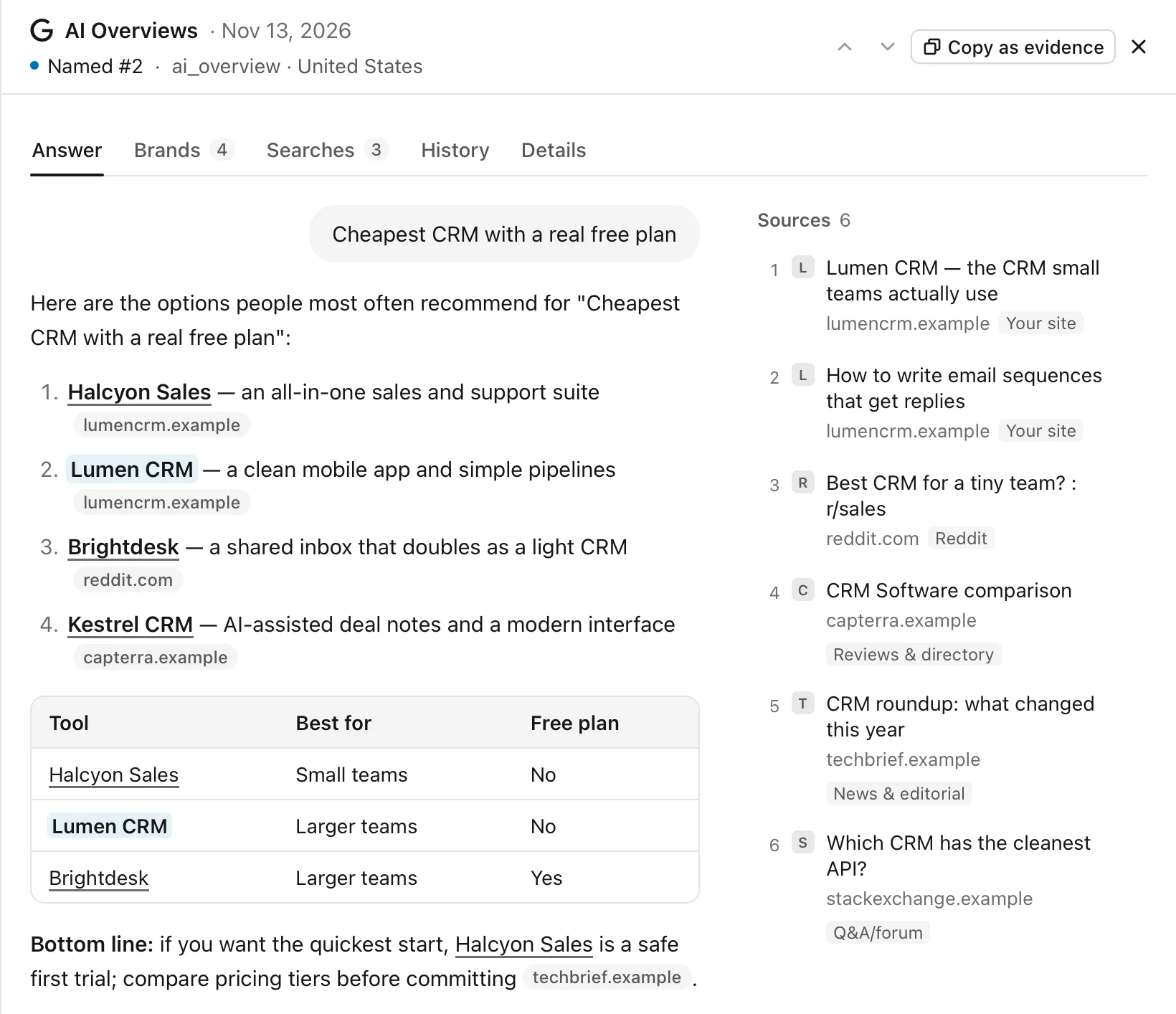
Google has no public API for AI Overviews. Surfacedd fetches the real Google results page through DataForSEO's SERP API on your own DataForSEO account, with the load_async_ai_overview option on. That matters: DataForSEO's docs say that without it, only Overviews that load with the page are returned, and Overviews that Google loads a moment later are missed.
From each page Surfacedd keeps the Overview's text, its references in the order Google shows them, and the organic results underneath. Because the organic positions come from the same page, you can see whether Google cited pages it also ranks on page one, or reached further down.
Exact location and language
This is where AI Overviews are easier to track than chat engines. DataForSEO takes a location code down to city level, or coordinates with a radius, plus a language code. So "emergency plumber" checked in Leeds and in Bristol, in English, are two different results pages, exactly as two searchers in those cities would see them.
Set markets once on a report and every prompt is checked in each of them. Use this to answer questions a national rank tracker can't: does Google show an Overview for your service in the cities you serve, and whose pages does it trust in each?
Cost per check
AI Overviews are billed per results page, with no tokens and no model. DataForSEO prices the page by queue: the standard queue is cheapest and answers within minutes, priority is faster, and live answers at once. Surfacedd uses the standard queue for scheduled runs and the live endpoint only when you press Run now.
| DataForSEO queue | Price per results page | Used for |
|---|---|---|
| Standard | $0.0012 | Scheduled runs |
| Priority | $0.0024 | Faster scheduled runs |
| Live | $0.0040 | Run now |
AI Overviews is captured from the Google results page through DataForSEO, so there is no model or token cost. Prices from price table 2026-11-13.1 on 2026-11-23 (UTC).
At the standard rate, 50 queries in 3 cities, checked weekly, cost about $1.76 a month, paid to DataForSEO. Billed DataForSEO requests are never retried automatically, so a server error can't charge you twice.
Reading AI Overview citations
Each reference in an Overview is a page Google used for part of the answer. Surfacedd numbers them in display order, so position 1 is the reference a reader sees first. Three patterns are worth looking for:
- Cited and ranking. Your page is in the Overview and on page one. Protect it: don't restructure the passage Google quotes.
- Ranking, not cited. You rank, but the Overview cites others. Compare the cited pages' opening paragraphs with yours; the cited ones usually answer the query in the first two sentences.
- Cited, not ranking. Google cites a page it ranks lower. This is common for specific sub-questions, and it's a sign the page answers one part of the query unusually well.
The Sources screen totals these across every query, so you see which domains Google's AI trusts in your category, not only on one search.
AI Overviews vs AI Mode
They share a company and an index, but they are different surfaces with different endpoints and different meanings of "not shown". An Overview sits on top of the classic results and often doesn't appear. AI Mode is a separate conversational results page that always answers. Surfacedd tracks them as two engines, so a trend in one never hides inside the other. The Google AI Mode tracker page explains the second surface.
How to show up more often
Google says there are no special requirements or optimisations for its AI features: a page must be indexed and eligible to show with a snippet. In practice, the pages that get cited answer the query directly, near the top, in a passage that stands on its own. The full method, including when to use max-snippet and nosnippet, is in how to rank in AI Overviews. Before you change anything, measure the shown rate, so you know the change has room to matter.
What it doesn't do
You need a DataForSEO account with credit; the DataForSEO setup guide covers the login, the API password and the minimum top-up. Then buy Surfacedd once and add the key.
Sources
Fair questions
Why does Surfacedd count "no AI Overview" as a result?
Because it's what the searcher saw. If Google showed no Overview, nobody read your brand in one. Counting those checks keeps visibility honest and comparable over time. The shown rate is reported next to it, so you can tell "Google showed fewer Overviews" apart from "Google stopped citing us". Dropping the empty checks would make a shrinking surface look like a stable one.
How accurate is DataForSEO's capture?
It fetches the real Google results page for the location and language you set, with the delayed Overview loaded, and returns the Overview's text and references as Google showed them. It can't reproduce a signed-in person's personalised page. Google also varies Overviews between identical searches, which is why Surfacedd reports rates over many checks rather than single results.
Can I track AI Overviews in a specific city?
Yes. DataForSEO accepts a location code down to city level, or coordinates with a radius, plus a language. Each market on a report is checked separately, so you can compare whether Google shows an Overview, and whom it cites, in each city you serve. This is the most precise location control of the eight engines Surfacedd tracks.
How much does an AI Overviews check cost?
It depends on the DataForSEO queue. Scheduled runs use the standard queue, the cheapest; Run now uses the live endpoint, which costs more. The table on this page shows today's prices from our price table. There's no token cost, because no model is involved: the price covers the whole results page.
Does blocking Google-Extended remove me from AI Overviews?
Google says Google-Extended controls whether content is used for Gemini training and grounding in some of its other products, and that it doesn't affect inclusion in Google Search. AI Overviews are part of Search. To limit what Google shows from a page in Search, Google points to nosnippet, data-nosnippet, max-snippet and noindex instead.
Is AI Overviews tracking the same as rank tracking?
No. A rank tracker tells you your position in the organic results. AI Overviews tracking tells you whether an AI summary appeared above them, whether it named or cited you, and who it cited instead. Surfacedd keeps the organic positions from the same page, so you can compare the two directly.
How we research, write and correct pages: read our editorial policy.