How to get cited when Gemini searches Google
Gemini looks things up with Google Search, so most of what gets you found in Google gets you found in Gemini. The exceptions are one robots.txt token and the fact that Gemini writes its own searches.
By the Surfacedd teamUpdated 6 min readMarkdown
On this page
Short answer
Gemini grounds its answers in Google Search, so classic Google SEO carries over: be indexed, rank for the specific sub-questions Gemini searches and answer them plainly. The one Gemini-specific control is Google-Extended, which Google says governs grounding in Gemini Apps without affecting your inclusion in Google Search.
How does Gemini ground its answers?
Gemini uses Google Search as its retrieval layer. Google's grounding documentation describes the loop: when grounding is on, the model decides whether a search would improve its answer; if so, it writes one or more search queries, runs them, reads the results and returns an answer with citations that mark which text each source supports.
So Gemini doesn't have its own separate index you need to get into. It has Google's. The question is not "how do I get into Gemini" but "when Gemini searches Google for the sub-questions behind my buyer's prompt, does my page come back, and is it the clearest answer?"
Grounding is the general term for this: tying a model's answer to retrieved sources rather than to memory alone.
What carries over from Google SEO
Nearly everything that gets a page found in Google Search applies, because the searches are Google searches.
| Google SEO practice | Why it matters for Gemini |
|---|---|
| Indexable, crawlable pages | Gemini can only cite what Google's index returns |
| Ranking for specific long-tail questions | Gemini's own queries are often narrower than the user's prompt |
| Clear headings and answer-first paragraphs | Gemini cites passages; a passage that stands alone is easier to use |
| Facts in HTML text | Prices, specs and dates hidden in images or scripts may not be read |
| Real authorship and update dates | Helps Google judge a page worth surfacing |
| Mentions on reputable sites | Google's results for comparison queries lean on roundups and reviews |
What Google says about its own AI features applies by extension: in its AI optimisation guide, there's "no special schema.org markup you need to add", no need to "break your content into tiny pieces", and creating many pages "primarily to manipulate rankings or generative AI responses" breaks its scaled content abuse policy.
What's different about Gemini
Three things.
Gemini writes its own searches. A user's prompt becomes one or more Google queries chosen by the model. Those sub-queries are often longer and more specific than anything in a keyword tool, so a page that answers one narrow question well can be cited without ranking for the head term. The query fan-out guide shows how to find them.
Location isn't controllable through the API. Google's grounding docs describe no location or region setting; grounding "works with all available languages". Results for local questions depend on how the question is phrased more than where it's asked from, so put the place in the content: city names, service areas, local proof.
The Gemini app isn't the API. The Gemini app adds a user's history, settings and Google account context. The grounded API gives a repeatable answer for a given prompt. Measure with the API; spot-check in the app.
Google-Extended: what it does and doesn't control
Google-Extended is a robots.txt token, not a crawler with its own user agent. Google's crawler documentation says it controls two things:
- Whether content Google crawls may be used to train future Gemini models.
- Whether Google may supply content from the Search index to those models at prompt time to ground answers, in Gemini Apps and in Grounding with Google Search on Vertex AI.
And one thing it doesn't: Google says it "does not impact a site's inclusion in Google Search" and isn't a ranking signal.
That second point is the one most sites miss. Blocking Google-Extended to opt out of training can also stop your pages being used to ground Gemini app answers. If being cited in Gemini matters to you, weigh that before adding:
# Opts out of Gemini training AND grounding in Gemini Apps / Vertex AI.
# Does not affect Google Search, AI Overviews or AI Mode.
User-agent: Google-Extended
Disallow: /
Google also says it plans to support the shared AI-training preference signal (__usage_ai-training) in early 2027, which may eventually let sites separate training from grounding more cleanly. Until then, it's one switch for both. The Google-Extended glossary entry has more detail.
A worked checklist
A hypothetical example: a garden-design studio in Bristol wants Gemini to cite it for "who designs small urban gardens in Bristol?"
- Google-Extended isn't blocked (or the studio has decided the training trade-off is worth it).
- The services page says "small urban gardens" and "Bristol" in plain text, near the top.
- A section answers "How much does a small garden design cost in Bristol?" with a real range.
- A section answers "How long does a garden design project take?"
- Project pages name neighbourhoods (Clifton, Bedminster) with photos and captions in text.
- The studio is listed accurately on the directories and local roundups that rank for those questions.
- Gemini's answers are checked over several weeks, along with the searches it ran.
Every box is ordinary local SEO. That's the point: for Gemini, Google SEO is the strategy.
Measuring Gemini
Measure how often Gemini names you and how often it cites your pages for your buyers' prompts, over several weekly runs, and record the searches it ran. Gemini's API returns its search queries and the cited URLs, so you can see which sub-question led to which citation.
Two quirks to plan for: Google's citation titles are the source's domain rather than the page title, and links can arrive as Google redirect URLs, so a tracker has to resolve them to see the real page. And Google's Gemini API terms restrict what may be done with grounded results, including analysing them, and require Google's Search Suggestions to be shown with them. If you track Gemini on your own API key, you're Google's customer: read those terms before you start.
Measuring Google's other AI surfaces
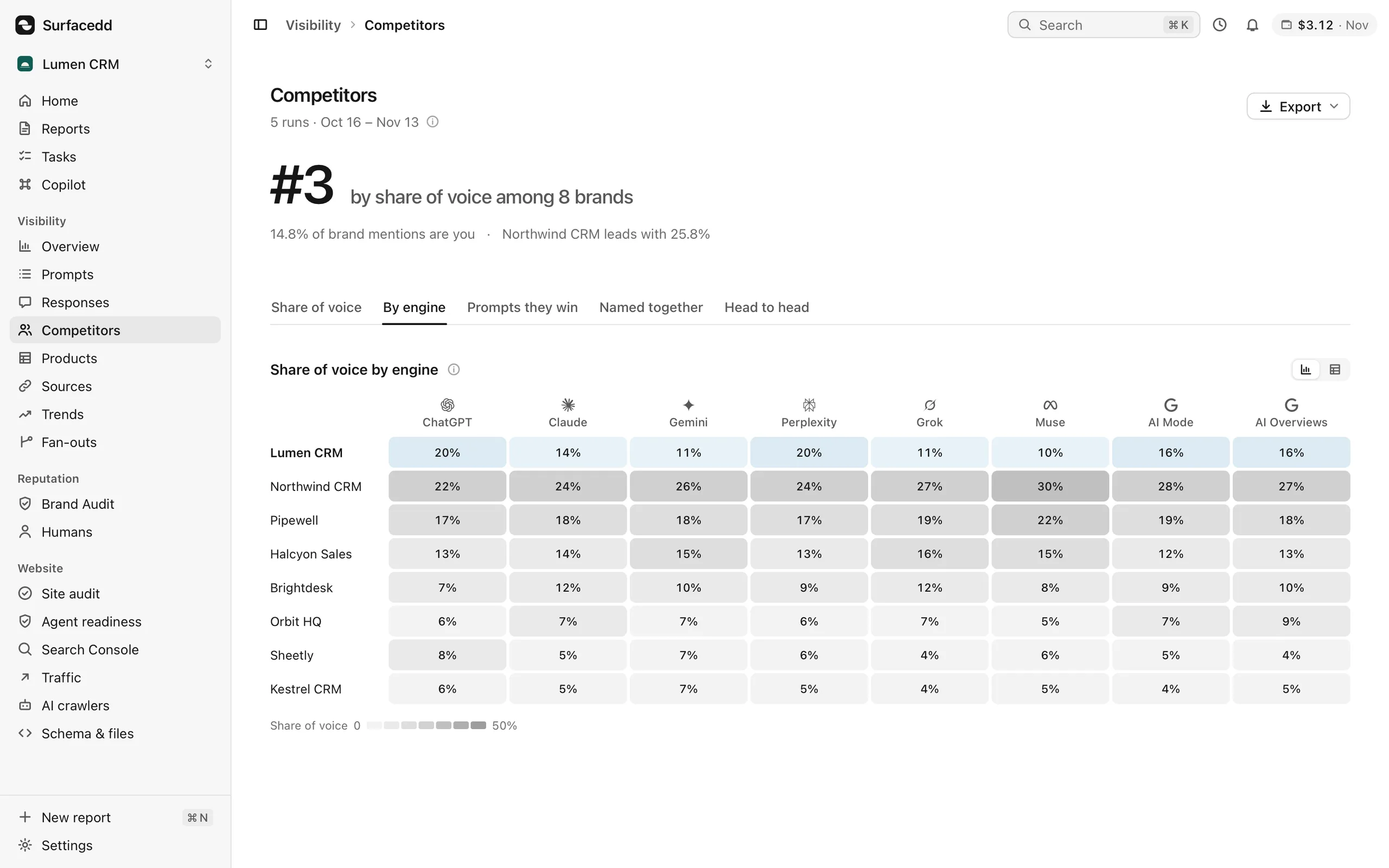
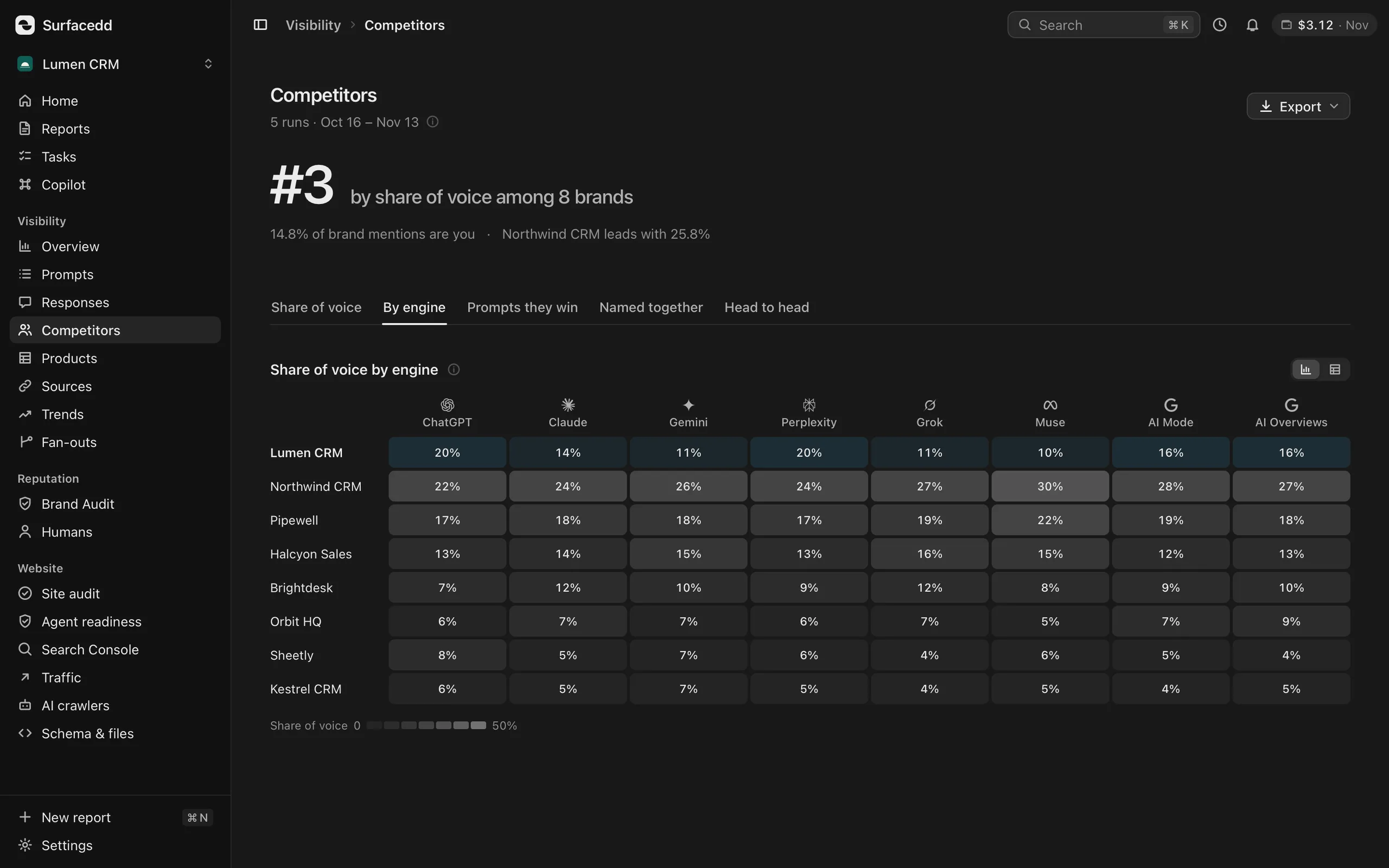
Gemini shares Google's index with AI Mode and AI Overviews, and work that gets you cited in one usually helps the others. Those two are captured from the real Google results page at exact locations, which Gemini's API can't do. Surfacedd tracks both as separate engines, so you can see whether Google's AI surfaces cite you in each city you serve; the AI Mode guide covers what to change. The by-engine view shows where Google's surfaces agree with ChatGPT and Claude and where they don't, and the competitors and sources feature lists the pages they rely on.
Sources
Fair questions
Does Gemini use Google Search?
Yes, when grounding is on. Google's documentation says the model decides whether a search would help, writes one or more queries, runs them on Google Search and cites the results it used. That's why ranking in Google for the specific sub-questions behind a prompt is the core of being cited by Gemini.
Will blocking Google-Extended hurt my Google rankings?
No. Google says Google-Extended doesn't affect inclusion in Google Search and isn't a ranking signal. It does control whether your content is used to train Gemini models and to ground answers in Gemini Apps and Vertex AI, so blocking it can reduce your presence in Gemini's grounded answers while leaving Search untouched.
Is ranking in Gemini different from ranking in AI Overviews?
They draw on the same index but are different products. AI Overviews appear on the Google results page for some queries; Gemini answers whatever it's asked, in a chat. The pages that win are similar, clear answers to specific questions, but the citation sets differ, so measure each separately.
Can I target Gemini users in a specific city?
Not through location settings: Google documents no location control for grounding. Put location into your content instead: city and area names, local prices and local proof in plain text. For location-precise measurement of Google's AI, track AI Mode and AI Overviews, which can be captured at a specific city.
Does structured data help Gemini cite me?
Not as a special requirement. Google says there's no special schema.org markup needed for its AI features. Accurate structured data still helps Google understand your entities and earn rich results in Search, which Gemini's searches draw on, so keep it correct and matching the visible page.
How we research, write and correct pages: read our editorial policy.