A GEO strategy that shows what worked in 90 days
Baseline in week one, fix access and facts in weeks two to four, earn mentions after that, and decide with like-for-like re-checks instead of single screenshots.
By the Surfacedd teamUpdated 9 min readMarkdown
On this page
Short answer
A GEO strategy is a 90-day loop: measure a fixed prompt set on each AI engine, fix crawler access and wrong facts, earn mentions on the pages engines cite, then re-check weekly. Judge each change over about four weekly runs, and stop tactics that show no clear change by day 60.
What is a GEO strategy, and why 90 days?
A GEO strategy is a written plan for raising how often AI answers name and cite your brand, with a fixed measurement set, a budget and decision rules agreed before the work starts. Generative engine optimization is the practice; the strategy is the order you do it in and the evidence you'll accept that it worked.
Ninety days is the shortest window that fits three needs:
- Enough runs to see a change. AI answers vary between identical runs. Our methodology advice is to judge trends over about four weekly runs, not one. A 90-day plan gives you a baseline month plus two months of re-checks.
- Enough time for crawling. Off-site mentions and new pages have to be crawled, indexed and then picked by an engine. That takes weeks.
- Short enough to kill bad ideas. If a tactic hasn't moved anything by day 60, you still have a month to try something else before the quarter ends.
This guide is the plan. For the cross-engine "what matters" reference, read how to optimize for AI search; for every individual check, use the GEO checklist.
Before week 1: what to decide up front
Write four decisions down before you run anything, because changing them mid-quarter breaks comparisons.
- The prompt set. 20–50 questions your buyers ask, with your brand name in at most 30% of them. More branded prompts than that and the numbers mostly tell you that AI knows your name. Don't wait for search-volume data to choose them: true prompt volume isn't published by any AI company. Spread them across awareness, consideration and decision, with at least three per stage.
- The competitor list. Three to six named rivals you lose deals to. Share of voice is only as meaningful as this list.
- The engines. The ones your buyers use. The default four in Surfacedd are ChatGPT, Claude, Perplexity and Google AI Mode; add Gemini, Grok, Meta AI or AI Overviews when they matter to your market.
- The success measure. Pick one primary number per engine. For most teams it's AI visibility (the share of answers naming you); for categories where everyone is named, it's position or share of voice.
Week 1: build the baseline
The baseline is a full run of your prompt set on every chosen engine, repeated so you know how much the numbers move on their own. Without it, every later number is unreadable.
Run the set three times in week 1 (or once a day for three days). Three samples per prompt are the minimum for a per-prompt range: with k≥3 samples Surfacedd shows a Wilson 95% range per prompt, and at aggregate level it bootstraps over prompts. If a range is wide, that is the information: the engine isn't settled on an answer.
Record for each engine:
| Baseline metric | Why you need it |
|---|---|
| Visibility with its 95% range | The number you'll compare against |
| Share of voice vs your listed rivals | Shows whether you're losing to specific brands |
| Prompts a rival wins without you | Your first target list |
| Pages cited in answers, by domain | Where mentions and fixes will come from |
| Citation rate for your own domain | Whether your pages are used, not just your name |
The AI visibility score tiers give a rough reading: Strong at 50% or more, Moderate at 25–49%, Emerging below 25%.
Weeks 2–4: fix access and facts
Weeks 2–4 are for fixes you control completely: who can read your site, and what your own pages say. They are cheap, quick to verify, and they're preconditions for everything after.
Access (week 2).
- Allow each engine's search crawler and user-triggered fetcher in robots.txt: OAI-SearchBot, Claude-SearchBot, PerplexityBot, Googlebot, Bingbot. Decide separately about training bots like GPTBot.
- Check your firewall doesn't serve challenge pages to those bots.
- Make sure key pages render their text without JavaScript.
Facts (weeks 3–4).
- One name, one description, one price, one feature list across your site, docs, app listings and main profiles.
- An answer-first section on an owned page for each of your top five buyer questions.
- Correct the pages that AI answers cite with wrong facts about you, starting with your own.
Decision point at the end of week 4. Re-run the full set once. Compare like for like, meaning the same prompts, engines, markets and models as the baseline.
- If an engine moved from near zero to above zero after an access fix, keep going; access was the blocker.
- If nothing moved anywhere, that's normal at week 4. Don't change the prompt set to "find" a change.
Weeks 4–12: earn mentions where engines read
From week 4, most of the effort goes to third-party pages, because most citations in AI answers point to sites you don't own. In Ahrefs' study of 75,000 brands, branded web mentions correlated with AI Overview visibility at 0.664, against 0.218 for backlinks (Ahrefs, May 2025). That's correlation, not proof, but it tells you where to look.
A weekly cadence for one person, about three hours:
| Day | Task | Output |
|---|---|---|
| Monday | Scheduled run finishes; read the "won without you" prompts | 3–5 prompts to work this week |
| Tuesday | Open the answers for those prompts; list the cited pages that name a rival and not you | A target list with URLs |
| Wednesday | Pitch, correct or contribute to two or three targets (listicle authors, review profiles, docs you're listed in) | Dated notes per target |
| Thursday | Fix one owned page that a lost answer should have cited | One page shipped |
| Friday | Log what you did against each prompt, so the next run can be read against it | Change log |
Where to find the targets, and how to approach them without spam, is covered in brand mentions in AI search and Reddit and AI answers.
How do you re-check and decide?
Re-check by running the same prompt set weekly and comparing only the prompts, engines, markets and models present in both runs. Call a change real only when it's significant: the 95% range of the difference excludes zero. Everything else is "no clear change".
Decision rules worth agreeing in advance:
- If share of voice is flat after four weekly runs on an engine, stop adding content and re-read the sources behind the lost answers. The pages you're working on probably aren't the ones that engine reads.
- If visibility rises but citation rate doesn't, you're being named from third-party pages; your own pages aren't answering the question. Fix the owned page the answer should have cited.
- If one engine drops sharply and the others don't, check that engine's crawler access and your server errors before anything else.
- If a rival appears in a new batch of answers, look at which pages started citing them. That's the play they ran.
- If the prompt set changes, the trend line breaks. Note it, and start a new comparison window.
What does a GEO strategy cost?
The direct cost is API fees for measurement plus your time; the licence is separate. These are the monthly API costs for asking each prompt once per run on the four default engines, at today's list prices:
| Prompts | Weekly | Daily |
|---|---|---|
| 10 | $1.52 | $10.47 |
| 25 | $3.75 | $26.21 |
| 50 | $7.47 | $52.38 |
A full 90-day plan for 25 prompts looks like this:
- Baseline, week 1: one pass with three samples per prompt costs about $2.58 on the default four engines, or $5.78 on all eight.
- Weeks 2–13: one sample weekly on the default four, about $3.75 a month, so roughly three times that for the quarter.
Daily runs rarely pay off. Answers vary day to day, so daily data mostly adds noise unless you're watching a launch. Per-answer prices by engine are in the cost calculator.
What goes in the day-90 review?
The day-90 review is a one-page note that says, per engine, what changed, what you did, and what you'll do next quarter. Write it so someone who wasn't involved can check every number against the answers behind it.
A template that works:
| Section | What to write | Example (fictional) |
|---|---|---|
| Scope | Prompt set, engines, markets, run count | 25 prompts, 4 engines, US, 12 weekly runs |
| Headline per engine | Baseline vs latest visibility, with ranges, and whether the change is significant | Perplexity 18% (12–25%) → 31% (24–39%), significant; ChatGPT 22% → 24%, no clear change |
| Share of voice | Your share vs each listed rival, start and end | You 14% → 19%; main rival 41% → 37% |
| What moved it | The dated actions that line up with a significant change | Week 5: listed on two cited comparison pages; week 7: pricing page answers "cost per seat" |
| What didn't | Tactics with no clear change after four runs | Three new blog posts on fan-out topics: no change on any engine |
| Next quarter | Three bets, each tied to a lost prompt or cited page | Work the five cited listicles that name rivals only |
Two rules keep the review honest. Report "no clear change" as a result, not a failure: knowing that a tactic did nothing is what lets you stop paying for it. And never report a single engine's best week as the quarter's outcome; use the like-for-like comparison of the first and last month.
How Surfacedd runs this plan
Surfacedd is built around the loop above: a fixed prompt set per report, scheduled runs that catch up after your laptop sleeps, like-for-like comparisons with 95% ranges, and tasks that carry the answers behind them. It shows the cost of every run before it starts.
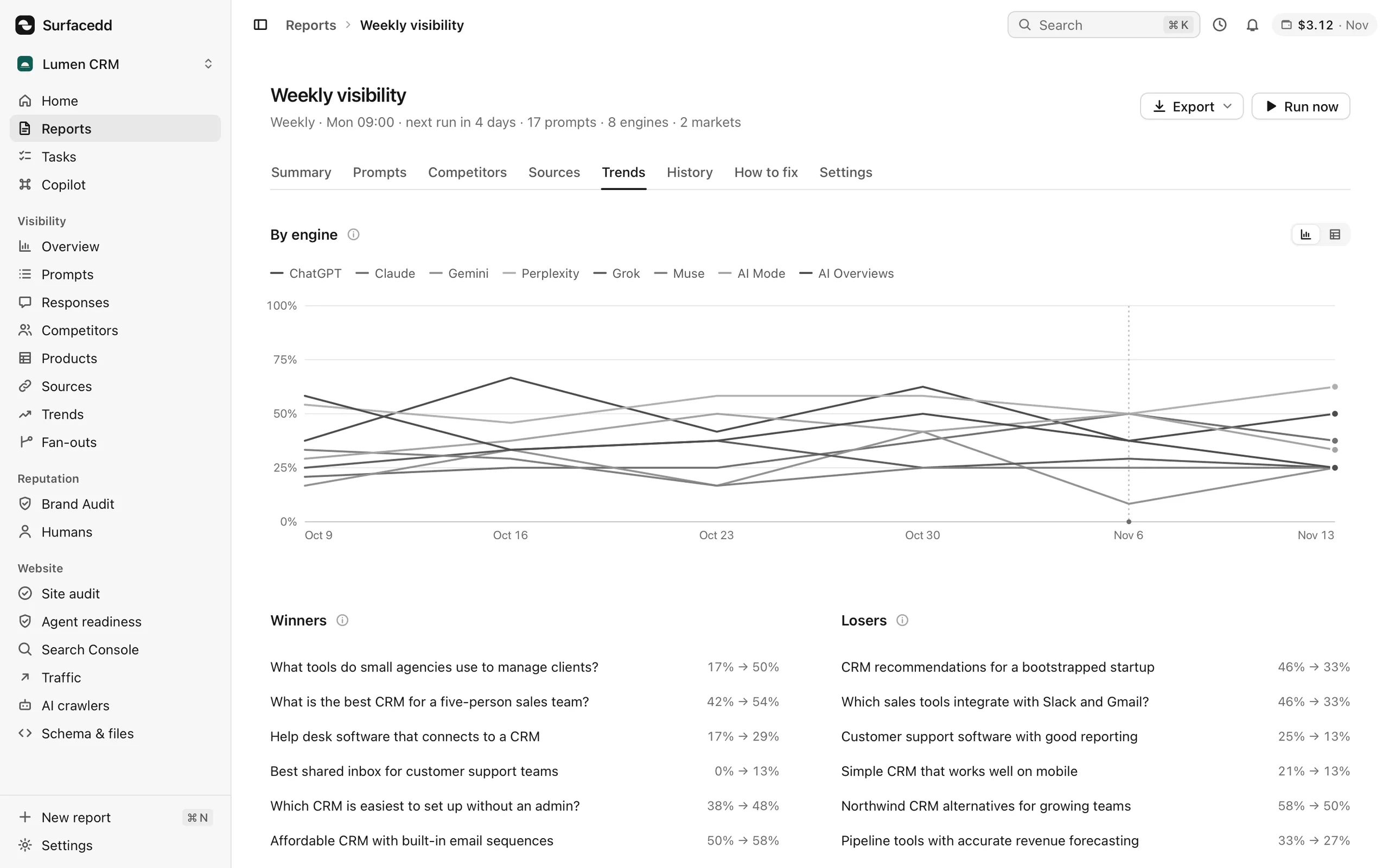
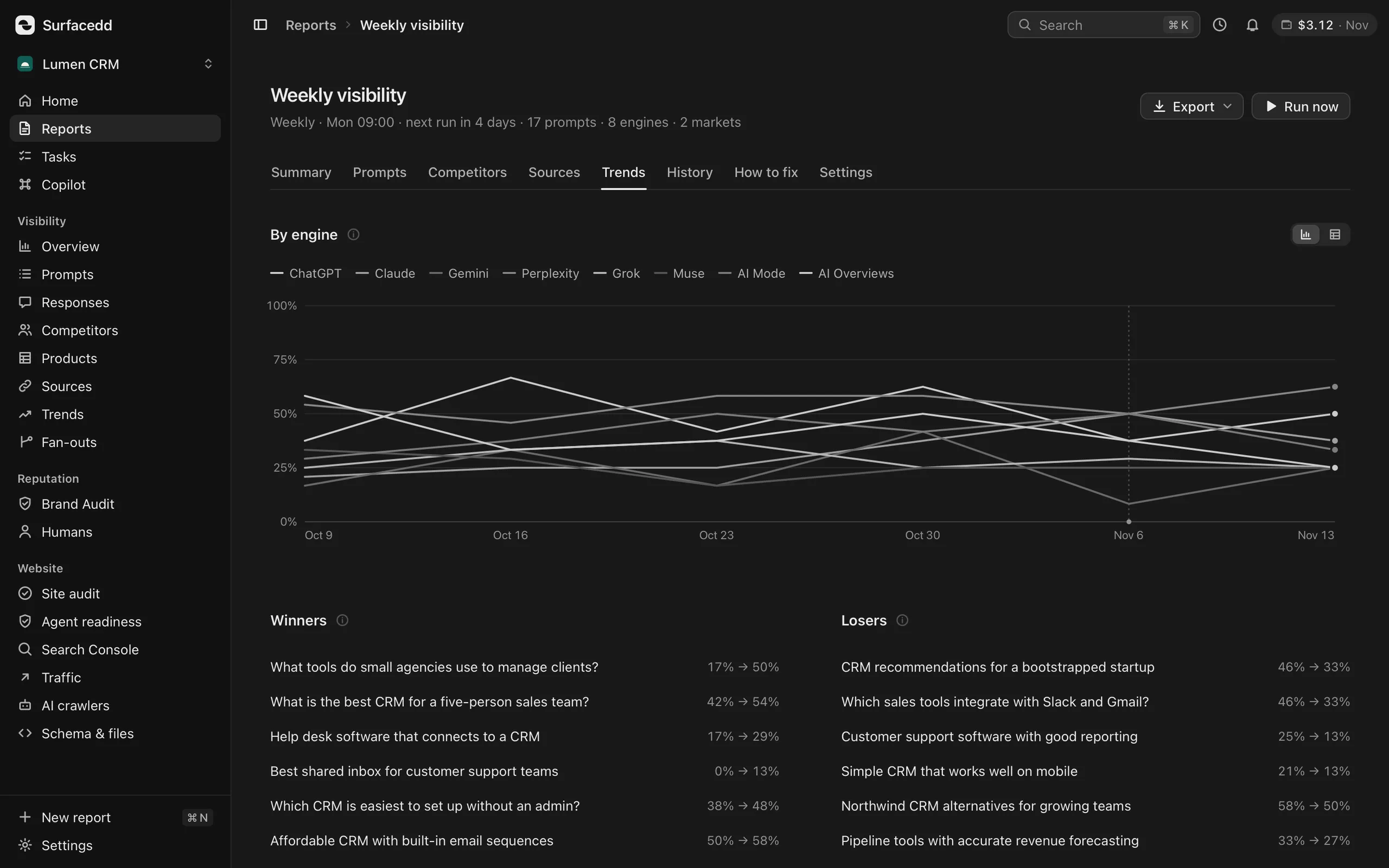
The Trends view shows each engine's line and the prompts that gained or lost the most between runs, which is your Monday reading list. Runs whose configuration changed get a marker, so you don't mistake a new prompt set for progress.
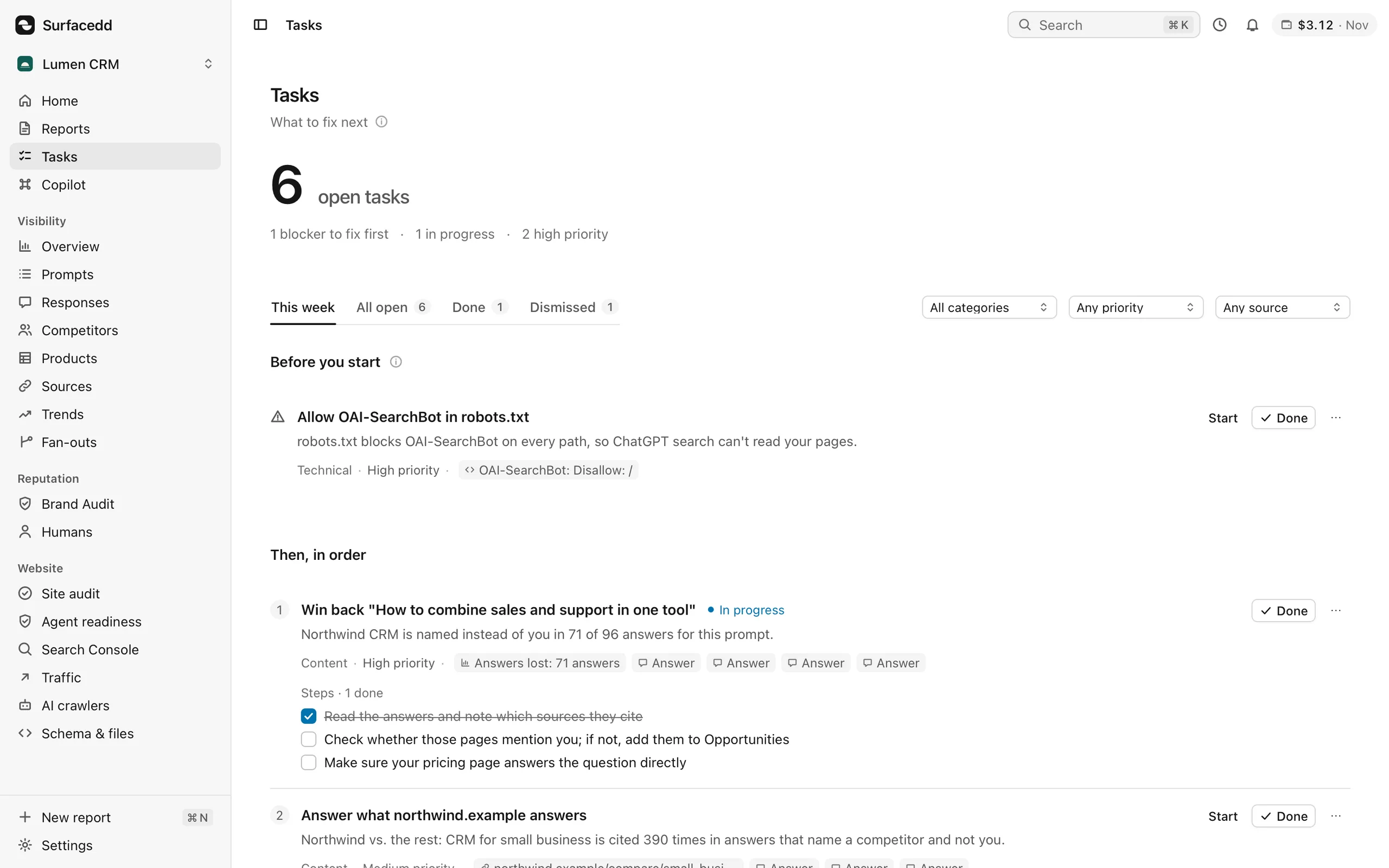
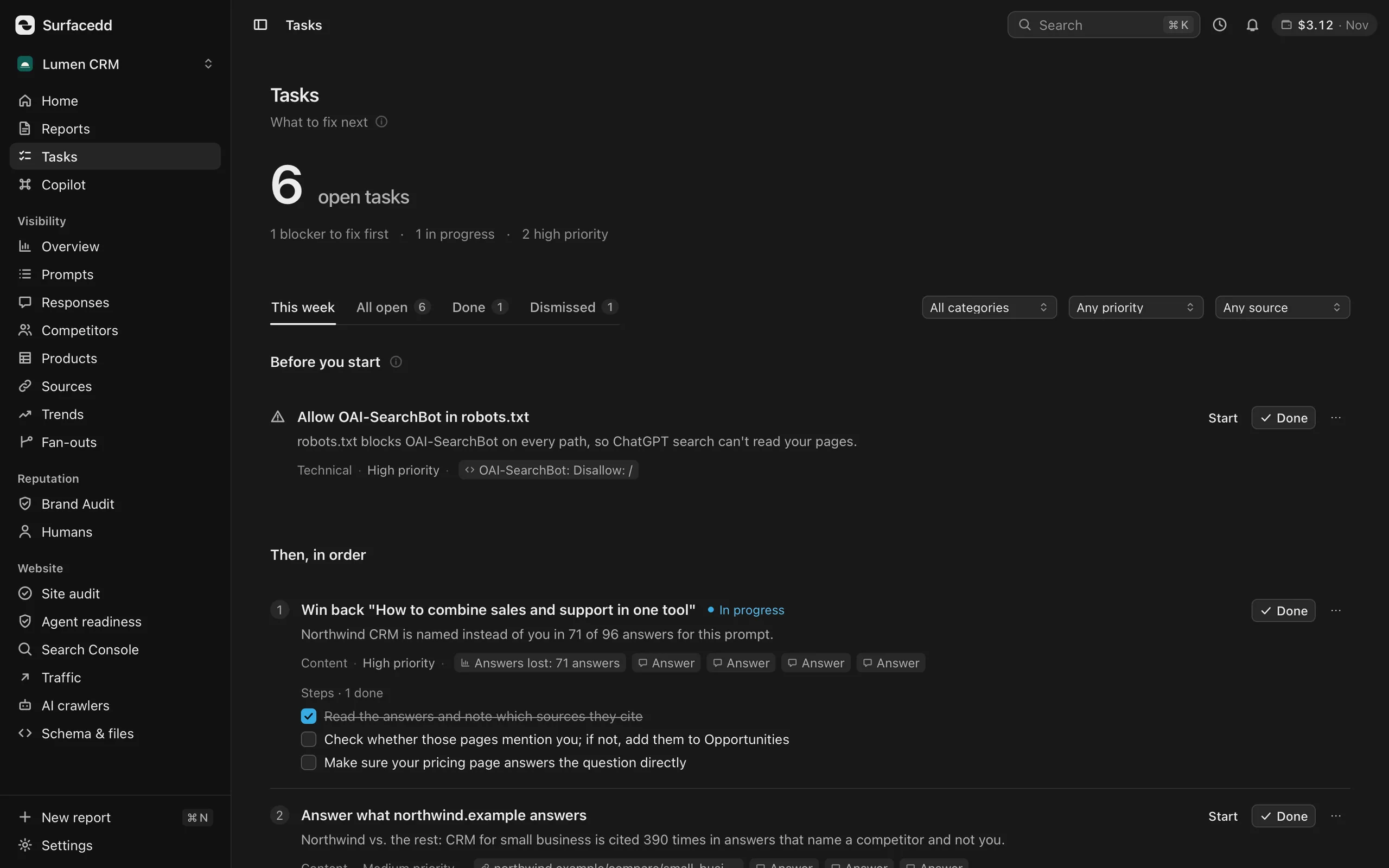
Tasks put access blockers first ("Allow OAI-SearchBot in robots.txt") and then rank the rest, each with the answers and pages that justify it. The app doesn't write pages, posts or emails; it tells you where to act. See AI visibility reports for scheduling and exports, and pricing for the licence (Launch price $29, $79 after 23:59 UTC on January 30, 2027.$79 once.).
Sources
Fair questions
How is a GEO strategy different from an SEO strategy?
An SEO strategy targets positions for keywords in one index; a GEO strategy targets the share of AI answers that name and cite you, across several engines that each retrieve differently. Much of the work overlaps: crawlable, answer-first pages help both. GEO adds per-engine crawler access, a heavier focus on third-party mentions, and repeated sampling, because AI answers vary between identical runs.
How many weekly runs before I can judge a change?
About four. Single runs move around on their own, so one good week proves little. After four weekly runs you have enough answers for ranges to narrow, and a significant change, where the 95% range of the difference excludes zero, starts to be possible. If the range still includes zero after four runs, report "no clear change" and act on the decision rules above.
What if my share of voice is flat after a month?
Stop producing more of the same and re-read the sources behind the answers you lost. A flat line usually means the pages you're working on aren't the ones the engine reads. List the cited pages that name a rival and not you, check whether your own page answers the question directly, and check that engine's crawler access. Then pick new targets for the next four weeks.
Should I run daily or weekly?
Weekly, for most brands. Daily runs cost about seven times more and mostly add noise, because answers vary day to day. Daily makes sense for short windows: a launch, a crisis, or checking that an access fix has taken. Run three samples per prompt for the baseline, then one per week, and compare like for like.
Do I need all eight engines?
No. Start with the engines your buyers use; the four defaults cover OpenAI, Anthropic, Perplexity and Google's own AI Mode, which use different retrieval systems. Add Gemini, Grok, Meta AI or AI Overviews when your market uses them. Measuring an engine nobody in your market uses costs money and adds lines you won't act on.
Who should own GEO in a team?
Whoever already owns organic search and content, with help from PR for third-party mentions. The weekly cadence above fits about three hours for one person. What matters is that one owner keeps the prompt set fixed, reads the lost answers each week and logs changes, so results can be read against actions. Our marketing teams page covers splitting the work.
Free tools for this guide
How we research, write and correct pages: read our editorial policy.