Find out if AI recommends your startup, in 30 minutes a week
Surfacedd asks the AI assistants your buyers use the questions they ask, shows who gets recommended instead of you and which pages convinced the AI, and turns it into one task a week.
By the Surfacedd teamUpdated 7 min readMarkdown
On this page
Short answer
For a founder, AI visibility is three questions: does AI recommend us, who does it recommend instead, and what to fix. Surfacedd answers them from a scheduled weekly run of about 10 buyer prompts on four AI engines, which costs a few dollars a month in provider fees on your own API keys, plus a one-time licence.
The three jobs
Founders don't need an AI visibility dashboard. They need three answers, once a week, without a new subscription to approve:
- Are we recommended? When a buyer asks ChatGPT "What's the best {category} for {audience}?", is your product in the answer, and where?
- Who is recommended instead, and why? Which competitors get named, and which pages did the AI read before naming them?
- What should we fix this week? One change with evidence behind it, not a 40-item audit.
Surfacedd answers all three from stored answers you can open and read. It's a desktop app for Mac and Windows: it asks each AI engine your questions through its official API on your own keys, and keeps every answer, citation and cost on your computer.
Selling software? AI visibility for SaaS companies goes deeper on the best-software prompts and the review sites that decide them. Other roles are on the use cases page.
Setup in five steps
The first-launch setup takes one sitting and shows the price of every paid step before it runs.
- Activate and add keys. Paste your licence key, then API keys for OpenAI, Anthropic, Perplexity and DataForSEO (for Google AI Mode). Each key gets a free test before it's saved to your OS keychain.
- Describe the company. Enter your URL. Surfacedd reads your home page and up to eight linked pages and suggests your categories, aliases and competitors, for about a fifth of a cent. You edit what it got wrong.
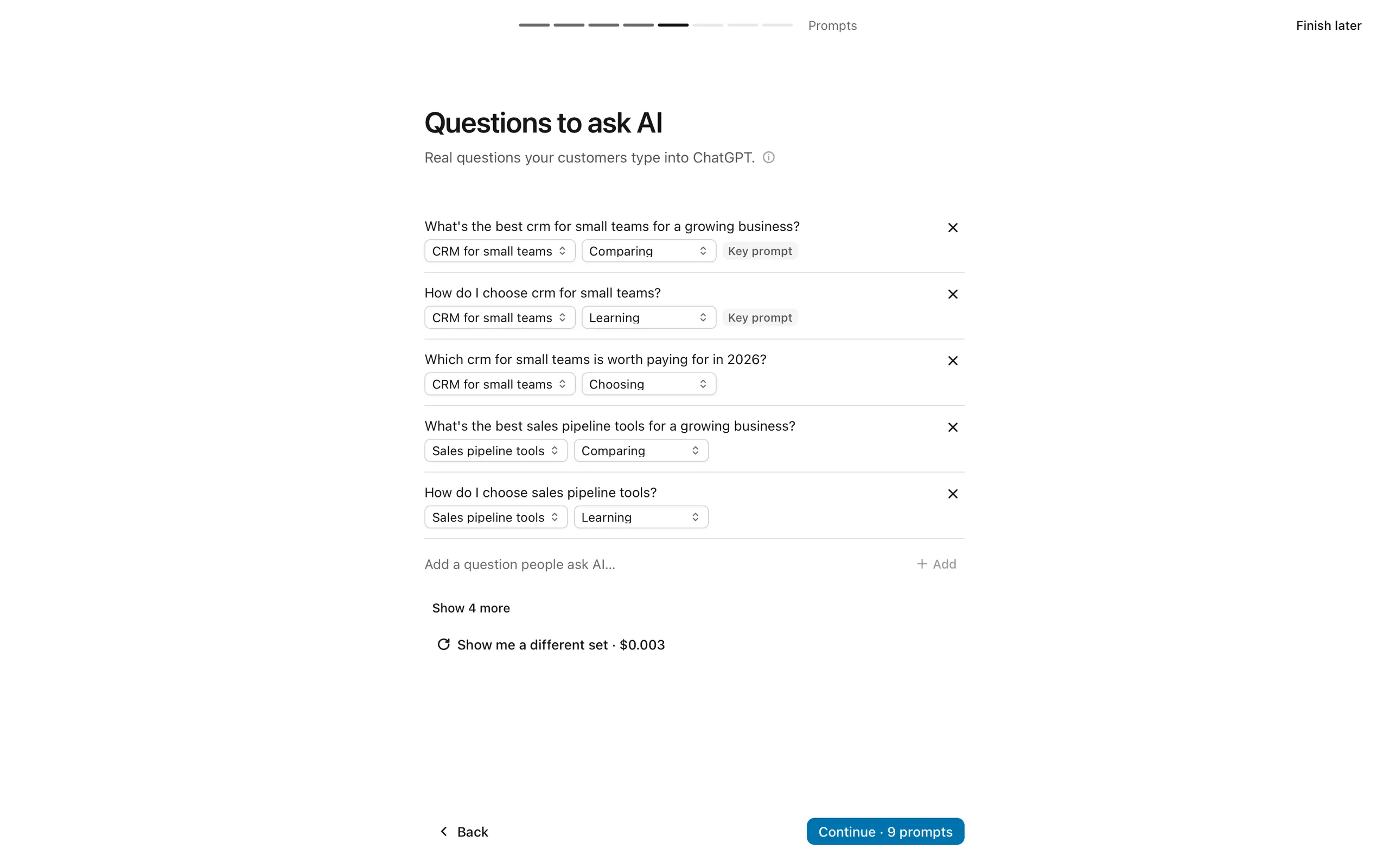
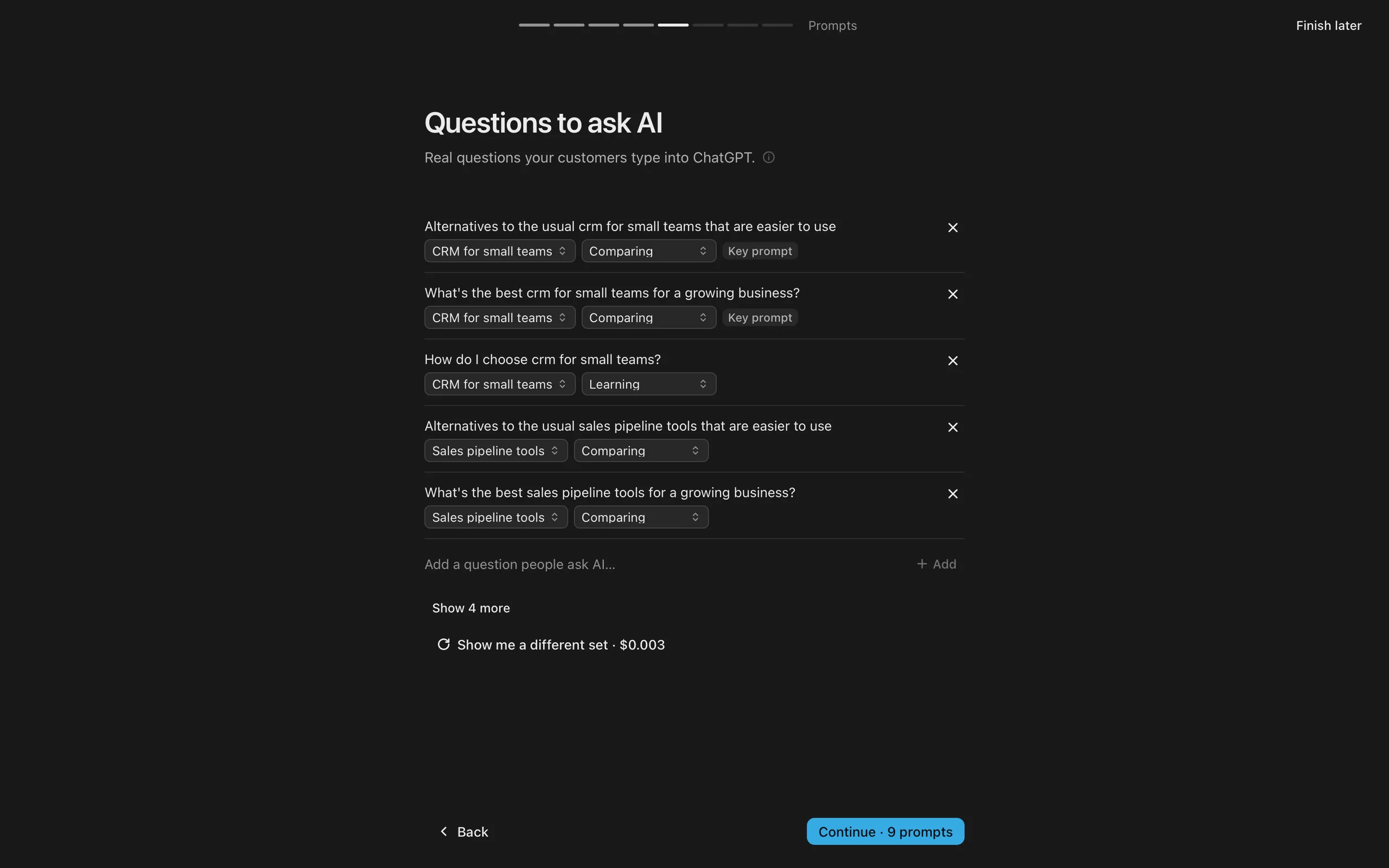
- Review the prompts. It drafts nine buyer prompts, three per category, tagged by funnel stage. Rewrite them in your buyers' words.
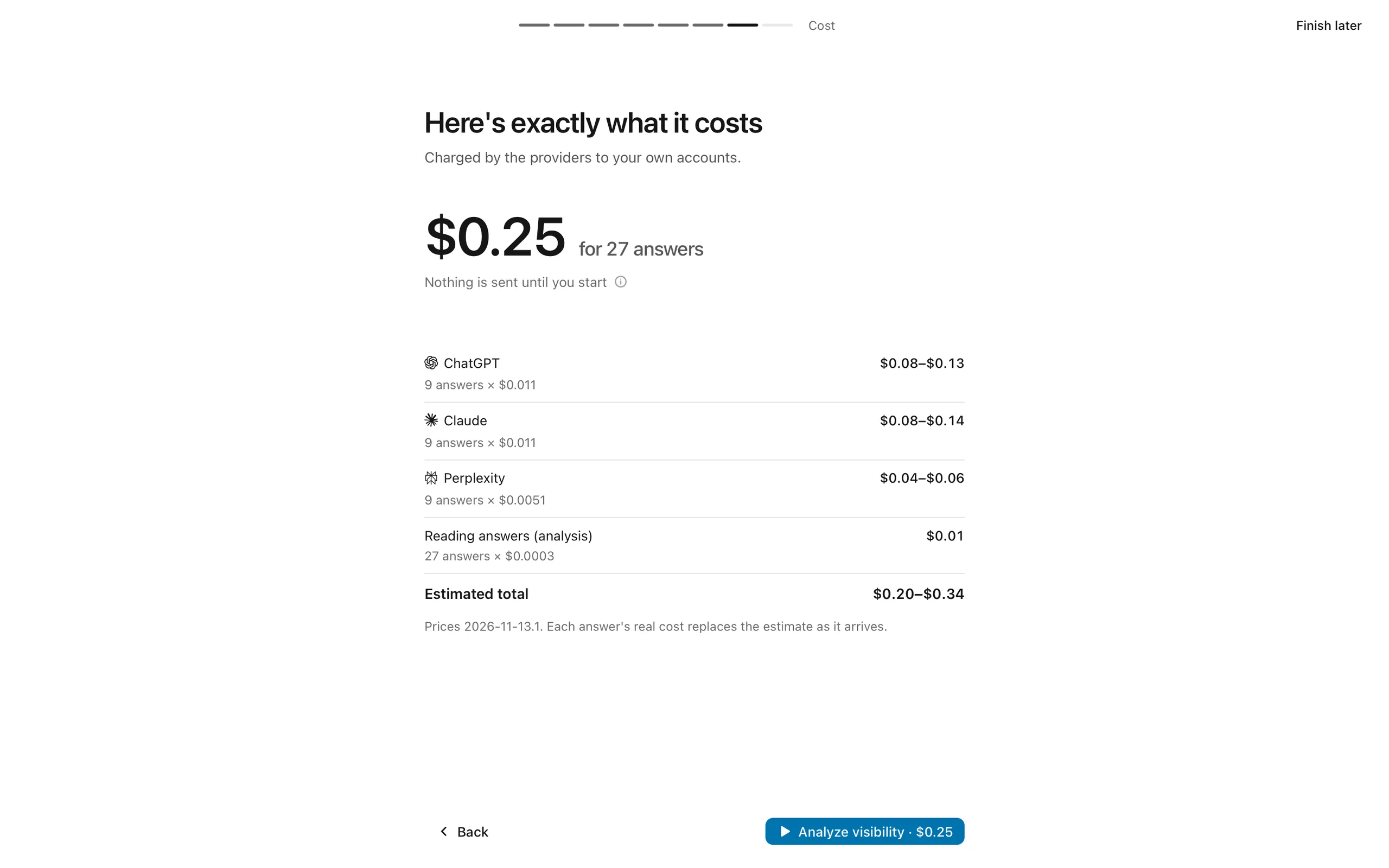
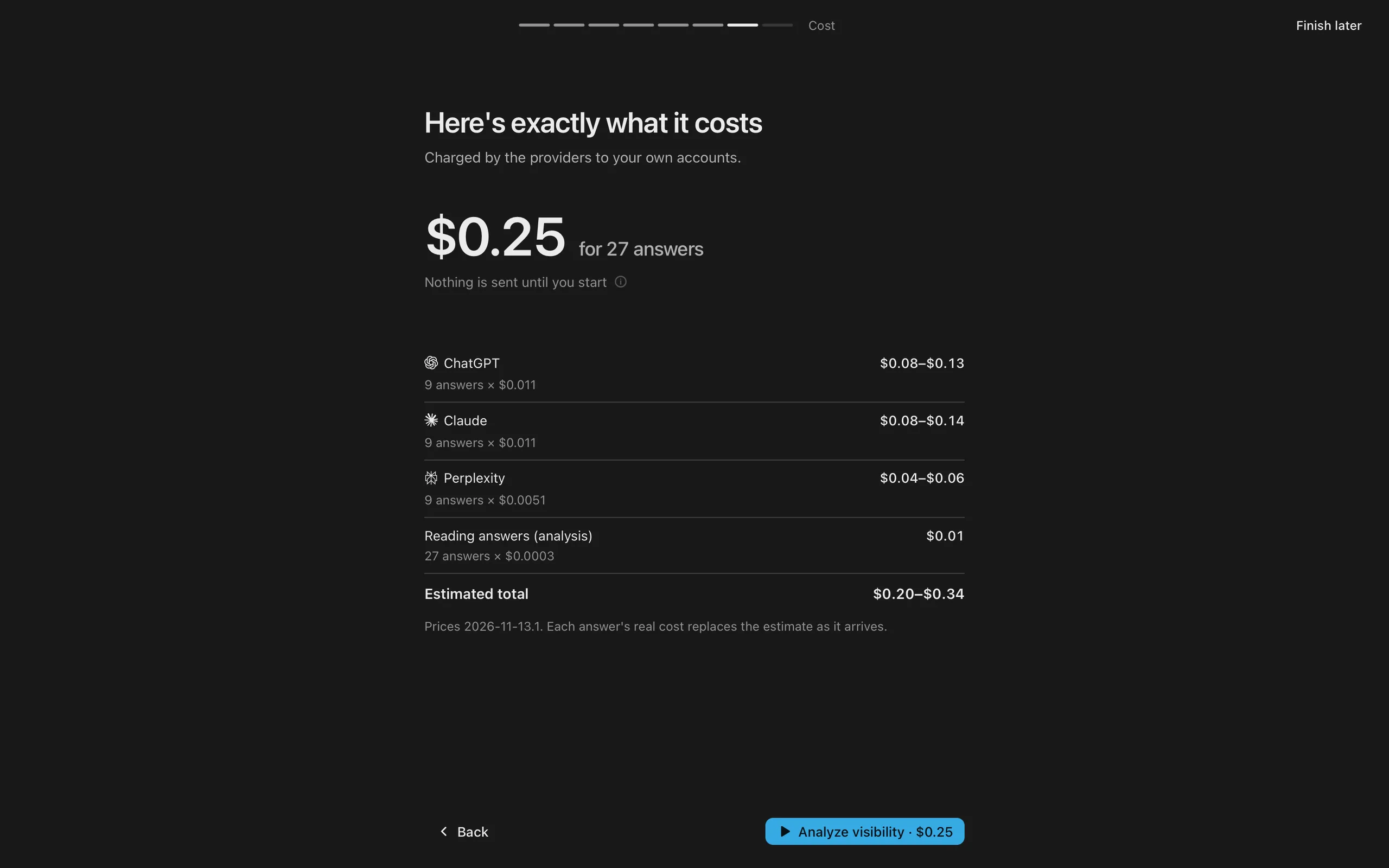
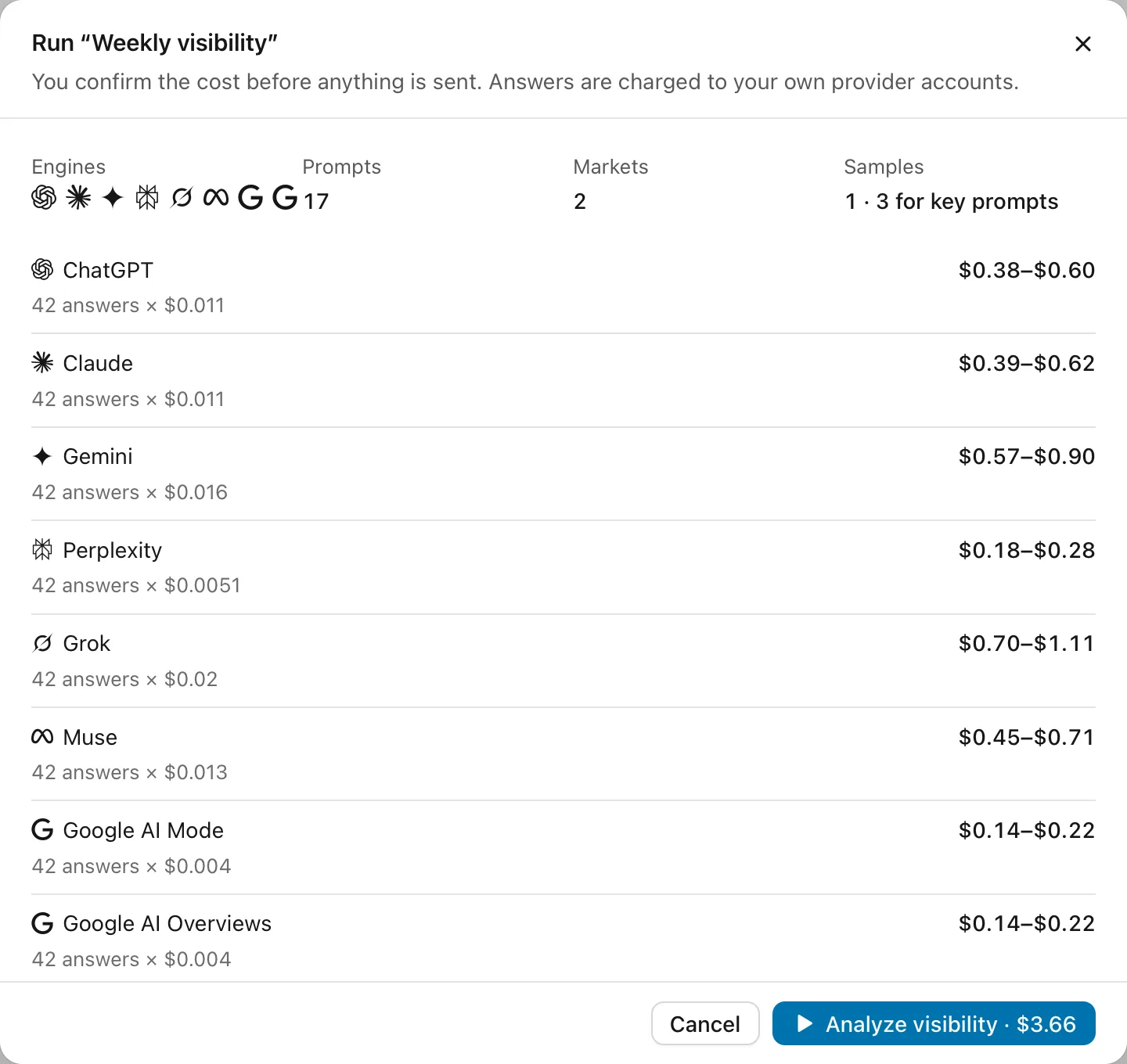
- See the price, then run. The cost sheet shows the estimate with a range, per engine, before anything is sent. A first run of nine prompts on four engines costs about $0.31 at today's list prices.
- Read the result and start the plan. You get a one-line summary, who AI names, which pages it read, and three or four tasks with evidence. "Track weekly" schedules the run for Monday 09:00 local time; if your laptop is asleep, it catches up when it wakes.
The full walkthrough, with what each step writes to disk, is on How it works.
The 10 prompts to start with
Your prompts are the questions your buyers type, not your keywords. Start with ten that span the funnel, then replace the ones that never change. Download them with intent tags and notes: b2-founder-starter-prompts.csv.
| # | Prompt pattern | Funnel stage | Why it's in the set |
|---|---|---|---|
| 1 | What's the best {category} for {audience}? | Consideration | The question that decides shortlists |
| 2 | {category} tools for small teams | Consideration | Size-qualified; startups often win here first |
| 3 | What are alternatives to {competitor}? | Consideration | Where challengers get named |
| 4 | {your product} vs {competitor} | Decision | What AI says when buyers compare you directly |
| 5 | Is {your product} worth it? | Decision | Surfaces reviews and objections AI repeats |
| 6 | How do I {job your product does}? | Awareness | Whether AI suggests a tool at all, and which |
| 7 | Cheapest {category} with {key feature} | Decision | Price-led answers often quote pricing pages |
| 8 | Which {category} integrates with {tool your buyers use}? | Consideration | Integration pages get cited |
| 9 | {category} for {industry} | Consideration | Vertical answers name different winners |
| 10 | What should I look for in a {category}? | Awareness | Shows the criteria AI uses to judge you |
What it costs at founder scale
You pay each AI provider directly for the answers you collect, and the licence once. These are monthly estimates for weekly runs on four engines (ChatGPT, Claude, Perplexity and Google AI Mode), at today's list prices, including the step that reads each answer:
| Setup | Answers a month | Provider cost a month |
|---|---|---|
| 10 prompts, weekly | about 174 | $1.52 |
| 25 prompts, weekly | about 435 | $3.75 |
| 50 prompts, weekly | about 870 | $7.47 |
| 20 prompts, weekly, all eight engines | about 696 | $6.70 |
The licence is Launch price $29, $79 after 23:59 UTC on January 30, 2027.$79 once. It includes a year of updates, 3 devices and unlimited brands; renewing updates afterwards is optional at $49 a year. Monthly budget caps per provider stop a run that would exceed them. Model your own numbers in the cost calculator, or see pricing.
The weekly routine, in 30 minutes
The Monday run finishes before you open the app. Then:
| Minutes | Where | What you do |
|---|---|---|
| 0–5 | Home | Read the headline: share of answers that name you, your rank among brands, and whether the change since last week is real or "no clear change". |
| 5–15 | Competitors › Prompts they win | Open two or three prompts a competitor won and you didn't. Read the answers and the pages they cited. |
| 15–25 | Tasks | Pick the top task. Each one carries its evidence: the answers lost, the pages cited, the robots.txt line. Do it, or brief whoever will. |
| 25–30 | Humans, or the Copilot | Glance at your own profile, or ask the SEO Copilot "What should I do next?" for an ordered plan built from your data. |
Most weeks the honest headline is "no clear change". That's useful: it stops you reacting to noise. When something does move, Surfacedd marks it as significant only when the 95% ranges say so.
An example result
The sample workspace tracks Lumen CRM, a fictional sales tool for small teams, against seven competitors.
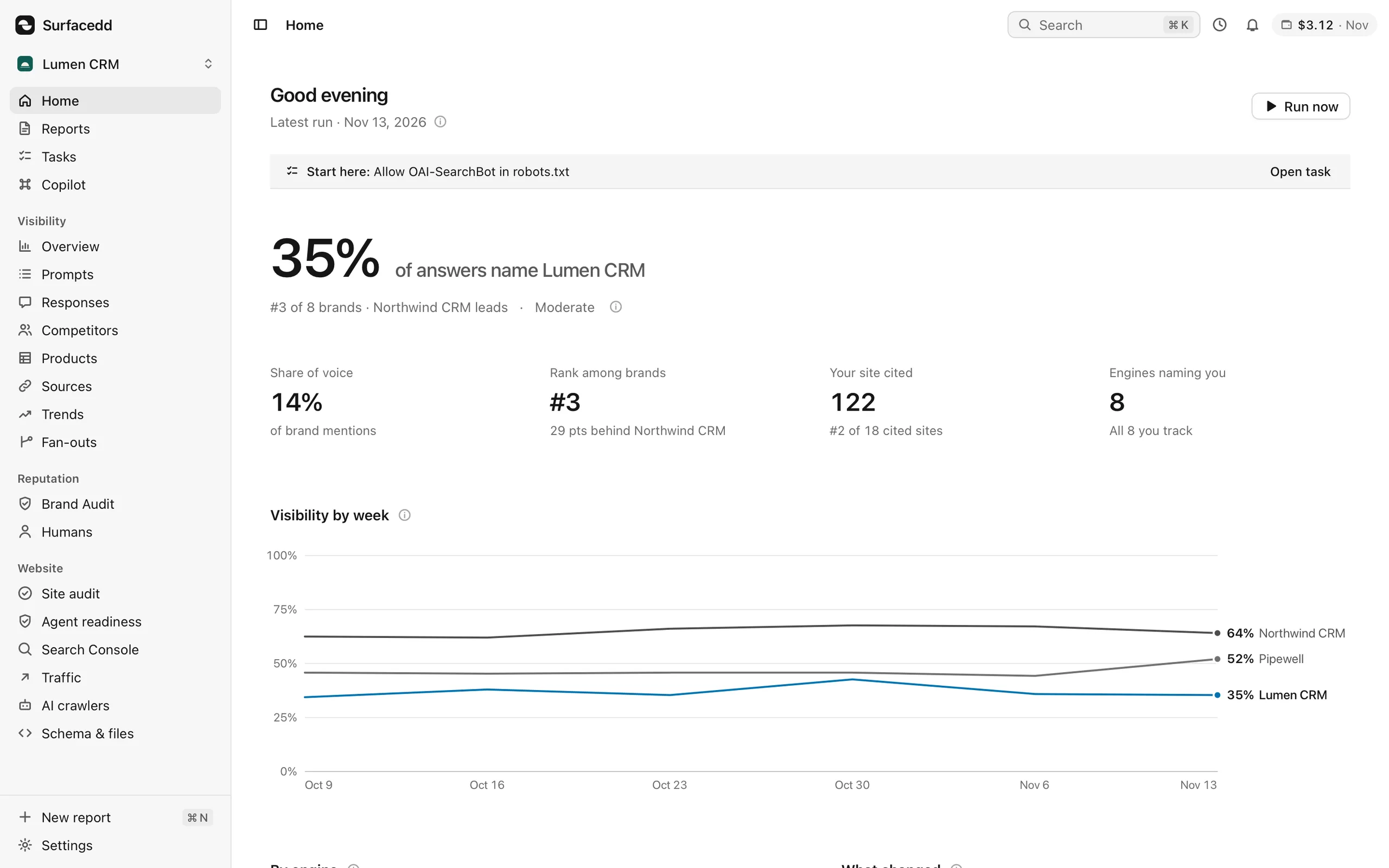
- Are we recommended? 35% of answers in the latest run name Lumen CRM. It's third of eight brands by share of voice.
- Who instead? Northwind CRM leads, 29 points ahead. In one prompt, "How to combine sales and support in one tool", Northwind is named instead of Lumen in 71 of 96 answers.
- What to fix? The first task is a blocker: robots.txt blocks OAI-SearchBot, so ChatGPT's search can't read the site. The second is the prompt Northwind wins, with the four answers to read first.
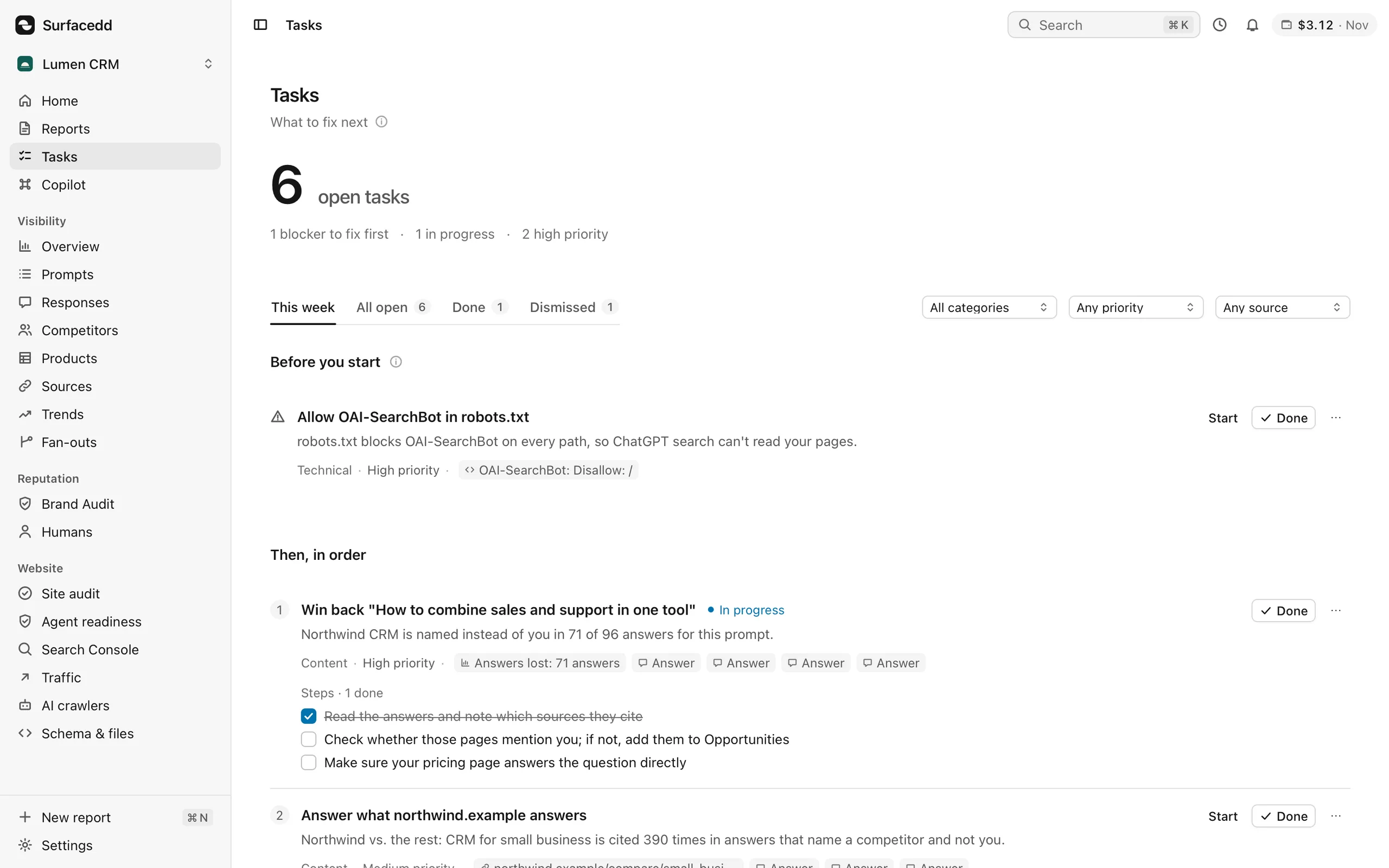
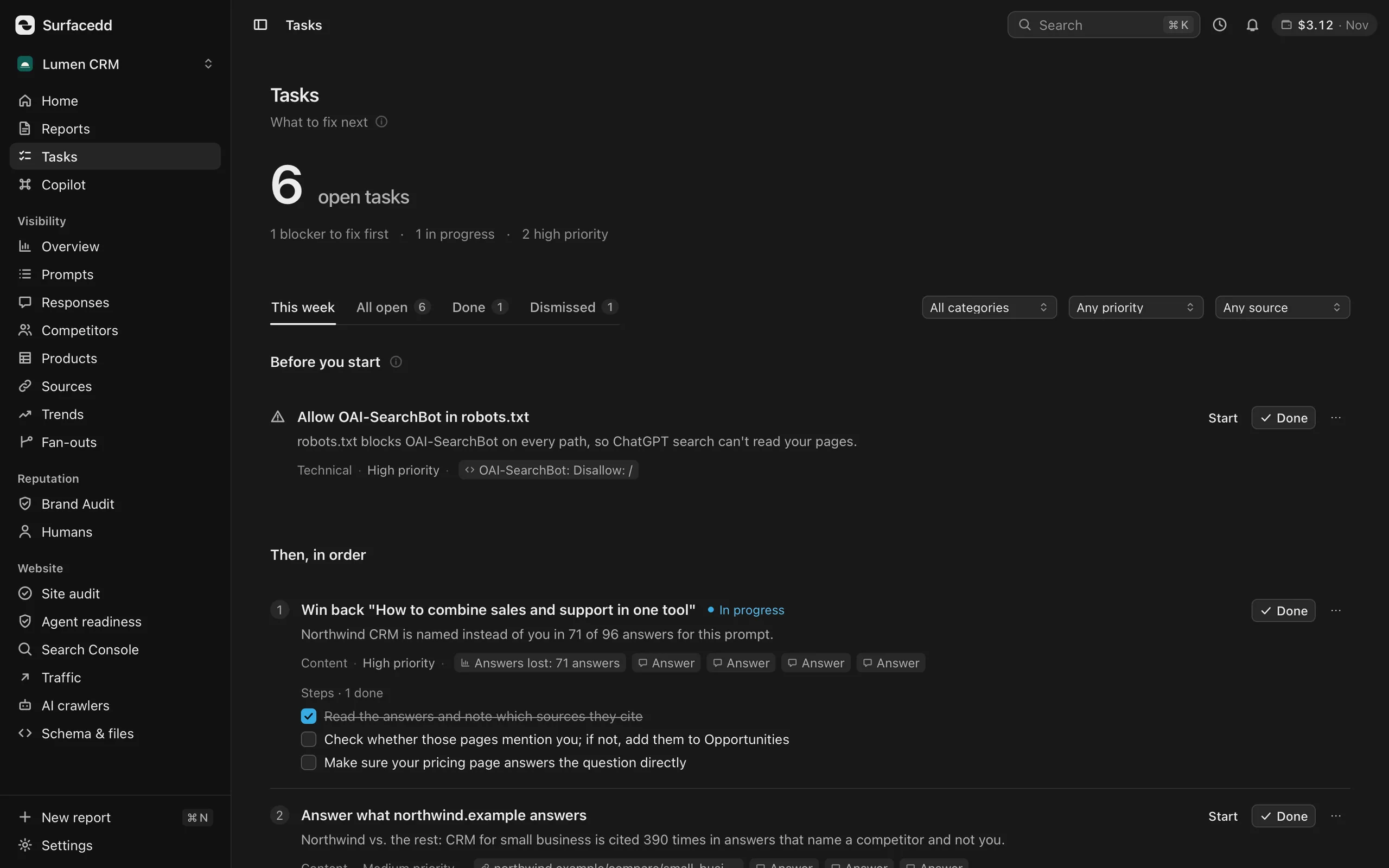
That's a typical first week: one technical fix that takes ten minutes, and one content question that takes longer.
What to do with your first result
The first run gives you one of three pictures. Each has a different first move:
- AI rarely names you (under about 10% of answers). Check access first: the site audit's crawler matrix shows whether AI search crawlers can read your key pages. Then look at which third-party pages the answers cite; you're probably missing from them.
- AI names you, but behind one competitor. Open "Prompts they win" for that competitor and read the pages cited. One comparison or pricing page often explains most of the gap.
- AI names you often but describes you wrongly. Run a Brand Audit, which shows each claim that disagrees with your facts and the page it came from.
Your own name, too
Investors and candidates also ask AI about the founder. Humans runs a separate profile for you, with questions like "Who founded {company}?" and "Top {industry} founders to watch", and checks the answers against your own fact sheet. It's included in the licence; see Humans for founders and executives.
When Surfacedd is the wrong choice
- You want a shared web dashboard for a team. Surfacedd is a desktop app. Data lives on the computer that runs it, and there are no shared logins.
- You don't want to manage API keys. You need your own keys from each provider. If that's a blocker, a hosted subscription tool is simpler.
- You need backlinks or a full SEO suite. Surfacedd tracks your Google positions and keywords next to AI answers (Google rank tracking), but it has no backlink index.
- You're on Linux. It runs on macOS and Windows only.
- You want content written for you. It finds what to fix and suggests titles and FAQ questions, but doesn't write or publish pages.
For a wider plan of what to do with the results, read the GEO strategy guide.
Fair questions
What is the best AI visibility tool for a startup?
The one you'll actually check every week at a cost that needs no approval. For most startups that means a small, stable prompt set, a few engines, and a tool that shows which pages convinced the AI. Surfacedd fits if you're fine with a desktop app and your own API keys; a hosted tool fits if you need shared dashboards.
How many prompts does a startup need?
Ten is enough to start, as long as they're the questions buyers really ask. More prompts narrow your ranges but cost more and take longer to read. Add prompts when you enter a new category or segment, and drop the ones whose answers never change. At ten prompts weekly on four engines, providers charge about $1.52 a month.
Why not just ask ChatGPT ourselves?
One answer in your own chat is one sample, shaped by your account and history. You won't see the pages it read, and you can't compare next week with this week. Surfacedd asks every prompt the same way through the API, stores the answers and sources, and shows whether a change is larger than the normal variation.
Is AI search big enough to matter for us yet?
Check your own numbers rather than an industry average. Surfacedd can read your Google Analytics 4 data and show visits from AI assistants by assistant and landing page, next to your visibility. If those visits are tiny and your buyers don't use assistants, a monthly run is enough; the cost scales down with it.
Do we need all eight engines?
No. Start with the four defaults: ChatGPT, Claude, Perplexity and Google AI Mode. Add Gemini, Grok, Meta AI or AI Overviews when you know your buyers use them. Each engine's cost per answer is shown on its key card and in the cost sheet before you run.
What happens after the first year?
The app keeps working. The licence covers updates released in the first year, and renewing is optional. Bug fixes, security fixes, engine and price-table updates are never locked. If you don't renew, only features released after your update year stay locked until you do.
How we research, write and correct pages: read our editorial policy.