See what Meta AI tells people about your brand, and which pages it cites
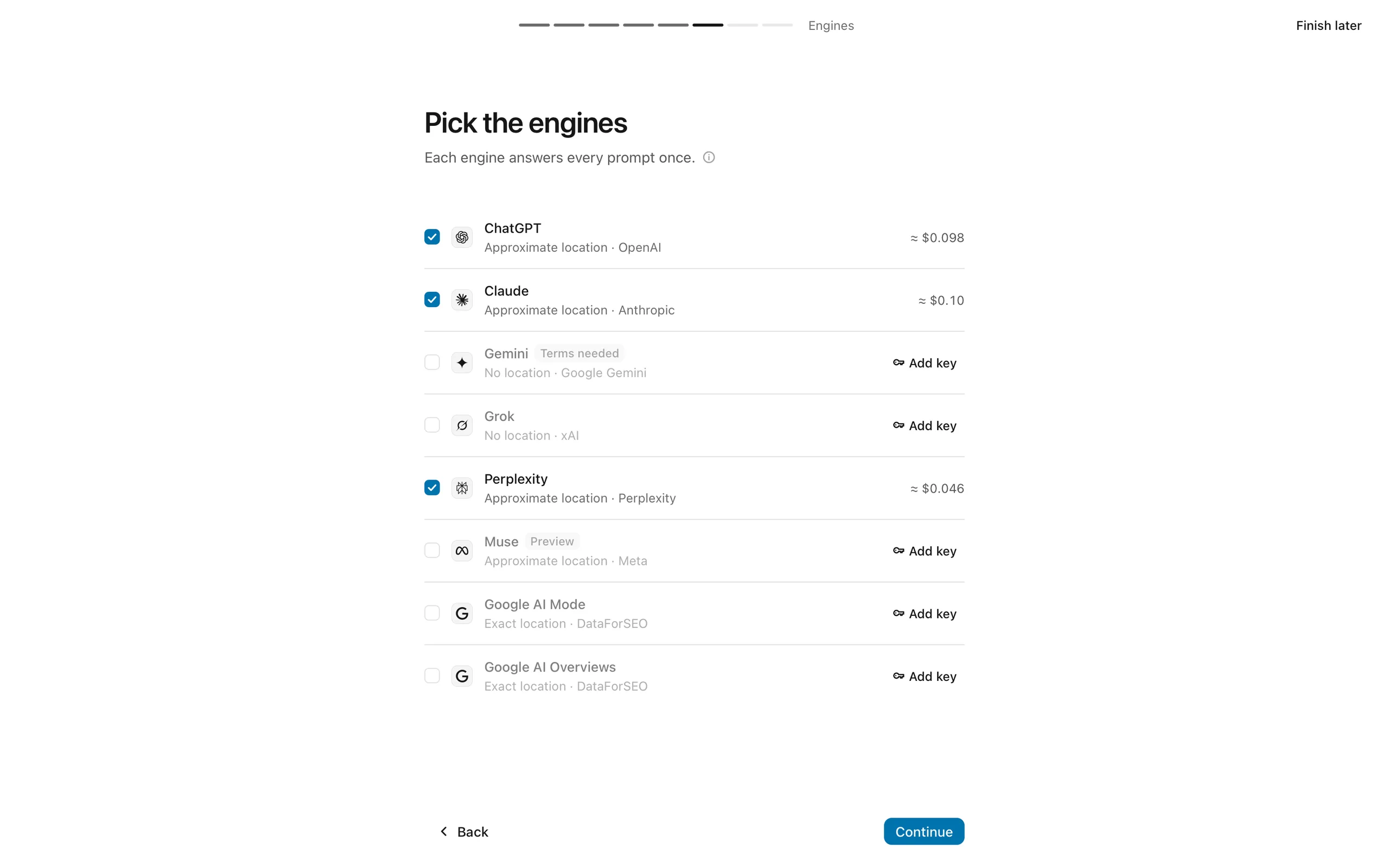
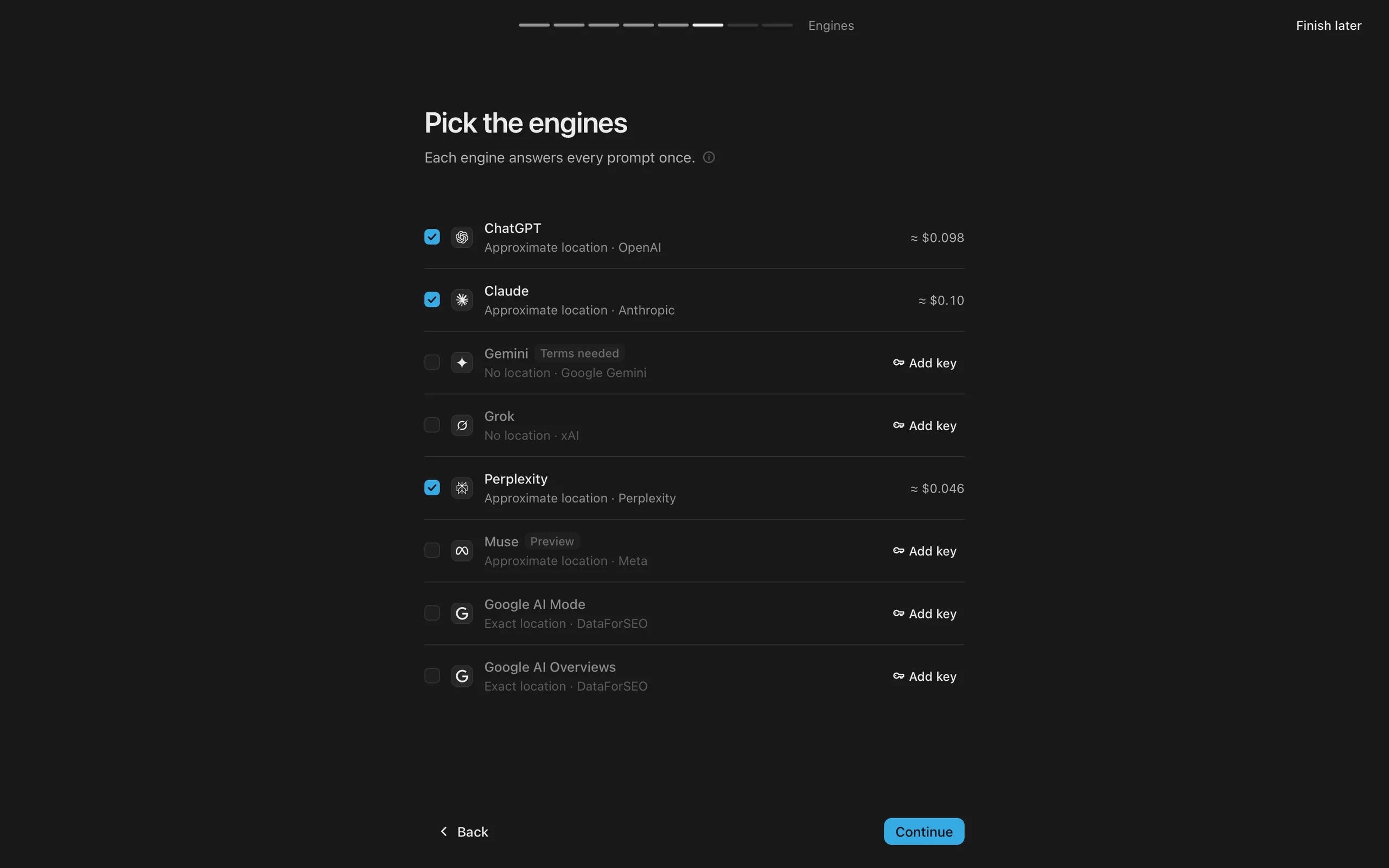
Meta AI runs on Meta's Muse models, which now have a paid public API with web search. Surfacedd tracks it as an opt-in Preview, on your own key, and never uses the cheaper models that let Meta train on your data.
By the Surfacedd teamUpdated 6 min readMarkdown
On this page
Short answer
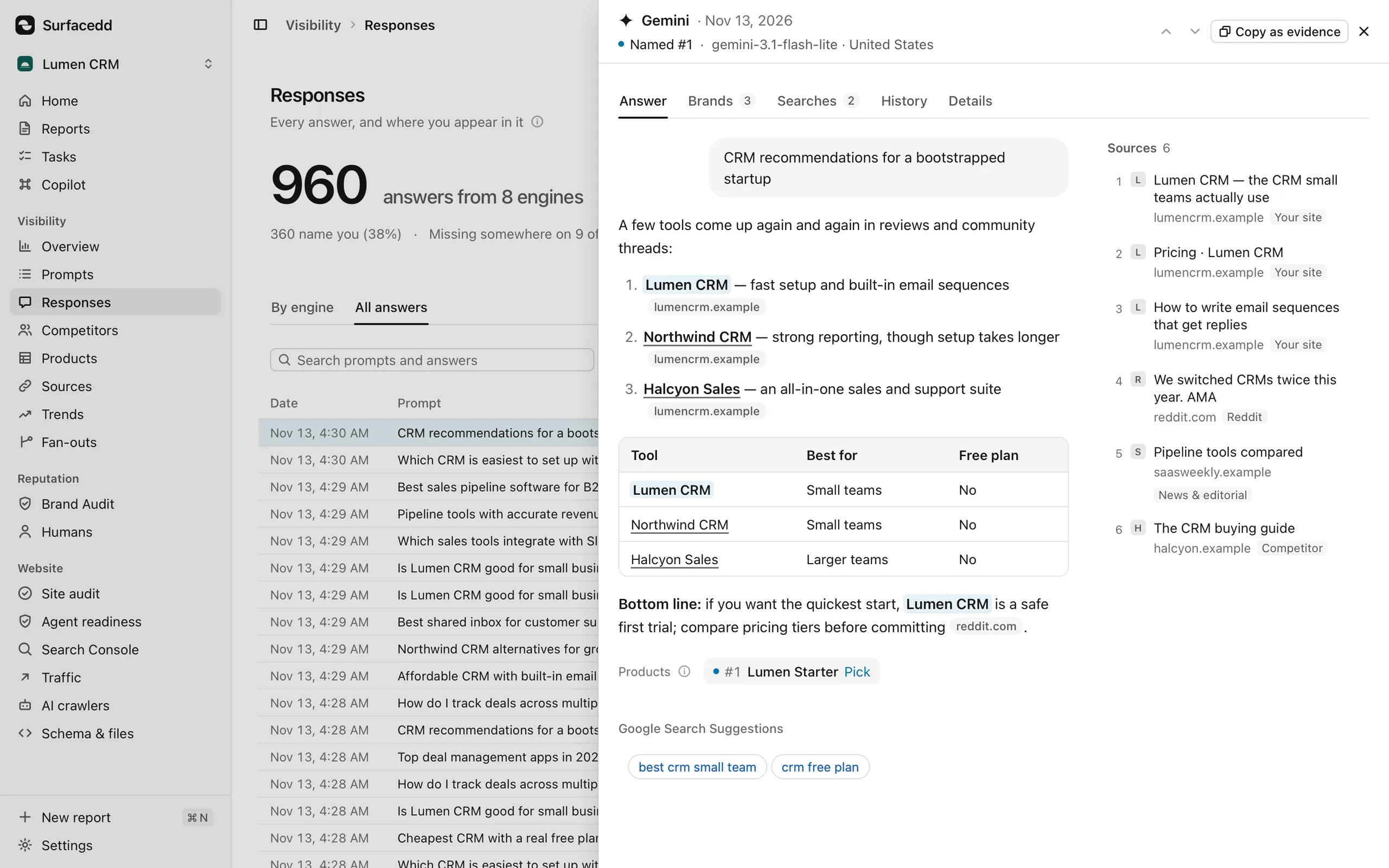
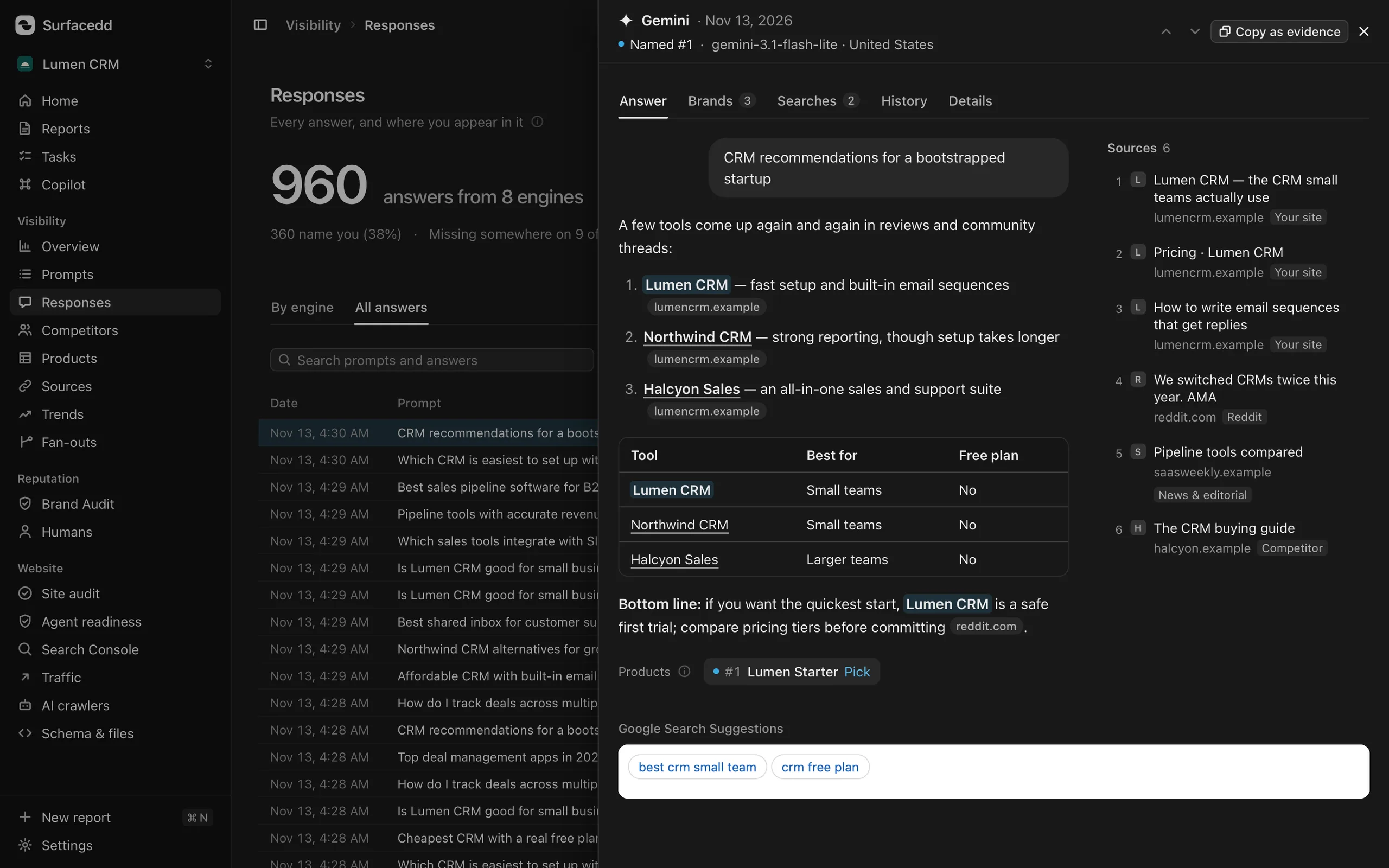
A Meta AI tracker asks Meta's Muse models your prompts with web search on and records whether your brand is named and which pages are cited. Surfacedd offers it as an opt-in Preview through Meta's Responses API on your own key, never uses Meta's contributor models, which train on your requests, and stores every source Muse read.
How Meta AI is collected
- How Surfacedd asks
- Meta Model API (Responses shape) with the web_search tool, on Muse Spark.
- Key you need
- Meta Model API key
- Location
- Approximate: country, region, city and time zone.
- Searches it ran (fan-outs)
- Not exposed. Meta's API reports that a search ran, not what it searched for, so none are stored.
- Citations
- Citations with real page titles, plus the search results the model read.
- Search fee
- $2.50 per 1,000 search queries, plus tokens
- Default model
- Muse Spark 1.3. Mid and flagship models can be picked per report.
Worth knowing
- Ships as an opt-in Preview. Meta's API may not be available for your account's region yet; Surfacedd says so plainly instead of failing silently.
- Models that let Meta train on your requests (the contributor variants) are never used unless you opt in explicitly.
Cost per answer
$0.0129
estimated, paid to Meta on your account
- 100 answers
- $1.29
- 25 prompts × 3 samples, weekly, for a month
- $4.21
- Reading each answer (GPT-6 Luna)
- +$0.0015
From price table 2026-11-13.1, using typical token counts and one search per answer. The app recalibrates from your own answers and shows its estimate before each run. How costs are estimated
What "Meta AI" means in the API
Meta AI, the assistant inside Facebook, Instagram, WhatsApp and Messenger, runs on Meta's Muse family of models. Meta sells API access to those models through its developer platform, and the Responses API includes a web_search tool that grounds answers in the web. That's what Surfacedd calls when you track Meta AI: the same model family, with search, through the API.
The API answer isn't a copy of what someone sees in WhatsApp. The apps add their own context, and a signed-in person's history shapes their answers. What the API gives you is a repeatable sample of what Meta's model says, with search, for a given question. Surfacedd labels each answer with the model Meta reports.
Preview status, and why it's opt-in
Meta AI ships in Surfacedd as an opt-in engine with a Preview badge. Three reasons:
- The API is young. Meta's own search grounding docs say "answer quality and source selection are still improving", that "coverage is incomplete", and that "single-fact and recent-events queries work best. Complex multi-hop research is less dependable."
- Availability varies. Meta's API may not be available for your account's region. When Meta refuses a request for that reason, Surfacedd shows "Meta's API isn't available for your account's region yet" and suggests switching the engine off, instead of failing silently or retrying.
- Not every request searches. Meta says switching the tool on doesn't mean every request searches, so some answers come from the model alone.
Preview means the numbers are real, but the engine is newer and less predictable than the others. Read its trends over more runs before acting on them.
Contributor models: why they're off
Meta offers discounted "contributor" versions of its Muse Spark models. Its pricing page explains the trade: contributor mode gives lower token prices "in exchange for permission to use your prompts, code, files, context, and model responses to train future Meta models." Standard mode doesn't use your content for training.
Your prompts describe your market, your competitors and your plans, so Surfacedd never uses a contributor model by default. They don't appear in the model picker or the cost tables. They can only be used after you switch on an explicit opt-in in Settings › Engines › Muse (Preview), which says plainly what Meta does with the data.
No fan-out queries
Meta's API tells you that a search happened, not what it searched for. By default a web_search_call item includes only an id, a type and a status. Surfacedd therefore stores no fan-out queries for Meta AI, and the Fan-outs screen leaves it out rather than showing an empty column as if it were a finding.
Citations and sources read
Meta's answers carry url_citation annotations with the real page title and the character positions of the claim they support. With web_search_call.results requested, the API also returns every source the model considered, with title, URL and snippet. Meta notes the cited sources are a subset of those results.
Surfacedd stores both: cited pages in order of appearance, and the rest as read but not cited. Real page titles mean Meta AI answers need no extra title lookups, unlike Gemini and Grok.
Cost
Meta bills web search per search query, on top of tokens. The default is Muse Spark 1.3, the model Meta AI's assistant is built on.
| Model | Tier | Input per 1M tokens | Output per 1M tokens | Per 1,000 searches | Est. per answer |
|---|---|---|---|---|---|
| Muse Spark 1.3 (default) | cheap | $1.25 | $4.25 | $2.50 | $0.0129 |
| Muse Ember 1.0 | cheap | $0.10 | $0.50 | $2.50 | $0.0035 |
| Muse Wonder 1.0 | flagship | $4.00 | $20.00 | $2.50 | $0.0417 |
Estimates assume about 5,300 input and 900 output tokens and 1 search per answer, at Meta's list prices on 2026-11-23 (UTC), price table 2026-11-13.1.
At the default, 25 prompts with 3 samples asked weekly cost about $4.71 a month, paid to Meta. Because Meta's API doesn't return the queries, Surfacedd counts searches from the search calls in the response; the estimate is labelled accordingly.
Location
Meta's web search accepts an approximate location: a two-letter country code, region, city and time zone. Surfacedd passes the market you set on the report. There's no language parameter, so language comes from the prompt.
How to show up in Meta AI
Meta publishes no ranking guidance for Meta AI, and keyword data for it is too thin to measure. The mechanism is documented: with web search on, Muse searches the web and cites a subset of what it retrieved. Meta's own note that single-fact queries work best is the most useful hint.
- State single facts plainly. "Founded in 2019", "integrates with Shopify", "from £12 per user per month" in HTML text, near the top. Meta says its search works best on single-fact questions; make your facts easy to find one at a time.
- Let Meta's crawlers read you. Meta-WebIndexer builds Meta's search index, and Meta-ExternalFetcher fetches pages on a user's request. Meta-ExternalAgent is the one that collects training data; you can block it without blocking the other two. See the Meta-ExternalAgent glossary entry.
- Be consistent everywhere. If your price or positioning differs between your site, directories and review profiles, an engine that checks one fact at a time can pick the wrong one.
- Get onto the pages Muse cites. Check which domains it cites for your prompts and whether they mention you.
- Track it over more runs. Preview engines vary more; judge trends over at least four weekly runs.
For how each engine's search works, see where AI answers get their sources.
Getting a Meta key
Create a key in Meta's developer platform and add payment; keys start with LLM_. The Meta API key guide covers the steps and what the region error means. Then switch Meta AI on in Settings › Engines.
What it doesn't do
See all eight surfaces on the engines overview, or buy Surfacedd once.
Sources
Fair questions
Is Muse the same as Meta AI?
Muse is the family of models Meta's assistant runs on, and Meta sells API access to it with web search. Tracking through the API measures what Meta's model says, with search, for your prompts. It isn't a capture of Meta AI inside WhatsApp or Instagram, where the apps add their own context, so Surfacedd labels each answer with the model Meta reports.
Why is Meta AI marked Preview?
Because Meta describes its search grounding as still improving: coverage is incomplete, multi-hop research is less dependable, and switching search on doesn't mean a search always runs. API availability also varies by account region. The numbers Surfacedd records are real, but expect more variation, and judge trends over more runs than for the established engines.
What are Meta's contributor models?
Discounted versions of Muse Spark that Meta offers in exchange for permission to use your prompts and responses to train its future models, per Meta's pricing page. Standard models don't train on your content. Surfacedd hides contributor models from the picker and cost tables and uses them only if you switch on an explicit opt-in.
Why are there no fan-out queries for Meta AI?
Meta's API doesn't return them. A search call in the response carries only an id, a type and a status, so there's no query text to store. Surfacedd stores nothing rather than guessing. For the sub-questions behind your prompts, use the fan-outs from ChatGPT, Claude and Perplexity, which do expose them.
What happens if Meta's API isn't available in my region?
Surfacedd's key test, or the first request, gets a region or permission refusal from Meta, and the key card shows "Meta's API isn't available for your account's region yet" with an option to switch the engine off. Nothing retries in a loop and no other engine is affected. Re-test later if Meta extends availability.
How we research, write and correct pages: read our editorial policy.