Find the AI visibility tool that fits how you work
We compared thirteen AI visibility trackers on the five things buyers (and the AI agents searching for them) check first, plus how each one actually collects answers. Written by Surfacedd, which sells one of them, so every fact is sourced from the vendor's own pages and dated.
By the Surfacedd teamUpdated 14 min readMarkdown
On this page
Short answer
The best AI visibility tool depends on how you work. Hosted platforms such as Profound, Peec AI and Semrush suit teams that want shared dashboards and no API keys. Ahrefs Brand Radar suits market-wide benchmarking. Surfacedd, Greta.sh and the open-source trackers suit people who want local data and to pay providers directly.
Who wrote this, and how we checked
This list is written by Surfacedd, and Surfacedd is one of the tools on it. That is a conflict of interest, so we have set ourselves four rules. First, the tools are listed alphabetically, with no scores, stars or ranks. Second, each tool gets a "best for" line, so you can rule tools out quickly. Third, our own entry is no longer than anyone else's and lists its limits. Fourth, every fact about another tool comes from that vendor's own website, documentation or GitHub repository, checked on 19 November 2026, and is linked in the sources at the end.
The criteria: what buyers and AI agents check first
When an AI assistant researches "the best AI visibility tool" for someone, it runs smaller searches behind the scenes. Search data shows what those look like: "most reliable ai search optimization tool for data accuracy", "best ai search optimization historical data software", "recommended tools for ai search optimization competitor tracking", "best ai search optimization platform for beginners" and "best ai visibility platforms with seo capabilities" each draw a few hundred searches a month. We use those five attributes as the criteria, and add two that decide the bill: how answers are collected, and the price.
- Data accuracy. Does the tool ask the engine the way a real person does, and does it tell you when a change is just noise? Answers vary between identical runs, so a single reading can mislead.
- History. How far back can you see, and is the trend like-for-like when prompts or models change?
- Competitor tracking. Can you see who gets named instead of you, and which pages convinced the engine?
- Ease for beginners. Can someone start without API keys, a server or a terminal?
- SEO integration. Does it sit next to your search data: Search Console, GA4, keyword or backlink data?
- Collection method. Consumer app capture, provider API with web search, or a pre-collected index. Each measures something slightly different; see the section below.
- Price as of 19 November 2026, at the cheapest plan that tracks your own prompts.
Comparison table (as of 19 November 2026)
| Tool | How answers are collected | Runs where | Own API keys | Entry price for your own prompts |
|---|---|---|---|---|
| Ahrefs Brand Radar | Pre-collected index of 578M+ prompts, plus custom prompts | Hosted | No | $50/mo (custom prompts) |
| AthenaHQ | Not stated on the pages we checked | Hosted | No | Free plan; Starter $295/month |
| Greta.sh AI Visibility Tracker | Provider APIs with web search on | Your Mac or PC | Yes | $29 once (first 100), then $79 |
| LLMrefs | Prompts generated from your keywords; method not stated | Hosted | No | $79/month |
| Open-source trackers | APIs, scraping providers or your own browser logins, by project | Your server or computer | Yes | Free software; you pay providers |
| Otterly.AI | Not stated on the pages we checked | Hosted | No | €29/mo |
| Peec AI | Scraping each platform's web interface | Hosted | No | $95/mo |
| Profound | Captured from the consumer apps | Hosted | No | Custom quote (Enterprise) |
| Rank Prompt | Not stated on the pages we checked | Hosted | No | Free plan; Starter $49/mo |
| Rankscale | Not stated on the pages we checked | Hosted | No | From $17/mo billed yearly; Pro $99/mo |
| Scrunch | Not stated on the pages we checked | Hosted | No | $250/mo |
| Semrush AI Visibility Toolkit | Not stated on the pages we checked | Hosted | No | $99/mo per domain |
| Surfacedd | Provider APIs with web search on; Google AI Mode and AI Overviews from the results page | Your Mac or PC | Yes | $29$79 once, plus provider fees |
"Not stated" means the vendor's pricing, product and AI-instruction pages didn't say how answers are gathered on 19 November 2026. It doesn't mean the method is bad. Ask the vendor before you buy if it matters to you.
Tool by tool (alphabetical)
Ahrefs Brand Radar
- Best for: benchmarking a whole market, including brands you haven't thought to track, inside the Ahrefs suite.
- Price as of 19 Nov 2026: custom prompt packages from $50/mo (2,500 checks); the AI Visibility Index $199/mo; Ahrefs Lite at $129/mo includes 5 tracked prompts. No free trial.
- Strengths: an index of 578 million+ prompts built from Ahrefs' keyword data, so you see visibility with no setup; six platforms plus Claude; Bot Analytics, AI traffic and YouTube, TikTok and Reddit sources alongside Ahrefs' SEO data.
- Limits: by Ahrefs' own description, the index re-tests question sets monthly on a 90-day window and may have limited coverage for brands with little search volume. Custom prompts cost checks per platform, and Claude uses 8 checks per update.
AthenaHQ
- Best for: teams that want tracking and content optimisation in one place, especially Shopify stores.
- Price as of 19 Nov 2026: a Free plan with $25 of credit; Starter $295/month for 3,600 responses; Enterprise custom.
- Strengths: 11 models on Starter, including Grok, DeepSeek, Meta AI and Mistral; GA4 and Search Console integrations; a content optimisation agent and publishing through Shopify; SOC 2 Type 2 by its own statement.
- Limits: one credit is one response, so daily tracking of many prompts uses credits fast; the API is a paid add-on. If you don't want generated content, much of the plan is unused.
Greta.sh AI Visibility Tracker
- Best for: a solo founder on a Mac who wants a local, pay-once tracker for a handful of brands and a free trial first.
- Price as of 19 Nov 2026: $29 one time for the first 100 customers, then $79; free updates across 1.x; 7-day free trial.
- Strengths: local SQLite data and no telemetry; five web-grounded engines; one OpenRouter key can run all of them; a cost preview and a per-run budget cap (default $5); email and Slack summaries; a local MCP server.
- Limits: no Google AI Mode, AI Overviews or Meta AI; one computer at a time; it measures from your own location only; the Windows build isn't code-signed yet. Its own llms.txt lists who it's not for, including teams needing seats.
See the Surfacedd vs Greta comparison for a point-by-point table.
LLMrefs
- Best for: SEO teams who think in keywords and want hundreds of prompts generated for them at a low monthly price.
- Price as of 19 Nov 2026: All in One $79/month, marked "limited time only", with a 7-day trial and a free account.
- Strengths: 500 prompts on ten engines with no extra fees; 50+ countries; unlimited team members and projects; CSV and API.
- Limits: you enter keywords rather than writing each question, so you control less of the wording; data refreshes at least weekly rather than daily.
Open-source trackers (Elmo, Hearsay, Limelit Open and others)
- Best for: developers who are comfortable with Node, Go or Docker and want to inspect and change the code.
- Price as of 19 Nov 2026: free software under MIT or Apache-2.0; you pay the AI providers and any scraping service. Elmo also sells a hosted cloud from $29 a month.
- Strengths: full control and auditable metrics. Hearsay reports Wilson 95% intervals; Limelit Open runs as one binary with SQLite; Elmo runs every prompt several times a day and scrapes consumer apps through providers.
- Limits: you install, schedule, update and back them up yourself; support is the issue tracker; several need a server or Docker.
Our open-source trackers review compares six of them.
Otterly.AI
- Best for: small teams that want the lowest hosted monthly price and unlimited seats.
- Price as of 19 Nov 2026: Lite €29/mo for 16 prompts; Standard €189/mo; Premium €489/mo (prices were shown to us in euros).
- Strengths: seven engines available; prompt research and a query fan-out tool; crawlability and content audits; Looker Studio, API and MCP from Standard; a free trial with no card.
- Limits: plans are sized for four of seven engines, and each engine uses credits, so wide coverage moves you up a tier.
Peec AI
- Best for: marketing teams that want daily data captured from the consumer interfaces, with unlimited users.
- Price as of 19 Nov 2026: Starter $95/mo for 50 prompts; Pro $245/mo; Advanced $495/mo; 15% off annually.
- Strengths: UI scraping, so answers reflect what users see; visibility, position, sentiment and share of voice; Looker Studio, API and MCP; SOC 2 Type II and GDPR compliance by its own statement.
- Limits: three models per plan, with extra models as paid add-ons; API access and SSO sit on Enterprise.
Profound
- Best for: enterprise brands and large agencies with procurement, SSO and many stakeholders.
- Price as of 19 Nov 2026: Enterprise only, custom quote. Profound retired its self-serve plans for brands in September 2026.
- Strengths: up to ten engines captured from the consumer apps; prompt volumes from a panel of real conversations; AI crawler analytics through CDN integrations; agents that write content and run campaigns; all-time history.
- Limits: no public price and no self-serve plan, so it is out of reach for small teams. We compare it with its closest rival in Peec AI vs Profound.
Rank Prompt
- Best for: a team that wants one hosted account that tracks, writes, publishes and reports to clients.
- Price as of 19 Nov 2026: Free plan (one report); Starter $49/mo billed monthly; up to $299/mo for Agency Plus.
- Strengths: seven engines on every plan; content generation and publishing integrations; GA4, Search Console and AI crawler logs; a public API and hosted MCP server on every plan.
- Limits: credits reset monthly, and running all seven engines costs three credits per prompt.
Rankscale
- Best for: budget-conscious buyers who want many engines and flexible scheduling in a hosted tool.
- Price as of 19 Nov 2026: Essentials from $17/mo billed yearly; Pro $99/mo ($84/mo yearly); up to $780/mo.
- Strengths: 17+ engines including DeepSeek, Mistral and Copilot; scheduling from hourly to monthly; credits roll over; MCP on every plan.
- Limits: answers draw on monthly credits; sentiment and exports start on Pro, and the REST API on Pro+.
Scrunch
- Best for: brands that want a vendor to change what AI agents receive from their site, not only measure it.
- Price as of 19 Nov 2026: Core $250/mo with a 7-day free trial; Enterprise custom.
- Strengths: 15,000 responses a month on eight engines, including Grok and Meta AI; page optimisation and generation; agent traffic analysis; Agent Pages on Enterprise.
- Limits: Core covers one brand and five competitors; Claude is an Enterprise add-on.
Semrush AI Visibility Toolkit
- Best for: teams already paying for Semrush who want AI visibility next to keyword and backlink data.
- Price as of 19 Nov 2026: $99/mo per domain for 25 tracked prompts, no free trial; or bundled in Semrush One from $199/mo.
- Strengths: AI visibility estimates for any domain; prompt research with topic volume and difficulty; sentiment and share of voice; AI checks in Site Audit.
- Limits: four engines (ChatGPT, Google AI, Gemini, Perplexity); 25 prompts on the base toolkit, with more at $60/mo per 50. For the enterprise-versus-suite choice, see Profound vs Semrush.
Surfacedd
- Best for: marketers, consultants and founders who want to pay once, keep data on their own computer and see the provider cost of each run.
- Price as of 19 Nov 2026: Launch price $29, $79 after 23:59 UTC on January 30, 2027.$79 once. Provider fees on your own keys come on top: a weekly 25-prompt check on the four default engines costs about $3.75 a month.
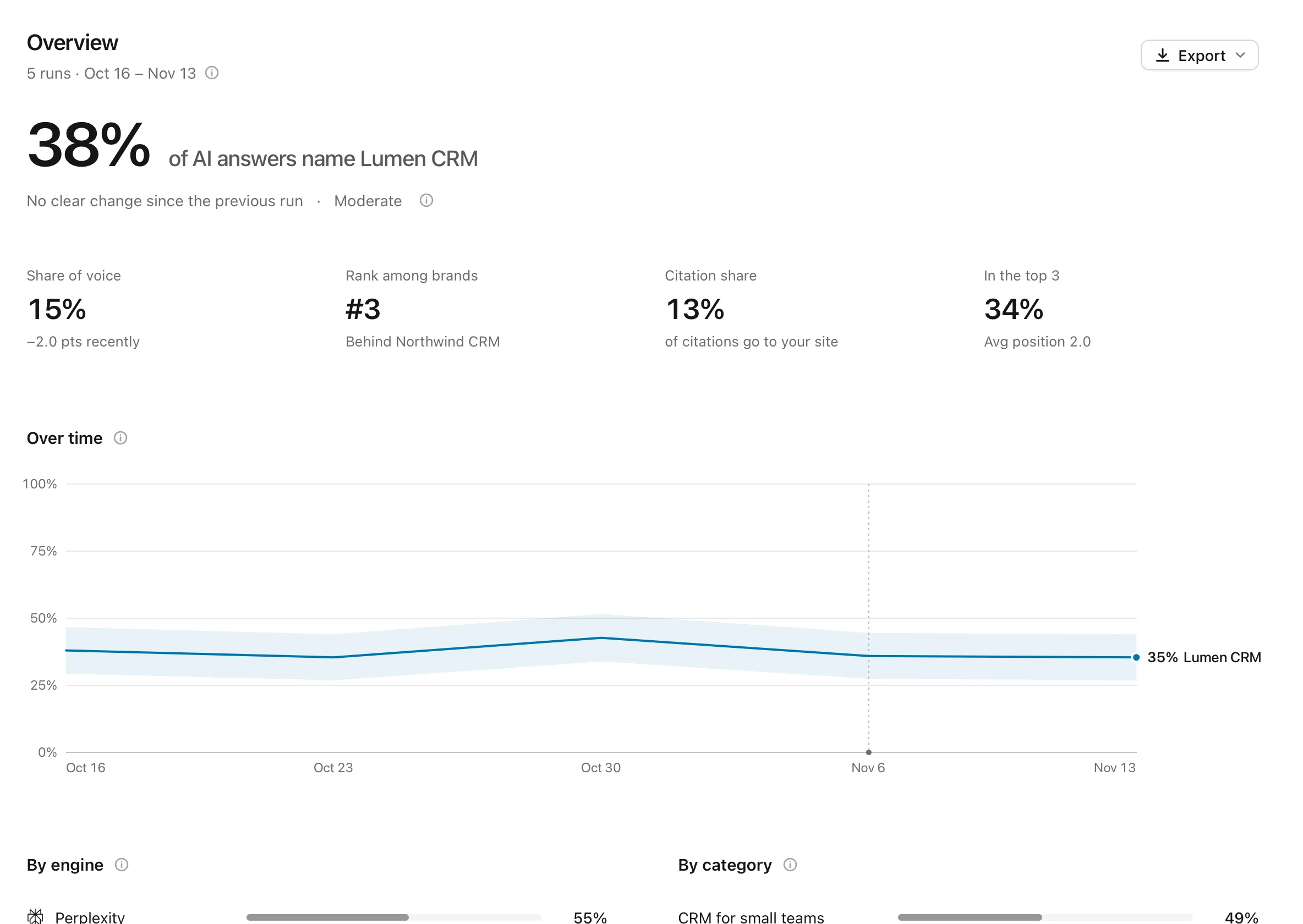
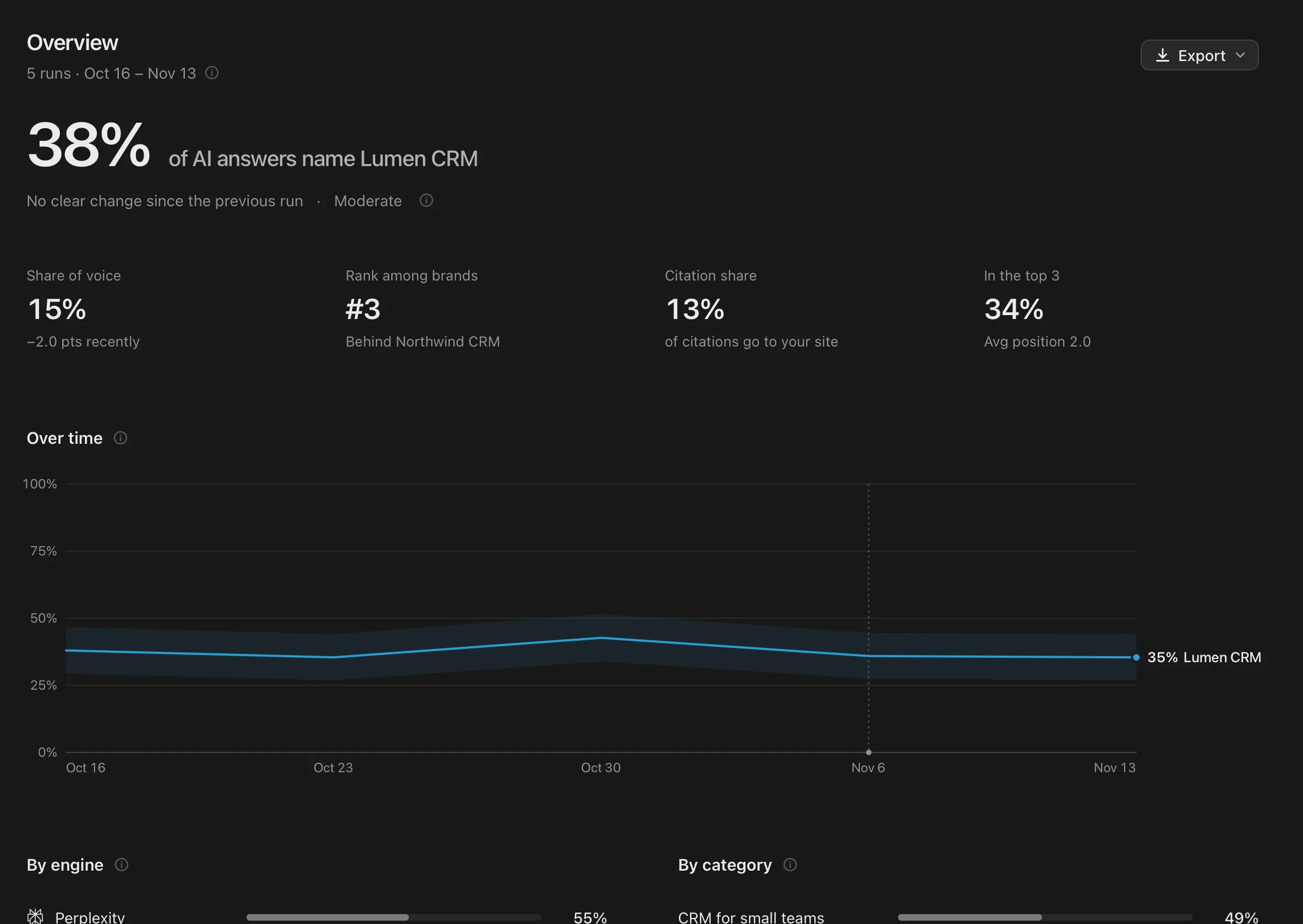
- Strengths: eight answer surfaces including Grok, Meta AI, Google AI Mode and AI Overviews; repeated samples with 95% ranges and "no clear change"; competitors, sources and tasks that cite their evidence; Search Console and GA4; Humans for person profiles.
- Limits: no hosted dashboard, seats or free trial; you manage API keys; scheduled runs need your computer on; it doesn't write content.
Collection method matters: consumer app, API or index
Three tools can report different numbers for the same brand on the same day without any of them being wrong. They are measuring different things.
Consumer app capture. Profound captures responses "directly from the consumer browsing experience", and Peec AI uses "UI scraping technology" to run prompts through each platform's web interface. Several open-source projects do the same through scraping services or your own logged-in browser. The answer is the closest thing to what a real user sees. The trade-off: consumer apps change their layout often, and the vendor has to keep the scrapers working.
Provider API with web search on. Surfacedd, Greta.sh and API-mode open-source trackers send the prompt to each provider's API with its search tool switched on, and read the citations from the structured response. This is repeatable, it documents the model and location used, and it works on your own keys. But it is not exactly the consumer app: the app adds memory, personalisation and its own interface choices. Surfacedd labels every answer with how it was collected, and reads Google AI Mode and AI Overviews from the real results page. Our guide to ChatGPT's API versus the app shows where the two diverge.
Pre-collected index. Ahrefs Brand Radar runs hundreds of millions of prompts derived from its keyword database and lets you look up any brand. You get breadth and instant answers with no setup. But the questions are Ahrefs' rather than yours, and the index refreshes on a monthly cycle. It is strongest for established brands in categories with search demand.
What this means for accuracy. No method gives "the" answer, because engines answer the same question differently from run to run. Look for three things: whether the tool asks each prompt more than once, whether it shows how certain a number is, and whether its trend marks a break when the prompts, models or collection method change. Our methodology explains how Surfacedd does each. Hearsay and Elmo also publish their methods in their repositories.
Price over 12 months (entry plan, as of 19 November 2026)
The cheapest plan that tracks your own prompts, over one year, at the vendor's published price. Plans include very different volumes, so read the "includes" column before comparing.
| Tool | Entry plan | Includes | 12 months |
|---|---|---|---|
| Ahrefs Brand Radar | Custom prompts, Basic | 2,500 checks a month | 12 × $50 |
| AthenaHQ | Starter (a Free plan exists) | 3,600 responses a month | 12 × $295 |
| Greta.sh AI Visibility Tracker | One-time licence | Updates across 1.x; your own API fees on top | $29 once (first 100), then $79 |
| LLMrefs | All in One | 500 prompts, weekly | 12 × $79 |
| Otterly.AI | Lite | 16 prompts, daily | 12 × €29 |
| Peec AI | Starter | 50 prompts, 3 models, daily | 12 × $95 |
| Profound | Enterprise | Custom | Quote only |
| Rank Prompt | Starter (a Free plan exists) | 150 credits a month | 12 × $49, or $470 billed annually |
| Rankscale | Essentials | Up to 480 answers a month | From $17/mo, billed yearly |
| Scrunch | Core | 15,000 responses a month | 12 × $250 |
| Semrush AI Visibility Toolkit | Per domain | 25 prompts, daily | 12 × $99 |
Surfacedd is a one-time licence of $29$79 with a year of updates, plus provider fees on your own keys. Those fees depend on volume: about $3.75 a month for 25 prompts weekly on four engines, or about $52.38 a month for 50 prompts daily. That second figure is the honest catch: very heavy daily tracking on your own keys can cost more per month than some hosted entry plans. The cost calculator works it out for your own numbers.
If you'd rather choose by the job a tool does (measure, audit, fix or write) than by tracker features, our lists of answer engine optimization tools and generative engine optimization tools group the same vendors that way.
What Surfacedd doesn't do
Sources
- Ahrefs Brand Radar
- Ahrefs pricing
- AthenaHQ plans
- AthenaHQ home and FAQ
- AI Visibility Tracker (Greta.sh) llms.txt
- LLMrefs home and pricing
- OtterlyAI pricing
- OtterlyAI llms.txt
- Peec AI pricing
- Peec AI docs: intro
- Profound pricing
- Profound AI instructions
- Rank Prompt pricing
- Rank Prompt llms-full.txt
- Rankscale pricing
- Scrunch pricing
- Semrush KB: AI Visibility Toolkit
- Semrush AI Visibility pricing
- Elmo on GitHub
- Hearsay on GitHub
- Limelit Open on GitHub
Fair questions
What is the best AI visibility tool?
There isn't one best tool, because the tools are built for different buyers. Enterprise teams with procurement usually look at Profound or Peec AI. Teams already in Semrush or Ahrefs often add their AI modules. Small teams on a budget look at Otterly, Rankscale or LLMrefs. People who want local data and to pay providers directly look at Surfacedd, Greta.sh or an open-source tracker. Start from the "best for" lines above.
Why doesn't this list rank the tools or give scores?
Because we sell one of them, and a score from a competitor would be hard to trust however carefully it was made. So we list tools alphabetically, give each a "best for" line, and link every fact to the vendor's own page. That lets you check the facts yourself and decide which trade-offs matter to you.
Which AI visibility tools let me use my own API keys?
Of the tools here, Surfacedd, Greta.sh and the open-source trackers (Elmo, Hearsay, Limelit Open and others) run on your own keys. You pay each AI provider directly. The hosted platforms include the cost of AI answers in their plans instead, so you never hold a key but pay the vendor's price per prompt or credit. Which is cheaper depends on how many prompts you run and how often.
Do API-based tools show the same answers as ChatGPT users see?
Not exactly. API answers with web search switched on are close to the consumer app, but the app adds its own interface, memory and personalisation. Tools such as Profound and Peec AI capture the consumer apps instead; tools such as Surfacedd and Greta.sh use the APIs and label it. Both are valid if you compare like with like over time and repeat samples.
How much history do these tools keep?
It varies, and most pricing pages don't say. Profound's Enterprise plan lists all-time history. Ahrefs' index uses a 90-day reporting window. Local tools such as Surfacedd and Greta.sh keep every answer in a database on your computer for as long as you keep it. Ask any hosted vendor what happens to your history if you cancel.
Which tool is easiest for a beginner?
A hosted tool with a free trial or free plan is the easiest start: Rank Prompt, AthenaHQ and LLMrefs have free tiers, and Otterly, Peec AI and Scrunch offer trials. You sign up, type your brand and see results without keys. Local tools need you to create API keys with each provider first, but then show the cost of every run before you start.
How we research, write and correct pages: read our editorial policy.