Get AI to describe you correctly
Humans asks AI assistants the questions people ask about you, checks every answer against your own fact sheet, and shows the page behind each wrong fact so you know what to fix first.
By the Surfacedd teamUpdated 10 min readMarkdown
On this page
Short answer
Humans is Surfacedd's AI reputation module. It asks ChatGPT, Claude, Perplexity and Meta AI up to 22 questions about you, checks each answer against a fact sheet you write, and links every wrong fact to the page behind it. Profiles are yours, or a client's with written authorization, and stay on your computer.
What does AI say when someone asks about you?
When a client, investor, recruiter or journalist types your name into ChatGPT, the answer they get is built from two places: what the model learned in training, and whatever its web search finds for your name right now. Either can be wrong. A stale speaker bio, an old company database entry or someone else with your name can end up in the answer, stated as fact.
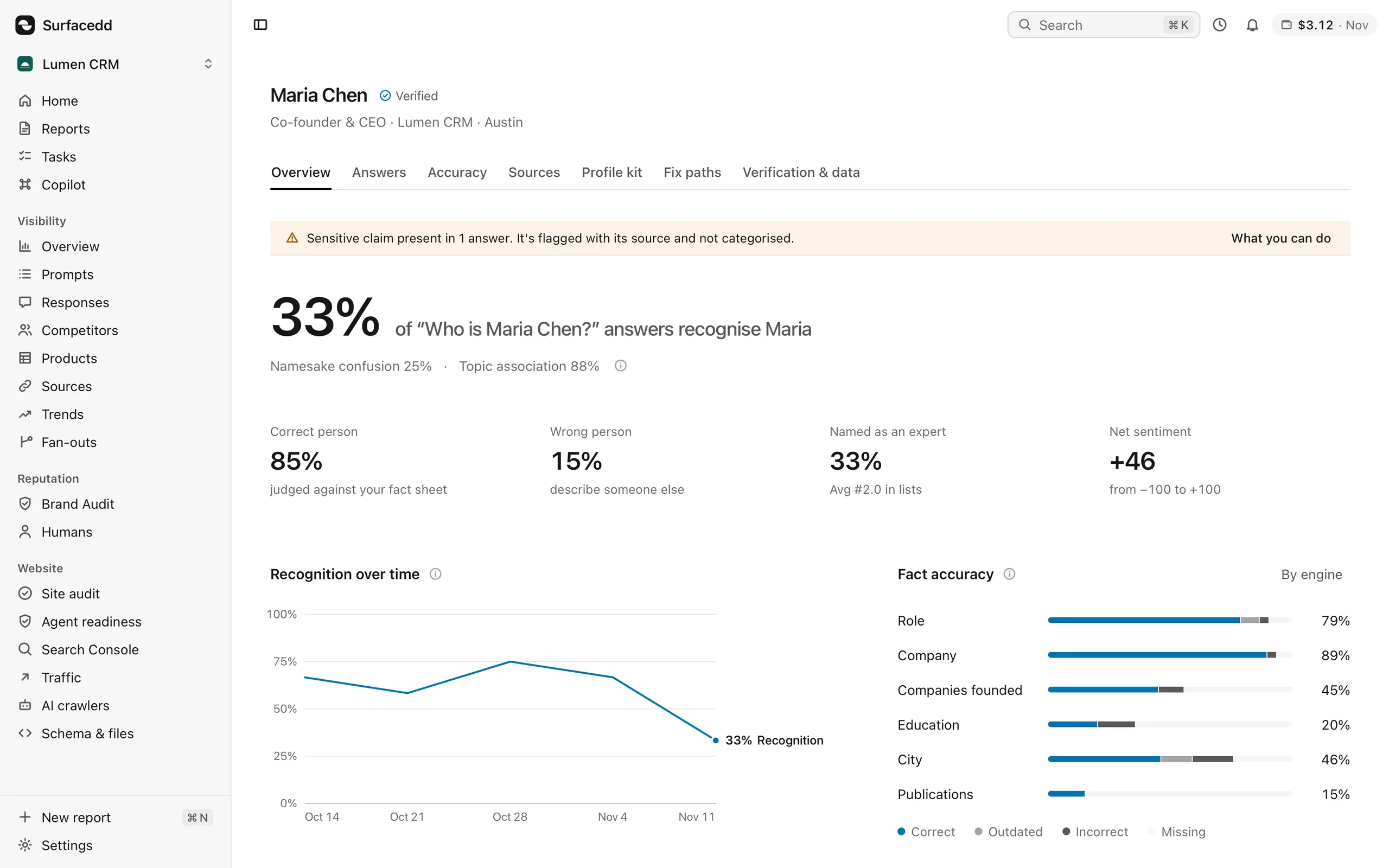
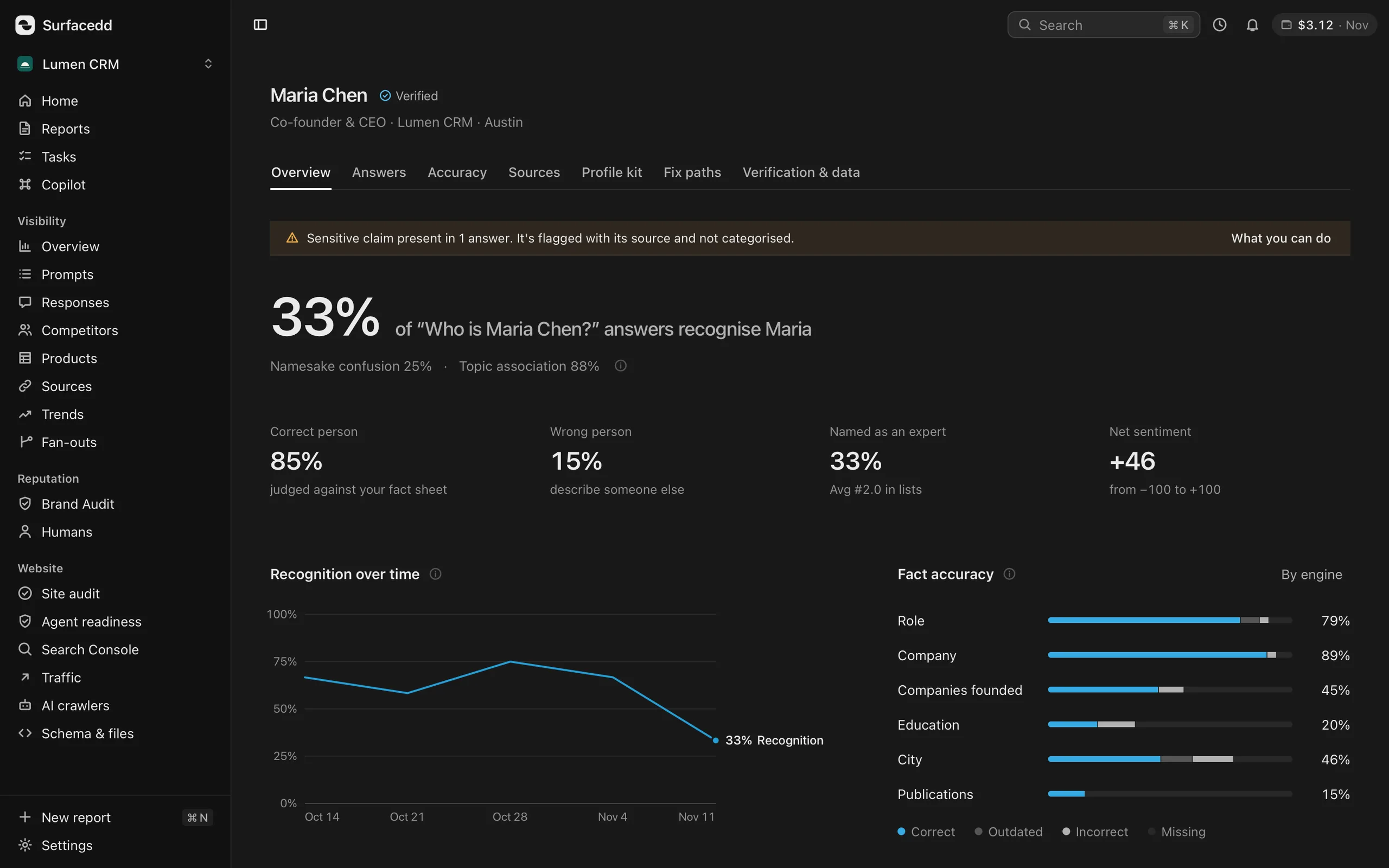
Humans measures that answer instead of guessing at it. You write down the facts that should be true (your role, company, city, education, the companies you founded, what you publish), and Surfacedd asks each assistant the questions people really ask: "Who is {name}?", "Where does {name} work?", "Who are the leading experts on {topic}?". Every answer is checked against your fact sheet, field by field.
What Humans measures
Humans reports seven numbers, each computed from stored answers you can open and read.
| Metric | What it answers | Example from the sample profile |
|---|---|---|
| Recognition rate | When asked "Who is {name}?" with no context, does the assistant know you? | 33% of bare-name answers recognise Maria |
| Correct-person rate | When it describes someone, is it you, judged against your fact sheet? | 85% correct person, 15% describe someone else |
| Namesake confusion | How often a bare-name answer describes a different person with your name | 25% |
| Field accuracy | For each fact: correct, outdated, incorrect or missing | Company 89%, role 79%, city 46%, education 20% |
| Discovery mention rate and list position | Are you named when someone asks for an expert, not for you? Where in the list? | Named in 33% of discovery answers, average position 2.0 |
| Topic association | Do answers connect you to the topics you listed? | 88% |
| Sentiment | Net tone of answers about you, from −100 to +100 | +46 |
Discovery is the number to watch. Recognition tells you whether AI knows you when someone already has your name; discovery tells you whether AI hands out your name when someone is looking for a person like you. Both come with ranges, because one run is a sample, not a verdict.
The 22 questions Humans asks
Prompts come from a fixed template set, so the numbers stay comparable from run to run. Placeholders are filled from your fact sheet; templates whose fields you left empty are skipped. The essentials run uses the eight marked below.
| Group | Prompt | In the essentials run |
|---|---|---|
| Recognition | Who is {name}? | Yes |
| Recognition | What is {name} known for? | Yes |
| Recognition | Tell me about {name}. | No |
| Recognition with context | Who is {name}, {role} at {company}? | Yes |
| Recognition with context | Who is {name} from {city}? | No |
| Recognition with context | What does {name} do at {company}? | No |
| Facts | Where does {name} work? | Yes |
| Facts | What companies has {name} founded? | No |
| Facts | What is {name}'s background and education? | No |
| Facts | What books or articles has {name} written? | No |
| Expertise | Is {name} an expert on {topic}? | Yes |
| Expertise | What has {name} said about {topic}? | No |
| Expertise | Is {name} a credible source on {topic}? | No |
| Discovery | Who are the leading experts on {topic}? | Yes |
| Discovery | Best {role} in {city} | No |
| Discovery | Who should I follow to learn about {topic}? | Yes |
| Discovery | Top {industry} founders to watch | No |
| Discovery | Good podcast guests on {topic} | No |
| Reputation | What do people say about {name}? | Yes |
| Reputation | Is {name} trustworthy? | No |
| Company | Who founded {company}? | No |
| Company | Who is the CEO of {company}? | No |
22 prompt templates. {name} and the other placeholders are filled from your own fact sheet.
You can add your own prompts. Each one is checked when you save it, and anything asking about sensitive traits is refused (see "Questions Humans never asks" below).
The accuracy matrix: every wrong fact, by engine
The Accuracy tab puts your facts down the side and the engines across the top. Each cell shows how often that engine got that fact right, how many answers were wrong or outdated, and the wording it used. Click a cell to open the answer and the sources it cited.
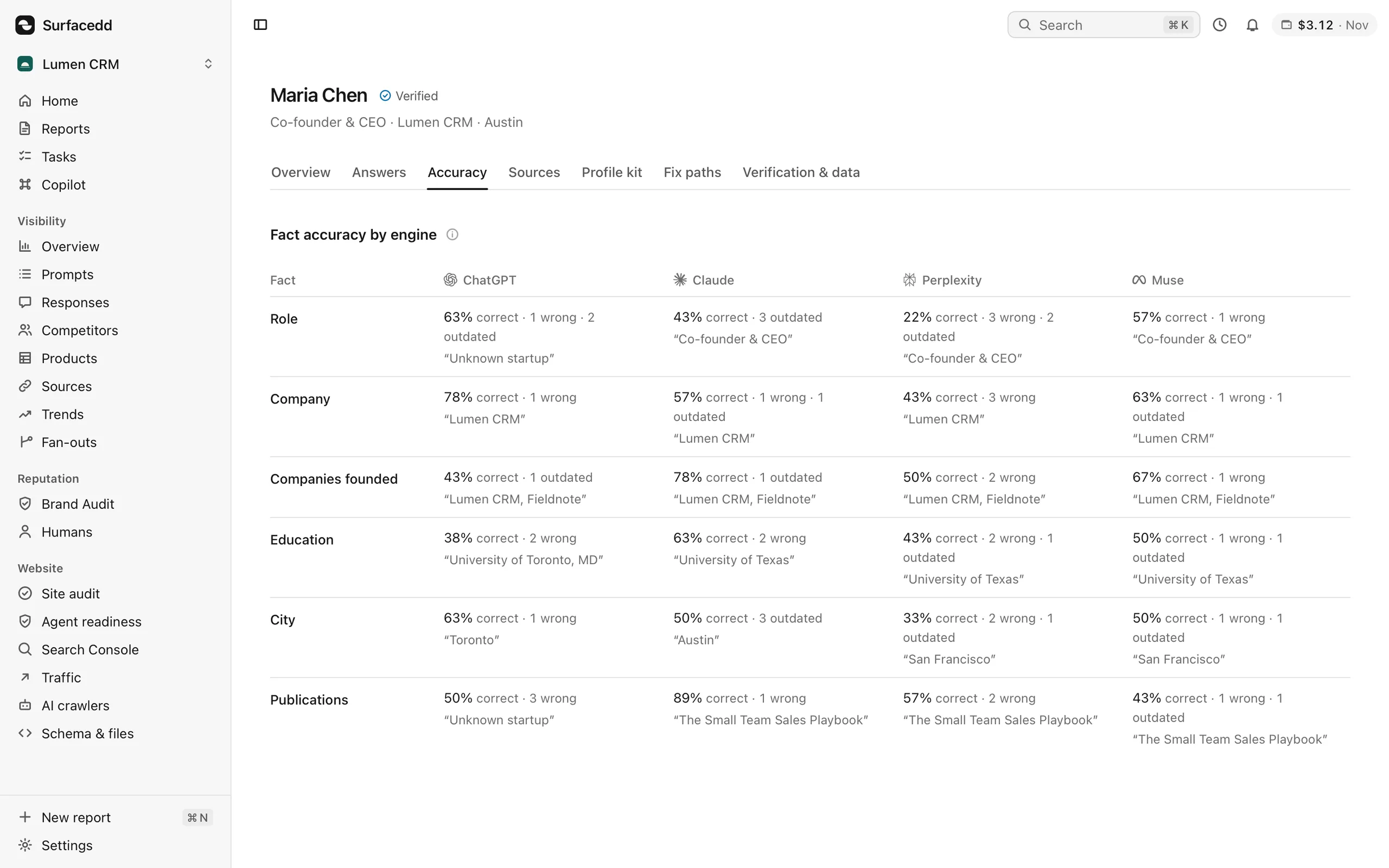
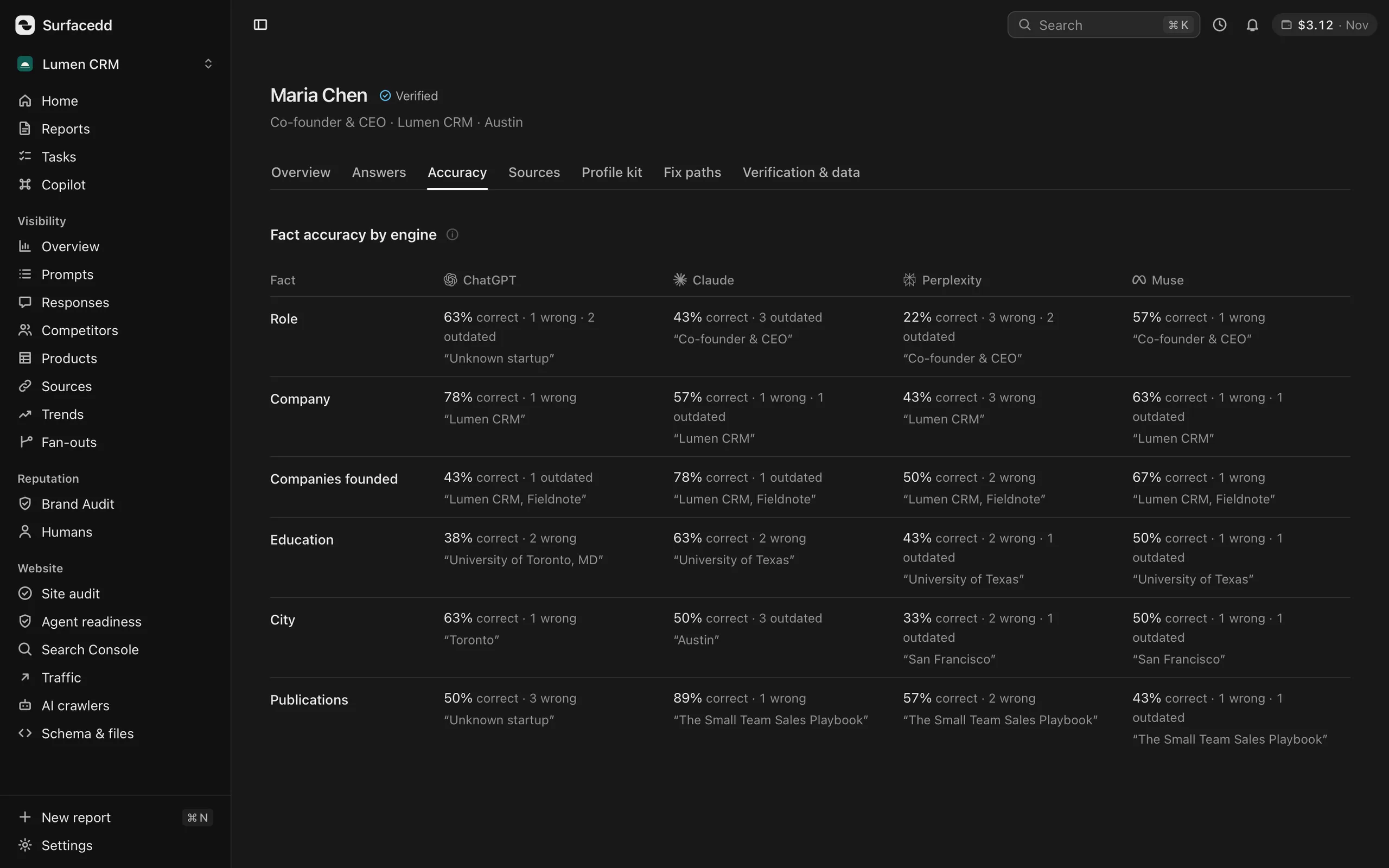
Reading the sample profile shows why the matrix matters. ChatGPT's "University of Toronto, MD" is not a typo: it is a different Maria Chen, a physician, bleeding into the answer. Perplexity's "San Francisco" comes from a company-database page with an old address. Those are two different problems with two different fixes, and a single "accuracy score" would hide both.
Which page is behind each wrong fact?
The Sources tab groups the pages that engines cited in answers that got a fact wrong. In the sample profile, three pages explain almost every error:
| Page | Wrong fact it feeds | Answers affected | Fix route |
|---|---|---|---|
| companydb.example/person/maria-chen | City | 4 | Update the listing (you can edit it) |
| medicalnews.example/people/maria-chen | Education | 3 | A namesake's page: strengthen your own disambiguation instead |
| techbrief.example/2019/fieldnote-launch | Companies founded | 2 | Ask the publisher to add a correction |
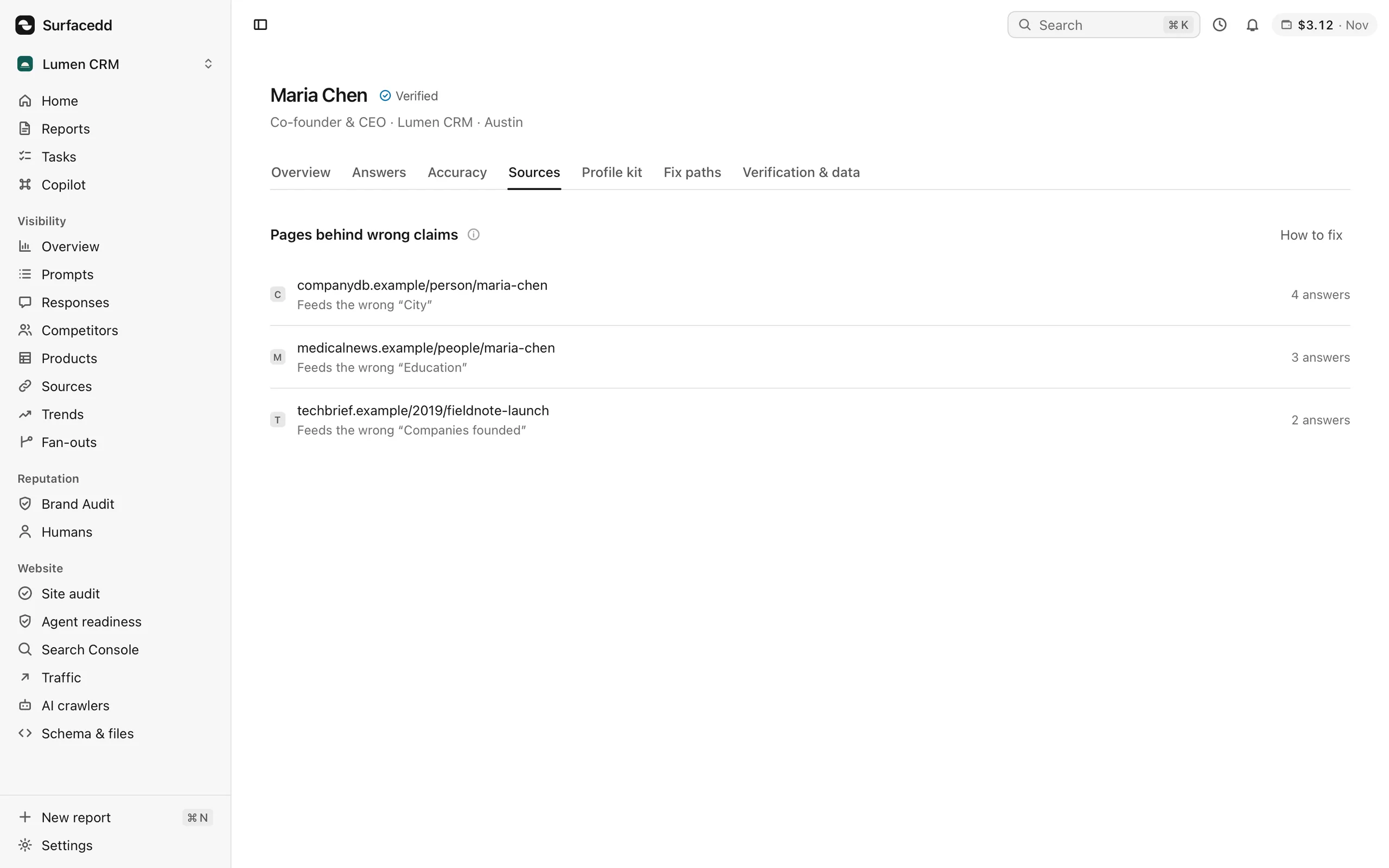
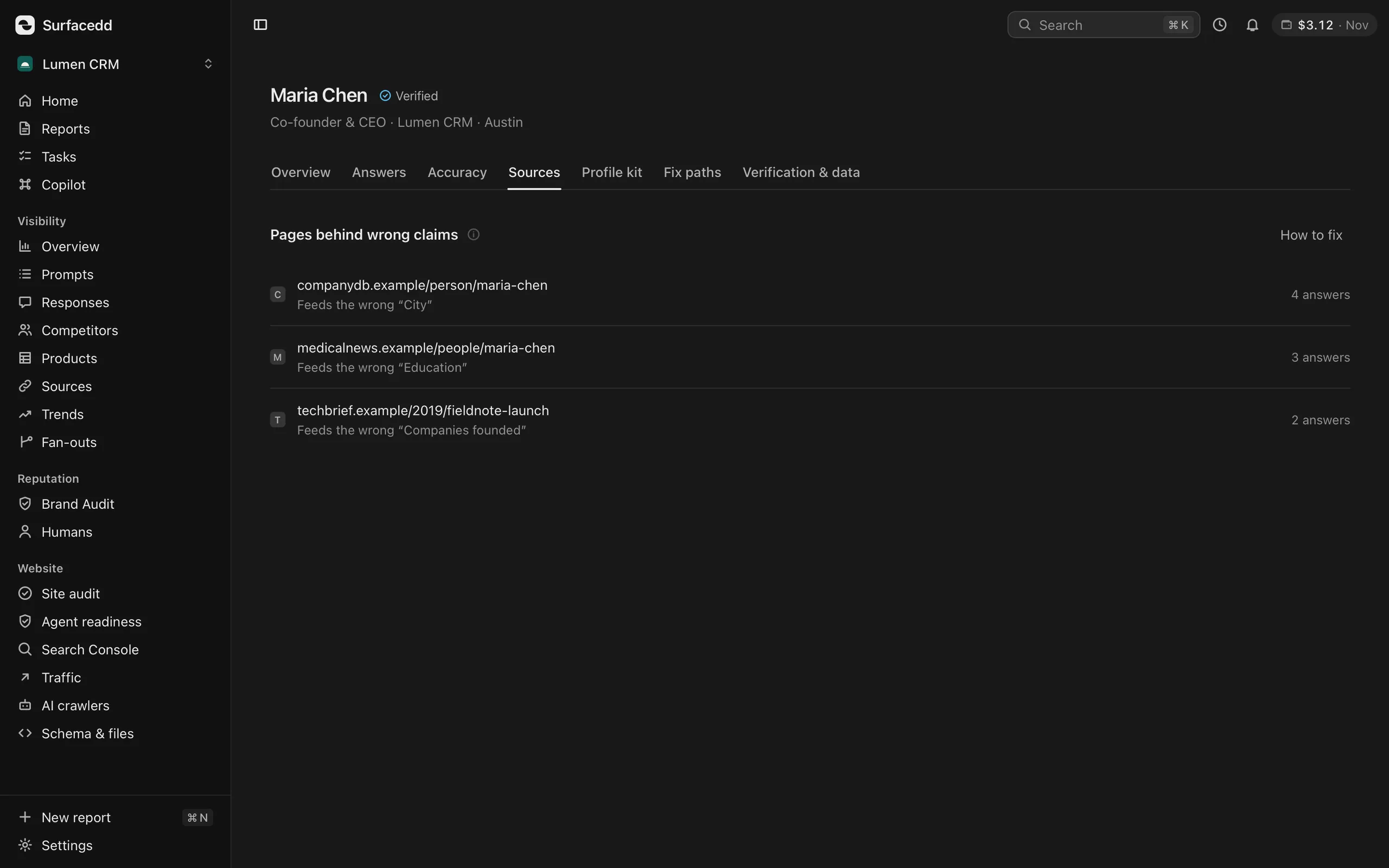
This is the step most "AI reputation" advice skips. Fixing your own bio does nothing if the assistant keeps citing a directory you forgot about.
Fix paths: what you can change, in order
Humans never promises to change what an assistant says. It shows you what the assistant reads, and the Fix paths tab lists the routes available to you, in the order they tend to pay off. Your progress is saved on your computer.
- Fix the page behind each wrong claim. If you control it, correct it. If you don't, ask the site owner.
- Update your canonical page and profiles. Make one page state every fact on your fact sheet, then bring linked profiles into line.
- Send feedback on search knowledge panels. Google lets people claim their panel by signing in to an official profile, such as YouTube or Search Console. Not every panel can be claimed yet. (Google)
- Ask AI providers to correct personal data. The tab links OpenAI's privacy request portal; other providers list a privacy contact in their policies.
- In the EU or UK, request rectification or erasure. GDPR Article 16 gives a right to have inaccurate personal data corrected; Article 17 gives a right to erasure in some cases, with exceptions that include freedom of expression.
- Preserve evidence of harmful claims. Export the answer with its timestamp and sources before it changes, and get legal advice. Surfacedd doesn't write demand letters.
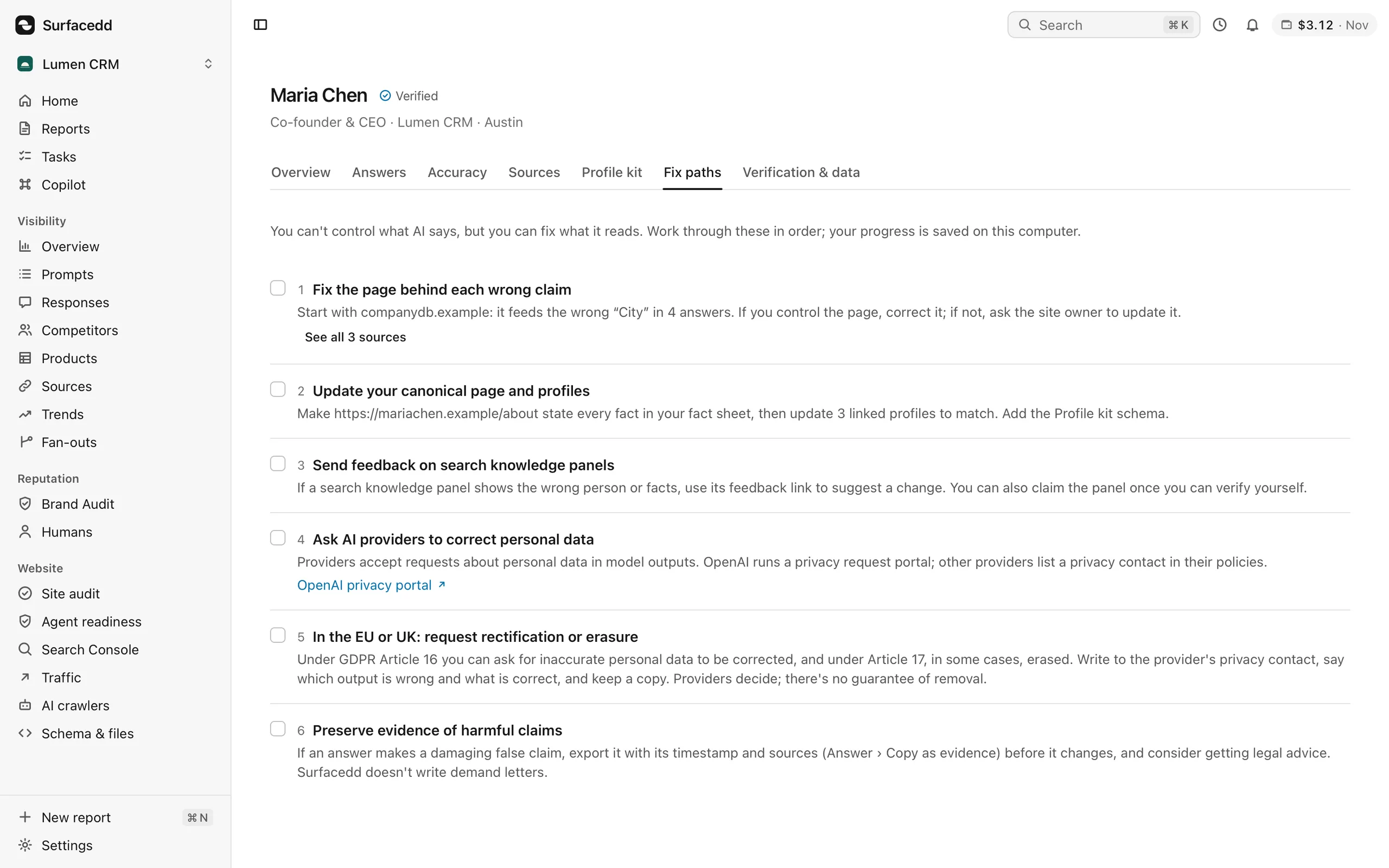
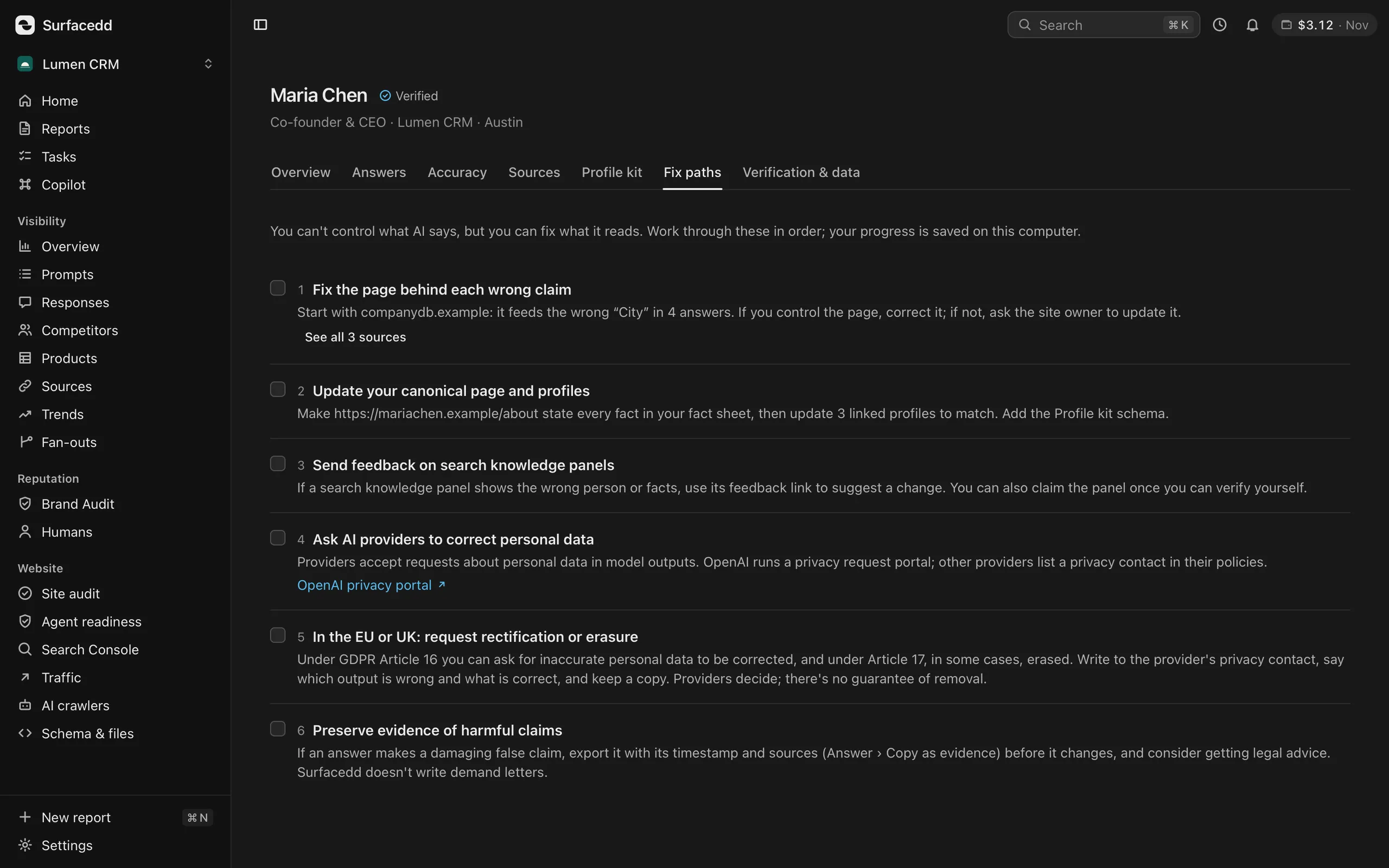
The guide how to fix what ChatGPT says about you walks through each route by cause, with realistic timelines.
The profile kit: one source of truth for your facts
Assistants trust facts that agree across many pages. The Profile kit gives you the pieces to make them agree:
- A canonical one-sentence bio to paste everywhere you control: your site, LinkedIn, speaker pages, author boxes.
- ProfilePage and Person JSON-LD generated from your fact sheet:
name,jobTitle,worksFor,alumniOf,knowsAboutandsameAs. Google documentssameAs,identifierandalternateNameas recommended properties for the person on a profile page (Google Search Central). - A bio consistency check: paste the bios you have published and see where they disagree with your fact sheet.
rel="me"guidance for two-way links between your profiles.
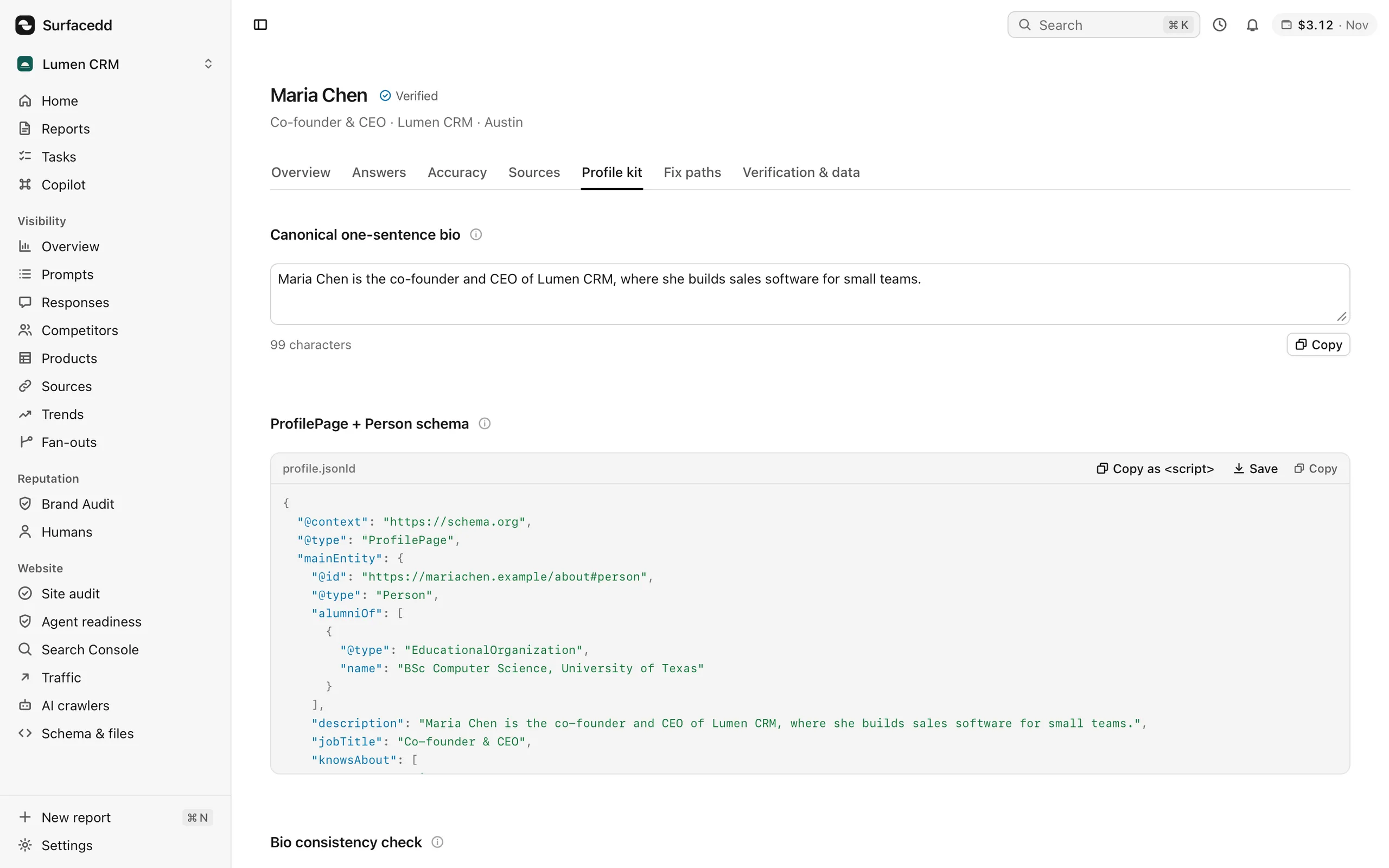
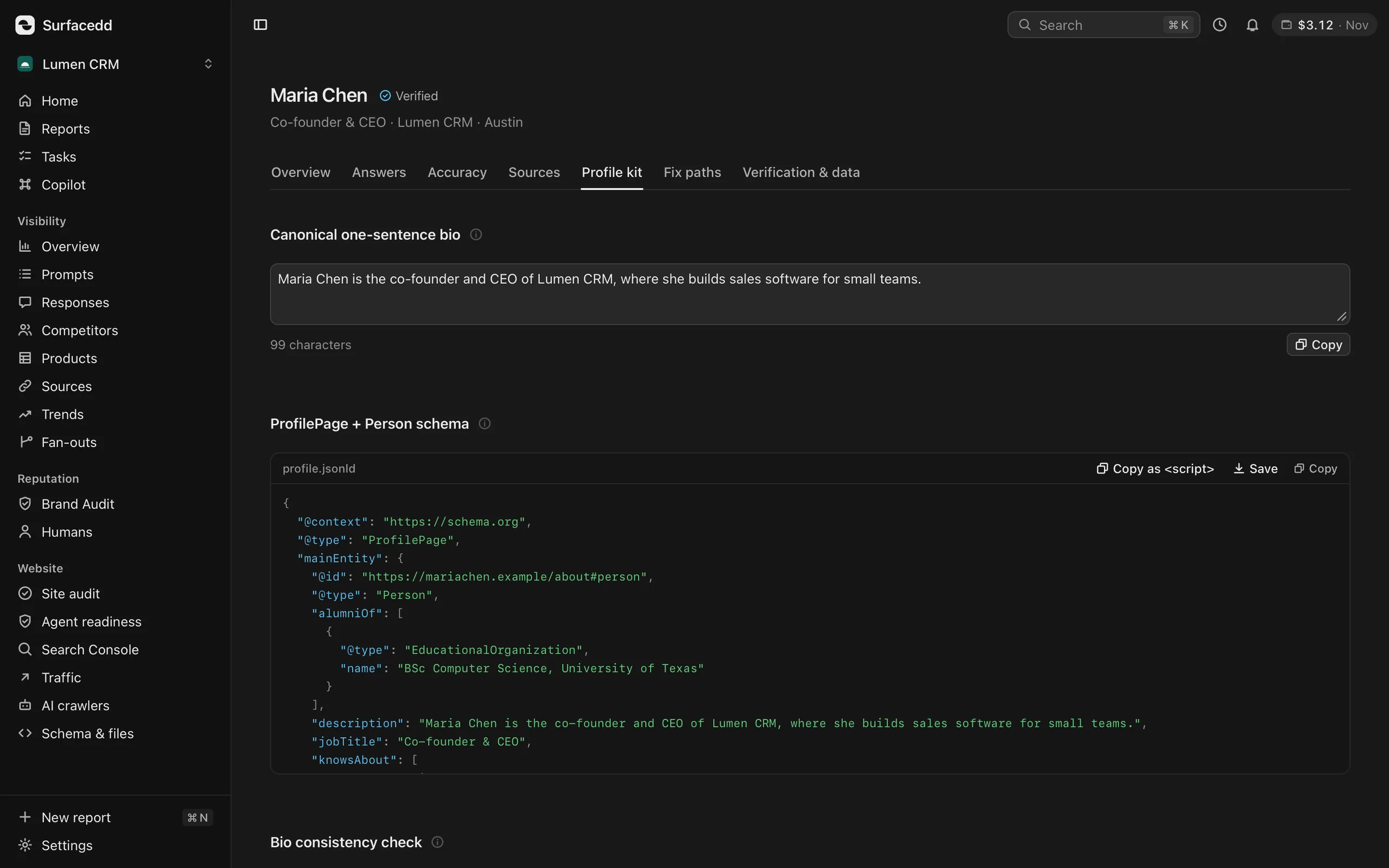
The free Person schema generator produces the same markup in your browser, and the Person schema guide explains each property.
Who you can track, and how it's verified
A Humans profile is yours, or a client's who has given you written authorization. There is no way to set up a profile for anyone else, and the acceptable use rules and licence say the same.
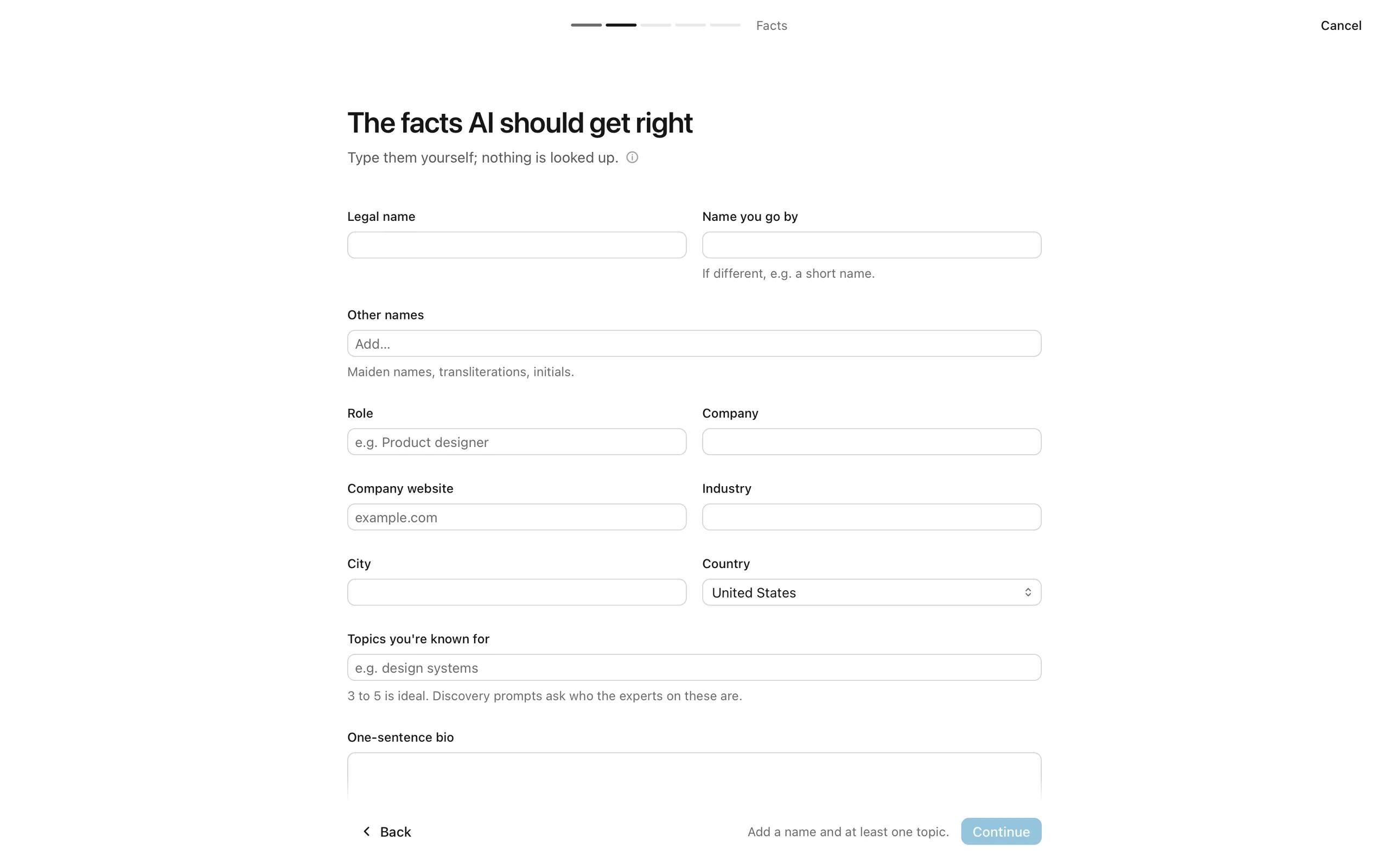
Setup starts with one question: "Me" or "A client". Then you type the fact sheet yourself; nothing is looked up or scraped. Then you verify, using any one of these:
| Method | What you do | Badge |
|---|---|---|
| Domain proof | Add a surfacedd-verify meta tag, a DNS TXT record or a /.well-known/surfacedd-verify.txt file on the domain of your canonical profile. Surfacedd checks it from your computer, free. | Verified |
| Self-attestation | Type your full name to confirm the profile is you | Unverified |
| Client authorization | Attach the client's written authorization (name, scope, date, how to revoke). Required for client profiles. | Recorded with the profile |
The method and date are stored with the profile. The Humans verification docs cover each method step by step.
Questions Humans never asks
Ten categories are blocked in the template layer and in your custom prompts, in five languages: marriage and family, religion, health, sexual orientation, political views, ethnicity, criminal records and allegations, home address, phone numbers, and salary or net worth.
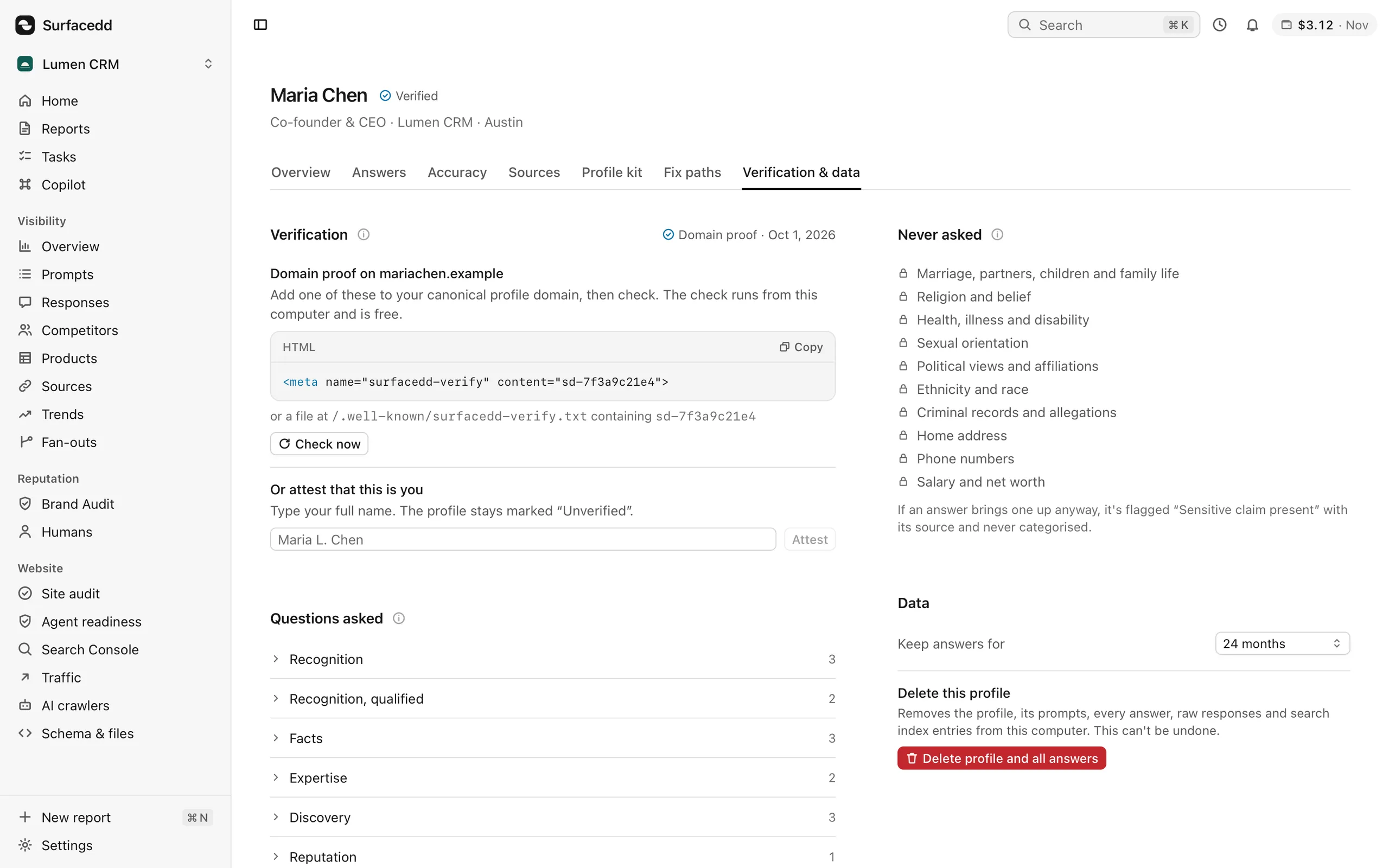
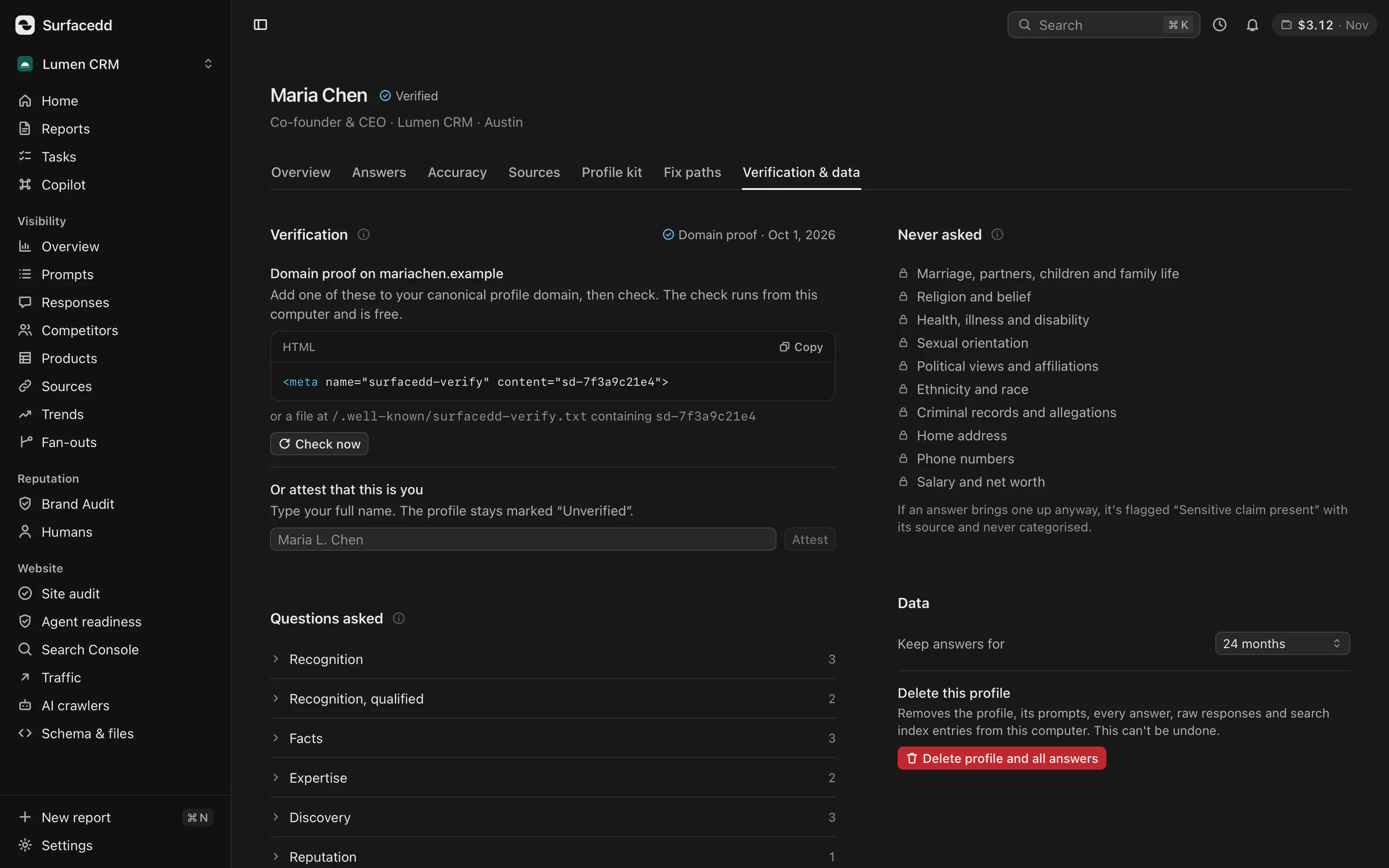
If an answer brings one of these up anyway, Humans flags "Sensitive claim present" with its source and never categorises it. Other people who appear in answers, such as namesakes or other experts, are kept only as names inside the answer text, for share-of-voice counts. They get no profile, no enrichment and no alerts.
What a Humans run costs
You pay the AI providers directly, on your own API keys, and Surfacedd shows the estimate before anything runs. At today's list prices:
| Run | Questions × engines | One run | Weekly, per month |
|---|---|---|---|
| Essentials | 8 × 3 (ChatGPT, Claude, Perplexity) | $0.25 | $1.11 |
| Full | 22 × 4 (adds Meta AI) | $1.02 | $4.43 |
The figures include the step that reads each answer and checks it against your fact sheet. The licence itself is a single payment (Launch price $29, $79 after 23:59 UTC on January 30, 2027.$79 once.), with no Humans add-on and no per-profile fee. See pricing for what the licence covers.
Deleting everything
One button on the Verification and data tab deletes the profile, its prompts, every answer, the raw responses and the search index entries from your computer. You can also set how long answers are kept. Surfacedd the company never receives your profile or answers, so there is nothing to delete on our side.
Which Humans page fits you
- Preparing for interviews? The pre-interview AI check is eight questions, three engines, and a two-week fix order.
- Founder or executive? Executive reputation in AI adds the company-link questions: does AI know who founded your company?
- Consultant, author or speaker? Expert discovery measures whether you're named on "who are the experts on…" questions.
Brands get the same treatment in Brand Audit, which checks what AI says about the company rather than the person.
What Humans doesn't do
Sources
Fair questions
Can I use Humans to check what AI says about someone else?
No. A profile is either yours or a client's who has given you written authorization, and client profiles require that authorization to be attached before they run. There is no setting for tracking a competitor, a candidate or an ex, and the licence forbids it. Other people who show up in answers are kept only as names inside the answer text.
Can Surfacedd remove false information from ChatGPT?
No tool can. Humans shows the page each wrong fact came from, so you can correct the pages you control and ask the owners of the pages you don't. It also links the formal routes: OpenAI's privacy request portal and, in the EU or UK, GDPR rectification and erasure requests. Providers decide those requests; nothing about the outcome is promised.
How is this different from online reputation management?
Classic reputation management works on search results and reviews. Humans works on the answer an assistant writes about you, which can mix your facts with a namesake's and cite pages that never rank on page one. It measures that answer field by field and points at the cited page behind each error. It doesn't publish content or suppress results.
Do my answers or fact sheet go to Surfacedd?
No. The prompts go from your computer to each AI provider on your own API keys, and the answers are stored in a database on your computer. Surfacedd the company receives licence data only. The providers do receive your name inside the prompts, as part of your own API use under their terms.
How often should I run it?
Weekly is the default, and it's enough for most people: answers that cite web pages change when those pages change, which takes days to weeks. The essentials run costs $1.11 a month weekly at current list prices. Run it again right after you fix a source page to see whether the cited answer moved.
What if a famous person has my name?
Don't measure yourself on the bare "Who is {name}?" question; you'll lose to the famous namesake for years. Humans reports namesake confusion separately and keeps the qualified questions, such as "Who is {name}, {role} at {company}?", as the main measure. Disambiguation (a middle initial, a consistent title, linked profiles) is what moves those.
Which engines does Humans ask?
The essentials run asks ChatGPT, Claude and Perplexity; the full run adds Meta AI. All are asked through their official APIs with web search on, so each answer comes with the sources it cited. You choose engines per profile in the setup, and the cost estimate updates as you change them.
How we research, write and correct pages: read our editorial policy.