See when Claude recommends you, and the exact passages it cites
Surfacedd asks Claude your buyers' questions with Anthropic's web search tool, then stores the answer, the passage each citation quotes, every result Claude received and the searches it ran.
By the Surfacedd teamUpdated 6 min readMarkdown
On this page
Short answer
A Claude rank tracker asks Claude your prompts with web search available and records whether it names your brand and which pages it cites. Surfacedd uses Anthropic's Messages API and web search tool on your own key, capped at three searches per answer, and keeps the quoted passage, up to 150 characters, behind every citation.
How Claude is collected
- How Surfacedd asks
- Anthropic Messages API with the web search tool, up to three searches per answer.
- Key you need
- Anthropic API key
- Location
- Approximate. For countries the tool does not support, location is omitted and the answer is marked so.
- Searches it ran (fan-outs)
- Exposed. Each web_search query is saved.
- Citations
- Citations attached to the exact text span they support, plus every search result Claude received.
- Search fee
- $10.00 per 1,000 search calls, plus tokens
- Default model
- Claude Haiku 5.5. Mid and flagship models can be picked per report.
Worth knowing
- Search errors can arrive inside a successful response; the answer is still kept and the error is noted.
- Long answers that pause mid-turn are resumed, up to four times, and usage is summed across turns.
- If an admin has switched web search off for your Anthropic organization, Anthropic rejects the request; the key card links to the setting that turns it back on.
Cost per answer
$0.0112
estimated, paid to Anthropic on your account
- 100 answers
- $1.12
- 25 prompts × 3 samples, weekly, for a month
- $3.65
- Reading each answer (GPT-6 Luna)
- +$0.0015
From price table 2026-11-13.1, using typical token counts and one search per answer. The app recalibrates from your own answers and shows its estimate before each run. How costs are estimated
How Claude searches
Claude decides for itself whether a question needs the web. Anthropic's web search documentation says Claude searches when a request depends on information that is "current, changing, or outside its training data", including "specific organizations, people, or products that might have changed", and answers directly when the request draws on stable knowledge.
That has a direct consequence for tracking. Claude answers some buying questions from what it learned in training, with no search and no citations. Those answers are still worth measuring: they show what Claude believes about your category before it looks anything up, and changing them takes longer than winning a citation. Surfacedd stores them like any other answer, so you can see the share of Claude's answers that searched at all.
When Claude does search, the response contains a server_tool_use block with each query, a web_search_tool_result with the results (URL, title and page age), and text blocks whose citations point to exact passages. Surfacedd keeps all three.
Cost drivers: results are billed as tokens
Claude's search pricing has two parts, and the second one is easy to miss. Anthropic charges per search, and then "search results count as input tokens, both while Claude keeps searching within a turn and in later conversation turns." A search that pulls in several long pages costs more than the search fee suggests, and a model with higher token prices multiplies that.
Surfacedd controls this in three ways:
- A cap of three searches per answer with
max_uses. Anthropic notes single-fact questions typically use one to three searches, while comparative research can use ten or more; three keeps the cost predictable without cutting typical buying questions short. - The basic search tool version, without dynamic filtering. Filtering reduces tokens but adds code-execution blocks that make cost and parsing less predictable.
- Low effort on the answering model, so thinking tokens don't inflate the answer.
Failed searches aren't billed, per Anthropic. Every answer stores the number of searches it actually used.
| Model | Tier | Input per 1M tokens | Output per 1M tokens | Per 1,000 searches | Est. per answer |
|---|---|---|---|---|---|
| Claude Haiku 5.5 (default) | cheap | $0.10 | $0.50 | $10.00 | $0.0112 |
| Claude Sonnet 5.5 | mid | $2.00 | $10.00 | $10.00 | $0.0346 |
| Claude Opus 5.5 | flagship | $4.00 | $20.00 | $10.00 | $0.0592 |
Estimates assume about 8,300 input and 800 output tokens and 1 search per answer, at Anthropic's list prices on 2026-11-23 (UTC), price table 2026-11-13.1.
The default is Claude Haiku 5.5. At the default, 25 prompts with 3 samples asked weekly cost about $4.15 a month, paid to Anthropic.
Location
Anthropic accepts an approximate user location: city, region, a two-letter country code and a time zone. Surfacedd passes your report's market. One wrinkle: Anthropic rejects a country code it doesn't support with an error, rather than ignoring it. When that happens, Surfacedd drops the location, asks again and marks the answer "location not applied", so you never mistake a location-less answer for a local one.
Consulted vs cited
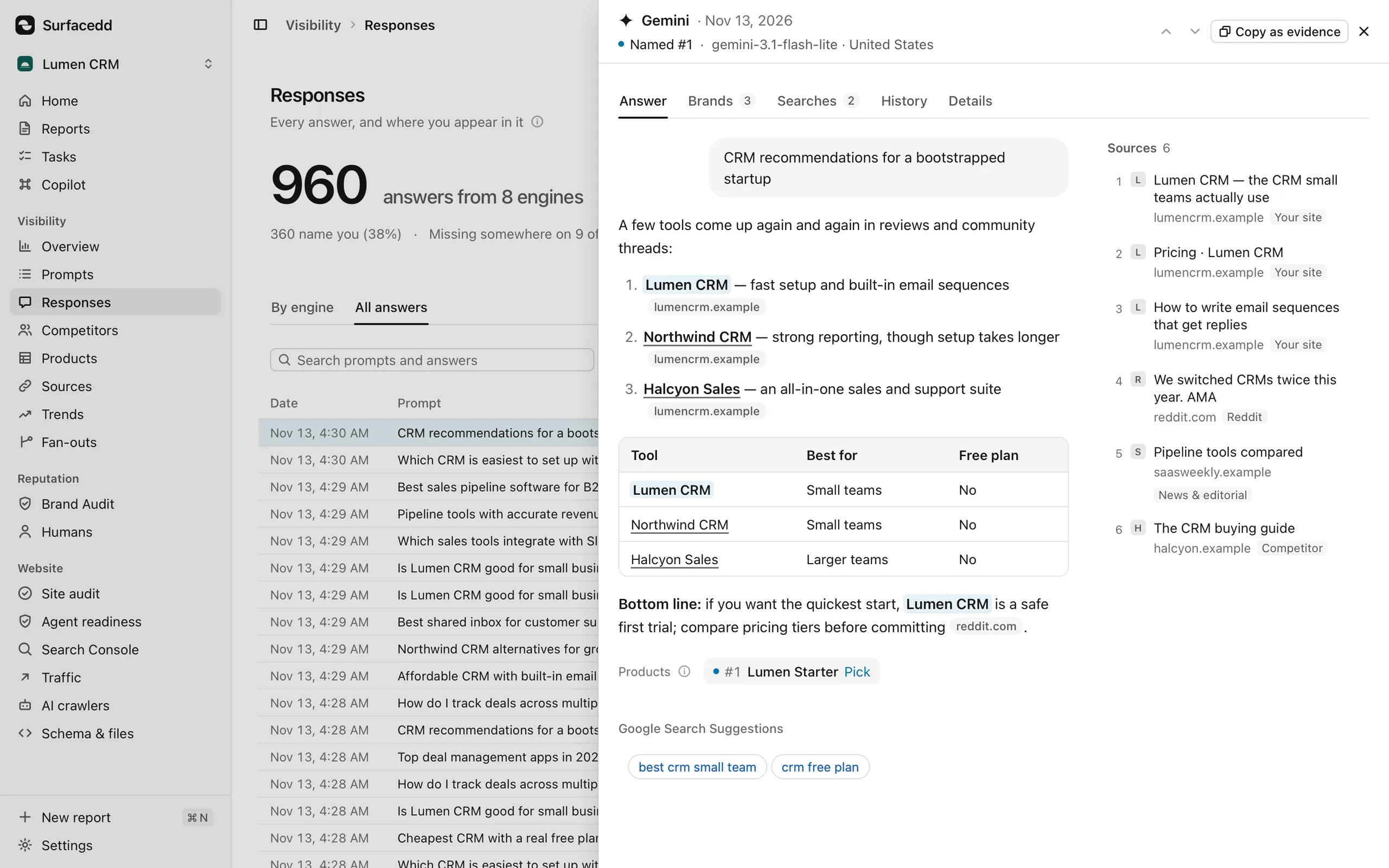
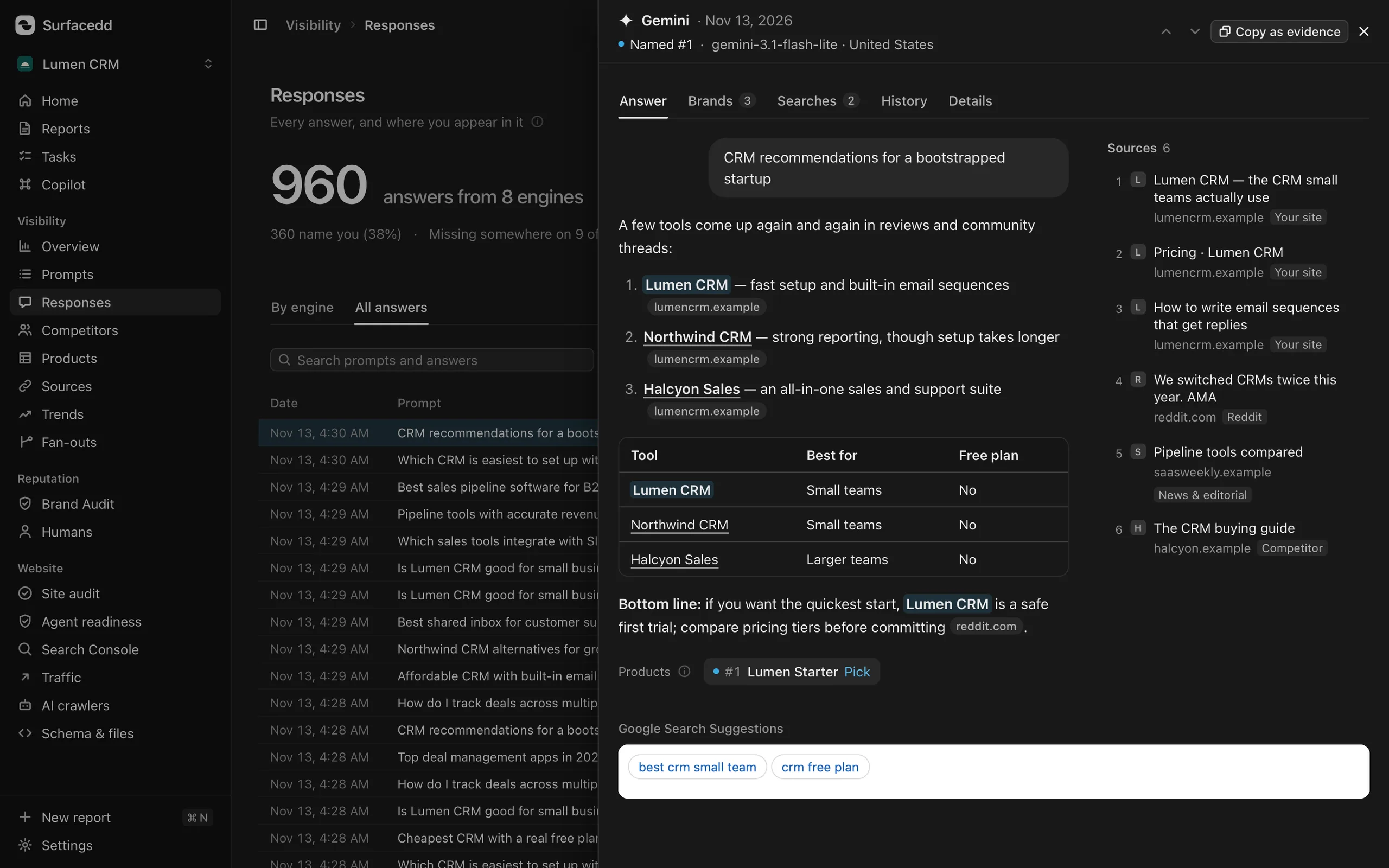
Claude's citations are the most precise of any engine. Each one is a web_search_result_location with the URL, the page title and cited_text: up to 150 characters of the passage Claude relied on. So you don't only see that Claude cited your pricing page; you see which sentence.
The full list of results Claude received sits in the web_search_tool_result blocks. Anything there that no citation points to is stored as read but not cited. Comparing the quoted passages of the pages that won with your page that was read and skipped is the fastest way to see what Claude wanted and didn't find.
The capability toggle that blocks first runs
Anthropic lets organisation admins switch web search off in the Claude Console. Its docs say web search "is enabled for your organization unless an administrator has disabled it", and that when it's off, a request that includes the tool fails with a 400 error saying web search isn't enabled.
This trips up teams whose Anthropic account was set up by someone else, often with search disabled as a precaution. Surfacedd's optional search test on the key card catches it before your first report and tells you where the setting lives: the capabilities page in the Claude Console. Fix it once, re-test, and the error doesn't come back.
Quirks worth knowing
- Search errors arrive inside successful responses. If a search hits a limit or fails, Anthropic still returns HTTP 200 with an error block (such as
too_many_requestsormax_uses_exceeded) in place of results. Surfacedd keeps the answer and notes the error. - Long answers can pause. Anthropic may return
pause_turnon a long search turn. Surfacedd sends the paused message back to continue, up to four times, and sums the usage across turns. - Spend caps return 429 without a retry hint. That means your Anthropic spend limit was reached; Surfacedd stops and says "Raise your provider spend limit" instead of retrying.
The searches Claude ran
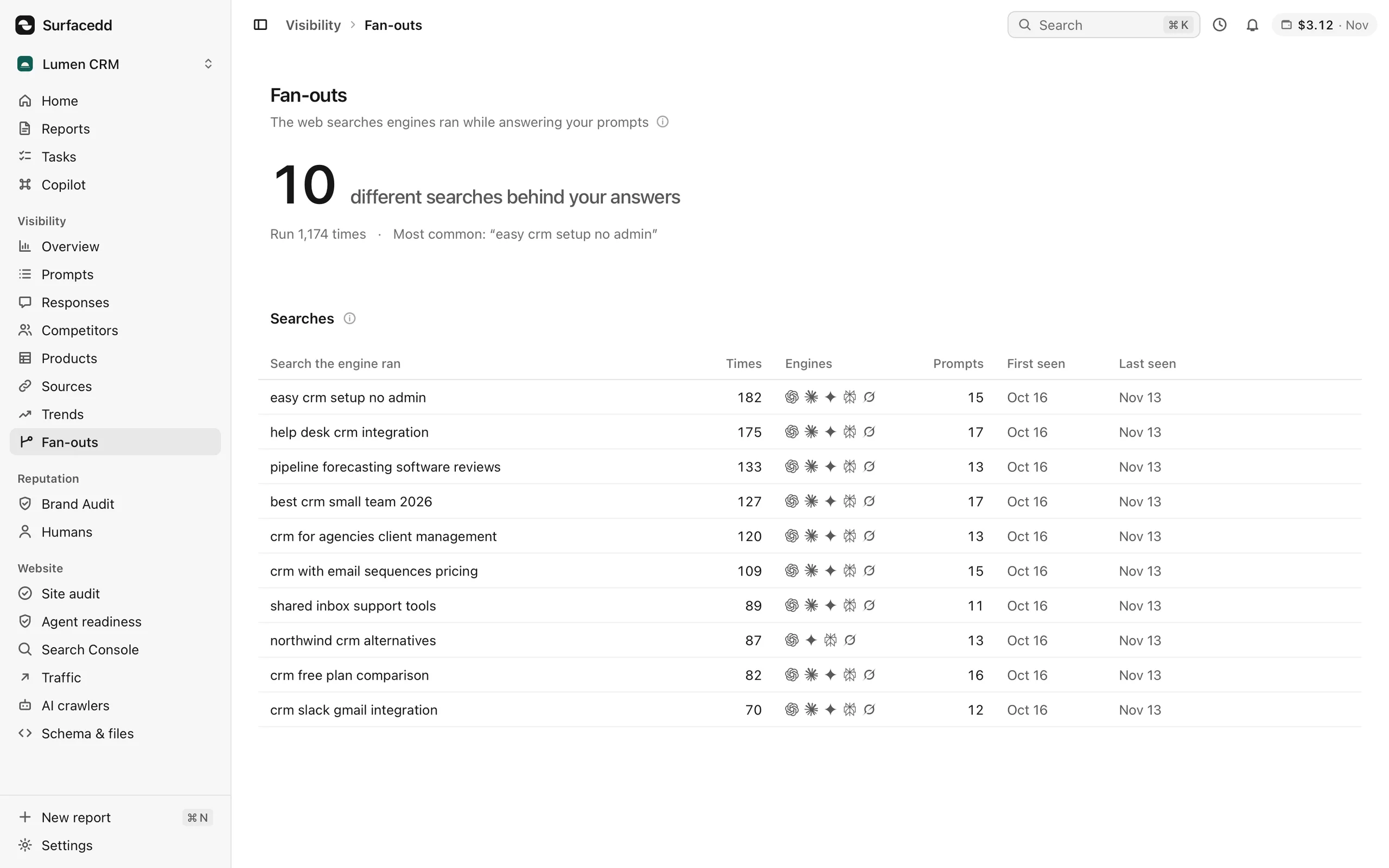
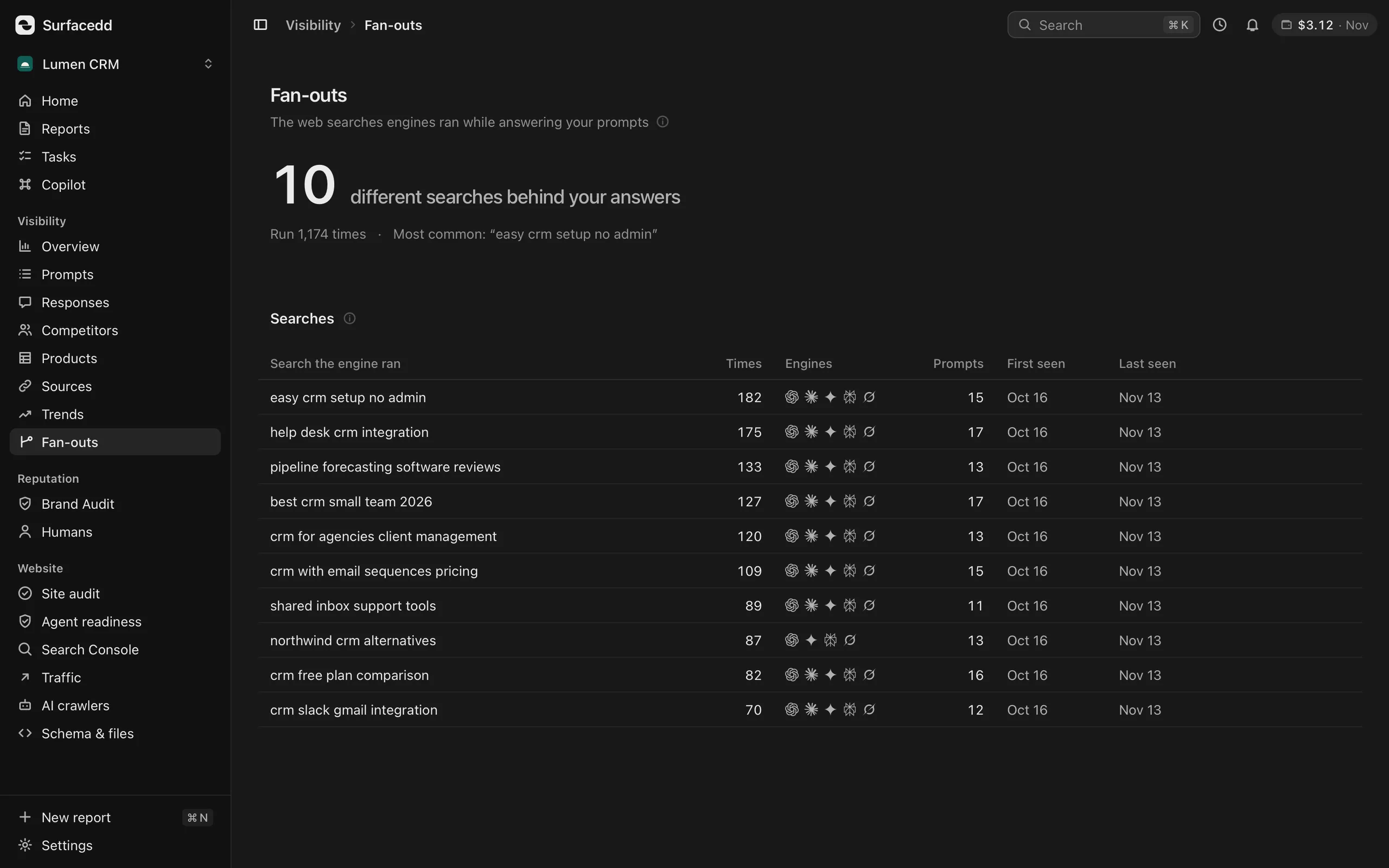
Every server_tool_use block carries the query Claude sent. Surfacedd saves them as fan-outs, so you can see the sub-questions Claude researched for your prompt and which pages answered them. Claude caps at three searches here, so its fan-outs are short and pointed: usually a category search, a comparison and one specific check.
Getting an Anthropic key
Anthropic requires prepaid credit before the first call; there's no free API tier. The Anthropic API key guide covers the key, credit, the capability setting and the test. The same key can read answers for every engine. For the other half of the story, how Claude picks the pages it cites and how to use Claude on your own SEO data, see the Claude SEO guide.
What it doesn't do
See all eight surfaces on the engines overview, or buy Surfacedd once.
Sources
Fair questions
Why do some Claude answers have no citations?
Because Claude chose not to search. Anthropic's docs say Claude answers directly when a question draws on stable knowledge and searches when it needs current or changing information. Buying questions about established categories sometimes get answered from training data. Those answers still count: they show what Claude already believes about your market, which is slower to change than a citation.
What is the Claude web search capability setting?
An organisation-level switch in the Claude Console that lets admins turn web search off. Anthropic says it's on unless an admin disabled it; when it's off, any request using the web search tool fails with a 400 error. Surfacedd's optional search test on the key card detects this before your first report and links to the setting.
How much does it cost to track Claude?
About $0.0112 per answer on the default model at today's list prices, paid to Anthropic on your key. Search results are billed as input tokens on top of the per-search fee, so larger models cost noticeably more per answer. Surfacedd caps searches at three per answer and shows the estimate before every run.
Does blocking ClaudeBot stop Claude from citing me?
Not by itself. Anthropic describes three agents: ClaudeBot collects content that may be used for training, Claude-SearchBot indexes content to improve search results, and Claude-User fetches pages when a user asks. Anthropic says disabling Claude-SearchBot or Claude-User may reduce your visibility in its search results. Decide on each separately.
Which search engine does Claude use?
Anthropic doesn't name it in its web search documentation. Third-party analyses have reported links to Brave Search, but that isn't confirmed by Anthropic's API docs. For tracking, it matters less than it seems: Surfacedd records the actual pages Claude received and cited for your prompts, which is the evidence you act on.
How we research, write and correct pages: read our editorial policy.