See the story AI tells about your brand, and the coverage behind it
Brand Audit shows what models say from memory and from the web, with the page behind each wrong claim; citation data turns into a list of publications to pitch.
By the Surfacedd teamUpdated 7 min readMarkdown
On this page
Short answer
For PR teams, AI answers are a new kind of coverage. Surfacedd's Brand Audit asks ChatGPT, Claude and Perplexity what they know about your brand, from memory and from the web, scores the tone, and traces each wrong claim to its page. Citation data then lists the articles AI cites that name competitors but not you.
The three jobs
AI assistants have become a channel journalists, buyers and candidates use to get a quick read on a company. For a communications team that creates three jobs:
- Know the narrative. What do assistants say about the brand when asked directly, and is the tone what you'd expect from your coverage?
- Correct what's wrong. Which claims are false or outdated, and which page each one comes from.
- Earn the citations that matter. Which publications AI trusts in your category, and which of their articles name your competitors but not you.
Surfacedd measures all three from stored answers and cited pages. It doesn't write releases, pitches or emails; it gives the team the evidence to decide what to pitch and what to correct.
For share of voice and the leadership report, the marketing side of the same data, see AI visibility for marketing teams. Agencies running PR for several clients should read AI visibility for agencies.
What AI says about the brand: Brand Audit
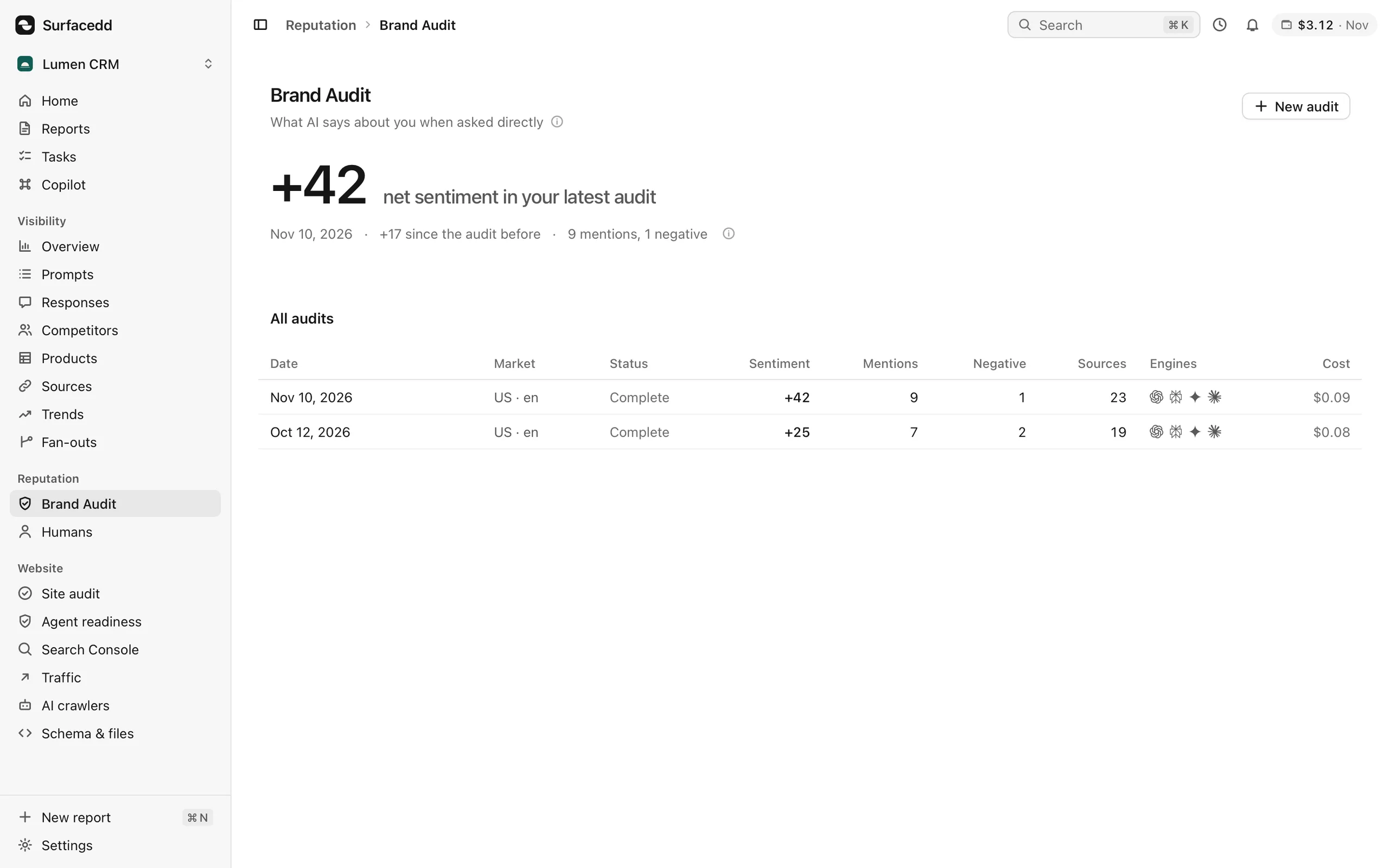
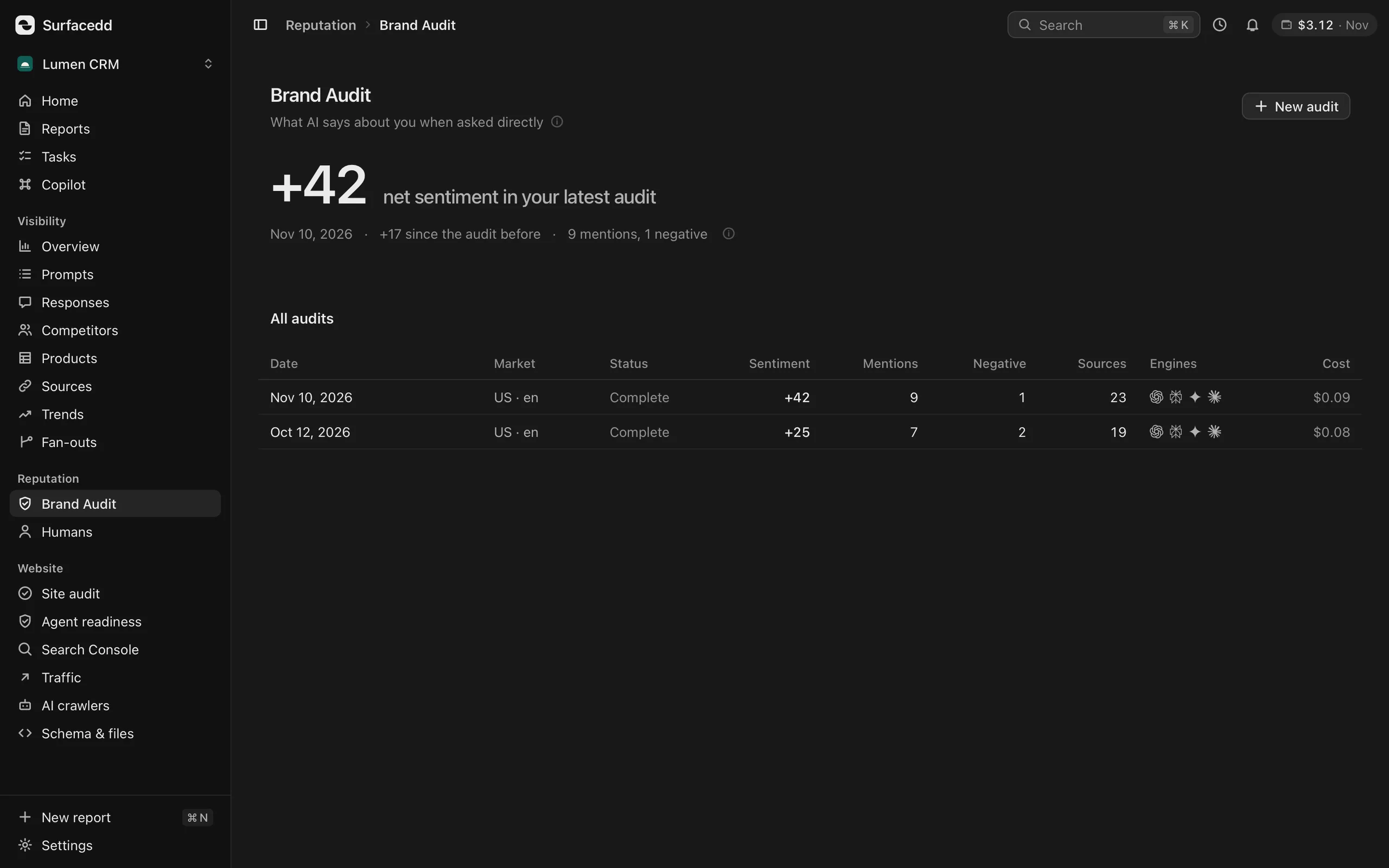
A Brand Audit asks two kinds of question, about information and about reputation, in six AI setups. Three answer with live web search (ChatGPT, Perplexity, and Gemini or Claude), and three answer from training memory only (ChatGPT, Claude and Gemini). Comparing the two shows whether a problem lives on today's web, which you can work on, or in a model's memory, which changes only with new model versions.
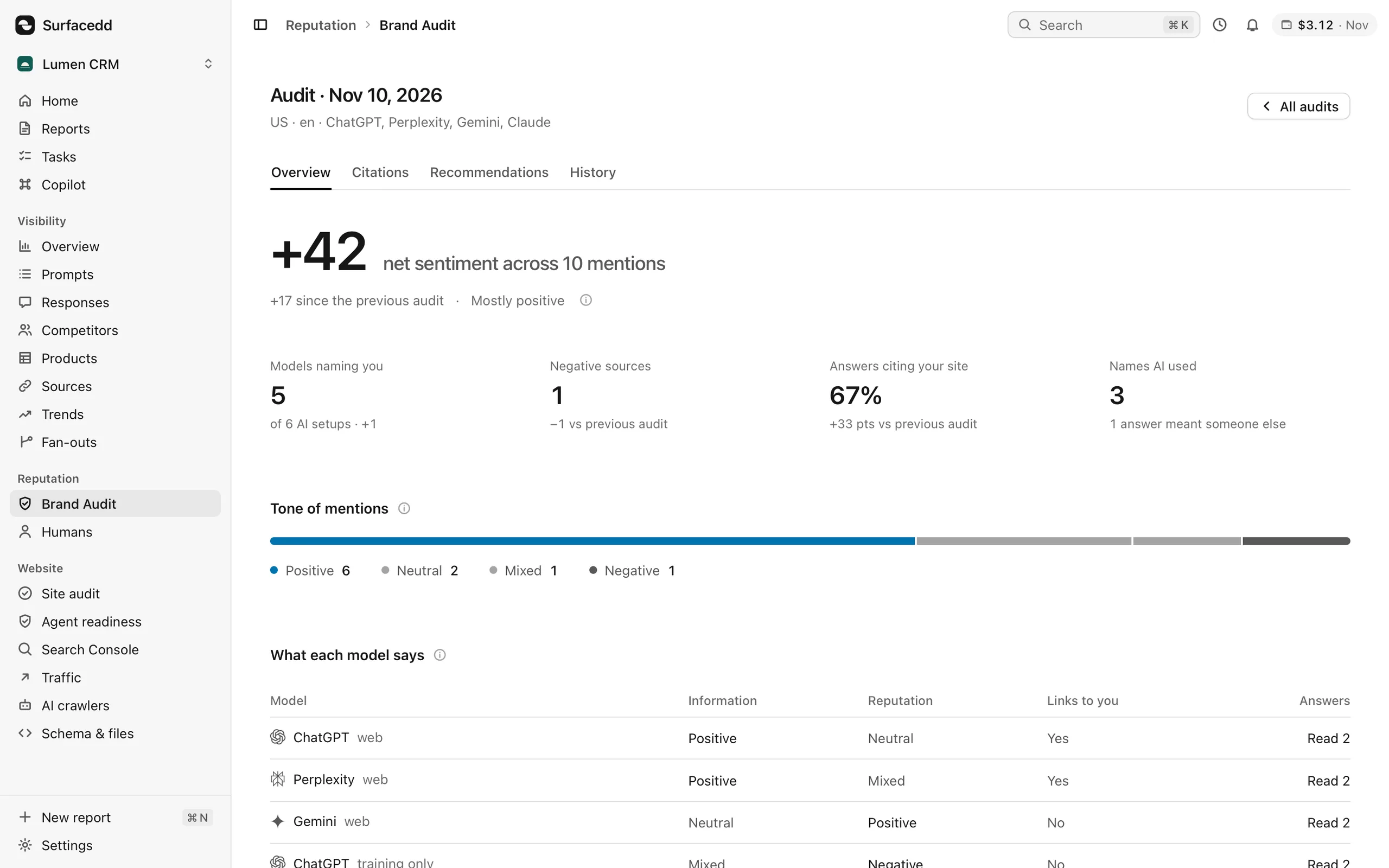
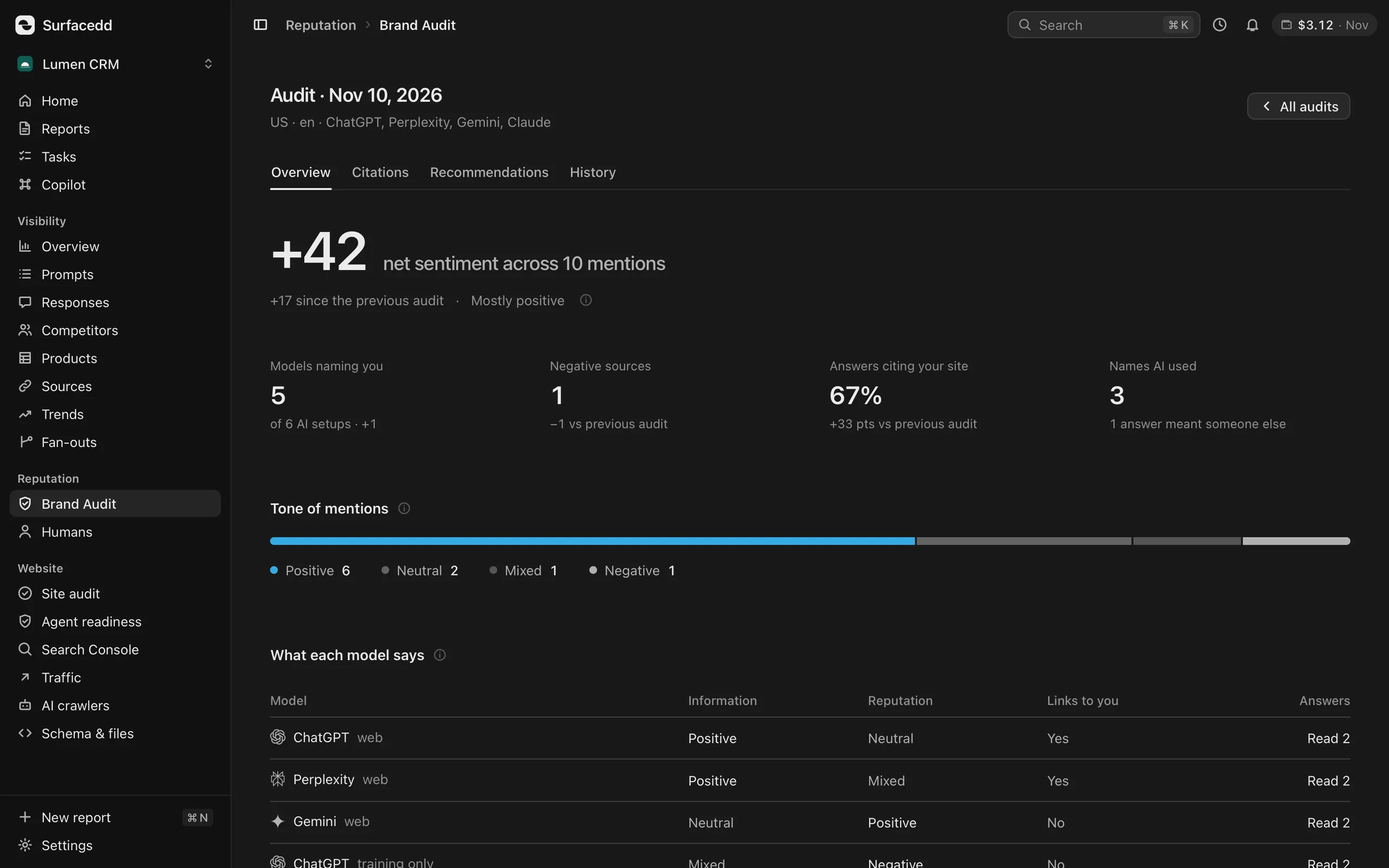
Each audit reports:
| Measure | What PR uses it for |
|---|---|
| Net sentiment, −100 to +100, and tone of mentions | A headline number for the narrative, compared audit to audit |
| What each model says, on information and reputation | Which assistant tells the weakest story, and whether it's web or memory |
| Models naming you | Whether the brand is known at all in each setup |
| Negative sources | The pages behind negative claims |
| Answers citing your site | Whether your own newsroom and about pages are being used |
| Names AI used, and answers that meant someone else | Name confusion with another company |
| Newly mentioned and lost | What changed since the previous audit |
An audit costs about eight cents in provider fees, plus a fraction of a cent for each cited page analysed. Two audits can be compared side by side.
Possible misinformation, with the page behind it
The audit's Citations tab lists each claim that disagrees with your facts, the page it came from and how many answers repeated it. Each cited page gets a sentiment, an alignment score and a citability score, each from 0 to 100, and a recommended action: request a link, request a mention, request an update, or monitor.
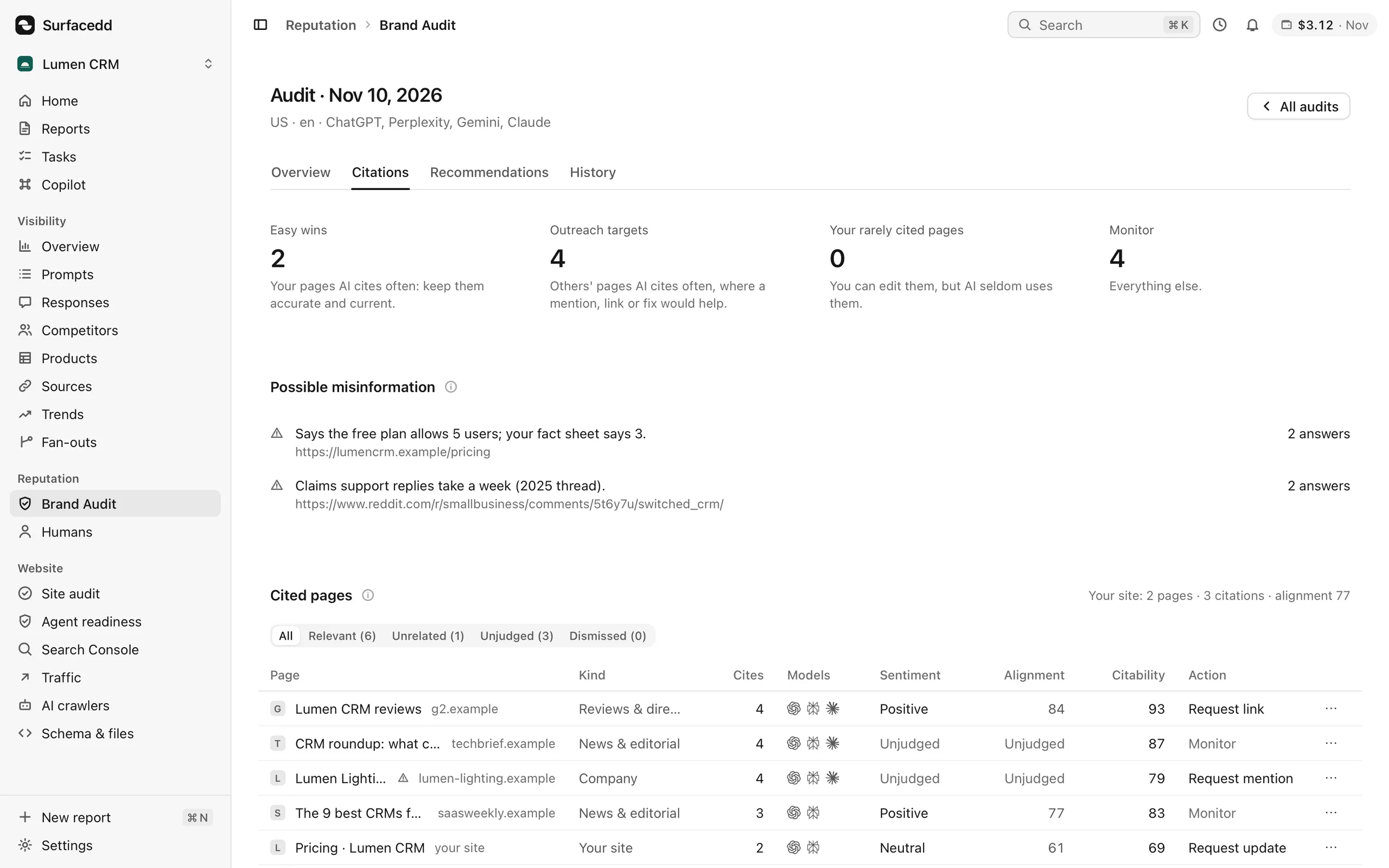
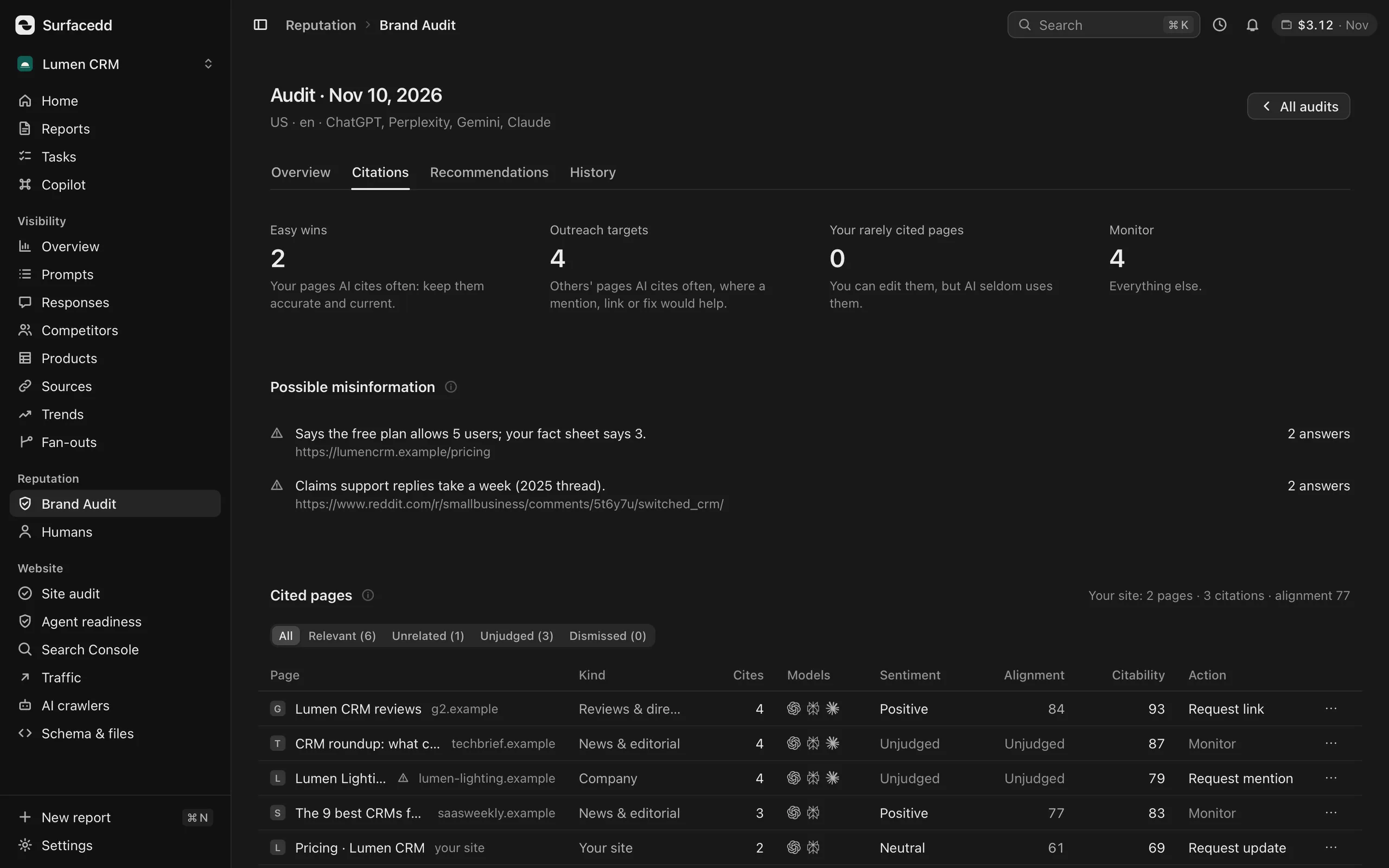
In the sample audit, both claims are ordinary and fixable. One says the free plan allows five users when the fact sheet says three, and the source is the brand's own pricing page. The other says support replies take a week, from a 2025 Reddit thread. One is a website edit; the other is a community response with current facts. Neither is a press release.
Brand Audit covers the feature in full.
Which publications AI trusts in your category
Across every tracked prompt, Surfacedd classifies cited pages into source kinds: news and editorial, reviews and directories, Q&A and forums, Reddit, YouTube, LinkedIn, Wikipedia, institutional and more. The Sources view ranks domains by how often engines cite them for your prompts. That's a media list ranked by AI influence in your category, built from your own data rather than a generic "top publications" list.
The earned-media target list
The Outreach targets tab lists cited pages that name a competitor and not you, excluding your own pages, with their source kind, how many prompts they appear in and how many citations they got. Export it as CSV.
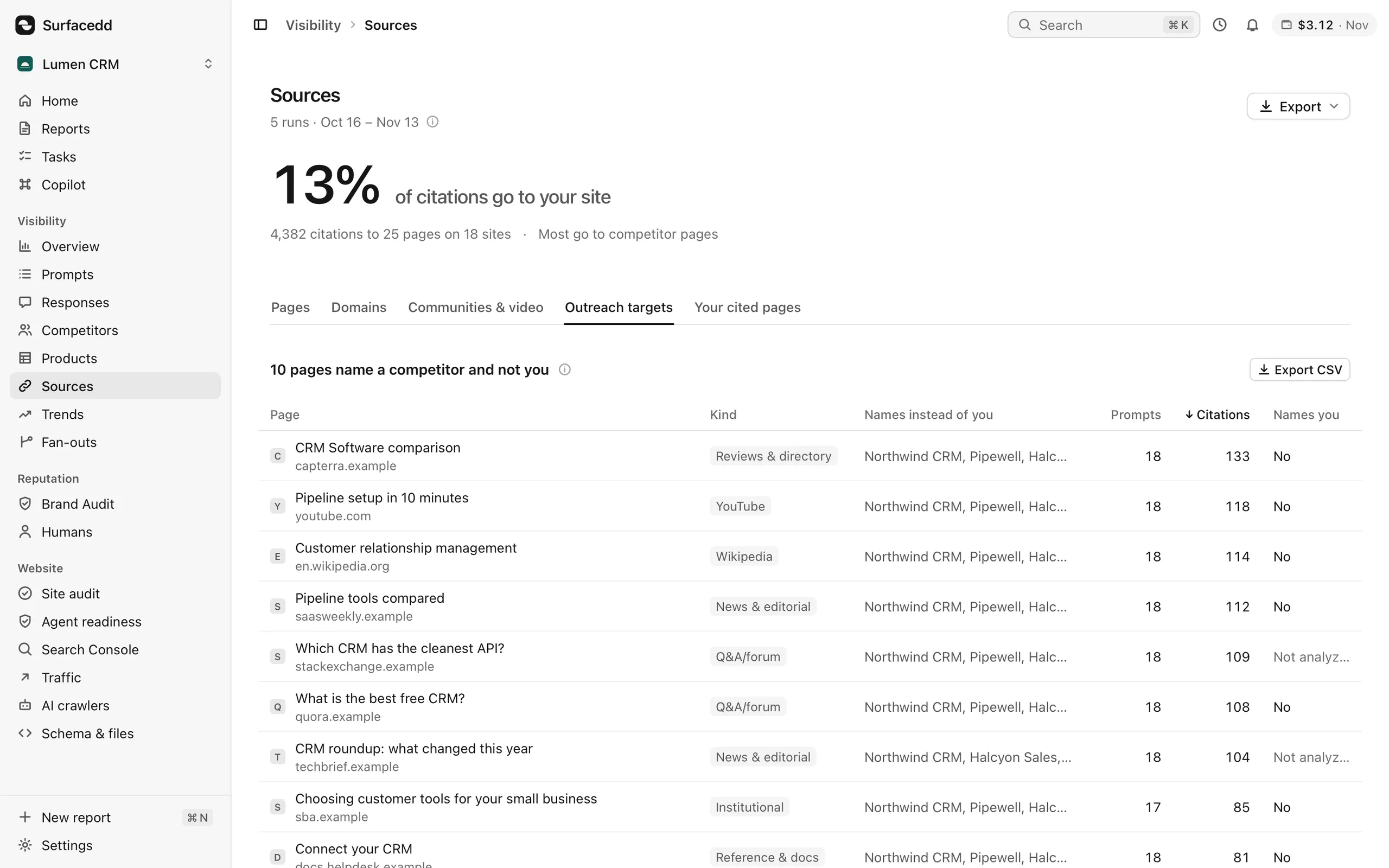
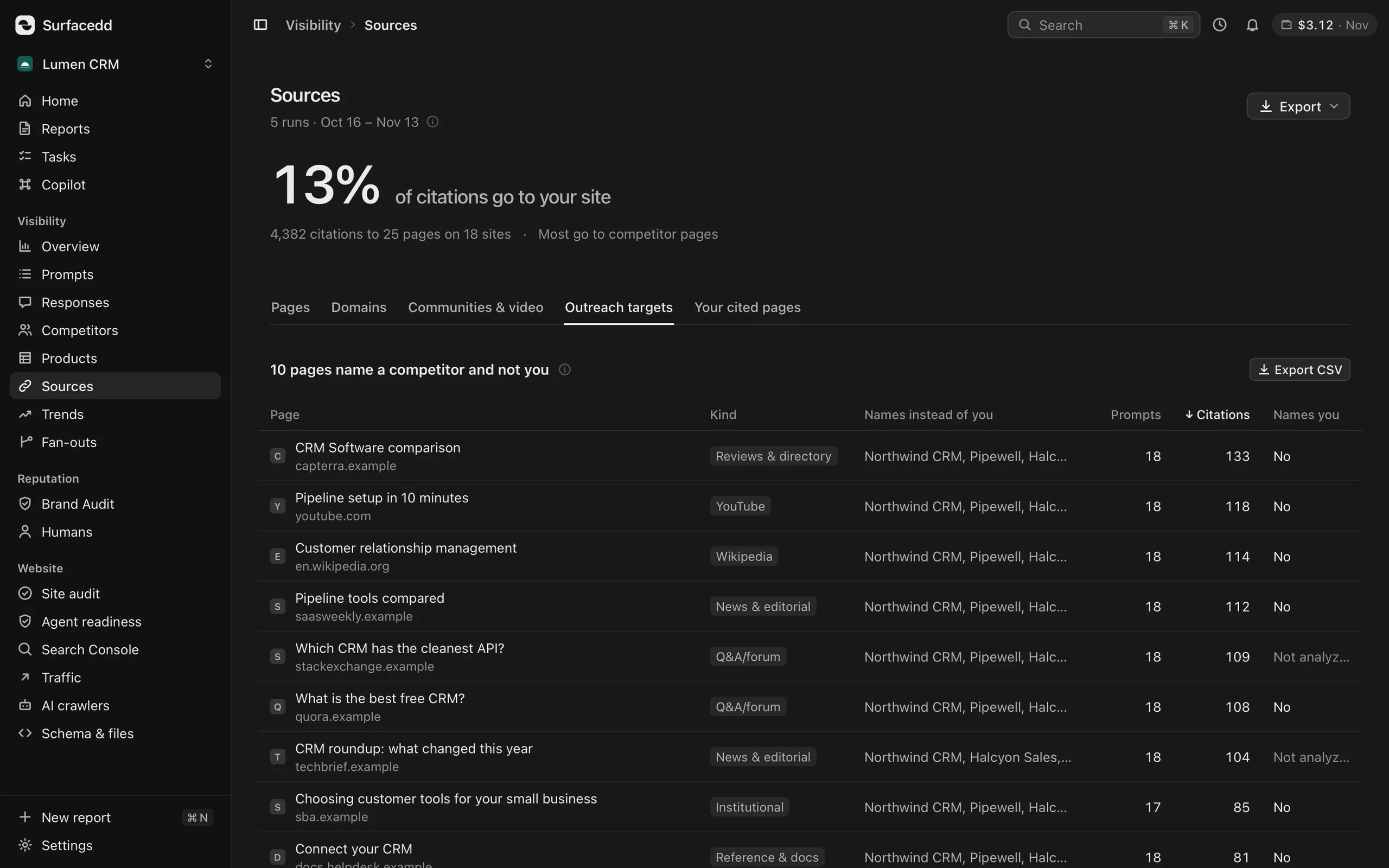
For a PR team, the news and editorial rows are the pitch list. In the sample data, a "pipeline tools compared" article and a "CRM roundup" are each cited more than 100 times in answers that name competitors and not the brand. Updating an existing roundup with a fair comparison is a more realistic ask than a new feature story, and it's the page AI is already reading.
Surfacedd lists pages, not people: it doesn't scrape contact details or write outreach emails. The brand mentions guide covers how to earn mentions honestly, and Competitors and sources explains the citation views.
A worked example: one claim, from discovery to correction
The sample audit's second claim, "support replies take a week", shows the full loop.
- Find it. The audit's misinformation list shows the claim in two answers, with its source: a 2025 Reddit thread in a small-business community.
- Check whether it's still true. If support times have improved, the claim is outdated rather than false. That matters for the response: you're updating a record, not rebutting an attack.
- Fix what you control. Publish current support hours and response times on the brand's own support page, in plain text, where engines can read it.
- Respond where the claim lives, openly. A reply in the thread from a named staff account, stating the current facts and the affiliation, is within most communities' rules. An anonymous "customer" reply is not, and it's the kind of thing that gets found.
- Re-check. Run the next audit and compare it with this one. If the two answers now cite the support page, or the thread with the reply, the claim should drop off the misinformation list. If they still cite the old thread alone, the answer may be coming from the model's memory, which takes a model update to change.
Each step leaves evidence: the stored answers before and after, with timestamps and sources. That's what you show leadership, and what you keep if a claim ever becomes a legal matter.
Crisis cadence
During an incident, move the reports that matter to daily runs and turn on notifications. Surfacedd sends an OS notification and an inbox entry when a run finishes with a significant change, and when a competitor overtakes you on three or more prompts. Run a Brand Audit at the start and again after your statement is published, then compare the two.
Daily runs cost more, and the cost sheet shows how much before you switch. At today's list prices, 20 prompts on four engines cost $20.94 a month daily, against $3.00 weekly. Switch back when the story settles.
If an answer makes a damaging false claim, export it with its timestamp and sources before it changes, and take legal advice. Surfacedd doesn't generate demand letters.
Executives: Humans
Journalists ask assistants about the CEO as often as the company. Humans runs a separate profile for an executive with their written authorization, checks each fact about them, and asks "Who founded {company}?" and "Who is the CEO of {company}?". See Humans for founders and executives.
Setup in five steps
- Add API keys for OpenAI, Anthropic and Perplexity (and DataForSEO for Google's AI answers).
- Add the brand with its facts, aliases and the competitors you're compared with.
- Run a first Brand Audit and read every negative or misaligned claim.
- Add 15 to 25 prompts journalists and buyers ask, from the CSV below, and schedule them weekly.
- Export the outreach list after the second run and share it with the media team.
Starter prompts, grouped by narrative, category and executive questions: b2-pr-prompts.csv.
When Surfacedd is the wrong choice
- You need media monitoring. It doesn't track news, social or broadcast mentions; it tracks what AI assistants say and cite.
- You need a media database. It lists cited pages, not journalists or contacts.
- You need a shared dashboard for the whole comms team. It's a desktop app; others get PDFs and exports.
- You want AI to draft statements or pitches. It doesn't write content.
Fair questions
How do you measure PR in AI answers?
Measure three things: the tone and accuracy of what assistants say when asked about the brand, the share of answers that name you on category questions, and which publications get cited. Surfacedd's Brand Audit covers the first, scheduled prompt runs the second, and the Sources view the third, each from stored answers you can open.
Can we stop ChatGPT repeating a false claim?
No tool can stop it directly. What you can do is find the page it came from and get that page corrected, which Surfacedd shows for each claim. Answers that cite the page can change once it's updated and fetched again. Claims from training memory change only when the provider ships a newer model.
Is a citation in an AI answer worth as much as coverage?
They're different. Coverage reaches a publication's readers; a citation means an assistant used that article to answer a buyer's question, often repeatedly. The useful link is that the articles AI cites are usually existing coverage. Surfacedd shows which of your past and future placements are actually being used.
Does it monitor journalists or other people?
No. It records which pages were cited, not who wrote them, and it doesn't collect contact details. Humans profiles are only for people who've given written authorization, typically your own executives. Other people named in answers are kept only as text inside those answers.
How often should we run a Brand Audit?
Monthly in normal times, plus one before and after any major announcement or incident. Each audit costs about eight cents in provider fees, so cadence is a question of how much change you expect, not budget. Comparing two audits shows what's newly mentioned and what was lost.
Which AI engines matter most for PR?
Start with ChatGPT, Claude, Perplexity and Google's AI answers, because they show sources and are widely used. Brand Audit adds a training-only view of ChatGPT, Claude and Gemini, which shows what models say without searching. Add Grok or Meta AI if your audience uses them.
How we research, write and correct pages: read our editorial policy.