Find the hidden searches AI runs before it answers
When ChatGPT, Claude or Google's AI answer a question, they first run several narrower searches. Those sub-queries decide which pages get cited, and most of them never show up in a keyword tool.
By the Surfacedd teamUpdated 5 min readMarkdown
On this page
Short answer
Query fan-out is the technique AI answer engines use to split one question into several related web searches, then build the answer from all their results. Google says AI Mode and AI Overviews use it. ChatGPT, Claude, Perplexity and Gemini return their sub-queries through their APIs; Meta's API and Google's results pages don't.
What is query fan-out?
Query fan-out is what an AI engine does between your question and its answer: it rewrites the question into several narrower web searches, runs them, and writes one answer from everything they return. Google describes it for AI Mode and AI Overviews as "issuing multiple related searches across subtopics and data sources" in its guide to AI features. OpenAI's web search tool works the same way in practice: one answer can contain several search calls, each with its own query.
The practical effect: the page that gets cited is often the best answer to one sub-query, not the page that ranks for the question the person typed.
Which engines show their fan-out queries?
Four of the eight answer surfaces return their sub-queries through their APIs. The rest don't, so for those you work from proxies.
| Engine | Exposes sub-queries? | Where they appear in the API response |
|---|---|---|
| ChatGPT | Usually | web_search_call items with action.query; OpenAI says "usually (but not always)" |
| Claude | Yes | server_tool_use blocks with input.query |
| Perplexity | Yes | search_results.queries |
| Gemini | Yes | google_search_call steps with the queries |
| Grok | When xAI includes them | web_search_call items, not yet confirmed on every response |
| Meta AI (Muse) | No | Search calls carry only an id, type and status |
| Google AI Mode | No | The results page doesn't show them |
| Google AI Overviews | No | The results page doesn't show them |
Sources: OpenAI web search, Anthropic web search, Perplexity web search, Gemini grounding, Meta search grounding.
Engines that search more also fan out more. Anthropic notes that single-fact questions typically use one to three searches with Claude, while comparative research can use ten or more. Buying questions ("best X for Y") are comparative, so they tend to produce the widest fans.
A worked example
Here is a hypothetical prompt from a fictional project-management brand, with sub-queries of the kind ChatGPT, Claude and Perplexity return for it. Each engine's set differs, which is itself useful.
Prompt: "What's the best project management tool for a small architecture practice?"
| Sub-query | Seen on | What it tells you |
|---|---|---|
| project management software for architects | ChatGPT, Claude, Perplexity | The core category search; expected |
| architecture firm project management features drawings revisions | ChatGPT | The buyer cares about drawing revisions; does your page say you handle them? |
| best project management tool small business 2026 | Perplexity | A generic roundup search; you need to be in those roundups |
| project management time tracking fee billing architects | Claude | Fee tracking matters; a feature you may not mention |
| reddit architects project management tool recommendations | Perplexity | Community opinion is being weighed |
None of these is the prompt itself. Three of the five are long, specific and probably show zero search volume in a keyword tool. Yet each one returns pages that end up cited, and each one points at a section your page either has or lacks.
Why keyword tools miss these queries
Keyword tools report what people type into Google, aggregated monthly. Fan-out queries are written by the model, on the fly, for one conversation. Most are too specific, too long or too new to cross a keyword tool's volume threshold, so they show as "no data" even when an engine searches them every time your category comes up.
That doesn't make keyword research useless. It means keyword volume measures human demand, while fan-outs measure what AI engines research on a human's behalf. You need both, and only the second tells you which passages AI is looking for.
Turning fan-outs into prompts and content gaps
Collect the sub-queries across many runs, not one, because they vary. Then work through them in three passes:
- Group them. Cluster near-duplicates ("architect project software", "project management for architects") and count how often each cluster appears across engines and runs. Frequency tells you what engines consistently research.
- Check your coverage. For each cluster, ask: does one of our pages answer this in a passage that stands alone, under a heading that names the question? Mark each Yes, Partly or No.
- Act on the gaps. A "No" with high frequency is a section to write on an existing strong page. A "Partly" is usually an answer buried in the middle of a paragraph; move it up. A cluster that names a platform (Reddit, a review site) is an outreach task, not a content one.
Then promote the most important sub-queries to tracked prompts. Tracking "time tracking and fee billing for architects" directly tells you whether your new section is being cited, instead of hoping the parent prompt moves.
Google adds one guardrail. Its AI optimisation guide says creating many pages "primarily to manipulate rankings or generative AI responses" violates its scaled content abuse policy. Cover fan-outs as sections of strong pages, not as a page each.
In Surfacedd
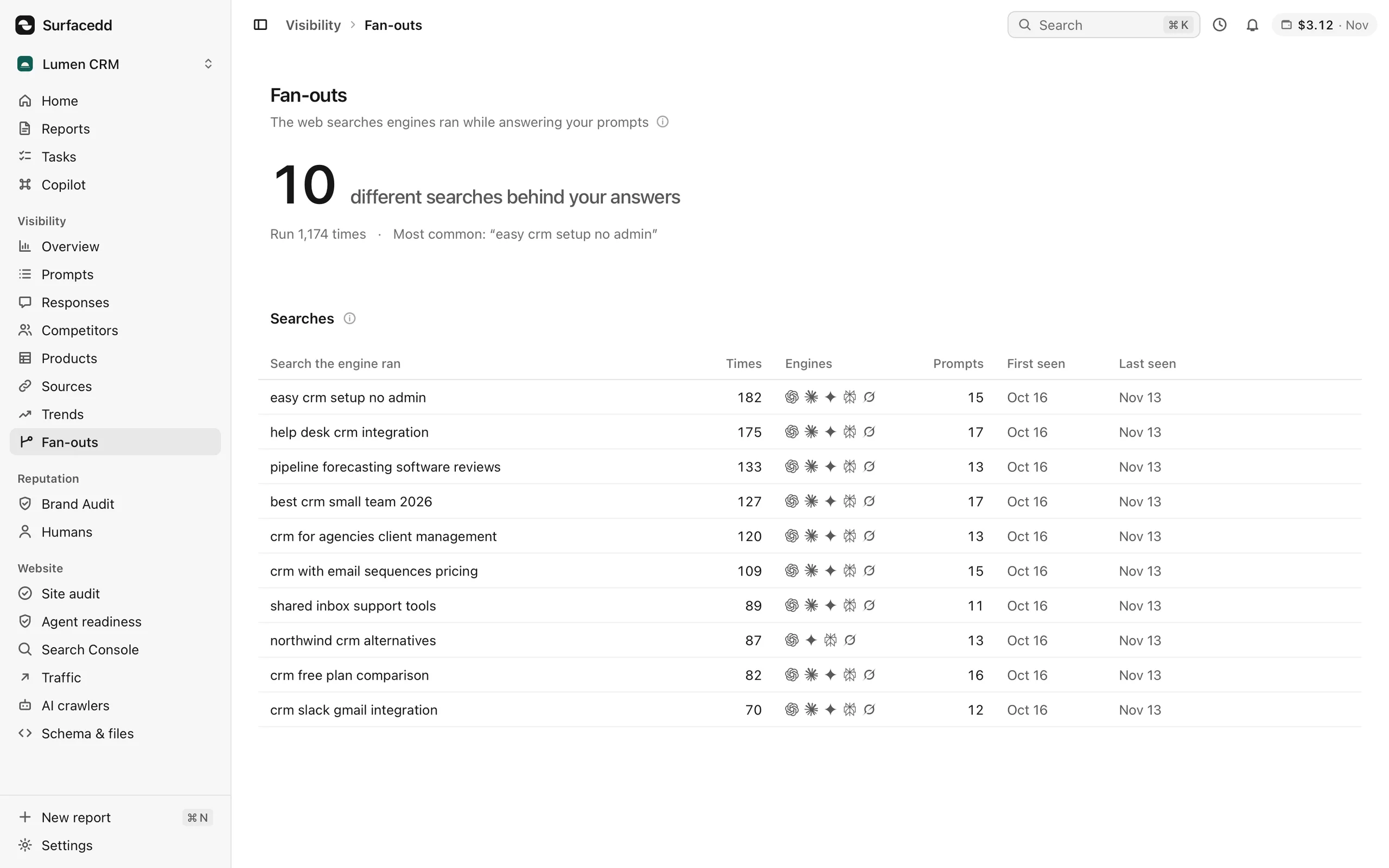
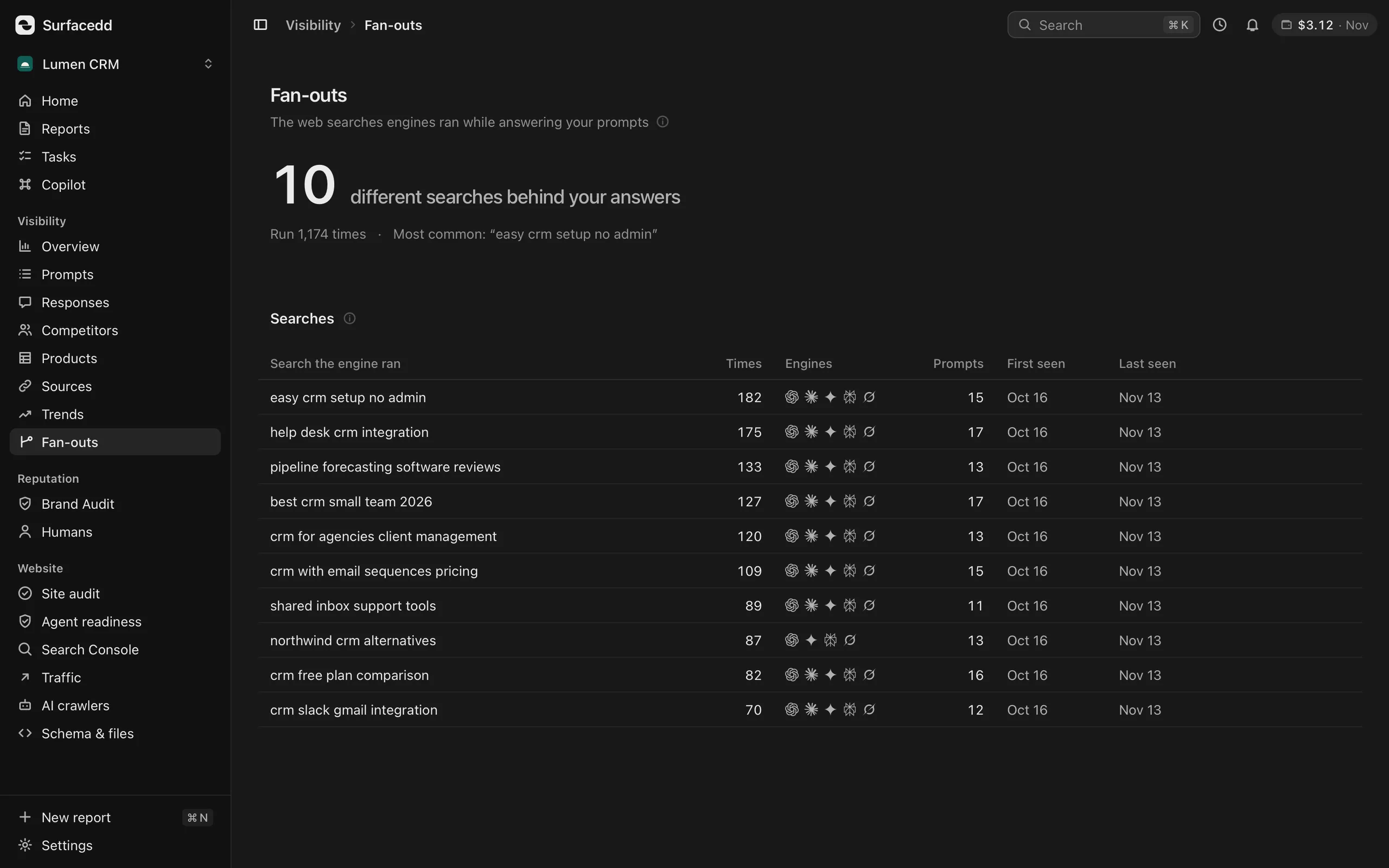
Surfacedd saves every sub-query each engine returns with its answer, and the Fan-outs screen totals them: the query, how often it appeared, on which engines, for which prompts, and when it was first and last seen. Any row can be turned into a tracked prompt with Track as prompt. Engines that don't expose sub-queries (Meta AI and Google's two surfaces) are left out rather than shown as empty.
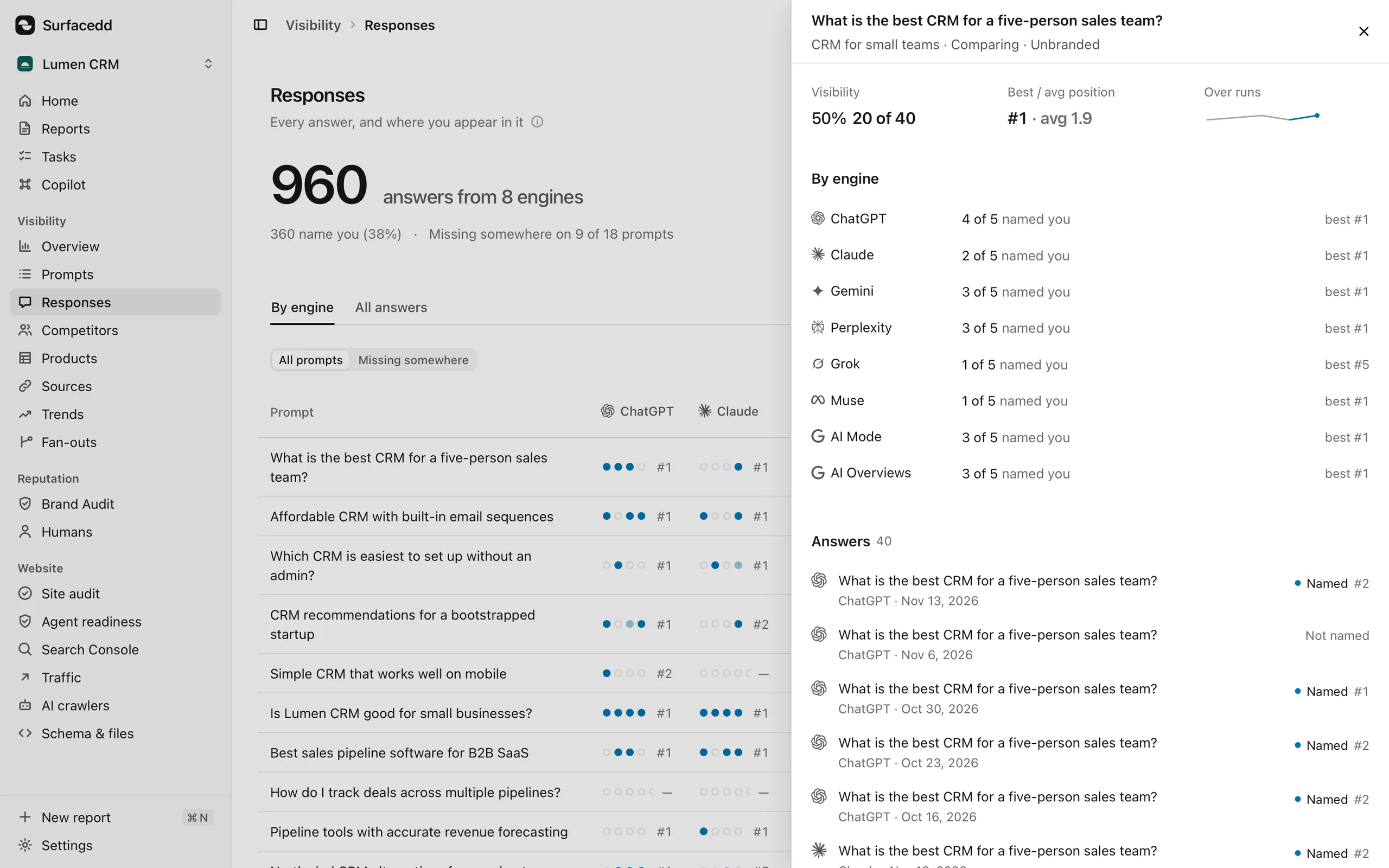
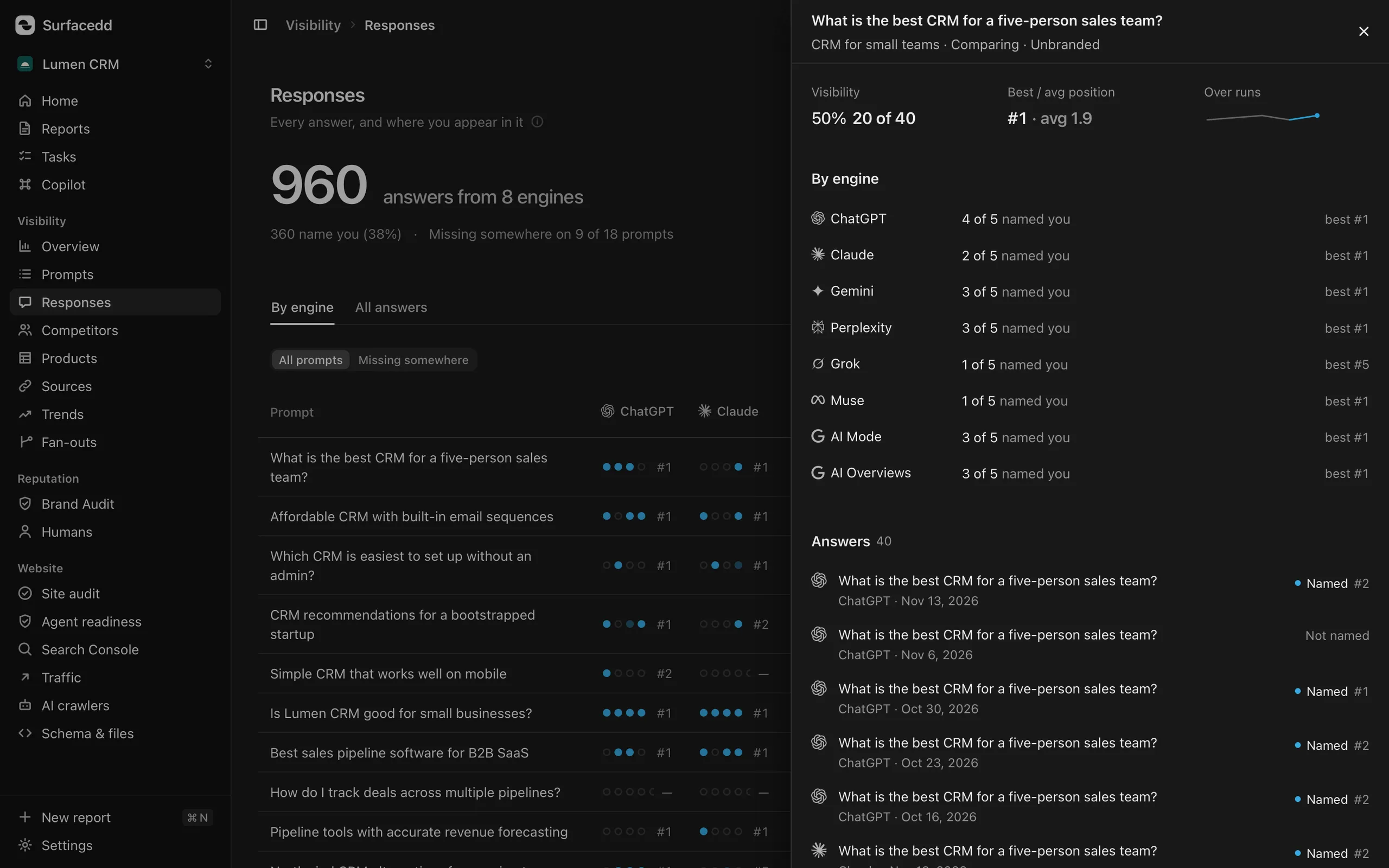
The prompt drawer shows the same thing for one prompt: answers per engine, brands named, domains cited and the fan-outs behind them, so you can see which sub-query led to a competitor's citation. The competitors and sources feature explains the wider view, the fan-outs concept doc covers the details, and the engines overview shows what each engine exposes.
Sources
Fair questions
Is query fan-out the same as "People also ask"?
No, though they overlap. "People also ask" shows questions real searchers asked, chosen by Google for display. Fan-out queries are searches an AI engine writes for itself while answering one person's question. They're often more specific and include technical terms the person never typed. Both are useful; only fan-outs show what an AI engine researched before it cited someone.
Can I see Google AI Mode's fan-out queries?
Not directly. Google says AI Mode and AI Overviews may use fan-out, but neither the results page nor DataForSEO's capture shows the sub-searches. The best proxy is the sub-queries that ChatGPT, Claude and Perplexity return for the same prompt, which usually cover the same sub-topics for buying questions.
Do fan-out queries change between runs?
Yes. The model writes them fresh each time, so the exact wording varies and some appear only occasionally. That's why counting matters: a sub-query that appears in most runs across several engines is a stable research need, while one that appeared once is noise. Collect over several weeks before you prioritise.
Should I write a page for every fan-out query?
No. Google warns that creating many pages mainly to manipulate rankings or AI answers is scaled content abuse. Group the sub-queries into clusters and answer each as a clear section of an existing strong page, under a heading that states the question. Promote only the most important ones to tracked prompts.
Why do different engines run different sub-queries?
Each engine's model decides what to search, and each has its own search back end. Claude may research fee billing while Perplexity looks for a Reddit thread. The differences are informative: they show what each engine weighs. A sub-query that appears on every engine is the strongest signal of all.
How we research, write and correct pages: read our editorial policy.