Walk into the interview knowing what AI says about you
Humans asks three assistants eight questions about you, marks each fact as correct, outdated or wrong, and shows the page it came from, so you fix the right thing before someone else reads it.
By the Surfacedd teamUpdated 7 min readMarkdown
On this page
Short answer
Ask three assistants eight questions an interviewer might: who you are, where you work, what you're known for. Humans checks each answer against a fact sheet you write, flags outdated jobs and namesakes, and shows the page behind every wrong fact. One essentials run costs well under a dollar on your own API keys.
Why check AI before an interview?
Googling yourself before a job search is old advice. The newer version is asking an assistant. Anyone preparing to meet you, from a recruiter to the hiring manager to a future teammate, can type "Who is {name}?" into ChatGPT and get a confident paragraph back. That paragraph may list a job you left two years ago, merge you with someone who shares your name, or say nothing at all.
You can't see it unless you ask, and asking once in a chat window tells you little: answers vary from one run to the next, and the consumer app may know who you are because you're signed in. Humans asks through each provider's API with web search on, the way a stranger's question would be answered, and checks each answer against facts you wrote down.
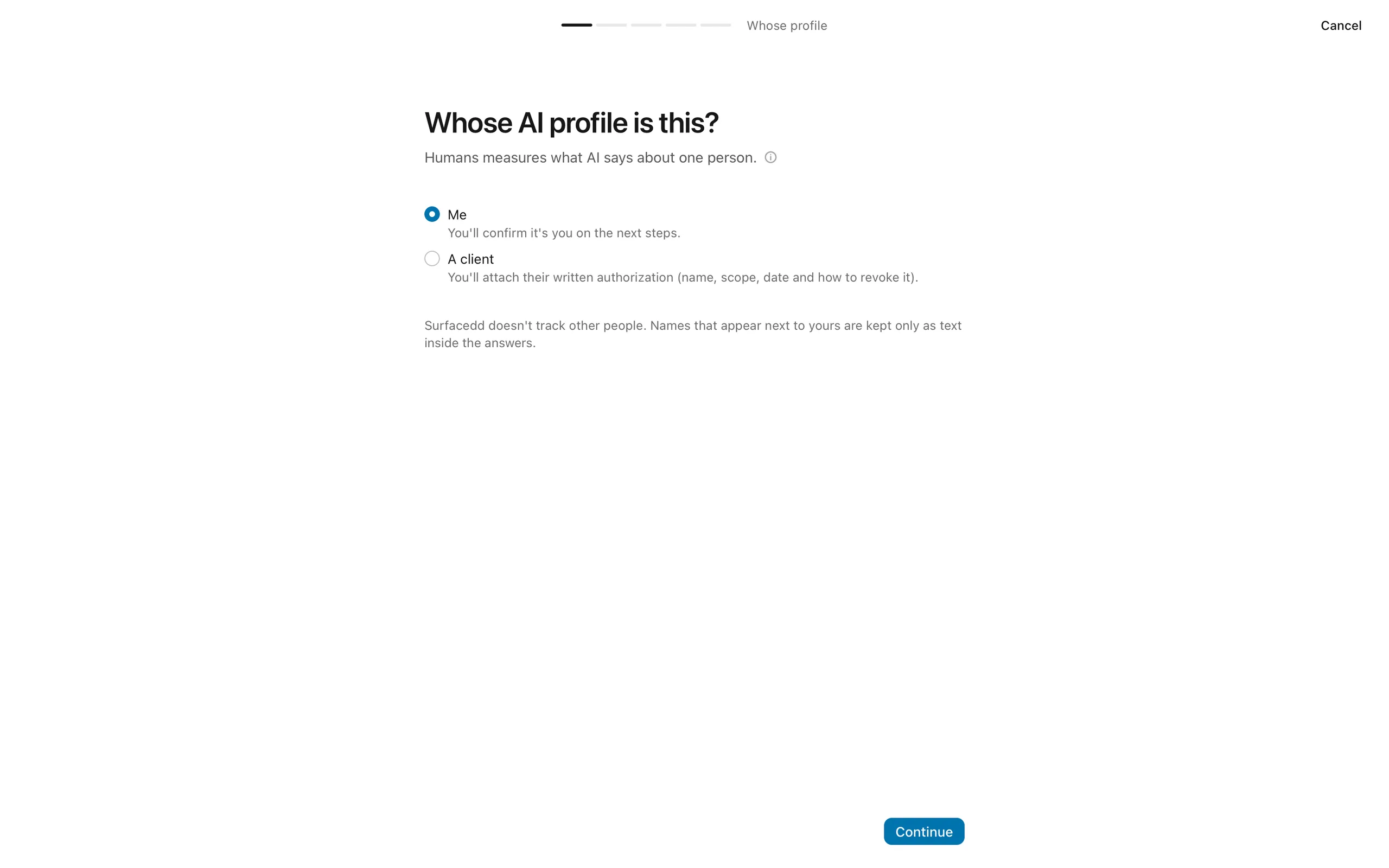
This page is for your own profile only. Surfacedd can't be used to look up candidates, colleagues or anyone else; see the acceptable use rules.
The eight-question check
The essentials run is the eight templates below, asked of ChatGPT, Claude and Perplexity. For a job search, the right-hand column is what to read for.
| # | Question asked | Group | What to look for before an interview |
|---|---|---|---|
| 1 | Who is {name}? | Recognition | Are you recognised at all? Is it you, or a namesake? |
| 2 | What is {name} known for? | Recognition | Does the summary match the story you'll tell in the interview? |
| 3 | Who is {name}, {role} at {company}? | Recognition with context | With context, does it get your current role right? |
| 4 | Where does {name} work? | Facts | The classic error: a previous employer stated as current |
| 5 | Is {name} an expert on {topic}? | Expertise | Does it connect you to the skills on your CV? |
| 6 | Who are the leading experts on {topic}? | Discovery | Are you named when nobody asks for you? (Most job seekers aren't, and that's fine.) |
| 7 | Who should I follow to learn about {topic}? | Discovery | Same, for people who write or speak in public |
| 8 | What do people say about {name}? | Reputation | Any negative or odd claim, and where it came from |
If you sell your expertise as a consultant or speaker, expert discovery goes deeper on questions 6 and 7. Use your current or target role for {role} and two or three skills you want to be hired for as topics. Download the set with a "what to look for" column: b2-job-seeker-ai-check.csv.
What it costs
You pay the AI providers directly on your own API keys. At today's list prices, including the step that checks each answer against your fact sheet:
| Plan | Answers | Cost |
|---|---|---|
| One check before applying | 8 questions × 3 engines = 24 | $0.25 |
| Check, fix, re-check two weeks later | 48 | about twice that |
| Weekly during a three-month search | about 13 runs | $1.11 a month |
The app shows its own estimate before every run and asks you to confirm. The licence is a one-time payment (Launch price $29, $79 after 23:59 UTC on January 30, 2027.$79 once.) and also covers brand tracking if you ever need it.
An example result
The sample workspace includes a profile for Maria Chen, a fictional co-founder in Austin. She isn't job hunting, but her result shows the three patterns job seekers hit most often.
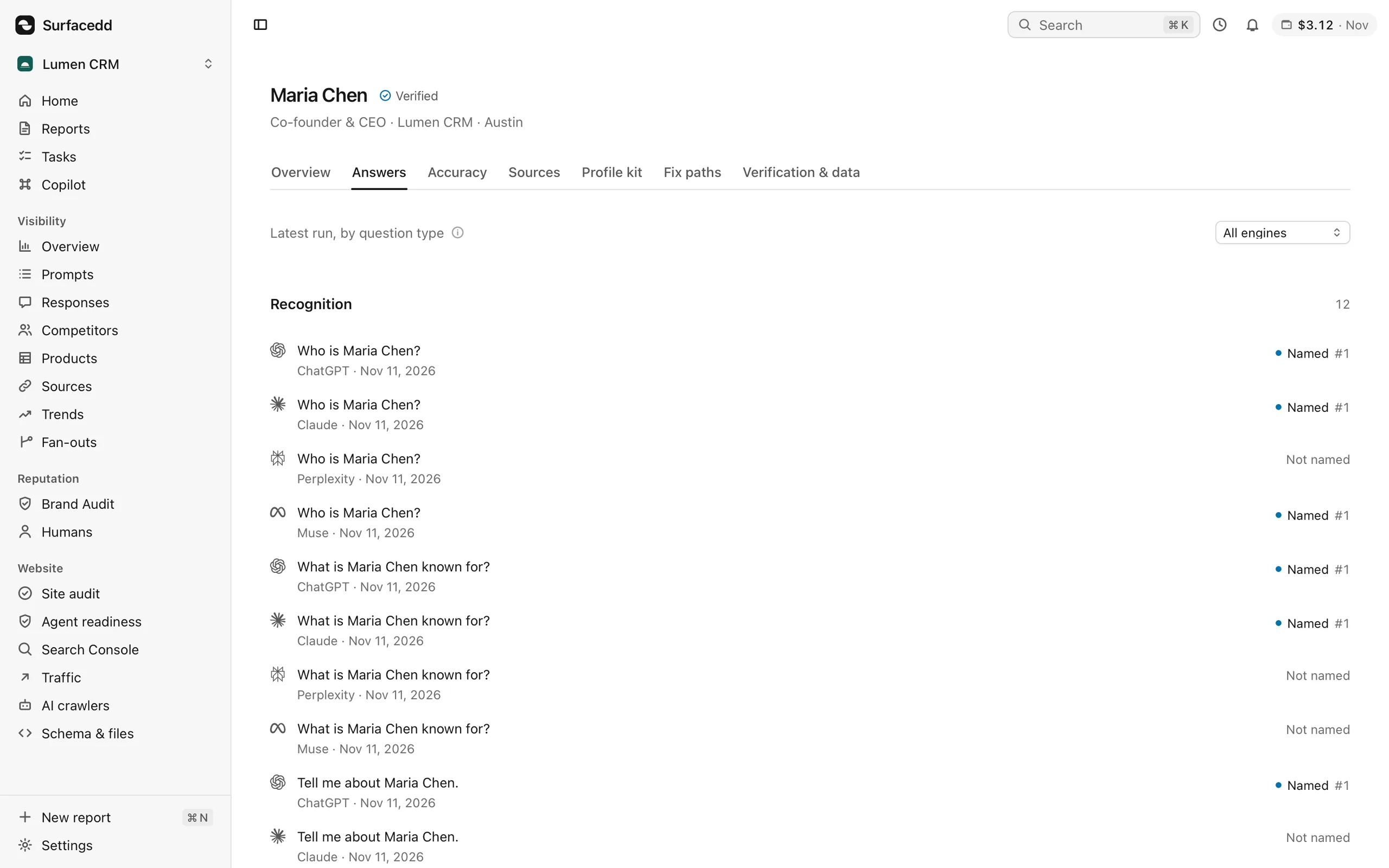
- Partial recognition. Only 33% of the bare "Who is Maria Chen?" answers recognised her. ChatGPT and Claude did; Perplexity didn't name her at all. Once the question included her role and company, accuracy rose: the company was right in 89% of answers.
- A namesake. A quarter of bare-name answers described a different Maria Chen. ChatGPT gave her education as "University of Toronto, MD", which belongs to a physician with the same name.
- An outdated fact from a directory. Perplexity placed her in San Francisco. The Sources tab traced that to one company-database page, cited in four answers.
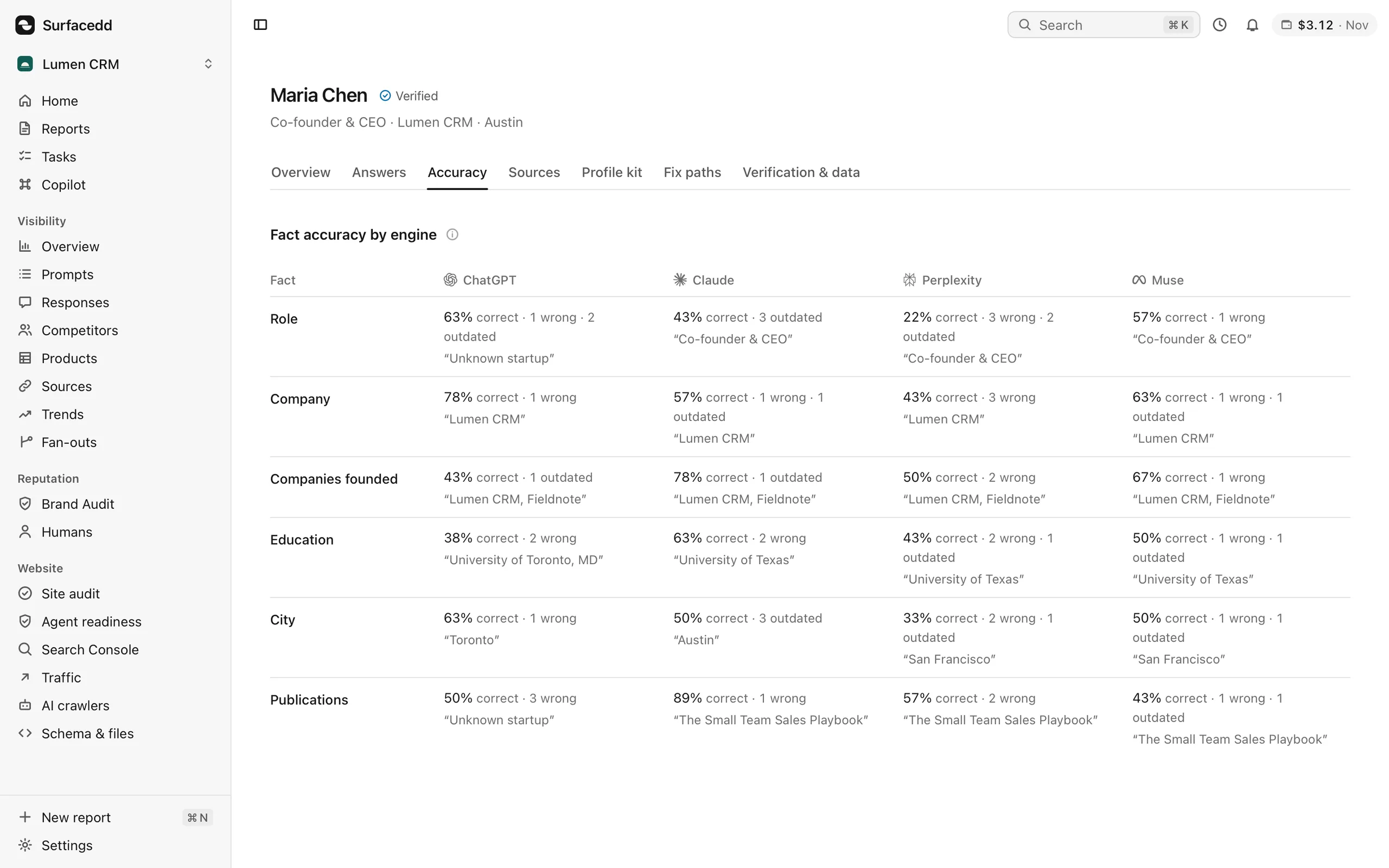
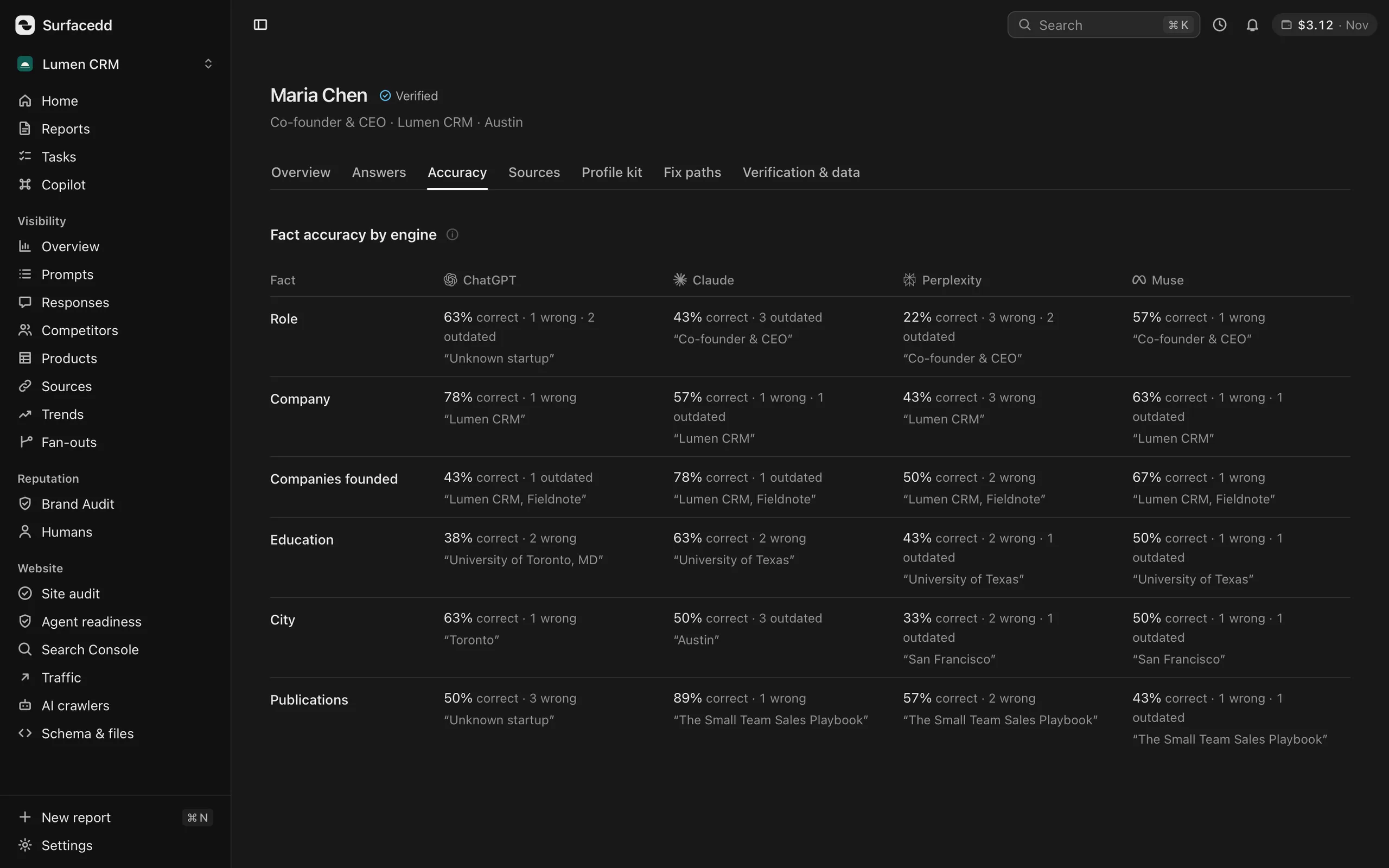
For a job seeker, pattern 3 is the most common and the easiest to fix: an old employer page, a conference bio or a directory listing still says where you used to work.
What to fix first: a two-week order
Answers that cite web pages change when those pages change and get re-read; what a model learned in training changes only when the provider ships a new model. So spend your two weeks on the pages assistants cite.
| When | Do this | Why |
|---|---|---|
| Day 1 | Run the check. Open every answer marked outdated or wrong and note the cited pages. | You fix sources, not answers. |
| Days 2–3 | Write one canonical sentence: name, role, field, city. Put it on your own page (a personal site or portfolio "About") and in your LinkedIn headline and About section. | Assistants repeat facts that agree across pages. |
| Days 3–6 | Update or ask to update each stale page the answers cited: old team pages, speaker bios, directory listings. | One stale page can feed several answers. |
| Days 6–8 | Add Person markup to your own page with sameAs links to your profiles, and link back from those profiles. | Linked profiles help engines tell you from a namesake. |
| Day 14 | Re-run the same eight questions. | Like-for-like, so a change means something. |
The Person schema guide has a copyable template, and the free Person schema generator builds it in your browser.
LinkedIn deserves a specific note. In Profound's analysis of 1.4 million citations from November 2025 to February 2026, LinkedIn was the most cited domain for professional queries across six models, and posts and articles made up a growing share of the LinkedIn pages ChatGPT cited, while profile citations fell (Profound). A consistent headline matters; an original post about your field may matter more.
If a famous person shares your name, don't judge yourself on question 1. Judge on question 3, the one with your role and company, and use the same disambiguating detail everywhere (a middle initial, your field, your city). The guide what does AI know about me covers the other half of the question: what assistants remember from your own chats, and how to view or delete it.
Verification and privacy
- Only your own profile. Setup asks "Me" or "A client". As a job seeker you choose "Me" and confirm it either with domain proof on a site you own or by typing your full name.
- You type the facts. Nothing is scraped from LinkedIn or anywhere else.
- Sensitive questions are blocked. Family, health, religion, politics, ethnicity, criminal matters, home address, phone and salary are never asked, even in custom prompts.
- It stays on your computer. Prompts go from your machine to each provider on your keys; answers are stored locally. One button deletes the profile and every answer.
The verification docs show each method step by step, and the Humans page covers the rest.
What it doesn't do
Sources
Fair questions
Does ChatGPT know who I am?
Only if enough public pages about you exist for it to have learned from, or for its web search to find now. Most people outside public roles get either nothing or a mix-up with a namesake. Asking it yourself once tells you little; Humans asks three assistants the same eight questions and reports how often each one gets you right.
Will recruiters actually ask an AI about me?
Some may, some won't, and we haven't found a reliable public study that measures it, so we won't quote a number. The case for checking doesn't need one: the check costs less than a coffee, and an outdated job or a namesake's credentials in the answer is something you'd rather know about before the conversation than during it.
Why not just ask ChatGPT myself?
You can, and you should look. But your own chat can be shaped by memory and earlier conversations, one answer is one sample, and you won't see which page each fact came from. Humans asks through the API with web search on, on three engines, and lists the cited sources for every wrong or outdated fact.
How long until a fix shows up in answers?
When the wrong fact comes from a page the assistant cites, the answer can change once that page is updated and fetched again, often within days to a few weeks. When it comes from training memory, it changes only when the provider releases a newer model. Re-run the same eight questions after two weeks to see which kind you're dealing with.
Can I check a friend or a candidate?
No. Humans profiles are for yourself, or for a client who has given you written authorization. The app has no option for tracking anyone else, and the licence and acceptable use rules forbid it. Names of other people that appear in answers are kept only as text inside the answer.
Do I need my own API keys?
Yes. Surfacedd runs on your keys, so you pay providers directly and nothing passes through us. For this check you need keys for OpenAI, Anthropic and Perplexity. Each key takes a few minutes to create, and the app tests it before your first run. One essentials run costs $0.25 at current list prices.
How we research, write and correct pages: read our editorial policy.