How to get your brand recommended in ChatGPT
There is no position to win in ChatGPT, because its answers change from run to run. There is a rate to raise: how often it names you and cites your pages. Here is what moves it and how to measure it.
By the Surfacedd teamUpdated 9 min readMarkdown
On this page
Short answer
You can't hold a fixed rank in ChatGPT, because its answers change from run to run. You can raise how often it names and cites you: let OAI-SearchBot crawl your site, get indexed in Bing as well as Google, answer narrow buying questions directly, keep pages current and earn mentions on the sites ChatGPT reads.
Can you rank first in ChatGPT?
No. ChatGPT doesn't keep a ranked list of brands, and the same question often returns a different set of names on the next run. SparkToro's research, reported by Search Engine Journal, found ChatGPT returned the same list of brands in under 1% of repeated runs of the same prompt.
What you can change is your odds: the share of answers that name you, how early you appear, and whether ChatGPT links to your site. That is the goal this guide works toward. When someone sells a top spot in ChatGPT, they are describing a single lucky run.
How does ChatGPT choose what to say?
ChatGPT answers from two places: what the model learned during training, and what it finds when it searches the web for the current question. For buying questions ("best project management tool for a ten-person agency"), ChatGPT usually searches, and the brands it names track closely with the pages it reads.
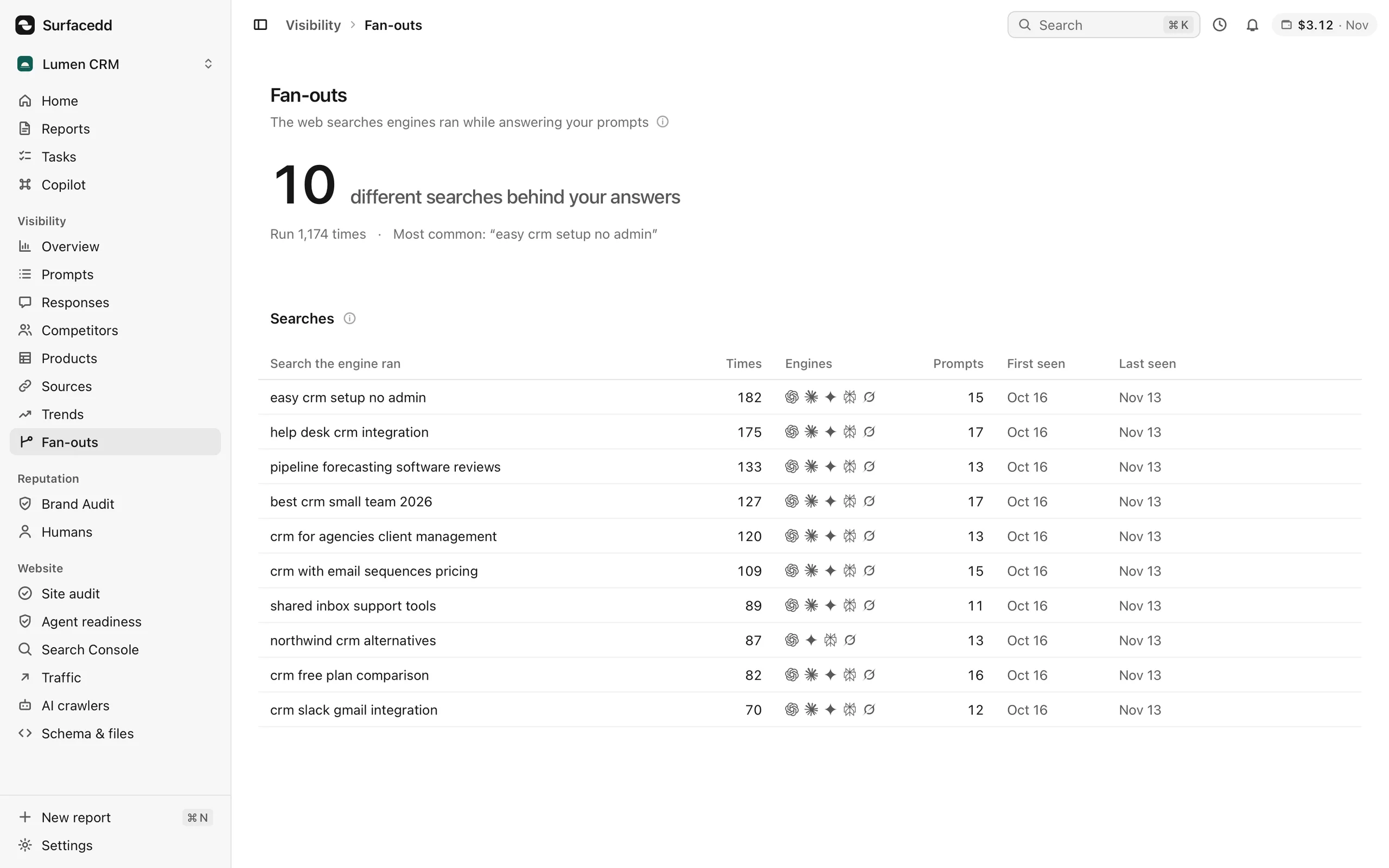
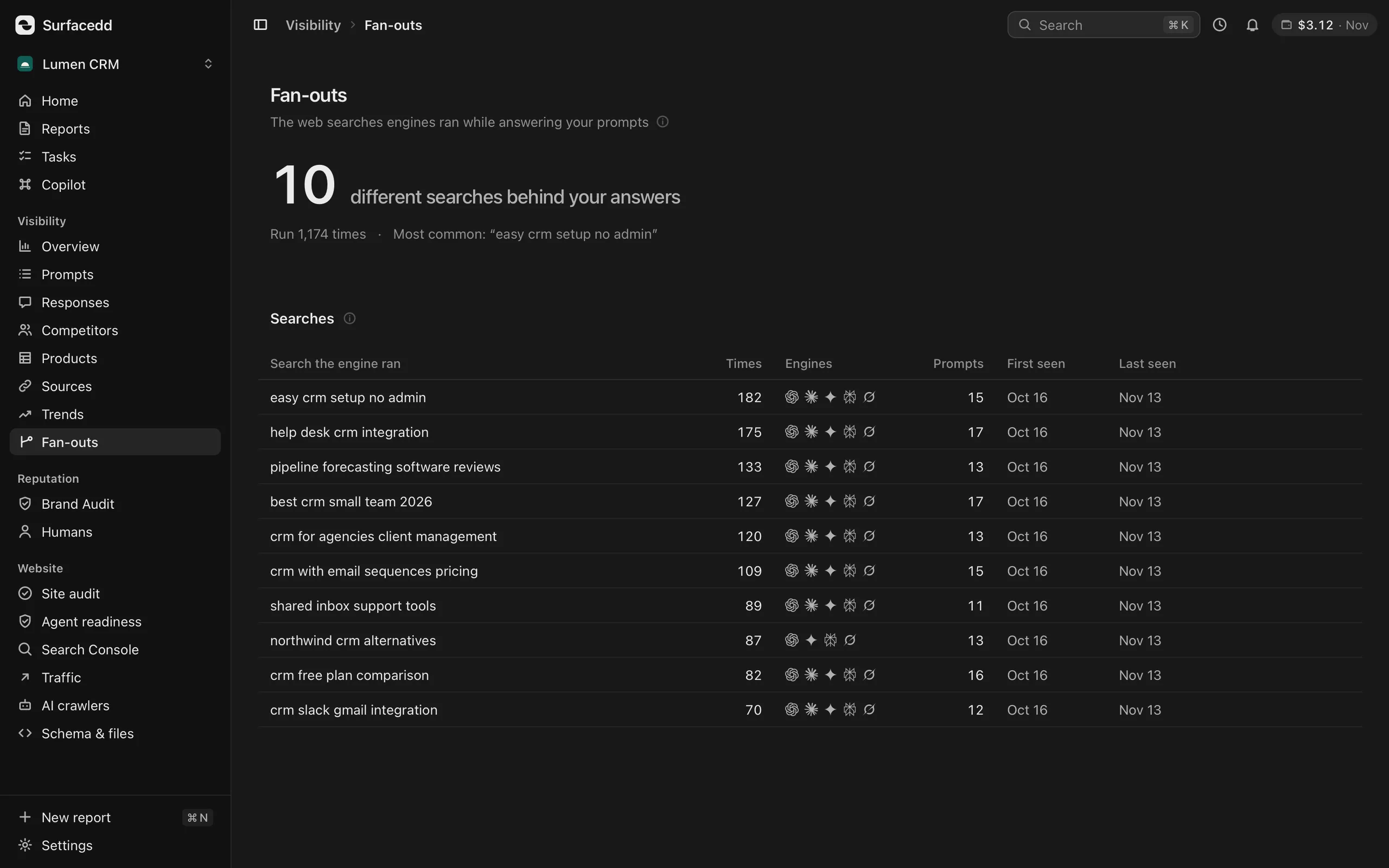
When it searches, ChatGPT often runs several queries for one question. This is called query fan-out. A question about project tools might become searches for "project management tools agencies 2026", "project tool with client approvals" and "project management pricing per seat". Sub-queries like these are long and specific, so keyword tools usually show no data for them, which is why classic keyword research misses them. The query fan-out guide covers them in depth.
Which crawlers does ChatGPT use?
OpenAI runs three separate crawlers, and they do different jobs. Treat them separately in robots.txt (OpenAI crawlers overview).
| User agent | What it does | Effect of blocking it |
|---|---|---|
| OAI-SearchBot | Indexes pages so they can appear and be cited in ChatGPT search | Your pages can still appear as plain navigation links, but not as cited sources |
| ChatGPT-User | Fetches a page when a user's conversation needs it | OpenAI says robots.txt rules may not apply to these user-initiated visits |
| GPTBot | Collects pages for model training | Affects future models' background knowledge, not ChatGPT search |
If you want to be cited, OAI-SearchBot must be allowed. Blocking GPTBot is a legitimate choice for publishers who don't want their content used for training, and it doesn't remove you from ChatGPT search. Check your CDN or firewall too: bot protection features often block these crawlers even when robots.txt allows them.
Why does Bing matter for ChatGPT?
OpenAI says ChatGPT search builds on OAI-SearchBot's crawl, and its help pages mention working with third-party search providers without naming them for consumer ChatGPT. Third-party analyses have long pointed to Bing; treat that as reported, not confirmed. Either way, being well indexed in Bing as well as Google is cheap insurance.
Practical steps:
- Verify your site in Bing Webmaster Tools and submit your sitemaps.
- Turn on IndexNow so Bing hears about new and changed pages within minutes instead of waiting for a crawl.
- Check that your important pages are actually indexed in Bing, not only in Google.
What kind of pages does ChatGPT cite?
ChatGPT tends to cite pages that answer the specific question directly, are recently updated, and come from sources other writers already reference. Three patterns stand out in public data.
Fresh pages. In an Ahrefs study of about 17 million citations (July 2025), ChatGPT showed the strongest preference for recent pages of the assistants studied: its citations were on average 458 days newer than Google's organic results. Keep comparison, pricing and "how to choose" pages current, and update the visible date only when the content really changed.
Reference and professional sources. Several third-party studies place Wikipedia high in ChatGPT citations, and Profound's March 2026 analysis of 1.4 million citations found LinkedIn is the most cited domain for professional queries, with LinkedIn climbing to about fifth among ChatGPT's cited domains. If your category is B2B, your company page and your team's original LinkedIn posts are part of your ChatGPT presence.
Pages that answer the sub-question. Since fan-out queries are narrow, a section titled "Does X integrate with QuickBooks?" with a one-sentence answer under it is easier to retrieve and quote than a long page that buries the answer.
How to raise your chances of being named
The tactics that hold up are the ones that make you easier to find, easier to quote and more widely mentioned. Work through them in this order.
- Allow OAI-SearchBot and confirm with a robots.txt check that your key pages aren't blocked by an old wildcard rule.
- Get indexed in Bing with sitemaps and IndexNow.
- Write answer-first sections. Under each heading, answer the question in the first one or two sentences, then add detail. Google calls this good writing, not a requirement, and it helps every engine.
- Cover the comparison questions buyers actually ask: alternatives, pricing, integrations, limits. Be accurate about competitors; assistants cross-check claims against other sources.
- Keep facts identical everywhere. Price, platforms, founding year and product names should match on your site, review sites, directories and social profiles. Conflicting facts are a common cause of wrong answers.
- Earn independent mentions. Comparison articles, review sites, community threads where you participate openly, podcasts and video walkthroughs. In an Ahrefs study of 75,000 brands, branded web mentions had the strongest correlation with AI visibility of the factors measured (0.664), far ahead of backlinks (0.218). That study looked at Google's AI Overviews and is correlational, but the logic carries over to any engine that summarizes the web.
- Publish something only you can. Original data and benchmarks give others a reason to cite you.
What doesn't help
Some popular advice has no evidence behind it. An llms.txt file showed no correlation with AI citations across about 300,000 domains in SE Ranking's October 2026 study. Separate "AI-only" pages risk being treated as scaled content abuse by Google, and paid or fake forum mentions break community rules and tend to be found out. Adding FAQ schema won't change what ChatGPT writes.
How to measure your ChatGPT visibility
Measure ChatGPT the way a pollster would: a fixed set of questions, asked several times, reported as a rate with a range. Checking a prompt once in the ChatGPT app and taking a screenshot tells you about one run.
A workable method:
- Pick 20 to 50 prompts, mostly unbranded, that match real buying questions.
- Use the API with web search enabled, so the answer reflects ChatGPT's search behavior and returns its citations. Note that API answers can differ from the consumer app, which may use a different model or personalization.
- Sample each prompt at least three times per run.
- Record whether you were named, your position among the brands named, which competitors appeared, and which URLs were cited.
- Compare runs like for like over about four weeks before drawing conclusions.
The measurement guide explains the statistics, and the cost calculator shows what a prompt set costs on your own OpenAI key.
API answers vs the ChatGPT app
API answers and app answers are related, not identical. The app adds memory, custom instructions, OpenAI's own model routing and a location inferred from the user's connection; the API gives a controlled, repeatable version of the same search-and-answer behaviour. For tracking over time, repeatability wins. Use the app as a spot check, and when the two disagree sharply, look at location and model first. The ChatGPT API vs app guide covers the differences and the statistics.
Watching referral traffic from ChatGPT
ChatGPT normally adds utm_source=chatgpt.com to the links in its answers, and GA4 added an AI Assistant channel to its default channel group in May 2026 for traffic from assistants such as ChatGPT, Gemini and Claude. Tagging isn't perfect: Profound measured that between 8 and 16 October 2026 many cited links lost the tag, dropping to around 5% of answers for more than a day. Annotate gaps like that before reading a dip as a real drop. Surfacedd's Search Console and GA4 screens count AI assistant visits next to your AI visibility and fall back to referrer rules when the channel is missing.
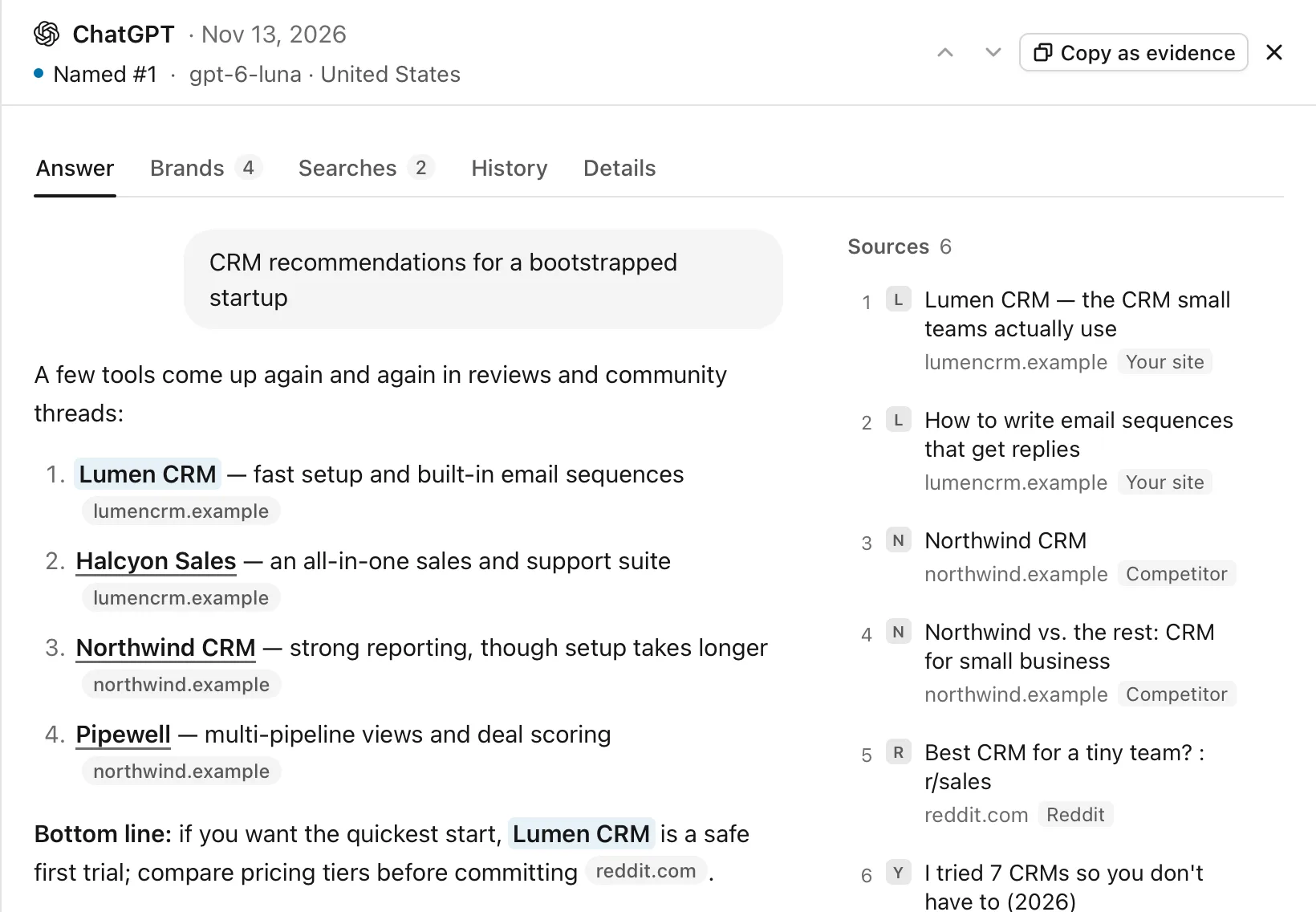
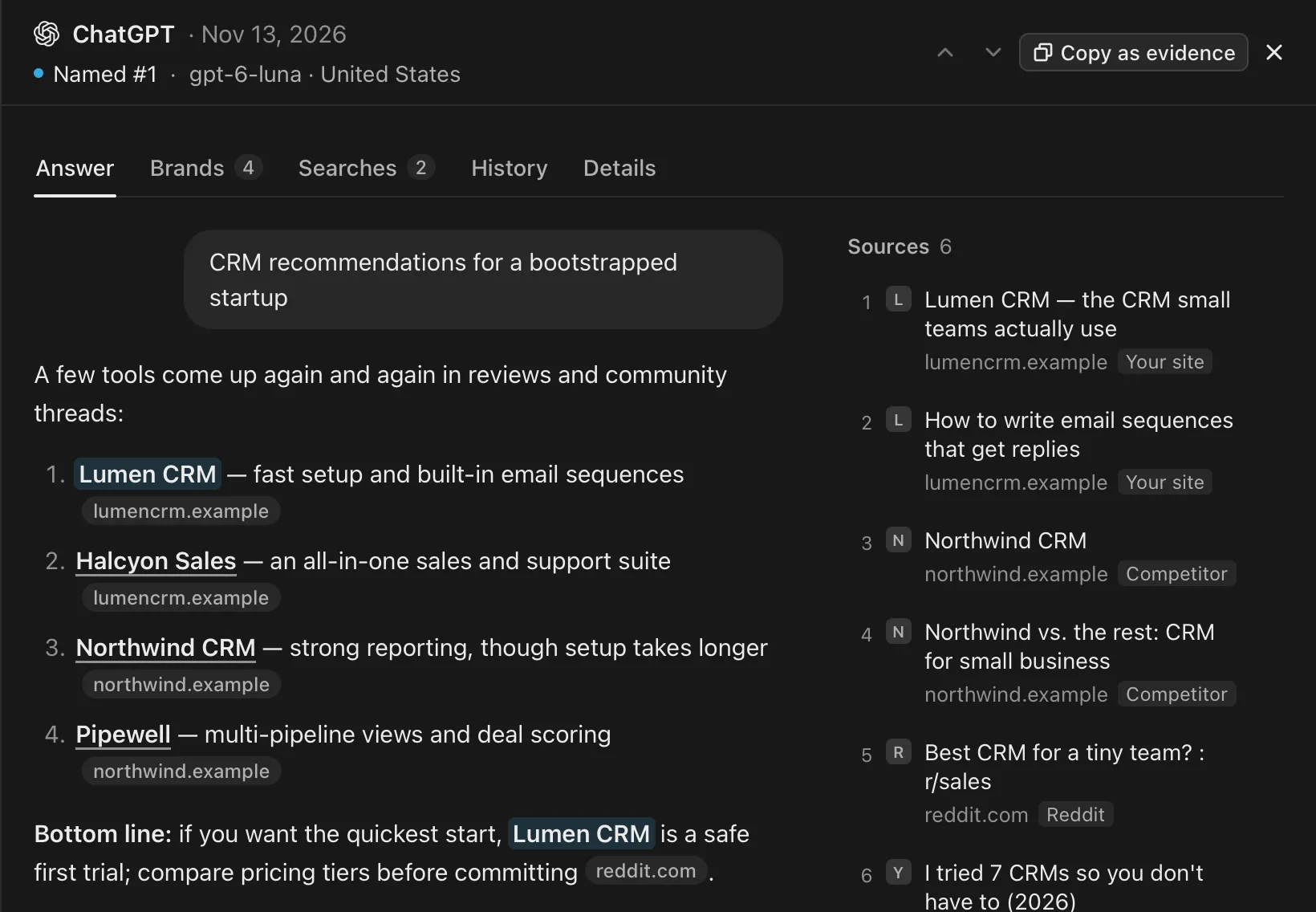
What a ChatGPT answer looks like inside a tracker
Here is a hypothetical example of one answer, to show what to read in it. The prompt is "best CRM for a ten-person agency", asked through the API with web search on, located in London.
| What the tracker records | Example | What to do with it |
|---|---|---|
| Brands named, in order | Competitor A, Competitor B, your brand, Competitor C | You're named third: in the shortlist, not leading it |
| Cited pages | Two roundups, Competitor A's pricing page, a G2 category page | The roundups are your outreach list; is your pricing page as clear as A's? |
| Read but not cited | Your pricing page, a Reddit thread | ChatGPT found your pricing page and preferred A's: a page fix |
| Fan-out searches | "crm for agencies client approvals", "crm pricing per seat uk", "best crm small agency 2026" | Do your pages answer "client approvals" and "per-seat price" in plain text? |
One answer is an anecdote. The same fields across three samples of 30 prompts, every week for a month, are a measurement: you can see that your pricing page is read and skipped in most answers, that Competitor A's is cited in most, and whether that changes after you fix yours.
In Surfacedd
Surfacedd tracks ChatGPT through OpenAI's Responses API with web search on, using your own OpenAI key. For each answer it stores the full text, the brands named and their order, the inline citations, the pages ChatGPT consulted but didn't cite and the searches it ran. Each prompt can be sampled several times per run, and visibility is shown as a rate with a 95% range rather than a single rank. The default model costs about $0.0109 per answer at today's list prices, and the app shows its estimate before each run and the actual cost afterwards.
The Fan-outs screen collects the searches ChatGPT ran across all your prompts, so the sub-questions above become a list you can sort by frequency and turn into tracked prompts. The same prompts can run on the other engines, so you can see where ChatGPT's shortlist differs; the competitors and sources feature shows who wins the answers you miss. Everything is stored on your computer, and Surfacedd is a one-time purchase.
Sources
- OpenAI: Overview of OpenAI crawlers
- OpenAI: Web search tool guide
- Search Engine Journal: AI recommendations change with nearly every query (SparkToro, January 2026)
- Ahrefs: Do AI assistants prefer to cite fresh content? (July 2025)
- Ahrefs: AI Overview brand correlation study (75,000 brands, May 2025)
- Profound: LinkedIn is the most cited domain for professional queries (March 2026)
- SE Ranking: llms.txt and AI citations (October 2026)
- Profound: ChatGPT missing UTM tags (October 2026)
- Google Analytics Help: Default channel group
- IndexNow
Fair questions
How long does it take to show up in ChatGPT?
Pages can be cited soon after OAI-SearchBot crawls them, because ChatGPT searches the live web for buying questions. OpenAI says robots.txt changes take about 24 hours to apply. Being named in answers that come from training data takes much longer, because that depends on future models. Measure weekly for about a month after a change before judging it.
Does blocking GPTBot remove me from ChatGPT?
No. GPTBot collects content for training. ChatGPT search relies on OAI-SearchBot, and OpenAI says sites that opt out of OAI-SearchBot won't appear in ChatGPT search answers, though they can still appear as navigational links. You can block GPTBot and allow OAI-SearchBot; many publishers do exactly that.
Do I need to be on page one of Google to be cited by ChatGPT?
No, but good indexing in both Google and Bing helps. ChatGPT's searches are its own sub-queries, often narrower than the question asked, so a page that answers one specific sub-question can be cited without ranking for the head term. Make sure your key pages are indexed in Bing too, with sitemaps and IndexNow.
Does schema markup help with ChatGPT?
Not directly as far as public evidence shows. ChatGPT reads the page text it retrieves. Structured data helps search engines understand entities and earn rich results, so keep it accurate, but the bigger wins for ChatGPT are answer-first sections, facts in plain HTML and consistent details across the web.
Why does ChatGPT describe my product wrongly?
Usually because a source it read says so: an outdated review, an old pricing page, a directory listing or a forum post. Find the cited or consulted page behind the wrong claim, correct what you control and ask the owners of the rest to update. The guide to fixing what ChatGPT says about you walks through it.
How many prompts should I track?
Twenty to fifty prompts that match real buying questions is a workable start, mostly unbranded, with a few comparison and pricing prompts. Sample the important ones three times per run. That's enough to see a rate with a useful range, and cheap on the default model. Add prompts from your fan-out list as you learn what ChatGPT researches.
Free tools for this guide
How we research, write and correct pages: read our editorial policy.