From "does AI recommend us?" to your first fix in one sitting
Ten steps, each with its cost shown before it runs. Setup takes about three minutes; the first answers arrive a minute or two later.
By the Surfacedd teamUpdated 13 min readMarkdown
On this page
Short answer
Surfacedd works in ten short steps: activate the licence, add your own AI keys, let it read your website, accept nine suggested prompts, see the exact price, run it, then read who was named and which pages were cited. A first run of 9 prompts on 3 engines costs about $0.25, paid to the providers.
This page follows one first run from download to the first thing worth fixing. It uses the same screens you will see, in the same order, and says at each step what it costs and what gets saved. The figures come from the app's own cost estimate on the default models; your numbers will differ slightly because the app calibrates estimates from your own past answers.
The short version: you bring the questions and the API keys, Surfacedd asks each AI engine through its official API from your computer, reads every answer, and shows you who was named, in what order, and which pages the engine cited. Nothing is sent to us except licence checks.
What you need
You need three things, and none of them is a subscription:
| What | Why | Cost |
|---|---|---|
| A Surfacedd licence | Runs and schedules need an active licence. The sample workspace works without one. | Launch price $29, $79 after 23:59 UTC on January 30, 2027.$79 once. |
| One OpenAI or Anthropic API key | One of the two reads every answer and turns it into structured data. Either can also be an engine. | pay-as-you-go to the provider |
| Your website address | The app reads a few of your pages to suggest categories, competitors and prompts. | a fraction of a cent |
A Perplexity key and a DataForSEO account are recommended: Perplexity is the cheapest engine per answer, and DataForSEO is how Surfacedd reads Google AI Mode and AI Overviews. You can add keys for Grok, Meta AI (Preview) and Gemini (off by default) at any time. See bring your own key for which key powers what.
Before you start: try it with no keys at all
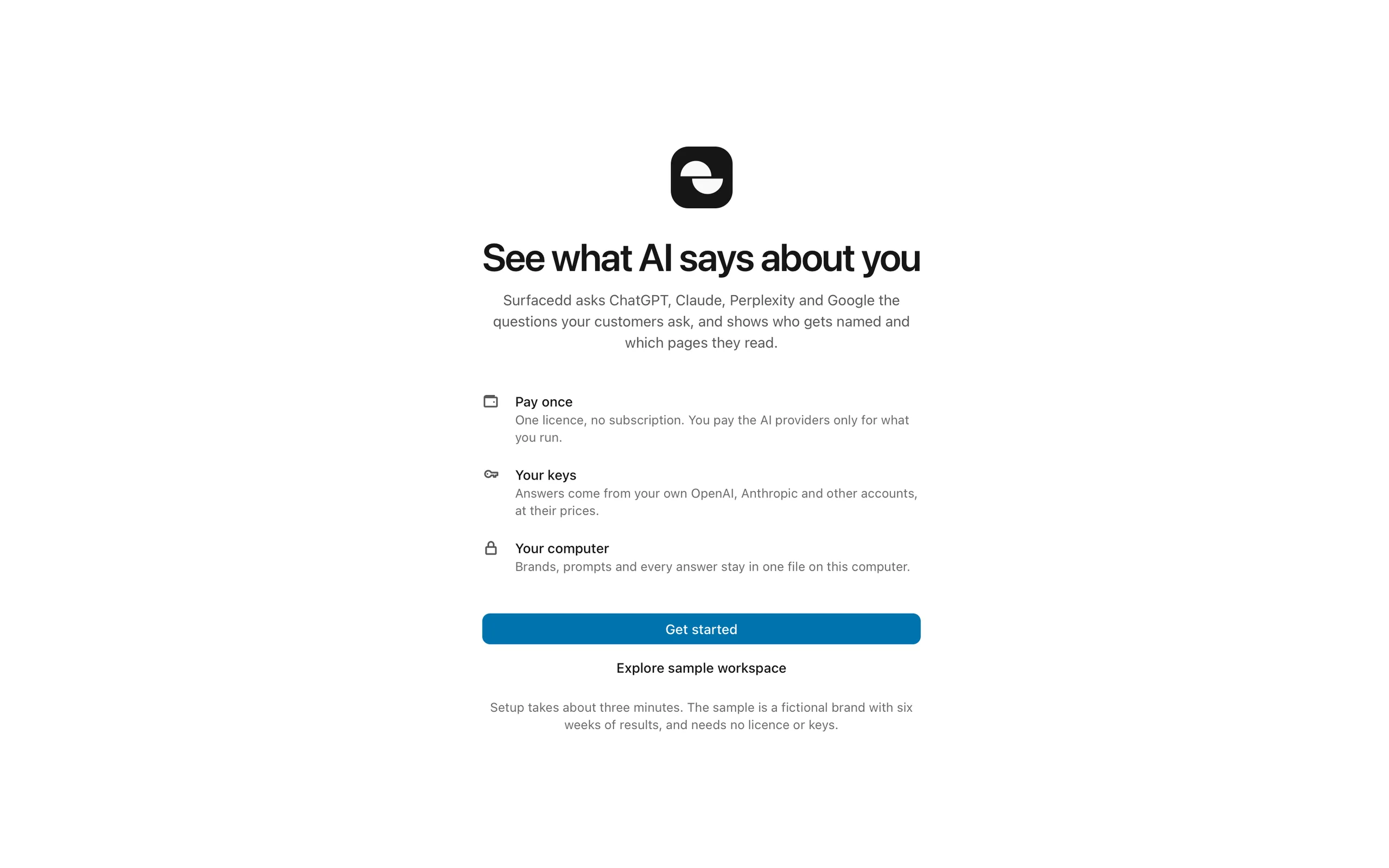
The first screen states the three facts the app is built on: pay once, your keys, your computer. Below them are two buttons. Get started begins setup. Explore sample workspace loads a fictional brand with six weeks of results across all eight engines, so you can click through every screen before spending anything. The sample needs no licence and no keys, and spend and edit actions are switched off inside it.
Time: a few seconds. Cost: none. Saved: nothing yet.
1. Activate the licence
Paste your licence key, or click the activation link from your purchase email, which opens the app through a surfacedd:// link and fills the key in. The key is checked once with our payment provider, Polar, and the app stores a signed entitlement that it re-checks about once a day. One licence covers 3 computers at a time, Mac and Windows mixed. If all of them are in use, the app shows your devices and lets you deactivate one from the same screen.
If the licence server can't be reached later, the app keeps working for 30 days. If a licence is refunded or revoked, the app goes read-only: you can still view, search and export everything, but it won't spend money.
Time: under a minute. Cost: none. Saved: the licence key and device ID in your system keychain, plus a signed entitlement. See activating your licence for error messages.
2. Add your API keys: a free test, or a 1-cent real test
Each provider gets a card that says what it powers, roughly what one answer costs, and where to get a key. When you paste a key, Surfacedd runs a free check, usually a request that lists the provider's models, which proves the key is valid without spending anything. An optional search test asks one real question with web search on ("What is the capital of France?") and shows its exact cost, about one cent, so you know billing and web search are both enabled before your first run.
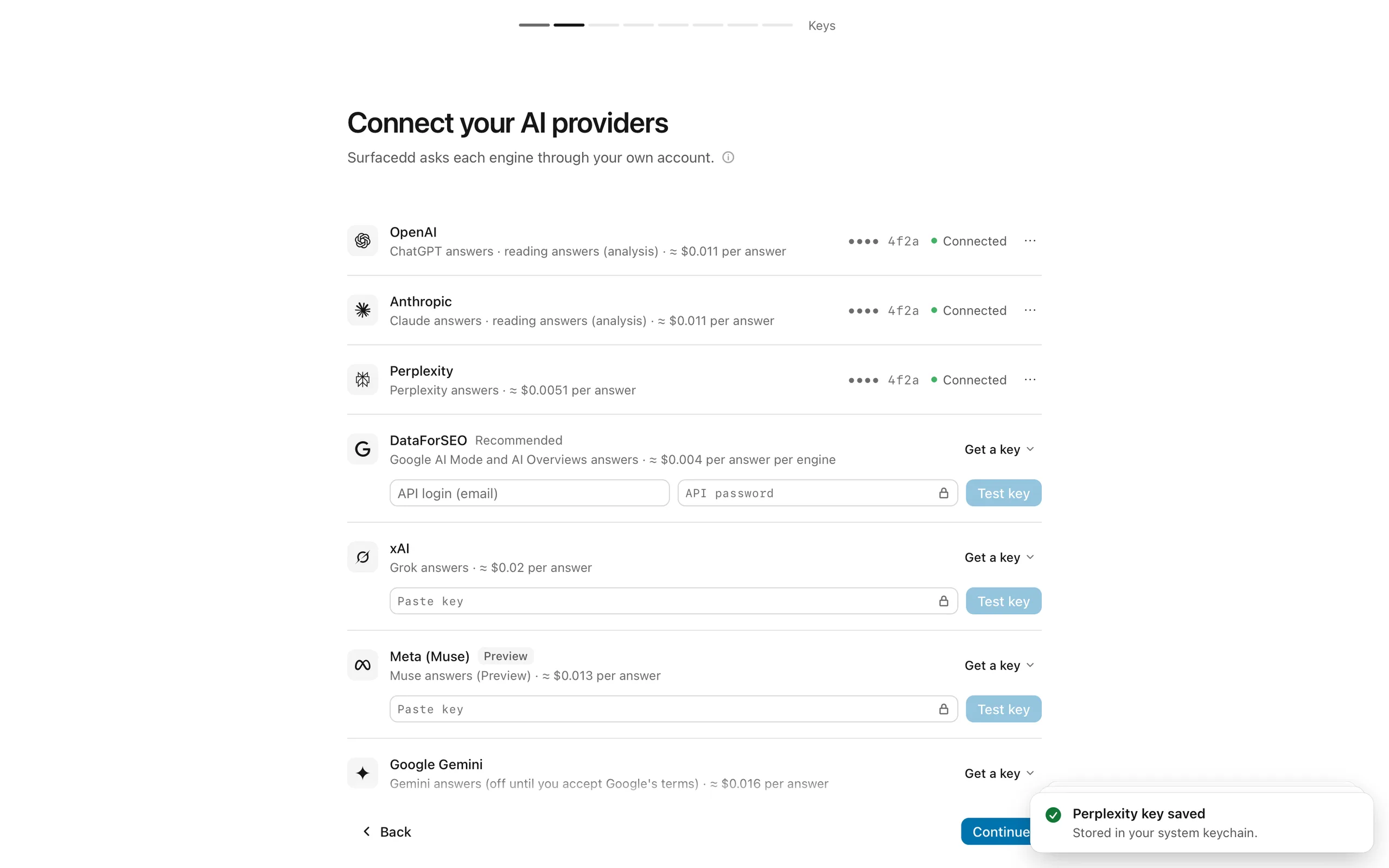
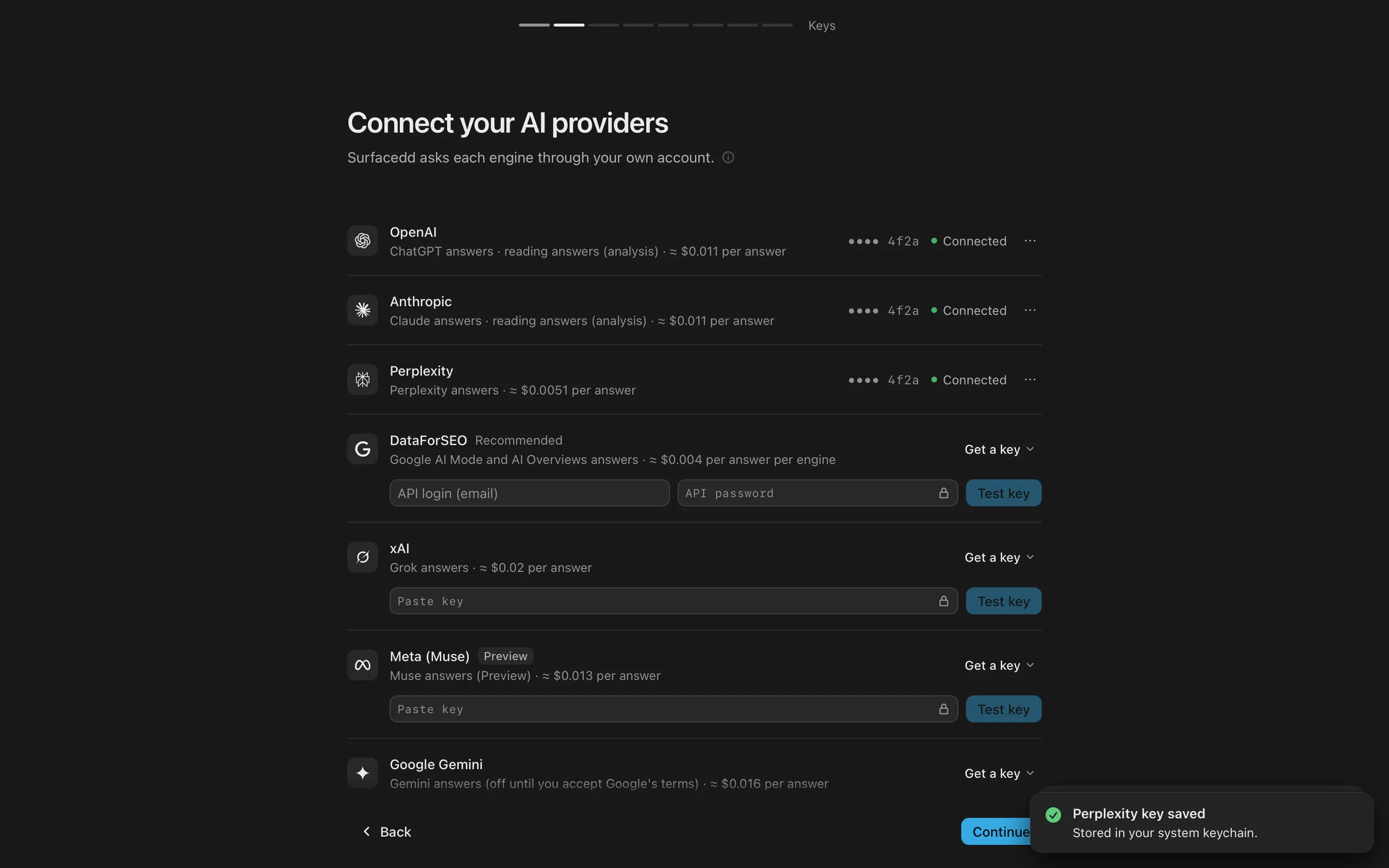
The test turns provider errors into plain status: Valid, Billing needed (for example an OpenAI key with no credit), Region unavailable (Meta's API in unsupported countries) or Invalid. Keys are saved only after they pass, and only to your operating system's keychain. They never go into the database, the logs or our servers.
Time: one to three minutes, mostly spent copying keys. Cost: free, or about a cent per optional search test. Saved: keys in the keychain; the last four characters are shown afterwards.
3. Describe the brand: one site read for about a fifth of a cent
Enter your website (or a client's). Surfacedd fetches your home page and up to eight linked pages, such as About, Pricing and product pages, from your own computer. A single call to your analysis model returns a short profile: what you do, up to five categories, aliases people use for you, products, key facts and suggested competitors. That call costs about $0.002.
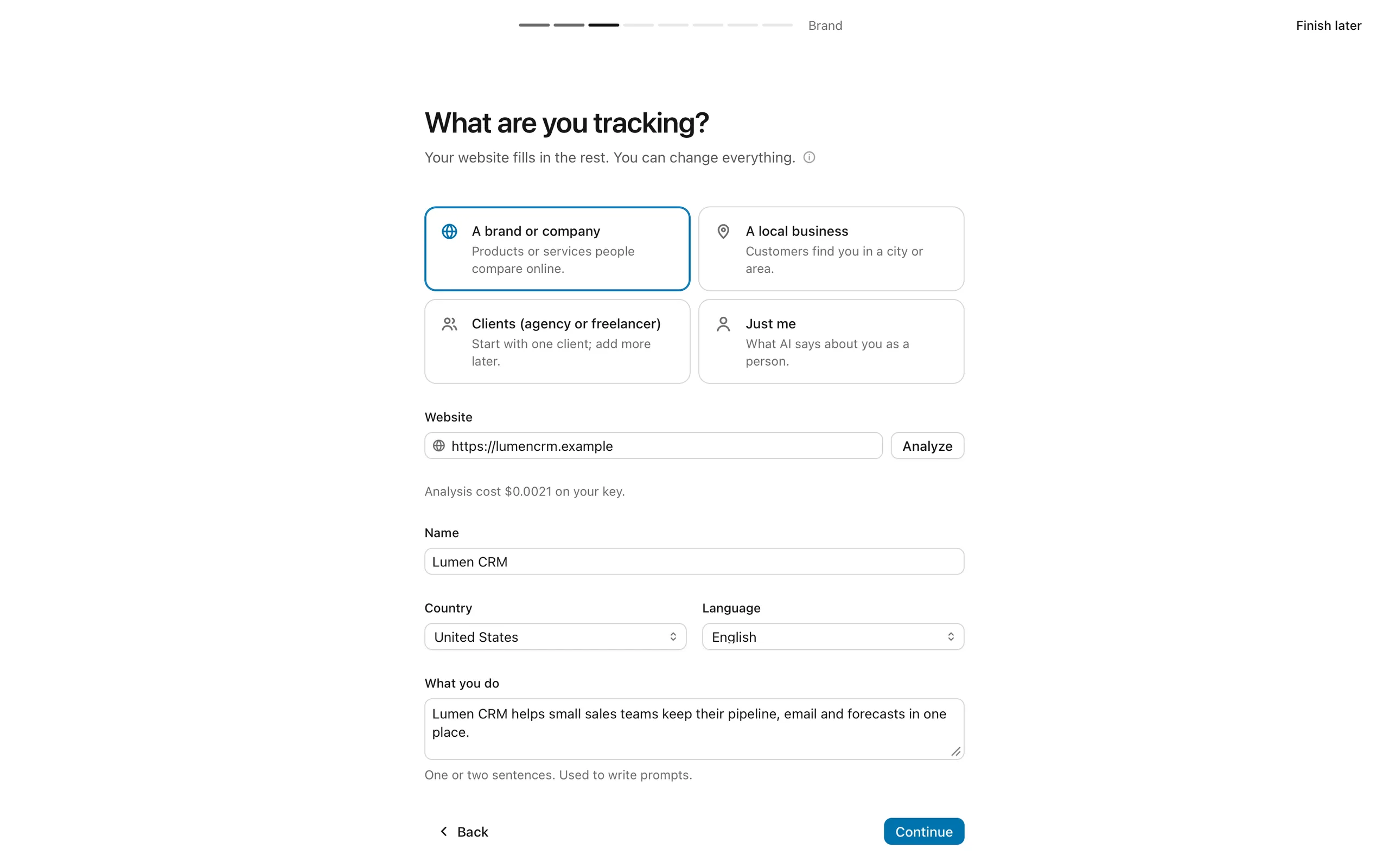
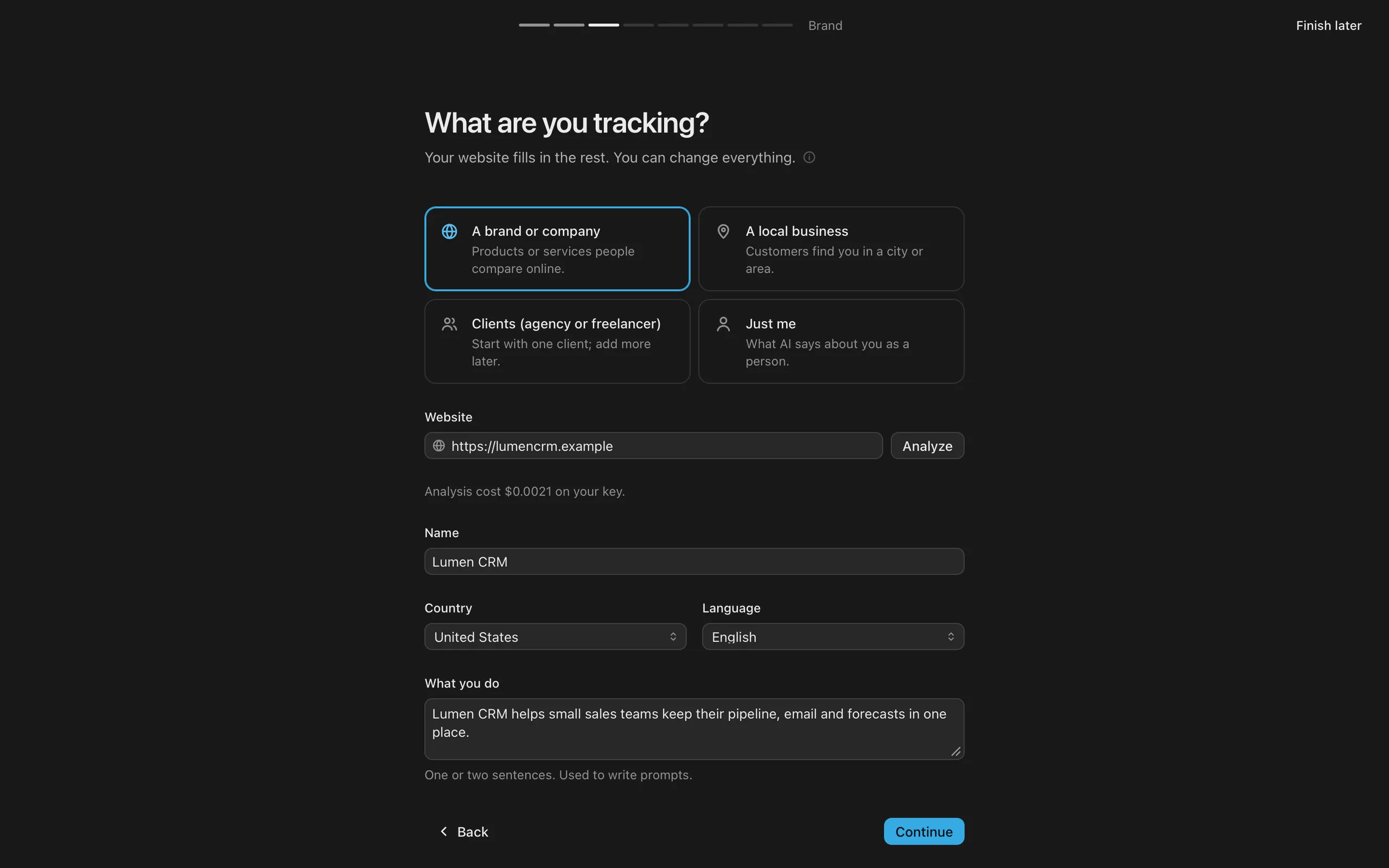
You confirm or edit everything: brand name, country and optional city, categories, aliases and competitors. Aliases matter more than they look. They decide what counts as "naming you", and if you change them later the app re-counts every past answer locally, for free. If the site can't be read (blocked, empty, or unreachable), the app says why and lets you describe the business in a sentence instead.
The next screen asks where your customers are. Pick a country, a region preset such as DACH or UK & IE, or a city from an offline list. Each engine applies location differently, and the app records on every answer whether location was applied.
Time: about a minute. Cost: about $0.002. Saved: the brand profile, categories, aliases and competitors in the local database.
4. Choose the prompts: nine questions buyers ask
Surfacedd suggests nine prompts: three for each of three categories, each tagged with a funnel stage (Awareness, Consideration or Decision). They are written the way a buyer asks an assistant ("What's the best invoicing tool for freelancers in the UK?"), not as keywords. You see five at first and can show the other four, edit any of them inline, add your own or remove them. If the set doesn't fit, Show me a different set generates another, up to three times, and asks before overwriting your edits. Each set costs about $0.002.
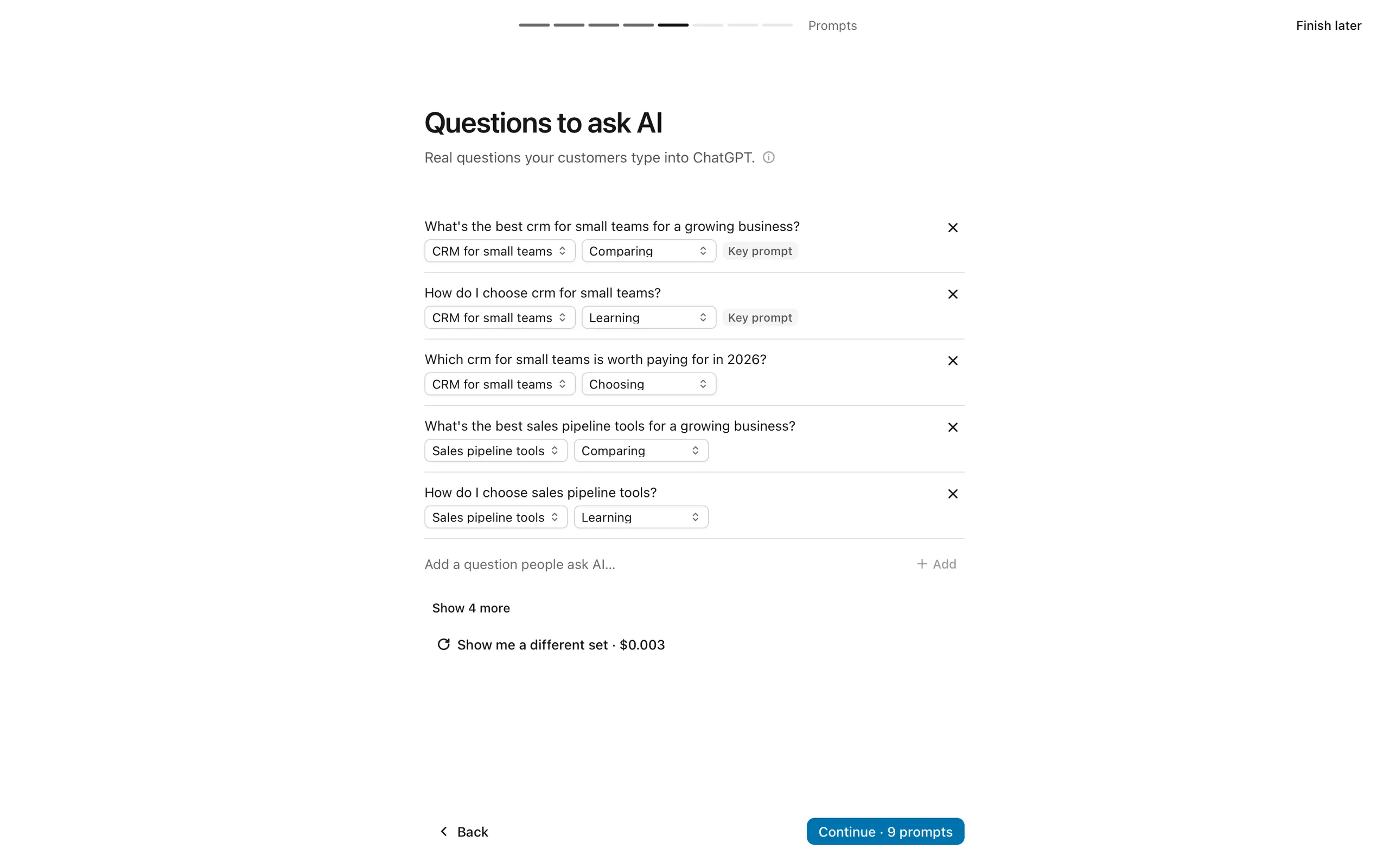
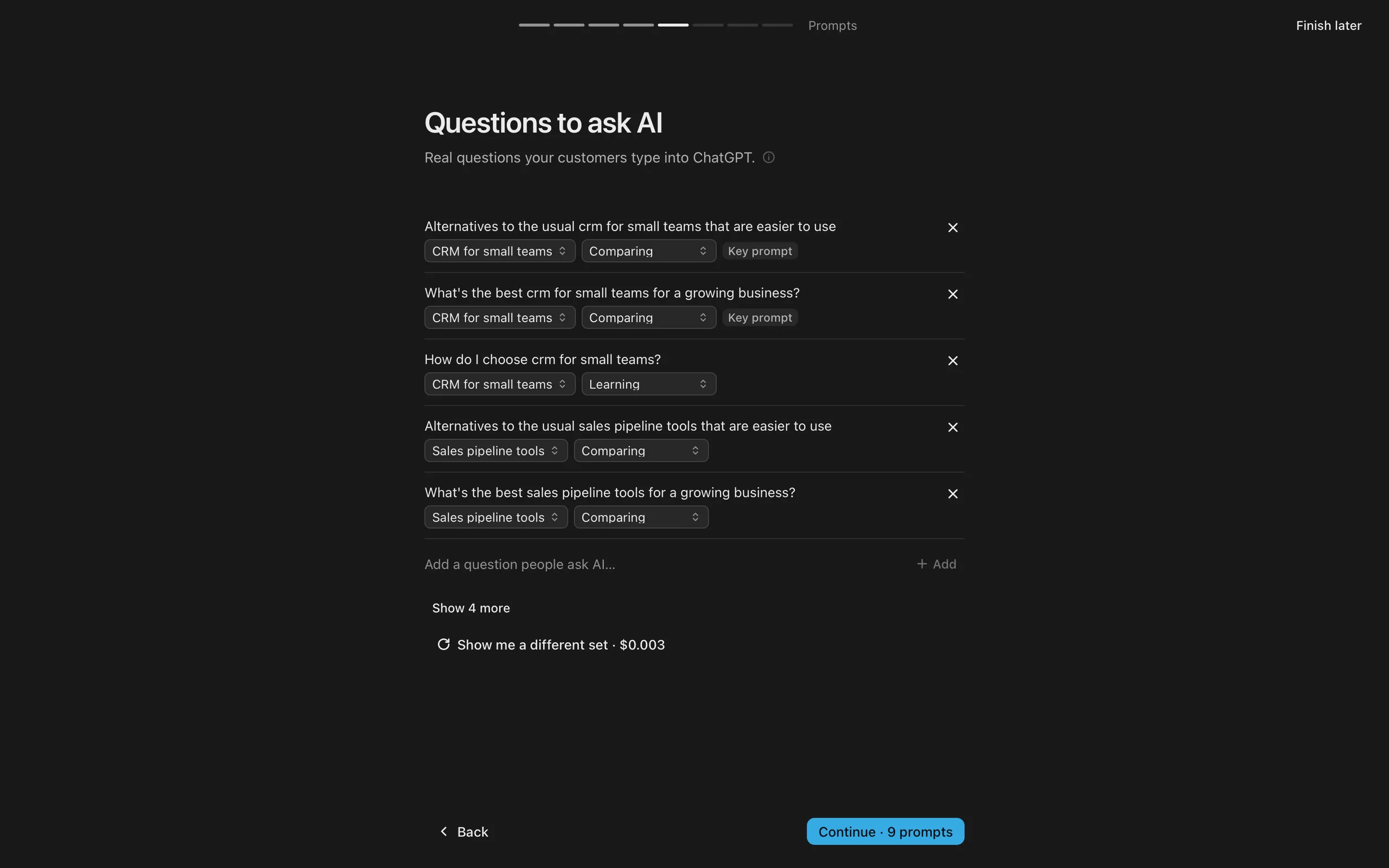
Why only nine? A first run is meant to be cheap and fast. Once you trust the method, you can grow to 10, 25 or 50 prompts; the cost table in step 10 prices each. Fewer than 10 prompts is also below the threshold where the app will show a statistical range, which brings us to step 8.
Time: one to two minutes. Cost: about $0.002 per set. Saved: the prompts, their categories and intents.
5. See the price, then run
You pick the engines next. Only engines with a working key are selectable, and each chip shows its price per answer. Then the app shows exactly what the run will cost before anything is sent: one line per engine (answers × price per answer, with a low-to-high range), one line for reading the answers, and a total.
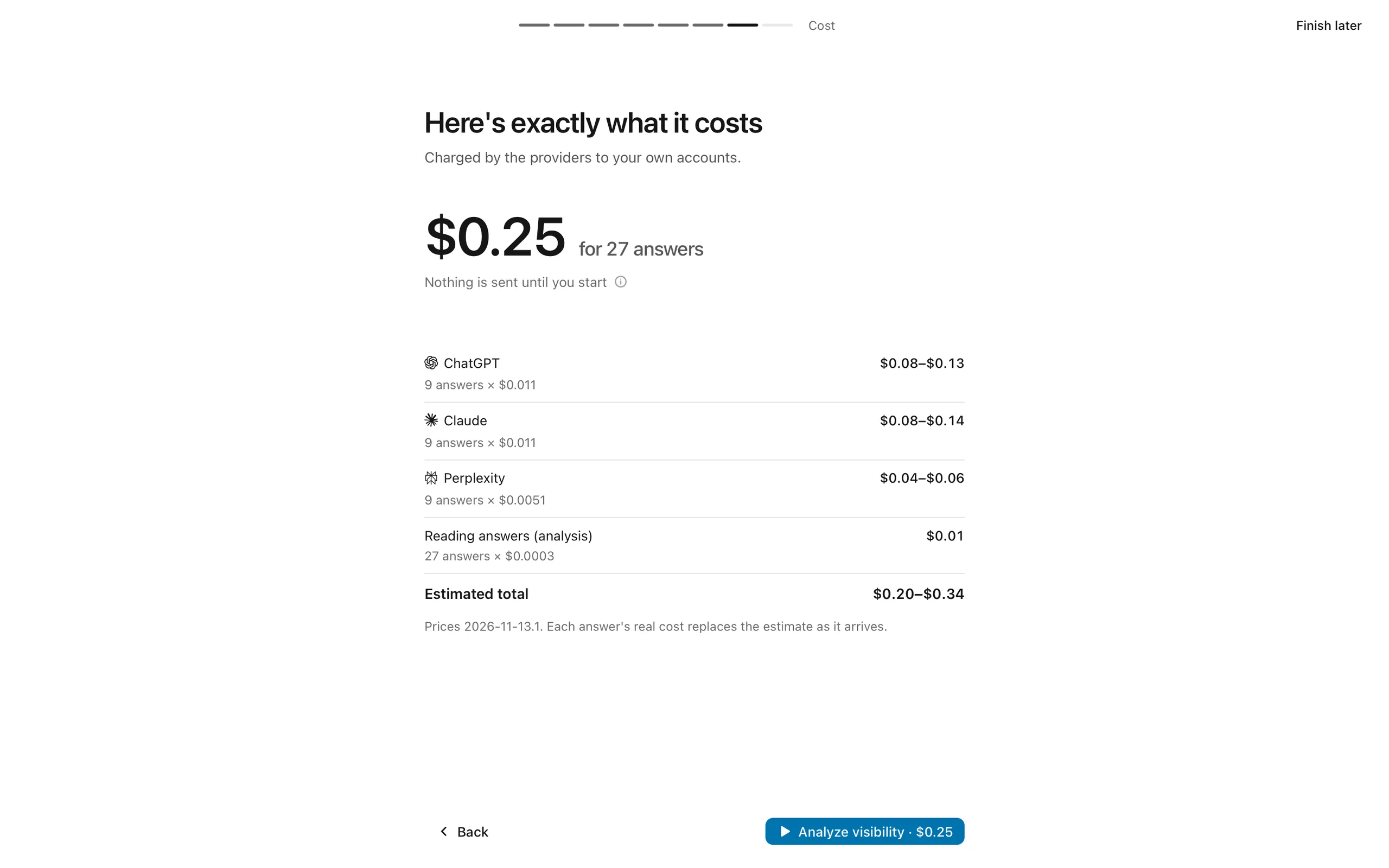
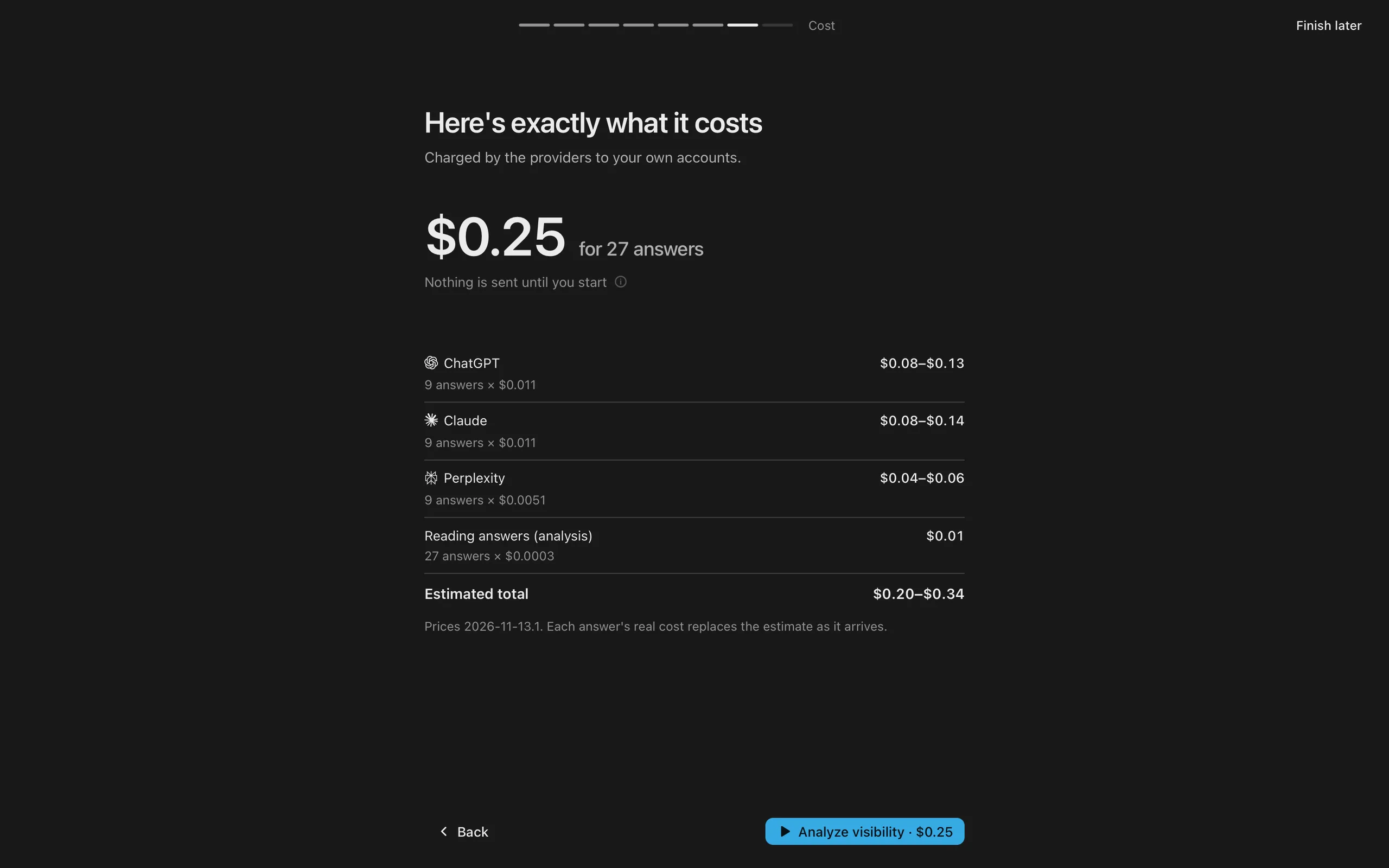
In the sample capture above, nine prompts on ChatGPT, Claude and Perplexity is 27 answers. The estimate is about $0.25, with a range of $0.20 to $0.34, of which about one cent is the cost of reading the answers. Prices come from a signed, dated price table, and each answer's real cost replaces the estimate as it arrives.
| Engine (default model) | Price per answer today |
|---|---|
| ChatGPT (GPT-6 Luna) | $0.0109 |
| Claude (Claude Haiku 5.5) | $0.0112 |
| Perplexity (Sonar) | $0.0051 |
You can also set monthly budgets per provider. A run that would break a hard cap is blocked before it starts, unless you override it for that run.
Time: seconds. Cost: none until you press the button.
6. Watch the answers arrive
Press Analyze visibility and the run moves through five stages: Queued, Asking engines, Reading answers, Finishing, Ready. Each engine gets its own progress bar, the running cost is shown against the estimate, and an early visibility score fills in as answers arrive. In practice this takes a minute or two. You can stop at any point; finished answers are kept (and were charged), and pending ones are cancelled.
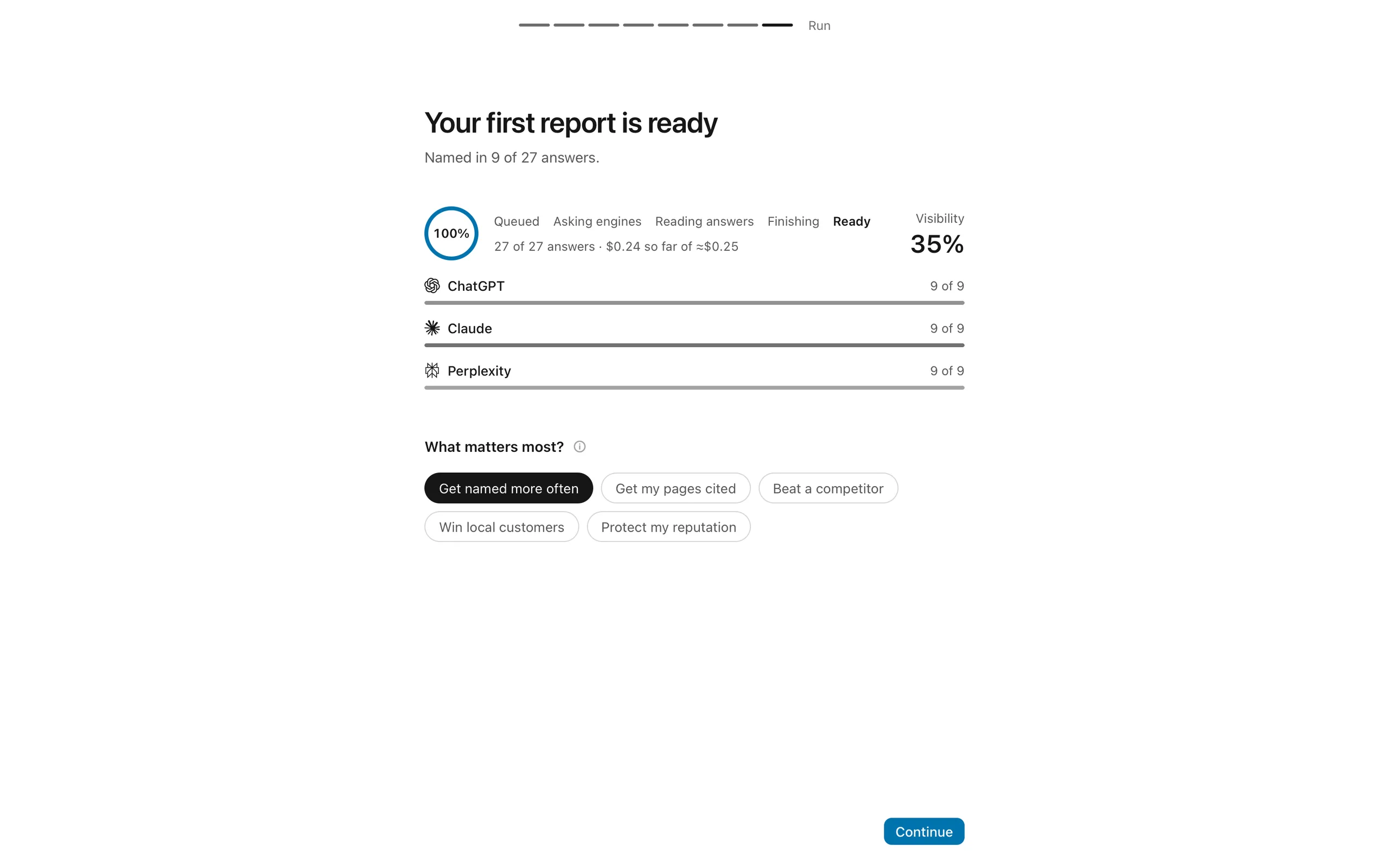
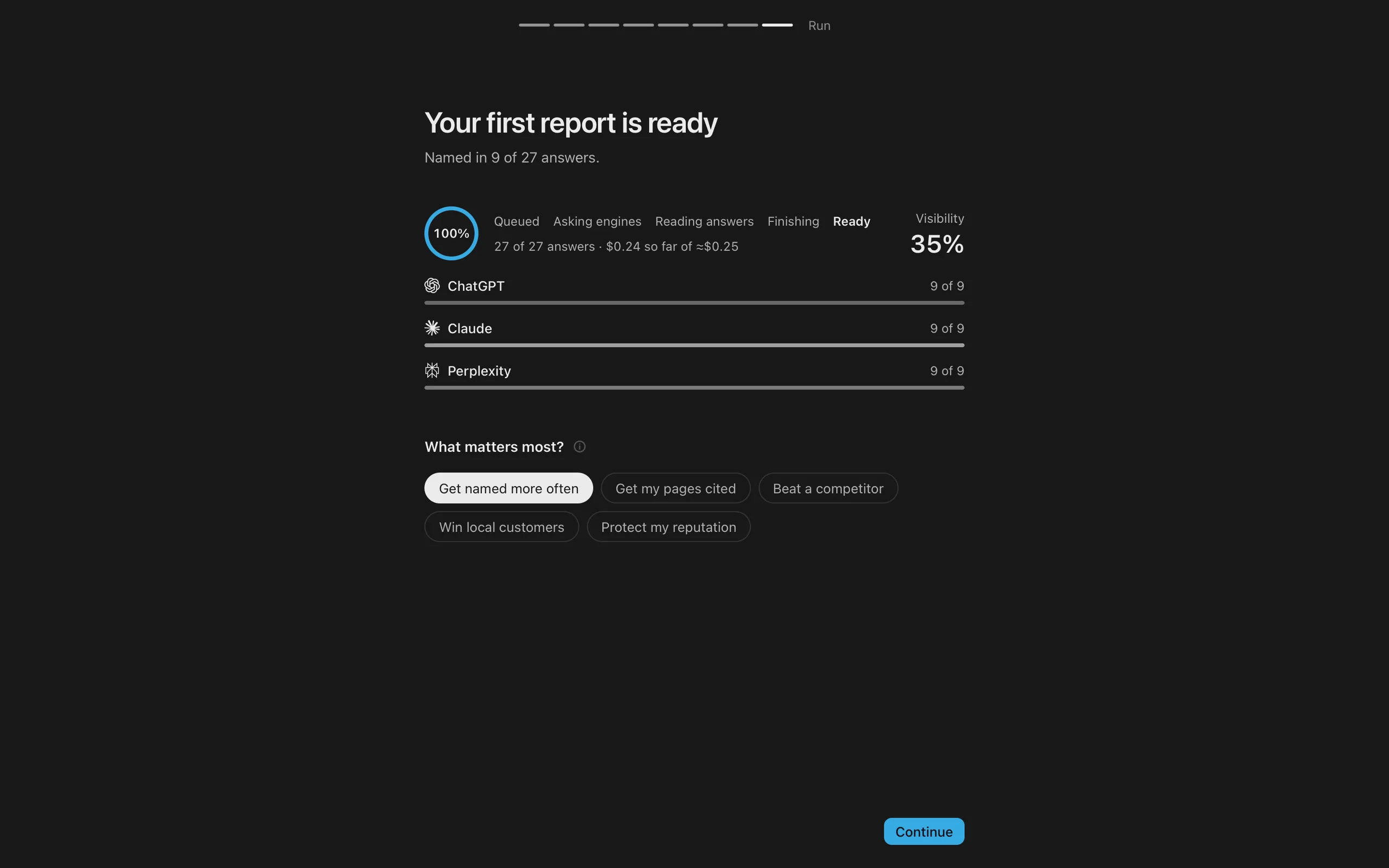
While you wait, the app asks what matters most: getting named more often, getting your pages cited, beating a competitor, winning local customers, or protecting your reputation. Your plan puts that goal first.
Cost: the run itself, about $0.25 in this example. Saved: every answer, word for word, with its citations, the pages the engine read, its search queries, the model string, the market, whether location was applied, latency and cost.
7. Read the answers, not just the score
A score alone tells you little. Every number in Surfacedd opens the answers behind it. The answer drawer shows the full text with your brand highlighted and competitors underlined, your status ("Named #2", "Not named" or "Homonym" when a different company shares your name), every brand mentioned, and two kinds of sources: pages the engine cited, and pages it read but did not cite. That second list, which the OpenAI, Anthropic, Perplexity, xAI and Meta APIs return, is often where the easiest wins are.
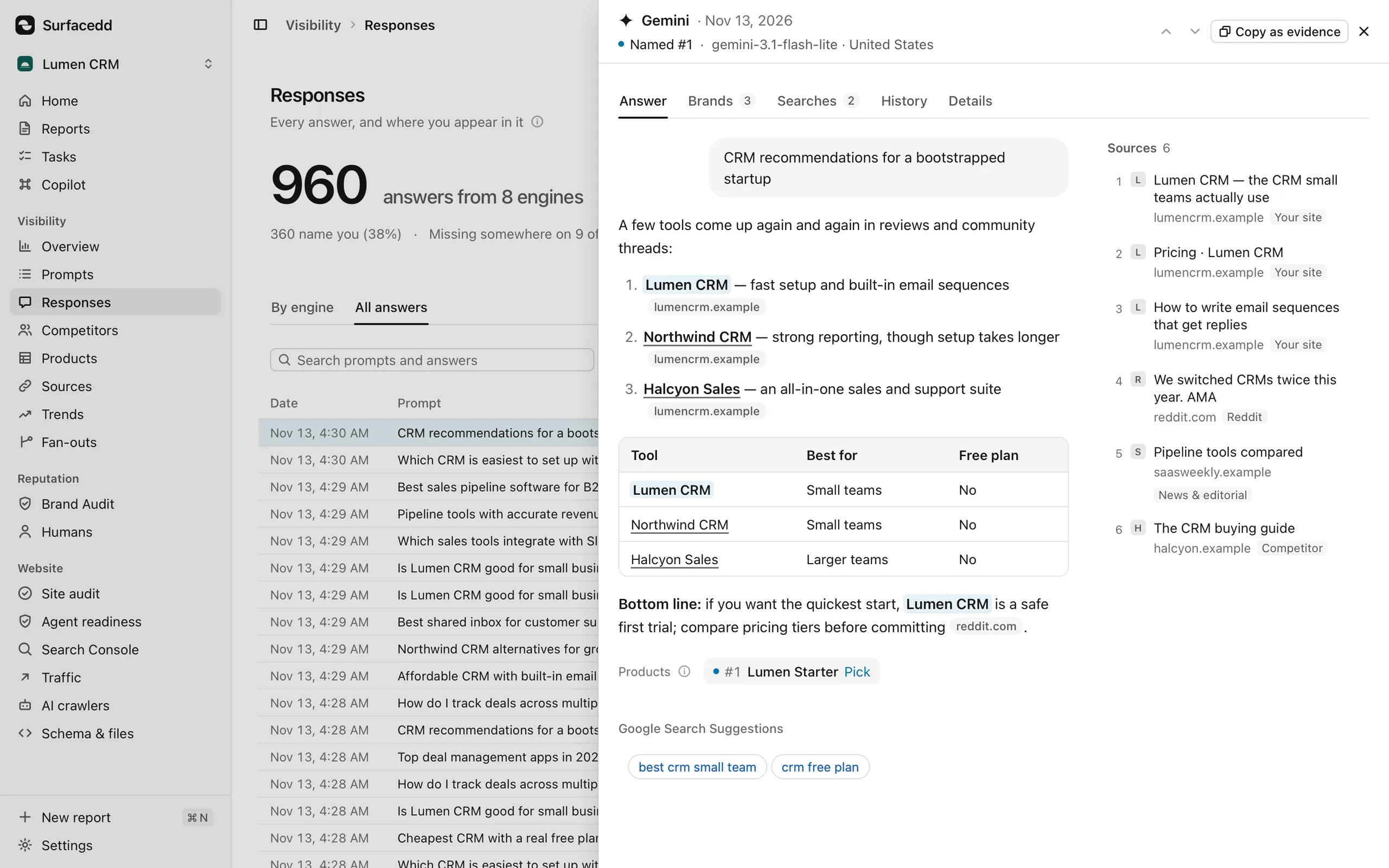
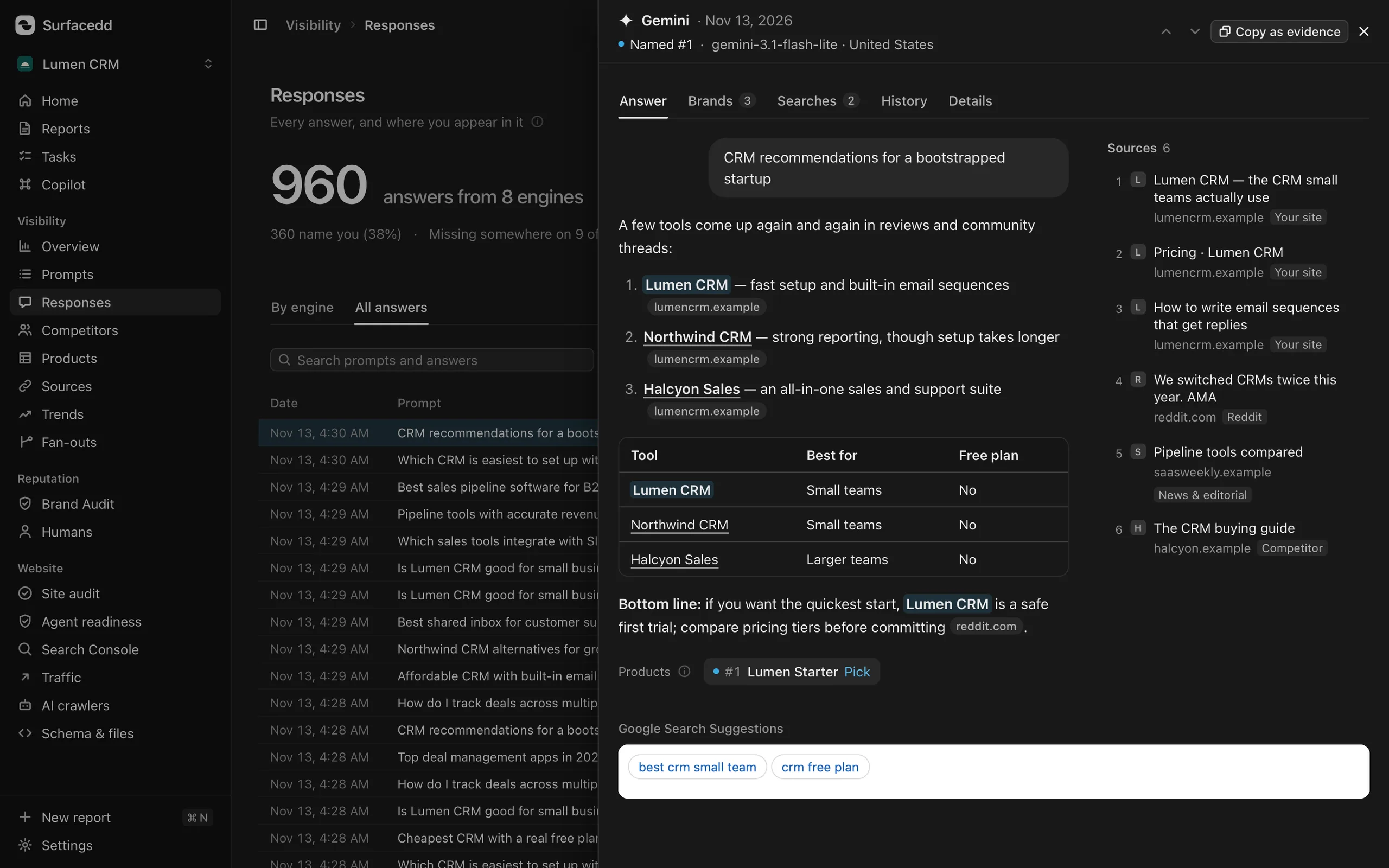
The drawer also lists the engine's fan-out queries, the searches it ran behind the scenes. These show what the engine thought your buyer's question meant, and they are a direct list of topics your site may not cover.
How does it decide you were named? A word-boundary match on your name or an alias, or a link to your own domain inside the answer text. A link that appears only in the engine's source list counts as a citation, not a mention. The full rules are on the methodology page.
8. Ranges and real changes, not noise
Ask an AI engine the same question twice and you can get two different answers. Surfacedd treats that as a fact to measure, not a nuisance to hide. With enough data, every headline figure comes with a 95% range ("44% · 95% range 36–52%"), and a change between runs gets an arrow only when that range of the difference excludes zero. Otherwise the app says No clear change.
On a first run of nine prompts you will see "Not enough data" where the range would be, because ranges need at least 10 prompts and 20 answers. That's intentional: one small run is a first look, not a measurement. Our advice, printed in the app, is to judge trends over about four weekly runs.
Comparisons are like-for-like: a change between two runs counts only prompts, engines and markets present in both. If you change the prompt set, engines, models or markets, the trend chart puts a marker on that run so you never mistake a config change for a real one.
9. Get a task list with evidence attached
Deterministic checks look for patterns in your results, for example a prompt where a competitor is named and you aren't in most samples, a page that keeps getting cited for a rival, or a robots.txt rule that blocks an AI search crawler. Each finding carries its evidence: the answer IDs, page URLs or metric changes behind it. One cheap model call then orders the findings and writes a short title and reason for each, and it may only use numbers present in the evidence. That call costs about one to three cents.
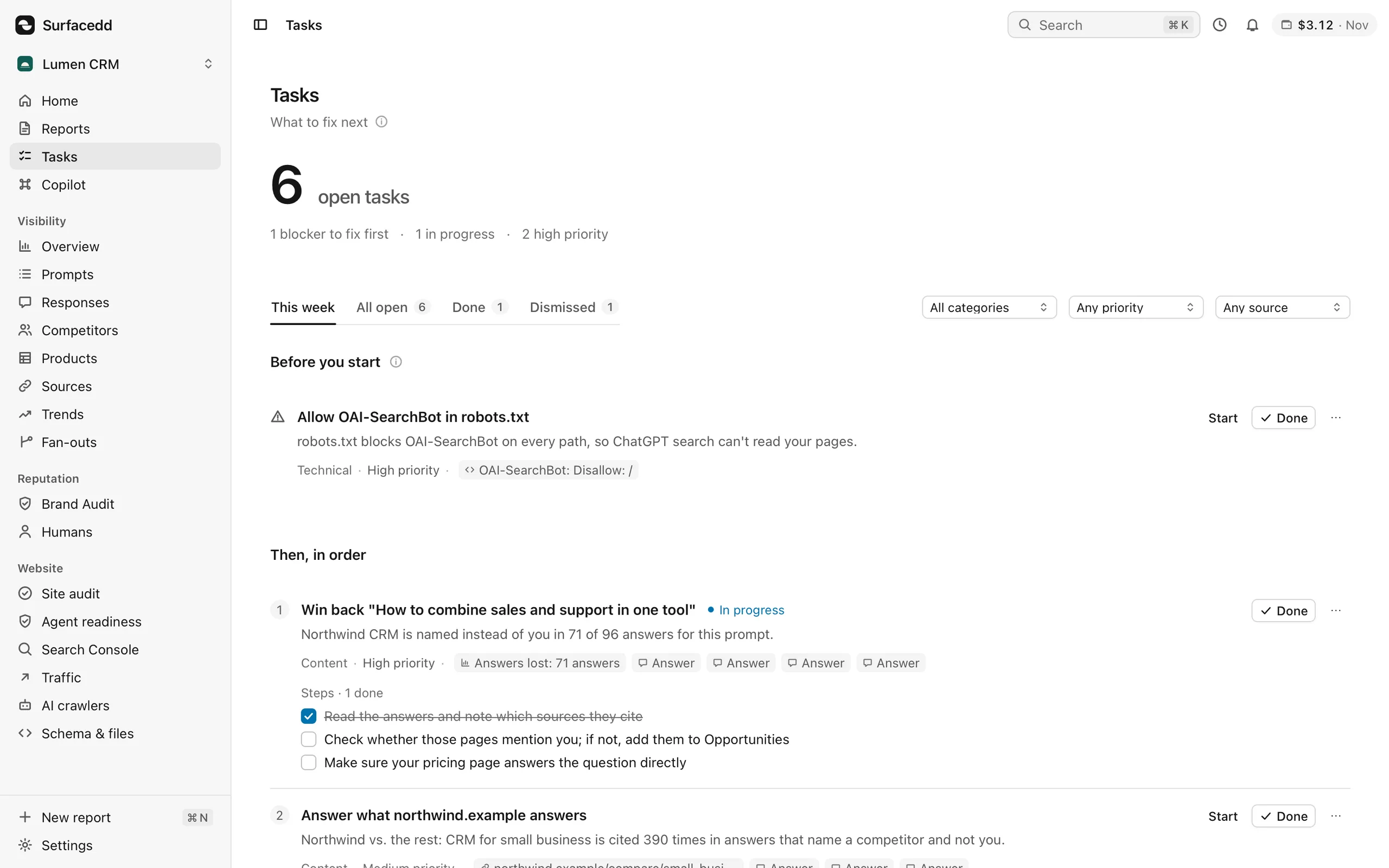
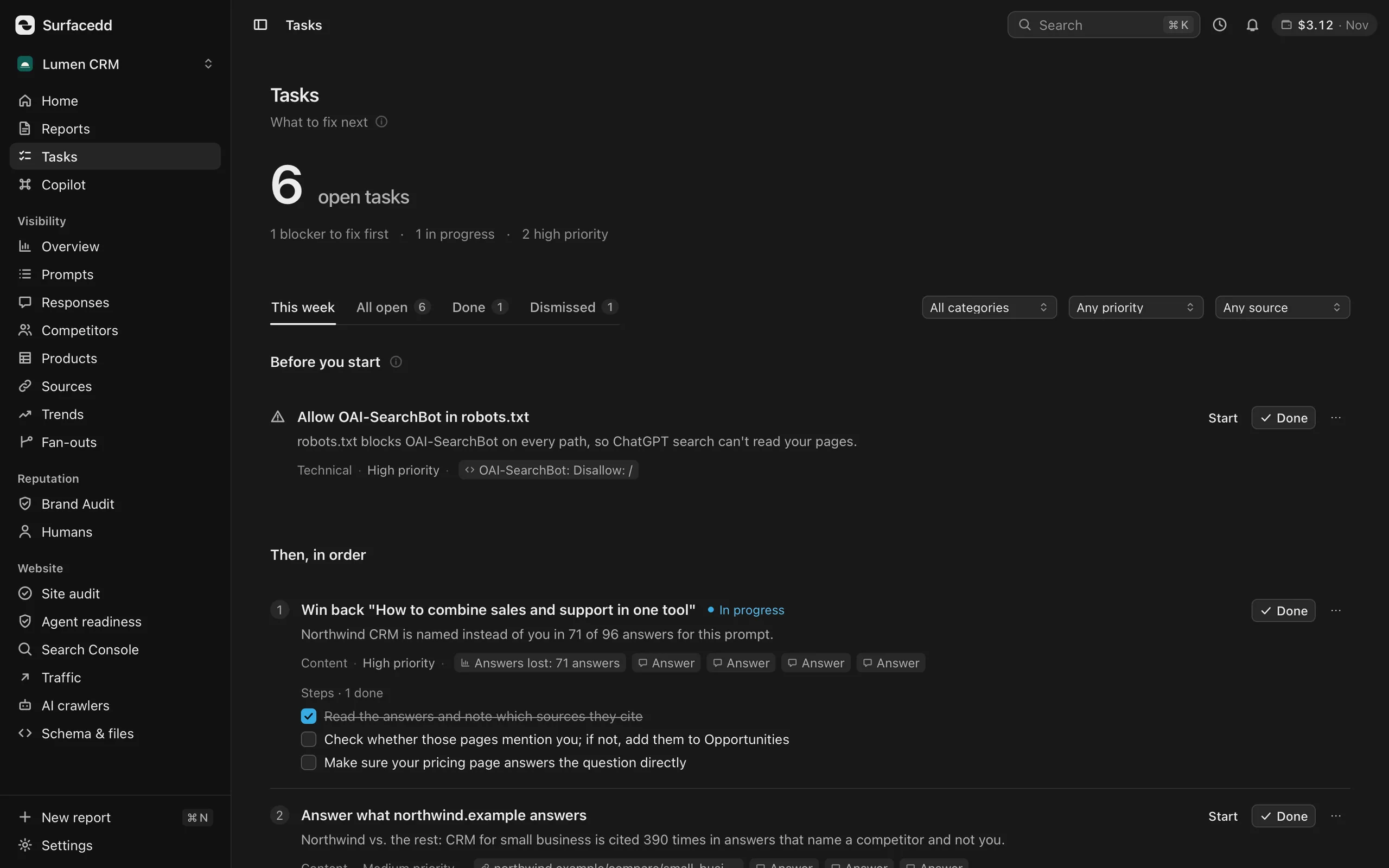
Tasks are things you do, not things the app does for you. A task card has a reason, evidence chips that open the answers or pages, checkable steps and a Copy brief button. Tasks close themselves when the next check passes, for example when a prompt is won back in two consecutive runs or the robots rule is fixed. Surfacedd never writes articles, posts, replies or emails for you.
Some fixes live on your website rather than in your content. The site audit crawls up to 500 of your pages locally for free and checks AI-crawler access, snippet controls and structured data, and Agent readiness builds on it to check whether AI agents can reach, understand and act on your pages.
10. Schedule it weekly, even if your laptop sleeps
The last setup screen offers three switches: Track weekly (Mondays at 9:00 in your time zone, same prompts, same engines, same cost), Launch at login, so the app opens quietly in the menu bar or system tray, and Allow notifications for finished reports and anything that needs you.
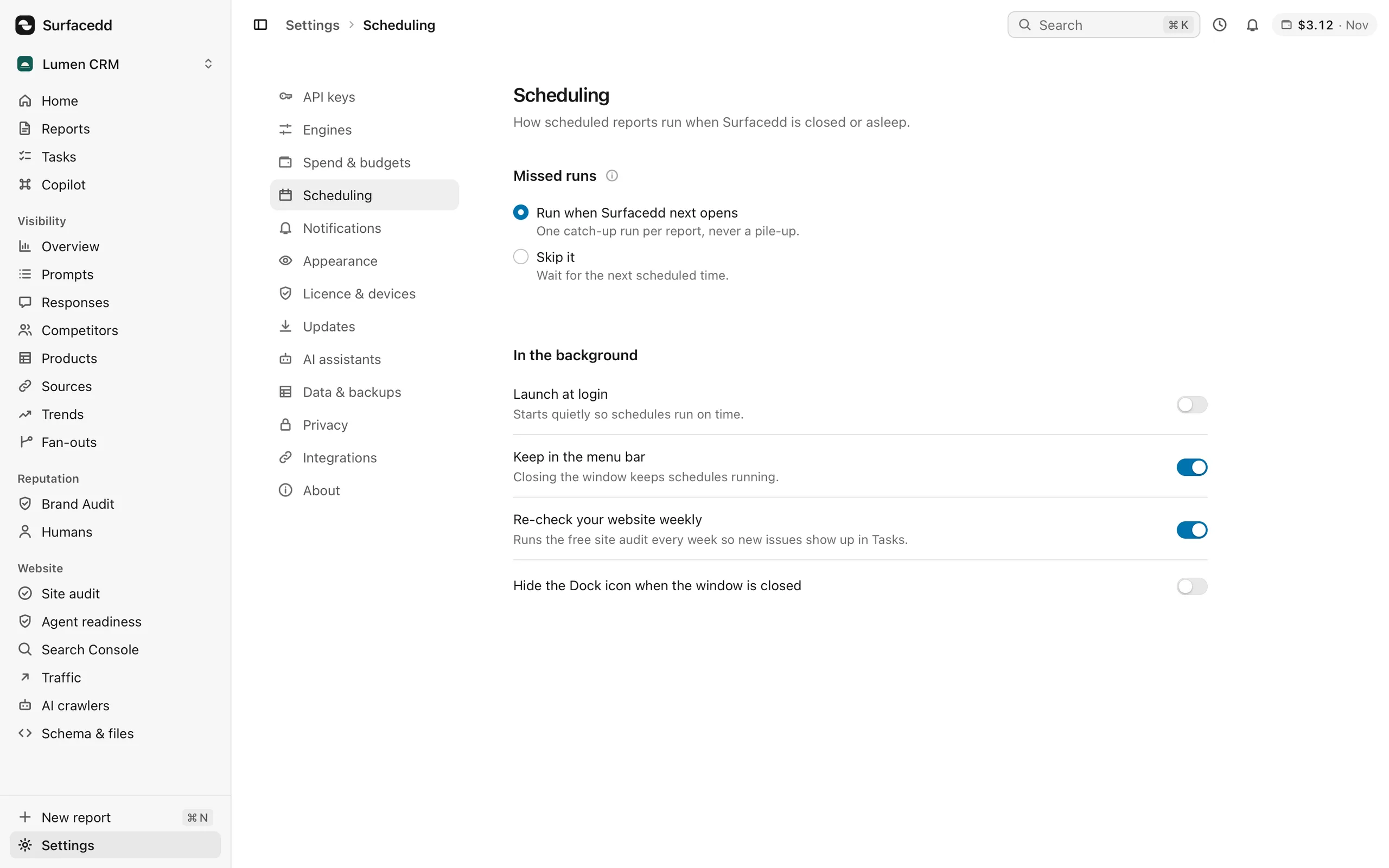
Scheduled runs happen while your computer is awake. If it was asleep or off at the scheduled time, Surfacedd runs one catch-up run when you're back, never a pile of missed ones, and you can switch that to "skip" in Settings. Scheduled Google AI Mode and AI Overview checks use DataForSEO's standard queue, about a third of the live price. A schedule that would break a hard budget pauses itself and tells you.
What does a weekly habit cost? At today's default models:
| Setup | Monthly AI cost |
|---|---|
| 10 prompts, weekly, ChatGPT + Claude + Perplexity + AI Mode | $1.52 |
| 25 prompts, weekly, same engines | $3.75 |
| 50 prompts, weekly, same engines | $7.47 |
Use the cost calculator to price your own setup, and see pricing for the licence.
Where your data lives
Everything the app collects is in one SQLite database in your user account's app-data folder: brands, prompts, every answer with its sources, metrics, tasks and settings. The app keeps seven rolling nightly backups, and you can export the whole workspace as one file, optionally encrypted with a passphrase, to move it to another computer. API keys are never part of a backup or export.
What leaves your computer
| Destination | What is sent | When |
|---|---|---|
| The AI providers you enabled (OpenAI, Anthropic, Perplexity, xAI, Meta, Google) | Your prompt, the market's location where the engine supports it, your key | Each run, Ask now, analysis calls |
| DataForSEO, if you use it | The prompt as a Google query, location and language, your login | AI Mode and AI Overview checks |
| Your own website and pages engines cited | Ordinary page requests, identified as Surfacedd | Brand analysis, citation cards, site audit |
| Polar and surfacedd.com | Licence key, device ID, app version, platform | Activation, then about once a day |
| surfacedd.com | A request for the signed price table and AI-crawler list | Daily |
| surfacedd.com (Mac and direct Windows builds) | Current version and platform, to check for updates | Every few hours |
Your prompts, answers and results are never sent to us, and the app sends no analytics or crash reports. The full list, with exact payloads, is on private and local.
What it doesn't do
- It doesn't see inside any engine. It measures what engines say through their APIs, which can differ from a signed-in person's chat app.
- It doesn't promise you'll be recommended. It shows where you stand, what the evidence suggests, and whether a change was real.
- It doesn't write or publish content, reply to reviews or send outreach emails.
- It doesn't run in the cloud. Scheduled runs need your computer awake; missed runs catch up once.
- It doesn't hide uncertainty: small runs show "Not enough data" instead of a confident-looking number.
Sources
- OpenAI: Web search tool
- Anthropic: Web search tool
- Perplexity: Agent API quickstart
- DataForSEO: Google AI Mode live advanced
Fair questions
How long does the first run take?
Setup takes about three minutes if your keys are ready: licence, keys, website, markets, prompts, engines and the cost check. The run itself usually takes a minute or two for 27 answers, because engines are asked in parallel. Google AI Mode and AI Overview checks through DataForSEO's live endpoint can take longer, up to a couple of minutes per answer. You can keep working, or close the run sheet and get a notification when it's done.
What does the first run cost, exactly?
In our sample capture, 9 prompts on ChatGPT, Claude and Perplexity came to an estimate of about $0.25, including roughly one cent to read the answers, and $0.24 actually spent. You pay that to the providers on your own accounts; Surfacedd takes nothing per run. The app shows the estimate before you start, so you can drop an engine or a prompt if you want it cheaper.
Do I need all eight engines?
No. Most people start with ChatGPT, Claude, Perplexity and Google AI Mode, which together cover the assistants and Google's AI answers. You need one OpenAI or Anthropic key to read answers; every other engine is optional. Gemini is off by default because Google's terms limit analysing search-grounded results, and Meta AI is an opt-in preview.
Why are my results different from what I see in ChatGPT?
Surfacedd asks through the official API with web search on, and without your chat history or personalisation. A signed-in app can use different models, memory and settings. API answers are reproducible and comparable over time, which is what tracking needs, but they are not a screenshot of anyone's personal chat. Every answer records its model and collection mode.
Can I try it before buying?
Yes, in the sense that the sample workspace is free: it loads a fictional brand with six weeks of results across all eight engines and needs no licence or keys. There's no free trial for running your own prompts. Purchases can be refunded within 14 days.
What happens if my laptop is closed at the scheduled time?
Nothing is lost. When the computer wakes or the app opens, Surfacedd runs one coalesced catch-up run for that schedule and works out the next slot from then. You can change the policy to skip missed runs instead. Runs keep the computer awake while they're in progress so a long run isn't cut off by sleep.
How we research, write and correct pages: read our editorial policy.