See which of your products AI recommends
Product tracking reads every answer for the products you sell and the ones you compete with, then shows mention rate, picks, rank and category share, with the answers behind each number.
By the Surfacedd teamUpdated 8 min readMarkdown
On this page
Short answer
Surfacedd's product tracking counts how often AI answers name and recommend each product in your catalogue, and which competitor products are picked instead. It reports mention rate, recommended rate, average rank, category share of voice and won-without-you answers, with 95% ranges. Products are read in the same extraction call as brands, so tracking them adds no AI cost.
Brand tracking tells you whether AI names your company. It doesn't tell you which of your products it names, or whether a buyer asking "best CRM for a five-person team" gets your entry plan or a rival's. Two brands can sit level on brand visibility while one wins every product pick. Product tracking measures the products themselves: yours, and the competitor products that get recommended instead.
How do you see which of your products AI recommends?
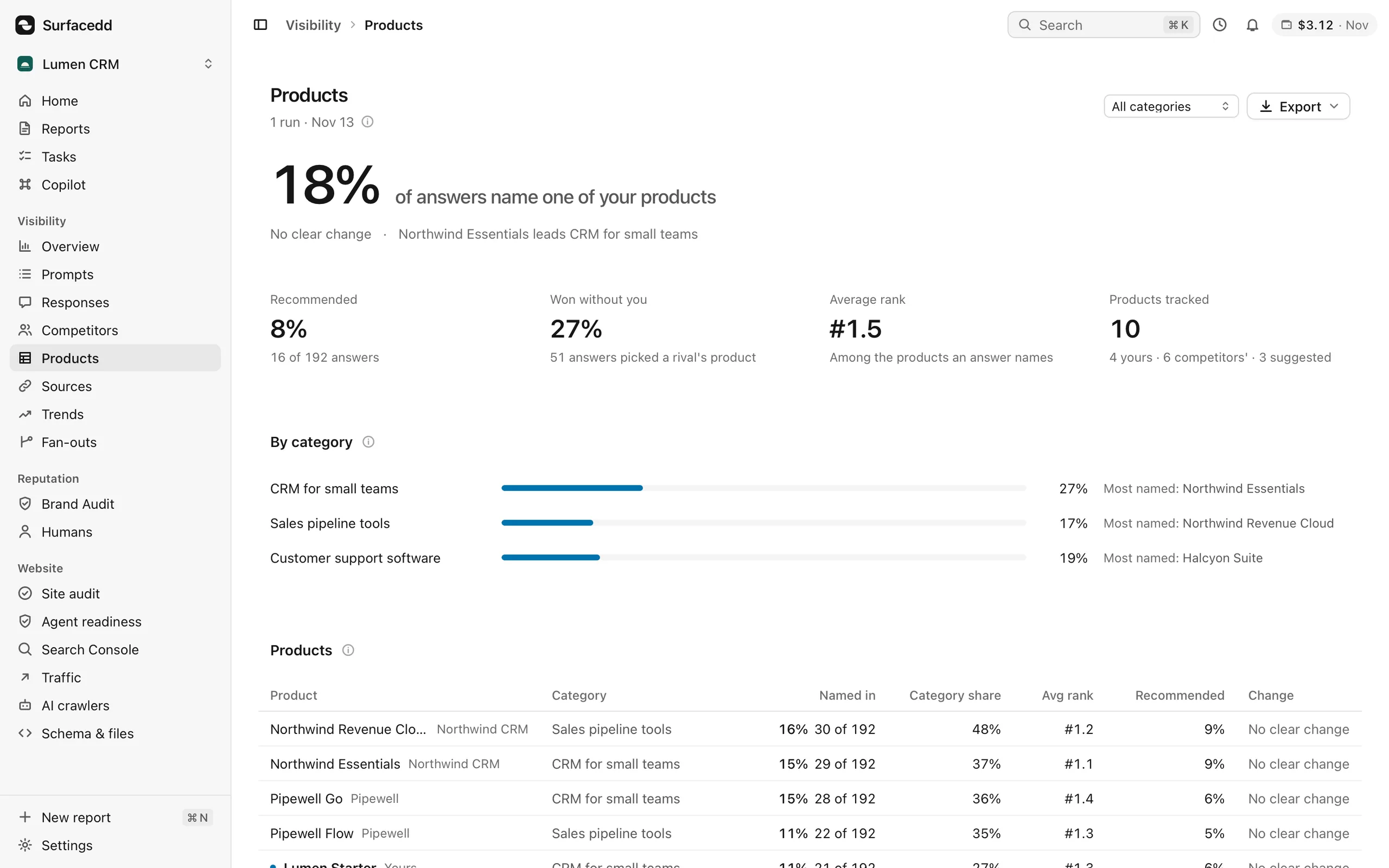
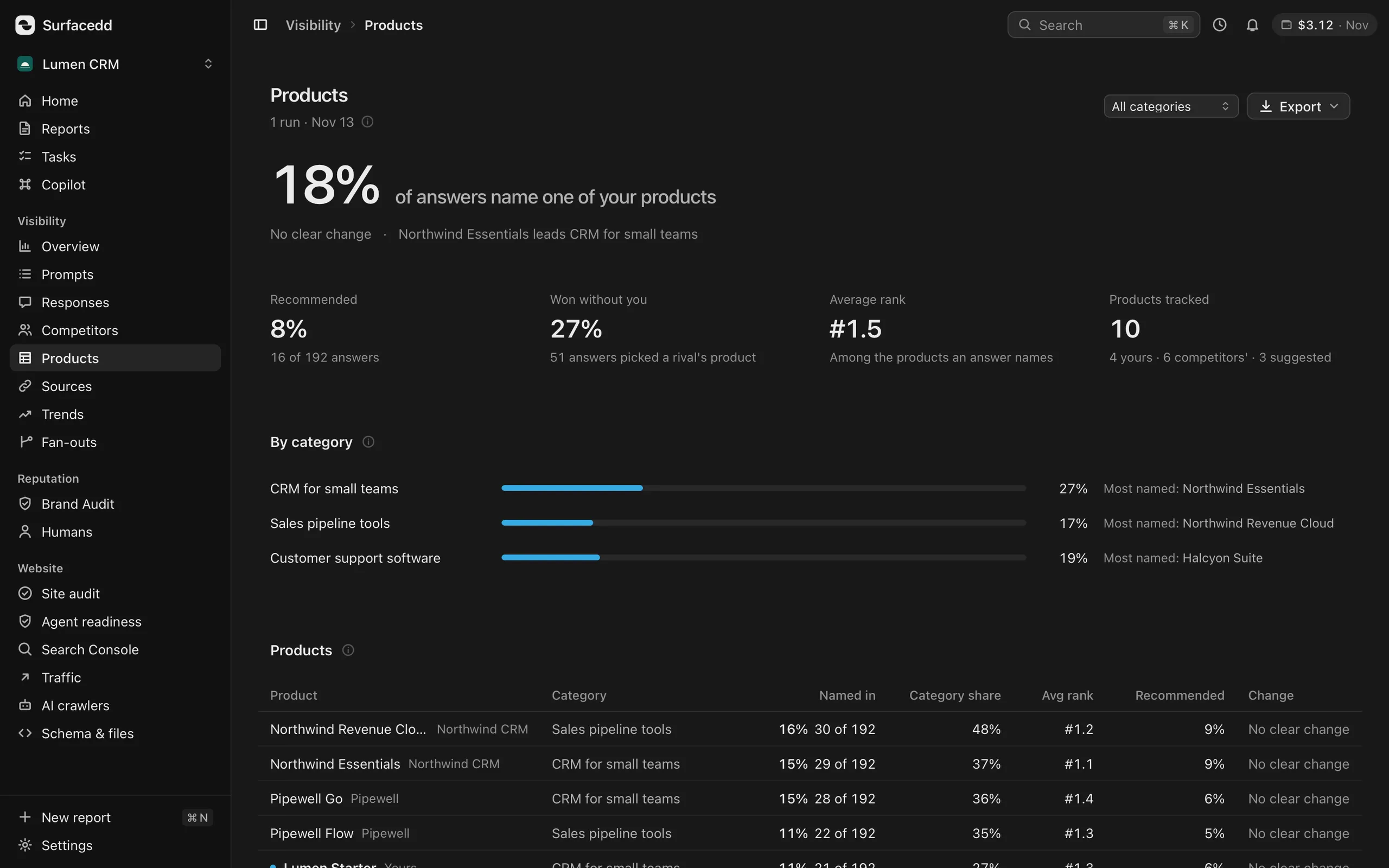
Surfacedd reads every answer it collects for the products in your catalogue and records whether each one is named, where it appears in the answer, and whether the engine presents it as a pick. It then rolls those reads into rates per product, per category, per engine, per market and per prompt intent, and every number opens the answers behind it.
| Metric | What it counts |
|---|---|
| Own mention rate (the headline) | answers naming any of your products ÷ answers in scope |
| Mention rate, per product | answers naming that product ÷ answers in scope |
| Recommended rate | answers where the engine presented the product as a pick ÷ answers in scope |
| Won without you | answers where a competitor's product was recommended and none of yours was ÷ answers in scope |
| Average rank | mean order of first appearance among the products an answer names |
| Category share of voice | answers naming the product ÷ answers naming each tracked product in the same category |
Every rate carries a 95% range from a cluster bootstrap over prompts, and below 10 prompts or 20 answers the app says "Not enough data" rather than show a number that can't hold. Changes between runs are like-for-like, and only significant changes get an arrow; the rest read "No clear change". These are the same rules the brand metrics use, explained on the methodology page.
Build your product catalogue in minutes
Each product has a name, other names it goes by, a maker, a category, an optional price and a page. You can fill the catalogue five ways:
- From Brand analysis. The products Surfacedd found when it read your site during setup.
- From a CSV file, with a
brandcolumn if you sell other makers' products. - From your site's Product structured data. The import reads the pages your latest site audit found with Product JSON-LD, up to 40 pages, or your home page and its product links.
- From a Shopify store's public product list (
/products.json). It needs no login, reads at most 5,000 products, and fetches politely at one request per second while respecting robots.txt. - By hand.
The catalogue holds up to 2,000 products per brand. Competitor products you care about go in the same list, each with its maker, so the app knows "Northwind Essentials" belongs to Northwind CRM.
Products you didn't know to track. When answers name products that aren't in your catalogue, they appear as suggestions with how often they were seen and recommended. You track or dismiss each one, the same way you handle suggested brand names. Accepting a suggestion recounts every past answer on your computer, free.
See whose products win instead
The "Won without you" number is the one to watch. It counts answers where the engine recommended a competitor's product and none of yours, which is the moment a buyer gets steered elsewhere. The Products screen lists the rival products that win most, and the By category view shows which product leads each category you sell in.
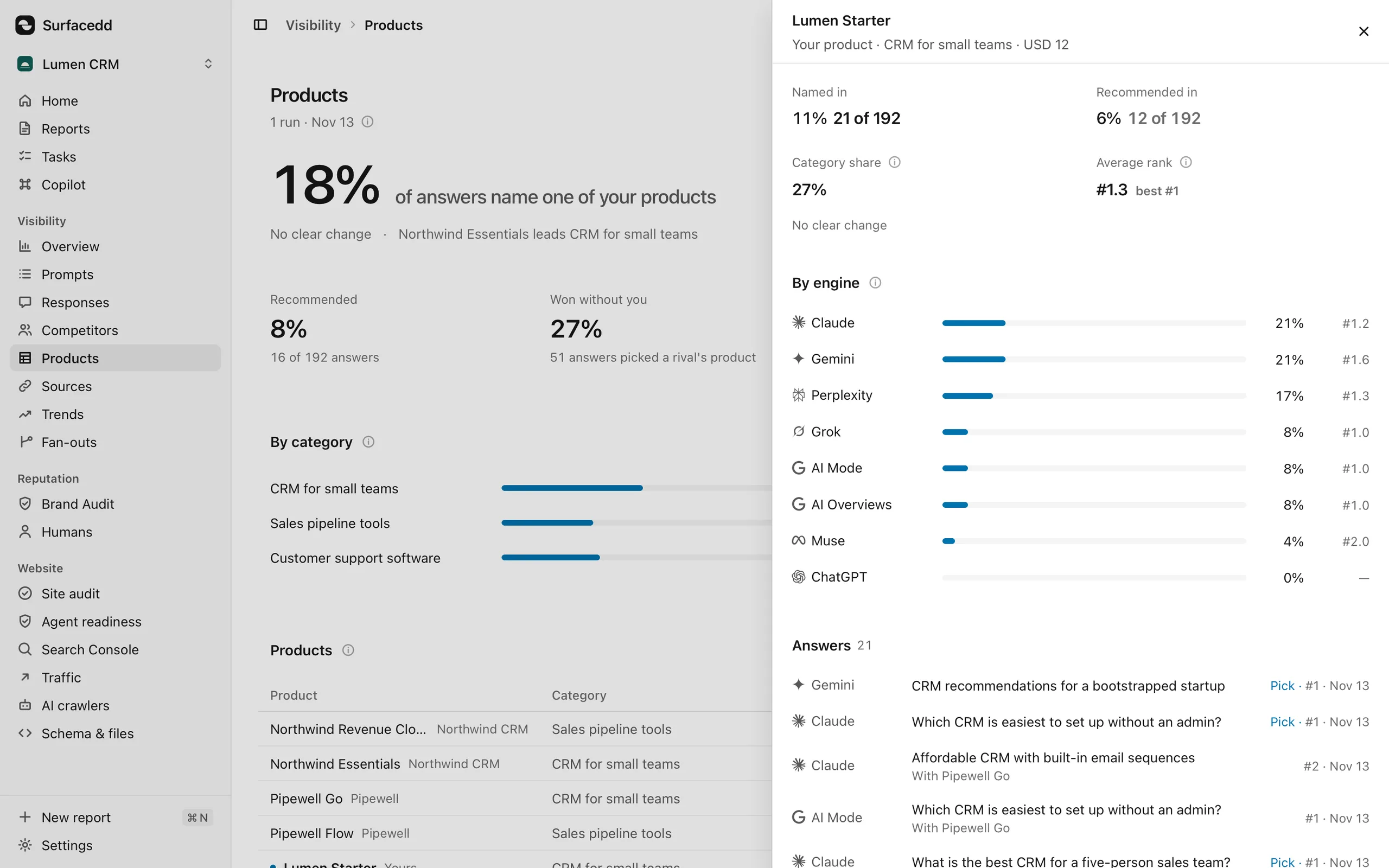
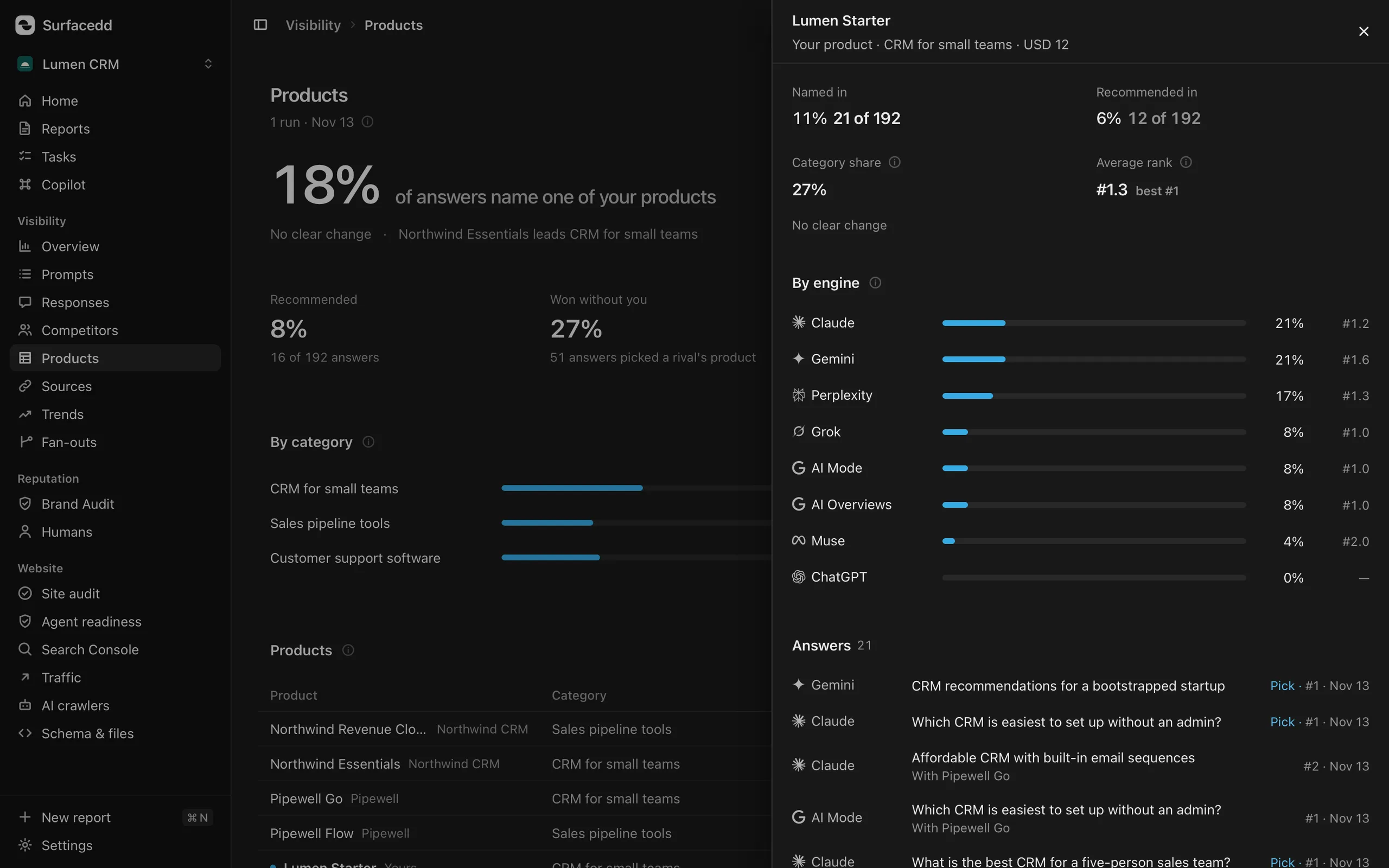
Click any product to open its drawer: its rates, its results by engine, every answer that named it, the pages those answers cited, and the rival products named next to it. That last list is where a fix starts, because the cited pages are what convinced the engine. For the page-level view across your whole brand, see competitors and sources.
Product findings also feed your task list. Two evidence-backed findings are added when the data supports them: "product never named for its category" and "rival product wins your category". Each task links the answers that triggered it, so you can see why it exists before you act on it.
Worked example: an entry-level plan that ChatGPT never names
This example comes from the sample workspace, where Lumen CRM is a fictional CRM brand tracking 10 products: 4 of its own and 6 from competitors, with 3 more suggested. One run collected 192 answers across eight engines.
- Headline: 18% of answers named one of Lumen's products. 8% recommended one (16 of 192 answers).
- The problem: 27% of answers, 51 of 192, picked a rival's product and none of Lumen's.
- The category: in "CRM for small teams", Northwind Essentials leads with a 37% category share. Lumen Starter has 27%.
- The engine gap: Lumen Starter was named in 21% of Claude answers and 21% of Gemini answers, 17% of Perplexity and 8% of AI Mode, but 0% of ChatGPT answers.
That last line is the actionable one. The drawer's answer list shows which ChatGPT prompts named Pipewell Go instead, and which pages those answers cited. The next steps are to check whether those pages mention Lumen Starter at all, whether Lumen's own pricing page describes the entry plan in plain server HTML (the agent readiness check tests this), and to re-check after the change to see whether the gap closes or stays at "No clear change".
How products are found in each answer
Products run alongside the brand pipeline and never change it. First, a deterministic scan matches every product name and alias in the answer text, with word boundaries, masked URLs, and the longest match winning, so "iPhone 16 Pro" isn't also counted as "iPhone 16". Then the single AI reading step that already finds brands in each answer also returns the products it sees, their maker, their rank and whether each was recommended. No extra call is made.
The two are reconciled with the same rules as brands. A product name that is also a common word, such as "Pro" or "Essential", only counts when the reading step confirms it, or when the maker is named in the same answer. A hit is set aside as a homonym when the answer attributes that name to a different maker.
On a hand-labelled set of 60 answers in six languages, the full pipeline matched every product label correctly when given a correct reading step, and the deterministic scan alone reached precision 0.983 and recall 0.975. That test measures the matching rules, not a live model.
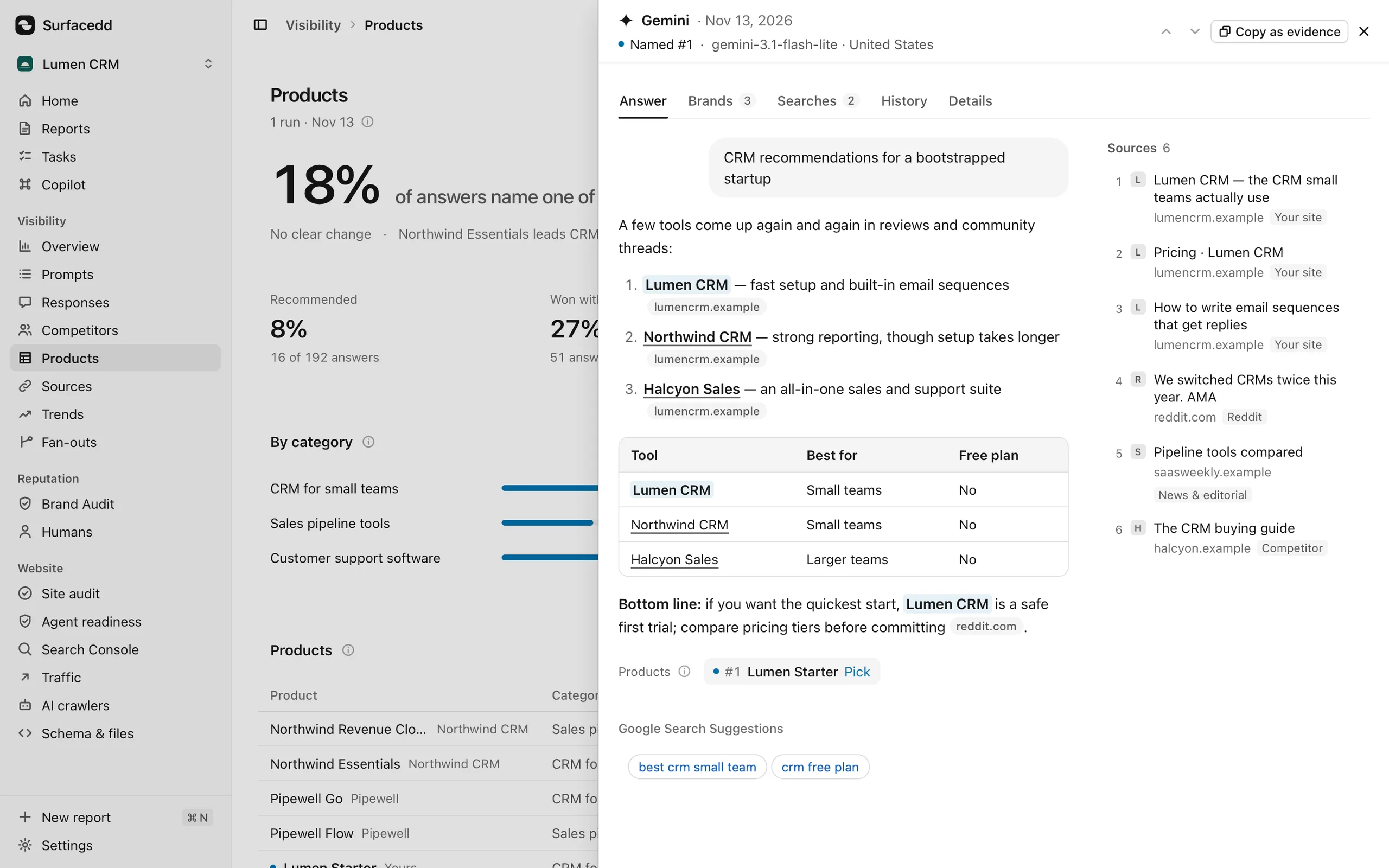
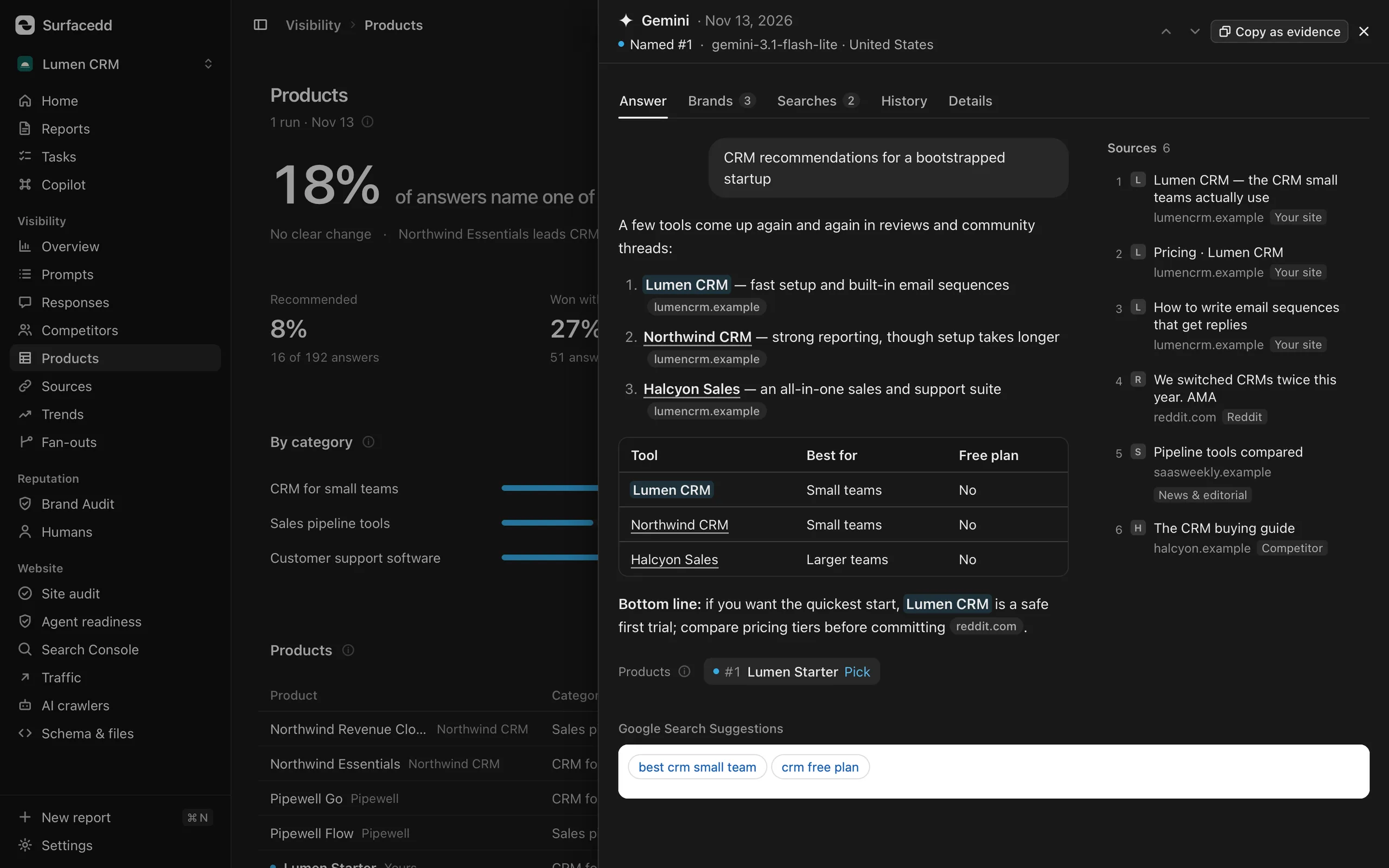
Shopping cards. Some answers come with product cards showing a price, seller and rating. Surfacedd stores them, shows them in the answer drawer, and counts a catalogue product that appears only in a card, marked "from a shopping card". In 1.0 these cards come from Google AI Mode and AI Overviews results through DataForSEO, whose response includes an ai_overview_shopping element. The other engines' APIs return no shopping fields that we read today.
Where product data shows up
- Overview gets a Products block once you have a catalogue.
- The answer drawer shows product chips with rank, and "Pick" when recommended.
- Exports: CSV exports include product mentions and a "Products named" column on responses, and the NDJSON history carries product mentions per answer.
- AI assistants: the local MCP server has two read-only tools,
product_shareandproduct_results, so you can ask Claude Desktop or Cursor which of your products lost ground this month.
Cost
Product tracking adds no AI cost. Products are read in the same extraction call that already runs on every answer, and catalogue edits, imports and accepted suggestions recount past answers on your computer for free. The Shopify and JSON-LD imports are plain web fetches with no API key. What you pay for is the answers themselves, at your providers' prices, for example $3.75 a month for 25 prompts weekly on the four default engines. See pricing for the licence.
What product tracking doesn't do
Sources
Fair questions
What does product tracking measure?
It measures how often AI answers name each product in your catalogue, how often they present it as a pick, where it appears among the products named, and its share of mentions within its category. It also counts answers where a competitor's product was recommended and none of yours. Each figure comes with a 95% range and opens the answers behind it.
Does tracking products cost extra?
No extra AI cost. Products are read in the same extraction call Surfacedd already makes for every answer, and recounts after catalogue changes run locally for free. Imports from Shopify or your site's structured data are plain web fetches. You only pay your AI providers for the answers you collect, which the app prices before every run.
How do I add my products?
Five ways: accept the products Brand analysis found on your site, import a CSV, import the Product structured data from pages your site audit found, import a Shopify store's public product list, or type them in. Competitor products go in the same catalogue with their maker. Products that answers mention but you don't track appear as suggestions to accept or dismiss.
Can it tell two products with similar names apart?
Usually. The longest match wins, so a longer model name isn't also counted as the shorter one. Names that are common words only count when the AI reading step confirms them or the maker is named in the answer, and a name the answer attributes to a different maker is set aside as a homonym. Products that are described but never named aren't counted.
Which engines show shopping cards?
In 1.0, only Google AI Mode and AI Overviews results collected through DataForSEO carry shopping cards that Surfacedd reads. A product that appears only in a card is counted and marked "from a shopping card". The other engines' APIs return text answers with sources but no product cards today, so for them Surfacedd counts the products named in the answer text.
Is this useful if I sell services, not products?
It is most useful when you sell several named offers, such as plans, editions or product lines, and want to know which one AI picks. If you sell a single service under your brand name, brand-level AI visibility tracking already answers the question, and product tracking adds little. You can leave the catalogue empty and nothing changes.
How we research, write and correct pages: read our editorial policy.