See when Grok recommends you, and how to show up more often
Surfacedd asks Grok your buyers' questions through xAI's API with web search on, records the pages it cited and every URL it touched, and takes the cost from xAI's own figure for each answer.
By the Surfacedd teamUpdated 6 min readMarkdown
On this page
Short answer
A Grok tracker asks Grok your prompts with web search on and records whether it names your brand and which pages it cites. Surfacedd uses xAI's Responses API on your own key, leaves X post search off so answers reflect the open web, and records the exact cost xAI reports, where 1 US dollar equals 10 billion ticks.
How Grok is collected
- How Surfacedd asks
- xAI Responses API with the web_search tool. xAI's separate X Search tool is not switched on, so answers reflect the open web, not posts on X.
- Key you need
- xAI API key
- Location
- Not applied. xAI's web search tool has no location setting.
- Searches it ran (fan-outs)
- Saved when xAI's response includes the search queries.
- Citations
- Citation annotations plus the response's citation list; inline [[n]] markers are removed from the displayed text.
- Search fee
- $5.00 per 1,000 search calls, plus tokens
- Default model
- Grok 4.3. Mid and flagship models can be picked per report.
Worth knowing
- Actual cost is taken from the cost xAI reports with each response.
- xAI lists every URL its search touched, including ones the answer never used; Surfacedd keeps those as consulted, not cited.
Cost per answer
$0.0201
estimated, paid to xAI on your account
- 100 answers
- $2.01
- 25 prompts × 3 samples, weekly, for a month
- $6.54
- Reading each answer (GPT-6 Luna)
- +$0.0015
From price table 2026-11-13.1, using typical token counts and one search per answer. The app recalibrates from your own answers and shows its estimate before each run. How costs are estimated
How Grok answers with search
Grok, xAI's assistant, can search the web before it answers. Through xAI's API that's the web_search tool, which xAI's pricing page describes as covering "searching the internet and browsing web pages". Like the other engines, the model decides whether a question needs it, and agentic answers can run several searches.
xAI also offers a separate tool, X Search, which searches posts, users and threads on X and is billed per post and profile fetched. Surfacedd doesn't switch it on. That's a deliberate choice: the question most brands need answered is what Grok tells people from the open web, and X Search would add cost per post while mixing two different source types into one number. If you want to know what X users say about you, that's a social-listening question, not an AI-answer one.
What the consumer Grok app combines by default isn't documented in xAI's API docs, so we don't claim the API answer matches it exactly. Each answer is labelled with the model xAI reports and the collection method.
Cost, reported to the tick
xAI is one of the two engines that report an answer's real cost. Every response carries usage.cost_in_usd_ticks: the billed amount for that request, after discounts such as prompt caching, covering tokens and every server-side tool call in the agentic loop. xAI's cost tracking docs define one US dollar as 10,000,000,000 ticks. Surfacedd divides and records the result as the actual spend for the answer.
Grok's default model reads more search content per answer than the other engines, so its per-answer estimate is higher, as the table shows.
| Model | Tier | Input per 1M tokens | Output per 1M tokens | Per 1,000 searches | Est. per answer |
|---|---|---|---|---|---|
| Grok 4.3 (default) | cheap | $1.25 | $2.50 | $5.00 | $0.0201 |
| Grok 4.20 (non-reasoning) | cheap | $1.25 | $2.50 | $5.00 | $0.0201 |
| Grok 4.7 | flagship | $2.00 | $6.00 | $5.00 | $0.0310 |
Estimates assume about 10,300 input and 900 output tokens and 1 search per answer, at xAI's list prices on 2026-11-23 (UTC), price table 2026-11-13.1.
At the default (Grok 4.3), 25 prompts with 3 samples asked weekly cost about $7.05 a month, paid to xAI. Agentic answers can run more than one search; the estimate assumes one, and the reported cost tells you the truth afterwards.
No location control
xAI's web search tool has domain filters and image options, but no location setting. A prompt asked for a London market and one asked for Sydney are, as far as xAI's API is concerned, the same request. Surfacedd records Grok's location as "not applied" on every answer instead of pretending otherwise.
If location matters to your prompts, write it into the prompt itself ("best accountant in Leeds"). For true city-level tracking, use Perplexity, which takes coordinates, or Google's AI surfaces, which take exact locations.
Citations, and every URL it touched
xAI returns two lists, and the difference matters. The answer's url_citation annotations are the cited sources, with character positions in the text. Separately, response.citations lists every URL the search encountered, which xAI's citations docs say includes sources it judged irrelevant: "Not every URL in this list will necessarily be directly referenced in the final answer."
Surfacedd stores the annotations as citations and the rest of the list as read but not cited. Two cleanups keep the record honest. xAI's annotation title is the citation number, not the page title, so Surfacedd drops it and fetches real titles separately. And Grok's inline [[1]](url) markers are switched off in the request, with any stragglers removed from the displayed text, so the answer reads as a person would see it.
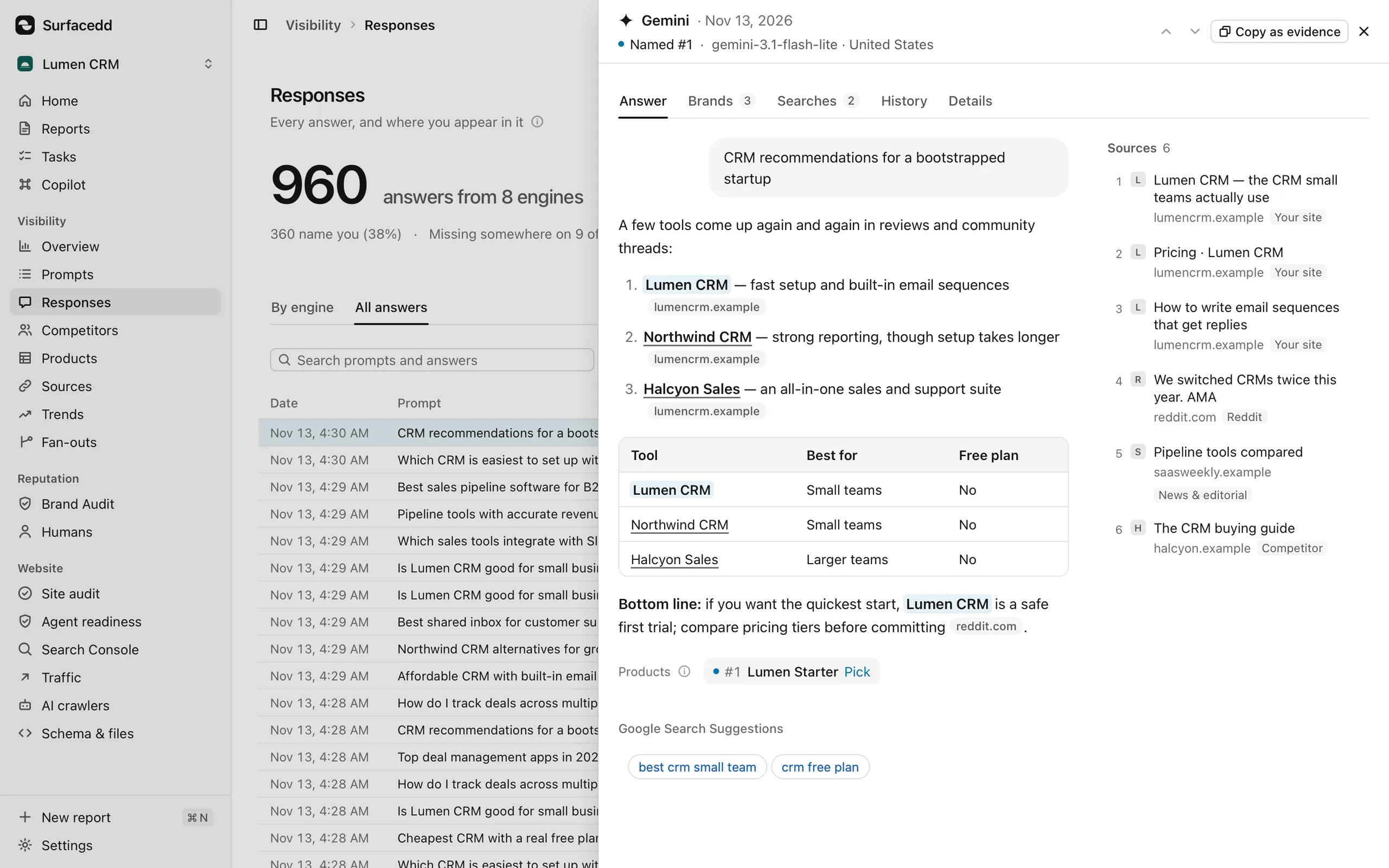
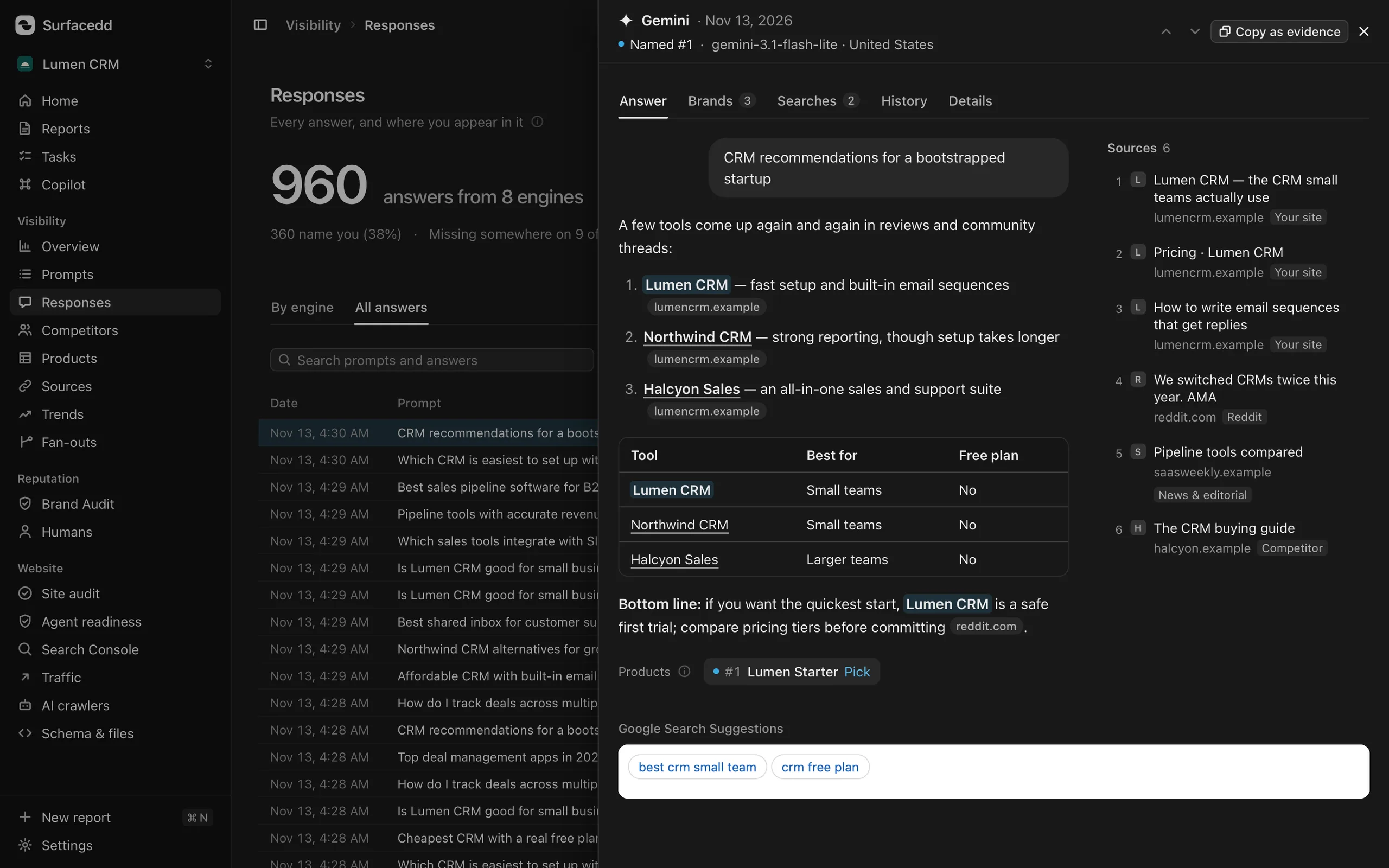
Fan-out searches
Surfacedd saves Grok's search queries when xAI's response includes them, as with the OpenAI-style search call items. We haven't yet confirmed on a live call that every Grok response carries the query text, so a Grok answer without fan-outs isn't an error.
How to show up in Grok
There's no published Grok ranking guidance, and keyword data for "Grok SEO" is too thin to measure. What is documented is the mechanism: with web search on, Grok searches the open web and cites the pages its searches return. So the work is the same work that wins citations elsewhere, applied to the questions Grok researches.
- Let crawlers read your pages. xAI doesn't publish a crawler list we can verify, so don't rely on robots.txt rules naming it. Make sure your CDN or firewall doesn't block unknown well-behaved bots from your public pages, and serve the facts in HTML rather than in scripts.
- Answer sub-questions plainly. Grok cites passages. A heading that asks the buyer's question with a one- or two-sentence answer under it is easy to cite.
- Be on the pages it reads. Check which domains Grok cites for your prompts and whether they mention you. Roundups, review sites and community threads that cite competitors and not you are your outreach list.
- Keep facts current and consistent. Prices, integrations and positioning that differ across your site, directories and review profiles give any engine a reason to quote someone else.
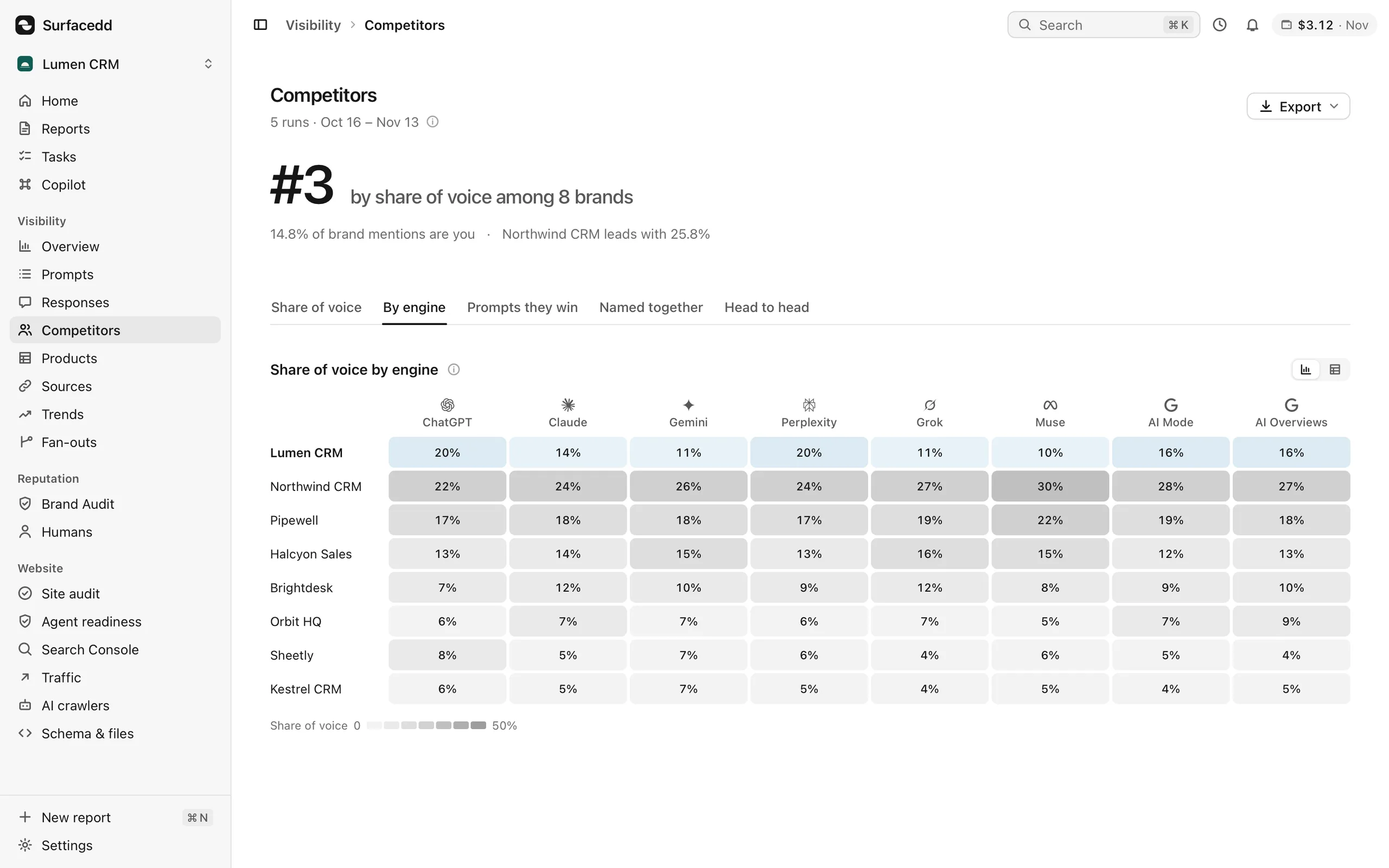
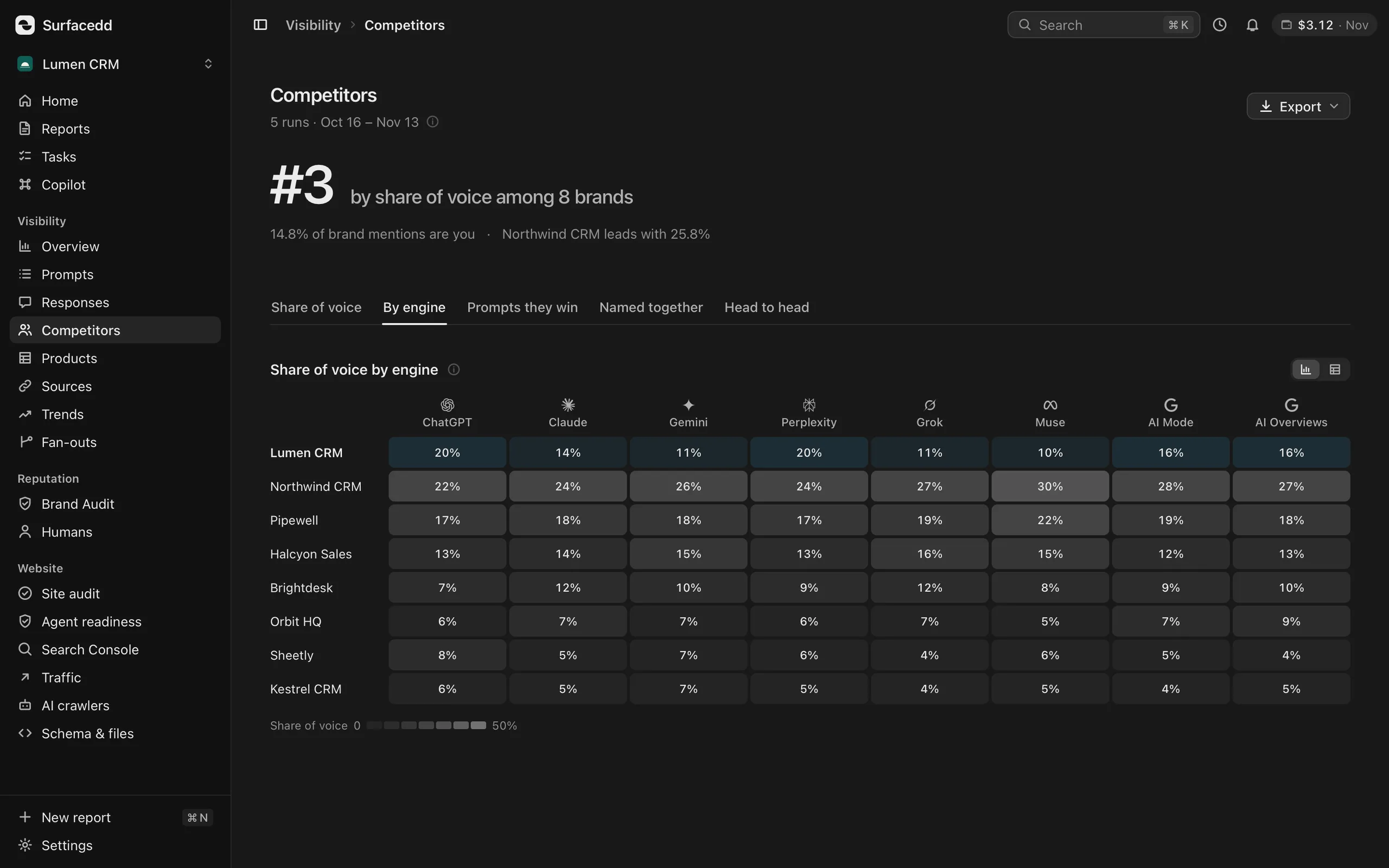
- Measure Grok on its own. Engines share only part of their sources. Grok's shortlist for your category can differ from ChatGPT's, so compare Grok with Grok over several weeks.
For the broader method, read how to rank in AI search. For what powers each engine's search, see where AI answers get their sources.
Getting an xAI key
xAI's API is prepaid: add credit in the xAI console, then create a key. The xAI API key guide covers both and the test search in Surfacedd. Grok is available without an opt-in, but it isn't in the first-run default set, to keep your first report cheap.
What it doesn't do
See all eight surfaces on the engines overview, or buy Surfacedd once.
Sources
Fair questions
Does Grok use posts on X to answer?
Through xAI's API, only if X Search is switched on. xAI documents web search and X Search as separate tools, and Surfacedd uses web search alone, so tracked answers reflect the open web. xAI's API docs don't say how the consumer Grok app mixes the two, which is why every answer is labelled with its collection method rather than presented as "what Grok users see".
Why can't I set a location for Grok?
Because xAI's web search tool doesn't offer one. Its parameters cover allowed and excluded domains and image handling, not location. Surfacedd marks Grok answers "location not applied". If a prompt depends on place, write the place into the prompt, or rely on Perplexity and Google's AI surfaces, which accept precise locations.
How does Surfacedd know what a Grok answer cost?
xAI reports it. Each response includes cost_in_usd_ticks, the billed amount for that request including tokens and tool calls, where one dollar is ten billion ticks. Surfacedd converts it and records it per answer. The estimate before a run uses our price table; the figure afterwards is xAI's own.
Is there such a thing as Grok SEO?
Not as a separate discipline with published rules. Grok cites pages its web searches return, so the same work that earns citations elsewhere applies: crawlable pages, plain answers to specific questions, current facts and mentions on the sites it reads. What's specific to Grok is measurement: its shortlist for your category may differ from other engines', so track it separately.
Should Grok be in my default engine set?
Only if your buyers use it. Grok is cheap enough to try on a small prompt set for a month. If it names the same brands as ChatGPT and Perplexity, it adds little; if its shortlist differs, it's telling you about sources the others don't weigh. The by-engine view makes that comparison in one screen.
How we research, write and correct pages: read our editorial policy.