Where AI answers get their sources, engine by engine
Every AI answer engine searches somewhere before it cites anything. Some vendors say where; some don't. Here is what each one documents, what it doesn't, and what that means for getting your pages cited.
By the Surfacedd teamUpdated 8 min readMarkdown
On this page
Short answer
AI answer engines cite pages from a web search they run first. Google's AI Overviews, AI Mode and Gemini search Google. Perplexity uses its own index built by PerplexityBot. ChatGPT relies on OAI-SearchBot plus third-party providers OpenAI doesn't name for consumer ChatGPT. Anthropic, xAI and Meta don't name their search back ends in their API docs.
Training vs retrieval: two places answers come from
An AI answer can come from two places, and they behave very differently. Training is what the model learned before it was released: a snapshot of the web and other text, frozen at a cutoff date. Retrieval is what the model looks up at answer time with a web search, then reads and cites.
For questions about current products, prices and "best X" shortlists, the engines below usually retrieve. When they do, the pages they cite come from whatever search back end they use, and the rules for getting into that back end are the rules for getting cited. When they don't retrieve, the answer reflects training data, which you can only influence slowly, through mentions across the web that future models will learn from.
So the first question for any engine is: where does its search come from?
The back end behind each engine
What each vendor documents, as of the date below. Where a vendor is silent, we say so rather than repeating guesses.
| Engine | Search back end, per the vendor | Crawler that feeds it | Confirmed by the vendor? |
|---|---|---|---|
| Google AI Overviews | Google Search's index, with query fan-out | Googlebot | Yes (Google) |
| Google AI Mode | Google Search's index, with query fan-out | Googlebot | Yes (Google) |
| Gemini (API, grounded) | Google Search | Googlebot; grounding governed by Google-Extended | Yes (Google) |
| Perplexity | Perplexity's own search index, plus live fetches on user request | PerplexityBot; Perplexity-User | Yes (Perplexity) |
| ChatGPT | OpenAI's search, using OAI-SearchBot's crawl; OpenAI says it also works with third-party search providers, unnamed for consumer ChatGPT | OAI-SearchBot; ChatGPT-User | Partly (OpenAI) |
| Claude | Anthropic's web search; provider not named | Claude-SearchBot; Claude-User | Crawlers yes, provider no (Anthropic) |
| Grok | xAI web search ("searching the internet and browsing web pages"); X posts via a separate tool | Not documented | Provider not named (xAI) |
| Meta AI (Muse) | Meta's web search tool | Meta-WebIndexer; Meta-ExternalFetcher | Provider not named (Meta) |
As of 19 November 2026.
Does ChatGPT use Bing?
OpenAI doesn't say so for consumer ChatGPT. OpenAI's crawler documentation says OAI-SearchBot is what surfaces websites in ChatGPT's search features, and that sites which opt out of it won't appear in ChatGPT search answers. OpenAI's help centre describes ChatGPT search working with third-party search providers without naming them for the consumer product. Third-party analyses have long linked ChatGPT's results to Bing, and some later analyses report growing overlap with Google. Treat "ChatGPT uses Bing" as reported, not confirmed, and make sure you're well indexed in both.
What each API shows you
The back end decides which pages are candidates. The API decides how much of the process you can see. That varies more than most people expect.
| Engine | What Surfacedd asks | Search fee | Location | Fan-out searches | Est. per answer |
|---|---|---|---|---|---|
| ChatGPT | ChatGPT with web search | $10.00 per 1,000 calls | Approximate: country, region, city and time zone are passed as the user's location | Exposed | $0.0109 |
| Claude | Claude with web search | $10.00 per 1,000 calls | Approximate | Exposed | $0.0112 |
| Gemini | Gemini grounded with Google Search | $14.00 per 1,000 searches (5,000 free a month) | Not applied | Exposed | $0.0163 |
| Perplexity | Perplexity Sonar with web search | $2.50 per 1,000 calls | Country, region and city, or coordinates, as you set them per market | Exposed | $0.0051 |
| Grok | Grok with web search | $5.00 per 1,000 calls | Not applied | Saved when xAI's response includes the search queries | $0.0201 |
| Meta AI (Preview) | Meta AI (Muse) with web search | $2.50 per 1,000 searches | Approximate: country, region, city and time zone | Not exposed | $0.0129 |
| Google AI Mode | Google AI Mode results page | $0.0012 per results page (standard queue) | Exact: any location DataForSEO supports, down to coordinates | Not exposed | $0.0012 |
| AI Overviews | AI Overview on the Google results page | $0.0012 per results page (standard queue) | Exact: any location DataForSEO supports | Not exposed | $0.0012 |
Per-answer estimates use each engine's default model, typical token counts and one search, at list prices on 2026-11-23 (UTC), price table 2026-11-13.1. Reading each answer adds about $0.0015.
Beyond location and fan-outs, three differences matter when you're trying to understand why you weren't cited:
| Engine | Pages read but not cited | Quoted passage per citation | Exact cost reported |
|---|---|---|---|
| ChatGPT | Yes (action.sources, "often greater than the number of citations") | No | No |
| Claude | Yes (all results returned) | Yes (cited_text, up to 150 characters) | No |
| Perplexity | Yes (all search results) | No | Yes (usage.cost) |
| Gemini | No separate list | No | No |
| Grok | Yes (response.citations, every URL encountered) | No | Yes (cost_in_usd_ticks) |
| Meta AI | Yes (with web_search_call.results) | No | No |
| Google AI Mode / AI Overviews | Organic results on the same page (AI Overviews) | No | Per results page (DataForSEO cost) |
Why your Google rank doesn't transfer one-to-one
Even for Google's own AI surfaces, ranking for a query doesn't mean being cited for it. In a study of 275 software-buying searches on 13 October 2026, 64.5% of the pages AI Overviews cited came from sites outside the top 10 for the search itself, and AI Mode shared only 56.3% of its cited sites with the Overview for the same search.
Three reasons explain most of the gap:
- Fan-out. The engine searches for narrower sub-questions and cites the best answer to each. Your page may rank for the head term but not for the sub-question that gets cited. See query fan-out.
- Different back ends. Perplexity's index isn't Google's; Claude's provider isn't named; Grok and Meta run their own search. A page that ranks well in Google can be absent, or ranked differently, elsewhere.
- Passage quality. The engine needs a passage it can quote or paraphrase confidently. A ranking page that buries its answer loses to a lower-ranking page that states it plainly.
How to check which back end cited you
You don't need the vendors to confirm their back ends to work out where you stand. Three checks, in order:
- Look at your server logs. Visits from OAI-SearchBot, Claude-SearchBot, PerplexityBot, Googlebot and Meta-WebIndexer show which indexes are reading your pages at all, and how often. No visits, no citations. The log file analysis guide shows how to verify the bots are real.
- Compare cited pages across engines. Ask the same prompts on several engines and list the domains each cites. Domains that appear on one engine and never on another point to a difference in back end, not in quality.
- Search the sub-queries yourself. Take the fan-out queries an engine returned and run them in Google and Bing. If the cited page ranks for the sub-query in one and not the other, you've found the likely source.
What to do with this
Turn the table into a short checklist. None of it is engine-specific trickery; it's making sure each back end can reach you and finds something worth citing.
- Allow the search crawlers you want to be cited by: Googlebot, OAI-SearchBot, Claude-SearchBot, PerplexityBot, Meta-WebIndexer. Decide training crawlers (GPTBot, ClaudeBot, Google-Extended, Meta-ExternalAgent) separately; the robots.txt guide for AI crawlers has a template.
- Get indexed in both Google and Bing. Submit sitemaps to both, and use IndexNow for fast updates where it's supported.
- Check your CDN or firewall. Bot protection often blocks AI search crawlers that robots.txt allows. Verify against the vendors' published IP ranges.
- Answer the sub-questions. Use the fan-outs the engines expose to find them, and answer each under a question heading.
- Measure each engine separately. Their sources overlap only partly, so a win on one says little about another.
In Surfacedd
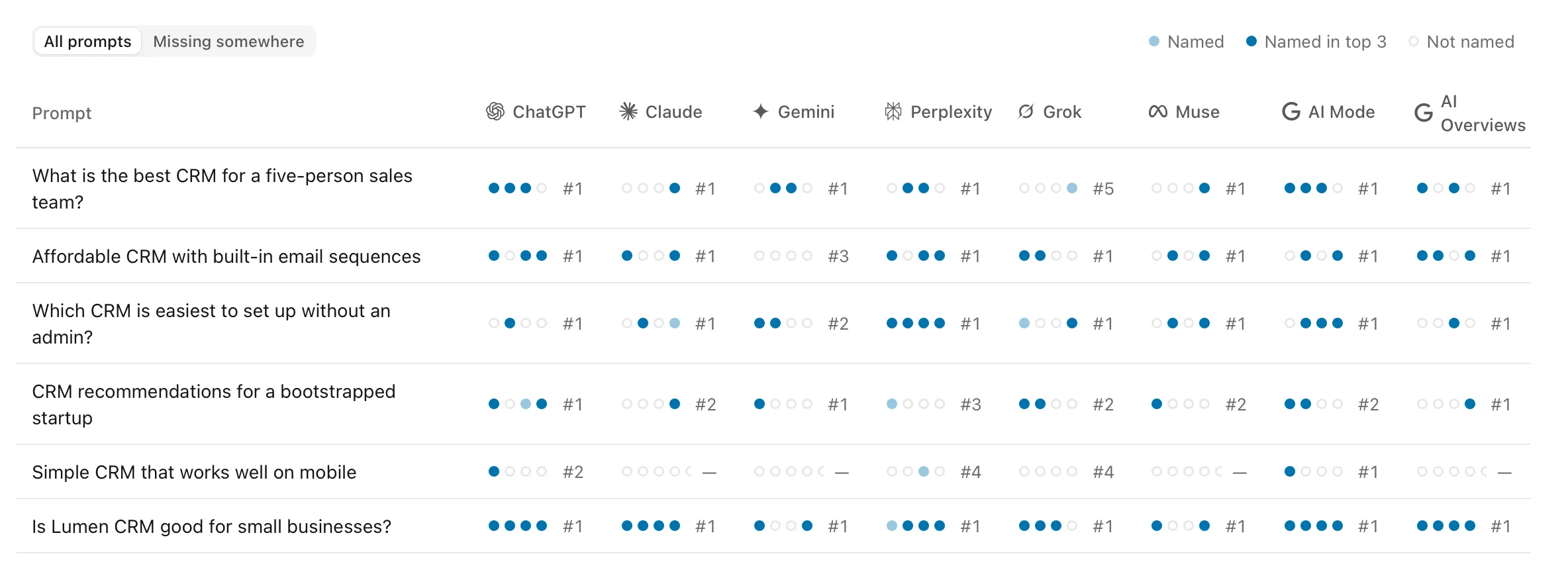
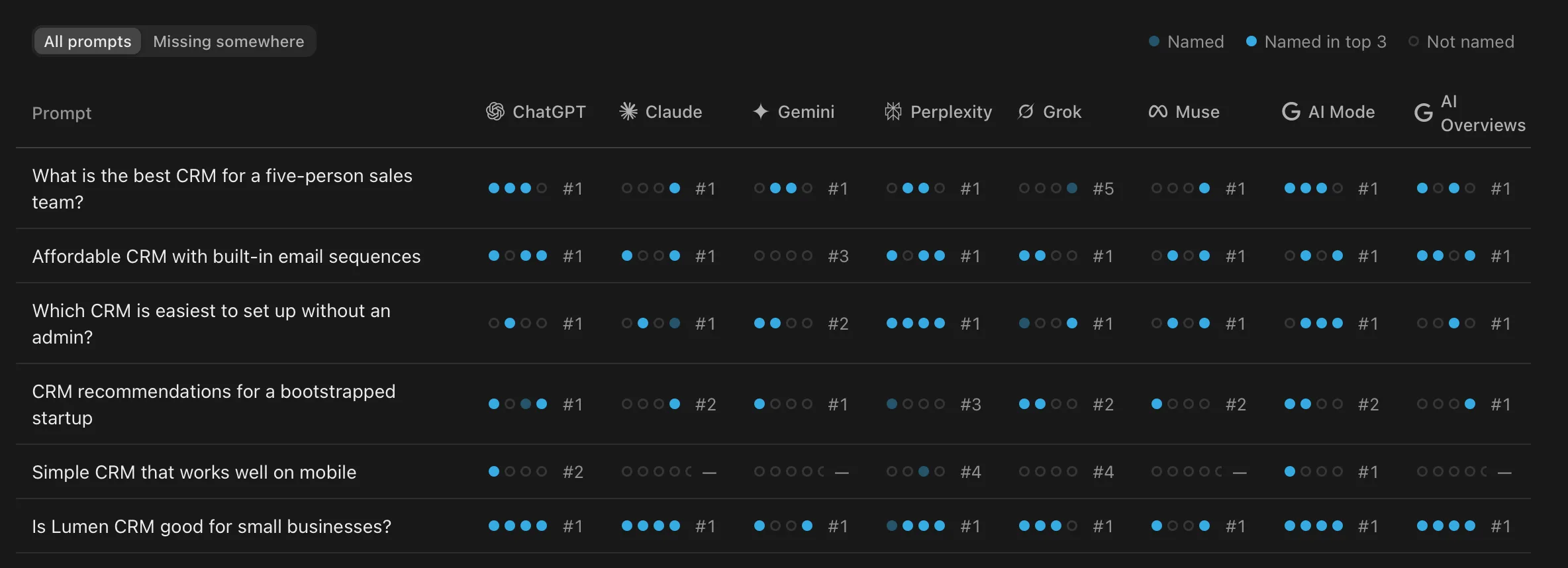
Surfacedd asks all eight engines the same prompts and keeps, for every answer, the cited pages and, where the API allows, the pages read but not cited, the searches run and the exact cost. The Sources screen then totals citations by domain and page across engines, so you see which sites each engine relies on for your category and which of them never mention you. That's this guide's table, filled in with your own data.
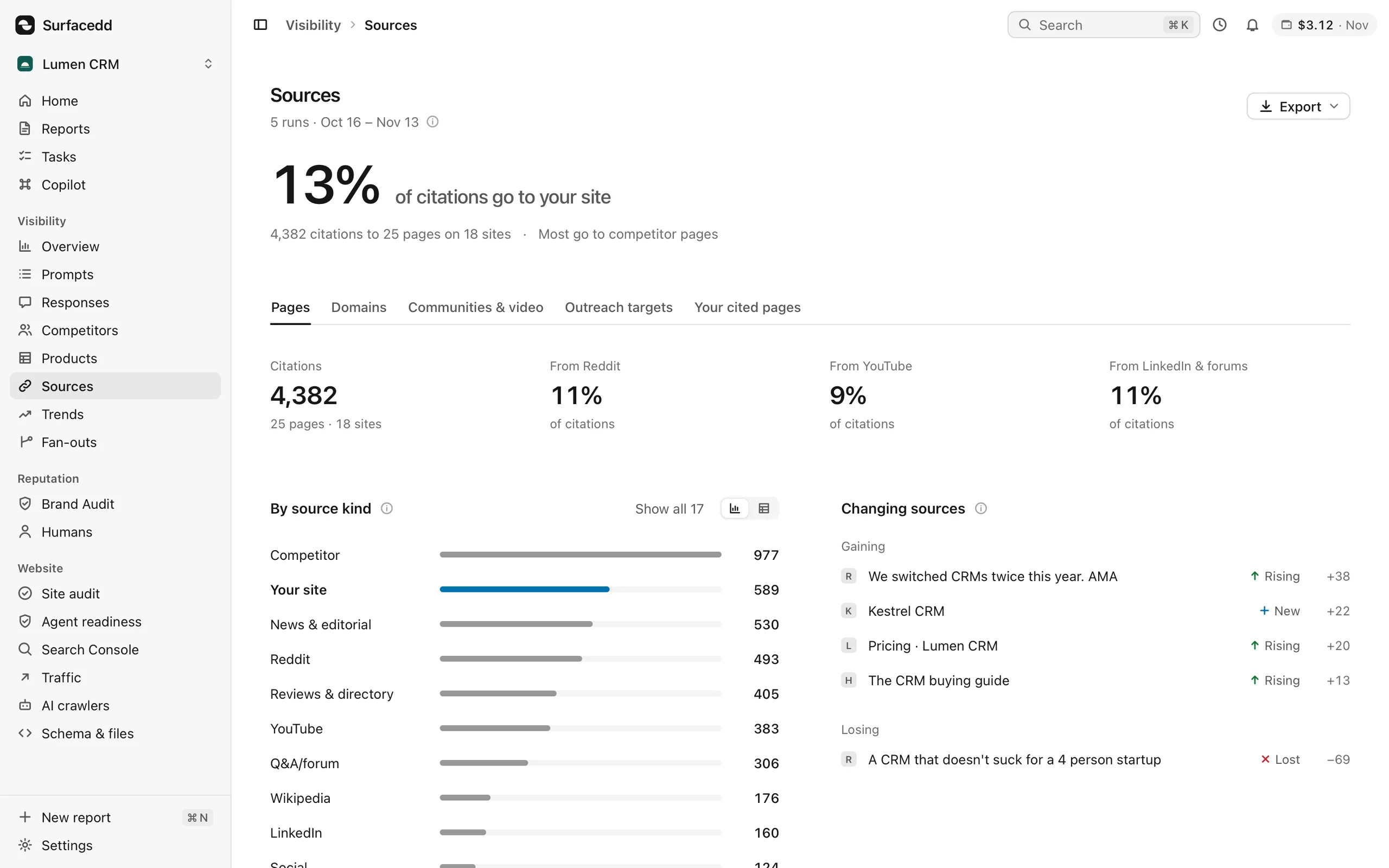
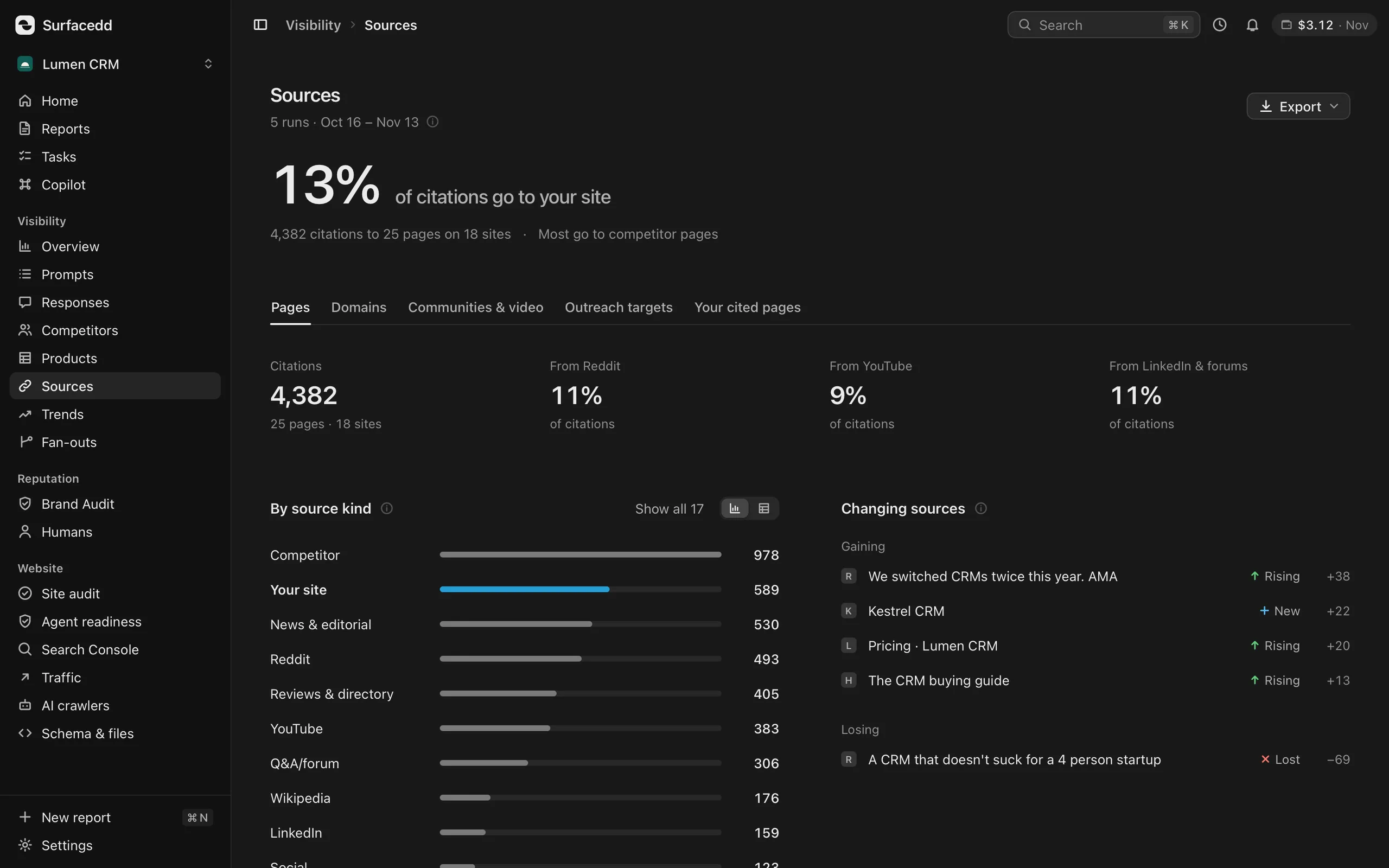
The engines overview explains how each engine is collected, and the competitors and sources feature shows the full view. Surfacedd is a one-time purchase, on your own keys.
Sources
- Google Search Central: AI features and your website
- Google AI Studio: Grounding with Google Search
- Google Search Central: Google's common crawlers
- OpenAI: Overview of OpenAI crawlers
- OpenAI: Web search tool guide
- Anthropic: Does Anthropic crawl data from the web?
- Anthropic: Web search tool
- Perplexity: Perplexity crawlers
- xAI: Pricing (web search and X Search)
- xAI: Citations
- Meta: Search grounding
- Lilach Bullock: AI Overview citations software study (13 October 2026)
Fair questions
What search engine does ChatGPT use?
OpenAI says ChatGPT's search features rely on its own crawler, OAI-SearchBot, and its help centre says ChatGPT search works with third-party search providers, without naming them for consumer ChatGPT. Third-party analyses have long pointed to Bing. The practical answer: allow OAI-SearchBot, and be well indexed in both Google and Bing.
Do all AI engines use Google?
No. Google's AI Overviews, AI Mode and Gemini use Google Search. Perplexity runs its own index. ChatGPT combines OpenAI's crawl with unnamed providers. Anthropic, xAI and Meta don't name their search back ends in their API documentation. That's why visibility in one engine doesn't predict visibility in another.
Does Claude use Brave Search?
Anthropic's web search documentation doesn't name a provider. Third-party analyses have reported a connection to Brave, but it isn't confirmed in Anthropic's API docs. What Anthropic does document is its crawlers: Claude-SearchBot indexes content for search, and Claude-User fetches pages when a user asks. Allow both if you want to be citable.
Why do AI engines cite pages I don't rank for?
Because they search for narrower sub-questions than the one typed, and cite the clearest answer to each. In one October 2026 study, 64.5% of the pages AI Overviews cited came from sites outside the top 10 for the search itself. Answering specific sub-questions plainly matters more than ranking for the head term.
Does Grok use posts from X?
Through xAI's API, X posts come from a separate X Search tool, billed per post, while web search covers the open web. A tracker that uses only web search, as Surfacedd does, measures the open-web answer. xAI's API docs don't say how the consumer Grok app combines the two.
Is training data or live search more important?
For buying questions about current products, live search usually decides the citations, so crawlability and clear answers matter most. Training data shapes answers when an engine doesn't search, which happens more with some engines than others. Both are worth measuring: track how often each engine names you and how often it searched at all.
How we research, write and correct pages: read our editorial policy.