How to get recommended in Google AI Mode
AI Mode answers from a fan of related searches, not from your target keyword alone. Pages that answer the sub-questions get cited; pages that only rank for the head term often don't.
By the Surfacedd teamUpdated 8 min readMarkdown
On this page
Short answer
You get recommended in Google AI Mode by answering the sub-questions it searches while building an answer, not only the query typed. Google says AI Mode uses query fan-out across subtopics. In one October 2026 study, 71.2% of pages AI Mode cited came from sites outside the top 10 for the search itself.
How does Google AI Mode work?
AI Mode is Google's conversational search page. You ask a question, often a long or comparative one, and Google writes a detailed answer with cited references, then lets you follow up. Google describes it as "particularly helpful for queries where further exploration, reasoning, or complex comparisons are needed."
Behind the answer, Google says AI Mode and AI Overviews may use a query fan-out technique, issuing "multiple related searches across subtopics and data sources" to build a response. So a question like "which accounting software is best for a UK sole trader who sells on Etsy?" isn't answered from one search. Google might search for Making Tax Digital compatibility, Etsy integrations, sole-trader pricing and reviews from small sellers, then write one answer from what those searches return.
That's the single most important fact for anyone who wants to be cited. You are competing for the sub-questions, not the question.
Can you rank in AI Mode at all?
Not in the sense of holding position three. AI Mode has no fixed list of results; its answer and its references vary between identical searches. What you can raise is how often it names you and how often it cites your pages, measured over many searches.
Google's guidance for AI features is the starting point: "There are no additional requirements to appear in AI Overviews or AI Mode, nor other special optimizations necessary." The page must be indexed and eligible to show with a snippet. The rest is about being the best answer to each sub-question.
AI Mode vs AI Overviews
They share Google's index and the fan-out technique, but behave differently enough to treat as separate channels.
| AI Overviews | AI Mode | |
|---|---|---|
| Where | Above the classic results | Its own conversational page |
| Appears for every query? | No; Google shows one only when it adds value | Yes, when someone uses AI Mode |
| Answer length | A short summary | Longer, comparative, with follow-ups |
| Best at | Getting "the gist" fast | Exploration, reasoning, comparisons |
| Share of cited sites in common (Oct 2026 study) | 56.3% of AI Mode's cited sites also cited by the Overview |
The last row comes from a study of 275 software-buying searches: across 206 searches where both cited sources, only 56.3% of the websites AI Mode cited were also in the Overview. Winning one doesn't mean winning the other. The AI Overviews guide covers the other surface.
Why fan-out coverage beats one keyword
Because the pages AI Mode cites mostly don't rank for the head query. In the same study, 71.2% of the pages AI Mode cited came from websites outside the top 10 for the search itself. Roundups took 46.4% of AI Mode's citations, user-generated content such as Reddit and YouTube 27.7%, and the software companies' own pages 17.5%.
The study is a single day in one country and one category, and its author says AI answers vary. But the pattern fits the mechanism Google describes: the cited page is the one that answers a sub-search well.
A worked example: mapping the fan-out
Here is a hypothetical prompt and the sub-questions a fan-out is likely to cover. Engines that expose their searches (ChatGPT, Claude, Perplexity and Gemini do; AI Mode doesn't) let you see real ones for your own prompts.
| Prompt: "best accounting software for a UK sole trader selling on Etsy" | Covered on your site? | Action |
|---|---|---|
| Making Tax Digital for income tax: which software is compatible | Yes, on a help page | Move the answer to the top; add the date checked |
| Accounting software with an Etsy integration | No | Add a section to the integrations page |
| Cheapest accounting software for sole traders UK | Pricing behind a toggle | Put the monthly price in plain text |
| Is free accounting software good enough for a sole trader | No | Write an honest comparison section |
| Reviews from small online sellers | Not on your site | Ask existing customers for reviews on the platforms buyers read |
Five rows, five concrete jobs, none of them "AI Mode SEO". Each turns a sub-question into a passage that can be cited. Google's AI optimisation guide adds a warning: building many pages "primarily to manipulate rankings or generative AI responses" violates its scaled content abuse policy. Cover sub-questions as sections of strong pages, not as a page per variation.
How do follow-up questions change what gets cited?
AI Mode is built for conversations, so the first answer is rarely the last. A person who asks for "the best accounting software for a UK sole trader" often follows with "which of those works with Etsy?" or "what does the cheapest one cost per month?". Each follow-up is a new, narrower question, with its own searches and its own citations.
That makes the follow-ups predictable work. For each tracked prompt, write down the two or three questions a buyer would ask next, and treat them as prompts too:
| First question | Likely follow-ups | Page that should answer it |
|---|---|---|
| Best accounting software for a UK sole trader | Which works with Etsy? What does it cost per month? | Integrations page; pricing page |
| Best project tool for an architecture practice | Does it handle drawing revisions? Can clients approve stages? | Features page sections |
| Emergency plumber in Leeds | Who's open on Sunday? What's the call-out fee? | Service-area page; pricing section |
A brand that wins the first answer but has no page for the follow-ups drops out of the conversation at the point the buyer is closest to choosing. Tracking the follow-ups as their own prompts shows you where that happens.
Page and site factors that matter
None of these is AI Mode-specific, which is the point. AI Mode cites from Google's index, so the quality signals that get a page into that index and onto its first pages for a sub-query are the ones that count.
- Indexable and snippet-eligible. No
nosnippeton pages you want cited. Checkmax-snippetisn't set so low that no useful passage fits. - Question headings with answer-first paragraphs. One sub-question per heading, the answer in the first one or two sentences.
- Facts in HTML text. Prices, compatibility, dates and limits written out, not hidden in images, tabs or PDFs.
- Comparisons that state trade-offs. AI Mode is used for comparisons; a page that says where each option fits gives it a quotable passage for each.
- Authorship and real dates. A named author or team and an "updated" date that changes only when the content does.
- Presence where the roundups and threads are. Since roundups and community content take most citations, being accurately listed in the roundups your buyers read, and helpful in the threads, matters as much as your own pages.
Measuring AI Mode
Measure two things per search and market, over at least four weekly checks: how often AI Mode names your brand, and how often it cites one of your pages. Record which pages it cites instead; that list is your work plan.
You can't get this from Search Console. Google counts traffic from AI features in the Performance report under the "Web" search type, but doesn't say which searches showed AI Mode answers or whether you were in them. You need to capture the AI Mode page itself, at the location your customers search from, because local results differ by city.
Keep comparisons honest: same searches, same markets, same number of checks in each period, and treat a change as real only when it holds across several runs.
In Surfacedd
Surfacedd tracks Google AI Mode as its own engine, separate from AI Overviews. Each check captures the real AI Mode page through DataForSEO on your account, at the city and language you choose, and stores the answer with its references in display order. AI Mode is in the default engine set, at about $0.0012 per scheduled check today.
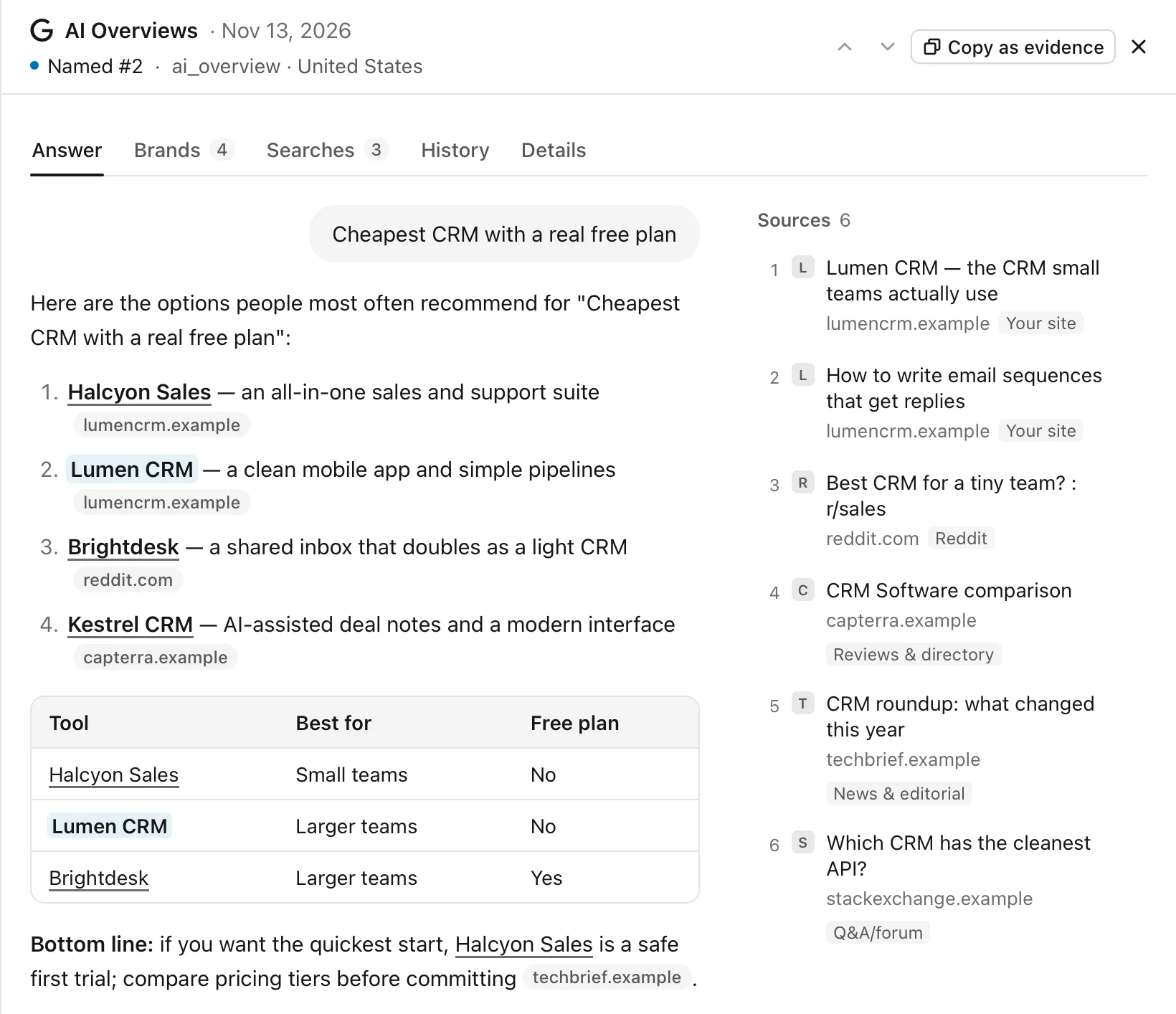
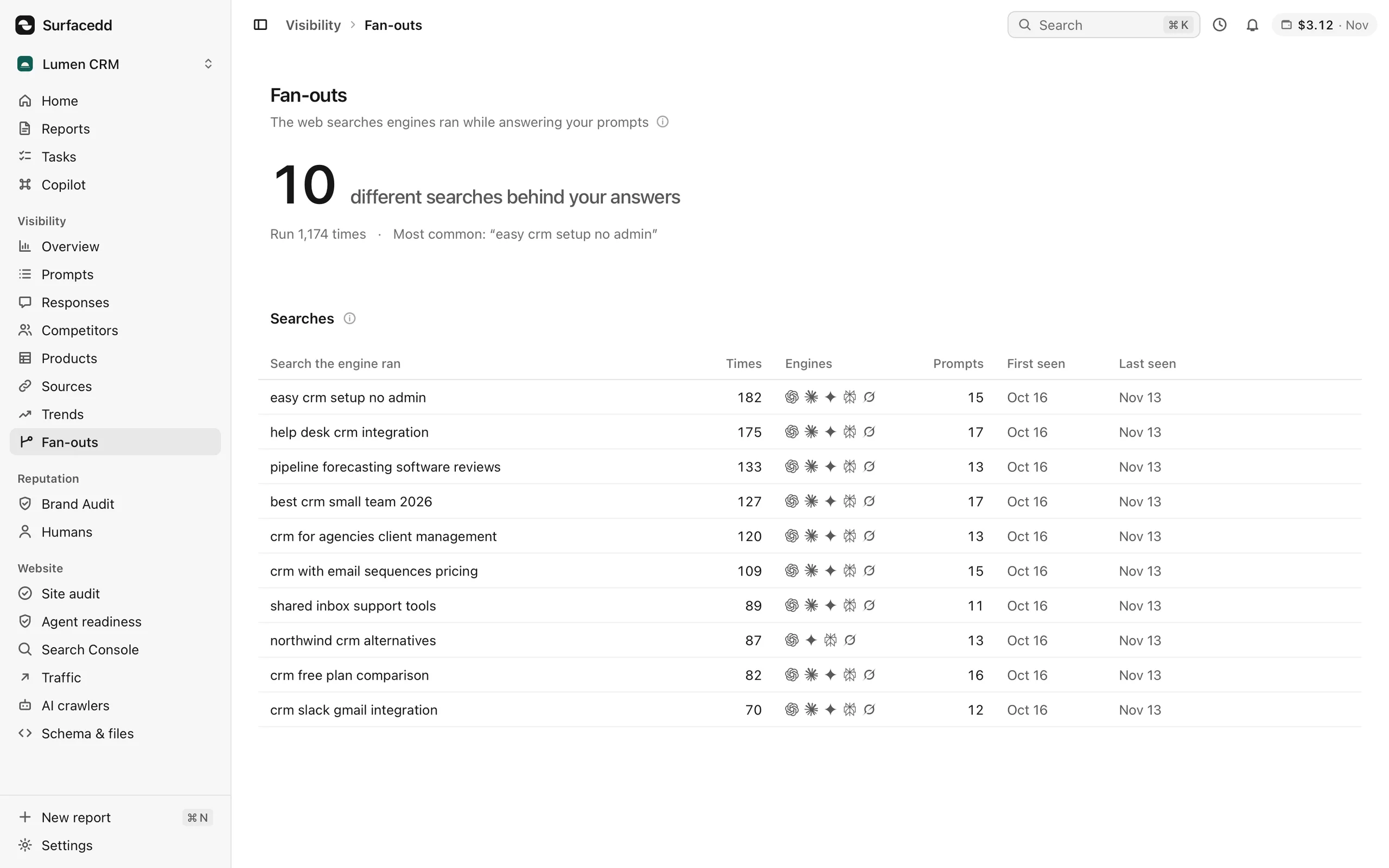
Because AI Mode doesn't reveal its sub-searches, Surfacedd's Fan-outs screen gathers the searches ChatGPT, Claude and Perplexity ran for the same prompts. They're the closest available map of the sub-questions, and any of them can be added as a tracked prompt. The competitors and sources feature then shows which domains Google's AI trusts in your category. Surfacedd is a one-time purchase.
Sources
Fair questions
Is AI Mode SEO different from normal SEO?
The foundations are the same: AI Mode cites from Google's index, and Google says there are no special requirements. What changes is the target. Instead of one keyword, you need the sub-questions AI Mode searches while building an answer. That shifts work from ranking one page to covering a topic's questions clearly across your strongest pages.
Do I need to rank in the top 10 to be cited in AI Mode?
No. In an October 2026 study of 275 software-buying searches, 71.2% of the pages AI Mode cited came from websites outside the top 10 for the search itself. They usually ranked for a narrower sub-question. Ranking still helps, but answering the sub-questions well matters more than the head term.
How can I see the sub-searches AI Mode runs?
You can't see them directly; Google doesn't expose AI Mode's fan-out. The closest proxy is the searches other engines run for the same prompt. ChatGPT, Claude, Perplexity and Gemini return their search queries through their APIs, and the overlap with Google's sub-topics is usually high for buying questions. Treat them as a map, not a copy.
Should I create a page for each fan-out query?
No. Google's AI optimisation guide says creating many pages primarily to manipulate rankings or generative AI responses violates its scaled content abuse policy. Cover sub-questions as sections of a strong page, each with a question heading and an answer-first paragraph. One thorough page beats twenty thin ones.
Does AI Mode show different answers in different cities?
For local and location-sensitive searches, yes. That's why AI Mode should be checked at the locations your customers search from, not from one national setting. For national software questions, answers often look similar everywhere, but it's worth confirming once per market before you assume so.
How is AI Mode traffic reported?
Google counts clicks and impressions from AI features inside Search Console's Performance report under the "Web" search type, mixed with classic results. It doesn't break out AI Mode separately or show whether you were cited. Use Search Console for traffic and a tracker for presence and citations.
How we research, write and correct pages: read our editorial policy.