Get AI to connect you to the company you built
Humans asks the questions investors, journalists and candidates ask about you and your company, links each wrong fact to the page it came from, and re-checks on a schedule.
By the Surfacedd teamUpdated 8 min readMarkdown
On this page
Short answer
For founders and executives, the AI question is two-sided: does it describe you correctly, and does it name you when someone asks who founded or runs your company? Humans asks ChatGPT, Claude, Perplexity and Meta AI 22 questions, including company-link and founders-to-watch prompts, and traces each wrong fact to its source page.
The two questions that matter for an executive
Most personal-reputation advice stops at "what does AI say about you". For a founder or executive there's a second question that matters as much: when someone asks about your company, does the answer lead back to you?
- An investor asks "Who founded {company}?" and gets your co-founder's name only, or the name of a founder who left in year one.
- A candidate asks "Who is the CEO of {company}?" and gets your predecessor.
- A journalist asks for "top {industry} founders to watch" and gets a list without you.
For the company side of the same question, whether AI recommends your product at all, see the weekly founder routine. These are company-link and discovery questions, and Humans measures them separately from recognition and bio accuracy, so you can tell an entity problem (AI doesn't connect you to the company) from a content problem (AI connects you but gets the facts wrong).
The founder and executive prompt set
The full run asks all 22 templates. These twelve carry most of the signal for executives:
| Group | Prompt | What a good answer looks like |
|---|---|---|
| Recognition | Who is {name}? | You, with your current title and company |
| Recognition with context | Who is {name}, {role} at {company}? | Correct role and tenure; no predecessor's details |
| Recognition with context | What does {name} do at {company}? | Your actual remit, not a generic job description |
| Facts | What companies has {name} founded? | Every company, none missing, none invented |
| Facts | What is {name}'s background and education? | The right school and earlier roles, not a namesake's |
| Facts | What books or articles has {name} written? | Your bylines, or a clean "none found" |
| Company | Who founded {company}? | All founders, you included |
| Company | Who is the CEO of {company}? | The current CEO |
| Discovery | Top {industry} founders to watch | You on the list, and your position |
| Discovery | Who are the leading experts on {topic}? | Named for the topic you speak about |
| Reputation | What do people say about {name}? | Fair tone, with sources you recognise |
| Reputation | Is {name} trustworthy? | No unsupported negative claim |
The company templates aren't in the eight-question essentials run, so executives should run the full set. Download it as a CSV with the fact each prompt tests: b2-founder-executive-prompts.csv.
At today's list prices, a full run of 22 questions on four engines costs $1.02, or $4.43 a month if it runs weekly, paid to the providers on your own keys.
An example result
The sample workspace has a verified profile for Maria Chen, the fictional co-founder and CEO of Lumen CRM in Austin. Her overview reads like many founders' would.
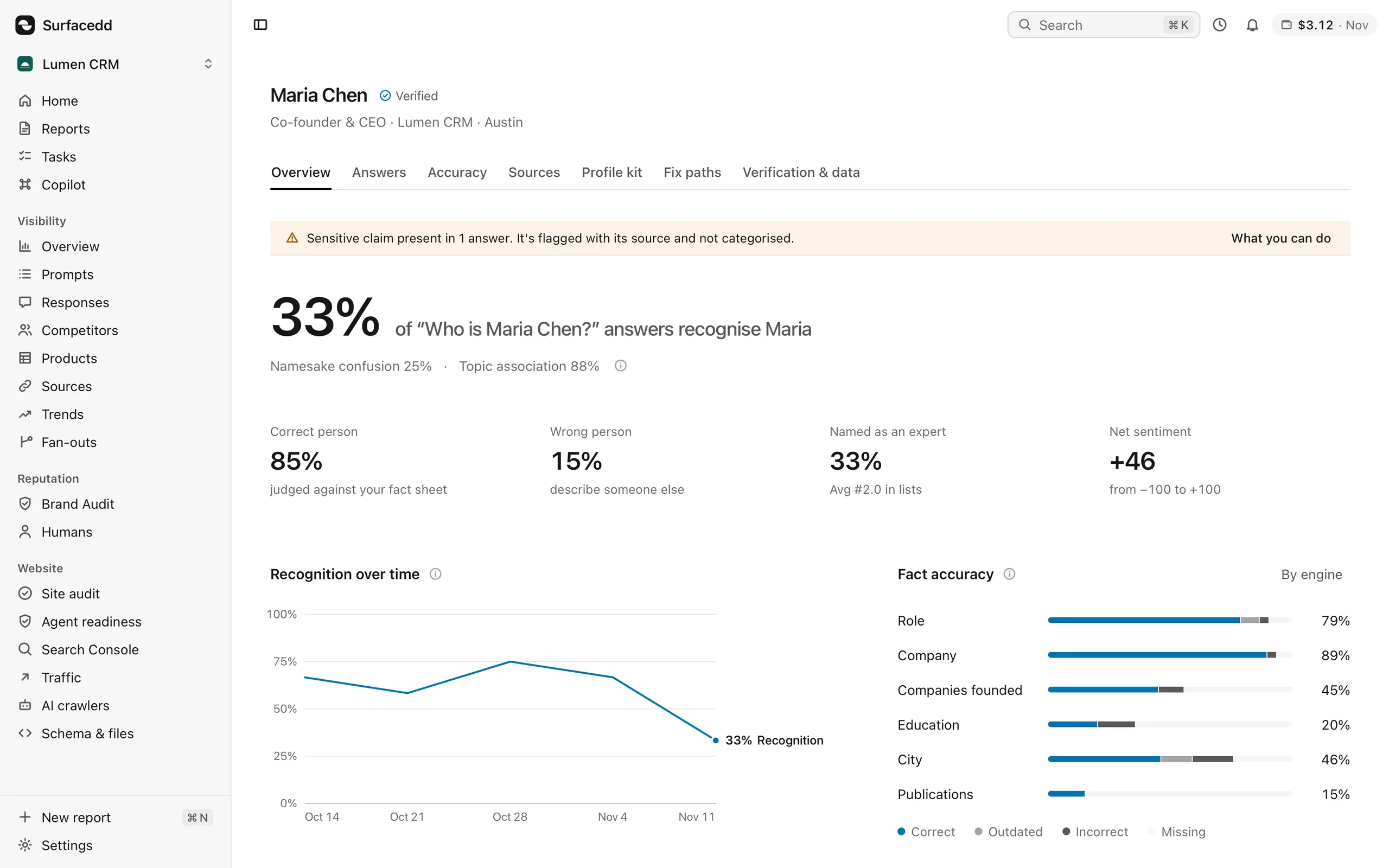
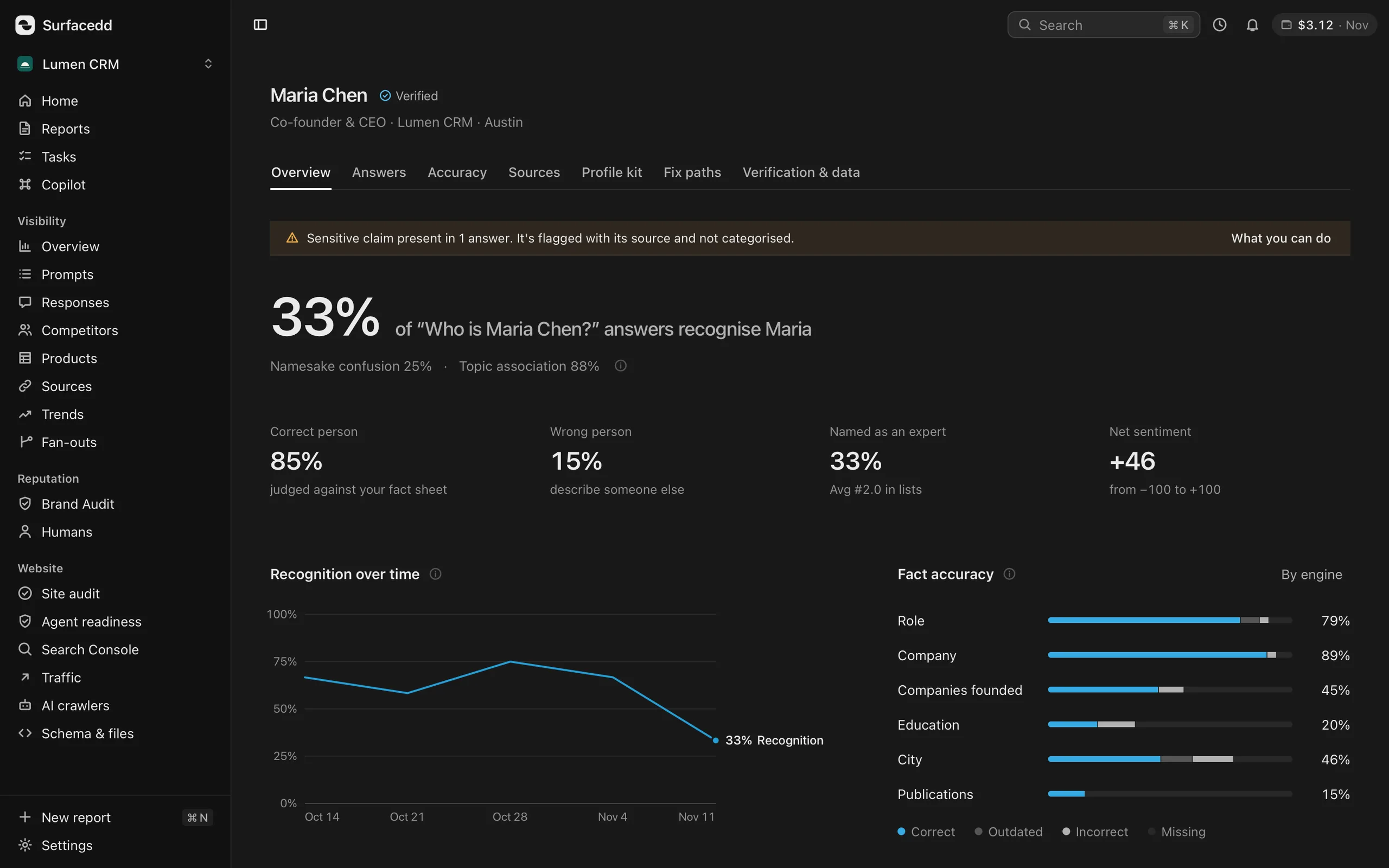
- The company link is strong. 89% of answers name Lumen CRM correctly as her company, and 79% get her role right.
- The founding history is weak. Only 45% of answers get the companies she founded right (Lumen CRM and Fieldnote). The Sources tab traces two of the wrong answers to one page: a 2019 article about Fieldnote's launch.
- Discovery is promising. She's named in a third of the "experts" and "founders to watch" answers, and when she's named she's near the top, at an average position of 2.0.
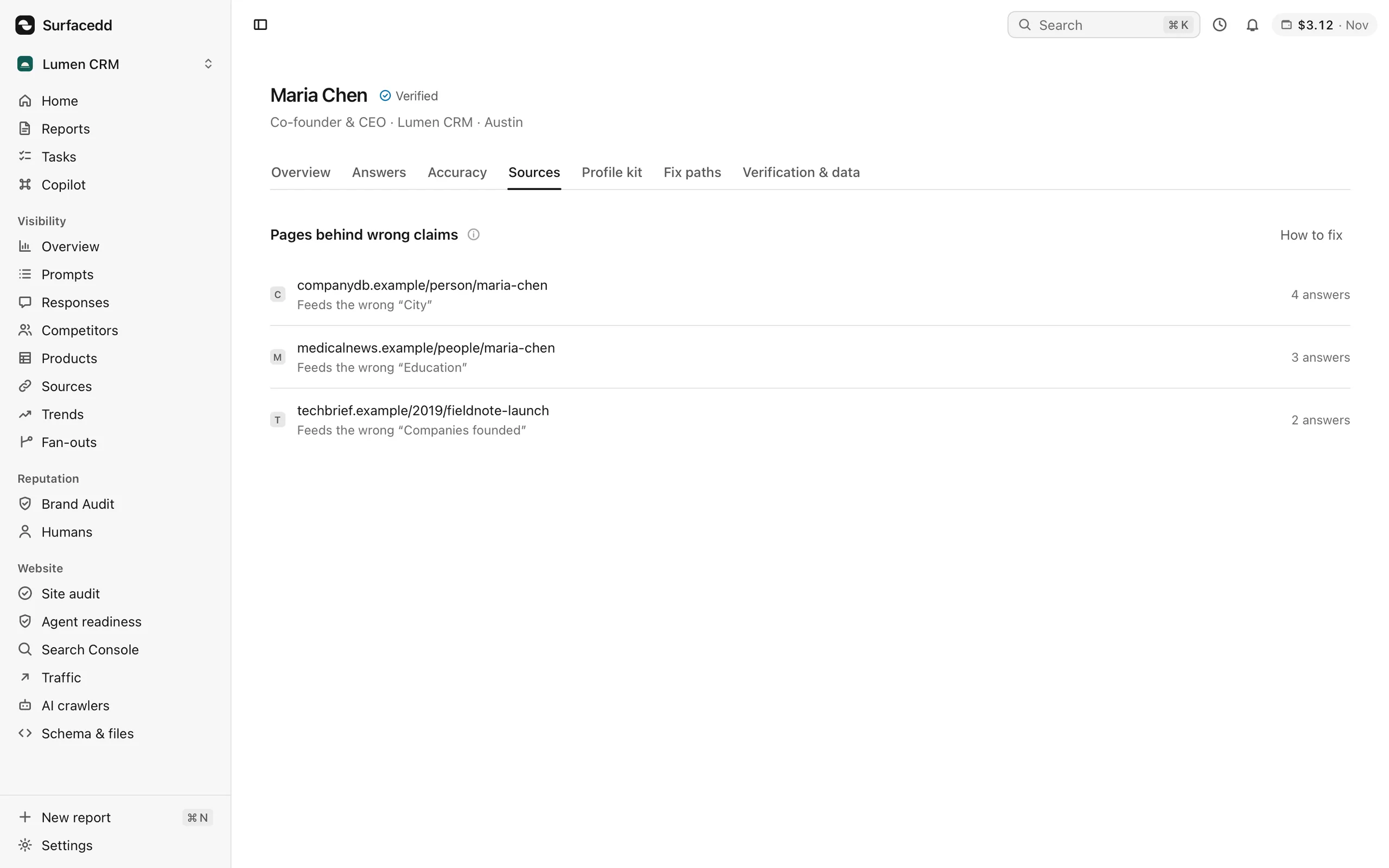

The second bullet is the typical founder problem. An early press article, written before the company's story settled, keeps getting cited because it ranks well for the company name, and whatever it got wrong or left out gets repeated.
Does AI connect you to your company?
Assistants answer "Who founded {company}?" from the pages that rank for the company name: your own about page, press coverage, company databases and, for bigger companies, Wikipedia and Wikidata. When those disagree, the answer picks one. Make them agree, starting with the pages you control.
- Your company's about or team page names every founder with the same title wording you use everywhere else, and links to each founder's own profile page.
- Your own profile page (a personal site or
/about/{name}on the company site) states the one sentence you want repeated: name, role, company, city, field. - Markup on both pages points at each other. Humans' Profile kit generates the ProfilePage and Person markup for your page. On the company site, add a
founderreference by hand:
{
  "@context": "https://schema.org",
  "@type": "Organization",
  "@id": "https://example.com/#org",
  "name": "Example Co",
  "url": "https://example.com",
  "founder": [
    { "@type": "Person", "@id": "https://example.com/team/jane-doe#person", "name": "Jane Doe" }
  ],
  "sameAs": ["https://www.linkedin.com/company/example-co"]
}
Use the same @id for the founder that your Person markup uses, so the two pages describe one person. The Person schema guide covers the rest of the properties, and the entity SEO guide explains why consistent IDs matter for how engines connect people and companies.
- Company databases and old press. Update the listings you can edit. For an article that credits the wrong founders, ask the publisher for a correction and cite your own about page as the reference.
Bio accuracy: companies founded, education, earlier roles
Humans checks each field on your fact sheet in every answer and marks it correct, outdated, incorrect or missing. The Accuracy tab shows the result by engine, with the wording each engine used, so you can see that one engine has your education wrong while three have it right.
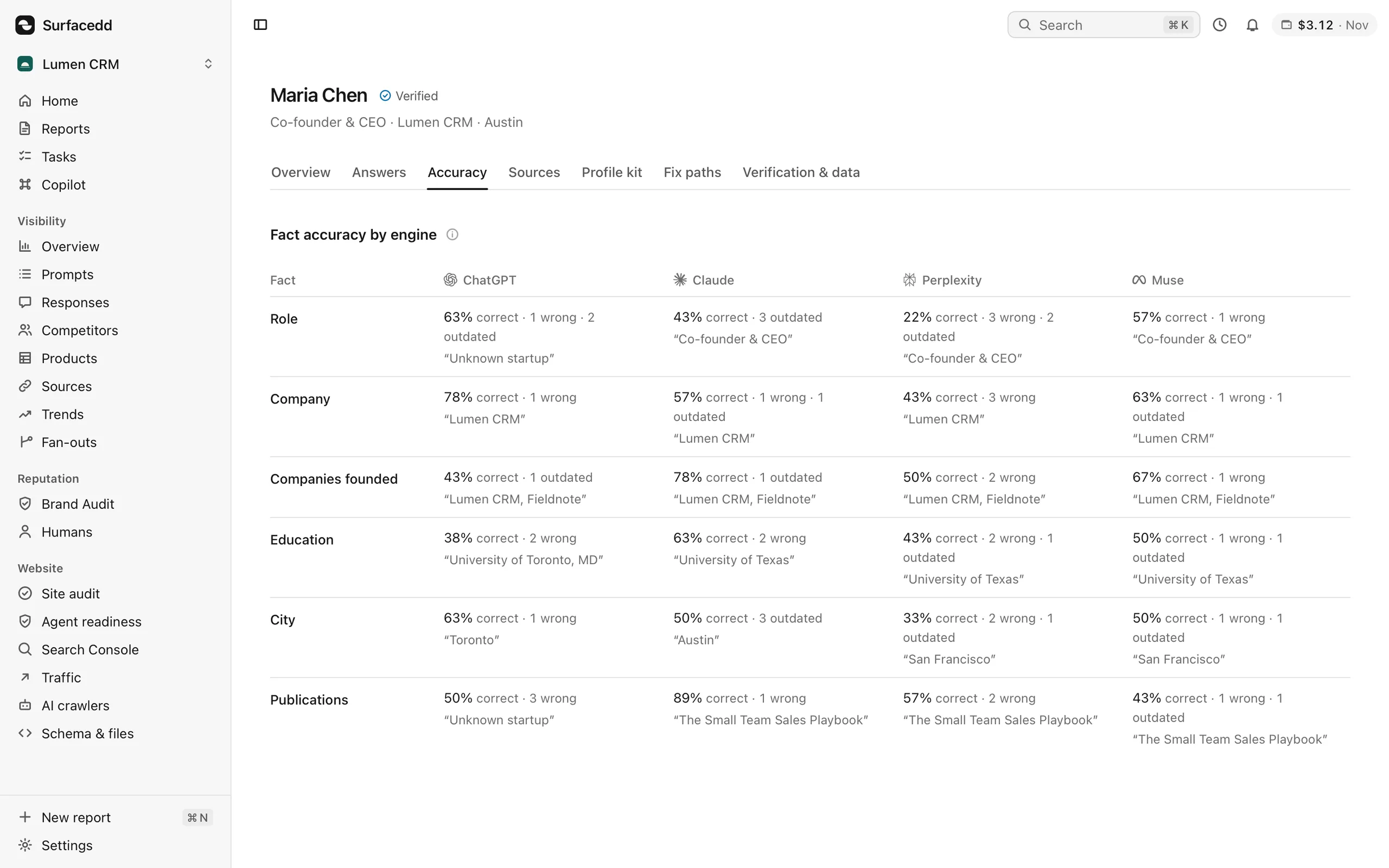
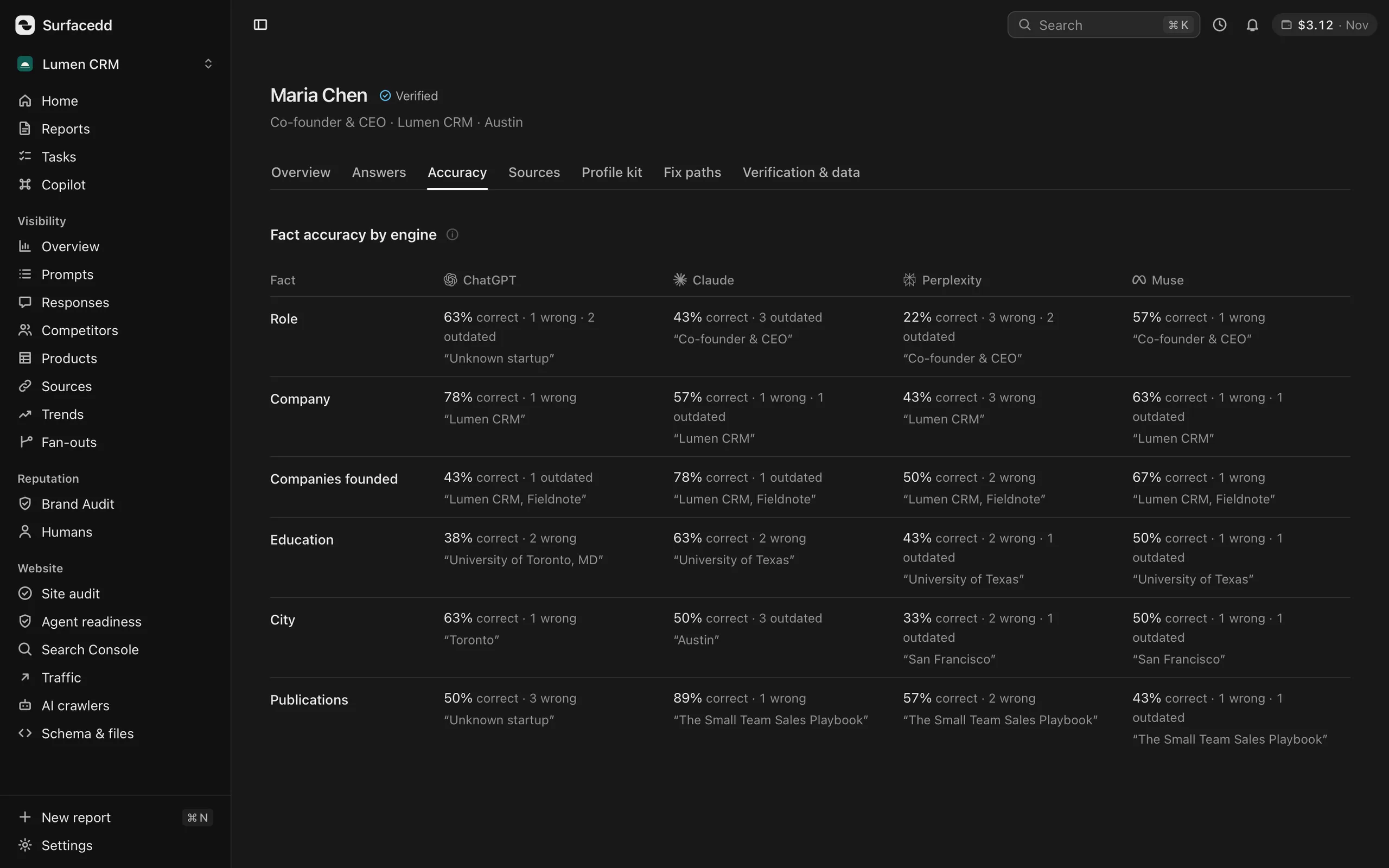
"Outdated" matters most for executives. A title from two roles ago is not wrong in the way a namesake's degree is wrong, but it's what a candidate or investor will read. It usually traces back to a speaker bio or a team page nobody updated.
Discovery: named as a founder to watch
"Top {industry} founders to watch" and "Who are the leading experts on {topic}?" are the questions where nobody types your name. Humans reports how often you're named in those answers and your position in the list, with a range, because a single run of a list question is noisy.
If you sell your expertise rather than a company, expert discovery for consultants and authors goes deeper on these questions. The sources cited in those answers tell you what to do. They're usually listicles, podcast pages, conference speaker pages and a handful of trade publications. Being on those pages, in your own words or in an interview, is what gets a name onto the list. The brand mentions guide covers how to find and earn those mentions without astroturfing.
Wikipedia and Wikidata, realistically
A knowledge panel or a Wikidata item helps engines disambiguate you, but neither is something to fake. Wikidata accepts an item for "a clearly identifiable conceptual or material entity" that can be described with serious, publicly available references, or one that fulfils a structural need (Wikidata). Wikipedia's bar is significant independent coverage, and its rules discourage writing about yourself. If your company already has an item, a founder item with independent references is often reasonable. The knowledge panel guide covers claiming and correcting a Google panel.
Verification and privacy, including comms teams
- Your own profile, or a client's with authorization. An executive sets up their own profile as "Me". A communications team or agency sets it up as "A client" and attaches the executive's written authorization: name, scope, date and how to revoke it.
- Verified badge with domain proof on the executive's own profile domain; the verification docs show the DNS, file and meta-tag options.
- No tracking of other people. Co-founders, competitors' CEOs and namesakes who appear in answers are kept only as names in the answer text. You can't create a profile for them.
- Sensitive questions are blocked, including family, health, politics, home address and net worth.
- Local only. Answers live on the computer that ran them; Surfacedd the company never receives them.
For a brand-level view of the same company, PR teams pair this with Brand Audit; see AI visibility for PR and communications.
What it doesn't do
Sources
Fair questions
Why does AI name my co-founder but not me?
Usually because the pages that rank for your company name, such as an early press article or a database entry, name only one founder. Humans' Sources tab shows which pages were cited in the answers that left you out. Fix your own about page first, then ask the publisher of the cited article for a correction and point it at that page.
Can our comms team run this for our CEO?
Yes, as a client profile. The team chooses "A client" in setup and attaches the CEO's written authorization, covering their name, the scope, the date and how to revoke it. The profile, answers and authorization file stay on the computer that ran them. It can't be used for anyone who hasn't authorized it.
How often should an executive profile run?
Weekly is the default. Run it again shortly after a funding announcement, a title change or a press cycle, when new pages appear that assistants may start citing. At today's list prices a weekly full run costs $4.43 a month on your own keys.
Does Organization founder markup make AI name me?
Nothing makes an assistant name you. Markup that ties your Person page to your company's Organization makes the relationship explicit and consistent, which helps engines that read structured data, but assistants mostly repeat what the pages they retrieve say in text. Treat markup as one part of making every page agree.
What if a better-known person shares my name?
Expect the bare "Who is {name}?" question to describe them for a long time; the pre-interview AI check shows the same problem from a job seeker's side. Measure yourself on the qualified questions, such as "Who is {name}, {role} at {company}?", and use the same disambiguating details everywhere: middle initial, title, company and city. Humans reports namesake confusion separately so it doesn't drown out the rest.
Is this reputation management in the agency sense?
No. Surfacedd doesn't publish content, suppress search results or run outreach. It measures what assistants say about you, shows which pages they read, and lists the fixes you can make or request. If you work with a reputation agency, the evidence export gives them the answers and sources to work from.
How we research, write and correct pages: read our editorial policy.