See which AI crawlers actually read your site
Import your access logs. Surfacedd labels every AI bot hit verified, spoofed, unverifiable or unchecked, shows the pages each bot reads, and keeps only daily totals, never IP addresses.
By the Surfacedd teamUpdated 10 min readMarkdown
On this page
Short answer
Surfacedd's AI crawler analytics reads your server access logs on your own computer and shows which AI crawlers visited, what each one read, which errors it got and whether it was real. Every hit is checked against the operator's published IP ranges or reverse DNS. Only daily totals per bot are kept, for 13 months, with no IP addresses.
Your robots.txt says which AI crawlers may read your site. Only your server logs show which ones did, how often, what they asked for and what they got back. AI crawler analytics turns an access log into those answers, on your own computer, so you can tell whether ChatGPT's search crawler is reading your pricing page or getting a 403 from your CDN.
What it shows: training, search and user fetches
AI crawlers do different jobs, and the difference decides whether you care about them. Surfacedd groups every hit by the purpose the operator documents:
| Purpose | What the bot does | Example bots | Why it matters |
|---|---|---|---|
| AI search (search index) | Crawls ahead of time to build the index an AI search feature answers from | OAI-SearchBot, Claude-SearchBot, PerplexityBot | Pages it can't read can't be cited in that engine's live answers |
| User-requested fetch | Fetches a page at the moment a user asks the assistant something | ChatGPT-User, Claude-User, Perplexity-User | Shows real questions reaching your pages, in close to real time |
| Model training | Collects pages that may be used to train future models | GPTBot, ClaudeBot, CCBot | A policy choice; no direct effect on today's answers |
| Ads and other | Ad review and other Google or OpenAI fetchers | OAI-AdsBot, GoogleOther | Usually noise for AI visibility |
The headline view is a daily chart of hits by purpose, with AI search highlighted because those crawlers feed live answers. Spoofed hits get their own line, so impostors never inflate the real numbers.
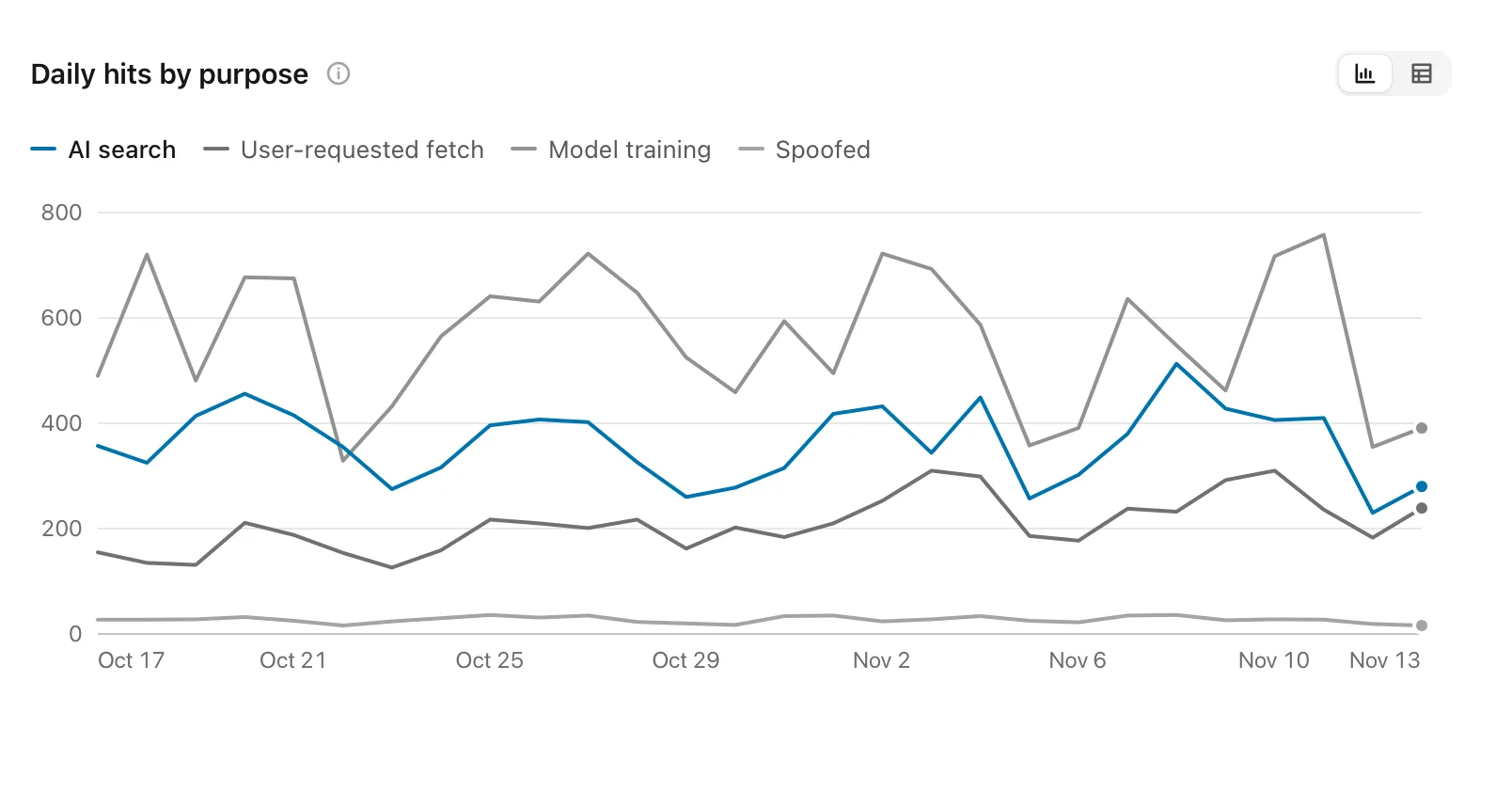
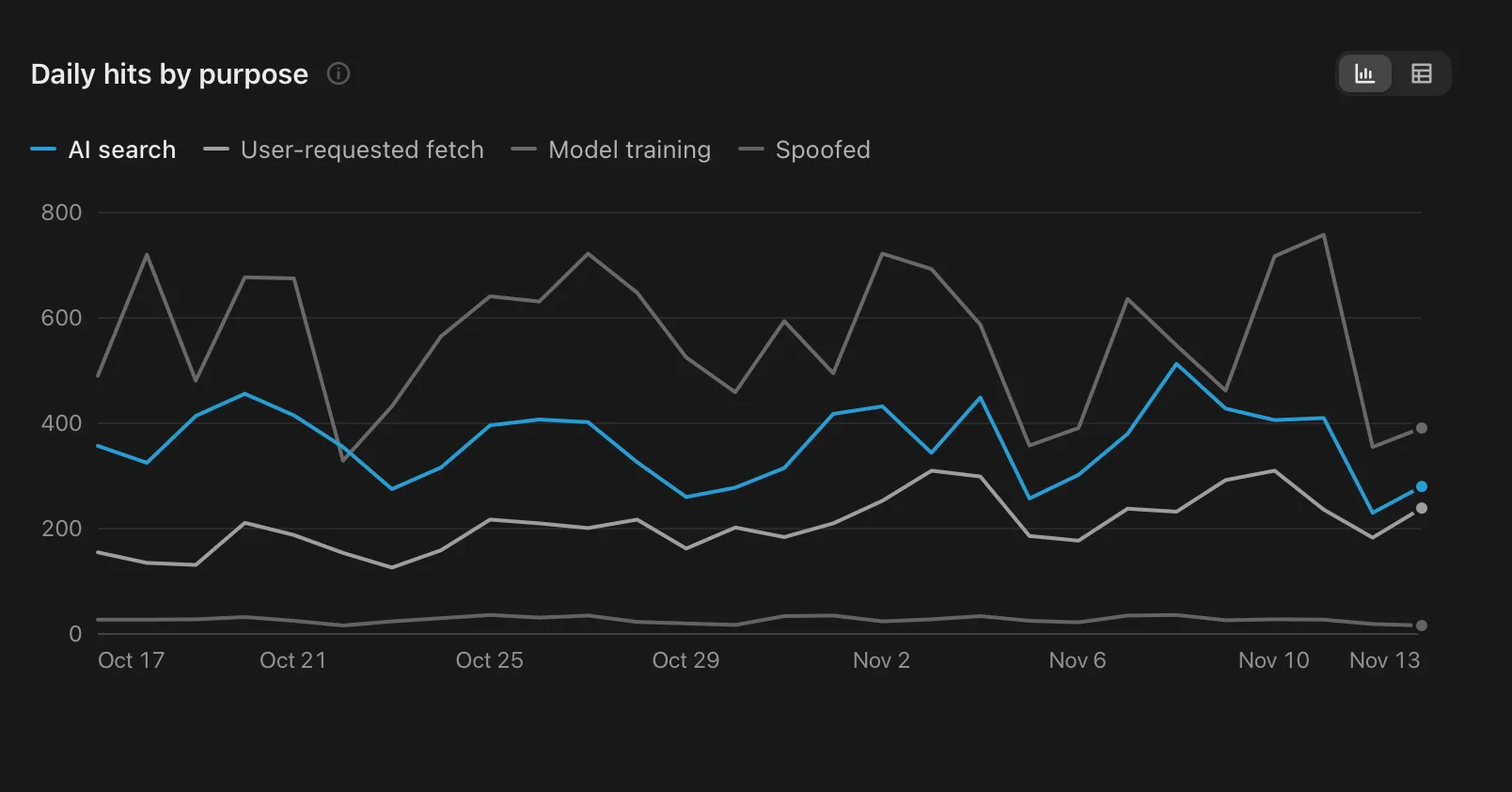
OpenAI and Anthropic document these roles themselves. OpenAI says sites that opt out of OAI-SearchBot won't be shown in ChatGPT search answers, and that for ChatGPT-User, because the fetches are user-initiated, "robots.txt rules may not apply". Anthropic says disabling Claude-User "prevents our system from retrieving your content in response to a user query". (OpenAI, Anthropic)
Which log formats work
You drag a log file into the app or pick it from disk. Supported formats:
- nginx and Apache access logs, common or combined format, including virtual-host-prefixed variants;
- Cloudflare Logpush JSON;
- generic JSON lines;
- CSV, with a dialog to map columns such as time, user agent, path, status and IP;
- any of these gzipped (
.gz).
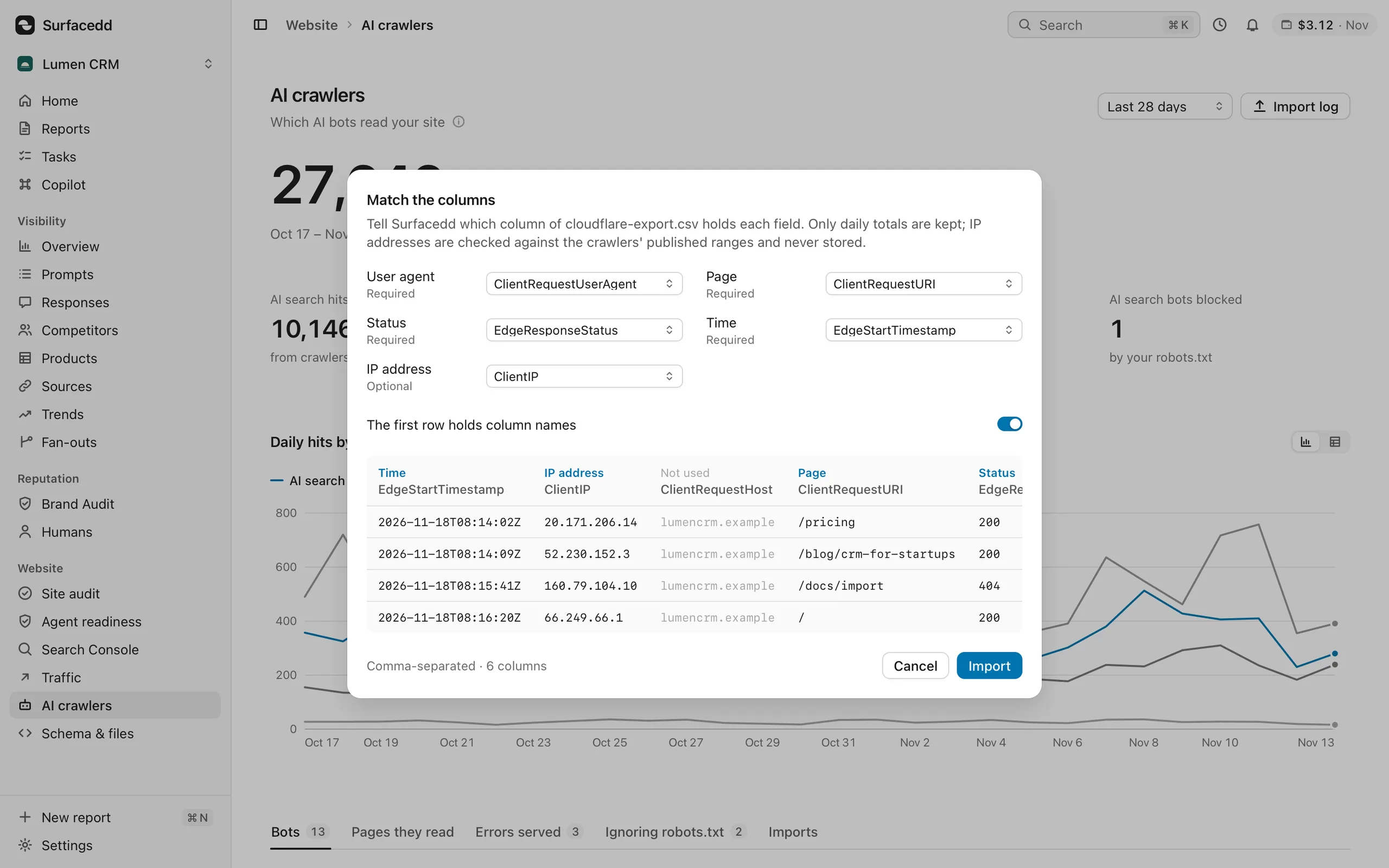
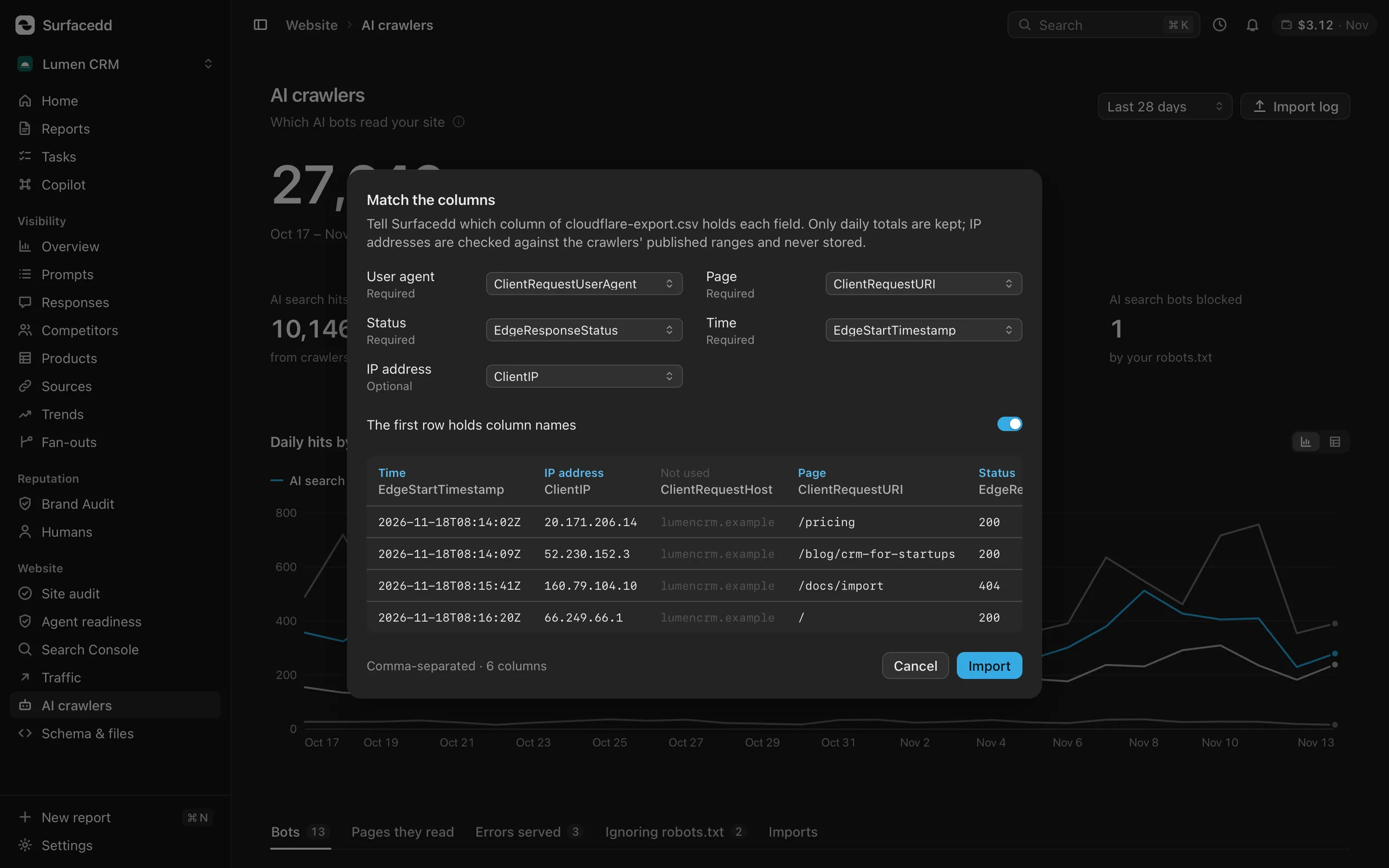
Files up to 2 GB are streamed, not loaded into memory. The parser handles about 1.27 million lines a second in a release build on the machine it was tested on, so a month of logs from a busy site takes seconds to minutes. Re-importing the same file is detected and skipped, so counts don't double.
Verified, spoofed, unverifiable, unchecked
Anyone can put "GPTBot" in a user-agent string. Surfacedd checks each hit against what the operator publishes and gives it one of four labels:
| Label | Meaning |
|---|---|
| Verified | The IP is in the operator's published IP ranges, or passes forward-confirmed reverse DNS |
| Spoofed | The operator publishes a way to verify, and the IP fails it |
| Unverifiable | The operator publishes no ranges and no DNS method, so a real hit and a fake can't be told apart |
| Unchecked | No ranges were loaded yet, or the log line has no IP |
The fourth label exists so that a missing range file never turns real crawlers into "spoofed" ones. The original specification had three states; we added unchecked during the build for exactly that reason.
Published ranges are downloaded on demand when you import (for example OpenAI's searchbot.json, Anthropic's bots.json and Google's crawler range files), cached for 7 days, and kept when a refresh fails. Google, Microsoft, Apple and Common Crawl crawlers can also be verified by forward-confirmed reverse DNS, the method Google documents for Googlebot: look up the hostname for the IP, check the domain, then look the hostname up again and confirm it returns the same IP. Amazonbot is verified by reverse DNS in Surfacedd, although the specification first listed it as unverifiable.
Which bots it knows
The catalog currently lists 32 AI and search bots, with each one's operator, purpose, robots token, and how it can be verified. It ships with the app and can be updated without a new release, because new AI crawlers appear every few months.
| Crawler | Operator | Purpose | robots.txt token | Can be verified |
|---|---|---|---|---|
| OAI-SearchBot | OpenAI | AI search and citations | OAI-SearchBot | Yes, IP list |
| Claude-SearchBot | Anthropic | AI search and citations | Claude-SearchBot | Yes, IP list |
| PerplexityBot | Perplexity | AI search and citations | PerplexityBot | Yes, IP list |
| Googlebot | AI search and citations | Googlebot | Yes, reverse DNS | |
| Bingbot | Microsoft | AI search and citations | Bingbot | Yes, reverse DNS |
| Applebot | Apple | AI search and citations | Applebot | Yes, reverse DNS |
| Meta-WebIndexer | Meta | AI search and citations | Meta-WebIndexer | No |
| YouBot | You.com | AI search and citations | YouBot | No |
| Amzn-SearchBot | Amazon | AI search and citations | Amzn-SearchBot | Yes, IP list |
| MistralAI-Index | Mistral | AI search and citations | MistralAI-Index | Yes, IP list |
| ChatGPT-User | OpenAI | Fetches for a user's question | ChatGPT-User | Yes, IP list |
| Claude-User | Anthropic | Fetches for a user's question | Claude-User | Yes, IP list |
| Perplexity-User | Perplexity | Fetches for a user's question | Perplexity-User | Yes, IP list |
| Google user-triggered fetchers | Fetches for a user's question | None | Yes, reverse DNS | |
| Meta-ExternalFetcher | Meta | Fetches for a user's question | Meta-ExternalFetcher | No |
| cohere-ai | Cohere | Fetches for a user's question | cohere-ai | No |
| DuckAssistBot | DuckDuckGo | Fetches for a user's question | DuckAssistBot | Yes, IP list |
| MistralAI-User | Mistral AI | Fetches for a user's question | MistralAI-User | Yes, IP list |
| Claude-Agent | Anthropic | Fetches for a user's question | Claude-Agent | No |
| Amzn-User | Amazon | Fetches for a user's question | Amzn-User | Yes, IP list |
| GPTBot | OpenAI | Model training | GPTBot | Yes, IP list |
| ClaudeBot | Anthropic | Model training | ClaudeBot | Yes, IP list |
| Google-Extended | Model training | Google-Extended | No | |
| Applebot-Extended | Apple | Model training | Applebot-Extended | No |
| Meta-ExternalAgent | Meta | Model training | meta-externalagent | No |
| CCBot | Common Crawl | Model training | CCBot | Yes, reverse DNS |
| Amazonbot | Amazon | Model training | Amazonbot | Yes, reverse DNS |
| Bytespider | ByteDance | Model training | Bytespider | No |
| MistralAI-Training | Mistral | Model training | MistralAI-Training | No |
| OAI-AdsBot | OpenAI | Ads | OAI-AdsBot | Yes, IP list |
| meta-externalads | Meta | Ads | meta-externalads | No |
| GoogleOther | Other | GoogleOther | Yes, reverse DNS |
32 crawlers from Surfacedd's bot catalog, version 2026-11-19.2. The app updates this catalog without a new release.
Two entries are tokens, not crawlers. Google-Extended and Applebot-Extended never appear in logs: Google says Google-Extended "doesn't have a separate HTTP request user agent string", and Apple says Applebot-Extended "does not crawl webpages". They matter only in robots.txt, which the AI visibility audit checks. (Google, Apple)
What gets stored, and what doesn't
Raw log lines are read and discarded. Surfacedd stores only:
- daily totals per bot, verification label and status class (2xx, 3xx, 4xx, 5xx);
- the top 200 paths each bot requested each day;
- a list of your imports.
No IP address is written to the database, which a test enforces by checking that no IP column or value appears in the bot tables. Totals are kept for 13 months, then deleted. Human visitors are skipped entirely. Because the data stays on your computer and contains no IPs, importing logs doesn't create a new copy of your visitors' personal data elsewhere.
Pages bots read, and pages that error
Four tabs under the chart answer the practical questions:
- Bots: hits, share verified, 4xx and 5xx rates, and whether robots.txt blocks it, per bot.
- Pages they read: the paths each crawler requests most. If OAI-SearchBot never asks for your pricing page, that's worth knowing before you rewrite it.
- Errors served: pages that returned 4xx or 5xx to AI bots. A 403 from a bot-protection rule looks like a block to the crawler even when robots.txt allows it.
- Ignoring robots.txt: bots that fetched a path your robots.txt disallows for them. Real AI crawlers usually respect robots.txt, so check whether these hits are spoofed before you worry. Remember that user-triggered fetchers may not apply robots.txt at all, by the operators' own description.
When a crawler gets errors on 5% or more of requests to pages that engines cite, it becomes a "crawler errors" task with the log figures as evidence. The task closes itself when the error rate stays under 1% for 7 days.
Worked example: four weeks of logs (sample workspace, fictional brand)
The sample workspace holds logs for lumencrm.example, a fictional CRM, from 17 October to 13 November 2026:
- 27,646 visits from 13 AI bots.
- 10,146 of them from AI search crawlers, the ones that feed live answers.
- 99% verified, with 1,765 hits that can't be checked because their operators publish no ranges.
- 336 spoofed hits: bot user agents from IPs the operator doesn't use.
- 1 AI search bot blocked by robots.txt, 3 paths serving errors to bots and 2 bots fetching disallowed paths.
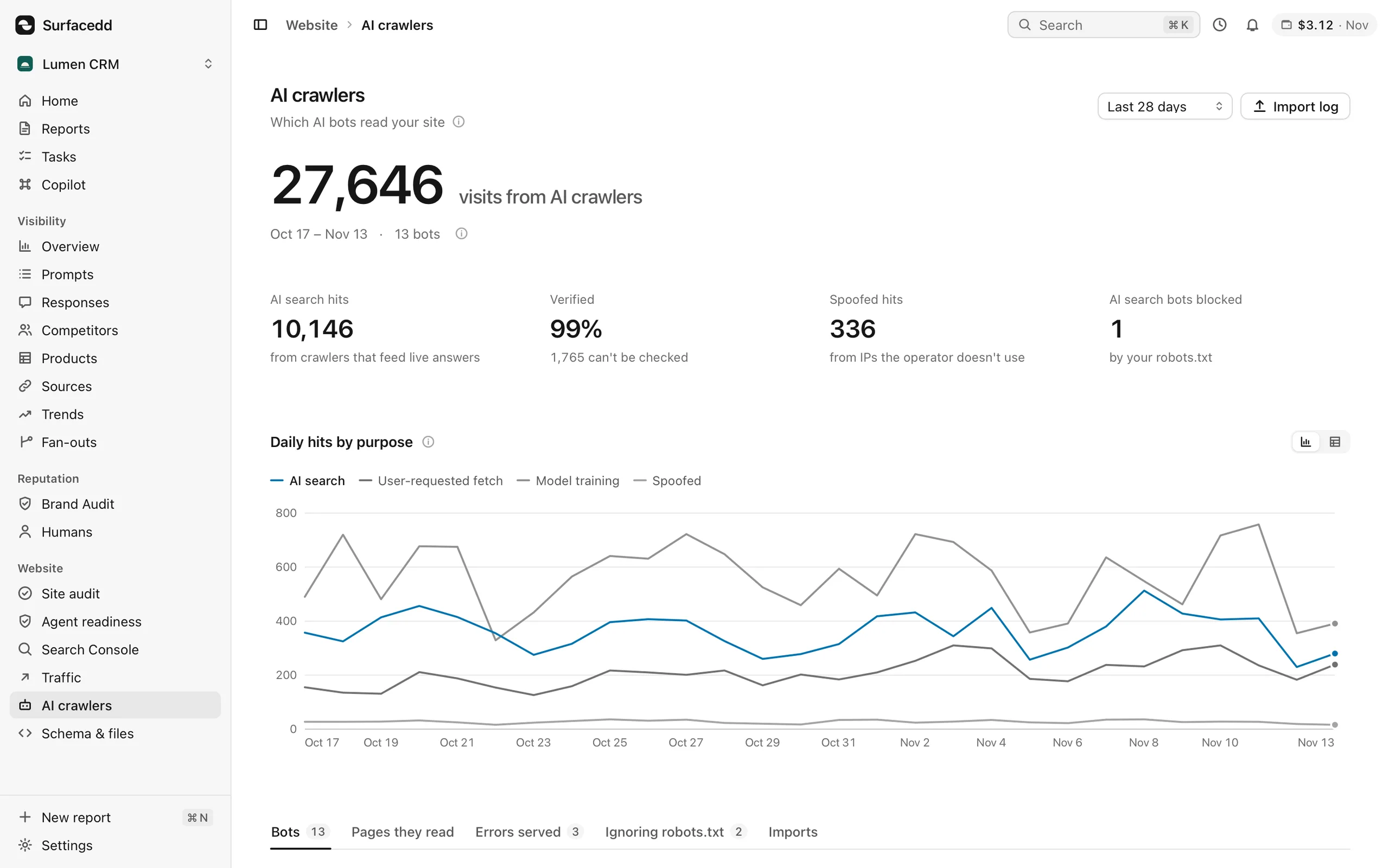
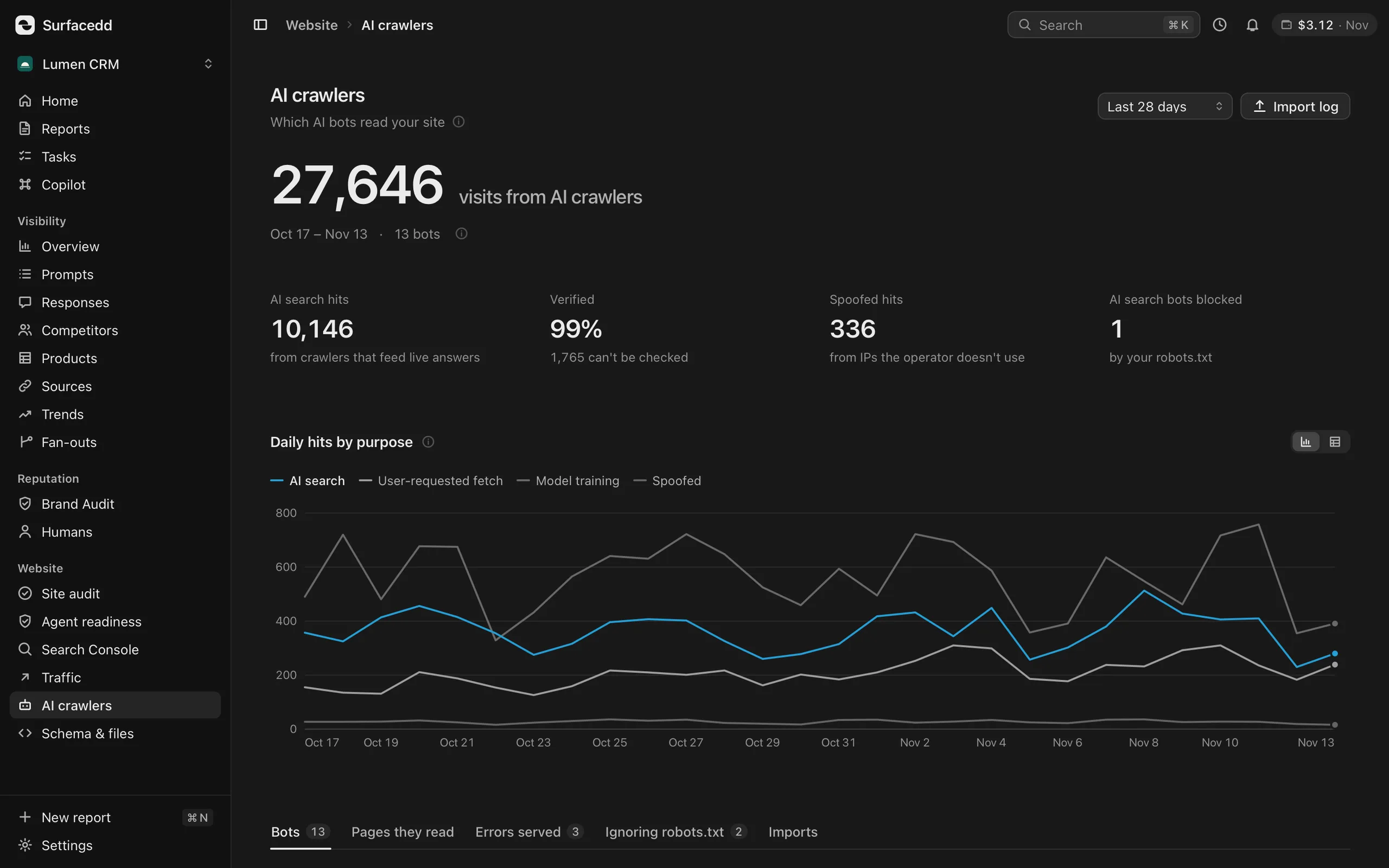
Reading it in order: the 336 spoofed hits are excluded from every real total, so nothing needs doing about them unless they load the server. The blocked AI search bot matches the site audit's critical robots.txt issue, and fixing that one line is the priority. The three error paths are next: if any is a page AI engines cite, it's costing citations. The two "Ignoring robots.txt" rows are worth one look to see whether they're the spoofed traffic.
Free browser version vs the app
You can try this without buying anything. The free AI bot log analyzer parses a log in your browser with the same Rust parser compiled to WebAssembly, and never uploads it. It shows bot hits per day and the top pages per bot.
| Free browser tool | Surfacedd app | |
|---|---|---|
| Parse nginx, Apache, Logpush, JSONL, CSV, .gz | Yes | Yes |
| Where the log is read | Your browser | Your computer |
| Verify against published IP ranges and reverse DNS | No; hits stay unchecked | Yes |
| History | One file at a time | 13 months of daily totals across imports |
| robots.txt cross-check | No | Yes |
| Tasks with evidence | No | Yes |
To learn the method behind it, read the guides on log file analysis for AI crawlers and how to verify AI crawlers.
Cost
Free. Log import, verification and the charts make no paid API calls; downloading the published IP ranges is a plain fetch of public files. Crawler analytics is part of the licence; see pricing.
What it doesn't do
Sources
Fair questions
How do I see GPTBot traffic on my site?
Import your server access log into Surfacedd, or try the free browser analyzer first. GPTBot is OpenAI's training crawler; for ChatGPT's search answers, look at OAI-SearchBot and ChatGPT-User instead. The app shows daily hits for each, the pages they read, the errors they got, and whether each hit came from OpenAI's published IP ranges.
Why not just use Google Analytics?
Crawlers don't run JavaScript, so tag-based analytics like GA4 never sees them. Only your server or CDN logs record crawler requests. GA4 is the right place to see people arriving from ChatGPT or Perplexity, which Surfacedd reads separately through its Search Console and GA4 connection. The two answer different questions: who reads you, and who visits because of AI.
What does "spoofed" mean?
A spoofed hit uses a real crawler's user-agent string, such as GPTBot, from an IP address the operator doesn't use. Scrapers do this to get past bot rules. Surfacedd only marks a hit spoofed when the operator publishes a way to verify and the IP fails it. Spoofed hits are counted separately and never added to the real crawler's totals.
Does Surfacedd store my visitors' IP addresses?
No. The log is read on your computer, and only daily totals per bot, status class and verification label are stored, plus the top 200 paths per bot per day. No IP address is written to the database, and human visits are skipped. Totals are deleted after 13 months. Nothing from the log is sent to Surfacedd.
Which log should I export from my host?
The raw access log from your web server or CDN, covering at least two weeks so weekly patterns show. On nginx or Apache that's the combined-format access log; on Cloudflare, a Logpush JSON export. Many hosts let you download gzipped daily files, which you can import as they are. CSV exports from other tools work after you map the columns.
Can it tell me whether being crawled led to citations?
Not by itself. Crawler analytics shows that a bot read a page and what it got back; prompt tracking shows whether answers cite that page. Seeing both side by side tells you whether a never-cited page is never fetched, fetched with errors, or fetched fine and simply not chosen, which are three different fixes.
How we research, write and correct pages: read our editorial policy.