Make sure AI can read the pages you want cited
A free crawl from your own computer that checks every key page for what stops AI engines and search from reading and citing it.
By the Surfacedd teamUpdated 9 min readMarkdown
On this page
Short answer
Surfacedd's AI visibility audit crawls up to 500 pages of your site from your computer, free, and runs 43 checks. It shows which AI crawlers your robots.txt blocks on each key page, snippet controls that limit AI Overviews, broken structured data and pages that need JavaScript, then tracks each issue as new, worse, still failing or resolved.
An AI engine can only cite a page it can fetch and read. A single Disallow line for the wrong crawler, a nosnippet tag left over from a redesign, or a product page that renders its text with JavaScript can keep you out of answers no matter how good the page is. The AI visibility audit finds those blockers on your own site, page by page, and tells you which ones matter for AI answers.
What an AI visibility audit should check
A useful audit separates three questions: can AI crawlers reach the page, are they allowed to use it, and can they understand it once they have it. Surfacedd's audit runs 43 checks: the site-audit rules ported from the open-source open-seo crawler, plus AI-readiness and crawl rules we added. Each issue has a severity, a plain explanation and a fix.
| Group | Checks (severity) | Why it matters for AI answers |
|---|---|---|
| AI readiness | AI answer engine blocked in robots.txt (critical) · content needs JavaScript (warning) · snippet controls limit AI use (warning) · structured data has errors (warning) · AI training crawler blocked (info) · Google-Extended opted out (info) · no structured data on a key page (info) · no llms.txt (info) · llms.txt has format problems (info) | Blocked search crawlers can't fetch the page for live answers. Most AI crawlers don't run JavaScript. Snippet limits cap how much of a page Google's AI features may use |
| Indexing | server error 5xx (critical) · page returns 4xx · robots.txt could not be read · conflicting canonicals · invalid hreflang (warnings) · no XML sitemap · slow response over 1.5 s · noindex page · canonicalized elsewhere (info) | Pages that error or point elsewhere aren't the ones engines quote |
| Crawl | crawler was refused (critical) · rate limited 429 · crawl stopped early by rate limit (warnings) · crawl reached the page limit (info) | A site that refuses or throttles a polite crawler often does the same to AI bots |
| Links | broken internal link (critical) · redirect chain · redirect loop · orphan page · no outgoing links (warnings) · deep page, 5+ clicks (info) | Bots find pages by following links; dead ends hide them |
| Content | missing title (critical) · duplicate title, meta description or content · missing meta description · missing or multiple H1 · thin content under 150 words · images without alt text (warnings) · Open Graph tags missing · title over 60 or under 10 characters · meta description over 160 or under 70 · heading levels skip (info) | Clear titles, headings and descriptions are what answers quote and link |
The SPEC that the app was built from listed 25 open-seo rules plus AI-readiness rules. The shipped crawler has more: broken-internal-link, orphan-page, the crawl-health rules and an llms-txt-invalid check were added during the build. We list what the code runs.
Can AI crawlers reach your key pages?
The audit reads your robots.txt the way the crawlers do and builds an access matrix: every AI crawler in Surfacedd's bot catalog that has a robots token, against your home page and a sample of up to 25 crawled pages. Each cell says allowed or blocked, with the rule that decided it. The parser follows RFC 9309 plus Google's documented leniencies, and treats a robots.txt that returns 4xx as "allow all" and one that errors (5xx) or times out as "block all", which is what crawlers do.
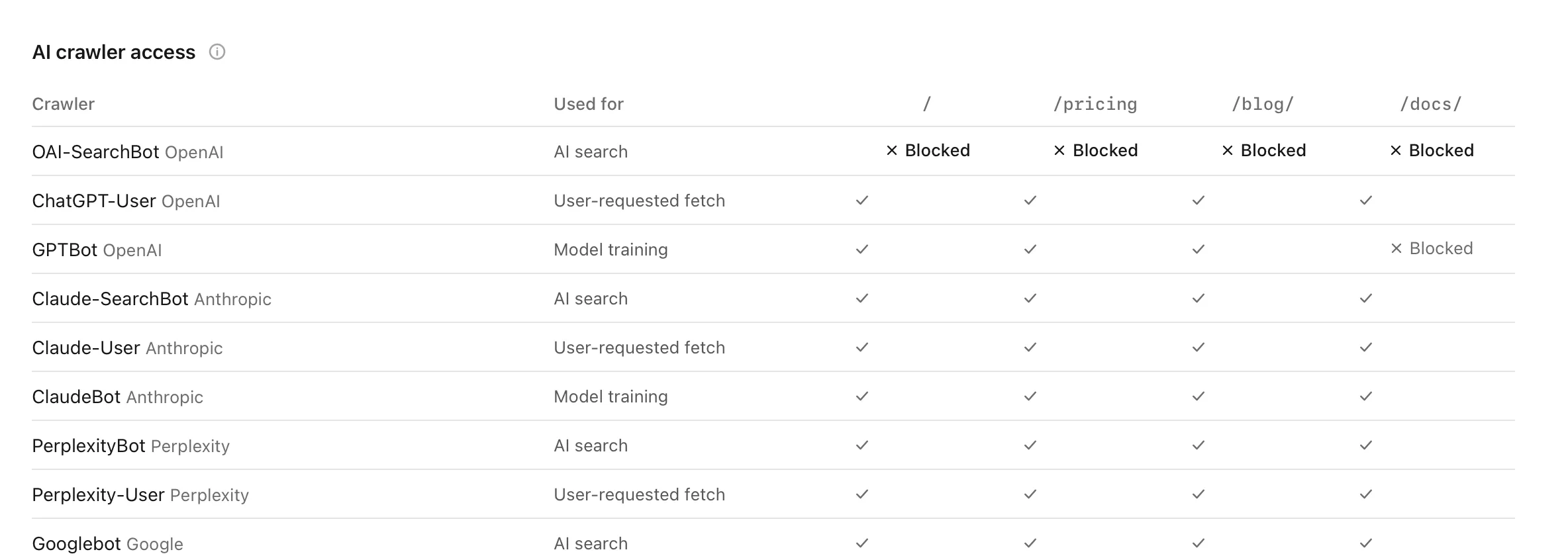
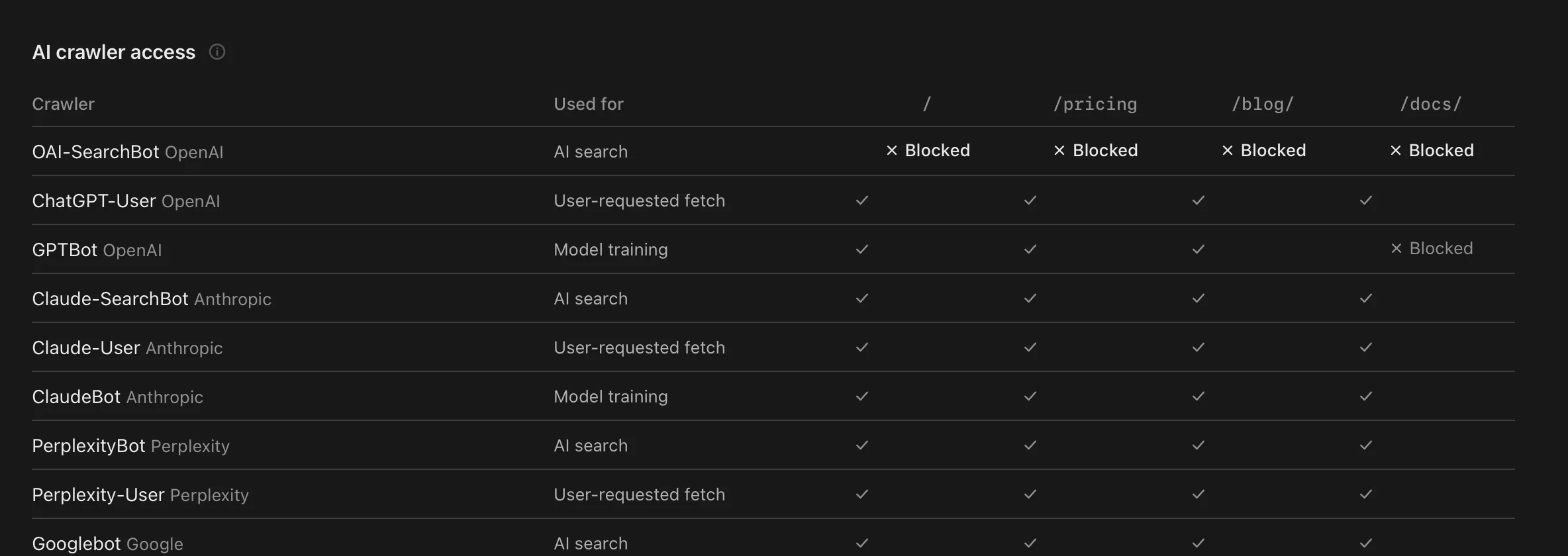
The severity depends on what the crawler does, because blocking a training crawler and blocking a search crawler have very different effects:
- Search and user-triggered crawlers (OAI-SearchBot, Claude-SearchBot, PerplexityBot, ChatGPT-User, Claude-User and others) fetch pages for live answers. Blocking one is critical: OpenAI says sites that opt out of OAI-SearchBot won't be shown in ChatGPT search answers. A deliberate opt-out is fine; an accidental one is the most expensive line in your robots.txt. (OpenAI)
- Training crawlers (GPTBot, ClaudeBot, CCBot and others) collect pages that may be used to train future models. Blocking one site-wide is reported as info: it's a policy choice, not an error.
- Google-Extended is a robots token, not a crawler. Google says it controls whether content Google crawls can be used for Gemini training and for grounding in Gemini Apps and Vertex AI, and that it "does not impact a site's inclusion in Google Search nor is it used as a ranking signal". The audit reports it as info so you know Gemini-app grounding is affected. (Google)
- Applebot-Extended is also token-only. Apple says it "does not crawl webpages" and only controls whether Applebot's crawl may train Apple's foundation models; pages that disallow it can still appear in Apple's search results. (Apple)
To check a robots.txt without installing anything, use the free AI crawler checker. The app adds the page-by-page matrix, the rest of the audit and history.
Snippet controls and nosnippet
A nosnippet robots meta tag or a very small max-snippet value limits more than the blue-link snippet. Google's documentation says nosnippet "will also prevent the content from being used as a direct input for AI Overviews and AI Mode", and max-snippet limits how much content those features can use. The audit flags nosnippet and any max-snippet from 0 to 49 characters as a warning, on the page where it appears. (Google)
Structured data present and valid
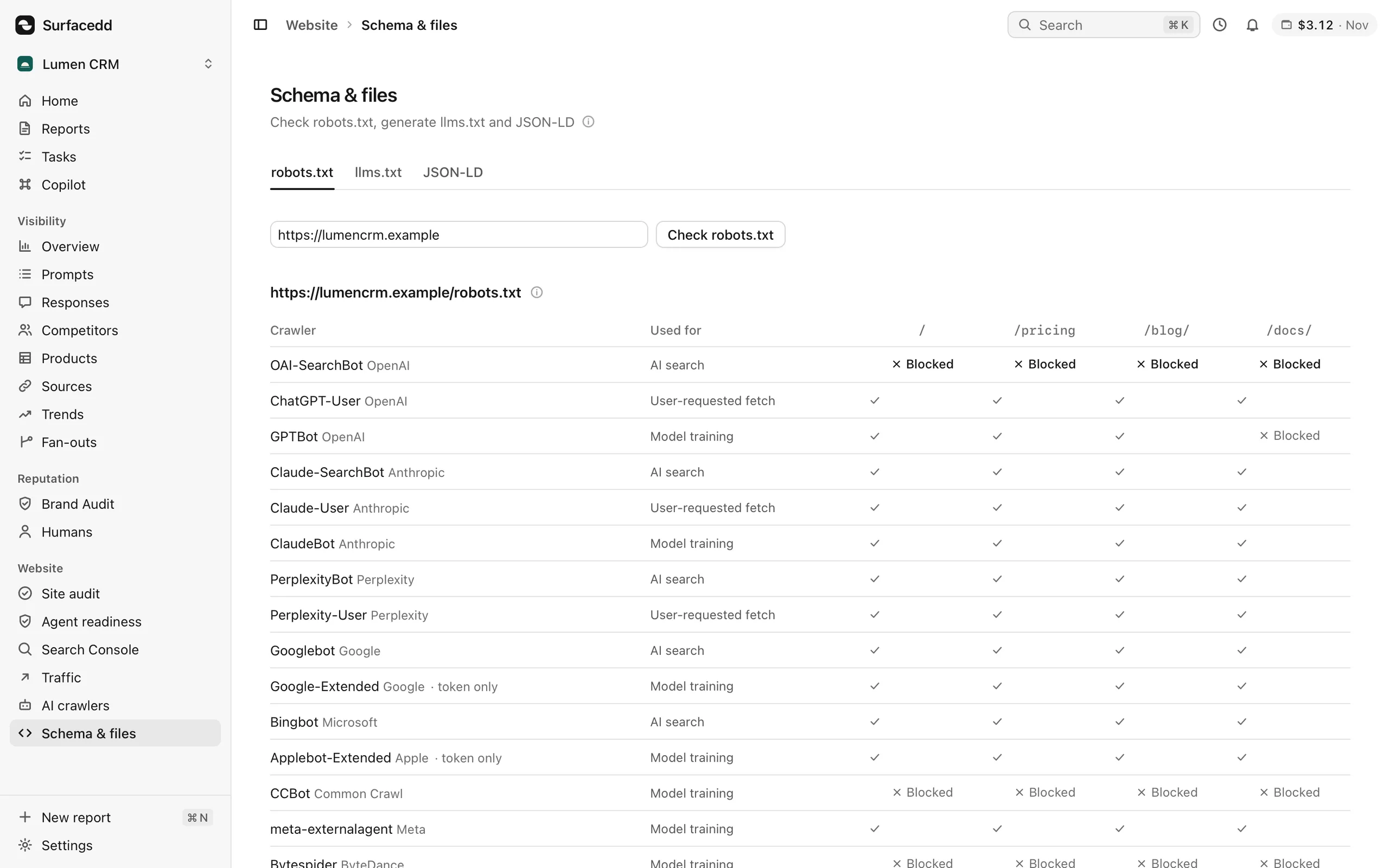
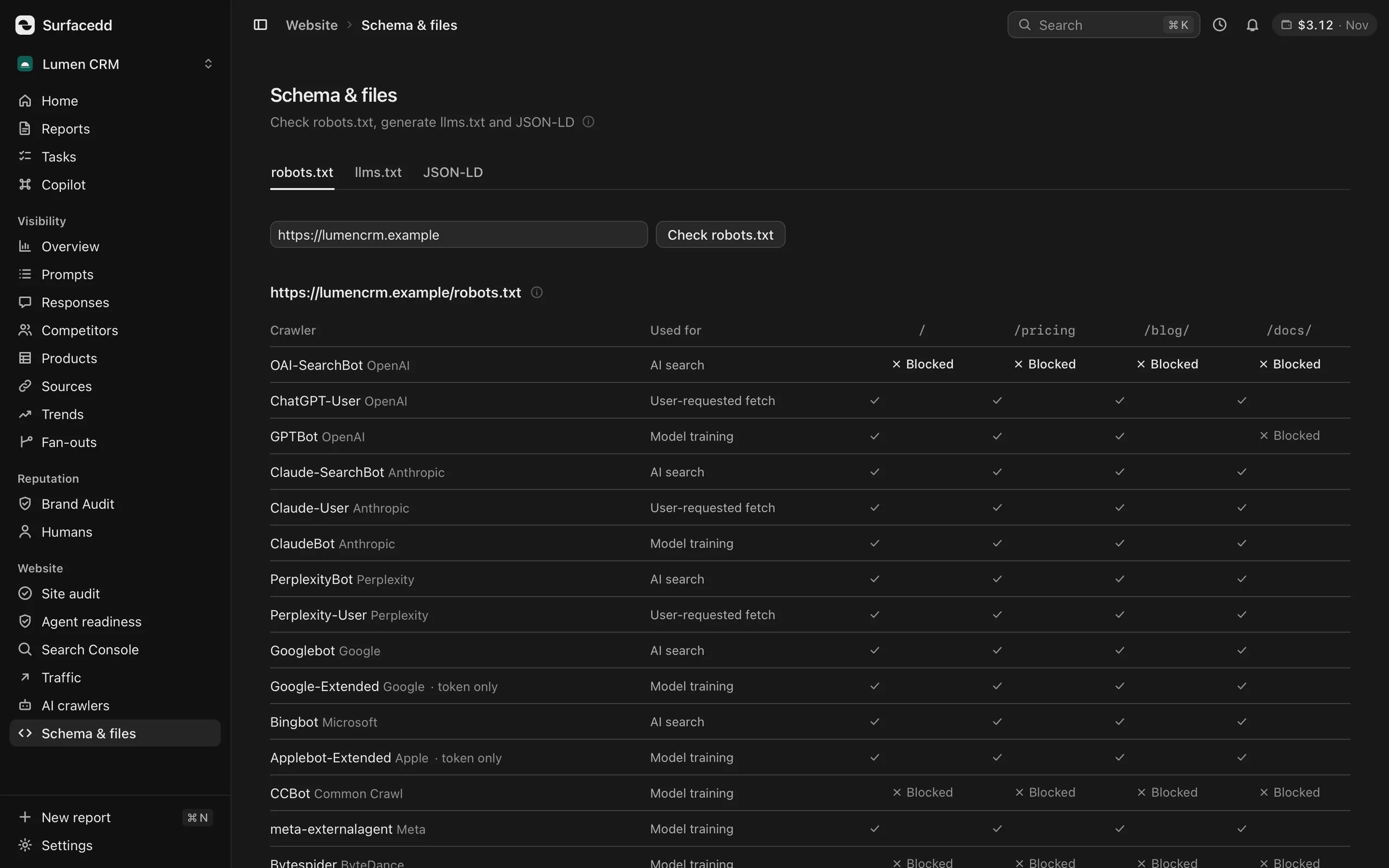
Pages at the top of your site (depth 0 or 1) with no JSON-LD get an info notice. JSON-LD that fails to parse, or is missing required properties, gets a warning with the error. The app's Schema & files screen generates deterministic JSON-LD for Organization, WebSite, SoftwareApplication, Article, LocalBusiness, Person/ProfilePage and BreadcrumbList, and validates any JSON-LD or HTML you paste, on your computer.
llms.txt: checked, labelled informational
llms.txt is a proposed Markdown file that gives AI agents a short overview of a site with links. The audit checks whether you have one and whether it follows the format, and both results are info only, labelled "no proven effect". Google ignores llms.txt, and we have seen no evidence that it raises citations. The app can generate one if you want it for agents that do read it. Read our llms.txt guide before spending time on it.
Canonicals, hreflang and Open Graph
Conflicting canonicals, where the HTML canonical and the HTTP Link header name different URLs, are warnings: search engines then ignore both. A page that names another URL as canonical gets an info notice, because that other URL is the one indexed and quoted. Invalid hreflang codes are ignored by search engines, so they're flagged. Missing Open Graph tags are info: they don't block AI, but answers and chat apps use them for link previews.
Reading the score and its history
The score starts at 100. Each issue type multiplies it by (1 − weight × share of pages affected), with weights of 0.25 for critical issues, 0.08 for warnings and 0 for info. A site-level issue, such as a blocked AI search crawler, counts as affecting every page. Info notices never lower the score, so llms.txt can't move it.
Every audit is compared with the previous one. Each issue type is marked New, Worse (more pages than last time) or Still failing, and fixed types are counted as Resolved. With weekly rescans on, a brand that has run an audit is re-crawled with the same settings once its newest audit is 7 days old. Brands that never ran one are never crawled unasked.
Worked example (sample workspace, fictional brand)
The sample workspace audits lumencrm.example, a fictional CRM. Its 12 November 2026 audit crawled 148 pages (limit 200) and scored 81 out of 100, up 7 since 5 November. It found 3 critical issues, 11 warnings and 24 notices.
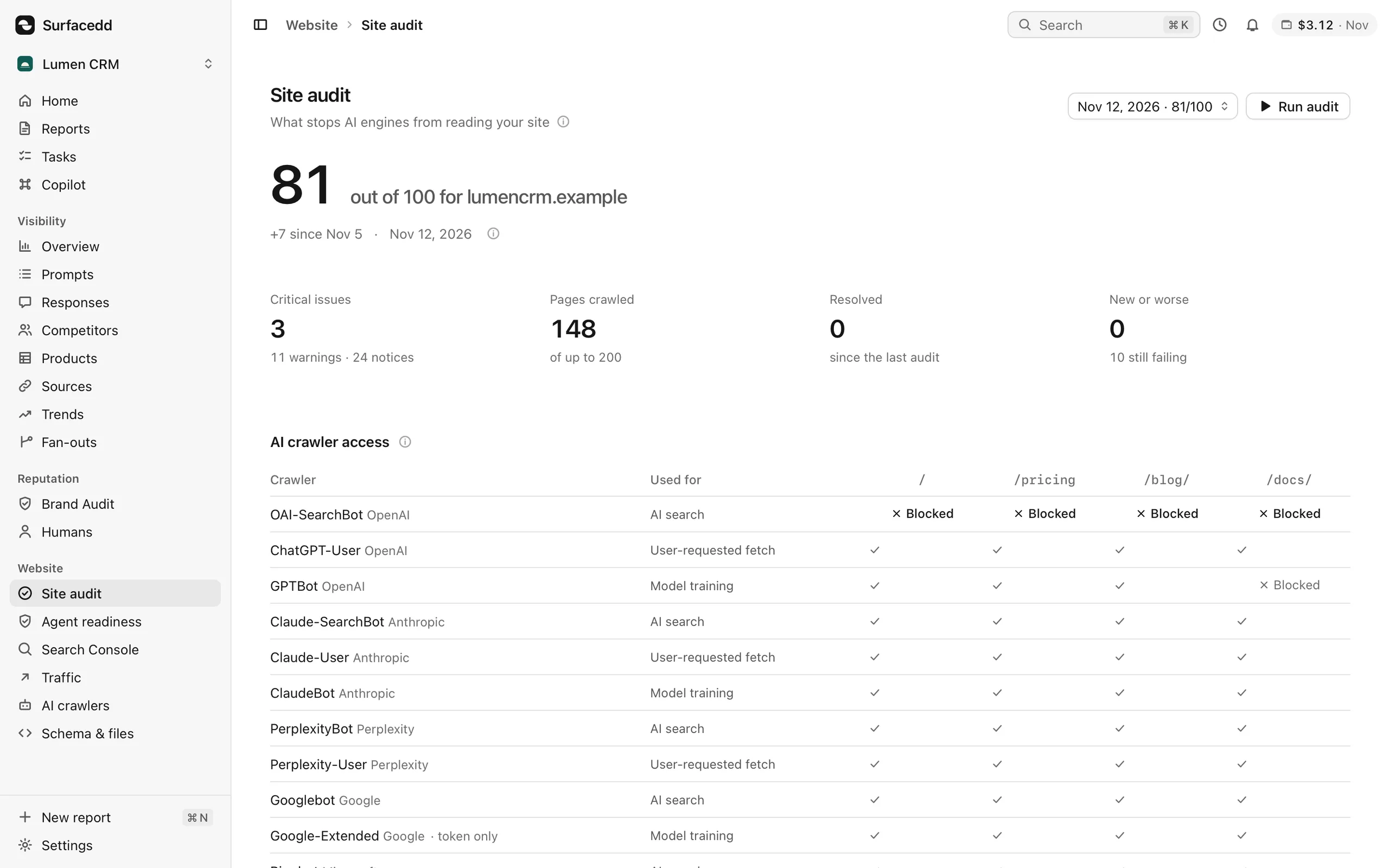
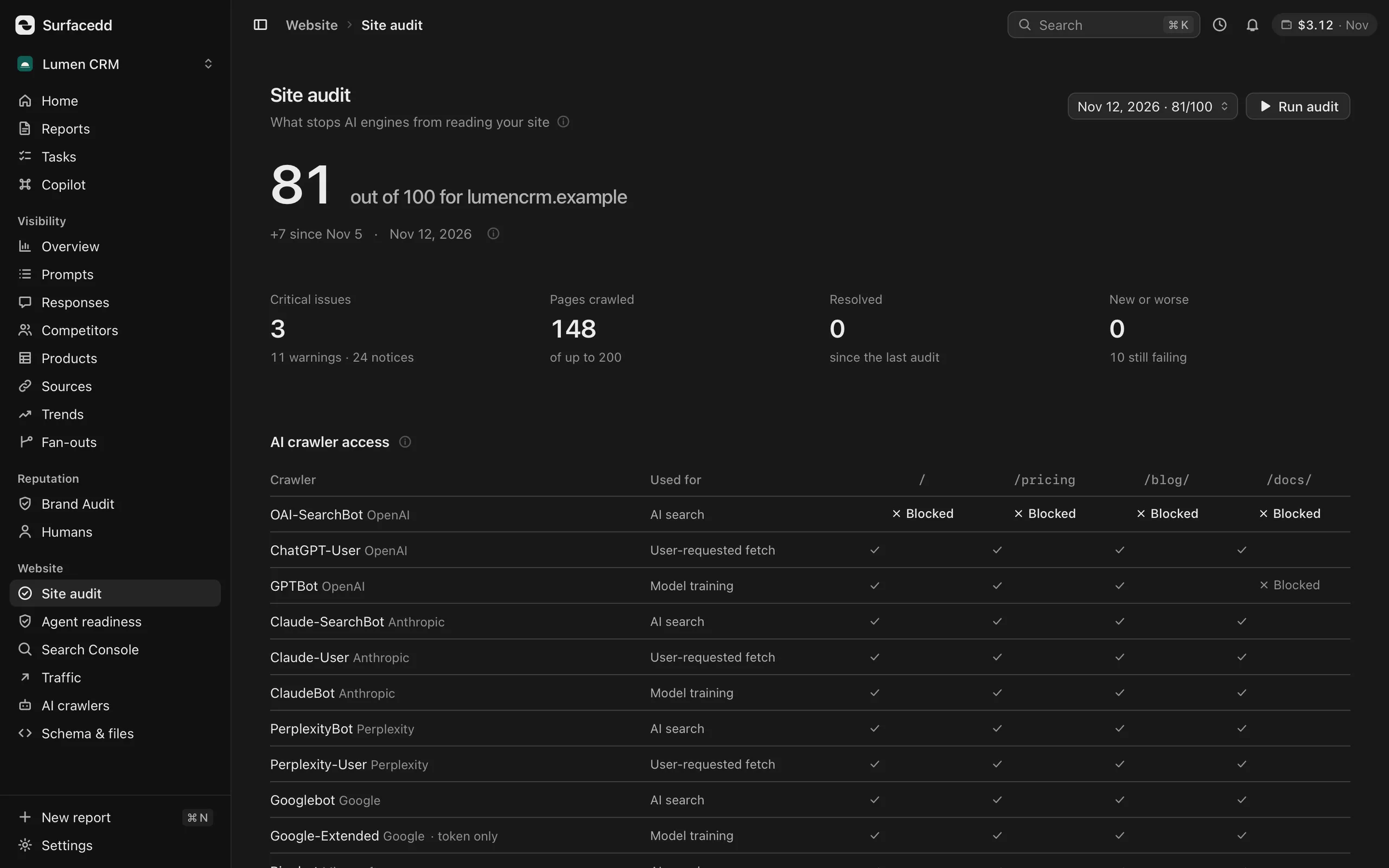
The matrix explains the biggest problem at a glance. OAI-SearchBot, the crawler behind ChatGPT search, is blocked on /, /pricing, /blog/ and /docs/, so that is one critical site-level issue. GPTBot is blocked only on /docs/, which is a training choice and costs no score. Every Anthropic and Perplexity crawler is allowed. The fix is one change in robots.txt:
User-agent: OAI-SearchBot
Allow: /
After the next audit, the issue moves to Resolved and the score recalculates. If the brand also tracks prompts, the blocked crawler appears as an "AI bot blocked" finding on the Tasks board, with the robots line as evidence.
From audit to tasks
Audit results feed Surfacedd's evidence-backed tasks. A blocked AI search crawler, crawler errors on pages engines cite, and site-audit issues on pages tied to prompts you're losing become tasks with the evidence attached, ranked with your other fixes. When the next scan passes the check, the task closes itself.
Pair it with crawler logs
robots.txt says what crawlers may do. Your server logs show what they did. A CDN bot-protection rule can return 403 to an AI crawler that robots.txt allows, and a spoofed "GPTBot" can ignore your rules entirely. AI crawler analytics imports your logs and shows which bots really visit, which are verified, and which hit pages your robots.txt disallows.
Agent readiness builds on the site audit
AI agents that browse and act for users need more than crawl access. Agent readiness extends this audit with a scored report in three parts, Reach, Understand and Act. It checks for bot walls, price and availability in server HTML, accessible forms and buttons, and a list of emerging agent protocols, which it labels as early adoption. Like the site audit, it runs locally, makes no AI calls and costs nothing per check.
Cost
Free. The crawl runs from your computer at 2 requests per second per host, reads up to 500 pages to a depth of 6, and calls no paid API. You choose 50, 100, 200 or 500 pages per audit. The crawler blocks requests to private network addresses unless you allow your own site's private host.
Prompt tracking, which the audit's findings link to, is priced per answer on your own keys; see pricing.
What it doesn't do
Sources
Fair questions
What is an AI visibility audit?
It's a check of whether AI engines can fetch, use and understand the pages you want cited. Surfacedd's audit crawls up to 500 pages from your computer and runs 43 checks, including which AI crawlers robots.txt blocks on each key page, snippet controls that limit Google's AI features, broken structured data and pages that need JavaScript. It costs nothing to run.
Should I block GPTBot or ClaudeBot?
That's a policy decision, not an SEO error. GPTBot and ClaudeBot collect pages that may be used for model training; blocking them doesn't remove you from ChatGPT or Claude search answers, which use OAI-SearchBot, Claude-SearchBot and user-triggered fetchers. The audit marks training-crawler blocks as info and search-crawler blocks as critical, so you can tell the two apart.
Does blocking Google-Extended hurt my Google rankings?
According to Google, no: Google-Extended doesn't affect inclusion in Google Search and isn't a ranking signal. It controls whether Google may use your content for Gemini training and for grounding in Gemini Apps and Vertex AI. The audit reports it as info so you know what it affects. It doesn't control AI Overviews; snippet controls do.
Will adding llms.txt get me cited more?
We don't know of evidence that it does, and Google ignores it. The audit checks for it and validates the format, but reports both results as info with no effect on the score. If agents you care about read it, the app can generate one. Fixing a blocked search crawler or a nosnippet tag is a far better use of an afternoon.
Why does the audit not render JavaScript?
Because most AI crawlers don't either. Reading raw HTML shows you what those crawlers get. Pages whose main text appears only after JavaScript runs get a "content needs JavaScript" warning, so you know which pages to server-render. JavaScript rendering is planned for a later version, mainly to compare raw and rendered text.
Is the free AI crawler checker the same thing?
The AI crawler checker on our site reads one robots.txt and shows which AI crawlers it allows. The app's audit goes further: it crawls the site, tests each crawler against your key pages, runs the other 42 checks, keeps history, schedules weekly rescans and turns findings into tasks. Both are free to use.
How we research, write and correct pages: read our editorial policy.