SEO Copilot · in Surfacedd for Mac and Windows
Ask what to fix next. Get a plan with receipts.
The SEO Copilot is an AI SEO agent that works only from your own data: tracked AI answers, site audits, crawler logs and, once connected, Google Search Console and GA4. Ask in plain words; it runs the tools it needs and answers with a short ranked plan in which every figure cites its source.
Your Anthropic, OpenAI or OpenRouter key · paid lookups ask first
Included in every licence · 14-day refund
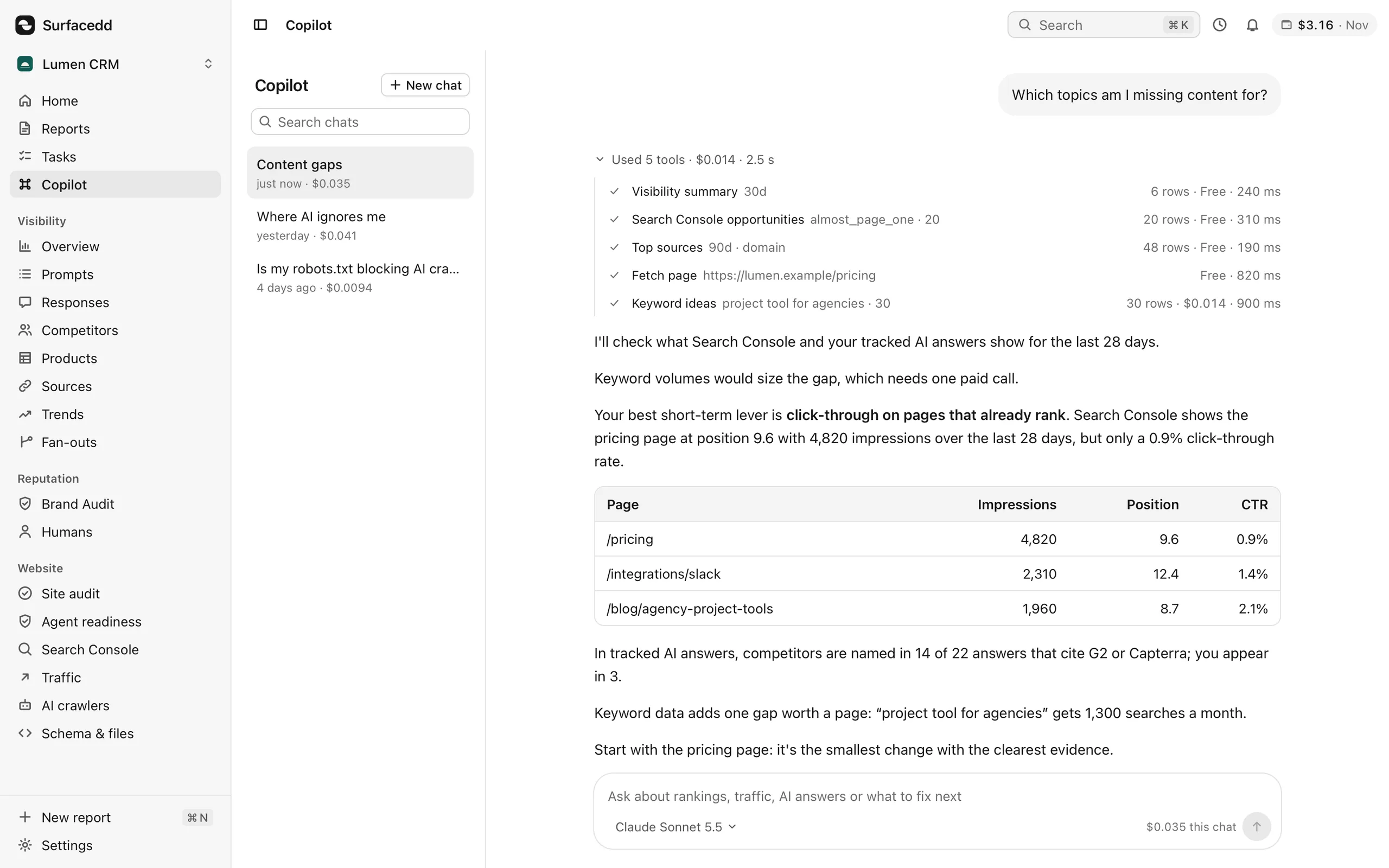
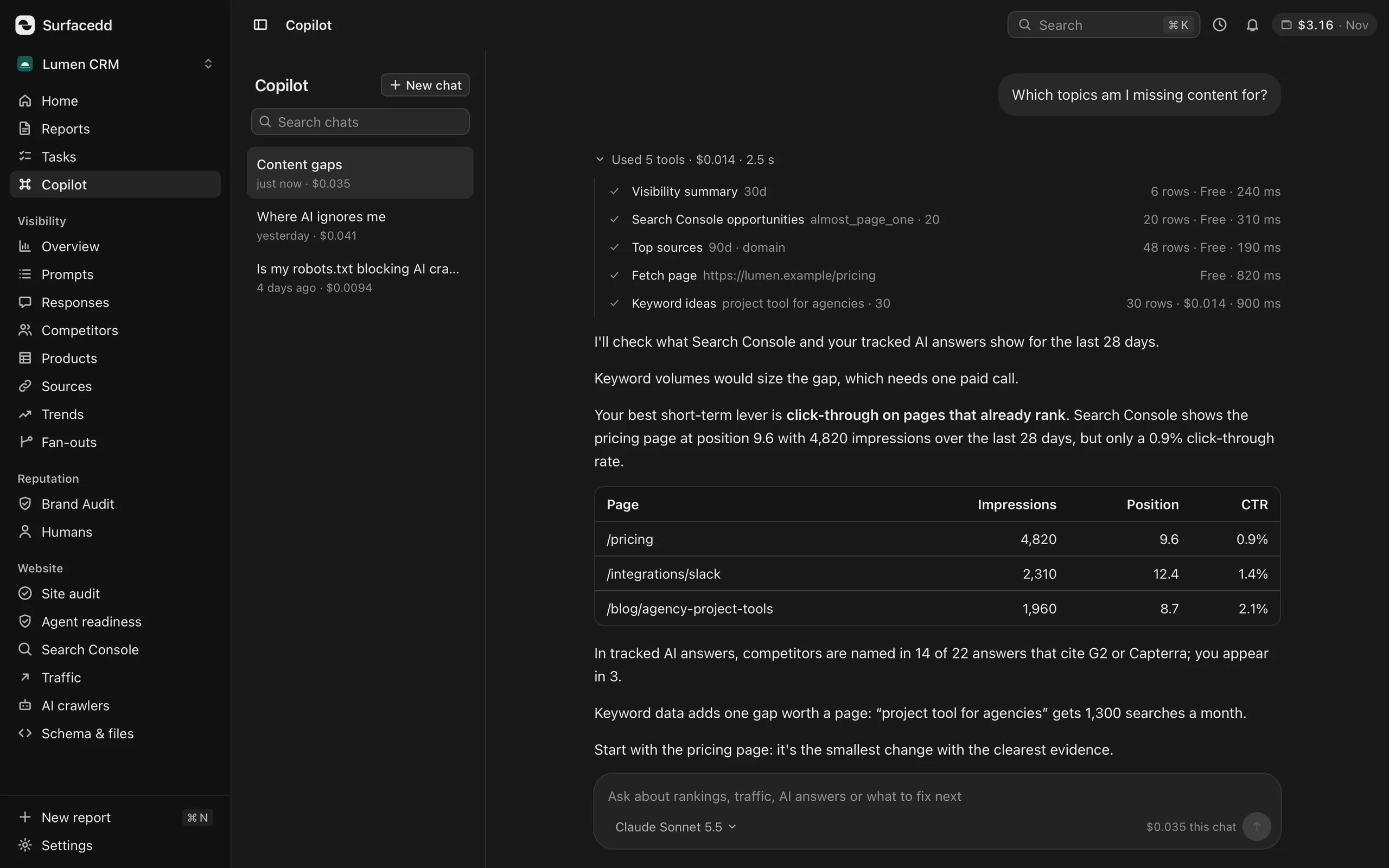
A finished answer with Tools used open · sample workspace · Lumen CRM is a fictional brand
- starter questions, each with its own playbook
- 6starter questions, each with its own playbook
- tool steps at most before it has to answer
- 12tool steps at most before it has to answer
- paid lookups without your approval, unless you set a limit
- 0paid lookups without your approval, unless you set a limit
- bytes of your data sent to Surfacedd's servers
- 0bytes of your data sent to Surfacedd's servers
01 · How it works
Ask. Tools run. A ranked plan comes back.
A chat in the app, on a full page or in a side panel you open anywhere with ⌘J or Ctrl+J. It is scoped to the brand you have open and replies in the language you write in.
01
You ask
Type a question or pick a starter: why traffic fell, what to do next, where AI answers leave you out. Follow-ups keep the context and the earlier tool results.
02
Tools run, free ones first
The model reads your local data, fetches a page when on-page facts matter, and stops to ask before any paid lookup. You watch each call appear as it runs, and can stop the answer at any point.
03
A plan you can act on
Up to five ranked items, each with a short why, impact, effort, time to effect and evidence chips that cite tool results. Add an item to Tasks with its evidence, or copy a suggested title, meta description, FAQ questions or outline.
Evidence on every item.
Each plan item carries chips such as “4,820 impressions at position 9.6 · Search Console opportunities”. Before a plan is shown, Surfacedd checks every figure in each item against the tool results it cites, allowing for rounding and units.
An item that cites a number the data doesn't contain is dropped, and the plan says how many were dropped. In the capture, a claim to “double organic traffic in a month” didn't survive.
- Categories
- fix · create · improve · promote · track
- Effort
- small · medium · large
- Time to effect
- days · weeks · months
- Copy-only
- title · meta description · FAQ questions · outline
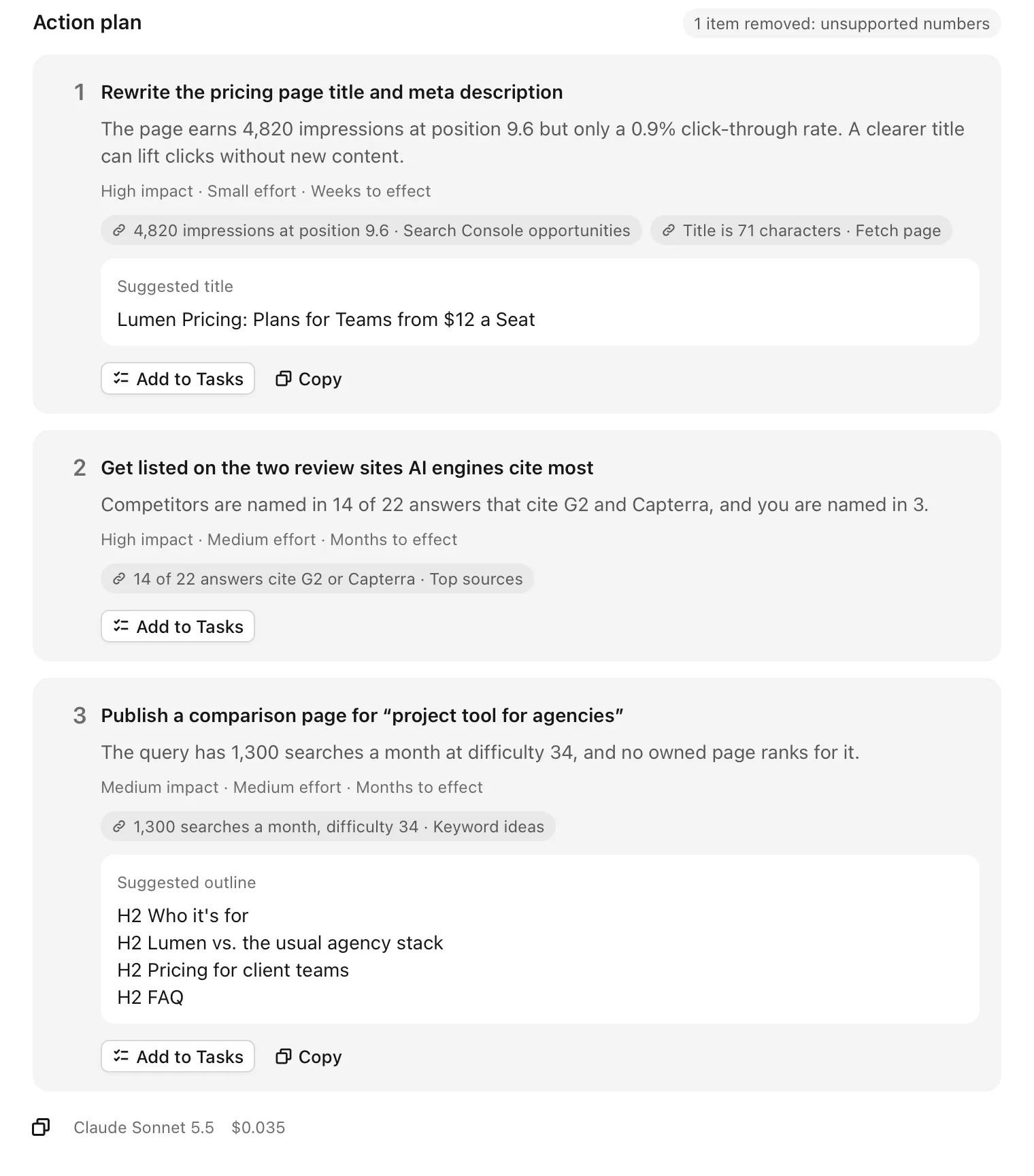
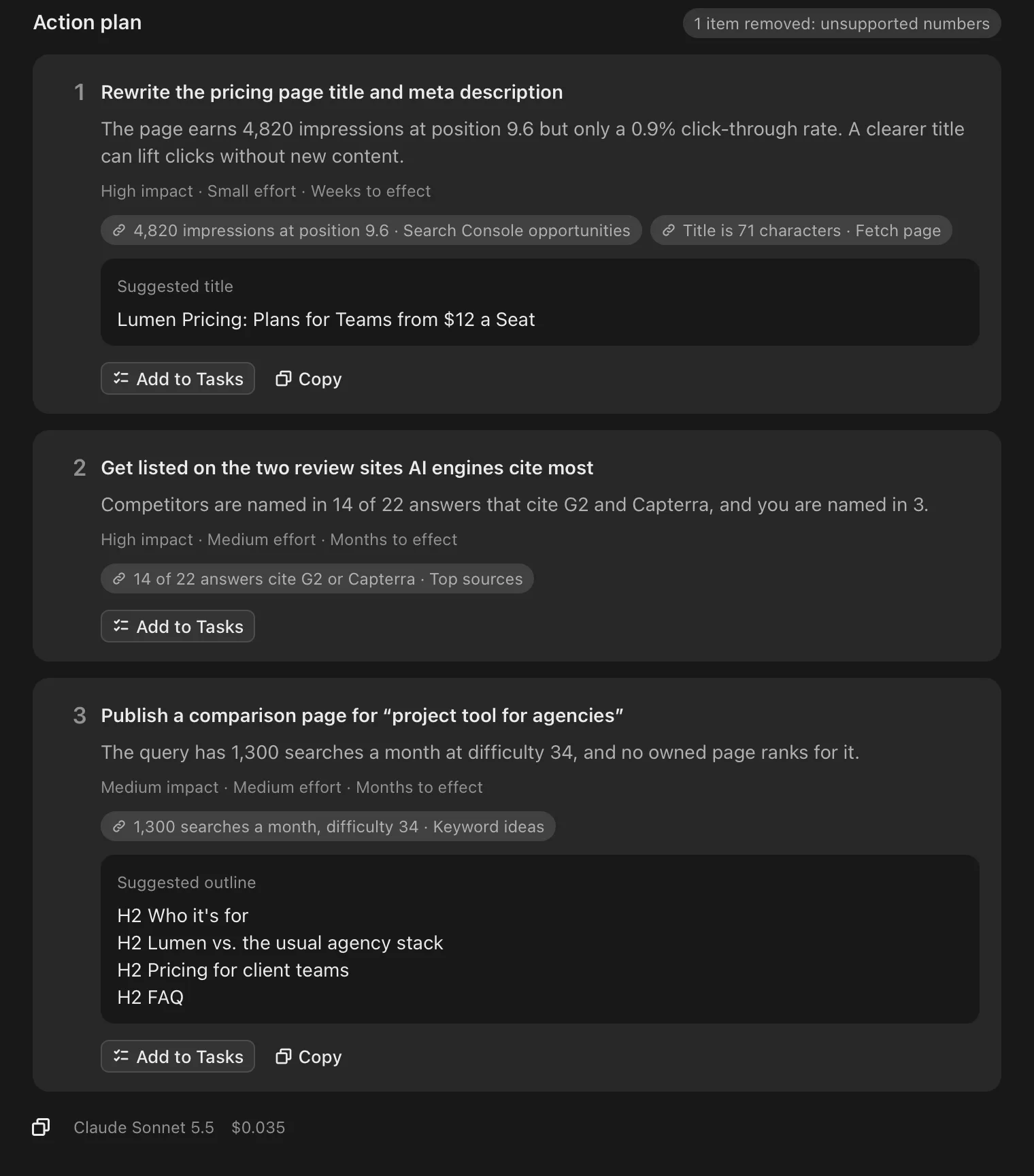
The finished plan in the sample workspace. Its footer shows the model and what the message cost.
02 · Starter questions
Six questions worth asking every week.
Each starter runs a playbook we wrote: which data to read first, what to compare, when a paid lookup is worth suggesting, and how to rank the result. Ask anything else in your own words and the Copilot adapts the closest playbook to the data it finds.
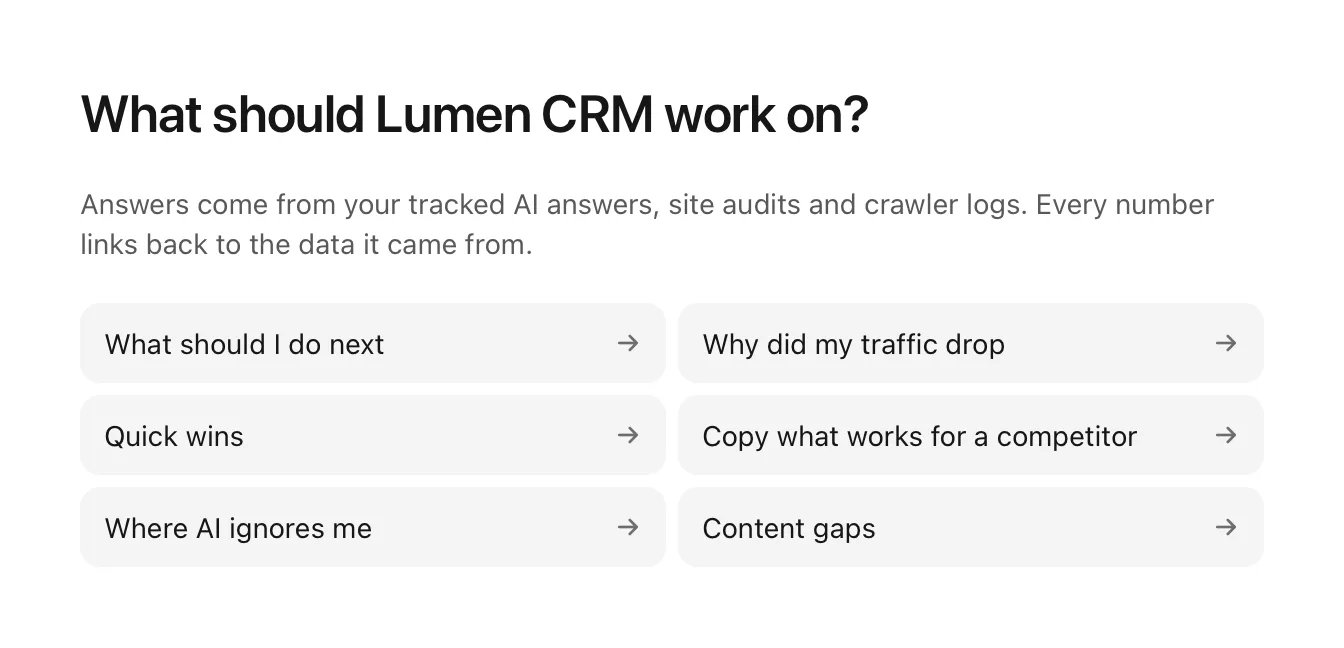
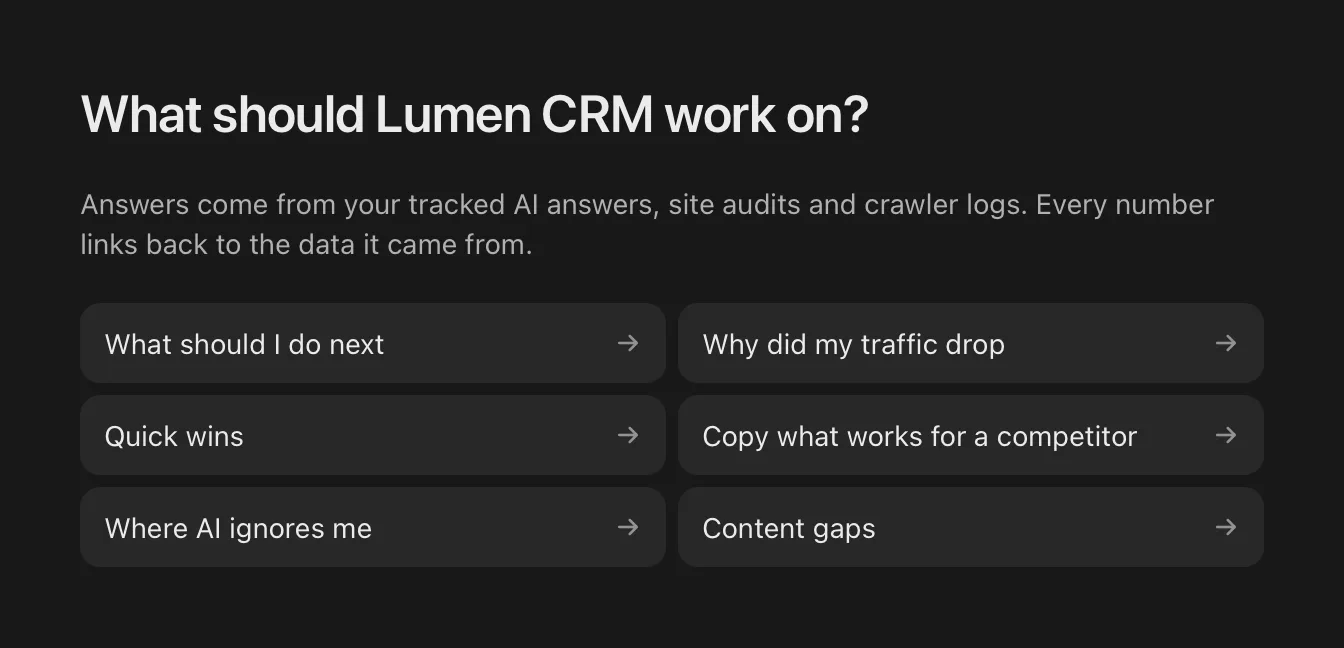
What should I do next
“What should I do next to grow my search and AI visibility? Give me a short ranked plan.”
Your visibility summary and open tasks, plus Search Console totals and opportunities when Google is connected. Ranked by impact over effort, five items at most.
Why did my traffic drop
“Why did my traffic drop? Compare the last 28 days with the 28 days before and tell me what changed.”
The Search Console drop diagnosis, GA4 traffic by channel for the same window, and an inspection of up to two pages that lost the most.
Quick wins
“Find quick wins: queries where I'm in positions 8–20 with lots of impressions or a low click-through rate.”
Almost-page-one and low-CTR queries, then the queries and live title and meta description of the top three pages. May suggest a new title or meta description.
Copy what works for a competitor
“What is working for my strongest competitor that I could do too?”
Share of voice to find the strongest competitor, the pages AI engines cite next to them, and one or two of those pages fetched. Their organic data only if you approve a paid call.
Where AI ignores me
“Where do AI answers leave me out, and what can I do about it?”
Prompts with low visibility, answers competitors win without you, the pages those answers cite, fan-out searches, and crawler and site-audit checks.
Content gaps
“Which topics am I missing content for?”
Fan-out searches, weak prompts and Search Console queries with impressions but no strong page, grouped into topics. Keyword volumes only if you approve the paid lookup.
03 · Tools used
See every call it made, and what each cost.
Under every answer, a Tools used line opens into one row per call: the tool, a summary of its arguments, the rows it returned, its cost and how long it took. If a figure looks wrong, you can see where it came from. Search Console tools return nothing until Google is connected, and the Copilot says so instead of guessing.
Free · on your computer
Your Surfacedd data
Read-only queries on the local database: visibility summary, prompts and results, stored answers and search, competitor share of voice, cited sources, fan-outs, runs, tasks, Humans, crawler statistics, site-audit issues and run-cost estimates.
Free · on your computer
Your Google data
Search Console summary, top queries and pages, the queries behind a page, Almost page one and Seen-not-clicked lists, the traffic-drop diagnosis, GA4 traffic by channel, source or landing page, and AI assistant traffic.
Free · network
Fetch a page
Loads one public URL, honours its robots.txt, and returns on-page facts: title and meta lengths, canonical, robots, headings, word count, structured data types, links and a text excerpt.
Free · Google quota
Inspect a URL
Search Console URL Inspection for a page on your connected property: index status, last crawl, canonical. Uses Google's daily quota of 2,000 inspections per property; results are cached.
Paid · DataForSEO
Market data, with approval
Keyword ideas, keyword metrics, SERP snapshots, domain overview, ranked keywords, competitor pages, backlink summary and referring domains, billed to your DataForSEO account. Each call asks first.
The local tools are the same read-only set the MCP server offers to Claude Desktop, Claude Code and Cursor. Inside the Copilot they run in-process on a read-only connection, and long results are trimmed before they reach the model.
04 · Your key
Pay the model provider. Nothing on top.
The Copilot runs on your own Anthropic, OpenAI or OpenRouter key, so each message is billed by the provider at its list price. The composer shows the running cost of the chat, every message shows its own cost, and the spend counts toward the monthly budgets you set for tracking runs.
Long chats stay cheaper than they look: Surfacedd uses prompt caching where the provider offers it, sends tool results trimmed to what the model needs, and drops the oldest turns when a chat outgrows the model's context.
Bring your own key| Model | Input | Output | Example |
|---|---|---|---|
| Claude Haiku 5.5 · Anthropic | $0.10 | $0.50 | $0.0032 |
| Claude Sonnet 5.5 · Anthropic | $2.00 | $10.00 | $0.065 |
| Claude Opus 5.5 · Anthropic | $4.00 | $20.00 | $0.13 |
| GPT-6 Luna · OpenAI | $0.10 | $0.50 | $0.0032 |
| GPT-6.1 Terra · OpenAI | $1.00 | $5.00 | $0.033 |
| GPT-6.1 Sol · OpenAI | $2.00 | $10.00 | $0.065 |
| GPT-6 Astra · OpenAI | $10.00 | $50.00 | $0.33 |
Example = 25,000 input + 1,500 output tokens across all tool steps of one answer, with no cache hits. That is arithmetic, not a measurement: real messages vary with the question and the number of steps. The app records each message's actual cost from the provider's usage figures. Through OpenRouter, the same vendors' models plus Gemini and Grok are available at OpenRouter's prices.
05 · Paid calls
Paid lookups stop and ask.
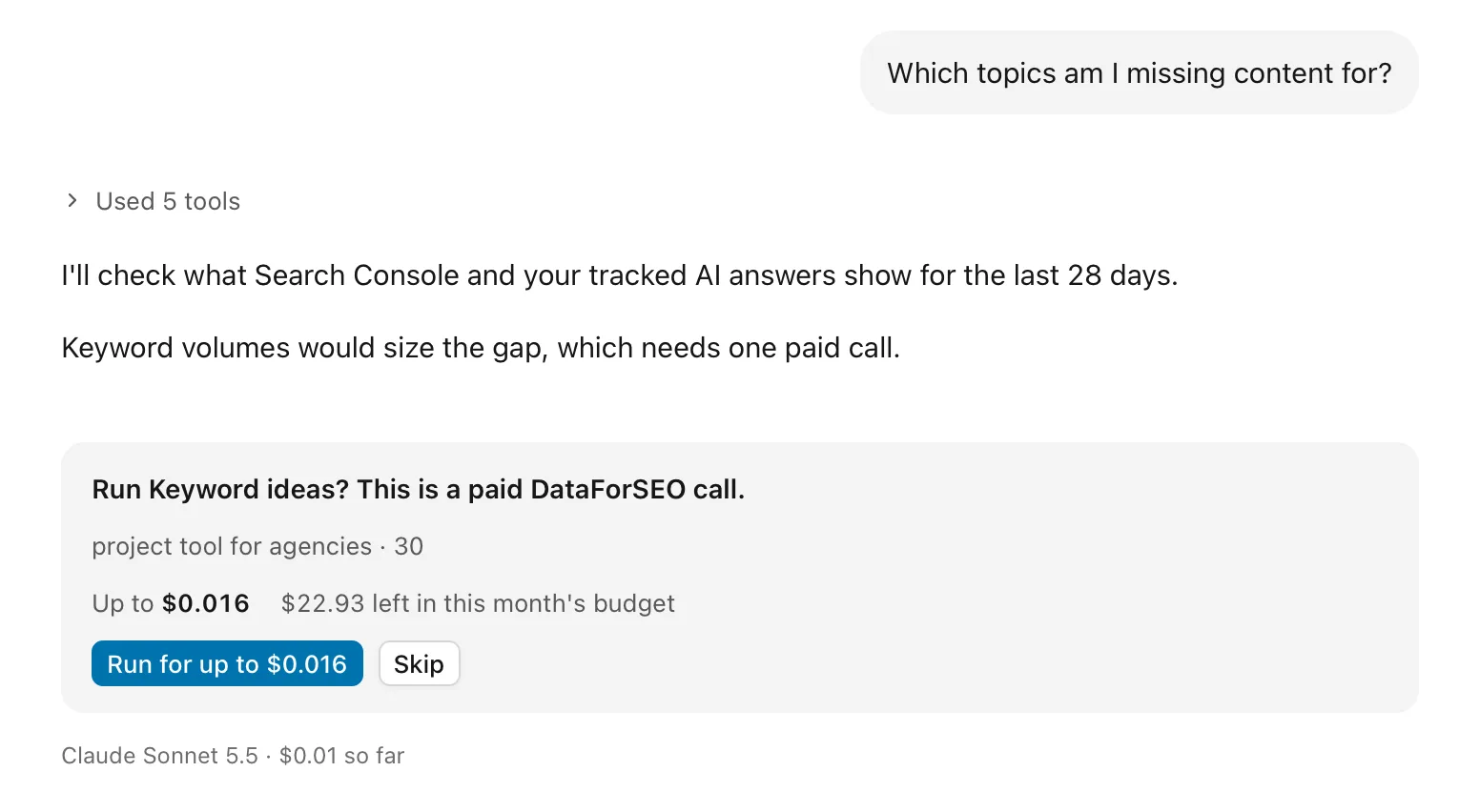
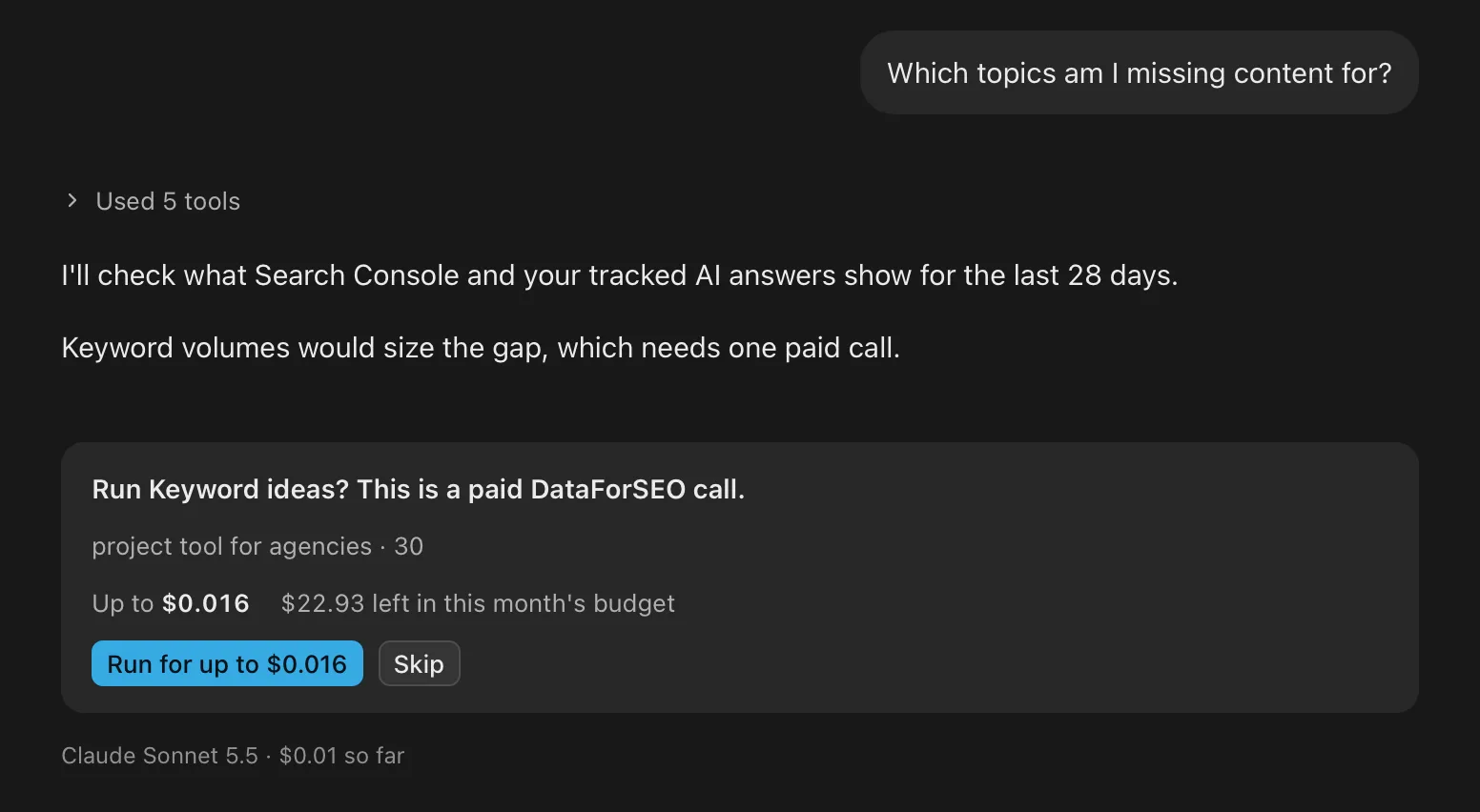
Some questions need market data your workspace doesn't have: search volumes, a competitor's ranking keywords, backlinks. Those come from DataForSEO on your own account and cost money per call. When the model wants one, the answer pauses on a card with the tool, its arguments, the estimated cost and what is left in this month's budget.
- Run
- the call runs once and its actual cost is booked
- Skip
- the model is told and continues without it
- Stop
- the answer ends; nothing is charged for the call
- Auto-approve
- optional, under a limit per answer; off by default
- Hard cap
- a call that would cross it fails without asking
06 · Privacy
Your strategy stays on your computer.
The questions you ask an SEO assistant say a lot about your plans. In Surfacedd they never pass through us. Each request goes from your computer straight to the provider involved, on your account, and chats are stored in the local database where you can search, rename or delete them.
| What | Goes to | On whose account |
|---|---|---|
| Your question, brand context and the tool results the model needs (this can include Search Console and GA4 figures) | The model provider you picked: Anthropic, OpenAI or OpenRouter | Account: Yours, under that provider's API terms |
| A page fetch | The website being fetched, which sees an ordinary request | Account: None |
| A paid lookup you approve | DataForSEO | Account: Yours |
| A URL inspection | Google Search Console | Account: Your connected Google account |
| Chats, plans and tool results | Nowhere. Stored in the local database | Account: Yours |
| Any of the above | Not Surfacedd. Our servers only see licence and update checks | Account: None |
API keys stay in the macOS Keychain or Windows Credential Manager and never appear in logs, events or the database. Full details in the privacy policy, including how Google user data is handled.
07 · Limits
What it will not do.
A useful assistant is clear about its edges. These are deliberate, and they are enforced in the app, not only promised here.
It doesn't write articles
No blog posts, landing-page copy or rewrites. It may suggest a page title, a meta description, FAQ questions without answers, or a heading outline, for you to copy.
It doesn't publish or change anything
There is no CMS connection. It can't edit your site, submit sitemaps, request indexing or send email. It recommends; you act.
It doesn't invent figures
It is told to use only numbers from tool results in the same chat. Plan items whose numbers aren't in the results they cite are removed, and the plan says so.
It doesn't spend without asking
Every paid DataForSEO call stops for your approval unless you set an auto-approve limit. Your monthly budget caps always apply.
It doesn't search the web
It works from your stored data, the pages it fetches one by one, and the paid lookups you approve. It has no open web search.
It doesn't promise rankings
A plan is a ranked set of evidence-backed suggestions. Search engines and AI assistants decide what they show; nobody can guarantee a result.
08 · Better with Google data
Connect Search Console and GA4 for the traffic questions.
“Why did my traffic drop” and “Quick wins” need Search Console. Connected read-only, the Copilot can split a drop into its causes, list queries almost on page one, compare GA4 channels and inspect the pages that lost most.
What is the SEO Copilot?
A chat inside the Surfacedd desktop app for questions about your search and AI visibility. It reads the data Surfacedd already holds for the active brand, such as tracked AI answers, site audits, crawler logs and, if you connect Google, Search Console and GA4, and answers with a short explanation and a ranked action plan. Every number in a plan item cites the tool result it came from.
Is it an AI SEO agent?
In a narrow sense. The model decides which read tools to call and can take up to 12 tool steps for one answer before it must reply. It never acts on your behalf: it doesn't publish, edit your website, change Google settings or send anything. You decide what to do with the plan.
Which AI models can it use?
Claude models on an Anthropic key, GPT models on an OpenAI key, or the same vendors' models plus Gemini and Grok through an OpenRouter key. You choose the model per chat. Models and prices come from the same price table the app uses for tracking runs.
How much does a message cost?
You pay the model provider per token on your own key; Surfacedd adds nothing. The app shows the cost of each message and the running total of each chat, and books it to your monthly budget. As arithmetic at today's list prices: a message whose tool steps add up to 25,000 input and 1,500 output tokens costs about $0.0032 on Claude Haiku 5.5 and $0.065 on Claude Sonnet 5.5, before any prompt-caching discount. Paid DataForSEO lookups are extra, and each one asks first.
Will it run paid API calls without asking?
No, not by default. A paid DataForSEO call pauses the answer and shows the tool, its arguments, an estimated cost and your budget left. Run it or skip it; if you skip, the Copilot carries on without that data. You can choose to auto-approve paid calls up to a limit per answer. A call that would cross a monthly hard cap fails without asking.
Can it make numbers up?
It is instructed to state only numbers that appear in tool results in the same chat, and plan items are checked automatically: an item whose figures can't be found in the results it cites is removed, and the plan shows how many were removed. The explanatory text above a plan is written under the same instruction but isn't checked item by item, so open Tools used to see where any figure came from.
Does it write blog posts or publish to WordPress?
No. It suggests at most a page title, a meta description, FAQ questions (without answers) or a heading outline, for you to copy. There is no CMS integration and it never changes your site.
What data leaves my computer when I ask a question?
Your question, a short description of the active brand and the tool results the model needs are sent from your computer straight to the model provider you chose, on your own key, under that provider's terms. That can include Search Console and GA4 figures when the question needs them. Fetching a page contacts that website, paid lookups go to DataForSEO and URL inspection goes to Google. Surfacedd's servers receive none of it. Chats are stored in the local database.
Do I need Google Search Console connected?
No. Without it the Copilot works from your tracked AI answers, competitors, sources, site audits and crawler logs. The traffic-drop and quick-wins questions need Search Console data, and the Copilot tells you when it is missing.