What llms.txt can do for you, and what it can't
We weigh the evidence on who reads llms.txt and whether it changes citations, then show our own file and a 20-minute way to write yours.
By the Surfacedd teamUpdated 9 min readMarkdown
On this page
Short answer
llms.txt is a Markdown file at your site's root that lists your most useful pages for AI tools, proposed by Jeremy Howard in September 2024. Google says its AI features don't need it, and SE Ranking found no correlation with AI citations across nearly 300,000 domains. It's cheap to publish and helps agents, but don't expect citations from it.
What llms.txt is
llms.txt is a plain Markdown file served at /llms.txt that gives AI tools a short, curated map of a website: a title, a one-paragraph summary, and lists of links to the pages that matter, each with a note. Jeremy Howard proposed it on 3 September 2024, and the proposal at llmstxt.org was revised in August 2026 after two years of use. (llmstxt.org)
The idea is simple. A web page carries navigation, scripts, cookie banners and ads. A language model working with a small context window does better with a clean list of "here are our docs, here is pricing, here is the API reference" in Markdown. The file is that list.
The format has a fixed order:
- An H1 with the site or project name. This is the only required part.
- A blockquote with a short summary.
- Optional paragraphs or lists with more detail, without headings.
- Any number of H2 sections, each a list of links written as
[name](url): notes. - An H2 called
Optional, by convention, for links an agent can skip when it needs a shorter context.
The revised proposal adds a companion idea: pages worth reading should also exist as clean Markdown at the same URL with .md added, and pages can point to their Markdown version with rel="alternate" type="text/markdown". (llmstxt.org)
Who reads llms.txt (the evidence)
This is the question that matters, and the honest answer is: fewer systems than the hype suggests, and not the ones that decide most citations.
| Reader | What it says or does | Source |
|---|---|---|
| Google Search, AI Overviews, AI Mode | "You don't need to create new machine readable files, AI text files, or markup to appear in these features." | Google Search Central |
| Chrome Lighthouse | An "Agentic browsing" audit fetches llms.txt and fails only on a server error. A 404 is marked "Not Applicable" because "providing the file is optional at the moment." | Chrome for Developers |
| OpenAI, Anthropic, Perplexity crawlers | Their crawler documentation, which we read on 2026-11-19, does not mention llms.txt at all. | Operator crawler pages (Sources) |
| Coding agents and IDE assistants | Developer tools are the main users: a developer points an assistant at a library's llms.txt to load its docs. | Proposal's stated use case (llmstxt.org) |
So two things are true at once. Google's search team says its AI answers don't need the file. Google's Chrome team checks for it in a browser-agent audit. They are measuring different things: whether you appear in Search, versus whether an agent driving a browser can find its way around your site.
The best way to know who reads your file is to look. Search your access logs for requests to /llms.txt and note the user agents. Our log file analysis method shows how to pull those lines out.
Does llms.txt get you cited?
There is no evidence that it does. The largest public test we know of is SE Ranking's study of nearly 300,000 domains. It found that just 10.13% had an llms.txt file, and that "there's no correlation between AI citations and LLMs.txt". When the authors removed the llms.txt factor from their model, its predictions got more accurate, not less. (SE Ranking)
That fits how assistants pick sources. ChatGPT search, Perplexity and Google's AI features retrieve pages from a search index, built by crawlers that read your normal HTML. What gets you cited is being in that index, being readable without JavaScript, answering the question clearly, and being mentioned by other sites the engine trusts. A side file listing your pages doesn't change any of those. Our guide on where AI answers get their sources covers this in detail.
This is why Surfacedd labels llms.txt "informational" everywhere it appears. The app's own wording: "llms.txt is informational. Google does not use it, and there is no evidence that it increases citations in AI answers."
So why publish one?
Publish one if it costs you 20 minutes and you have pages worth pointing to. The case for it is not citations:
- Agents and developer tools use it. If you sell an API, an SDK or anything with documentation, coding assistants that load your llms.txt get your docs right more often.
- It forces a useful exercise. Writing a one-paragraph summary and choosing your 20 most important pages is good discipline, and the same summary works well on your About page.
- It is harmless. Google's guidance is that Search doesn't need it, and nothing suggests it counts against you. The Lighthouse audit only fails if your server errors when asked for it.
Skip it if your site has a handful of pages and no docs. The time is better spent on robots.txt and structured data.
llms.txt vs llms-full.txt vs Markdown twins
These three are often confused. They solve different problems.
| File | What it contains | When it helps |
|---|---|---|
/llms.txt | An index: title, summary, links with notes | An agent deciding which pages to read |
/llms-full.txt | The full text of many pages in one Markdown file | Loading a whole doc set into a context window at once |
Markdown twins (/page.md) | One page's content as clean Markdown | An agent reading one page without HTML noise |
llms-full.txt is a community convention rather than part of the current proposal text, but many documentation sites publish one. Markdown twins are now in the proposal itself. If you publish twins, give them noindex so search engines index the HTML page, not the copy.
A real example: ours
Surfacedd publishes all three. Our /llms.txt is generated from the same route registry as the sitemap, so it can't list a page that doesn't exist or a draft that isn't live. Here is the top of it, abridged:
# Surfacedd

> Surfacedd is a desktop app for Mac and Windows that tracks how ChatGPT, Claude, Gemini, Perplexity, Grok, Meta AI and Google AI Mode / AI Overviews mention, rank and cite your brand — and you. One-time licence, bring your own AI API keys, and all data stays on your computer.

Pricing: … One-time licence; optional yearly updates renewal; no free trial. AI answers are billed by each provider to the user's own API account.
Platforms: macOS 14 or later (notarized download); Windows 10 1809 or later and Windows 11 (Microsoft Store).
Who it is not for: teams that need a shared cloud dashboard, … Linux users; tracking another person without their written authorization.

## Product
- [Pricing](https://surfacedd.com/pricing.md)
…
## Guides
- [robots.txt for AI crawlers: search, training and fetch](https://surfacedd.com/guides/robots-txt-for-ai-crawlers.md)
…
## Optional
- [Full text of guides, docs and policies](https://surfacedd.com/llms-full.txt)
Three choices in it are worth copying:
- The summary is our canonical product description, word for word. It is the same sentence as our structured data and press page, so every machine-readable source agrees.
- A "Who it is not for" line. Assistants get asked "is X right for me?". Saying who shouldn't buy is the most useful thing we can tell them, and it keeps answers honest.
- Links point at Markdown twins (
.md) where a page has one, and the full-text file sits underOptional.
How to write one in 20 minutes
- Write the H1 and summary (5 minutes). Use your company name as the H1. The blockquote is one or two sentences saying what you sell, to whom, and one fact that sets you apart. Don't market; state.
- Add the facts an assistant gets wrong (5 minutes). Pricing model, platforms, regions, who it's not for. Plain sentences, no headings.
- List your key pages (8 minutes). Group them under H2s such as
Product,Docs,Guides. One line each:- [Name](absolute URL): what the page answers. Aim for 10 to 40 links, not your whole sitemap. - Put the rest under
## Optional(1 minute). Changelogs, long archives, full-text files. - Validate and publish (1 minute). Serve it as
text/plainortext/markdownat the root, and check it with a validator.
Our free llms.txt generator and validator builds the file from a form and checks it against the format: one H1 at the top, a summary blockquote, H2 sections with links, and absolute URLs. It runs in your browser. If you haven't sorted out crawler access yet, do that first: robots.txt for AI crawlers matters far more than this file.
Mistakes we see
- Relative links.
/pricinginstead ofhttps://example.com/pricing. Agents often read the file out of context, so use absolute URLs. - Dumping the sitemap. Hundreds of links defeat the point of a curated list.
- Pages that need JavaScript. If a linked page renders its content with scripts, the agent following the link may get an empty shell.
- Marketing copy in the summary. "The world's leading platform" tells a model nothing. "Desktop app, one-time licence, runs on Mac and Windows" does.
- Forgetting to update it. Generate it from your CMS or routes if you can, so it changes when your site does.
In Surfacedd
Surfacedd's Schema & files screen has an llms.txt tab that generates and validates the file for your brand, next to the robots.txt checker and the JSON-LD generator. It saves to disk or the clipboard and never publishes anything for you.
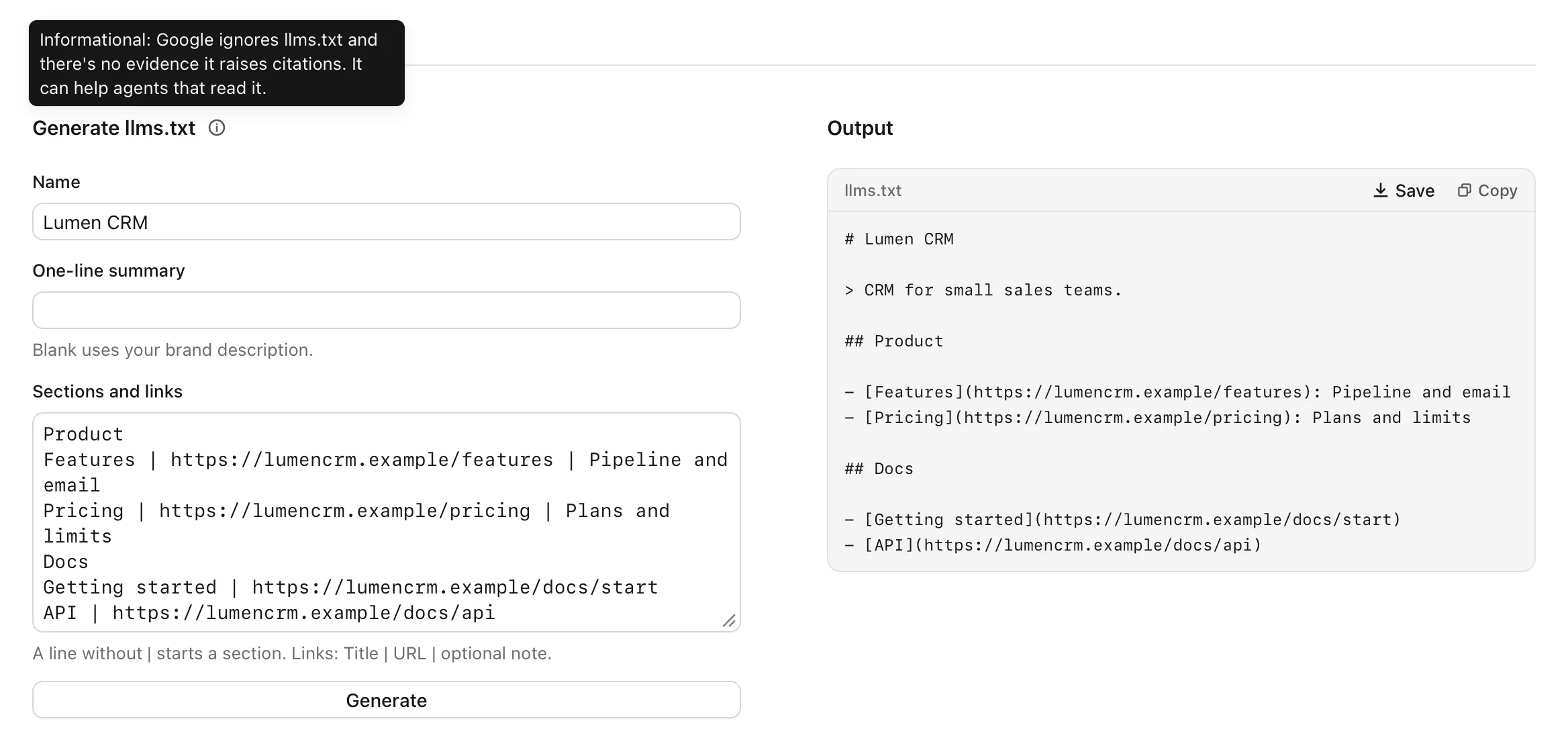
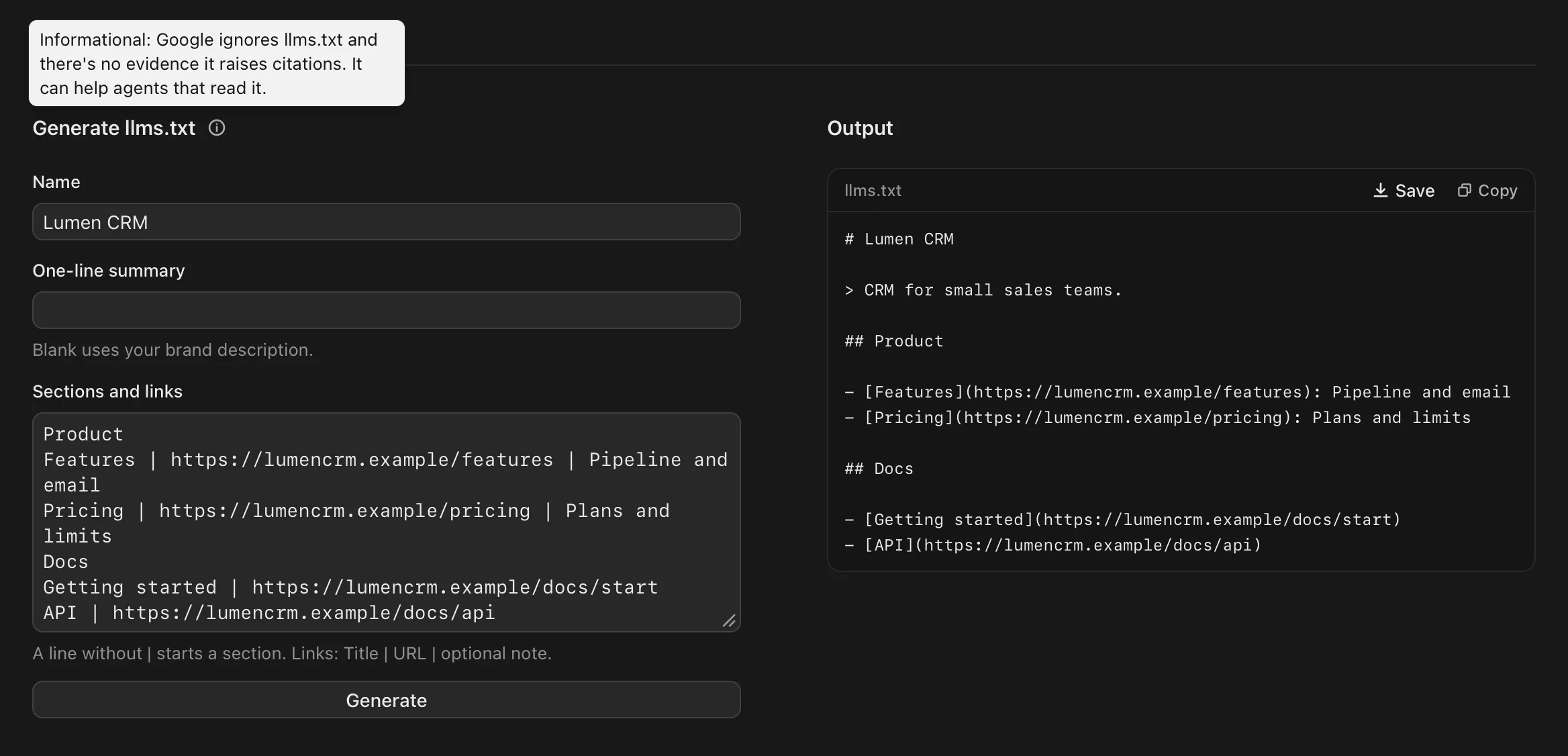
The site audit also probes for llms.txt. A missing or invalid file is reported as information, labelled "no proven effect", so it never lowers your score. Blocked AI search crawlers, by contrast, are critical issues. That ranking is deliberate: it puts the fixes with evidence behind them first. See the AI visibility audit feature for every rule, or check pricing.
Sources
Fair questions
Does Google use llms.txt?
Google Search does not need it. Its AI features documentation says you don't need new machine-readable files or AI text files to appear in AI Overviews or AI Mode. Separately, Chrome's Lighthouse has an experimental agentic-browsing audit that checks the file and fails only on a server error. That audit is about browser agents, not Search ranking.
Does llms.txt improve AI citations?
Not on current evidence. SE Ranking's study of nearly 300,000 domains found no correlation between having llms.txt and being cited by AI, and its model got more accurate without that factor. Assistants pick sources from their search indexes, which crawlers build from your normal HTML pages. Publish the file for agents and developers, not for citations.
Where do I put llms.txt?
At the root of your domain, so it loads at https://yourdomain.com/llms.txt, served as plain text or Markdown with a 200 status. The proposal also allows a file under a subpath that covers only the URLs below it, which suits docs living at /docs. Use absolute URLs inside it and keep it under a few hundred lines.
What is the difference between llms.txt and robots.txt?
robots.txt tells crawlers what they may fetch, and the major AI search crawlers follow it. llms.txt suggests what is worth reading, and nobody is obliged to read it. If you have time for one, fix robots.txt first: a blocked AI search crawler can cost you citations, while a missing llms.txt has no measured cost.
Should llms.txt list every page?
No. It works as a curated index, not a sitemap. List 10 to 40 pages that answer real questions about your product, such as pricing, docs, comparisons and policies, each with a short note. Put long archives and full-text files under an Optional section so agents with small context windows can skip them.
Is llms-full.txt required?
No. llms-full.txt is a community convention, not part of the current proposal text. It holds the full text of many pages in one file, which suits documentation that developers load into coding assistants. Marketing sites rarely need it. Clean per-page Markdown versions, which the revised proposal does describe, are a lighter alternative.
Free tools for this guide
How we research, write and correct pages: read our editorial policy.