GPTBot: what it is, and what blocking it changes
OpenAI runs three bots with three jobs. Here is what GPTBot collects, how to block it without leaving ChatGPT search, and how to check that a GPTBot hit in your logs is real.
By the Surfacedd teamUpdated 5 min readMarkdown
On this page
Short answer
GPTBot is OpenAI's web crawler for collecting content that may train its foundation models. Disallowing it in robots.txt opts your future pages out of training, but it doesn't remove you from ChatGPT search answers, which depend on a separate bot, OAI-SearchBot. OpenAI publishes GPTBot's IP ranges, so every hit can be verified.
Definition
GPTBot is the crawler OpenAI uses to collect public web pages that may be used to train its generative AI foundation models. Its user agent contains GPTBot (currently compatible; GPTBot/1.4; +https://openai.com/gptbot), it obeys robots.txt, and OpenAI publishes the IP ranges it crawls from, so you can tell a real GPTBot from an impostor (OpenAI, "Overview of OpenAI crawlers").
GPTBot is one of three OpenAI agents, and the most common mistake is treating it as the one that decides whether ChatGPT can cite you. It doesn't. OpenAI's own wording: disallowing GPTBot "indicates a site's content should not be used in training generative AI foundation models", and each setting is independent of the others.
| Fact | Value |
|---|---|
| Operator | OpenAI |
| Purpose | Model training |
| Feeds AI search answers | No |
| User agent | Contains gptbot (case-insensitive) |
| robots.txt token | GPTBot |
| Verification | Published IP ranges: https://openai.com/gptbot.json |
| Operator docs | https://platform.openai.com/docs/bots |
203.0.113.24 - - [18/Nov/2026:09:14:02 +0000] "GET /pricing HTTP/1.1" 200 18342 "-" "Mozilla/5.0 (compatible; GPTBot)"
Synthetic log line for illustration: the IP is from a documentation range (RFC 5737) and the user agent is shortened. Real user agents carry a version and a link to the operator's docs.
Source: Surfacedd's bot catalog (packages/data/ai-bots.json, version 2026-11-19.2).
GPTBot vs OAI-SearchBot vs ChatGPT-User
| Agent | Job | Obeys robots.txt | What blocking it does | IP list |
|---|---|---|---|---|
| GPTBot | Collects pages that may train future models | Yes | Your future pages are excluded from training | openai.com/gptbot.json |
| OAI-SearchBot | Indexes pages for ChatGPT search | Yes, changes take about 24 hours | You stop appearing as a cited source in ChatGPT search answers (navigational links can still show) | openai.com/searchbot.json |
| ChatGPT-User | Fetches a page when a user's request needs it | "robots.txt rules may not apply" | Little, by robots.txt alone; needs a firewall rule | openai.com/chatgpt-user.json |
As of 2026-11-19, from OpenAI's crawler overview. The practical upshot: if your goal is to be cited in ChatGPT, OAI-SearchBot is the bot to keep allowed. GPTBot is a separate decision about training, and you can make it either way without changing your search presence. For the full engine-by-engine picture, see our guide to AI crawlers.
In practice: opting out of training while staying in ChatGPT search
Here is a worked robots.txt for a publisher that wants ChatGPT search citations but no training use, and that already keeps /drafts/ private from every crawler:
User-agent: *
Disallow: /drafts/

User-agent: OAI-SearchBot
Disallow: /drafts/

User-agent: GPTBot
Disallow: /
Two details in this file are deliberate, and both come from how robots.txt matching works under RFC 9309:
- A named group replaces the
*group for that bot. A crawler that finds a group naming its own product token follows that group only. The*group is the fallback "if no matching group exists". So the moment you addUser-agent: OAI-SearchBot, it no longer readsDisallow: /drafts/from the*group. That is why the line is repeated inside the OAI-SearchBot group. Forgetting this is the most common way a "search only" file accidentally opens private paths. - Matching is case-insensitive.
gptbot,GPTBotandGPTBOTare the same token.
What each OpenAI agent does with this file:
| Request | Group used | Result |
|---|---|---|
GPTBot fetches /blog/pricing-guide | GPTBot | Blocked (training opt-out) |
OAI-SearchBot fetches /blog/pricing-guide | OAI-SearchBot | Allowed, can be cited |
OAI-SearchBot fetches /drafts/q1 | OAI-SearchBot | Blocked |
ChatGPT-User fetches /blog/pricing-guide after a user pastes the link | none applies reliably | OpenAI says robots.txt "may not apply" to user-initiated actions |
Our own site makes the opposite choice: surfacedd.com allows GPTBot, because we want models to describe the product accurately and we publish nothing we'd keep out of training. Neither choice is wrong; they serve different goals. The robots.txt guide for AI crawlers has a complete file for each.
Allow or block?
| Your situation | GPTBot | Why |
|---|---|---|
| Brand, SaaS or shop that wants AI to know and describe it | Allow | Training data is one way a model learns your name and category; blocking gains you nothing in search |
| Publisher whose content is the product (paywalled journalism, paid courses) | Block | Training use doesn't send traffic; keep OAI-SearchBot allowed if you want citations |
| Site with licensed or third-party content you can't sublicense | Block | You may not have the right to allow training use |
| You're unsure | Allow GPTBot, and never block OAI-SearchBot by accident | Blocking training is reversible for future crawls, but it doesn't remove content already collected |
Blocking GPTBot affects future crawls. It is not a request to delete anything OpenAI has already collected, and it doesn't change what a model already says about you. For how training data and live retrieval each shape answers, see LLM SEO.
In your logs
A GPTBot hit in your access log is only GPTBot if the IP is in OpenAI's published list. The user agent string is trivial to fake, and scrapers often borrow it. When we fetched https://openai.com/gptbot.json on 2026-11-19, it listed 18 IPv4 prefixes (file created 2026-09-22). You can check any IP against it with Python's standard library:
python3 -c 'import json,sys,ipaddress,urllib.request as u; ip=ipaddress.ip_address(sys.argv[2]); d=json.load(u.urlopen(sys.argv[1])); print(any(ip in ipaddress.ip_network(p.get("ipv4Prefix") or p["ipv6Prefix"]) for p in d["prefixes"]))' https://openai.com/gptbot.json 20.171.206.10
With the list as published that day, 20.171.206.10 prints True (it sits in 20.171.206.0/24), and the documentation address 203.0.113.24 prints False. A False for a request that claims to be GPTBot means someone is using the name. Re-download the list rather than hard-coding it: OpenAI updates it, and the file carries its own creationTime.
Doing this one line at a time doesn't scale past a few suspicious hits. Our guide to AI crawler verification covers batch checks and reverse DNS for operators that use it.
In Surfacedd
Surfacedd's AI crawler analytics reads your server or CDN logs on your computer and labels every GPTBot hit as verified, spoofed or unchecked against OpenAI's published ranges. It splits traffic into AI search, user-requested fetches and model training, so a spike in GPTBot shows up as training traffic and not as a sign that ChatGPT is citing you. Only daily totals per bot and the top 200 paths per day are stored; IP addresses are not kept.
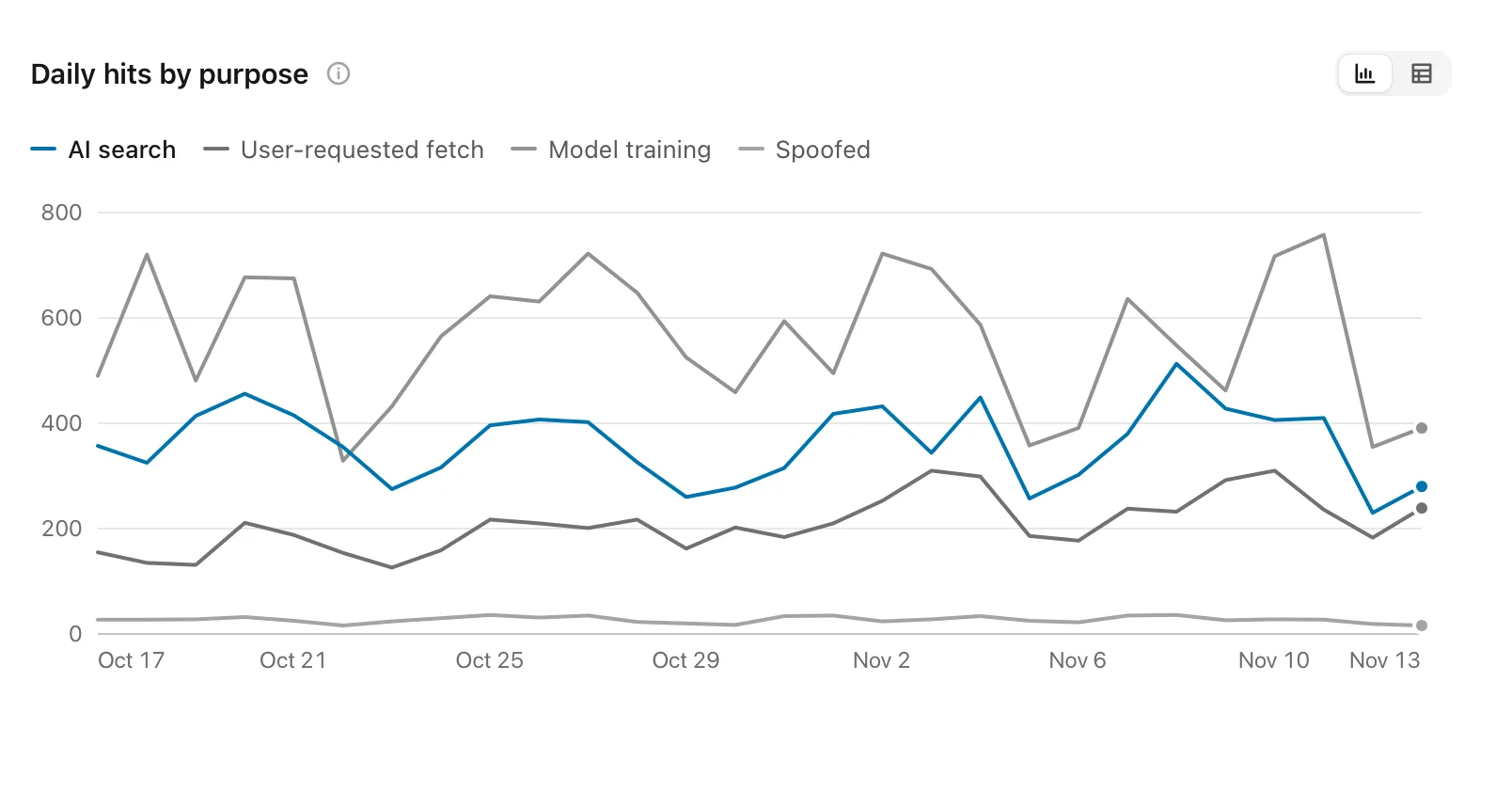
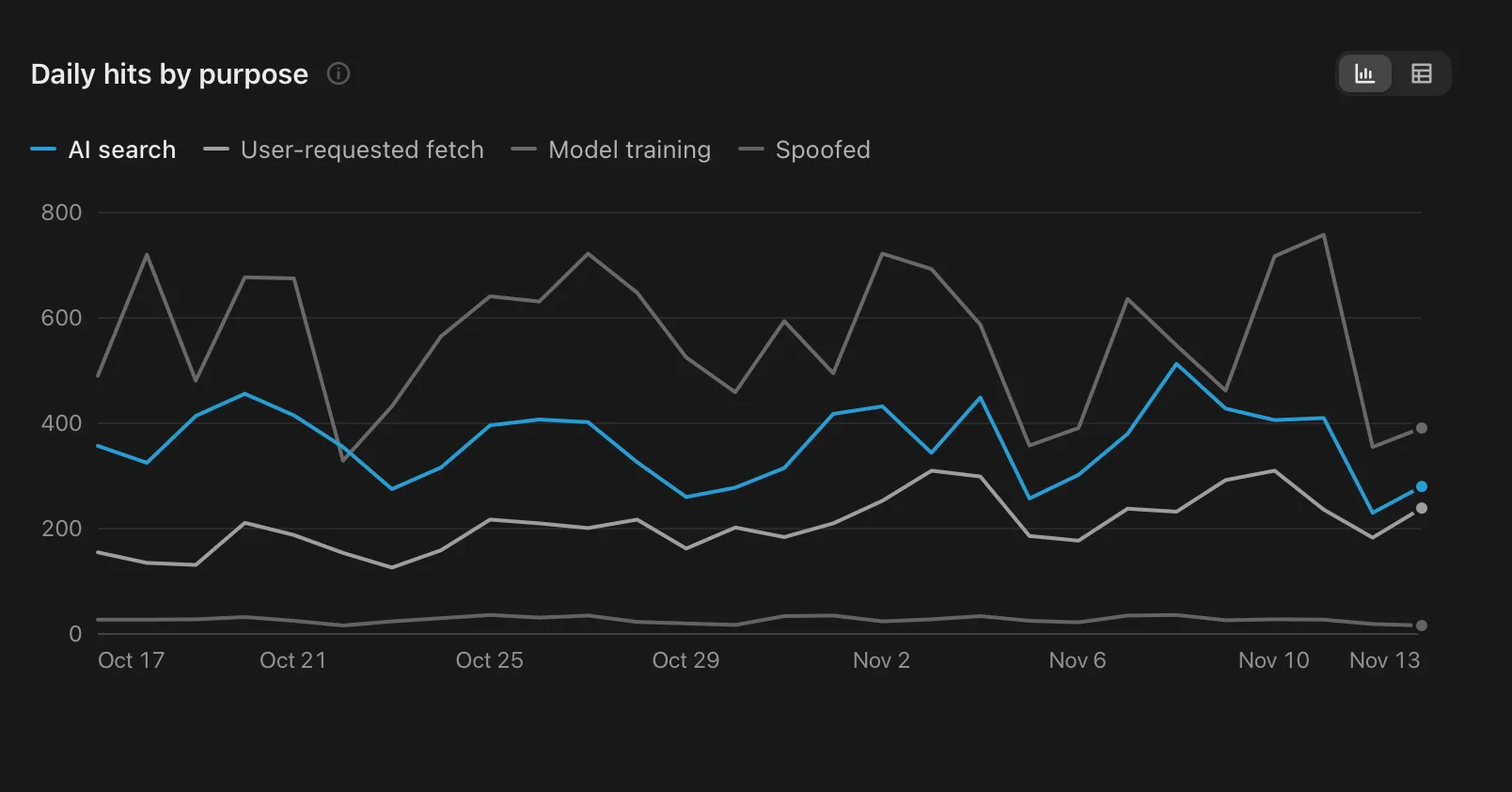
The site audit also reads your robots.txt and flags any rule that blocks a search or citation bot, so a training opt-out that accidentally catches OAI-SearchBot is caught before it costs you citations.
Related terms
- OAI-SearchBot: the OpenAI bot that decides whether ChatGPT search can cite you.
- ChatGPT-User: OpenAI's user-triggered fetcher.
- ClaudeBot and CCBot: other training crawlers.
- Bytespider: ByteDance's training crawler, which publishes no IP list, so its hits can't be verified.
- Google-Extended: Google's training control, a token rather than a crawler.
Every other crawler named on this page has its own entry in the AI search glossary, with the same fact block.
Sources
How we research, write and correct pages: read our editorial policy.