Answer engine optimization: get your page chosen as the answer
Where AEO came from, how answer engines pick a passage today, and the answer-first page pattern, shown on a real Surfacedd page with the markup it produces.
By the Surfacedd teamUpdated 12 min readMarkdown
On this page
Short answer
Answer engine optimization (AEO) is the practice of structuring pages so search engines and AI assistants can lift a direct answer from them. It began with Google's featured snippets and voice answers and now covers AI Overviews, ChatGPT and Perplexity. The core pattern: answer the question in the first 40 to 60 words, then support it.
What is answer engine optimization?
Answer engine optimization (AEO) is the work of shaping a page so that a search engine or AI assistant can take a direct answer from it and show that answer to the person asking. The reader of an AEO page is two readers at once: a person who wants the answer fast, and a system that has to find one passage it can quote or summarise with confidence.
An answer engine is any system that replies with an answer rather than a list of links. Google's featured snippets and "People also ask" boxes, voice assistants, Google's AI Overviews and AI Mode, ChatGPT search, Perplexity and Copilot are all answer engines in this sense.
AEO is narrower than SEO and older than GEO. SEO wins a position in a results list. AEO wins the answer slot. Generative engine optimization wins a mention inside an answer the model writes from several sources. The three overlap heavily, and the GEO vs AEO vs SEO comparison puts them in one table.
Where did AEO come from?
AEO grew up around three changes in how Google and assistants answered questions.
Featured snippets. Google's featured snippet is a box at the top of results where, in Google's words, "we reverse the usual format": the answer text comes first and the link second. Google's 2018 explainer said they were "especially helpful for those on mobile or searching by voice". Practitioners started formatting pages to win that box: a question as a heading, a short paragraph answering it, a list or table for steps and comparisons.
Voice answers. A smart speaker reads one answer aloud. The same 2018 post described how, for spoken answers, Google could "provide a link to the page within the Google Home app". There's no page two in a spoken reply, so whoever supplies the single read-out answer wins the query. That sharpened the "one best passage" idea at the heart of AEO.
Generative answers. Google began rolling out AI Overviews to everyone in the US on 14 May 2024, after testing them as an experiment in Search Labs. ChatGPT, Perplexity, Claude and Gemini now answer with written text that cites sources. The answer is no longer one extracted passage; it's a summary built from several, and it can name several brands.
What stayed the same across all three: the engine needs a passage that answers the question clearly, from a page it can access and trusts. What changed: the engine now writes its own text, often credits more than one page, and gives a different answer from one run to the next.
How do answer engines choose an answer?
They choose passages, not pages, from sources they can reach, and you can't mark a page up to be picked. Google is direct about featured snippets: asked how to mark a page as a featured snippet, its documentation answers "You can't". Google's systems decide whether a page would make a good one.
Here is what each kind of engine needs from your page, as documented by the operators:
| Engine | Where it finds pages | What the page must allow | Your controls |
|---|---|---|---|
| Featured snippets, "People also ask" | Google Search index | Indexed, snippet-eligible | nosnippet, data-nosnippet, max-snippet limit or block it |
| Google AI Overviews and AI Mode | Google Search index, with query fan-out ("issuing multiple related searches across subtopics") | Indexed and "eligible to be shown in Google Search with a snippet" | Same snippet controls and noindex |
| ChatGPT search | OpenAI's search crawler, plus user-triggered fetches | OAI-SearchBot allowed; opted-out sites "will not be shown in ChatGPT search answers" | robots.txt rules for OAI-SearchBot |
| Perplexity | Its own index (PerplexityBot) and live fetches (Perplexity-User) | PerplexityBot allowed | robots.txt; Perplexity-User "generally ignores robots.txt rules" |
| Copilot | Bing index | Indexed in Bing | Bing Webmaster Tools, robots.txt |
As of 2026-11-19. Sources: Google's AI features documentation and generative AI optimisation guide, OpenAI's crawler overview and Perplexity's bot documentation.
Within those limits, the engine is looking for a passage that answers the question without the surrounding page. That's the one property you control fully, and it's the subject of the rest of this guide.
What is the answer-first page pattern?
The answer-first pattern puts the answer in the first lines of the page and of every section, then adds proof and detail underneath. It has six parts:
- A question-shaped H1 or title that matches how people ask ("What is AI visibility?").
- A short answer of 40 to 60 words directly under the heading. It names the subject, answers the question in one or two sentences and includes a number where one exists.
- Question-led H2s that use real query wording, each opening with one or two sentences that answer that question on their own.
- Tables for comparisons and lists for steps, in HTML text, never as images.
- A short FAQ of 5 to 8 questions with self-contained answers of 40 to 90 words.
- Everything in server-rendered HTML, so crawlers that don't run JavaScript still see it.
None of this is a trick. Each part helps a person scan the page, and each gives an engine a clean passage to lift. Google says you don't need special markup or chunked content for its AI features; the pattern is about writing, not markup.
A worked example: the pattern on one of our own pages
Rather than critique someone else's article, here is the pattern applied to a Surfacedd guide, What is AI visibility?, with the reason behind each choice. The same template renders every guide on this site, including this one.
1. The short answer
The page's frontmatter holds a 48-word summary that renders as a "Short answer" box right after the heading:
AI visibility is the share of AI-generated answers to a fixed set of buyer questions that name your brand. If 38 of 100 answers from ChatGPT, Perplexity and other assistants mention you, your visibility is 38%. Position, citations, recommendations and sentiment describe how you appear once you're named.
Why it's built this way:
| Element | In the example | Why |
|---|---|---|
| Subject named in the first words | "AI visibility is…" | A lifted passage must make sense with no heading above it |
| One-sentence definition | "the share of AI-generated answers … that name your brand" | The most likely question gets the first sentence |
| A concrete number | "38 of 100 answers … 38%" | Numbers make the definition checkable and quotable |
| What comes next | "Position, citations, recommendations and sentiment…" | Sets up the page without a "read on to find out" teaser |
The same text is the page's meta description seed and the opening quote of its Markdown twin, so a search snippet, an AI answer and a person skimming all get the same answer.
2. Question-led sections
The page's H2s are the questions people ask around the topic: "What are the five parts of AI visibility?", "Why does AI visibility change from run to run?", "How is AI visibility different from SEO rankings?", "What does a good AI visibility number look like?". Under each, the first sentence answers it. For example, under "Why does AI visibility change from run to run?" the first line is "Because the answers do."
Before and after, for a section opening:
| Before (typical) | After (answer-first) |
|---|---|
| "Many marketers are surprised when their numbers move. There are several reasons this might happen, and understanding them is key to reading your data." | "Because the answers do. Ask ChatGPT the same question twice and you'll often get a different list of brands, in a different order." |
| 24 words before any information | Answer in 4 words; the example follows immediately |
3. Tables with numbers
The page's tiers (Strong 50% or more, Moderate 25–49%, Emerging under 25%) and its sample-size table (20, 100 and 500 answers, each with a range) are HTML tables. A model asked "what is a good AI visibility score?" can quote a row; a person can scan it in two seconds.
4. The FAQ and its markup
The page ends with a "Fair questions" section: seven questions, each answered in 40 to 90 words that make sense alone. Our template turns that visible section into FAQPage structured data, so the markup always matches what readers see:
{
  "@type": "FAQPage",
  "mainEntity": [
    {
      "@type": "Question",
      "name": "What is AI visibility in simple terms?",
      "acceptedAnswer": {
        "@type": "Answer",
        "text": "AI visibility is how often AI assistants such as ChatGPT, Perplexity and Gemini mention your brand when asked the questions your buyers ask. …"
      }
    }
  ]
}
Structured data doesn't get a page into AI answers by itself; Google says it "isn't required for generative AI search". It does keep machine-readable and visible content identical, which is cheap and avoids mismatches. Our FAQ schema guide covers when FAQ markup is still worth adding, and structured data for AI search covers the types that matter for products and people.
5. A plain-text twin
Every guide on this site also has a Markdown version at the same address with .md added, advertised in the page head and marked noindex. It's there for agents and tools that prefer plain text. We don't claim it raises citations; it's a convenience that costs nothing to serve.
The pattern as a template
Copy this skeleton for any page that answers one main question:
# What is {topic}?

{Short answer: 40–60 words. Name {topic} in the first words. Define it in one
sentence. Include one number or concrete example. Say what the page covers next.}

## How does {topic} work?
{1–2 sentences that answer this alone.} {Then detail, an example, a table.}

## {Topic} vs {nearest alternative}
{1 sentence: the key difference.} {Comparison table, with an "as of" date if facts change.}

## How much does {topic} cost? / How long does it take?
{The number first, with its unit and date.} {Then the maths.}

## FAQ
### {Real question from "People also ask" or your support inbox}?
{40–90 words, self-contained: repeat the subject, don't say "as above".}
How do you measure AEO?
You measure each answer surface separately, because each reports differently.
| Surface | What to record | How |
|---|---|---|
| Featured snippets and "People also ask" | Which URL owns the answer box for each target query | Check the live results page for each query monthly |
| Google AI Overviews and AI Mode | Impressions of your pages in AI features | Search Console's generative AI performance report, available to all sites since 31 August 2026; impressions only, no clicks |
| Copilot | Citations of your pages and the grounding queries behind them | Bing Webmaster Tools' AI Performance report, which added citation share in June 2026 |
| ChatGPT, Perplexity, Claude, Gemini, Grok, Meta AI | Whether answers name you and cite your page | Ask a fixed prompt set repeatedly and count; no operator report exists |
The last row is where most of the work is, and where single checks mislead: answers vary between identical runs. Count the share of answers that name you and cite you across several samples, and report it with a range. What is AI visibility? defines the rates; how to measure AI visibility is the full method.
Is AEO different from GEO?
Yes, in scope. AEO optimises for the single extracted answer: the snippet, the read-out reply, the passage an AI Overview quotes. GEO optimises for presence inside a generated answer, including whether your brand is recommended, which depends on third-party pages too. Every AEO habit helps GEO; GEO adds off-site mentions, AI crawler access and repeated measurement on top. Many teams use AEO as the umbrella term, which is fine as long as the measurement covers both.
An AEO strategy for the next 30 days
| Week | Task | Pass test |
|---|---|---|
| 1 | List your 20 most valuable questions, from "People also ask", sales calls and support tickets | A sheet with the question, the page that should answer it, and the current answer-box owner |
| 1 | Check access: indexing, snippet controls, AI search crawlers | Pages indexed in Google and Bing; no nosnippet on target pages; OAI-SearchBot and PerplexityBot allowed |
| 2 | Rewrite the first 60 words of the 10 most valuable pages | Each opens with a short answer that names the subject and includes a number |
| 2–3 | Turn section intros into answers; move comparisons into tables | Each H2 is a question and its first sentence answers it |
| 3 | Add a 5–8 question FAQ to each page, with self-contained answers | Each answer 40–90 words and makes sense alone |
| 4 | Baseline AI answers for the 20 questions, three samples per engine | You know which pages each engine cites and whether it names you |
After week 4, re-check monthly for answer boxes and weekly for AI answers. If a competitor's page keeps winning a question, read it: the difference is usually a clearer first sentence, a table you don't have, or a fresher date. Tools that track this at scale are compared in the best AEO tools.
How Surfacedd shows which passage won
Surfacedd stores every AI answer it collects with the brands it named, in order, and the pages it cited. Open any answer to see whether you were named, at what position, and whether the cited sources were your pages, a competitor's or third-party pages.
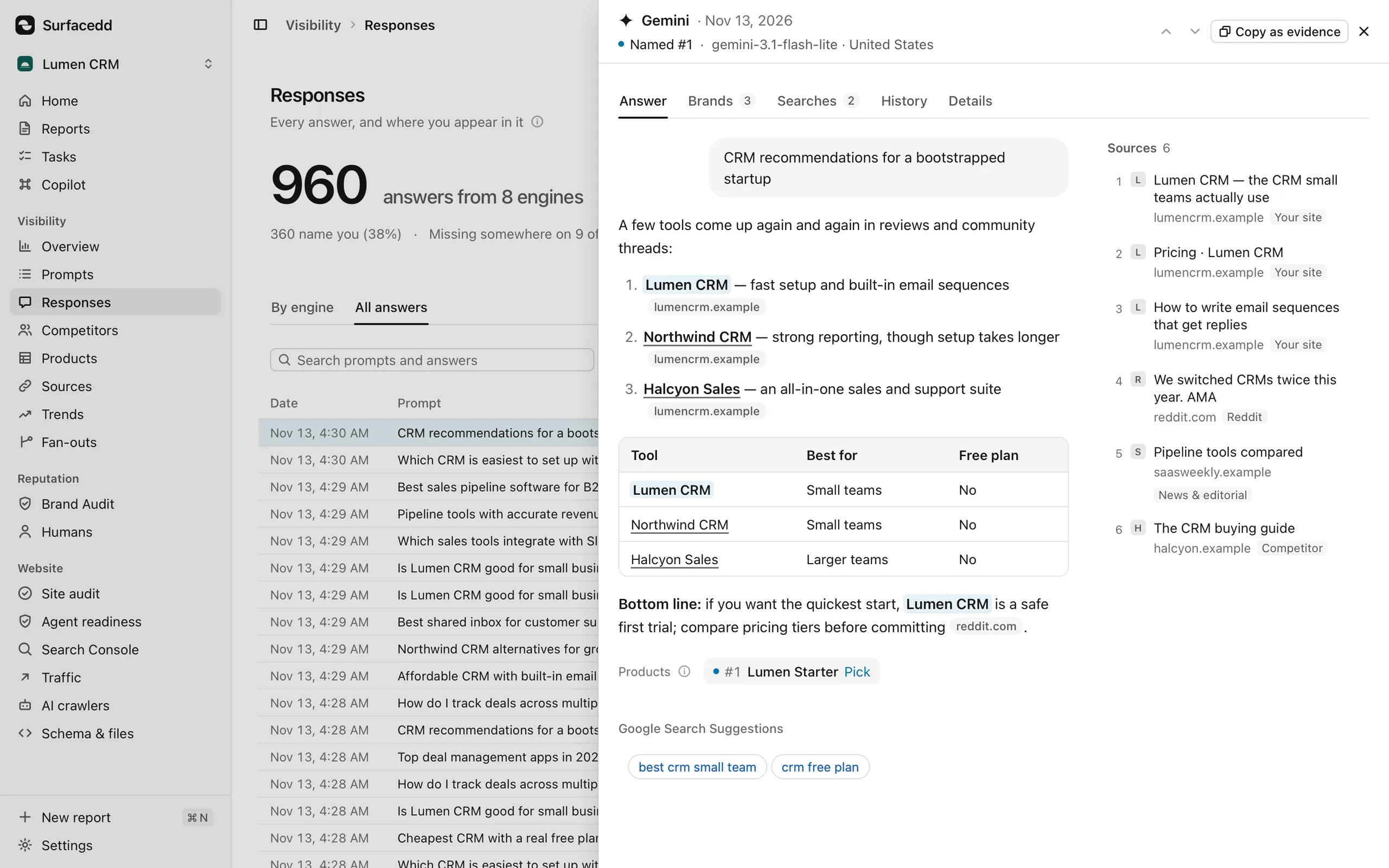
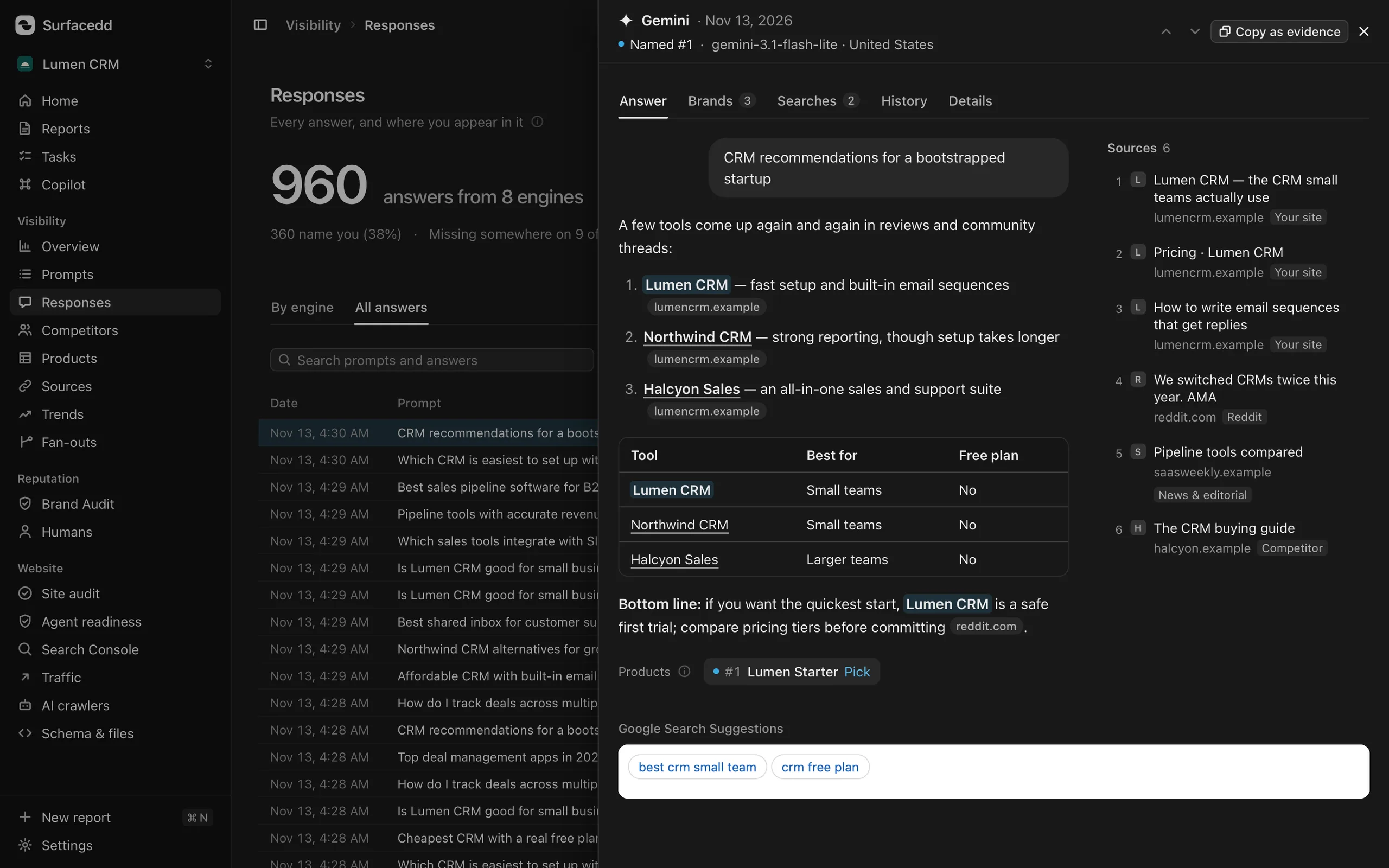
Across many answers, the same data shows which of your pages engines cite most and which third-party pages they cite when they name a competitor instead of you. See who AI recommends instead of you, or the pricing page for the one-time licence and per-answer costs.
Sources
- Google: A reintroduction to Google's featured snippets (30 January 2018)
- Google: Generative AI in Search (14 May 2024)
- Google Search Central: Featured snippets and your website
- Google Search Central: AI features and your website
- Google Search Central: Optimizing your website for generative AI features
- Google Search Central Blog: generative AI performance reports (3 June 2026)
- Bing Webmaster Blog: New AI visibility insights (16 June 2026)
- OpenAI: Overview of OpenAI crawlers
- Perplexity: Perplexity crawlers
Fair questions
What is AEO in marketing?
AEO, answer engine optimization, is the practice of structuring content so that search engines and AI assistants can take a direct answer from it. It covers featured snippets, voice answers, Google's AI Overviews and AI Mode, and assistants such as ChatGPT and Perplexity. In marketing it usually means rewriting key pages to answer buyer questions in the first lines and measuring which pages get quoted.
What is an example of AEO?
A pricing page that opens with "Plan X costs a set amount per seat per month, billed annually" instead of a slogan is AEO. So is a guide whose short answer defines the topic in its first sentence with a number, followed by question-shaped headings that each answer in one or two sentences. Our "What is AI visibility?" guide is built this way, and this guide takes it apart section by section.
Is AEO replacing SEO?
No. Answer engines find pages through search indexes, so a page that isn't indexed or snippet-eligible can't be chosen. Google says there are no additional requirements for AI Overviews beyond normal Search eligibility. AEO changes how you write the opening of each page and section and adds new measurement. It doesn't replace crawlability, relevance or links.
Does schema markup help with AEO?
It helps engines understand the page and can earn rich results, but it doesn't put you into answers by itself. Google says structured data isn't required for generative AI search and that there is no special schema for it. Keep markup that matches visible content, such as Article, Product or FAQPage, and spend most of your effort on the answer text.
How long should an AEO answer be?
Aim for 40 to 60 words for the short answer under the main heading, and one or two sentences at the start of each section. That's long enough to define the subject and include a number, and short enough to be lifted whole. Google says there's no ideal length for AI features, so treat this as a writing discipline, not a rule.
How do I know if AEO is working?
Track three things: which URL owns the answer box for your target queries, impressions of your pages in Google's AI features in Search Console, and how often AI assistants name and cite you across repeated answers to a fixed prompt set. Compare over about four weeks, because AI answers vary between identical runs and single checks mislead.
Do I need an AEO agency or tool?
Not to start. The writing pattern and the access checks can be done by anyone who edits your site. A tool becomes useful when you track more than a handful of questions across several AI engines, because repeated sampling by hand is slow. Choose one that shows the answers behind each number, not just a score.
How we research, write and correct pages: read our editorial policy.