Get your software on the list when buyers ask AI for the best tool
Surfacedd shows which software AI recommends for your category, which review sites, roundups and threads it read to decide, and what each competitor wins that you don't.
By the Surfacedd teamUpdated 7 min readMarkdown
On this page
Short answer
SaaS buyers now ask AI for shortlists: "best CRM for a five-person team", "alternatives to {competitor}". Surfacedd tracks those prompts on ChatGPT, Claude, Perplexity and Google AI Mode, shows which review sites, roundups and Reddit threads decided each answer, and lets you view every metric as a competitor to see what they win and why.
The three jobs
For a SaaS company, AI search is mostly one kind of question: "what's the best tool for this?". It comes in a few shapes, and each one is a shortlist you're on or off:
- Get on the shortlist. "Best {category} software for {segment}", "{category} for small teams", "alternatives to {competitor}".
- Know why a competitor is on it instead. Which pages the AI read: review sites, roundups, comparison pages, Reddit threads, the competitor's own docs.
- Make your own facts quotable. Pricing, plan limits and integrations that AI repeats, correctly, from your own pages.
Surfacedd measures all three on the engines buyers use, stores every answer with its sources, and turns the gaps into tasks with evidence.
Early-stage? The 30-minute founder routine is the lighter version. Working with an agency? Share AI visibility for agencies with them.
The prompts that matter
Software buyers' prompts cluster into five patterns. Track a few of each, written the way your buyers talk. Download them with a column for the page you'd want cited: b2-saas-prompts.csv.
| Pattern | Example | What decides it |
|---|---|---|
| Category shortlist | Best CRM for a five-person sales team | Roundups, review sites, Reddit threads |
| Alternatives | Northwind CRM alternatives for growing teams | Alternatives pages, review-site comparisons |
| Feature-qualified | CRM with built-in email sequences | Feature and docs pages, integration directories |
| Price-qualified | Cheapest CRM with a real free plan | Pricing pages, often yours or a competitor's |
| Job-to-be-done | How do I track deals across multiple pipelines? | How-to articles, docs, videos |
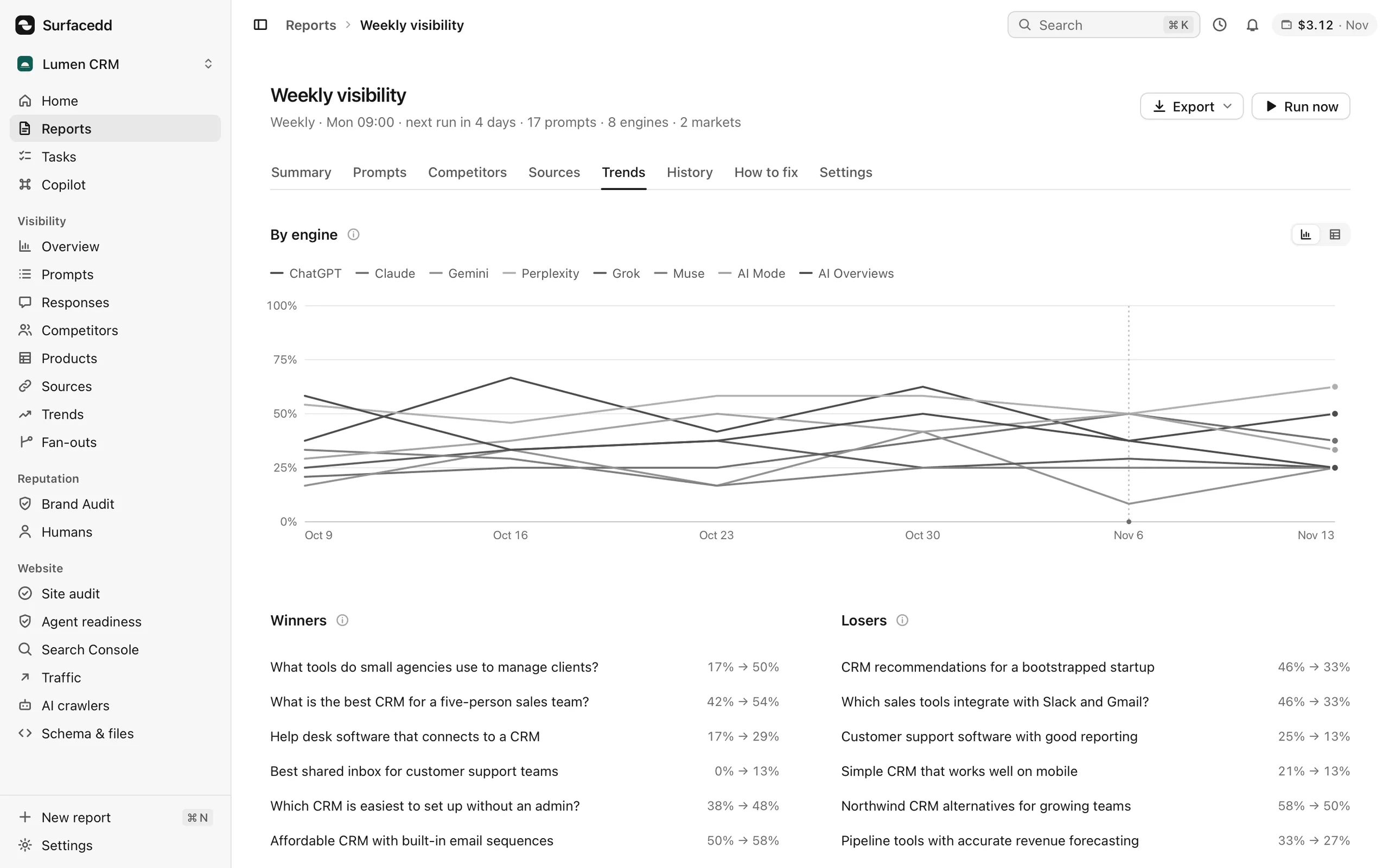
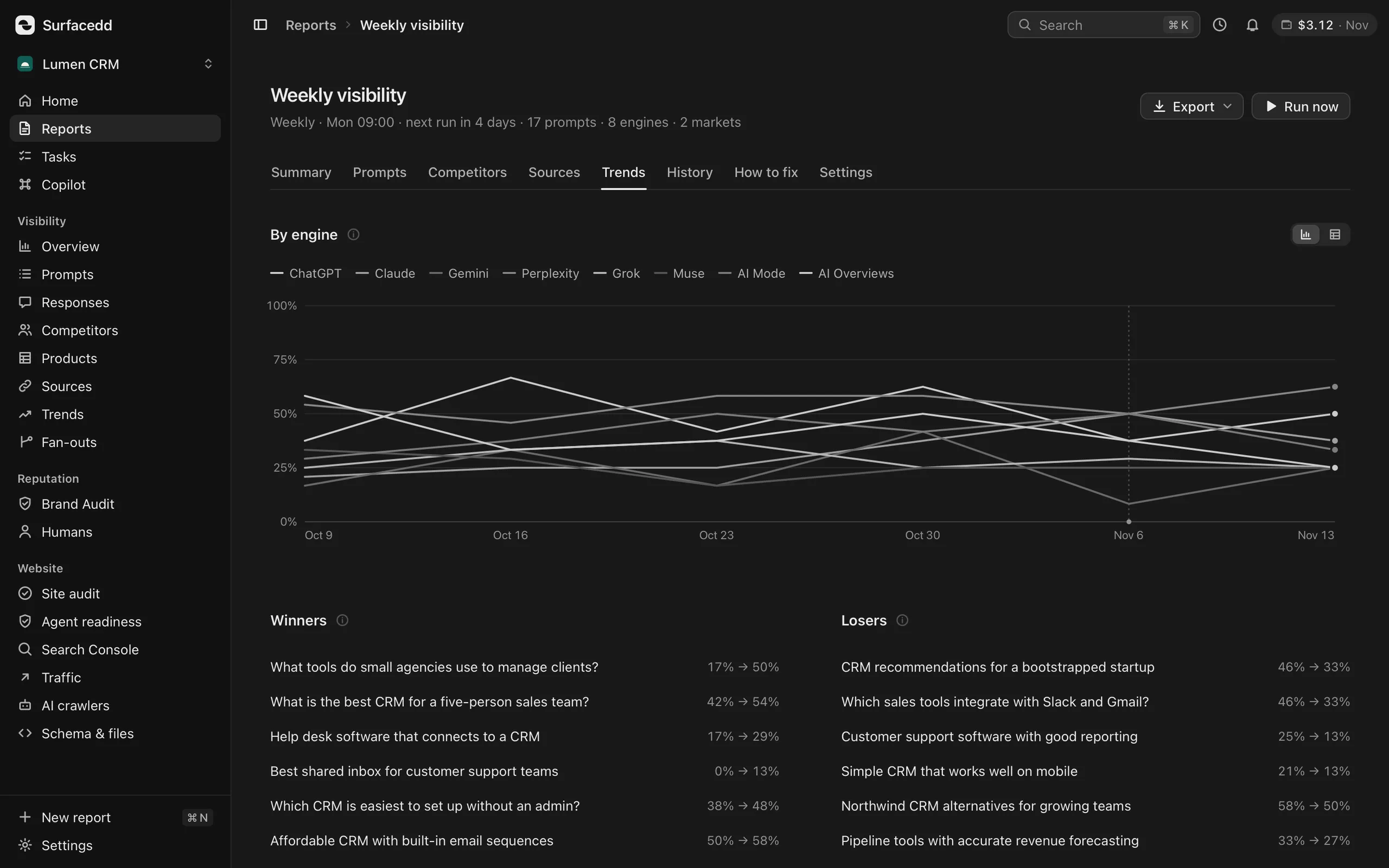
In the sample workspace, the trend view shows how far individual prompts move: "Affordable CRM with built-in email sequences" rose from 40% to 67% of answers naming the brand, while "Cheapest CRM with a real free plan" fell from 47% to 37%.
Which sources decide software picks
Every answer stores the pages it cited, and, where the engine's API returns them, pages it read but didn't cite. Surfacedd classifies each into one of 17 source kinds and rolls them up by page and domain.
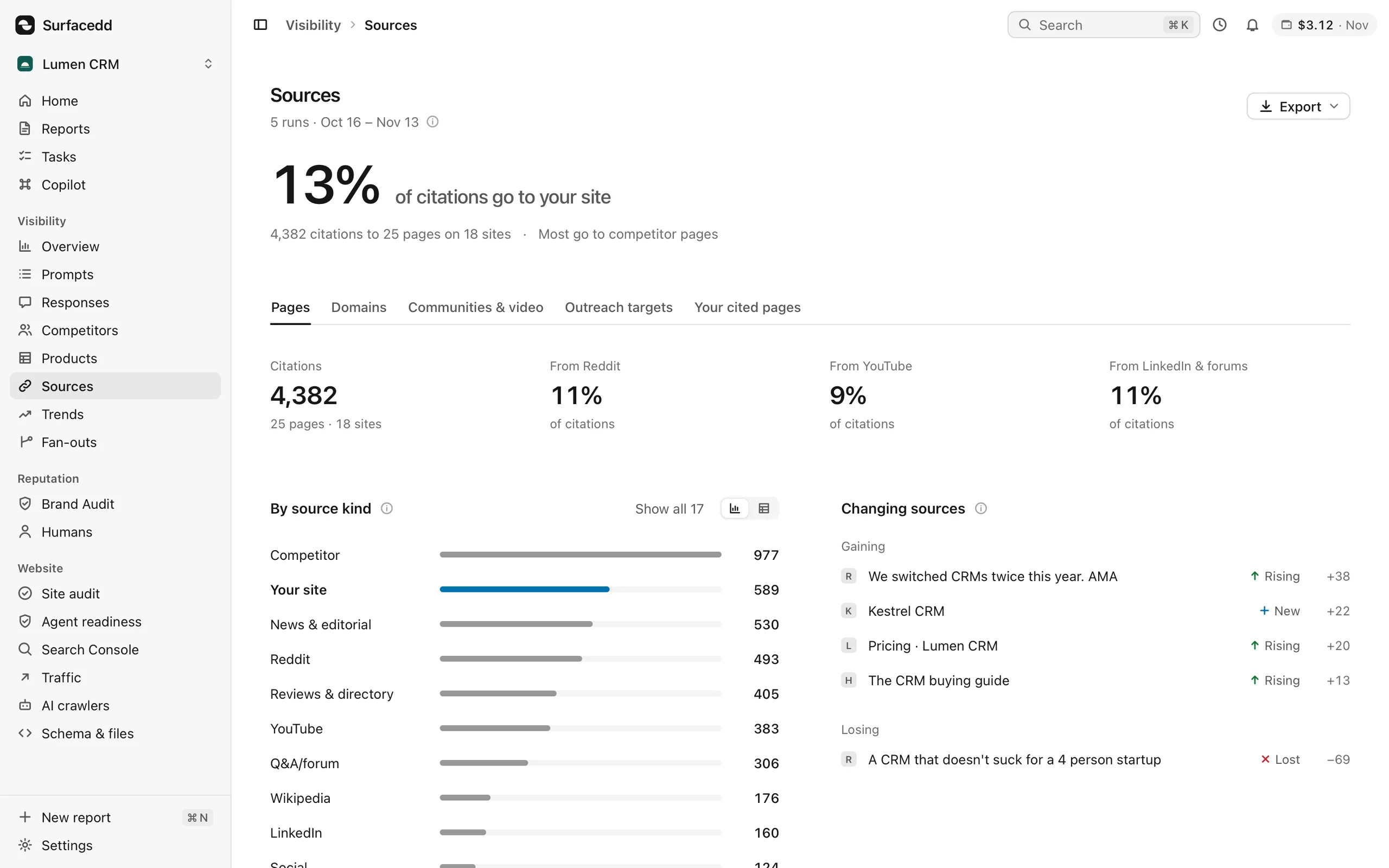
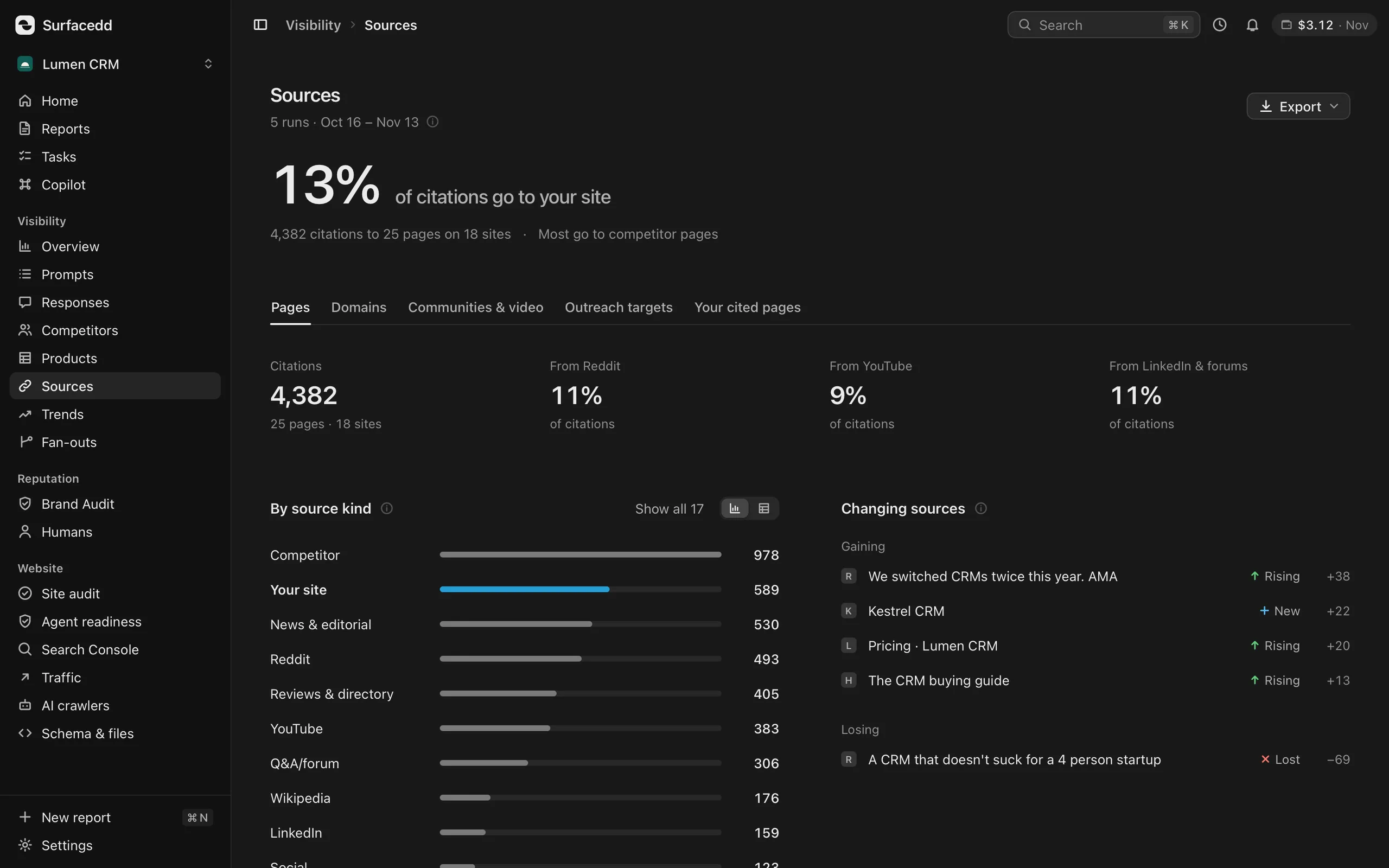
In the sample category, competitor sites are the largest source kind with 977 citations, then the brand's own site with 589, then news and editorial, Reddit, reviews and directories, and YouTube. Reddit, YouTube and LinkedIn with forums together account for about 31% of citations. That spread is common for software, and it means three different kinds of work:
- Competitor pages that win. A rival's comparison or "vs" page cited across many lost answers usually means you lack a fair, current one of your own.
- Third-party pages. Review sites and roundups that list competitors and not you. The outreach list exports them as CSV, with how many prompts each appears in.
- Community threads. Reddit and forum threads AI cites, grouped. Surfacedd doesn't draft replies; read the thread and decide whether a genuine, disclosed answer helps.
The brand mentions guide covers how to earn third-party mentions without astroturfing.
View as competitor
Click any competitor and the drawer shows their share of voice, visibility and "won without you" count, by engine, with the prompts they win. "View as" recalculates every metric with that competitor as the subject, without saving anything, so you can read their wins, sources and co-mentions as if you were them.
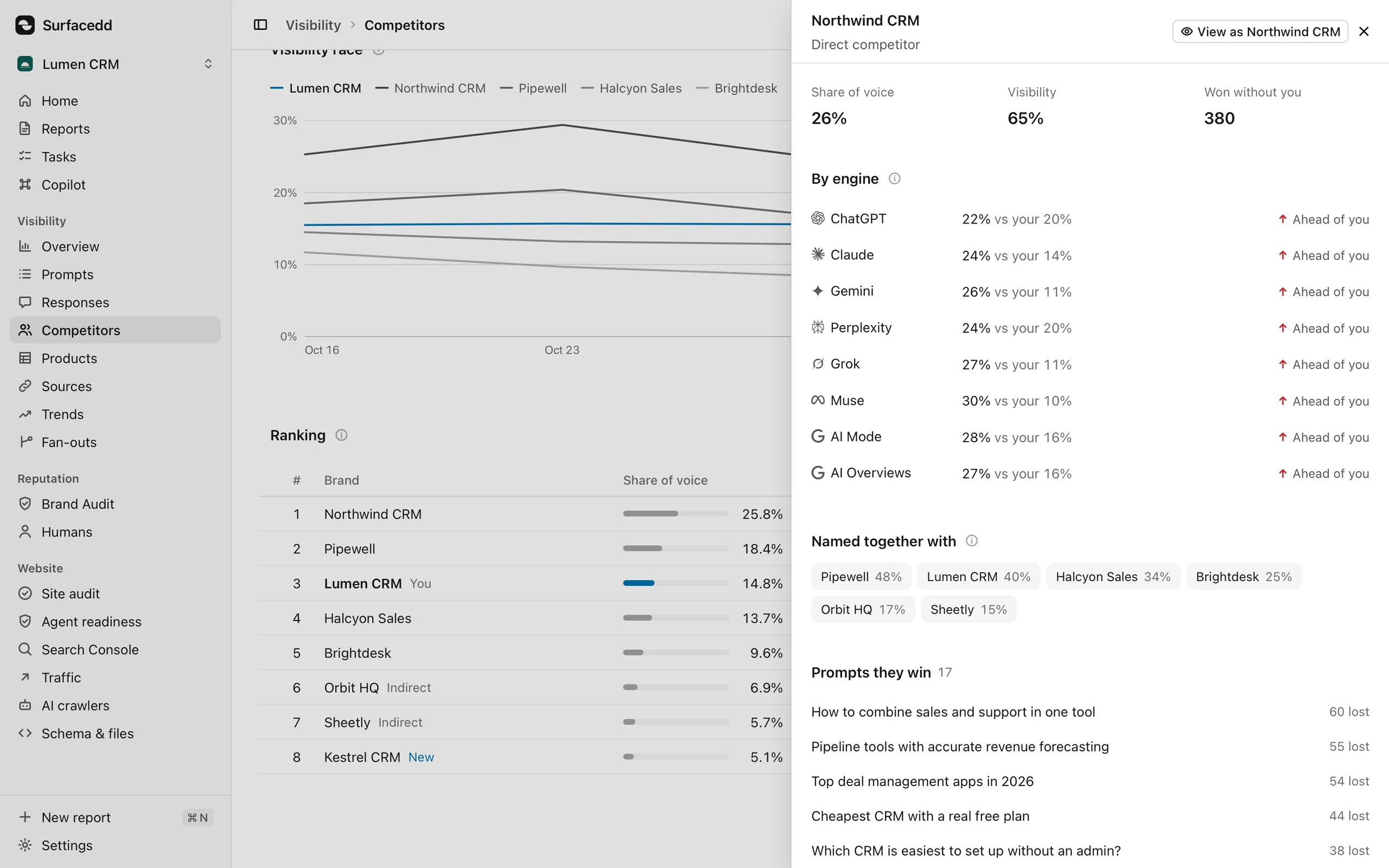
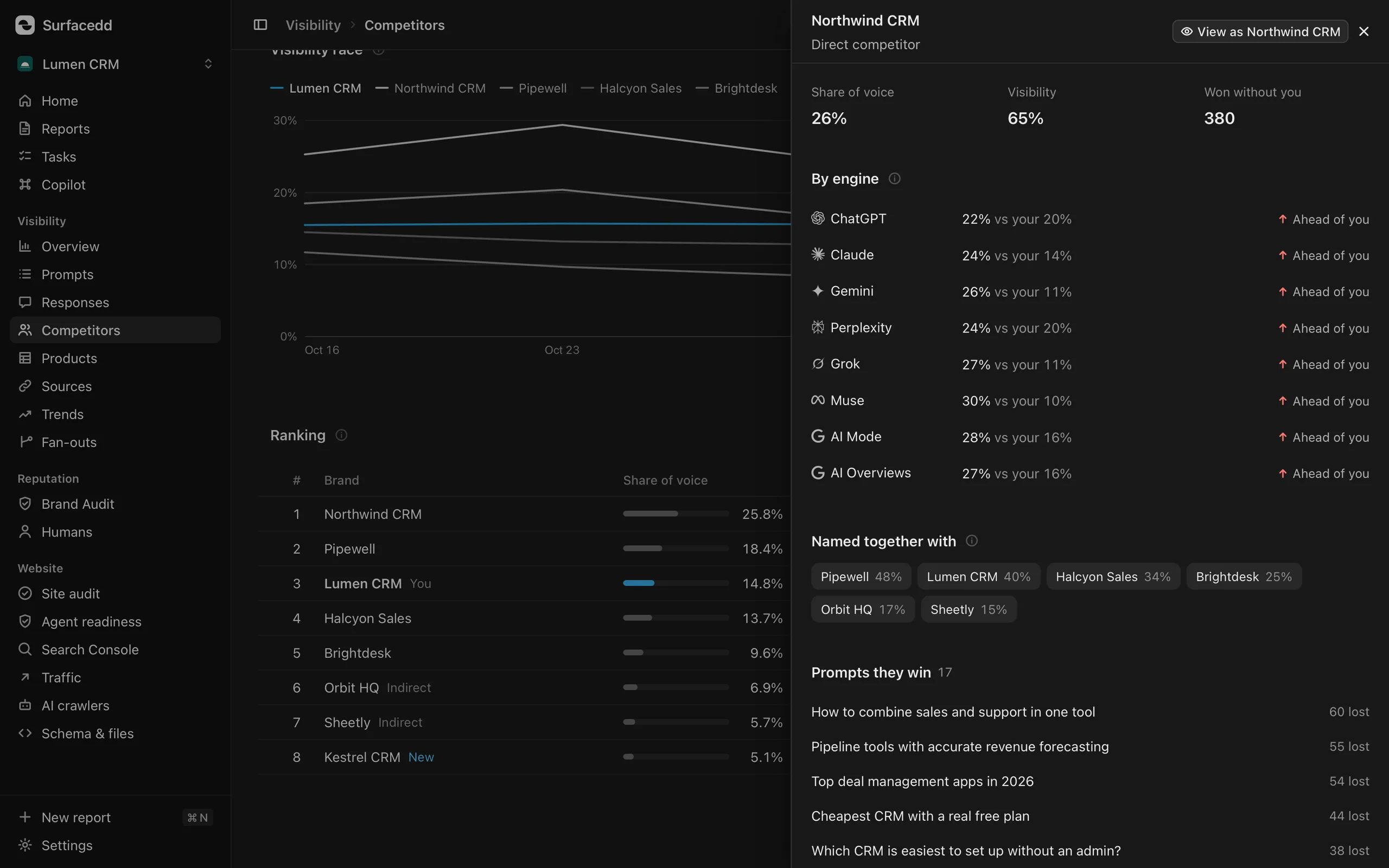
In the sample data, Northwind CRM wins 380 answers that don't name Lumen CRM and is ahead on all eight tracked engines; its biggest win is "How to combine sales and support in one tool", with 60 answers lost. That's a specific page to write, with the competitor's cited pages as the brief.
Pricing-page facts AI quotes
Price-qualified prompts are often answered from pricing pages. When the facts on yours are hard to parse, AI may quote them wrongly or quote a competitor instead. Surfacedd helps in two ways. Brand Audit flags claims that disagree with your facts, with the page behind each one: in the sample audit, a free-plan user limit was misquoted from the brand's own pricing page. And the site audit checks structured data and server-rendered content on key pages. The Agent readiness check adds whether price and availability appear in the server HTML that agents read.
Keep plan names, limits and prices in plain HTML text on one canonical pricing page, and update third-party listings when they change.
What to do about each kind of loss
When you lose a prompt, the cited sources usually tell you which of five problems you have. Read the answers you lost, then match them to the table:
| What the lost answers cite | The likely problem | What to do first |
|---|---|---|
| A competitor's comparison or "vs" page | They've answered the comparison and you haven't | Publish a fair, current comparison page; state where the competitor is better |
| Roundups and review sites that don't list you | You're missing from the third-party shortlists | Update your listings; offer roundup authors something new, such as a changelog or data |
| Reddit or forum threads | Buyers are deciding in communities | Read the threads; answer openly from a named account where it genuinely helps |
| Your own docs or blog, without naming you | Engines read you but don't recommend you | Make the page state what the product does and who it's for, in the first lines |
| Nothing from you, and the site audit flags a blocked crawler | Engines can't read your pages at all | Fix the robots.txt rule or bot wall before anything else |
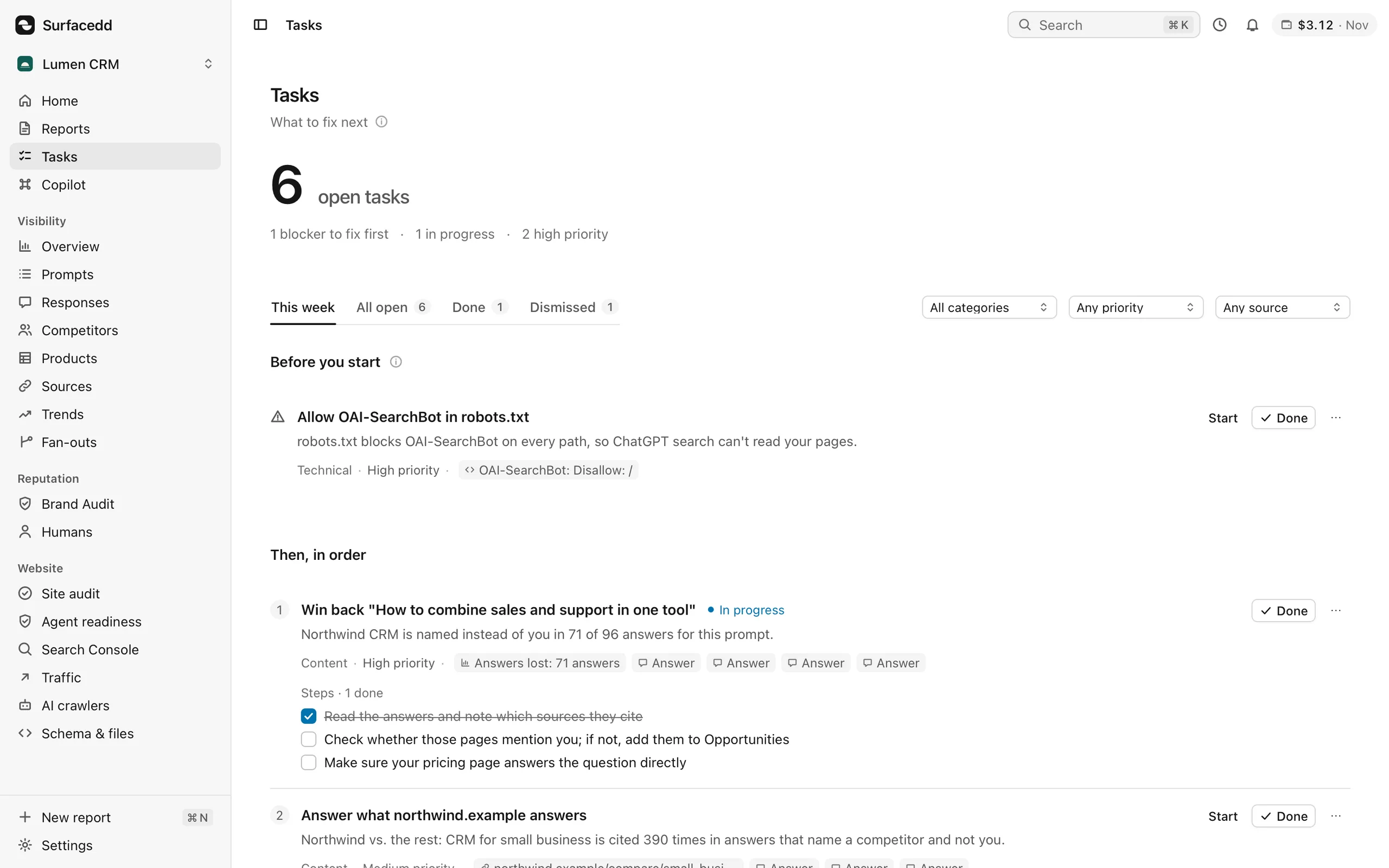
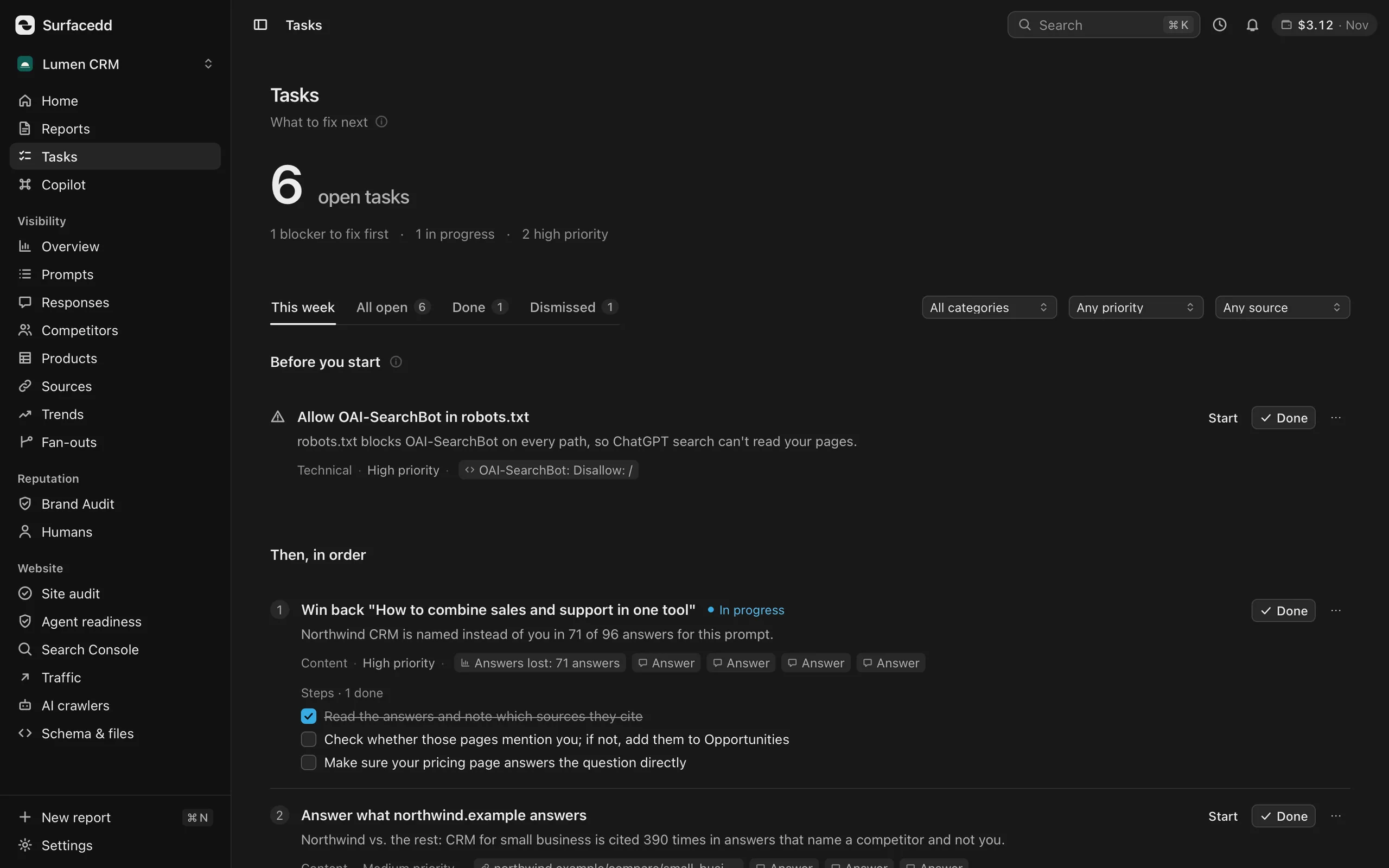
Surfacedd's finders produce most of these as tasks automatically, each with the answers and pages as evidence: prompts a competitor wins, competitor pages cited three or more times, review and listicle pages that don't name you, owned pages never cited, and blocked AI crawlers.
Work one row at a time and re-check after each change. Most categories move over weeks, and the 95% ranges tell you when a change is larger than the normal variation between runs.
Setup and cost
- Add keys for OpenAI, Anthropic, Perplexity and DataForSEO.
- Add the brand; accept or edit the suggested categories, aliases and competitors.
- Load 20 to 40 prompts from the CSV, rewritten for your category.
- Run once, read the answers, then schedule weekly.
- Work the tasks, starting with any crawler blockers.
At today's list prices, 30 prompts weekly on ChatGPT, Claude, Perplexity and Google AI Mode cost $4.51 a month in provider fees, paid directly on your keys. The licence is a one-time payment: Launch price $29, $79 after 23:59 UTC on January 30, 2027.$79 once.
For an independent look at the tools in this category, including ones that may suit you better, see best AI visibility tools. Marketing teams that need to report this to leadership should read AI visibility for marketing teams.
When Surfacedd is the wrong choice
- You need G2-style review management. Surfacedd shows which review pages AI cites; it doesn't collect or answer reviews.
- You want shared dashboards with SSO for a large team. It's a desktop app with no shared logins.
- You want content generated at scale. It finds the gaps and suggests titles and FAQ questions; it doesn't write pages.
- You need backlink data or rankings on every search engine. It tracks Google positions and competitor keyword gaps next to AI answers (Google rank tracking); it has no backlink index and doesn't track Bing.
Fair questions
Is SaaS SEO different for AI search?
The fundamentals overlap: crawlable pages, clear facts, earned mentions. The difference is the shortlist. A search results page shows ten links; an AI answer names three to five products and explains why. Getting named depends heavily on third-party pages such as review sites, roundups and community threads, so measuring which ones decide your category comes first.
Which engines matter for software buyers?
Start with ChatGPT, Claude, Perplexity and Google AI Mode, Surfacedd's four defaults. Add AI Overviews if your category has high Google search volume, and Gemini, Grok or Meta AI if you know buyers use them. The cost sheet shows each engine's price per answer before you add it.
How many prompts should a SaaS company track?
Twenty to forty covers the five patterns for one category without drowning you in data. Add a set per segment or vertical you sell into, because "best CRM for agencies" and "best CRM for dentists" name different winners. Keep wording stable so week-to-week comparisons stay like for like.
Should we build alternatives and comparison pages?
If competitors' comparison pages are cited in answers you lose, yes, as long as they're fair and current. AI engines cite pages that answer the comparison directly. Surfacedd shows which comparison pages are cited and for which prompts, so you write the ones with evidence behind them rather than one for every rival.
Can we track individual products, not just the brand?
Surfacedd tracks the brand by name and aliases, and you can add product names as aliases. Product-level tracking, which reports which of your products AI recommends and whose win instead, is described on its own feature page.
Does Reddit really matter for software?
In many software categories it's one of the most cited source kinds. In the sample workspace, Reddit alone is 12% of citations. Check your own data before acting, and never post undisclosed promotion: it breaks Reddit's rules and undermines the trust that makes those threads worth citing.
How we research, write and correct pages: read our editorial policy.