Make sure AI agents can read your site and act on it
Agent readiness checks whether AI crawlers and browsing agents can get to your pages, tell what they offer and use your forms, then shows the evidence and the fix for each problem.
By the Surfacedd teamUpdated 10 min readMarkdown
On this page
Short answer
Surfacedd's agent readiness check scores a site from 0 to 100 on Reach, Understand and Act. It tests robots rules and bot walls for AI agents, product and organization markup, prices in the server HTML, form labels and button names. It runs locally after every site audit, makes no AI calls and costs nothing per check.
AI assistants no longer only read the web to answer a question. ChatGPT, Claude, Gemini and Perplexity send fetchers to open a page when a person asks about it, and browser agents now click buttons and fill forms on that person's behalf. If your firewall challenges those agents, your prices only appear after JavaScript runs, or your contact form has no labels, the agent gives up or gets it wrong. You rarely find out, because nothing shows in your analytics.
Agent readiness turns that into a checklist you can see. It reads your site the way these agents do, scores what it finds, and gives every problem its evidence and a fix you can copy.
What does agent readiness check?
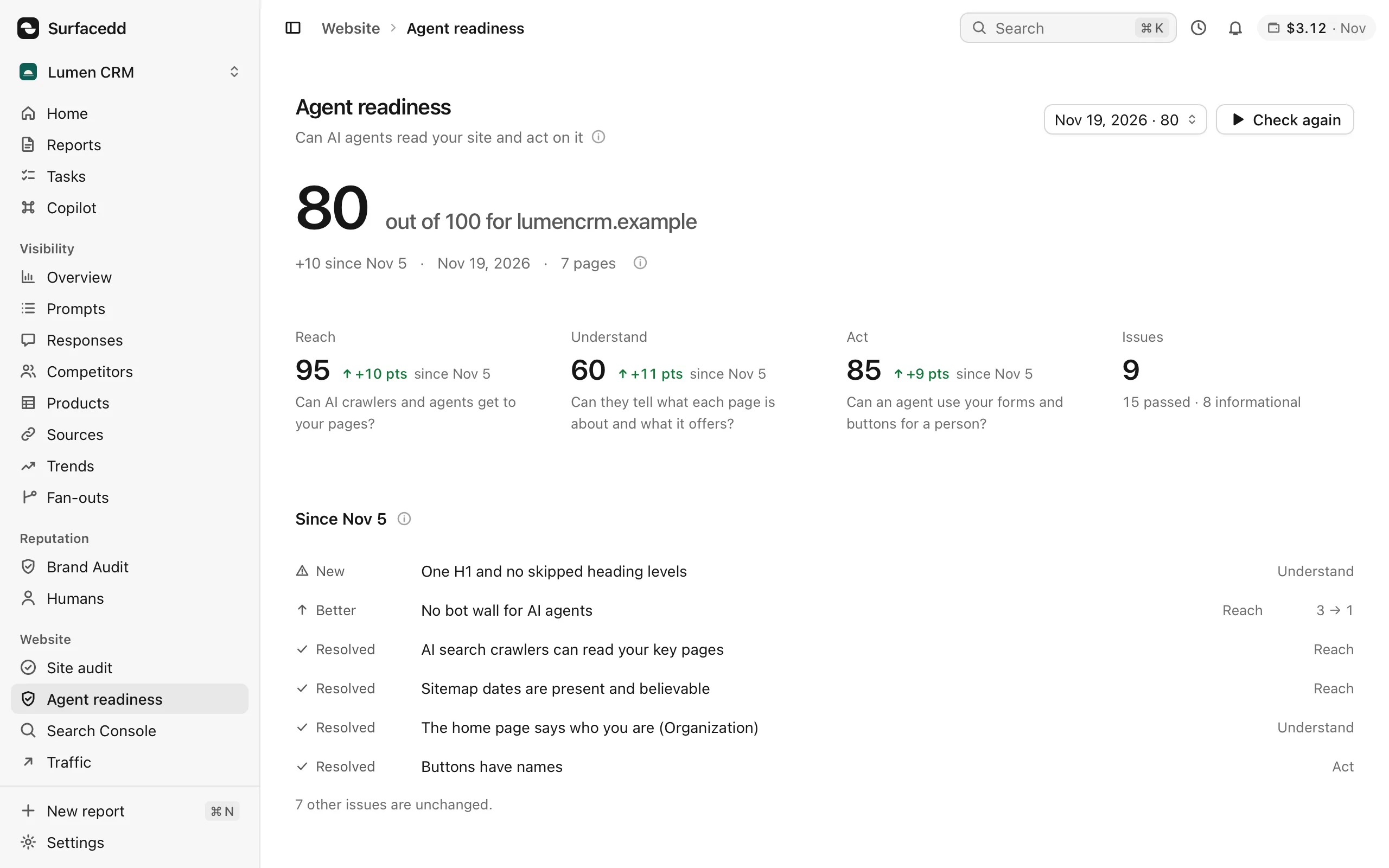
Agent readiness checks three things: whether AI agents can reach your pages, whether they can understand what each page offers, and whether they can act on it for a person. Each category gets a score from 0 to 100 built from weighted rules, and the headline score is the average of the three.
The rule table has 33 rules in version 2026-11-19.1. Twenty-five are scored. Eight cover emerging agent protocols and are informational only, so they never move your score. Every rule links the standard or vendor document it rests on.
| Category | The question it answers | What it checks |
|---|---|---|
| Reach | Can AI crawlers and agents get to your pages? | robots.txt rules for AI search crawlers and user-triggered fetchers, bot walls, robots.txt errors, content that needs JavaScript, sitemap presence, freshness and coverage, canonical consistency, key pages within three links of home |
| Understand | Can they tell what each page is about and what it offers? | Organization, Product and Offer, Article, BreadcrumbList and FAQPage markup, product identifiers, price and stock in the server HTML, valid JSON-LD, landmarks, heading order, link text |
| Act | Can an agent use your forms and buttons for a person? | form fields with accessible names, buttons with names, cart, contact and booking pages without a login wall, no interactive CAPTCHA on primary actions |
Can AI agents reach your pages?
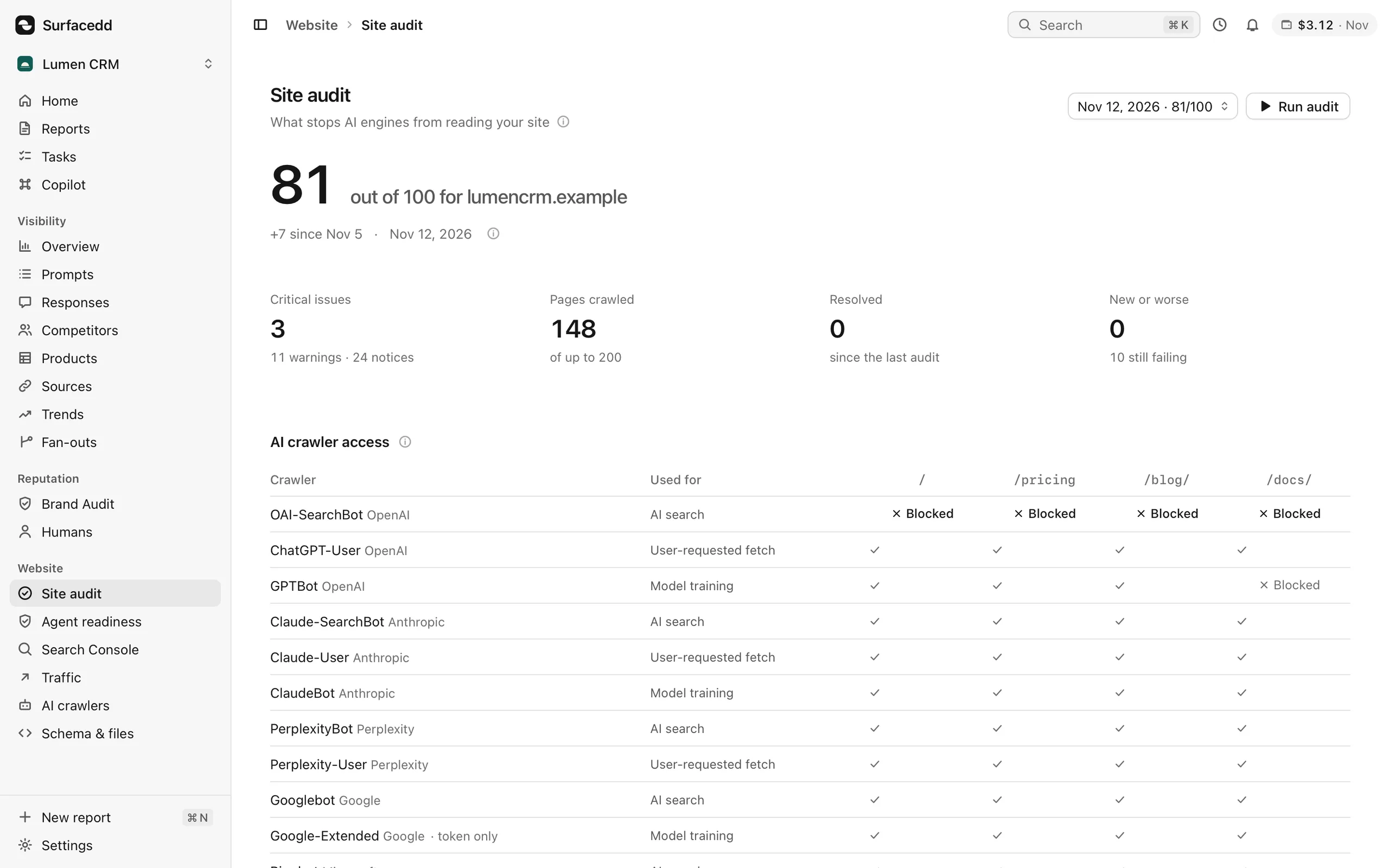
Reach is about getting through the door. The check reads your robots.txt under RFC 9309 for ten AI search crawlers, including OAI-SearchBot, Claude-SearchBot, PerplexityBot and Googlebot, and separately for user-triggered fetchers such as ChatGPT-User, Claude-User and Perplexity-User. It also flags a robots.txt that answers with a server error or times out, because crawlers read that as "disallow everything".
robots.txt is only half of it. Several operators say their user-triggered fetchers may not follow robots.txt at all: OpenAI says it "may not apply" to ChatGPT-User, and Google says its user-triggered fetchers "generally ignore" it. So the app marks those fetchers and reports the firewall test as its own result.
The bot-wall test is the rule with the highest weight. Surfacedd fetches your home page and one key page as a normal browser and as seven agent user agents. If an agent gets a challenge page (Cloudflare's cf-mitigated: challenge header, for example) or a 401, 402, 403 or 429 while the browser gets the page, that's a wall. If the browser is blocked too, the result is marked inconclusive and not scored.
The rest of Reach covers the basics agents share with search crawlers: a sitemap that exists and has believable lastmod dates, indexable pages that are actually listed in it, canonicals that point at a live page, and product, pricing, contact and booking pages within three links of home. That last one is a labelled heuristic: no primary source sets a click limit.
Can they understand what you offer?
Understand checks whether a page states, in plain HTML and valid markup, who you are and what you sell. On the home page it looks for Organization markup with a name, URL and logo. On product pages it looks for Product markup with a name, image and an Offer carrying a price above zero, a currency and availability, and it warns on AggregateOffer, because Google's merchant listing documentation requires an Offer.
Markup alone isn't enough. The check also looks for the price and stock wording in the HTML your server sends, and compares it with the markup. Mastercard's agentic-commerce guide asks merchants to put price, availability and checkout fields in the initial HTML, and an agent that doesn't run your JavaScript won't see a price that only appears after it does.
The page-structure rules come from accessibility standards, because that is how browser agents read a page. Anthropic's browser-use tool reads the accessibility tree first, listing each element's role and name. So the check wants one <main>, a <nav> on the home page, one H1 with no skipped heading levels, and links whose text says where they go, not "click here".
Two rules carry explicit caveats. FAQPage markup is checked for valid syntax only, because Google has shown no FAQ rich results since 2026-05-07. llms.txt is informational: Google says its Search doesn't use it, and the app says so next to the result. Google's same guide says structured data is not required for its AI features, and the app repeats that too.
Can an agent act on your site for a person?
Act checks whether an agent can complete the job a person sent it to do. Every form field needs an accessible name from a <label>, aria-label, aria-labelledby or title; a placeholder on its own fails. Buttons, including icon-only buttons, need names too. These follow WCAG 2.2 success criteria 3.3.2 and 4.1.2.
The check then follows the links to your cart, contact and booking pages and flags any that redirect to a sign-in page, answer 401 or show only a password form. It flags interactive reCAPTCHA, hCaptcha, Turnstile, Friendly Captcha and AWS WAF CAPTCHA widgets on those forms and on search. Invisible, risk-based widgets aren't flagged. Google's guidance on allowing Google-Agent asks sites to skip interactive CAPTCHAs for it. Nothing is ever submitted: the check only reads.
Emerging agent protocols: informational, adoption is early
Agent commerce and discovery standards are moving fast, and most sites don't publish any of them yet. Surfacedd checks for them so you know where you stand, labels each one "Informational: adoption is early", and never scores them.
| What it looks for | Where | Status on 2026-11-19 |
|---|---|---|
| Product fields an OpenAI product feed needs | your Product markup (the feed itself is uploaded to OpenAI, not read from your site) | Widespread feed format |
| Universal Commerce Protocol profile | /.well-known/ucp | Early adoption; IANA provisional |
| MCP server discovery (Server Cards) | /.well-known/ai-catalog.json | Proposal to early adoption |
| WebMCP tools | toolname forms or modelContext.registerTool in page scripts | Chrome origin trial |
| A2A agent card | /.well-known/agent-card.json | Early adoption; IANA permanent |
| API catalog | /.well-known/api-catalog (RFC 9727) | Established RFC, rarely published |
| AI-preference lines | __usage_ai-training group, Content-Signal: line in robots.txt | Drafts; early adoption |
/.well-known/mcp isn't checked, because it isn't in the MCP specification or the IANA registry.
Worked example: a bot wall, before and after
This example comes from the sample workspace, with a fictional CRM brand, Lumen CRM, at lumencrm.example. Its first check, on 5 November, found three agent user agents stopped while a browser got the page: ChatGPT-User and Claude-User received a 403 from Cloudflare, and Perplexity-User got a challenge (cf-mitigated: challenge). Its robots.txt also disallowed PerplexityBot. The Reach rule "No bot wall for AI agents" failed, with the response status for each agent as evidence.
The fix the app shows is a firewall rule that lets verified bots through before your challenge rules run:
# Cloudflare WAF custom rule, placed before your bot and challenge rules
When incoming requests match: (cf.client.bot)
Then: Skip (remaining custom rules, Super Bot Fight Mode, rate limiting)
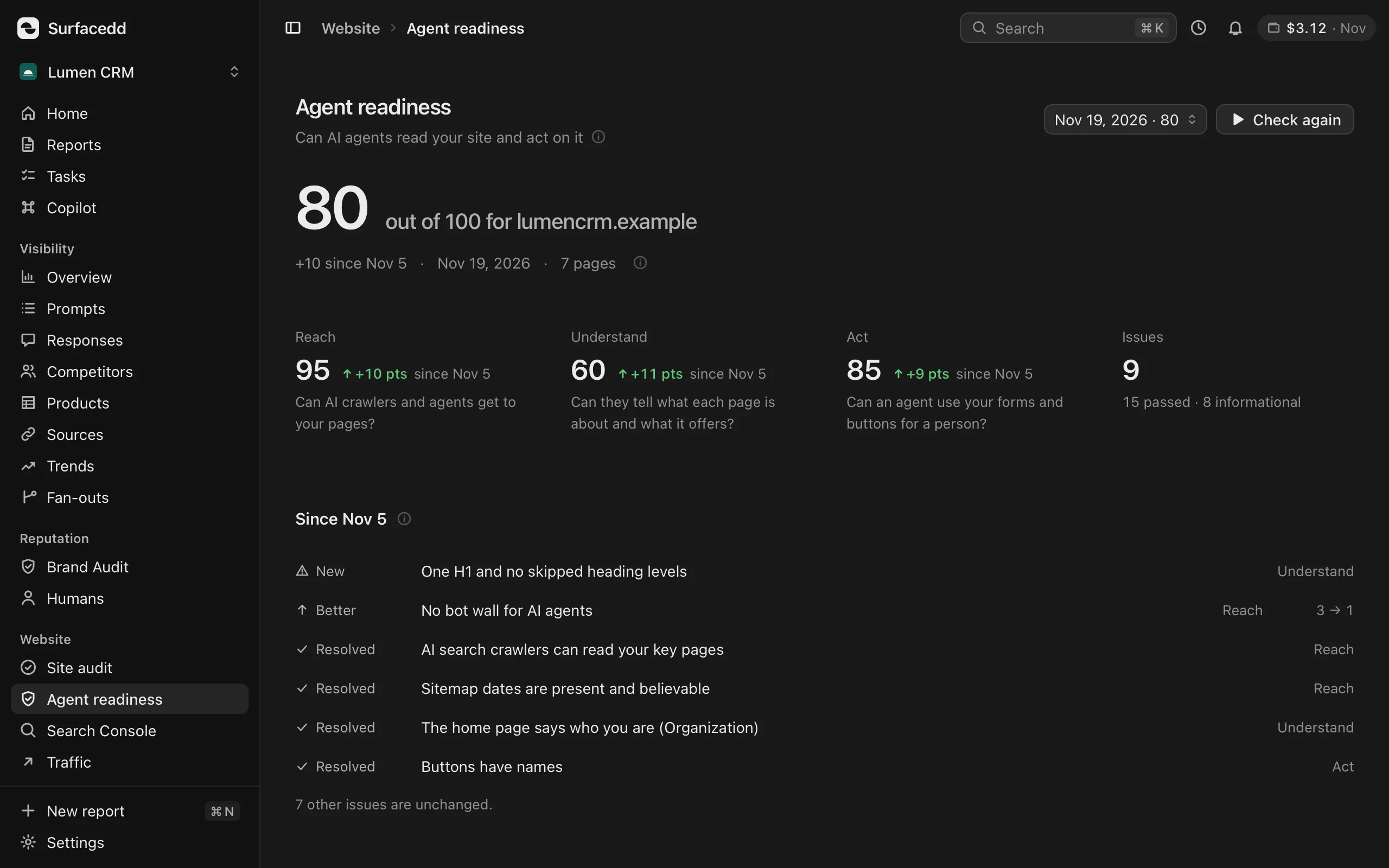
On the re-check two weeks later, the walled agents dropped from three to one, the robots, sitemap-date, Organization and button-name issues showed as resolved, and the headline score rose to 80, with Reach at 95, Understand at 60 and Act at 85. One new issue appeared: a page with a skipped heading level. Perplexity-User was still challenged on / and /pricing, so the rule stays open until the next check passes.
Form labels get the same treatment. A contact form whose email field relies on a placeholder fails act.form-labels, and the fix is a label tied to the field:
<label for="email">Email</label>
<input id="email" name="email" type="email" autocomplete="email">
How it fits the rest of Surfacedd
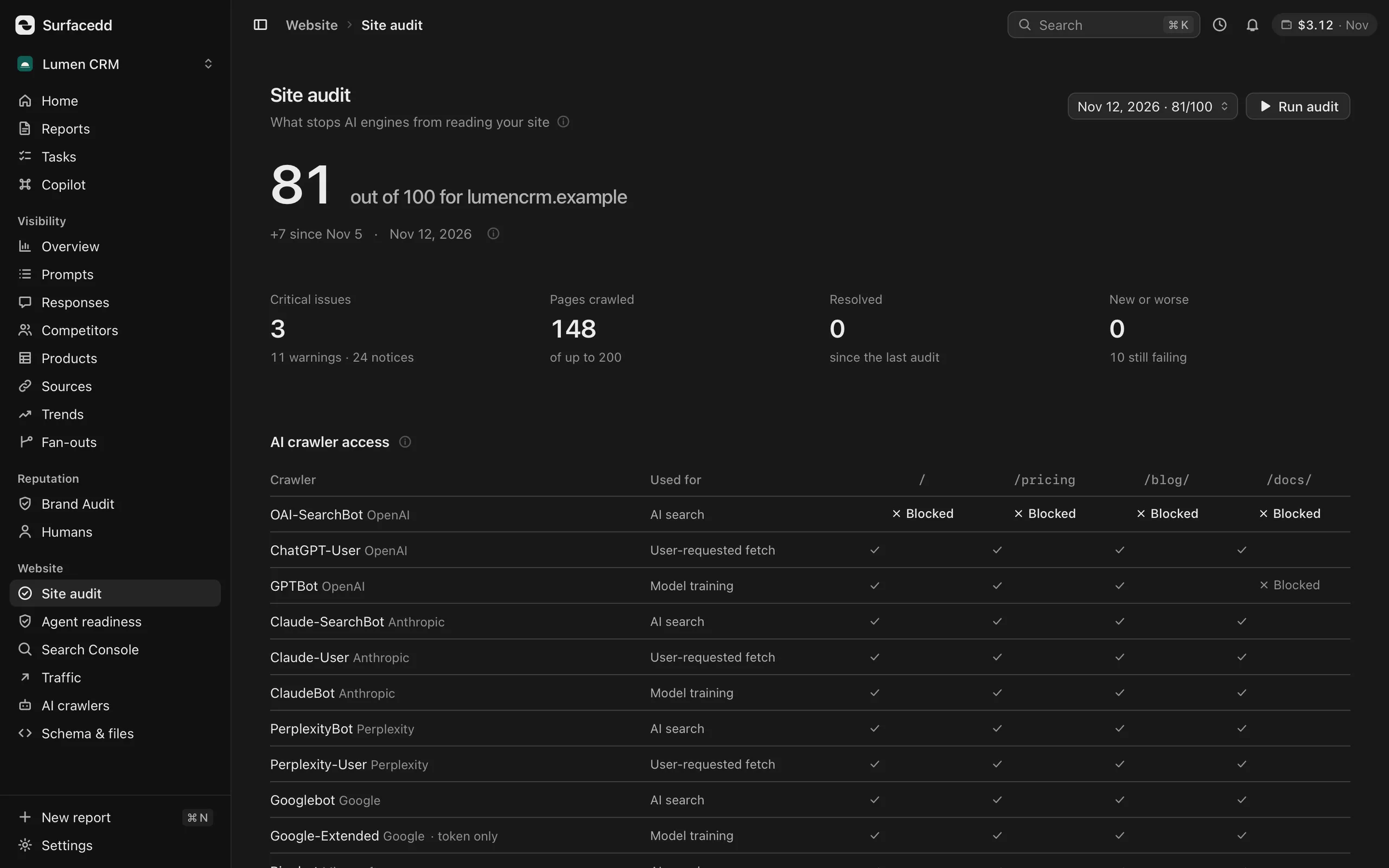
Agent readiness is a phase of the AI visibility audit: when the site audit's crawl finishes, the agent checks run on the pages it found. Weekly audit re-scans therefore re-check readiness too, and each check lists what is new, worse, better or resolved since the last one. It has its own Website › Agent readiness screen and a card on the Site audit screen.
Your AI assistant can read the result too. The local MCP server has an agent_readiness tool that returns the scores, the problems by weight with up to three evidence items each, the fixes and the changes. The SEO Copilot reads the same tool and can put the fixes into its action plans.
If you want to try it on one page before installing anything, the free agent readiness checker runs a lite version on your home page and one key page. The app runs every rule on every page the audit crawls. For the full list with what to do about each, see the AI agent readiness checklist.
To stop a release from undoing the fixes, the surfacedd command runs the same rules against a URL and exits with code 5 under a threshold you set, which fails a CI job. It needs no licence or keys for a URL. See run an agent readiness check in CI.
Cost
An agent readiness check costs nothing per run. It runs on your computer, uses no API keys and makes no AI calls, so the same site gives the same result every time. It is also available when your licence is read-only, like the site audit, because it doesn't spend money. The only cost is the one-time Surfacedd licence; see pricing.
What agent readiness doesn't do
Sources
- RFC 9309: Robots Exclusion Protocol
- OpenAI: Overview of OpenAI crawlers
- Google: Google's user-triggered fetchers
- Google: Allow Google-Agent
- Cloudflare: Detect a challenge page response
- Google: Merchant listing structured data
- Google: Optimizing for generative AI features (mythbusting)
- Mastercard: Agentic commerce guide
- Anthropic: Browser use tool
- W3C: Web Content Accessibility Guidelines 2.2
- Universal Commerce Protocol specification
- MCP SEP-2127: MCP Server Cards
- Chrome: WebMCP
- A2A protocol specification
Fair questions
What is agent readiness?
Agent readiness is how well AI crawlers and browsing agents can use your website: whether they can get to your pages, tell what each page offers and complete actions such as a contact form. Surfacedd scores it from 0 to 100 in three categories, Reach, Understand and Act, and shows the evidence and a copyable fix for every problem it finds.
Will fixing these issues get AI to recommend us more?
We don't claim that, and no primary source we found says any of these checks raises recommendations or citations. What the check does is find the things that stop an agent outright, such as a firewall challenge, a price that only appears after JavaScript, or an unlabelled form. To measure whether AI recommends you, use AI visibility tracking and compare runs over time.
How is this different from the site audit?
The site audit checks classic technical SEO and AI-crawler access across up to 500 pages. Agent readiness runs right after it on the same crawl and asks agent-specific questions: does a firewall challenge AI agents, does the server HTML carry prices, can a browser agent find form labels and button names. You get both from one crawl, and both re-run on the weekly schedule.
Does it cost anything to run?
No. The check runs locally on your computer, uses no API keys and makes no AI calls, so it adds nothing to your provider bills. It still runs when your licence is read-only, because it doesn't spend money. The only cost is the one-time Surfacedd licence, and the free web checker covers your home page and one key page without installing anything.
Can it tell if Cloudflare is blocking AI agents?
It can show that your site treats agent user agents differently from a browser. It looks for Cloudflare's documented cf-mitigated: challenge header and challenge script, AWS WAF markers, and 401, 402, 403 or 429 responses. It can't imitate a verified agent's IP range or signature, so a site that blocks only unverified traffic may still let the real agent in. The app says this next to the result.
Why are UCP, WebMCP and agent cards not scored?
Because adoption is early. The Universal Commerce Protocol, WebMCP, MCP Server Cards and A2A agent cards are new or still in drafts and trials, and few sites publish them. Scoring them would penalise almost everyone for skipping something agents rarely look for today. Surfacedd shows whether you publish each one, labelled informational, so you can decide when it is worth doing.
Does it work on sites built with JavaScript frameworks?
It checks the HTML your server sends, without running JavaScript, because that is what most crawlers and fetchers read. If your server sends an empty app shell, the JavaScript-only rule flags it as a labelled heuristic, and price and content checks may fail for that reason. Server rendering or pre-rendering key pages fixes both. Rendering pages inside the app is planned for a later version.
How we research, write and correct pages: read our editorial policy.