See who AI recommends instead of you, and which pages convinced it
Share of voice, head-to-head and co-occurrence for every competitor, plus the pages each engine cited or read to decide: from your own site, rivals, Reddit, reviews and the press.
By the Surfacedd teamUpdated 9 min readMarkdown
On this page
Short answer
Surfacedd shows which brands AI engines name instead of yours and the pages they relied on. Competitors get share of voice, a won-without-you count, head-to-head and co-occurrence views. Sources sorts every citation into 17 source kinds, separates cited pages from pages read but not cited, and lists outreach targets that name a rival but not you.
Knowing that ChatGPT left you out of an answer is half the picture. The other half is who it named instead and what it read before deciding. Surfacedd records both for every answer it collects, so you can see which competitor wins each prompt and which pages, yours, theirs or a third party's, the engine relied on.
Who does AI name instead of you?
Every answer goes through the same extraction pipeline: a deterministic name and alias scan, then one low-cost model call that lists every company, product and publisher the answer names, whether it was recommended, and in what order. Names you haven't told Surfacedd about become New competitors, so rivals you didn't know about show up on their own.
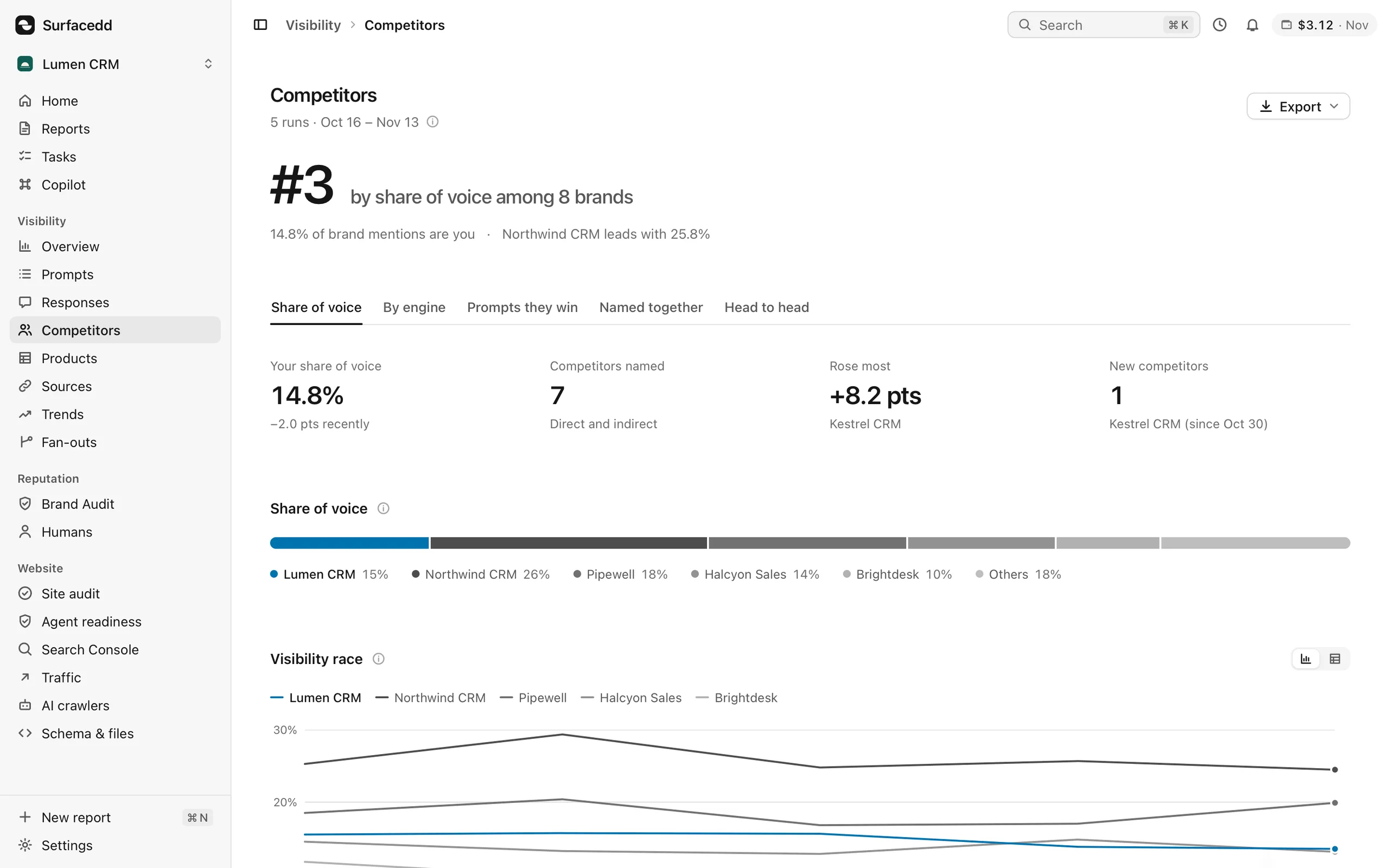
The Competitors screen turns that into a ranking:
| Measure | What it tells you | How it's calculated |
|---|---|---|
| Share of voice | Your slice of all brand mentions in your category | Answers naming you ÷ answers naming you or any selected competitor; Direct and Indirect competitors by default |
| Change | Whether that slice is growing | Share of voice in the newer half of runs minus the older half, in points |
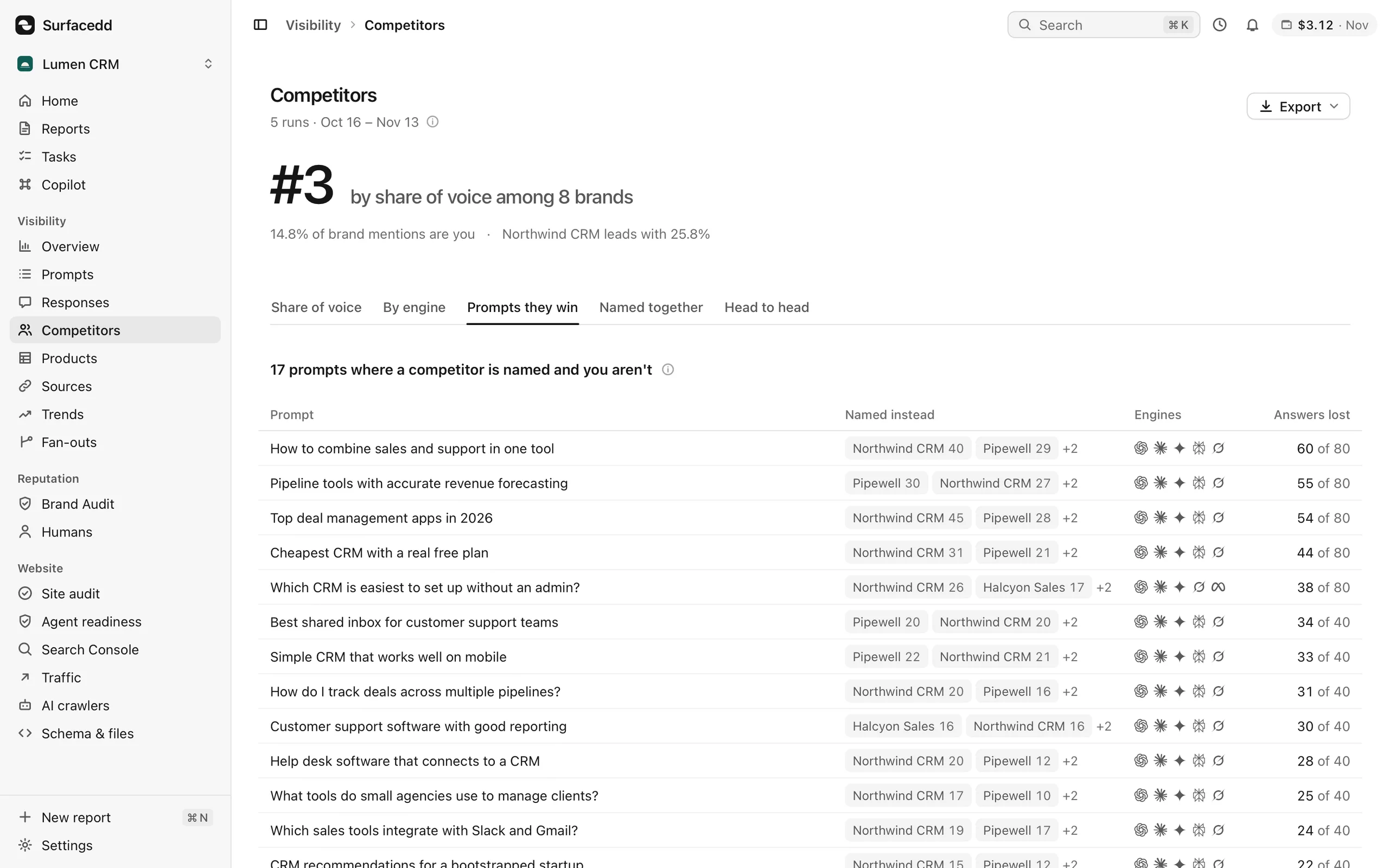
| Won without you | How often a rival appears where you don't | Answers naming the competitor and not you |
| Rose most | Which rival gained the most ground | Largest share-of-voice change among competitors |
| Rank among brands | Where you sit in the field | Your position when brands are sorted by answers naming them, plus the gap to the leader in points |
Every number links to the answers behind it. Click a competitor's won-without-you count and you get the list of answers, each opening the full text with the brand names highlighted.
Brands are classified as Direct, Indirect, Publisher, AI platform or Other. Re-typing one, say from Other to Direct, re-applies to your whole history, and duplicate names (same domain, or the same name once suffixes like Inc and Ltd are stripped) can be merged so "Pipewell" and "Pipewell Inc." count as one.
If you track a product catalogue, product tracking applies the same "who wins instead" view to individual products, so you see which rival product is recommended for a category where none of yours is.
Head-to-head, prompts they win, and co-occurrence
Three views answer the follow-up questions:
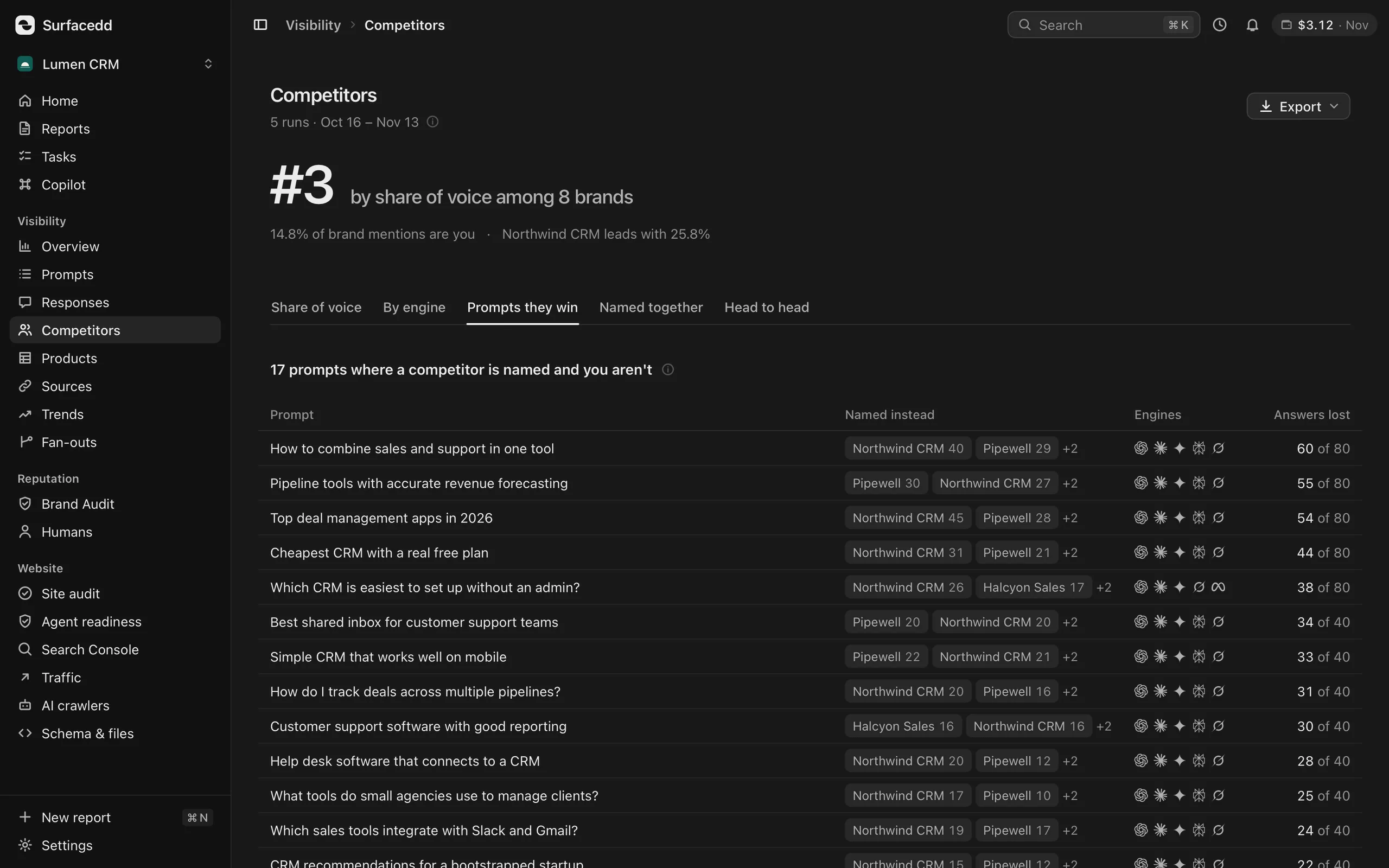
- Prompts they win lists the prompts where a competitor is named and you aren't, with the engines and the number of answers lost. It's the most direct to-do list Surfacedd produces.
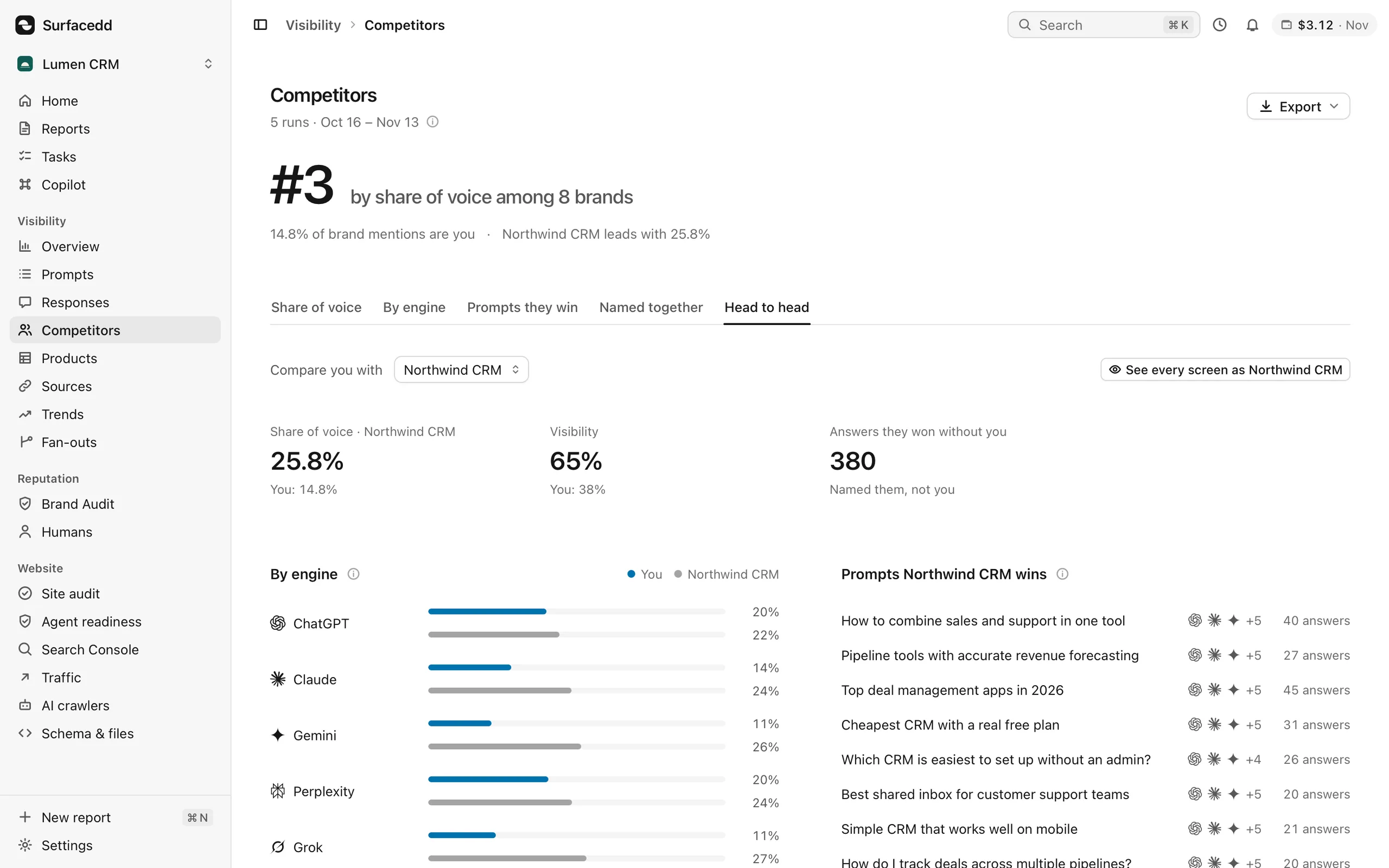
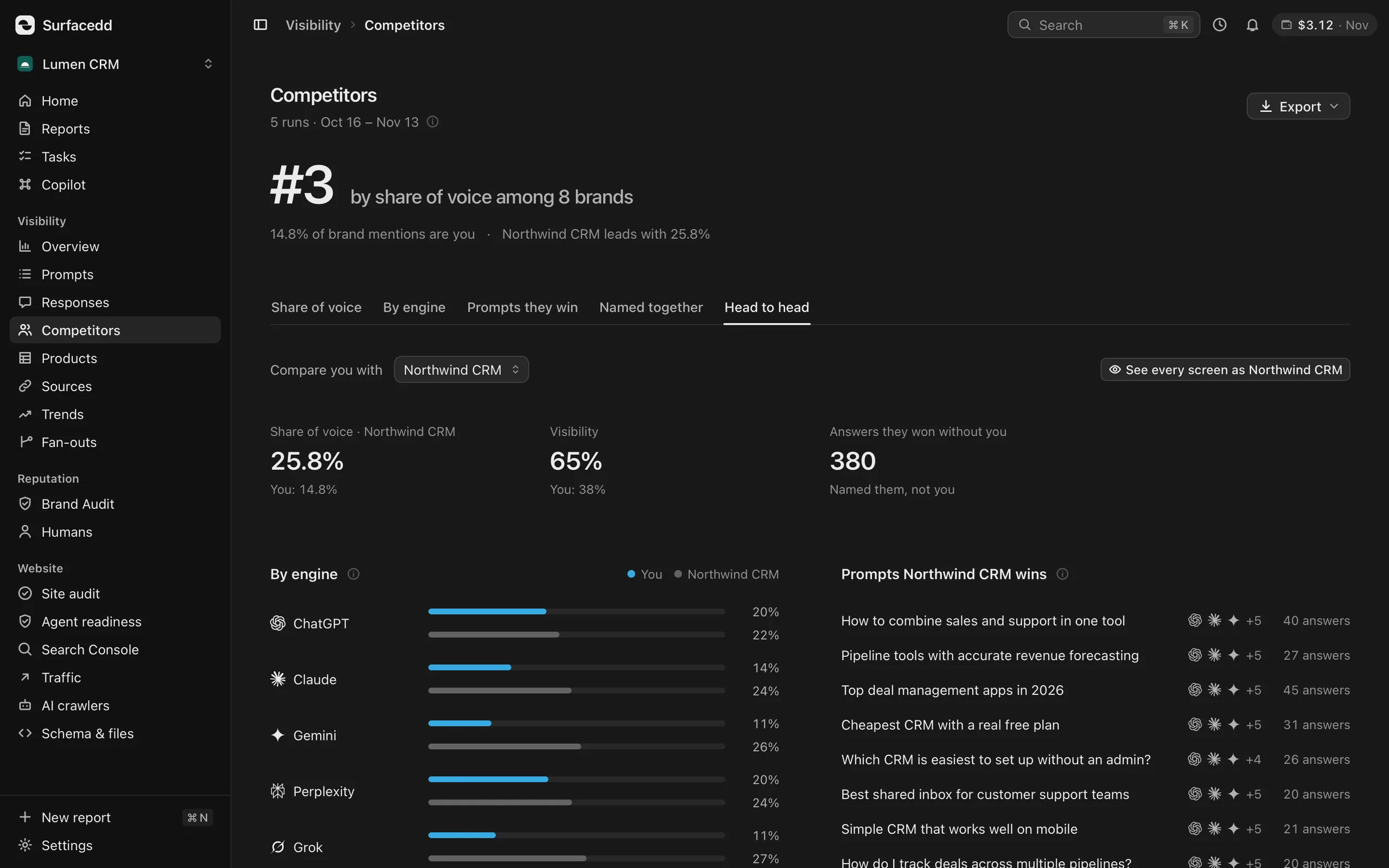
- Head to head puts you and one rival side by side across engines and prompts.
- Named together is a co-occurrence matrix: of the answers naming brand A, the share that also name brand B. It's asymmetric on purpose. A small brand may appear next to the market leader in most of its answers while the leader rarely appears next to it, which tells you who the engines treat as the reference point.
By engine breaks share of voice down per engine, because a competitor can dominate Perplexity and barely register in Claude.
View as competitor
From any competitor's drawer, View as recomputes every metric with that competitor as the subject. You see their visibility, their winning prompts and the pages cited when they're named, without changing your saved setup. It's the quickest way to study what the category leader does that you don't.
Which pages does AI cite?
When an engine answers with web search, its API returns the pages it cited. Surfacedd stores each citation with its position and builds the Sources screen from them.
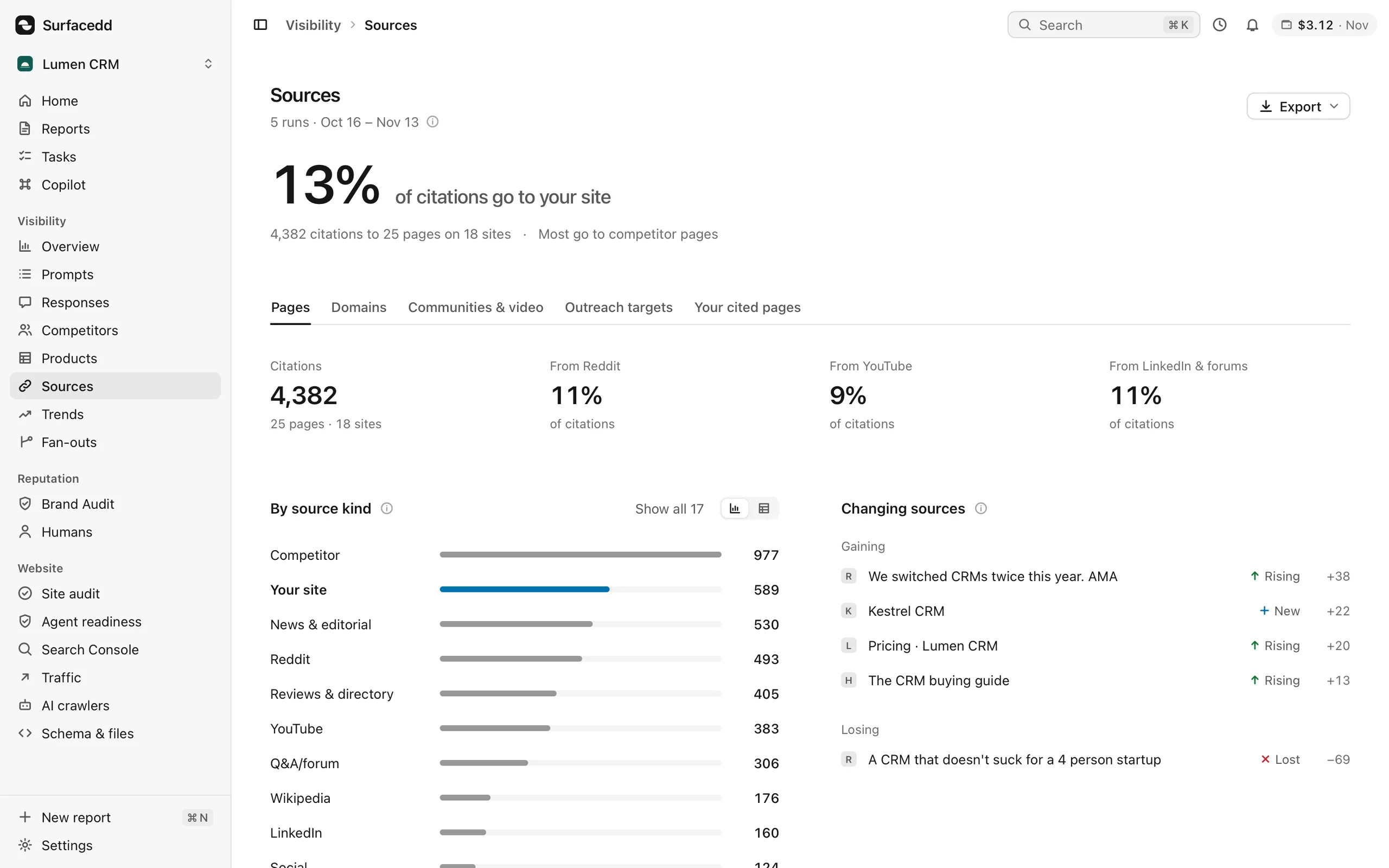
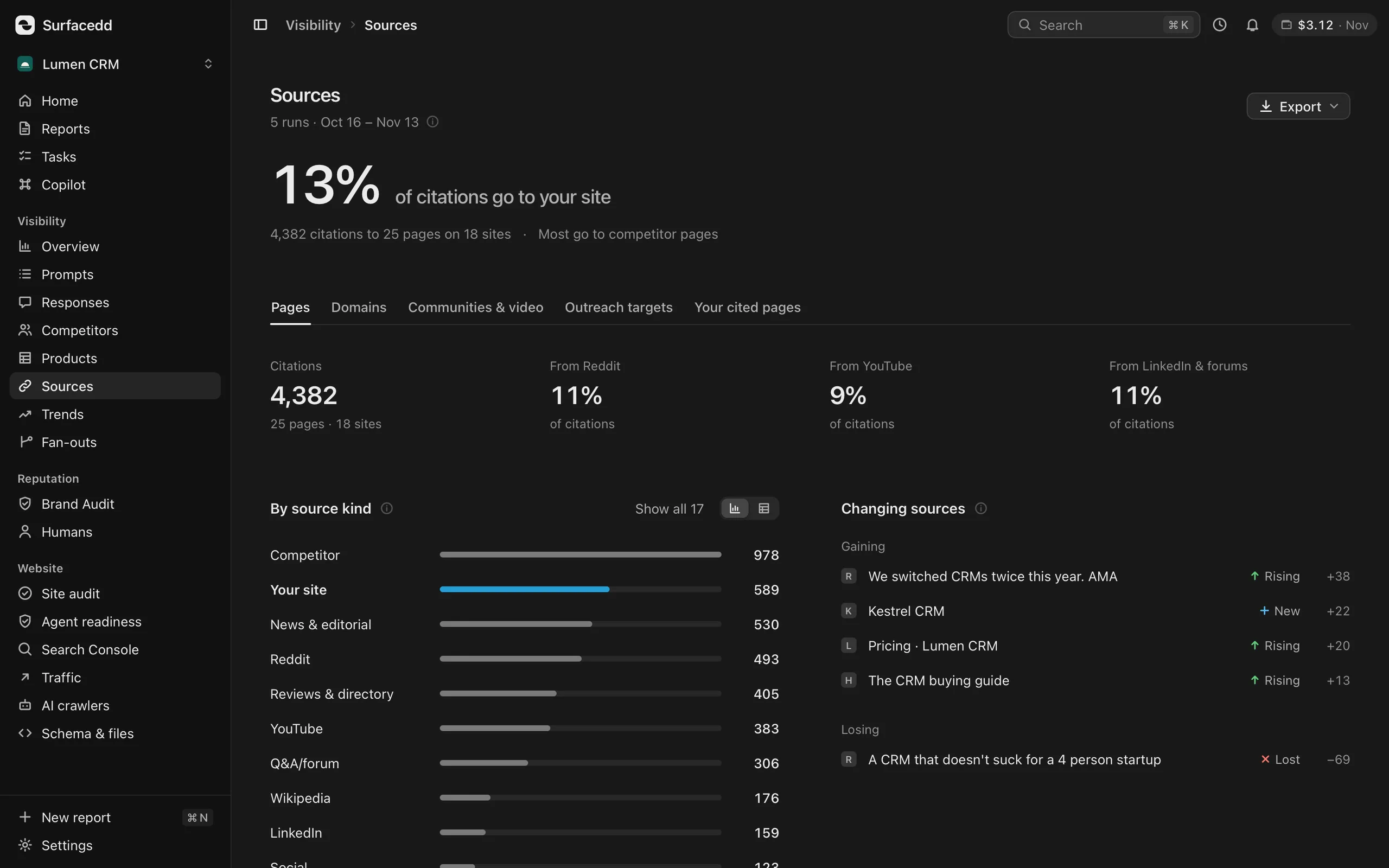
Every cited domain gets one of 17 source kinds: Owned, Competitor, Reddit, YouTube, LinkedIn, Wikipedia, News & editorial, Reviews & directory, Q&A/forum, Social, Company, Institutional, Reference & docs, Marketplace, Google Maps place, Google Shopping product, and Other. Rules handle the known domains (reddit.com is Reddit, g2.com is Reviews & directory, your own domain is Owned), and a single low-cost model call classifies any unknown domain once; you can correct it. Pages also get one of 10 content kinds, such as Listicle, Review, Docs or Homepage.
The Pages tab tells you, in one sentence, how many citations there were and what share came from your site and from Reddit, YouTube, LinkedIn and forums. The table shows each page's source kind, citations, trend and the prompts it was cited for. Trends follow fixed rules: New if a page had no citations in the older half of your runs, Rising at +30% or more, Falling at −30% or less, Lost if it vanished in the newer half.
Your own numbers sit next to them:
- Citation rate: the share of answers that cite at least one of your pages.
- Citation share: your pages' share of all citations, for example "12% of 310 citations". Only your website's domain and its subdomains count.
The Your cited pages tab lists which of your pages engines cite and how often, and the Domains tab rolls everything up per site.
Read but not cited
Several engines report more pages than they cite: the full set of results their search returned. OpenAI's documentation says its sources list is "the complete list of URLs the model consulted" and that it is often longer than the list of citations (OpenAI web search guide). Where the API exposes that list (ChatGPT's search sources, Claude's search results, Grok's citations list, Meta AI's results and Perplexity's unreferenced results), Surfacedd stores those pages as read but not cited and shows them in a separate section of each answer.
This is often the most useful list on the screen. A page of yours that is read but not cited was found and then passed over, which usually points to the page itself (thin answer, no clear claim, wrong format) rather than to whether the engine can find it. A page that's never read at all points to a discovery or access problem, which the AI visibility audit checks.
Reddit, YouTube, LinkedIn and forum threads
Community sources get their own tab, Communities & video, with sub-tables parsed from the URLs on your computer: Reddit posts and subreddits, YouTube videos and channels, LinkedIn posts, articles, people and companies, and Q&A threads. You see which threads engines cite for your prompts and whether competitors are named in them. Surfacedd doesn't draft replies; it shows you where the conversation is. The Reddit and AI answers guide covers what to do with that list.
Opportunities: pages naming a competitor and not you
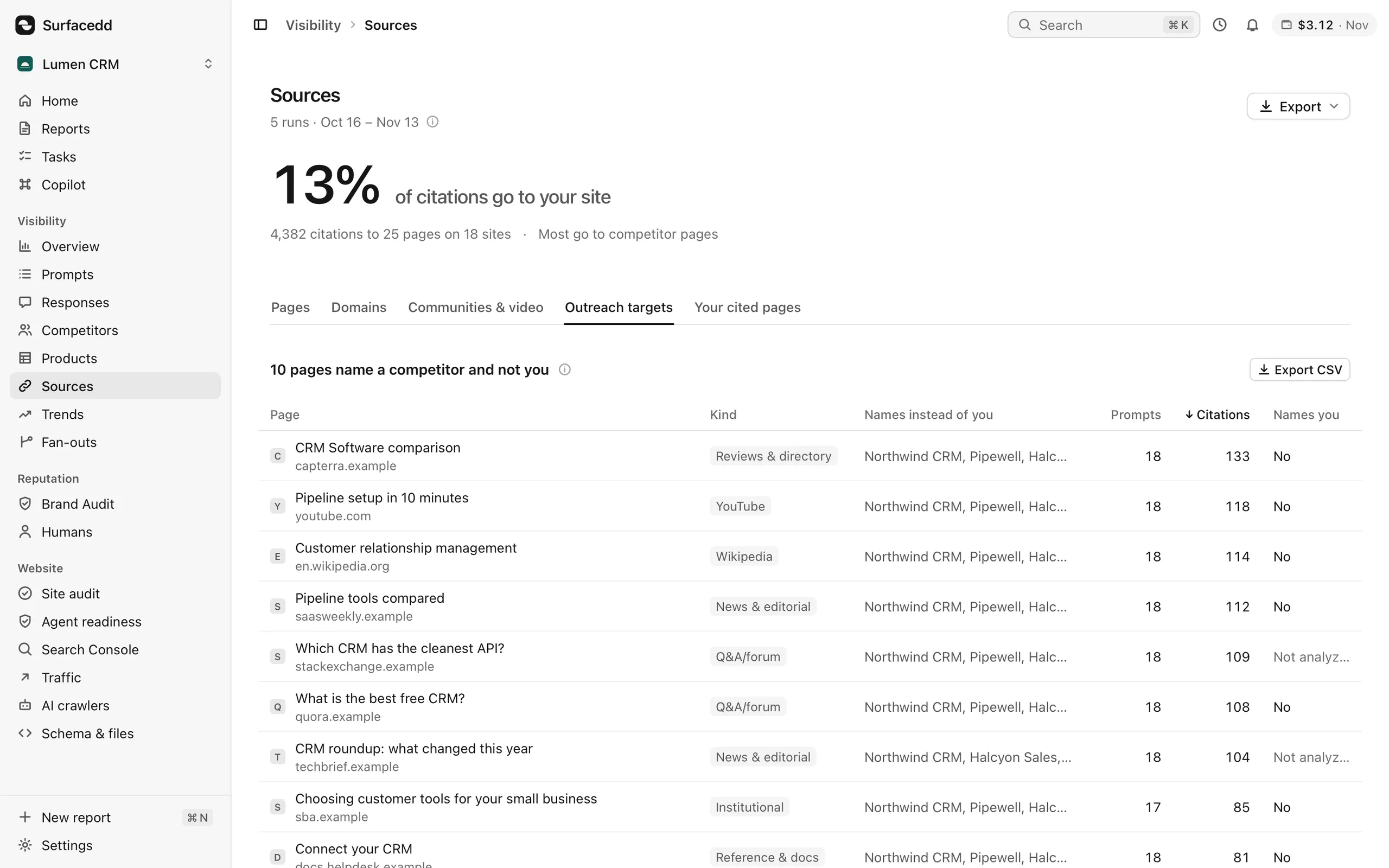
The Outreach targets tab lists cited pages that name a competitor but not you and aren't yours: the listicles, reviews and comparison pages engines rely on where you're missing. Each row shows the page's source kind, citations and the prompts it was cited for, and the list exports to CSV.
Worked example: one lost prompt, traced
From the app's sample workspace (fictional): Lumen CRM, a CRM for small teams, over 5 runs between 16 October and 13 November.
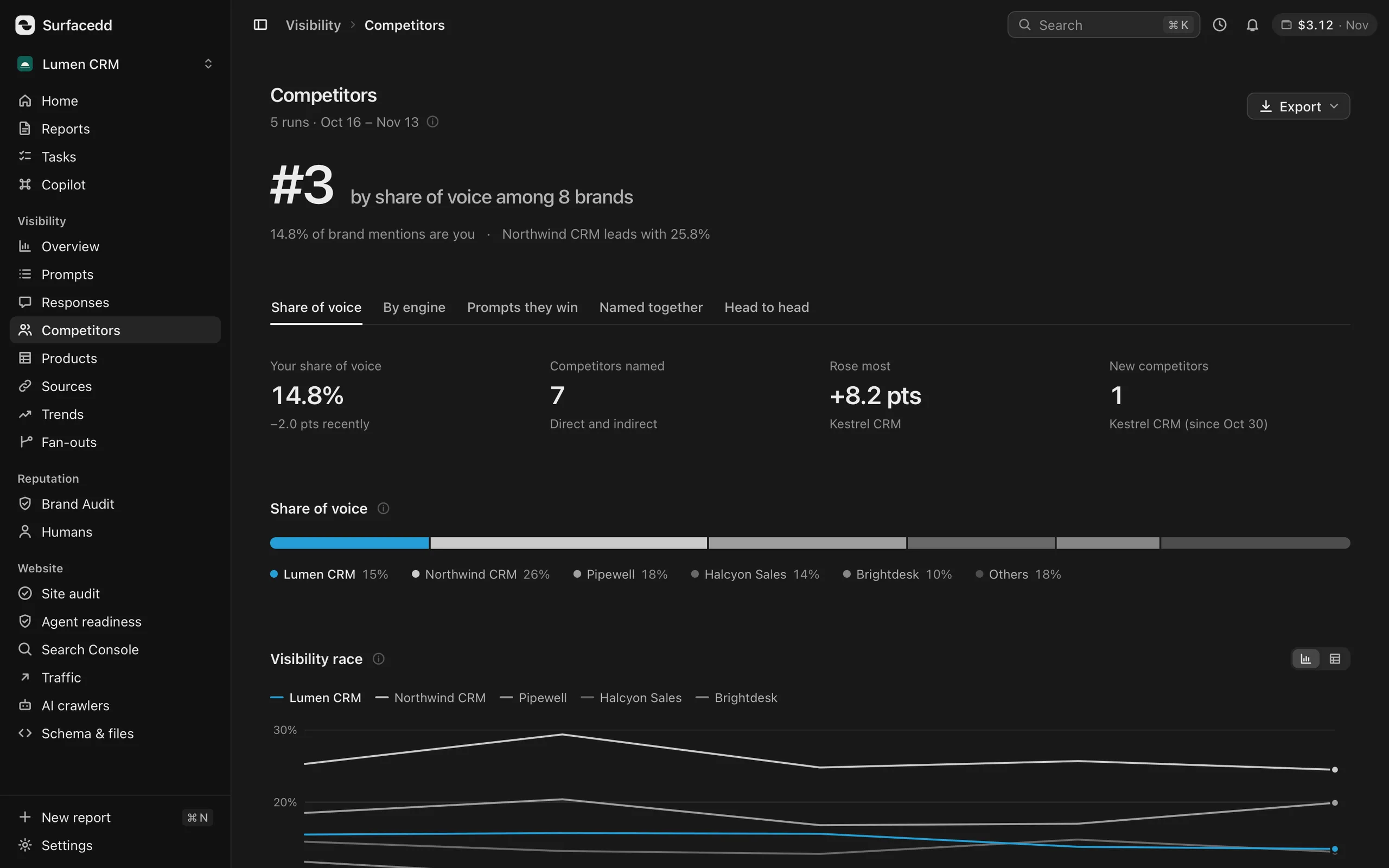
- Competitors ranks Lumen #3 by share of voice among 8 brands: 14.8% of brand mentions, while Northwind CRM leads with 25.8%.
- Head to head with Northwind shows its visibility at 65% against Lumen's 38%, and 380 answers it won without Lumen. Its list of winning prompts starts with "How to combine sales and support in one tool".
- Sources shows 13% of citations go to Lumen's own site, and most go to competitor pages.
- Outreach targets lists 10 pages that name a competitor and not Lumen. The top one, a CRM software comparison on a reviews site, was cited 133 times across 18 prompts and names Northwind and Pipewell.
- How to fix turns this into tasks with evidence chips that link back to the answers and pages. Surfacedd's finders create a "Cited competitor pages" task when a page is cited three or more times in answers that name a competitor and not you.
The result is two concrete jobs: get onto the comparison page engines keep citing, and give the prompts Northwind wins a page of your own worth citing. The next scheduled run shows whether either changed anything, using like-for-like comparisons described in our methodology.
What it costs
Everything on the Competitors and Sources screens is calculated locally from answers you've already collected, so viewing, filtering and exporting are free. The costs sit upstream: the answers themselves, billed by each provider, plus the small extraction call per answer and a one-time classification call per new domain, both included in the estimate before every run. As a guide, 25 prompts asked weekly on the default engines costs about $3.75 a month in provider fees. See pricing for the licence and the full table.
What it doesn't do
Sources
Fair questions
How does Surfacedd decide a brand was mentioned?
A brand counts as named when the answer text contains its name or one of its aliases, or a link to its own domain inside the answer. A URL that appears only in the engine's source list counts toward citation metrics instead. Common-word names are confirmed by the extraction model, and same-name companies in other industries are excluded, so a namesake doesn't inflate your numbers.
What's the difference between a mention and a citation?
A mention is the brand being named in the answer text. A citation is a page the engine links as a source. You can be mentioned without being cited, for example when ChatGPT recommends you but links a review site, and cited without being mentioned. Surfacedd tracks both separately: visibility and share of voice for mentions, citation rate and citation share for your pages.
Can I choose which competitors count?
Yes. Share of voice uses Direct and Indirect competitors by default, and you can change the competitor types in the filter. You can add, remove, re-type, tag and merge competitors in Brand settings, and new names the engines mention appear as New competitors for you to keep or dismiss. Re-typing a brand re-applies to all past answers.
Which engines report the pages they read but didn't cite?
Where the API returns it: ChatGPT's web search sources, Claude's search results, Grok's citation list, Meta AI's search results and Perplexity's unreferenced results. Google's AI Overviews and AI Mode, collected through DataForSEO, return the cited references only. The answer drawer shows read-but-not-cited pages in their own section whenever the engine provides them.
Does Surfacedd contact sites or competitors for me?
No. Surfacedd doesn't send emails, collect contact details or post anywhere. The Outreach targets list gives you the pages engines cite that name a competitor and not you, with the prompts and citation counts behind each, and exports it to CSV. What you do with it, and who you contact, is up to you.
Is the source-kind classification accurate?
Known domains are classified by fixed rules, such as reddit.com as Reddit or your own domain as Owned. Unknown domains get one classification call the first time they appear, and the result is cached. If a domain is classified wrongly, you can change its kind, and the change applies everywhere it appears.
How we research, write and correct pages: read our editorial policy.