Help AI describe your products and people accurately with structured data
Structured data won't get you cited on its own. It does give search engines and agents a clean, consistent fact sheet about your organisation, products and people. Here's what to mark up, with this site's own graph as the example.
By the Surfacedd teamUpdated 8 min readMarkdown
On this page
Short answer
Schema markup for AI search is schema.org structured data that states facts about your organisation, products and people in machine-readable form. Google says its AI features need no special markup, and Ahrefs found no meaningful citation lift across 1,885 pages that added JSON-LD. Its value is consistent facts and entity identity, not ranking.
What can structured data do for AI search, and what can't it?
Structured data can state your facts unambiguously: who you are, what you sell, what it costs, who wrote a page and when. It can't make an assistant cite or recommend you. Those are separate questions, and most of the confusion about "schema for AI" comes from treating them as one.
Here's the evidence, claim by claim:
| Claim you'll hear | What the primary sources say | Verdict |
|---|---|---|
| "You need special schema for AI Overviews" | Google: "Structured data isn't required for generative AI search, and there's no special schema.org markup you need to add." | False for Google |
| "Adding schema raises AI citations" | Ahrefs tracked 1,885 pages that added JSON-LD (Aug 2025–Mar 2026) against matched controls: AI Mode +2.4% and ChatGPT +2.2%, both indistinguishable from zero; AI Overviews −4.6% | Not supported for pages already cited |
| "AI reads your JSON-LD when it writes the answer" | A searchVIU test reported by Ahrefs found that during direct retrieval "every system extracted only visible HTML content" | Unlikely at answer time |
| "Schema helps engines understand your content" | Google uses structured data "to understand the content of the page, as well as to gather information about the web and the world in general"; Microsoft calls schema code that "helps search engines and AI systems understand your content" | True, as an input to understanding and indexing |
| "Schema is useless now" | Google still recommends it "as part of your overall SEO strategy", and it still powers rich results for products, articles, breadcrumbs and more | False |
Two limits on the Ahrefs study matter. Every page in it already had more than 100 AI Overview citations before adding schema, so it can't tell you whether markup helps pages AI hasn't found yet. And it measured a 30-day window, which may miss slow effects such as entity understanding. Ahrefs' own conclusion is that schema's role is slow and indirect, worth adding where it's natural, especially for organisations, people and products.
That's our position too. Mark up the facts that identify you, keep them identical to the visible page, and don't expect a citation bump.
Which schema types matter for products and people?
The types that describe who and what, plus the ones that describe the page itself. (If you sell physical products, the full Product and Offer field list, with a copyable example, is in how to get products recommended by AI.) In rough order of value for a brand that wants AI to describe it correctly:
| Type | Put it on | Properties that carry the facts | Why it matters for AI answers |
|---|---|---|---|
Organization | Home and about pages | name, url, logo, description, sameAs, founder, contactPoint | Ties your profiles together into one entity; Google says it helps "disambiguate your organization in search results" |
SoftwareApplication or Product with Offer | Product, pricing and download pages | name, operatingSystem, applicationCategory, offers.price, priceCurrency, availability | Prices and requirements are what buyers ask assistants; the markup must match the visible price |
Person and ProfilePage | Founder and author pages | name, jobTitle, worksFor, sameAs, identifier | Disambiguates people with the same name; see person schema |
Article or TechArticle | Guides and posts | headline, author, datePublished, dateModified, publisher | Freshness and authorship stated plainly |
BreadcrumbList | Every page below home | itemListElement | Shows where a page sits in the site |
FAQPage | Pages with a visible FAQ | mainEntity of Question and Answer | Harmless bookkeeping since FAQ rich results ended; see FAQ schema |
WebSite | Every page | name, url, publisher | Anchors every other node to the site |
Two rules from Google's guidelines trip up software companies. First, the Software App rich result requires aggregateRating or review, and the review-snippet rules say "don't aggregate reviews or ratings from other websites". So you can't copy your G2 stars into your markup. Ship SoftwareApplication without a rating rather than invent one. Second, "your structured data must be a true representation of the page content": if the page shows a launch price, the Offer must carry that price, not the list price.
A worked @graph: this site's own markup
Every page on surfacedd.com emits one JSON-LD @graph with stable @ids, so nodes on different pages refer to the same organisation and app instead of redefining them. Here's the graph for this guide, trimmed for length. It's built by the same code that renders the page, from the page's own frontmatter and visible FAQ.
{
  "@context": "https://schema.org",
  "@graph": [
    {
      "@type": "WebSite",
      "@id": "https://surfacedd.com/#website",
      "name": "Surfacedd",
      "url": "https://surfacedd.com",
      "publisher": { "@id": "https://surfacedd.com/#org" }
    },
    {
      "@type": "TechArticle",
      "@id": "https://surfacedd.com/guides/structured-data-for-ai-search#article",
      "headline": "Help AI describe your products and people accurately with structured data",
      "datePublished": "2026-11-19",
      "dateModified": "2026-11-19",
      "author": { "@id": "https://surfacedd.com/#org" },
      "publisher": { "@id": "https://surfacedd.com/#org" },
      "about": [{ "@id": "https://surfacedd.com/#app" }]
    },
    {
      "@type": "BreadcrumbList",
      "itemListElement": [
        { "@type": "ListItem", "position": 1, "name": "Home", "item": "https://surfacedd.com" },
        { "@type": "ListItem", "position": 2, "name": "Guides", "item": "https://surfacedd.com/guides" }
      ]
    },
    {
      "@type": "FAQPage",
      "mainEntity": [
        {
          "@type": "Question",
          "name": "Does schema markup help you get cited by ChatGPT?",
          "acceptedAnswer": { "@type": "Answer", "text": "There's no good evidence that it does…" }
        }
      ]
    }
  ]
}
What to notice:
- Stable
@ids.#org,#websiteand#appare defined once and referenced everywhere. The fullOrganizationnode, with the canonical description and contact points, is emitted on the home and about pages. Other pages point at it by@id. - The article is
aboutthe product. Theaboutreference to#applinks every guide to theSoftwareApplicationnode, whoseOfferprice comes from the same pricing file that renders the visible price. - Dates come from the frontmatter that drives the visible "Updated" line, so the markup can't claim a fresher date than the page shows.
- The FAQ is generated from the visible FAQ. There's no second, hand-written copy to drift.
- The author is the organisation until a real, named author page exists. We don't invent people for markup.
- No ratings. We have no first-party reviews, so there's no
aggregateRating.
The home page adds the full SoftwareApplication node: name, the canonical description, applicationCategory BusinessApplication, operatingSystem "macOS 14 or later, Windows 10 or later", a feature list, and one Offer with the live price, currency and availability. During the launch window that Offer also carries priceValidUntil, the day the launch price ends.
How do you validate structured data?
Check three things, in this order:
- It parses. One stray comma and engines ignore the whole block.
- Required properties are present for each type. For example
nameonOrganization,headlineonArticle,nameandacceptedAnsweron everyQuestion. - It matches the visible page. Same price, same dates, same names. No validator checks this for you, so make the markup and the text come from one source.
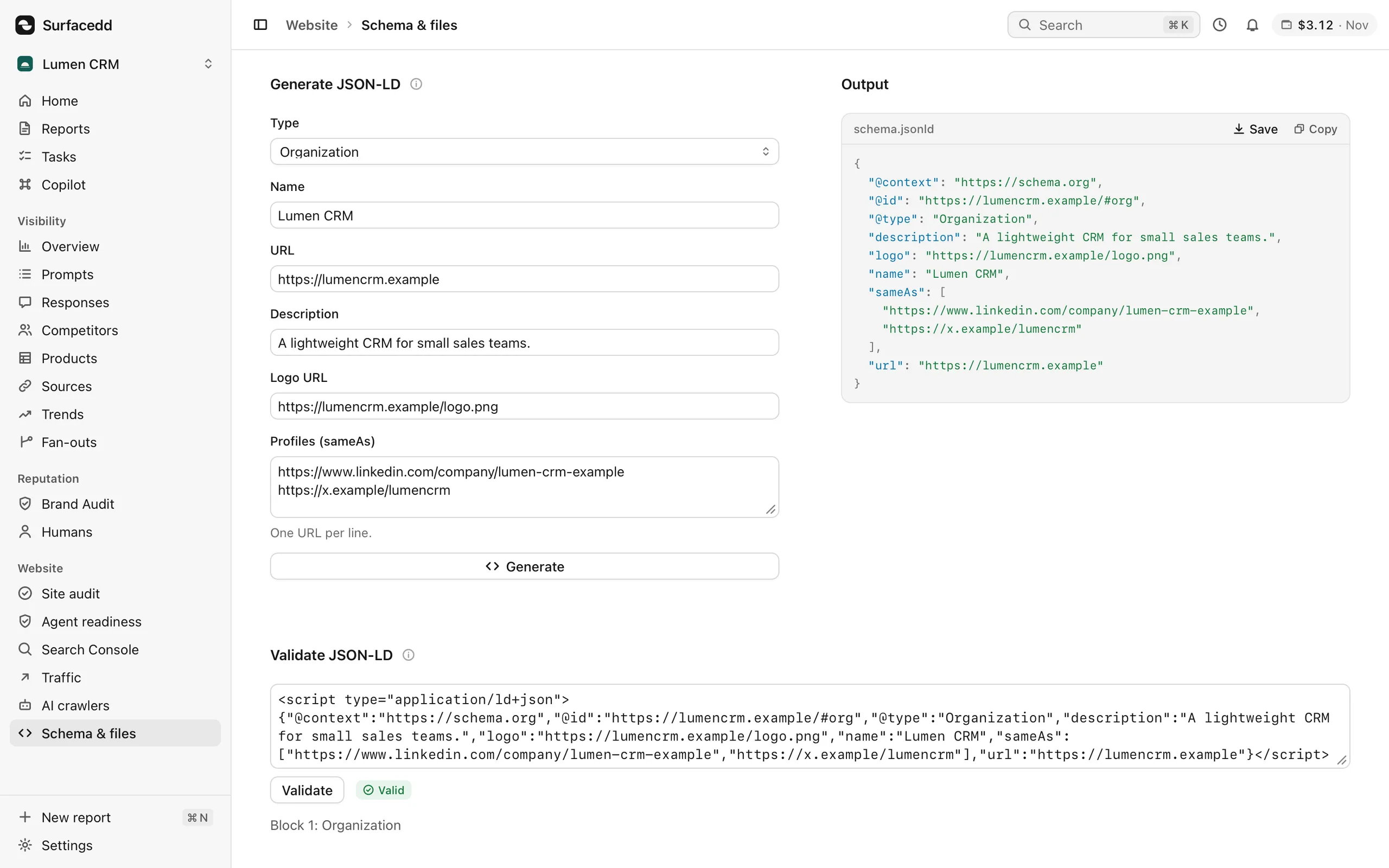
Paste a block into the free schema generator and validator for the first two checks, and use Google's Rich Results Test for the types that still earn rich results. Re-check after every template change, because a broken template breaks every page at once.
If you also want to know whether agents can read and act on your pages beyond the markup, the agent readiness pillar covers the rest.
Generate and check JSON-LD with Surfacedd
Surfacedd generates JSON-LD from deterministic templates for Organization, WebSite, SoftwareApplication, Article, LocalBusiness, Person with ProfilePage, and BreadcrumbList, which you copy or save to a file. Nothing is published to your site for you. The site audit crawls up to 500 pages locally and flags invalid-jsonld (a block that doesn't parse or misses required properties) and missing-structured-data (a home or top-level page with no structured data at all). Both checks are free.
Then measure what matters: whether AI answers state your facts correctly and cite your pages. The AI visibility audit covers the site side; pricing explains the one-time licence.
Sources
- Google Search Central: Optimizing your website for generative AI features
- Google Search Central: Introduction to structured data
- Google Search Central: General structured data guidelines
- Google Search Central: Generate structured data with JavaScript
- Google Search Central: Organization structured data
- Google Search Central: Software App (SoftwareApplication) structured data
- Google Search Central: Review snippet structured data
- Ahrefs: We tracked 1,885 pages adding schema. AI citations barely moved, May 11, 2026
- Microsoft Advertising: Optimizing your content for inclusion in AI search answers, October 8, 2025
Fair questions
Does schema markup help you get cited by ChatGPT?
There's no good evidence that it does. In Ahrefs' 2026 study of 1,885 pages that added JSON-LD, ChatGPT citations changed by +2.2% against matched controls, which is indistinguishable from zero. A separate test found AI systems extracted only visible HTML at retrieval time. Add structured data for accurate facts and entity identity, and work on visible content and third-party mentions for citations.
Which schema type matters most for a software company?
Organization on the home page, with sameAs links to your real profiles, and SoftwareApplication with an Offer carrying the visible price, currency and operating systems. Those two answer the questions buyers ask assistants: who makes it, what it costs, what it runs on. Add Article with honest dates on guides, and Person for named authors only when real author pages exist.
Can I put my G2 rating in my structured data?
No. Google's review-snippet guidelines say "don't aggregate reviews or ratings from other websites". Ratings in markup must come from reviews shown on the marked-up page itself. Without first-party reviews, ship SoftwareApplication without aggregateRating. You won't get stars in the results, but the rest of your facts are still machine-readable and accurate.
Does JSON-LD added by JavaScript count?
Google says it can process structured data "that's available in the DOM when it renders the page", but many AI crawlers don't run JavaScript, and the Ahrefs study only tested markup in static HTML. Put JSON-LD in the server-rendered HTML. It's simpler to validate, every crawler sees the same thing, and it can't fail when a script errors.
Should every page have FAQ schema?
No. Google stopped showing FAQ rich results from May 7, 2026, and FAQ markup only belongs on pages with a real, visible FAQ. Generate it from the same source as the visible questions so the two never drift. Padding pages with FAQs that exist only for markup adds nothing for readers or for engines.
Is structured data the same as llms.txt?
No. Structured data is schema.org markup embedded in your HTML, used by search engines for understanding and rich results. llms.txt is a proposed Markdown index file at your site root. Google says its Search ignores llms.txt, and there's no evidence that it raises citations. Our llms.txt guide covers when it's still worth publishing.
How we research, write and correct pages: read our editorial policy.