Get AI to describe your brand consistently with entity SEO
AI answers and knowledge panels piece your brand together from many sources. When those sources agree on your name, facts and profiles, the picture is consistent. When they don't, assistants guess. Audit the sources, fix the ones you control, and link them to each other.
By the Surfacedd teamUpdated 8 min readMarkdown
On this page
Short answer
Entity SEO is the work of making search engines and AI models recognise your brand or person as one distinct thing, with the same name, facts and linked profiles everywhere. It feeds knowledge panels and AI answers alike. Start with a consistency audit of about 12 sources: one wrong price on one profile can end up in an answer.
What is an entity, and why does it matter for AI answers?
An entity is a thing a search engine or language model can identify as distinct: a company, a product, a person, a place. "Lumen CRM, the sales software company in Austin" is an entity. "Lumen" on its own is just a word that could mean a lighting brand, a unit of light or a dozen other companies.
Entity SEO is the work of making your entity easy to identify and its facts easy to agree on. Google says it uses structured data "to gather information about the web and the world in general", including "the people, books, or companies" in the markup, and that Organization markup helps "disambiguate your organization in search results". AI assistants have no published equivalent. They build their picture from the pages they retrieve and the text they were trained on, which is exactly why consistency matters. When twelve sources say the same thing, the answer repeats it. When they disagree, the answer picks one, blends them or hedges.
Two failure modes show up again and again:
- Wrong facts. An old price on a review site, a former CEO on a directory, a retired plan on your own pricing page. The assistant repeats whichever source it read.
- Wrong entity. Answers describe a different company or person with the same or a similar name. This is common for short, generic or shared brand names.
Both are fixable at the source, and both are measurable.
How do you run an entity consistency audit?
List every place that states facts about you, record what each says, and mark the mismatches. Start with the sources AI is most likely to read: your own site, review platforms, business directories, social profiles, Wikipedia or Wikidata if you have them, and the pages assistants actually cite for your prompts.
Here's a worked audit for a fictional brand, Lumen CRM. The canonical facts are on the left; each row is a source.
| Source | Name as written | Price stated | Free-plan users | Founded | HQ | Links back to site | Verdict |
|---|---|---|---|---|---|---|---|
| Canonical fact sheet | Lumen CRM | 19 per seat per month | 3 | 2021 | Austin, TX | — | Reference |
| Own home page | Lumen CRM | 19 | 3 | 2021 | Austin | — | OK |
| Own pricing page | Lumen CRM | 19 | 5 | — | — | — | Fix: stale free-plan limit |
| Own about page | Lumen | — | — | 2020 | Austin | — | Fix: founding year; full name |
| Organization JSON-LD | Lumen CRM | 19 | — | 2021 | Austin | sameAs lists 4 profiles | OK, add 2 missing profiles |
| LinkedIn company page | Lumen CRM | — | — | 2021 | Austin | Yes | OK |
| G2 profile | LumenCRM | 15 | 3 | 2021 | Austin | Yes | Fix: name spacing, old price |
| Capterra profile | Lumen CRM | 19 | 3 | 2021 | Remote | Yes | Fix: HQ |
| Crunchbase | Lumen CRM | — | — | 2021 | Austin | Yes | OK |
| Product Hunt launch | Lumen | 12 (launch offer) | 3 | — | — | Yes | Note: dated launch price; add "launch offer" context |
| X profile | @lumencrm | — | — | — | — | Yes | OK |
| Top cited comparison page (third party) | Lumen CRM | 15 | 5 | — | — | No | Request update with sources |
Prices in this fictional example are in US dollars. The audit takes about an hour for a dozen sources, and the result is a short fix list, not a strategy deck. In this example: two fixes on the brand's own site, three profile edits, one context note, and one correction request to a third party. The own-site fixes come first. They're entirely in your control, and the same Brand Audit sample run (below) shows an assistant repeating the wrong free-plan limit from the brand's own pricing page.
What to record per source
- Name exactly as written. "LumenCRM", "Lumen", "Lumen CRM Inc." each look like slightly different strings to a matcher.
- The facts buyers ask about: price, plan limits, platforms, location, founding year, founder and CEO, what the product does in one sentence.
- Whether it links back to your canonical site, and whether your site links to it.
- The last-updated date, if the source shows one.
How do sameAs and identifiers help?
sameAs tells machines that several pages describe the same entity. Schema.org defines it as the "URL of a reference Web page that unambiguously indicates the item's identity", such as a Wikipedia page, a Wikidata entry or an official website. Google's Organization documentation lists sameAs among its recommended properties.
A minimal, honest Organization block for the fictional brand:
{
  "@context": "https://schema.org",
  "@type": "Organization",
  "@id": "https://lumencrm.example/#org",
  "name": "Lumen CRM",
  "legalName": "Lumen CRM, Inc.",
  "url": "https://lumencrm.example",
  "logo": "https://lumencrm.example/logo.png",
  "foundingDate": "2021",
  "description": "Lumen CRM is sales software for teams of 2 to 20 people.",
  "sameAs": [
    "https://www.linkedin.com/company/lumencrm-example",
    "https://x.com/lumencrm-example",
    "https://www.crunchbase.com/organization/lumencrm-example",
    "https://www.g2.com/products/lumencrm-example"
  ]
}
Rules that keep it useful:
- List only profiles you control or that clearly describe you. A
sameAsto the wrong company actively confuses matching. - Link both ways. Your site lists the profile, and the profile links back to your site. For people, the same two-way pattern with rel="me" links lets profiles corroborate each other.
- Use stable identifiers where they exist. A Wikidata item, an ORCID for researchers, a stock ticker or a company registry number in
identifier. - Keep the description identical to the one-sentence description you use on profiles, so every source repeats the same sentence.
On Wikidata: an item qualifies when it "refers to an instance of a clearly identifiable conceptual or material entity" that can be described with serious, public references, or when it has a Wikipedia sitelink or fills a structural need. Create one only when independent references exist, cite them, and disclose your connection. A thin self-made item invites deletion.
The structured data guide covers which other types to mark up, and the free schema generator validates the block.
How do you disambiguate from a namesake?
Give every source the same distinguishing anchors and use them everywhere. If your brand shares its name with another company, add the anchor that separates you in the places that matter most:
- A category word in the name as written: "Lumen CRM" rather than "Lumen".
- A location or market where it's true: "Lumen CRM (Austin)".
- A one-sentence description that names what you do and for whom, reused verbatim.
- A distinct domain referenced from every profile.
For people, the same logic applies with a role and company ("Maria Chen, co-founder of Lumen CRM"). Our guide to knowledge panels for people covers personal entities in depth.
Then measure the confusion rather than guessing. Ask assistants the bare question ("What is Lumen?") and the qualified one ("What is Lumen CRM?"), and count how often the answer describes a different company. Track the qualified prompt as your main measure: you rarely win the bare name against a famous namesake, and you don't need to. Buyers usually add the qualifier themselves.
How do you fix what's wrong?
Fix in order of control:
| Source type | What you can do | Typical time to change |
|---|---|---|
| Your own site and markup | Edit the page, update the visible date | Same day |
| Profiles you own (LinkedIn, X, G2 vendor fields) | Edit directly | Same day to a week |
| Directories and review sites | Use the vendor or claim flow; contact support with evidence | Days to weeks |
| Google knowledge panel | Claim it by signing in to a listed official profile, then flag the fact with links that verify the correction | Weeks |
| Third-party articles | Send the editor the corrected fact with a source; ask, don't demand | Weeks, sometimes never |
| Model training data | Nothing direct; fix the sources above and wait for retraining | Months |
The knowledge panel process is documented by Google: claim the panel by signing in to one of the listed official sites or profiles, then use Feedback to flag the fact and "include links that verify the correction". The same principle works for every third-party fix. Send the evidence, not just the request.
Find inconsistent facts with Surfacedd
Surfacedd's Brand Audit asks assistants about your brand twice: once with live web search and once from training data alone, across ChatGPT, Claude, Perplexity and Gemini where enabled. It flags possible misinformation against the fact sheet you entered and links each wrong claim to the page it came from, with an alignment and citability score per cited page and a suggested action.
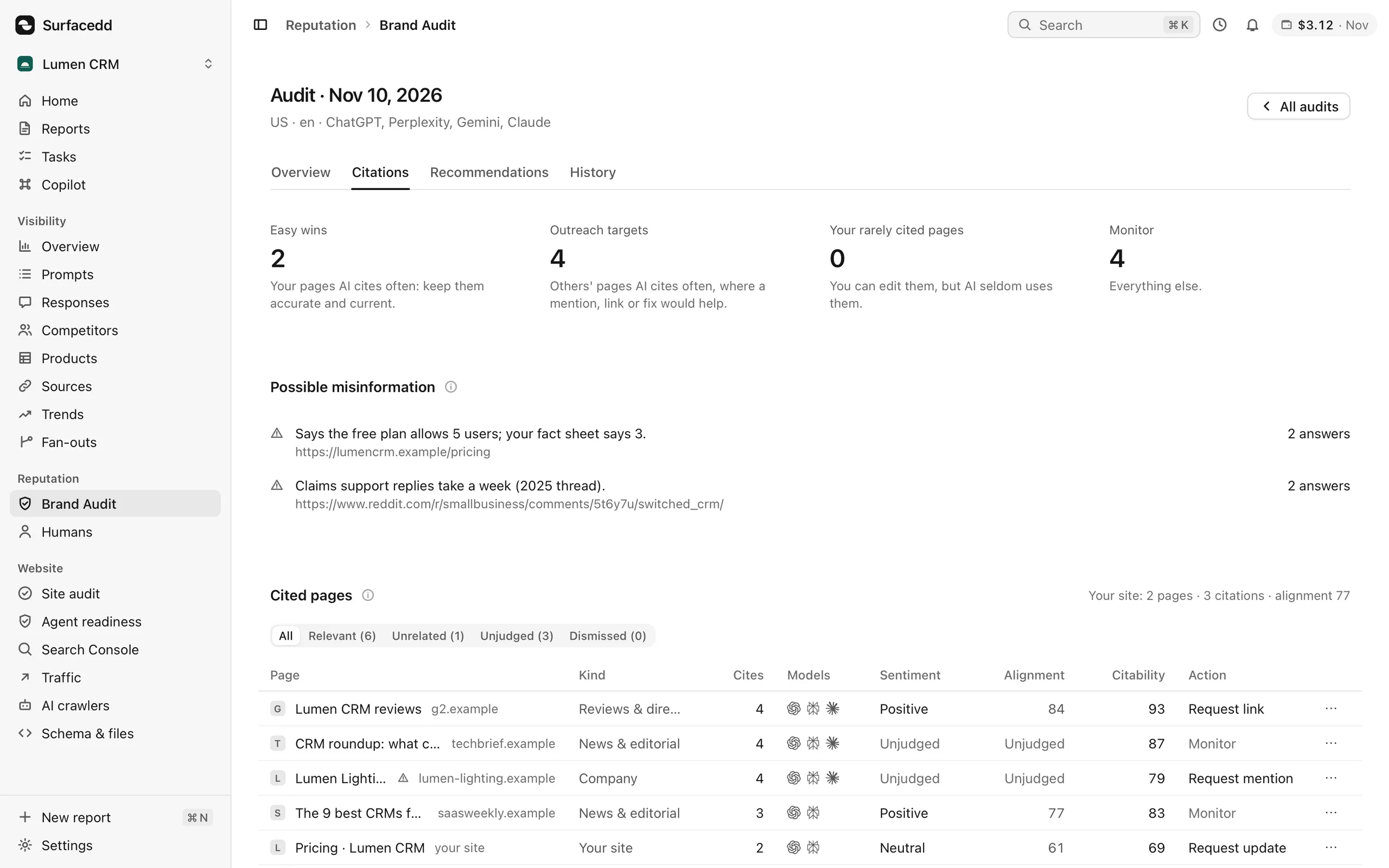
In tracking runs, brand aliases and homonym handling decide what counts as a mention: a name that matches but refers to a different company is flagged and not counted, and names that look like you but aren't aliases yet are suggested for review. For people, Humans adds a bio consistency check and a ProfilePage + Person kit with sameAs.
See the Brand Audit feature for what it reports and pricing for the one-time licence; each audit runs on your own API keys.
Sources
Fair questions
Is entity SEO different from regular SEO?
It's a part of SEO that focuses on identity rather than keywords. Keyword SEO asks "which pages rank for this query?"; entity SEO asks "does the engine know who we are, and are the facts about us the same everywhere?". The work overlaps with structured data, digital PR and profile management. It matters more for AI answers, because assistants summarise what sources agree on about an entity.
Does sameAs markup make AI recognise my brand?
It helps search engines connect your profiles to one entity, and Google lists sameAs among the recommended Organization properties. There's no published evidence that AI assistants read it when writing an answer. Treat it as one part of consistency: two-way links between your site and profiles, the same name and description everywhere, and accurate facts on the pages assistants actually cite.
How often should I repeat the consistency audit?
Quarterly, plus after any change to price, plans, leadership, name or location. Those are the facts that go stale fastest, and stale profiles keep getting read long after you've updated your own site. Between audits, watch what assistants actually say: when an answer states an old fact, it usually points you straight to the source that needs fixing.
What if AI confuses my brand with a bigger company?
Use a qualifier consistently ("Lumen CRM", not "Lumen"), reuse one descriptive sentence everywhere, and measure qualified prompts as your main metric. You're unlikely to win the bare name against a famous namesake, and you don't need to. Track the share of bare-name answers that describe the other company as a secondary measure, and check it falls as your qualifier spreads.
Do I need a Wikipedia article for entity SEO?
No. Wikipedia helps when an article exists, but articles are built from independent published sources, and its conflict-of-interest guideline discourages writing about your own company. Wikidata has a lower bar but still needs serious public references. Most brands get further by making their own site, markup, major profiles and the top-cited third-party pages agree on the same facts.
Can Surfacedd fix wrong facts for me?
No. Surfacedd finds them: it shows which answers state a wrong fact, which page they cite for it, and whether the page is yours or someone else's. The fix is yours to make, on your own pages or through each site's correction process. Re-runs then show whether answers changed, with "no clear change" when the difference is inside normal variation.
How we research, write and correct pages: read our editorial policy.