Applebot: what it reads, and how to decide what Apple may use
Applebot fetches pages for Apple's search features. Applebot-Extended never fetches anything: it's a robots.txt switch for whether Apple may train its models on what Applebot already read.
By the Surfacedd teamUpdated 4 min readMarkdown
On this page
Short answer
Applebot is Apple's web crawler. It feeds search in Siri, Spotlight and Safari, verifies by reverse DNS under applebot.apple.com, and obeys Googlebot rules when robots.txt doesn't name it. Applebot-Extended is a separate robots.txt token: blocking it opts you out of Apple model training without removing you from search.
What is Applebot?
Applebot is the crawler Apple uses to build the search index behind Siri, Spotlight and Safari suggestions. Apple's documentation says the same data "may also" help train the foundation models behind Apple Intelligence, and that use is the part you can switch off with a second token, Applebot-Extended (Apple, published 2026-09-04).
The two names do different jobs, and mixing them up is the most common mistake we see in robots.txt files:
| Name | Is it a crawler? | What a Disallow does |
|---|---|---|
Applebot | Yes. It fetches pages and identifies itself as Applebot/0.1 in its user agent | Keeps the blocked paths out of Apple's search features |
Applebot-Extended | No. Apple says it "does not crawl webpages" | Tells Apple not to use pages Applebot crawled to train its generative models. Apple says these rules "are not considered in ranking for Search" |
So if your goal is "show up when someone asks Siri, but don't train Apple's models", you allow Applebot and disallow Applebot-Extended. Google's equivalent split is Google-Extended, and the AI crawlers guide lists every operator's tokens side by side.
Fact block
| Fact | Value |
|---|---|
| Operator | Apple |
| Purpose | AI search and citations |
| Feeds AI search answers | Yes |
| User agent | Contains applebot (case-insensitive) |
| robots.txt token | Applebot |
| Verification | Published IP ranges: https://search.developer.apple.com/applebot.json |
| Operator docs | https://support.apple.com/en-us/119829 |
203.0.113.24 - - [18/Nov/2026:09:14:02 +0000] "GET /pricing HTTP/1.1" 200 18342 "-" "Mozilla/5.0 (compatible; Applebot)"
Synthetic log line for illustration: the IP is from a documentation range (RFC 5737) and the user agent is shortened. Real user agents carry a version and a link to the operator's docs.
Source: Surfacedd's bot catalog (packages/data/ai-bots.json, version 2026-11-19.2).
The rule that catches people: Applebot follows Googlebot
Apple documents one behaviour no other AI crawler has: "If robots instructions don't mention Applebot but mention Googlebot, the Apple robot will follow Googlebot instructions." It also says Applebot does not follow crawl-delay.
Here is a worked example. A site wants to keep Google out of a staging folder and writes this:
User-agent: Googlebot
Disallow: /beta/

User-agent: *
Allow: /
Reading it the RFC 9309 way, you'd expect Applebot to use the * group and crawl /beta/. It won't. Because there is no Applebot group and there is a Googlebot group, Applebot borrows the Googlebot rules and skips /beta/ too. The reverse trap is worse: a site that writes User-agent: Googlebot / Disallow: / to hide from Google for a week also drops out of Apple's crawl for that week, even though its * group says allow.
If you want Applebot to behave independently, give it its own group:
User-agent: Applebot
Allow: /

User-agent: Applebot-Extended
Disallow: /

User-agent: Googlebot
Disallow: /beta/
Now Applebot crawls everything, Apple is told not to train on it, and Googlebot alone skips /beta/. Our robots parser implements the same fallback, so the AI crawler checker reports Applebot's real verdict for each path rather than the * verdict.
How to verify that a request is really Applebot
Anyone can send a user agent containing "Applebot". Apple gives two ways to check: reverse DNS under applebot.apple.com, and a CIDR list at search.developer.apple.com/applebot.json. We ran the reverse-then-forward check on the address Apple uses in its own example on 2026-11-19:
$ host 17.58.101.179
179.101.58.17.in-addr.arpa domain name pointer 17-58-101-179.applebot.apple.com.

$ host 17-58-101-179.applebot.apple.com
17-58-101-179.applebot.apple.com has address 17.58.101.179
Both directions agree, so a hit from that address with an Applebot user agent is genuine. A request whose IP reverse-resolves to anything else, or whose forward lookup returns a different IP, is someone borrowing the name. The JSON list (creation time 2026-09-15 when we fetched it) is faster when you check thousands of log lines, because it needs no DNS lookups. The guide to verifying AI crawlers has scripts for both methods.
Allow or block?
| Your goal | Applebot | Applebot-Extended |
|---|---|---|
| Appear in Siri, Spotlight and Safari answers, allow training | Allow | Allow (or say nothing) |
| Appear in Apple search, opt out of Apple model training | Allow | Disallow |
| Stay out of Apple entirely | Disallow | Disallow (belt and braces) |
| Hide one folder from Google but not Apple | Allow, in its own group | Your choice |
Blocking Applebot has a visible cost: Apple's on-device search features can't suggest pages they never fetched. Blocking only Applebot-Extended has no search cost according to Apple. That makes the second row the sensible default for most businesses that worry about training but still want to be found. Weigh it the same way you weigh GPTBot against OpenAI's search crawler.
In your logs
A genuine Applebot line from a standard nginx or Apache combined log ends with (Applebot/0.1; +http://www.apple.com/go/applebot). You won't see Applebot-Extended in logs at all, because it never sends a request. If a log line claims to be "Applebot-Extended", it's fake by definition.
Apple also sends a separate user agent, iTMS, for podcast feeds, and its page says that one does not follow robots.txt. It isn't an AI crawler and shouldn't be counted as Applebot traffic.
In Surfacedd
Import your access logs into Website › AI crawlers and Applebot gets its own row: hits per day, the share verified against Apple's published ranges and reverse DNS, the pages it read, and any 4xx or 5xx it was served. Only daily totals and the top paths are stored, never IP addresses, and the import is free because it runs on your computer. The Ignoring robots.txt tab lists bots that kept fetching paths your robots.txt blocks them from, which is where a misread Googlebot fallback shows up.
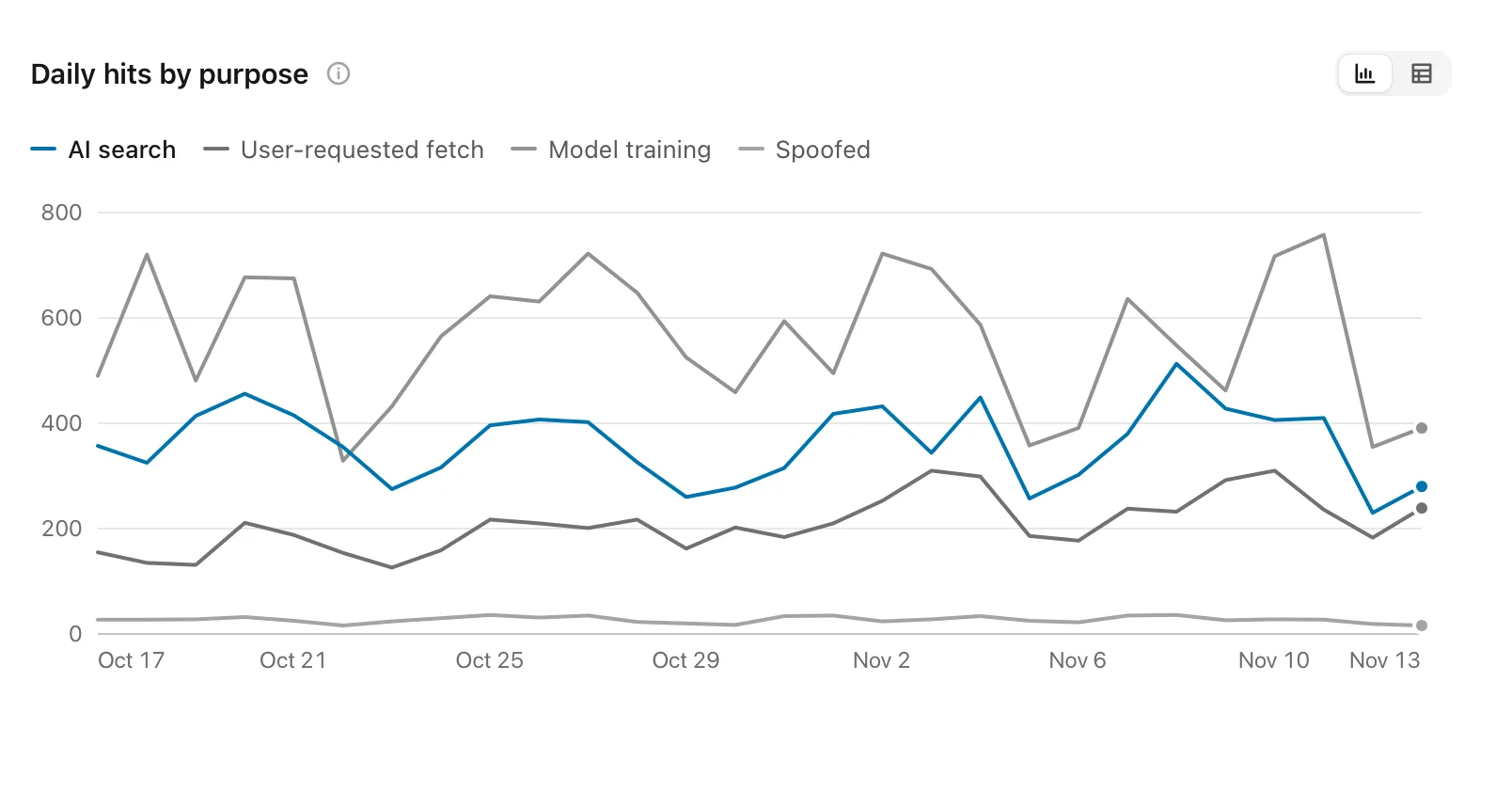
The site audit runs the same robots rules against your key pages and raises ai-search-bot-blocked when a search crawler like Applebot can't reach them. See AI crawler analytics for the full feature, or download Surfacedd to run it on your own logs.
Related terms
- Google-Extended: Google's training-only robots token, the closest analogue to Applebot-Extended.
- GPTBot and OAI-SearchBot: OpenAI's split between training and search.
- Amazonbot: another crawler you can verify by DNS, with its own caveats.
- Robots.txt for AI crawlers: copyable groups for every major operator.
Sources
How we research, write and correct pages: read our editorial policy.