Amazonbot: what Amazon's crawler does and how to check it's real
Amazon now runs three crawlers with three purposes. Here's what each one does, how robots.txt applies to it, and why checking Amazonbot by reverse DNS alone gives the wrong answer for many genuine requests.
By the Surfacedd teamUpdated 4 min readMarkdown
On this page
Short answer
Amazonbot is Amazon's general web crawler, used to improve Amazon products and possibly to train Amazon AI models. Amzn-SearchBot (search) and Amzn-User (live Alexa answers) don't train. Amazon publishes IP lists for all three; on 2026-11-19, 23 of 40 sampled Amazonbot IPs had generic EC2 reverse DNS.
What is Amazonbot?
Amazonbot is Amazon's general-purpose web crawler. Amazon says it "is used to improve our products and services" and "may be used to train Amazon AI models" (Amazon Developer, updated 2026-10-26). It identifies itself with a Chrome-style user agent that contains compatible; Amazonbot/0.1.
Amazon now documents two more crawlers on the same page, and the difference matters if you're deciding what to block:
| Crawler | What Amazon says it's for | Trains AI models? | Follows robots.txt? |
|---|---|---|---|
Amazonbot | Improving Amazon products and services | "May be used to" | Yes |
Amzn-SearchBot | Search experiences in Amazon products | No, per Amazon | Yes. If robots.txt doesn't name it but allows other search bots, it follows those rules |
Amzn-User | User actions, "such as responding to Alexa queries that require up-to-date information" | No, per Amazon | "May not follow all robots.txt directives", because a user starts the fetch |
The robots.txt details Amazon gives apply to all three automated crawlers: they read robots.txt per host (so shop.example.com needs its own file), they may use "a cached copy from the last 30 days", they treat an unreachable file as if it doesn't exist, and they ignore crawl-delay. Changes "may take ~24 hours" to show up in Amazon's systems. Amazon also honours two page-level meta values: noarchive, which it defines as "do not use the page for model training", and noindex.
Fact block
| Fact | Value |
|---|---|
| Operator | Amazon |
| Purpose | Model training |
| Feeds AI search answers | No |
| User agent | Contains amazonbot (case-insensitive) |
| robots.txt token | Amazonbot |
| Verification | Published IP ranges: https://developer.amazon.com/amazonbot/ip-addresses/ |
| Operator docs | https://developer.amazon.com/amazonbot |
203.0.113.24 - - [18/Nov/2026:09:14:02 +0000] "GET /pricing HTTP/1.1" 200 18342 "-" "Mozilla/5.0 (compatible; Amazonbot)"
Synthetic log line for illustration: the IP is from a documentation range (RFC 5737) and the user agent is shortened. Real user agents carry a version and a link to the operator's docs.
Source: Surfacedd's bot catalog (packages/data/ai-bots.json, version 2026-11-19.2).
How do you verify Amazonbot?
Amazon publishes one IP list per crawler: /amazonbot/ip-addresses/, /amazonbot/searchbot-ip-addresses/ and /amazonbot/live-ip-addresses/ under developer.amazon.com. Checking a log IP against the right list is the method Amazon documents today. Its page no longer mentions reverse DNS.
Many guides, and older bot catalogs, still tell you to verify Amazonbot by reverse DNS: the IP should resolve to a host under crawl.amazonbot.amazon, which should resolve back to the same IP. We tested that on 2026-11-19 against Amazon's own list, which held 1,292 addresses (creation time 2026-09-08). Here are two addresses from that list:
$ host 3.231.193.38
38.193.231.3.in-addr.arpa domain name pointer 3-231-193-38.crawl.amazonbot.amazon.
$ host 3-231-193-38.crawl.amazonbot.amazon
3-231-193-38.crawl.amazonbot.amazon has address 3.231.193.38

$ host 3.81.245.78
78.245.81.3.in-addr.arpa domain name pointer ec2-3-81-245-78.compute-1.amazonaws.com.
The first passes a reverse-DNS check. The second is on Amazon's official Amazonbot list but reverse-resolves to a generic EC2 hostname, so a DNS-only check would call it spoofed. In a sample of 40 addresses (every tenth entry of the list), 17 had a crawl.amazonbot.amazon name and 23 had an EC2 name. The worked conclusion: check the published list first, and treat reverse DNS as a second signal, not the test. A request that claims to be Amazonbot from an address on neither the list nor the crawl.amazonbot.amazon domain is the one to distrust.
Because the list is plain JSON ({"prefixes": [{"ipv4Prefix": "…"}]}), a one-line check works:
curl -s https://developer.amazon.com/amazonbot/ip-addresses/ | grep -c '"3.81.245.78"'
A result of 1 means the address is listed. The guide to verifying AI crawlers covers the same method for every operator that publishes ranges.
Allow or block?
| Your goal | Amazonbot | Amzn-SearchBot | Amzn-User |
|---|---|---|---|
| Be found in Alexa and Amazon search, allow training | Allow | Allow | Allow |
| Be found, but keep pages out of Amazon model training | Disallow, or allow and add noarchive to sensitive pages | Allow | Allow |
| Stay out of Amazon entirely | Disallow | Disallow | Disallow, plus a firewall rule if it matters, because Amazon says it may not follow every directive |
If you sell through Amazon or want Alexa to answer questions with your pages, blocking Amzn-SearchBot and Amzn-User costs you those surfaces. Blocking Amazonbot alone is a training decision, like blocking CCBot or GPTBot. Note that the 30-day robots.txt cache means a new Disallow can take weeks to stop all fetching, not hours.
In your logs
Amazonbot lines look like a normal Chrome request until you reach the token:
"Mozilla/5.0 AppleWebKit/537.36 (KHTML, like Gecko; compatible; Amazonbot/0.1) Chrome/W.X.Y.Z Safari/537.36"
Because the string starts like a browser, filters that look for "bot" at the start of the user agent miss it. Match on amazonbot, amzn-searchbot and amzn-user anywhere in the string instead. Expect Amazonbot to keep requesting a path for a while after you block it, because of the 30-day cache.
In Surfacedd
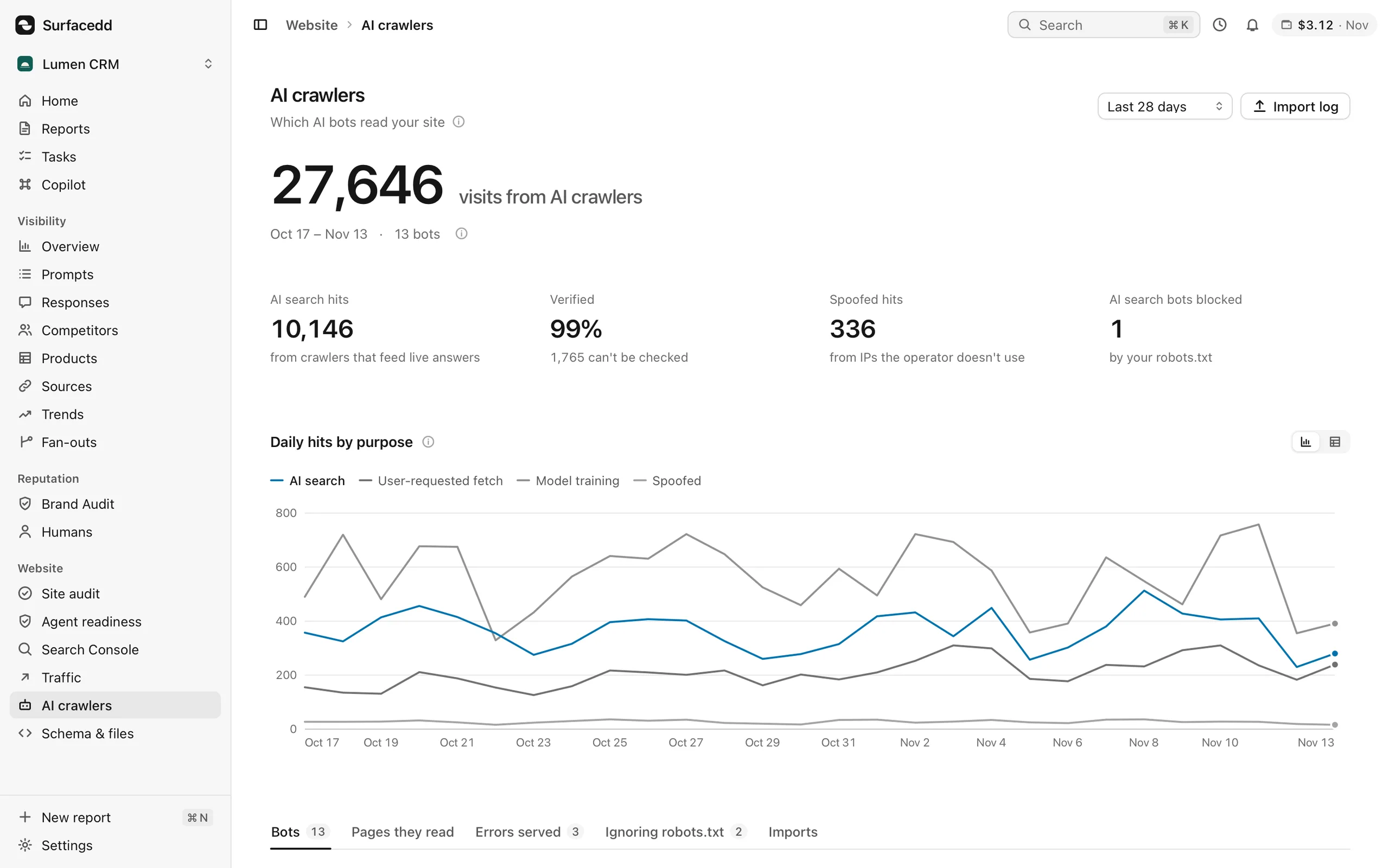
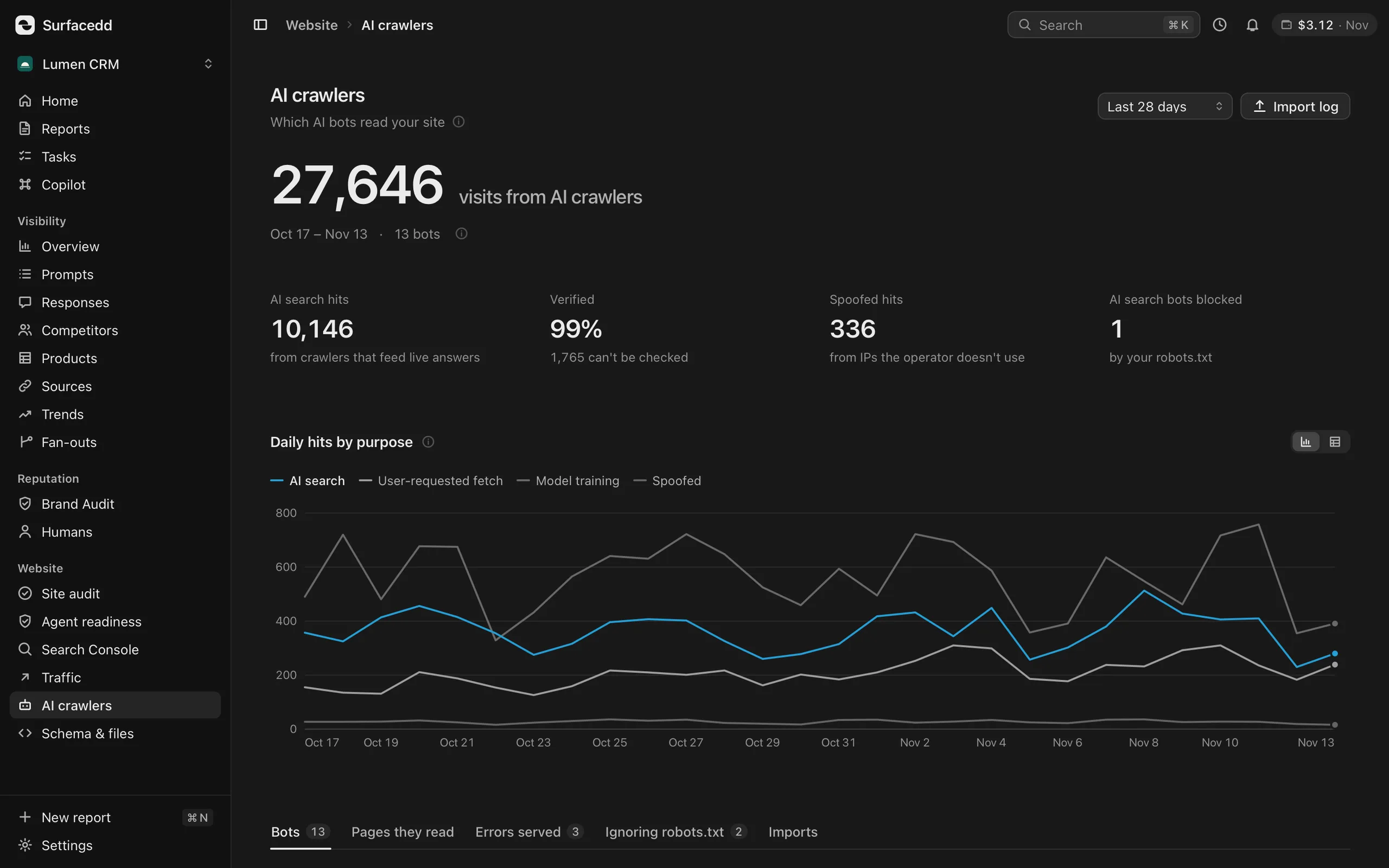
Website › AI crawlers reads your access logs on your computer, matches each line against the bot catalog and labels it verified, unverifiable, spoofed or unchecked. You see Amazonbot's daily hits, the pages it read, the errors it was served, and whether it kept fetching paths your robots.txt blocks. Only daily totals and the top 200 paths per bot per day are stored, with no IP addresses.
The app checks Amazonbot against Amazon's published IP list first (Amazon publishes it as JSON inside a web page, refreshed by the app like the other vendors' lists), then falls back to forward-confirmed reverse DNS under crawl.amazonbot.amazon. That order matters: as the test above shows, many of Amazon's listed addresses don't reverse-resolve to that host, so reverse DNS alone would wrongly label real Amazonbot visits as spoofed. Amzn-SearchBot and Amzn-User are checked against their own lists the same way.
The free AI bot log analyzer runs the same matching in your browser for a one-off check. The app adds history, robots cross-checks and the crawler view of AI crawler analytics, for a one-time licence (pricing).
Related terms
- CCBot: Common Crawl's crawler, the other big training-data source with a published IP list.
- Applebot: verifiable by reverse DNS, and its DNS names do match its list.
- Meta-ExternalAgent: a training crawler with no verification method at all.
- AI crawlers guide: every operator's crawlers in one table.
Sources
- Our reverse and forward DNS lookups on 40 addresses from that list, run 2026-11-19 with
host(method above), checked 2026-11-19
How we research, write and correct pages: read our editorial policy.