Bytespider: what you can and can't know about ByteDance's crawler
With no official IP list, no reverse-DNS domain and no English documentation we could reach, Bytespider is the crawler where you have to decide on evidence from your own logs. Here's how to do that, and how to block it properly if you choose to.
By the Surfacedd teamUpdated 4 min readMarkdown
On this page
Short answer
Bytespider is the web crawler operated by ByteDance, the company behind TikTok. ByteDance publishes no IP ranges or reverse-DNS domain for it, so no request claiming to be Bytespider can be verified. A robots.txt Disallow plus a user-agent rule at your server or CDN blocks both the real crawler and imitators.
What is Bytespider?
Bytespider is the web crawler run by ByteDance, the company behind TikTok and the Toutiao news and search apps. It announces itself with a user agent containing the token Bytespider. Our bot catalog classes it as a training crawler: it doesn't fetch pages to answer a user's question in real time, and none of the AI answer engines we track depends on it.
What's unusual is how little the operator publishes. For GPTBot, Applebot or CCBot, the operator has a page that states the purpose, the user agent, how robots.txt applies and how to verify a request. For Bytespider we found no such page on 2026-11-19. ByteDance's Toutiao webmaster portal (zhanzhang.toutiao.com) loaded only its title for us, and we found no official IP list or DNS domain. Plenty of third-party sites describe Bytespider, but they disagree with each other on its user-agent format and on whether it obeys robots.txt, and none of them is ByteDance. We don't repeat those claims as fact.
Fact block
| Fact | Value |
|---|---|
| Operator | ByteDance |
| Purpose | Model training |
| Feeds AI search answers | No |
| User agent | Contains bytespider (case-insensitive) |
| robots.txt token | Bytespider |
| Verification | Can't be verified: the operator publishes no IP ranges or DNS names |
203.0.113.24 - - [18/Nov/2026:09:14:02 +0000] "GET /pricing HTTP/1.1" 200 18342 "-" "Mozilla/5.0 (compatible; Bytespider)"
Synthetic log line for illustration: the IP is from a documentation range (RFC 5737) and the user agent is shortened. Real user agents carry a version and a link to the operator's docs.
Source: Surfacedd's bot catalog (packages/data/ai-bots.json, version 2026-11-19.2).
Why can't Bytespider be verified?
Verifying a crawler means checking the request's IP address against something only the operator controls: a published IP list, or a reverse-DNS name on a domain the operator owns. Bytespider has neither, so the user agent is the only identifier, and anyone can send it.
That changes what your log numbers mean, not what blocking does:
| Question | With a verifiable crawler (e.g. CCBot) | With Bytespider |
|---|---|---|
| "How many requests did the real crawler make?" | Count the verified hits | Unknown. The count is an upper bound |
| "Is someone pretending to be the crawler?" | Unverified hits from outside the list are spoofed | Can't be told apart |
| "Does a block by user agent work?" | Yes | Yes, and it also stops imitators |
| "Did the crawler obey my robots.txt?" | Check verified hits on blocked paths | Only by watching the trend after a change (below) |
Allow or block?
If you want ByteDance's systems to be able to train on your pages, allow it and do nothing. If you don't, or if its request volume is a cost to you, block it in two layers, because robots.txt is a request, not an enforcement:
# robots.txt
User-agent: Bytespider
Disallow: /
# nginx: refuse requests whose user agent contains "bytespider" (case-insensitive)
map $http_user_agent $block_bytespider {
    default         0;
    ~*bytespider    1;
}
server {
    # ...
    if ($block_bytespider) { return 403; }
}
The robots.txt group tells a compliant crawler to stay away. The nginx rule refuses any request that still carries the token, whether it's ByteDance or an imitator. Most CDNs offer the same thing as a user-agent firewall rule. There's no search or AI-answer cost to blocking, because Bytespider isn't a fetcher any of the engines we track relies on.
In your logs: test compliance yourself
Since no one can verify Bytespider for you, your own logs are the best evidence you'll get. Here's a worked method:
- Before changing anything, count a week of requests:
grep -ci bytespider access.logper day, and note the top paths withgrep -i bytespider access.log | cut -d'"' -f2 | sort | uniq -c | sort -rn | head. - Add the robots.txt group only, without the nginx rule, and wait 48 hours for any robots.txt cache to expire.
- Count again for a week. Requests for robots.txt itself are expected. Requests for pages after the wait mean either the crawler isn't honouring the rule or someone else is using its name; you can't tell which, but you now know the rule alone isn't enough on your site.
- Add the server rule and confirm the remaining lines are 403s.
This is also how you find out whether Bytespider's volume is worth worrying about at all. On small sites it's often a rounding error; on large catalogues it can be a real share of bandwidth.
In Surfacedd
Website › AI crawlers imports your access logs on your computer and labels Bytespider hits "unverifiable", the state for operators that publish no verification method. They count towards the "can't be checked" total, so they never inflate your verified share or get misreported as spoofed. The robots.txt cross-check shows Bytespider in the Ignoring robots.txt tab if it keeps requesting paths you've disallowed, which gives you step 3 above without any grep. Only daily totals and the top paths are stored, never IPs.
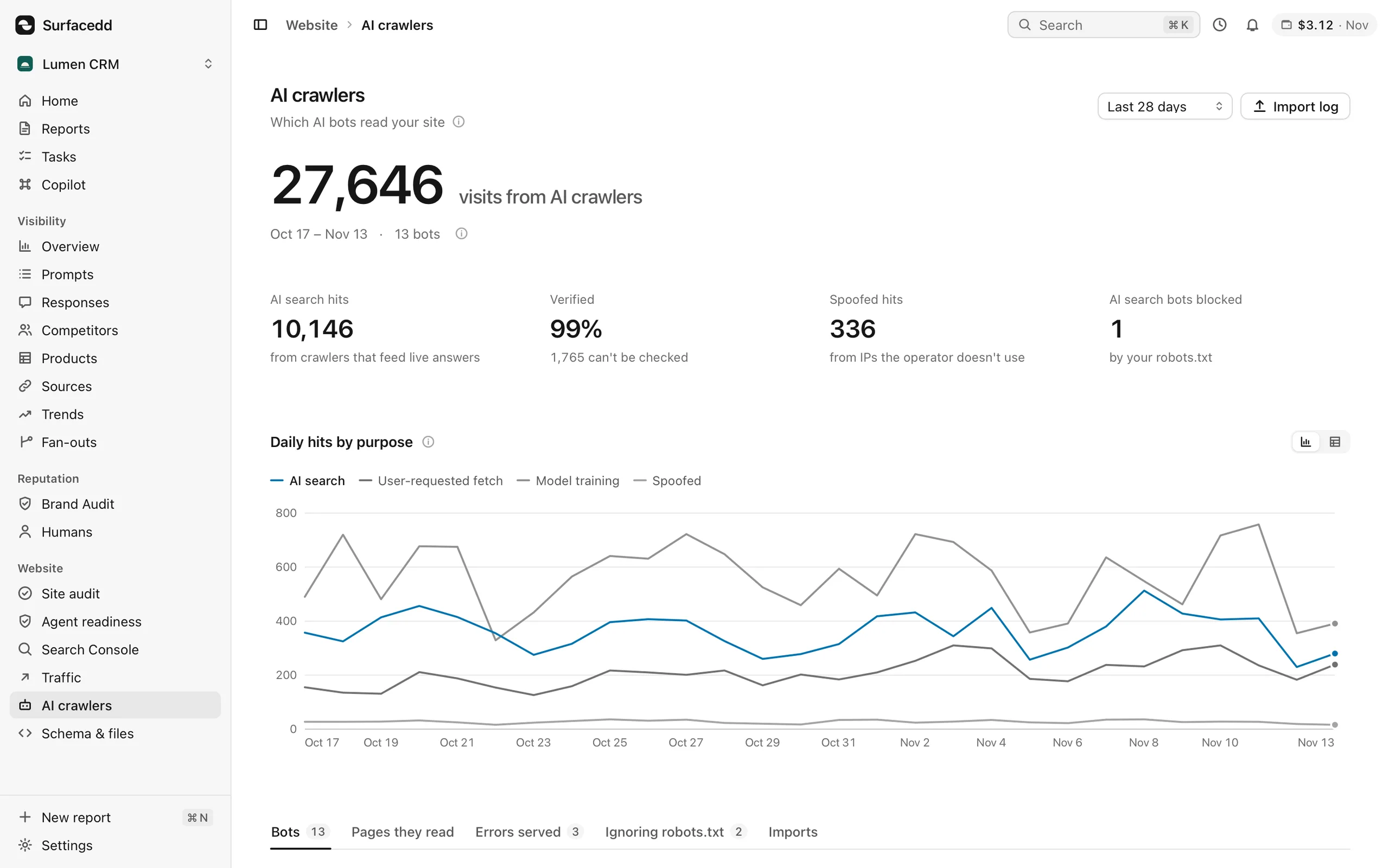
For a one-off check without installing anything, the free AI bot log analyzer runs the same matching in your browser. AI crawler analytics adds history and the robots cross-check, and the guide to verifying AI crawlers explains each verification state. Pricing is one-time (pricing).
Related terms
- Meta-ExternalAgent: Meta's training crawler, also unverifiable.
- Amazonbot: a crawler with a published IP list, and why that still needs care.
- CCBot: a training crawler you can verify two ways.
- AI crawlers guide: the full list of crawlers by operator and purpose.
Sources
How we research, write and correct pages: read our editorial policy.