CCBot: the crawler behind the web's biggest open training dataset
CCBot doesn't answer anyone's questions. It fills a free public archive that model builders have trained on for years, which makes blocking it a decision about future training data, not about today's AI answers.
By the Surfacedd teamUpdated 4 min readMarkdown
On this page
Short answer
CCBot is the crawler of Common Crawl, a non-profit that publishes a free archive of over 300 billion web pages. Many language models train on filtered copies; GPT-3 drew 60% of its training mix from it. Blocking CCBot affects future training sets only, not live AI search answers, and its IPs can be verified.
What is CCBot?
CCBot is the web crawler run by Common Crawl, a 501(c)(3) non-profit that publishes "a free, open repository of web crawl data that can be used by anyone" (Common Crawl). The archive spans "over 300 billion pages" collected since 2007, with "3–5 billion new pages added each month". It identifies itself as CCBot/2.0 (https://commoncrawl.org/faq/) (CCBot page).
Common Crawl doesn't run an assistant or a search engine. Nothing CCBot fetches turns into an answer next week. Its importance for AI visibility is indirect and slow: the archive is one of the standard sources model builders filter and train on.
Why does Common Crawl matter for AI models?
The clearest primary evidence is the GPT-3 paper. In its Table 2.2, OpenAI lists "Common Crawl (filtered)" at 410 billion tokens and 60% of the training mix, well ahead of WebText2 (22%), the two book corpora (8% each) and Wikipedia (3%) (Brown et al., 2020). Most labs no longer publish their exact data mixes, so for newer models you can't confirm the share, only that the archive is freely available to them. Common Crawl says its corpus is "cited in over 10,000 research papers".
That's the practical meaning of "CCBot is a training-data source": if your pages are in a Common Crawl snapshot, they're available to anyone building a model, including labs that never run a crawler of their own. If they aren't, those labs can't learn about you from that route. The LLM SEO guide explains how training data and live retrieval differ, and why the training route is the slow one.
Fact block
| Fact | Value |
|---|---|
| Operator | Common Crawl |
| Purpose | Model training |
| Feeds AI search answers | No |
| User agent | Contains ccbot (case-insensitive) |
| robots.txt token | CCBot |
| Verification | Published IP ranges: https://index.commoncrawl.org/ccbot.json |
| Operator docs | https://commoncrawl.org/ccbot |
203.0.113.24 - - [18/Nov/2026:09:14:02 +0000] "GET /pricing HTTP/1.1" 200 18342 "-" "Mozilla/5.0 (compatible; CCBot)"
Synthetic log line for illustration: the IP is from a documentation range (RFC 5737) and the user agent is shortened. Real user agents carry a version and a link to the operator's docs.
Source: Surfacedd's bot catalog (packages/data/ai-bots.json, version 2026-11-19.2).
Allow or block?
The decision is about training, not visibility in today's AI search. Blocking CCBot doesn't remove you from ChatGPT search, Perplexity or Google's AI features, because none of them use CCBot to fetch pages for live answers. Those depend on crawlers like OAI-SearchBot and PerplexityBot.
| Your situation | Suggested choice | Why |
|---|---|---|
| You want models to know your brand, products and facts by default | Allow | The archive is free to every model builder, so one crawler can reach many future models |
| You publish paid or licensed content | Block | Once a page is in a public snapshot, you can't control who trains on it |
| You've already blocked GPTBot and ClaudeBot for training | Block CCBot too | Otherwise the same pages can reach models through the public archive |
| You're unsure | Allow, and revisit | Blocking is cheap to add later; a snapshot already taken stays published either way |
Two worked consequences are worth stating plainly. First, a block only affects future crawls: pages already in published snapshots stay there. Second, the effect on model knowledge takes a training cycle or more to appear, so you won't see any change in AI answers for months, in either direction.
To block it, Common Crawl gives the standard group:
User-agent: CCBot
Disallow: /
The CCBot page doesn't say whether it honours crawl-delay or nofollow, so don't rely on either to slow it down.
How do you verify CCBot?
Common Crawl warns that some crawlers falsely claim to be CCBot and publishes two checks. Its IP ranges (IPv4 and IPv6) are at index.commoncrawl.org/ccbot.json; the file we fetched on 2026-11-19 is dated 2026-08-11 and says "For verification of IPv4 addresses, FCrDNS is also recommended". Forward-confirmed reverse DNS works for IPv4 only, with hostnames under crawl.commoncrawl.org. We ran it on the example address from Common Crawl's page:
$ host 18.97.14.84
84.14.97.18.in-addr.arpa domain name pointer 18-97-14-84.crawl.commoncrawl.org.

$ host 18-97-14-84.crawl.commoncrawl.org
18-97-14-84.crawl.commoncrawl.org has address 18.97.14.84
Both directions agree, so that address is genuine CCBot. For IPv6 requests, the published list is the only check. The guide to verifying AI crawlers has the same procedure for every operator.
In your logs
A genuine request carries the user agent CCBot/2.0 (https://commoncrawl.org/faq/). Because Common Crawl adds billions of pages a month, CCBot tends to arrive in bursts and then go quiet for weeks. A steady daily trickle of "CCBot" from addresses outside its list is a sign of a scraper using the name, and it's worth blocking at your firewall whatever you decide about the real crawler.
In Surfacedd
Import your logs into Website › AI crawlers and CCBot is counted as a training crawler, separate from AI search crawlers and user-requested fetches, so a CCBot burst doesn't hide a drop in the crawlers that feed live answers. Each hit is checked against Common Crawl's published ranges and reverse DNS, and spoofed requests get their own line. The import runs on your computer, costs nothing, and stores daily totals only, never IP addresses.
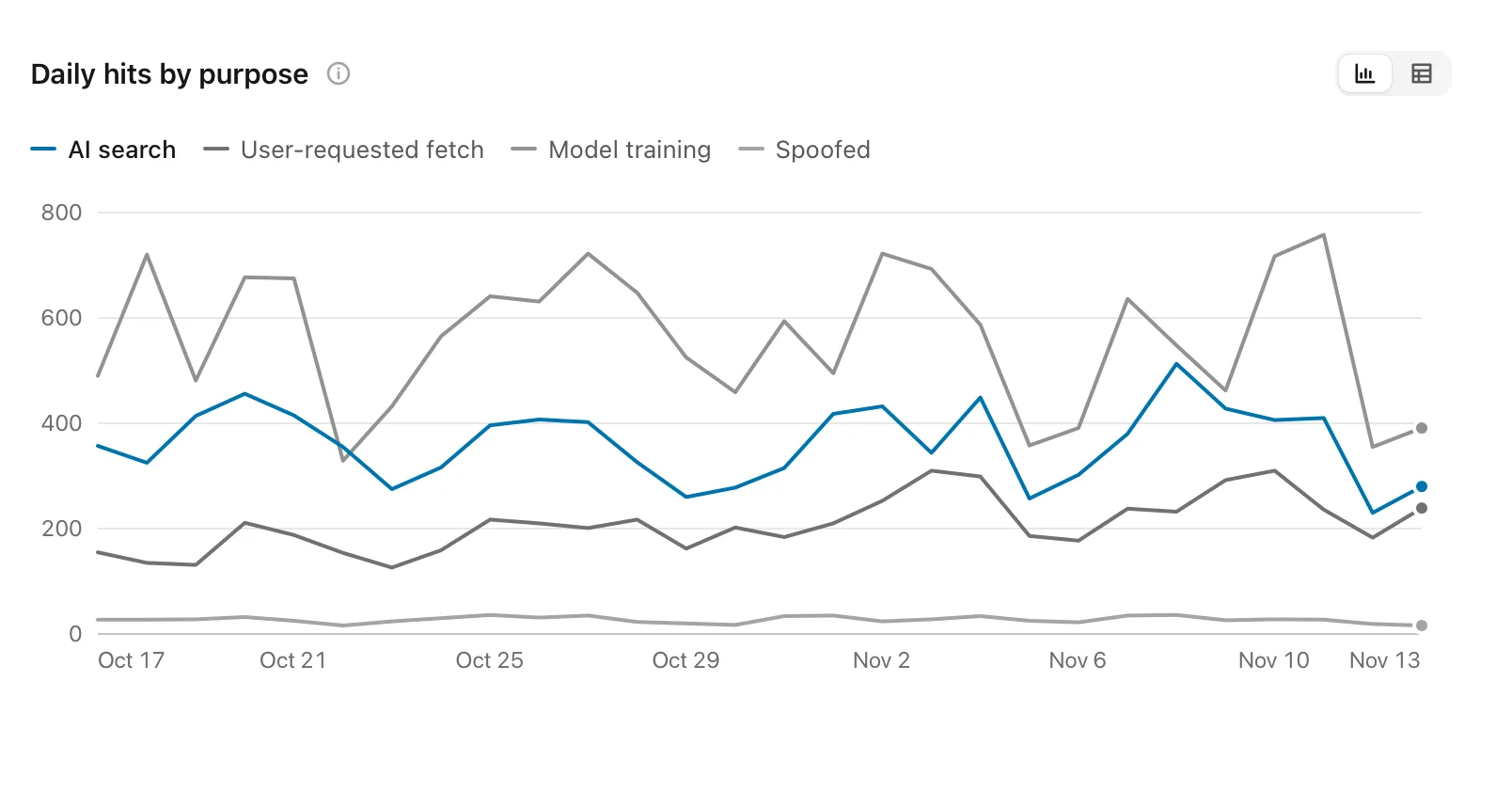
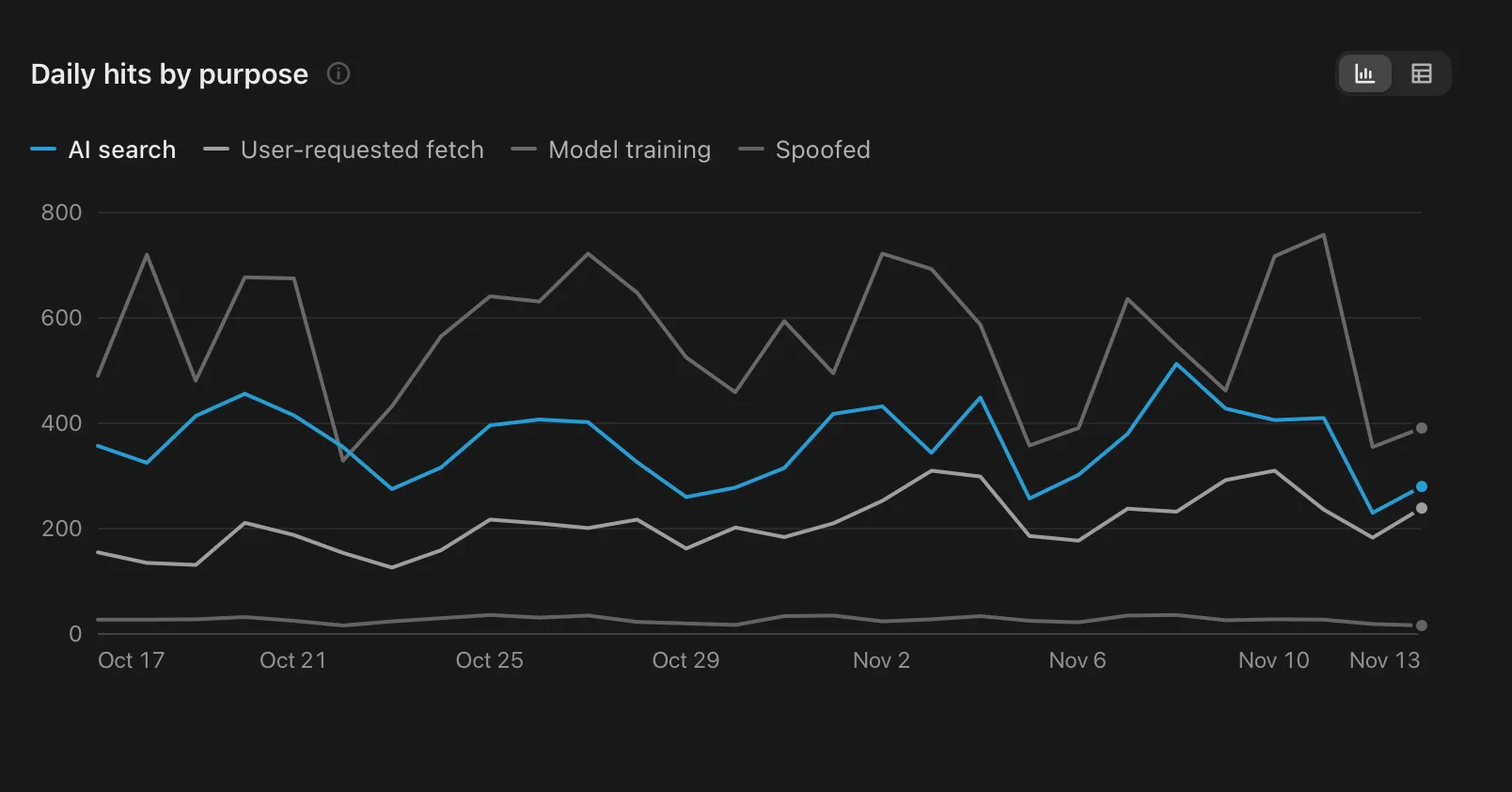
The site audit treats a blocked training crawler as information, not an error (rule ai-training-bot-blocked), because it's a legitimate choice. AI crawler analytics covers the full view, and the robots.txt guide has copyable groups.
Related terms
- GPTBot and ClaudeBot: training crawlers run by the model labs themselves.
- Amazonbot: another crawler that may feed model training, with a published IP list.
- Bytespider: a training crawler with no published IP list or DNS name, so it can't be verified at all.
- Retrieval-augmented generation: the live-retrieval route that CCBot has nothing to do with.
- Google-Extended: a training opt-out that works as a token rather than a crawler.
Sources
How we research, write and correct pages: read our editorial policy.