Ask Claude or Cursor about your search data: SEO MCP servers compared
Six MCP servers can put your analytics, rankings and AI-visibility data inside an assistant. They differ on where they run, whether they can change anything, how they sign in and what each question costs.
By the Surfacedd teamUpdated 15 min readMarkdown
On this page
Short answer
An SEO MCP server lets an assistant such as Claude or Cursor query your search data directly. Google's Analytics MCP server and the community Search Console servers run locally and read Google data; Semrush, Ahrefs and DataForSEO run remotely and spend API units; Surfacedd's runs locally, read-only, over AI-visibility data.
A Model Context Protocol server is a small program that exposes a set of named tools to an AI assistant. Once one is connected, you can ask "Which landing pages lost organic sessions last month?" and the assistant calls a tool, reads the rows and answers from them, instead of guessing or searching the web.
SEO data now has several of these servers. They look similar in a client's tool list, but they make very different promises. Some run on your computer and some on the vendor's servers. Some are strictly read-only, while others can submit sitemaps or spend API credit. Some read your own first-party data, and others sell you third-party estimates. This guide compares the six that come up most often, using each vendor's own documentation as of 19 November 2026.
What does an SEO MCP server do?
An SEO MCP server turns a data source into tools an assistant can call: "run a GA4 report", "list Search Console queries for this page", "get backlinks for this domain". The assistant chooses the tool, fills in the arguments, reads the result and writes the answer. The data never passes through a dashboard you have to open.
Three properties decide whether a server is a good fit:
- Where it runs. A local server is a process your MCP client starts on your computer (stdio transport). A remote server is a URL your client connects to over HTTP. Remote servers need no install but send your questions to the vendor.
- What it can change. Read-only servers can only answer. Servers with write tools can change real settings (for example, delete a sitemap). Paid-API servers spend money with every call.
- Whose data it reads. First-party servers read your own analytics or Search Console. Third-party servers return the vendor's index: keyword volumes, backlinks and competitors' rankings.
SEO MCP servers compared
The table below sets the six servers side by side on these properties. Plan names and endpoints change often, so check the vendor's page before you buy.
| Server | Runs | Read or write | Sign-in | Data | What a question costs |
|---|---|---|---|---|---|
Google Analytics MCP (analytics-mcp) | Local (pipx run analytics-mcp); can also be hosted over HTTP | Read-only: "can't create, modify, or delete" your GA configuration | Google Application Default Credentials, analytics.readonly scope | Your GA4 properties: reports, realtime, funnels, conversions, custom dimensions | GA4 Data API quota (200,000 core tokens per property per day on standard properties) |
Search Console MCP (community, e.g. AminForou/mcp-gsc) | Local (stdio); optional SSE | Read, plus write tools; destructive ones off by default | Your own Google OAuth client or a service account | Your Search Console properties: search analytics, URL inspection, sitemaps | Search Console API quota |
| Semrush MCP | Remote (mcp.semrush.com, streamable HTTP) | Retrieval; Projects API is read-only | OAuth, or API key header | Semrush SEO API, Trends API, read-only project data | API units from your plan |
| Ahrefs MCP | Remote (api.ahrefs.com/mcp/mcp) | Retrieval | OAuth consent creates an MCP-tagged key | Ahrefs API v3 data: backlinks, keywords, site metrics | API units, at least 50 per call |
DataForSEO MCP (dataforseo-mcp-server) | Local (npx, stdio) or remote (mcp.dataforseo.com/v3/mcp) | Sends authenticated API requests | API login and password, or OAuth over HTTP | DataForSEO APIs: SERPs, keywords, backlinks and more | Pay-as-you-go balance |
Surfacedd MCP (surfacedd-mcp) | Local (stdio), installed with the app | Read-only; never starts runs or spends money | None: reads the local database file | Your stored AI answers, share of voice, sources, tasks, crawler logs, synced Search Console and GA4 | Free; no network calls |
Google Analytics MCP: the official way to ask about GA4
Google publishes the Analytics MCP server in its googleanalytics GitHub organisation and documents it on Google for Developers. It exposes four Admin API tools (get_account_summaries, get_property_details, list_google_ads_links, list_property_annotations) and five Data API tools (get_custom_dimensions_and_metrics, run_report, run_realtime_report, run_funnel_report, run_conversions_report). It needs Python 3.10 or later and pipx or uv, plus a Google Cloud project with the Analytics Admin and Data APIs enabled.
Sign-in uses Application Default Credentials with the read-only Analytics scope. You can use your own user credentials (gcloud auth application-default login) or a service account. The Cloud project and credentials are the slow part of setup if you have never made one. Once connected, run_report can answer almost any question the GA4 interface can, because the model writes the report request itself.
Search Console MCP servers: community-built, check the write tools
Google has not published a Search Console MCP server. The community servers fill the gap; AminForou/mcp-gsc is the most widely listed. It runs locally over stdio, signs in with a Google Desktop OAuth client or a service account, and covers search analytics, URL inspection and sitemaps. Note the write side: add_site, delete_site and delete_sitemap exist and are disabled until you set GSC_ALLOW_DESTRUCTIVE to true. Leave that flag off unless you mean it.
Several other servers share similar names on npm and PyPI. Install from the repository you have read, not from a package name you searched for.
Semrush, Ahrefs and DataForSEO: third-party data, metered per call
These three answer a different question: not "how is my site doing?" but "what does the market look like?" (keyword volumes, competitors' rankings, backlinks).
- Semrush runs a remote server on streamable HTTP only. OAuth is the default; an
Authorization: Apikey …header works for clients without OAuth. Its documentation lists the plans that include MCP access and says each request "consumes a certain number of units, depending on the type of report and the amount of data requested." - Ahrefs runs a remote server on paid plans from Lite upwards. Connecting creates an MCP-tagged API key, and calls draw from the same monthly API-unit allowance as direct API calls, with a minimum of 50 units per call. Ahrefs says that using the endpoint from custom scripts or bridges is "unsupported and not permitted". It is for interactive use in an assistant.
- DataForSEO publishes an Apache-2.0 server that runs locally with
npx dataforseo-mcp-serveror remotely. Version 3 has four tools: three read DataForSEO's documentation, andapi_requestcalls any endpoint. There is no subscription; you top up a balance (minimum 50 dollars, and funds don't expire) and each call is charged to it.
The generic api_request design means the model can reach expensive endpoints as easily as cheap ones. Set a low balance while you experiment.
Surfacedd MCP: AI-visibility data, local and read-only
Surfacedd's server answers a third kind of question: "How do ChatGPT, Perplexity and Google's AI answers describe and cite us, and who do they recommend instead?" It ships inside the desktop app as surfacedd-mcp, opens your local database read-only, never reads your API keys and makes no network calls. Its 25 tools cover visibility with 95% ranges, prompts, full answers, competitors' share of voice, cited sources, fan-out queries, tasks, crawler logs, site-audit issues and, if you have connected Google, Search Console and GA4 data synced into the app.
It cannot start a run or spend money. The closest it gets is estimate_run_cost, which returns what a report would cost and the note "Estimate only. Start runs from the Surfacedd app."
Which SEO MCP server should you use?
Match the server to the question you ask most:
- "Why did traffic drop?" Start with Google Analytics MCP for sessions and a Search Console server for queries. For a ready-made answer, Surfacedd's
gsc_drop_diagnosissplits a click change into lost queries, lost pages, position, CTR and impression effects, and the parts sum to the total. - "Who ranks for this keyword, and with what links?" Use Semrush, Ahrefs or DataForSEO. Use whichever you already pay for: their data overlaps, and the cost model matters more than the tool list.
- "Does ChatGPT recommend us, and which pages convinced it?" None of the Google or backlink servers know this, because it isn't in their data. Surfacedd stores the actual answers and citations, so
competitor_shareandtop_sourcescan answer it. - Shared or client data on a laptop? Prefer local, read-only servers (Google Analytics MCP, Surfacedd). With a remote server, every question and result passes through the vendor.
Many teams connect two: one first-party server (GA4 or Surfacedd) and one market-data server. Most clients load tools from every connected server at once, so the assistant can join "our sessions fell on these pages" with "a competitor gained these links".
How to set up an SEO MCP server in Claude, Cursor and ChatGPT
Every client stores servers in a JSON file or registers them with a command. The shape is the same everywhere: a name, then either a command with args (local) or a url (remote).
Claude Desktop. Open Settings › Developer › Edit Config. That opens claude_desktop_config.json (~/Library/Application Support/Claude/ on macOS, %APPDATA%\Claude\ on Windows). Add the server under mcpServers, then quit and reopen the app completely. Step-by-step: Claude Desktop.
Claude Code. Register a local server with claude mcp add --scope user <name> -- <command> <args>. Everything after -- goes to the server untouched. A remote one uses claude mcp add <name> <url> -t http (Semrush documents exactly this). Check status with claude mcp list or /mcp. Step-by-step: Claude Code.
Cursor. Use ~/.cursor/mcp.json for every project, or .cursor/mcp.json inside one repository. By default Cursor asks for approval before each MCP tool call. Logs are under Output › MCP Logs. Step-by-step: Cursor. Every client Surfacedd connects to is listed on the integrations page.
ChatGPT. Semrush and Ahrefs document ChatGPT setup for their remote servers. We haven't verified that the ChatGPT desktop app can run a local stdio server such as Surfacedd's, so we don't claim it works.
A typical local entry looks like this (DataForSEO's documented config):
{
  "mcpServers": {
    "dataforseo": {
      "command": "npx",
      "args": ["dataforseo-mcp-server"],
      "env": { "DATAFORSEO_LOGIN": "your_api_login", "DATAFORSEO_PASSWORD": "your_api_password" }
    }
  }
}
Is it safe to connect an SEO MCP server?
It is as safe as the tools it exposes and the data it can reach. Check four things before you connect one:
- Write tools. List the tools after connecting (
/mcpin Claude Code, the connector list in Claude Desktop, the server panel in Cursor). Anything nameddelete_,submit_orupdate_can change real settings. MCP tools can also declare a read-only hint; Surfacedd marks every tool read-only, non-destructive and idempotent. - Credentials in plain text.
envblocks in a config file are readable by anything running as you. Prefer OAuth where the vendor offers it, and never commit a config with keys to a repository. Project-level files (.mcp.json,.cursor/mcp.json) are often committed. - Spend. Metered servers charge for every call, including calls the model makes while exploring. Watch your usage for the first week, and keep prepaid balances small.
- Where your data goes. Results from any server go to the model provider behind your assistant. A local server keeps the data off the vendor's servers. It does not keep it away from the model.
Ten prompts that work with SEO MCP servers
These prompts name the data and the period, which helps the model choose the right tool. Each one notes the server it suits.
- "Using Google Analytics, compare organic sessions by landing page for the last 28 days against the previous 28. List the ten biggest losers." (GA4 MCP)
- "Which Search Console queries for /pricing sit in positions 8–20 with at least 500 impressions?" (Search Console server; in Surfacedd,
gsc_opportunities) - "Explain last week's click drop. Split it into lost queries, lost pages, position and CTR." (Surfacedd
gsc_drop_diagnosis) - "How many sessions came from ChatGPT, Perplexity and Gemini this month, and on which landing pages?" (Surfacedd
ai_traffic; GA4 MCP with a referrer filter, see tracking AI traffic in GA4) - "Use the Ahrefs MCP server: which referring domains did competitor.example gain in the last 30 days?" (Ahrefs: Ahrefs suggests naming the server so the assistant doesn't fall back to web search)
- "Get the top 20 organic keywords for competitor.example in the US with volume and position." (Semrush or DataForSEO)
- "Which prompts do competitors win on Perplexity that we don't appear in at all?" (Surfacedd
competitor_share) - "Which pages on our domain were cited most in AI answers this month, and which competitor pages were cited for the same prompts?" (Surfacedd
top_sources) - "Which AI crawlers hit the site last week, and how many of their requests got a 4xx or 5xx?" (Surfacedd
crawler_stats) - "What would re-running the weekly report on all engines cost?" (Surfacedd
estimate_run_cost: an estimate only; it never starts the run)
SEO MCP servers in Surfacedd
Surfacedd writes the MCP config for you. Open Settings › AI assistants and choose Connect next to Claude Desktop, Claude Code or Cursor. Surfacedd adds one surfacedd entry to that client's config file and keeps a backup copy of the file. Restart the assistant and the tools appear.
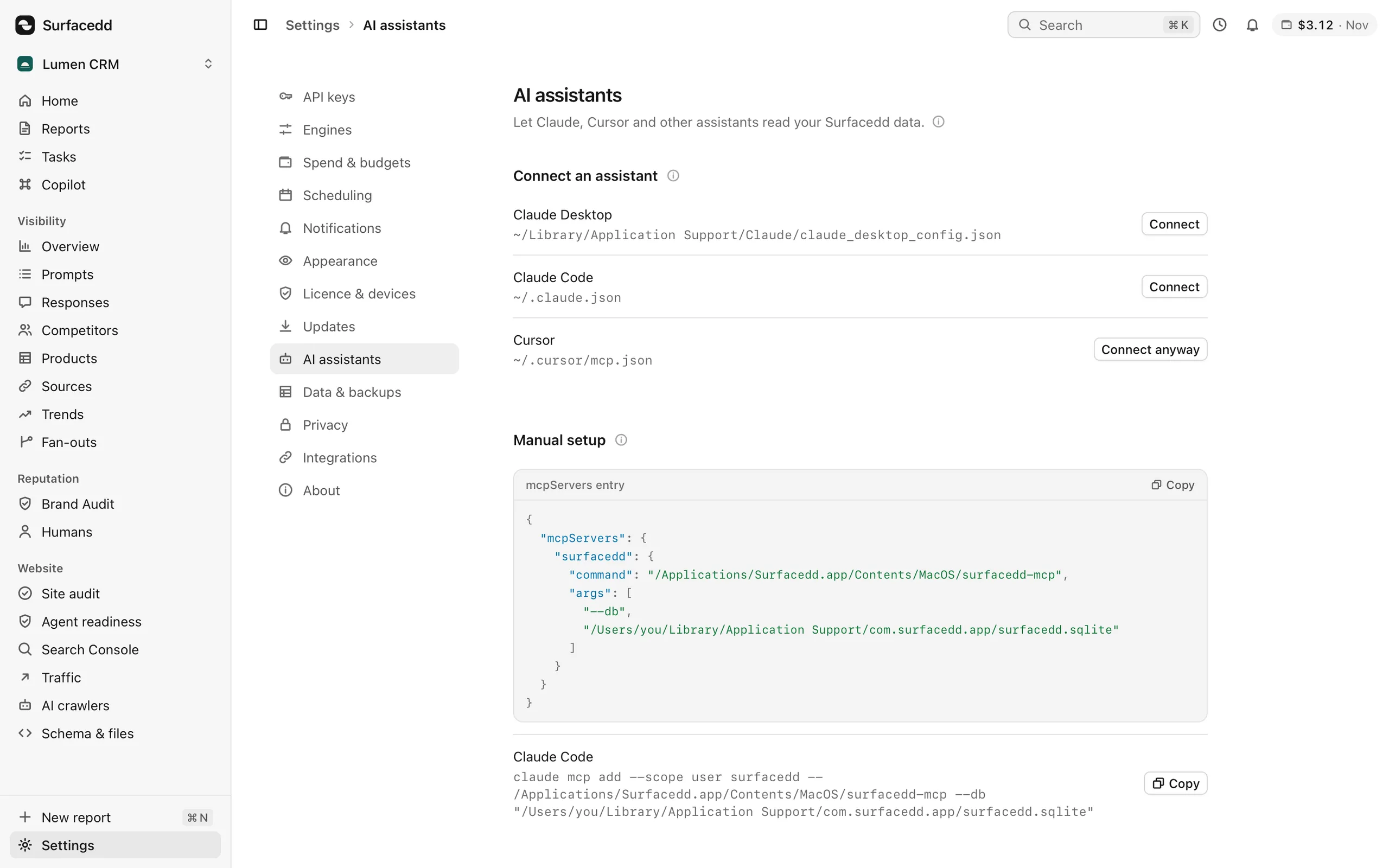
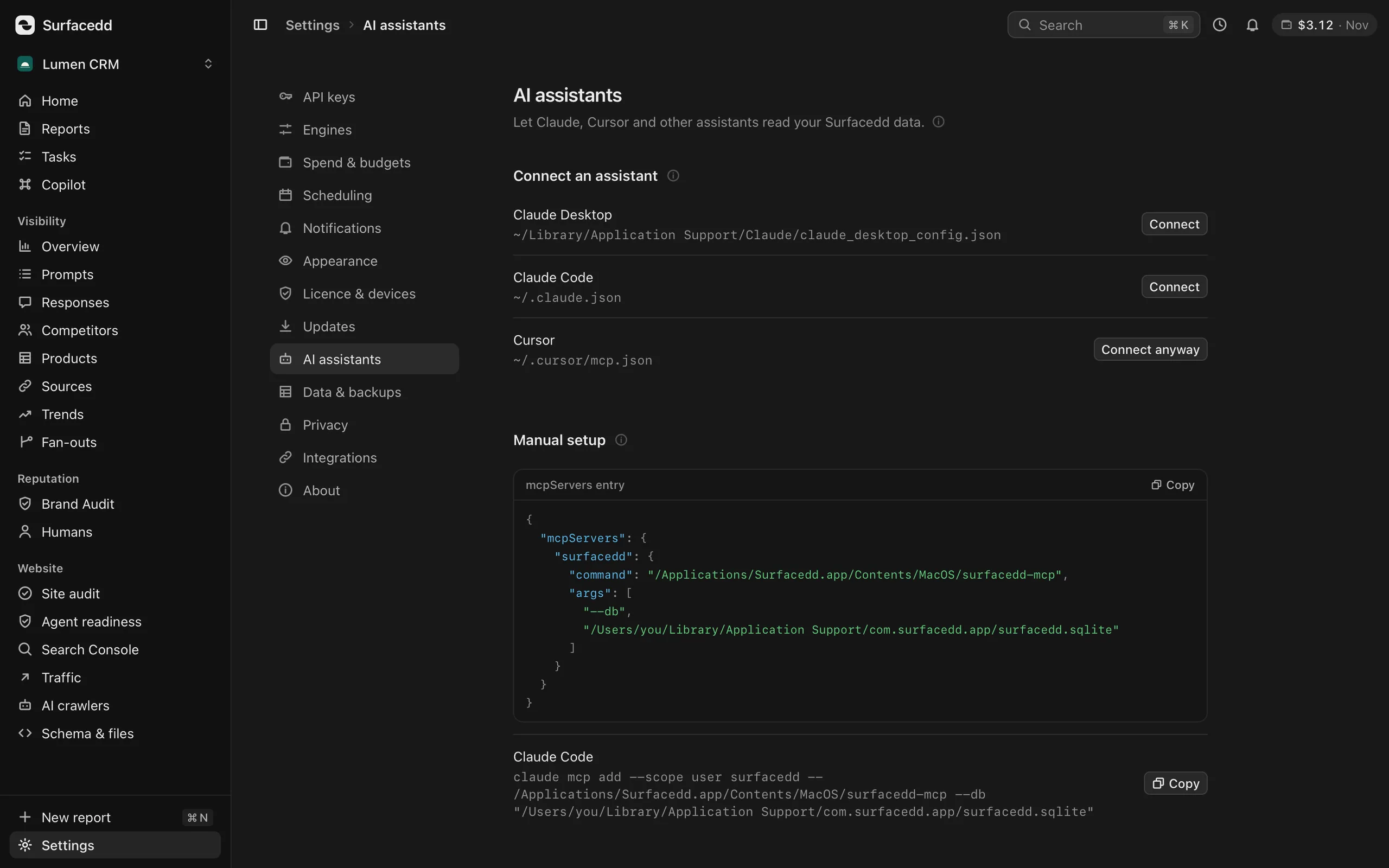
The one-click install is built and unit-tested, but we haven't yet tested it against live copies of each client. If a client doesn't show the tools after a restart, the manual entry on the same screen works with any client that accepts a local stdio server. The MCP setup doc covers both routes, and the tool reference lists every argument.
The tools it exposes:
| Tool | Area | What it returns |
|---|---|---|
list_brands | AI visibility | Brands and people tracked in Surfacedd, with their latest run and visibility. |
visibility_summary | AI visibility | Visibility, share of voice, rank, top-3, recommendation and citation rates (with 95% ranges and counts), by engine and category. |
list_prompts | AI visibility | Tracked prompts with visibility, average position and intent. |
prompt_results | AI visibility | One prompt per engine and run: whether the brand was named, its rank, the brands named and the citation count. |
get_answer | AI visibility | One stored AI answer in full: text, mentions, citations, fan-out queries, model and cost. |
search_answers | AI visibility | Full-text search over stored answers; returns snippets with engine, date and prompt. |
competitor_share | AI visibility | Share of voice per competitor and the answers competitors win without the brand. |
top_sources | AI visibility | Domains or pages cited in answers, with citation counts and trend. |
fanouts | AI visibility | Search queries the engines ran while answering, by frequency. |
list_runs | AI visibility | Recent runs with status, answers collected and cost. |
list_tasks | AI visibility | Recommended tasks with the evidence behind each. |
humans_summary | AI visibility | How AI answers describe a person: recognition, accuracy and discovery. |
crawler_stats | AI visibility | AI crawler visits per bot and day from imported server logs. |
site_audit_issues | AI visibility | Issues found by the latest site audit. |
agent_readiness | AI visibility | Agent readiness of the brand's website from the latest check: Reach, Understand and Act scores 0–100, failing rules with evidence and copyable fixes, informational findings on emerging agent protocols, and what changed since the previous check. |
estimate_run_cost | AI visibility | What running a report would cost (estimate only; this tool never starts a run). |
gsc_summary | Search Console and GA4 | Google Search Console clicks, impressions, CTR and average position for the brand's linked property, with the comparison period, daily trend and device/country split. |
gsc_top | Search Console and GA4 | Top Search Console queries or pages (whole weeks) with clicks, impressions, CTR, position and the change against the comparison weeks. |
gsc_page_queries | Search Console and GA4 | The Search Console queries one page ranks for, with clicks, impressions, CTR and position. |
gsc_opportunities | Search Console and GA4 | Quick wins from Search Console: queries almost on page one (positions 8–20) or seen but rarely clicked (CTR under half of what the position usually gets), ranked by potential clicks. |
gsc_drop_diagnosis | Search Console and GA4 | Deterministic explanation of a click change between two whole-week windows: lost and new queries, impressions, position and CTR effects, unattributed (anonymized) clicks, lost pages, device and country split, data gaps and Google update annotations. The parts sum to the total change. |
ga4_traffic | Search Console and GA4 | Google Analytics 4 sessions, engaged sessions and key events by channel group, source or landing page, with the comparison period. |
ai_traffic | Search Console and GA4 | Visits from AI assistants (ChatGPT, Perplexity, Gemini, Copilot, Claude, …) in Google Analytics 4: GA4's AI Assistant channel when present, else referrer rules; by assistant and landing page. |
product_share | AI visibility | Which of the brand's products AI answers name and recommend, and whose products win instead: mention rate, category share of voice, average rank and recommended rate with 95% ranges, by engine, market and intent. |
product_results | AI visibility | One product's mention and recommended rates by engine, the answers naming it, the pages those answers cite and the rival products named alongside. |
25 tools, all read-only: none starts a run, spends money or reads your API keys.
Every result is capped at 64 KB (and 200 rows per list), so an answer fits in the model's context. A capped result is marked as truncated, so the assistant knows the list was cut. The server is part of the app you buy once (Launch price $29, $79 after 23:59 UTC on January 30, 2027.$79 once.). See the MCP server feature page for what people ask it, and Claude SEO for getting your brand cited in Claude's own answers.
Sources
- Google Analytics MCP server, Google for Developers
- googleanalytics/google-analytics-mcp on GitHub
- GA4 Data API quotas, Google for Developers
- AminForou/mcp-gsc on GitHub (Search Console MCP)
- Semrush MCP, Semrush Developer docs
- What is Ahrefs MCP, Ahrefs docs
- Getting started with Ahrefs MCP, Ahrefs Help Center
- dataforseo/mcp-server-typescript on GitHub
- DataForSEO pricing
- Connect to local MCP servers, Model Context Protocol docs
- Connect Claude Code to tools via MCP, Claude Code docs
- Model Context Protocol, Cursor docs
Fair questions
Is there an official Google Analytics MCP server?
Yes. Google documents an Analytics MCP server on Google for Developers and publishes the code in its googleanalytics GitHub organisation as the analytics-mcp package. It runs locally with pipx or uvx, signs in with Application Default Credentials on the read-only Analytics scope, and can't change your GA4 configuration. It needs Python 3.10 or later and a Google Cloud project with the Admin and Data APIs enabled.
Is there an official Google Search Console MCP server?
Not as of 19 November 2026. The servers you'll find are community projects, such as AminForou/mcp-gsc (MIT licence). They need your own Google Cloud project with the Search Console API enabled and an OAuth client or service account. Some include tools that add or delete properties and sitemaps, so read the tool list and keep destructive tools switched off.
Do Semrush and Ahrefs charge extra for MCP?
Neither sells MCP as a separate product in its own docs. Semrush includes MCP access on listed plans, and requests consume API units by report type and size. Ahrefs offers its remote server on paid plans from Lite upwards, and each call uses at least 50 API units from the same monthly allowance as the API. Heavy exploration by a model can use units quickly.
Can an MCP server change my analytics or Search Console settings?
Only if it has write tools. Google's Analytics MCP server states it can't create, modify or delete configuration. Community Search Console servers can include tools that delete sitemaps or properties, usually disabled by default. Surfacedd's server is read-only by construction: it opens the database read-only and marks every tool read-only and non-destructive.
Are local MCP servers more private than remote ones?
Partly. A local server keeps your questions and data off the MCP vendor's servers: Surfacedd's makes no network calls at all. But the assistant still sends the tool results to its model provider to write the answer. If that matters, check your assistant's data-retention settings as well as the MCP server's.
Which SEO MCP server is best for AI search visibility?
Google, Semrush, Ahrefs and DataForSEO servers report classic search data: sessions, queries, rankings, links. None of them stores what ChatGPT, Claude, Perplexity or Google's AI answers actually said. Surfacedd's server reads stored AI answers, citations, competitors' share of voice and AI crawler logs, and also exposes synced Search Console and GA4 data if you connect Google in the app.
How we research, write and correct pages: read our editorial policy.