Citation share
Of all the pages AI engines cite when they answer your category's questions, how many are yours? The answer depends on which URLs you count as yours.
By the Surfacedd teamUpdated 3 min readMarkdown
On this page
Short answer
Citation share is the percentage of all citations in a set of AI answers that point to pages on your own website. If answers to your prompts cite 2,677 pages and 410 of those citations are yours, your citation share is 15%. Subdomains count as yours; other domains, review profiles and alias domains do not.
Definition
Citation share is your website's share of all the AI citations in a set of answers. Every source link an engine shows counts as one citation (one page in one answer), and citation share divides the ones that land on your own pages by the total:
citation share = citations to your own pages ÷ all citations in the answers
It is the citation-side counterpart to AI share of voice. Share of voice asks how often you are named compared with competitors; citation share asks how much of the evidence AI relies on comes from you. The two often diverge: a brand can be named often because review sites and Reddit threads talk about it, while its own site is rarely cited.
Why the owned-domain rules matter
The formula is simple; deciding which URLs are "yours" is not. Count too generously and the number flatters you. Surfacedd uses these rules (metric M7):
- Your website domain and all its subdomains count.
lumencrm.example,www.,help.andblog.are all yours. - Other domains you own do not count automatically. A separate country domain or a product microsite is a different site to an AI engine. Track it as its own entity if it matters.
- Aliases never add domains. If "Lumen" is an alias of Lumen CRM,
lumen.exampleis still someone else's site. - Shared platforms count only your path. If your website is a page on a shared platform (an Etsy shop, a Linktree, a YouTube channel), only that page and its subpaths count, never the whole platform.
- Pages about you are not pages of yours. Your G2 profile or a review naming you is a third-party source. It may help you get named, but it is not your citation.
- No website, no number. A brand without a website shows "—" rather than 0%.
In practice: ten citations, sorted by the rules
Suppose a run's answers for the fictional brand Lumen CRM (website lumencrm.example) cite these ten URLs:
| # | Cited URL | Yours? | Why |
|---|---|---|---|
| 1 | lumencrm.example/pricing | Yes | Own domain |
| 2 | www.lumencrm.example/blog/email-sequences | Yes | Subdomain |
| 3 | help.lumencrm.example/setup | Yes | Subdomain |
| 4 | lumencrm.example/pricing (in a second answer) | Yes | Same page, new answer: counts again |
| 5 | lumencrm-uk.example | No | Another domain the brand owns (rule 2) |
| 6 | lumen.example/features | No | Alias domain (rule 3) |
| 7 | g2.com/products/lumen-crm | No | A page about you (rule 5) |
| 8 | youtube.com/@lumencrm | No | Website isn't a YouTube channel (rule 4) |
| 9 | northwind.example/compare | No | Competitor |
| 10 | reddit.com/r/sales/… | No | Community thread |
Citation share is 4 ÷ 10 = 40%. A looser count that took every URL containing "lumen" would say 8 ÷ 10 = 80%, double the honest figure.
Rule 4 cuts the other way for small sellers. A pottery shop whose website is etsy.com/shop/fernwaypottery gets credit for citations under that shop path, but not for every Etsy page an answer cites. An individual Etsy listing lives under etsy.com/listing/…, outside the shop path, so it doesn't count either: if your listings are what AI cites, track them deliberately.
Reading the number
Citation share is a ratio of counts, so always read it with its denominator. "15% of 2,677 citations" and "15% of 40 citations" are different levels of evidence. Three patterns are common:
| Pattern | What it suggests | Where to look next |
|---|---|---|
| High visibility, low citation share | AI names you from third-party sources | Which publishers and threads cite you, and whether they're accurate |
| Low visibility, decent citation share | Your pages are read but competitors get recommended | Pages that are cited without naming you; comparison content |
| Both low | AI neither trusts nor finds you | Crawler access, then brand mentions |
Trends in the share can mislead too. If engines start citing more sources per answer, your share can fall while your own citation count rises. Compare counts alongside the percentage.
How it shows up in Surfacedd
The Sources screen leads with citation share as a sentence and the counts behind it, and the "Your cited pages" tab lists which of your pages earn those citations, on which engines, at what average position and with a trend chip. The same rules feed the citation share tile on Overview.
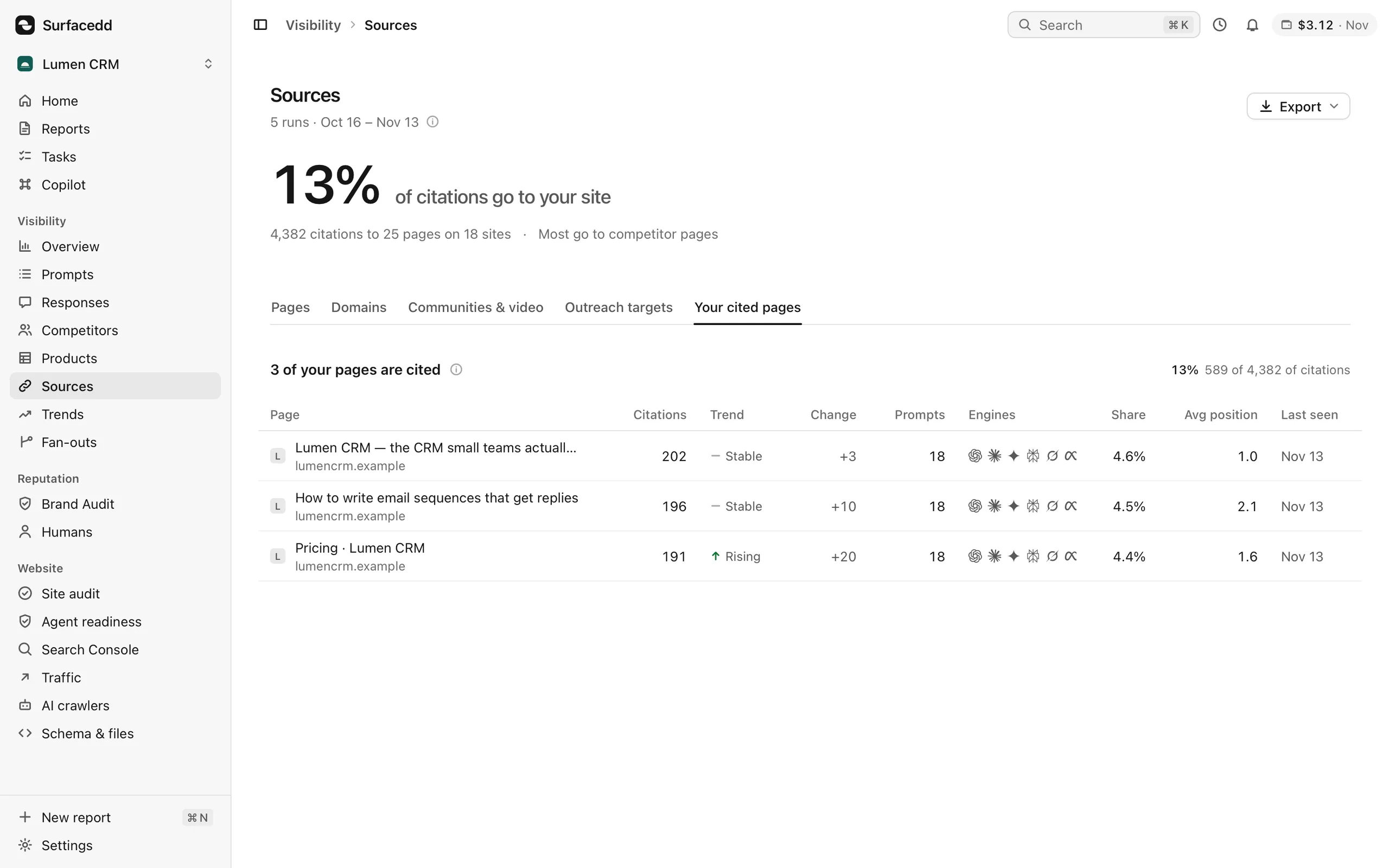
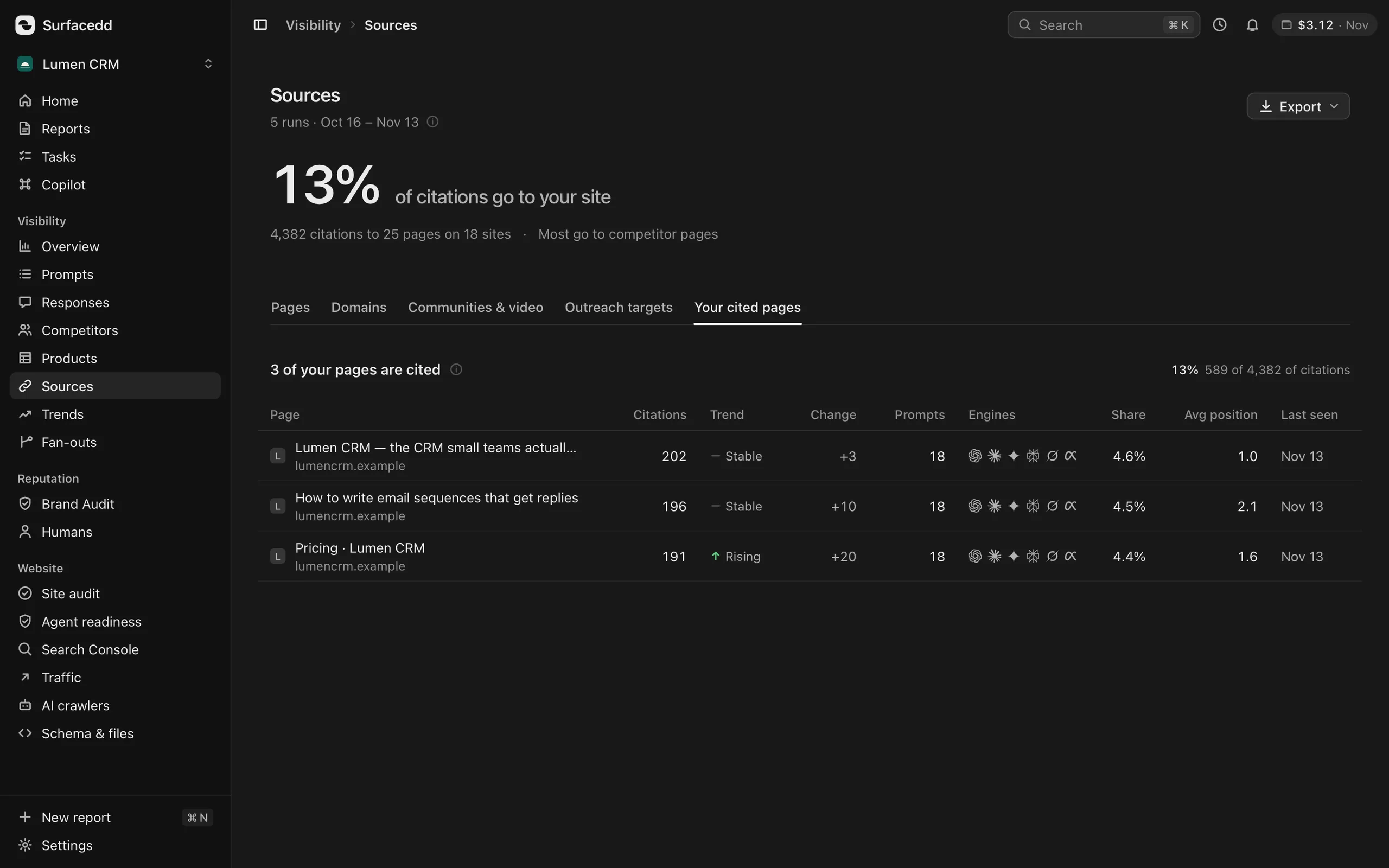
In this sample workspace 589 of 4,382 citations go to the brand's three cited pages, and most of the rest go to competitor pages. The competitors and sources feature turns that remainder into a list of pages that cite rivals but not you.
Related terms
- AI citation: the unit being counted, and why it is not a mention.
- AI visibility score: the share of answers that name you.
- Grounding: why answers have sources in the first place.
- Answer engine: the products that show citations.
Sources
How we research, write and correct pages: read our editorial policy.